The cryptocurrency industry is experiencing a wave of mergers and acquisitions: giants are bottom-fishing, and the Web3 ecosystem is being restructured
 Core Viewpoint
 While small projects are still struggling with the next round of financing and token issuance, the giants are already using cash to buy time and acquisitions to secure the future.
Author: Gu Yu, ChainCatcher
In the crypto world of 2025, an unprecedented wave of mergers and acquisitions is unfolding.
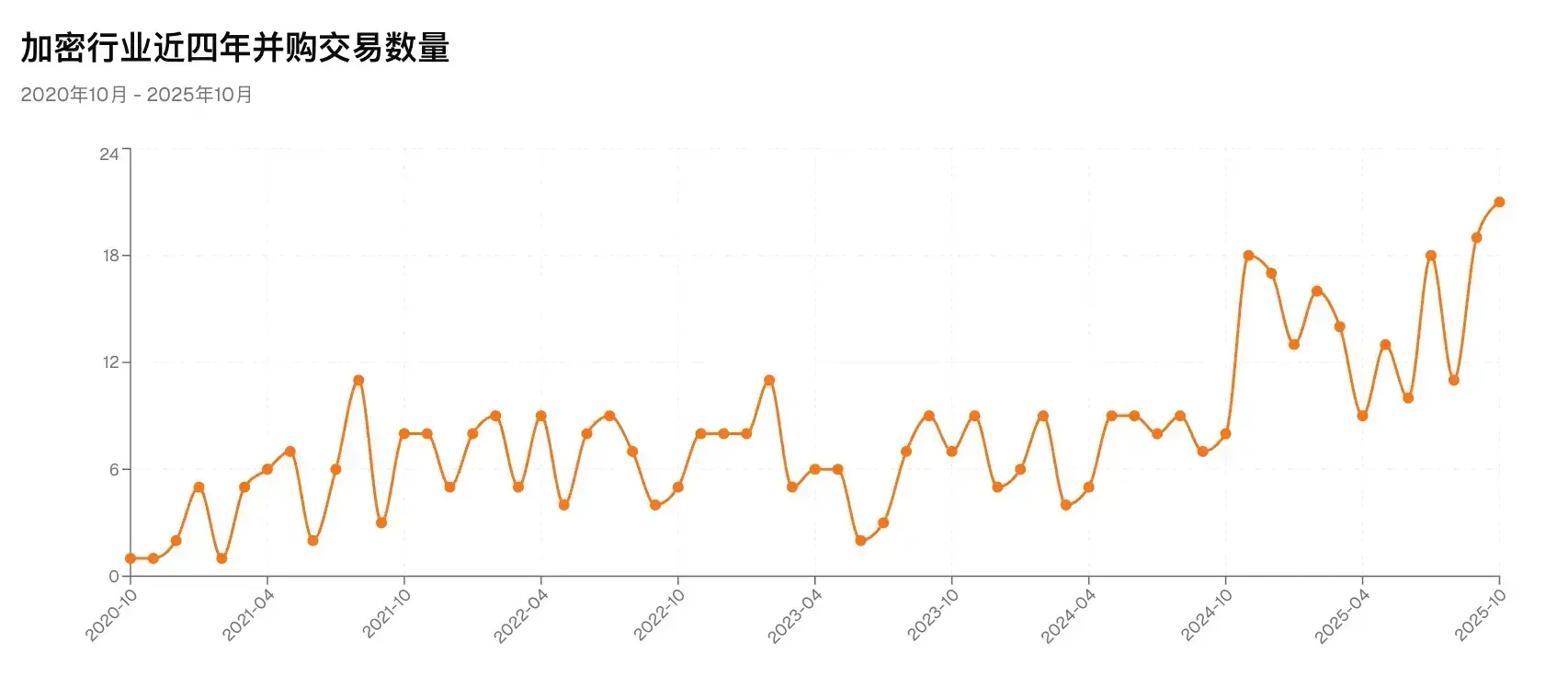
From DeFi protocols to asset management companies, from payment companies to infrastructure service providers, new M&A events occur almost daily. Kraken has acquired the futures trading platform NinjaTrader for $1.5 billion, while Coinbase has recently made consecutive moves to acquire the derivatives exchange Deribit and the on-chain fundraising platform Echo. According to RootData, the number of crypto mergers and acquisitions has reached 143 so far in 2025, setting a new historical record and growing by 93% compared to the same period last year.
Why are the giants keen on mergers and acquisitions in the current sluggish market? What impact will the accumulation of M&A have on the market?
1. Giants Exchange Capital for Time
Mergers and acquisitions are the most direct means for giants to expand their battlefield and enhance their competitiveness.
In recent years, giants represented by centralized exchanges have mostly relied on trading fees to thrive. However, after the secondary market turned bearish and regulations tightened, simple trading income could no longer support growth, and external Web2 giants were eyeing the market. Thus, they began to expand their battlefield through acquisitions—either to fill ecological gaps or to acquire compliance resources.
Through M&A, giants can skip the long periods of independent R&D and market cultivation, quickly bringing rivals or complementary teams under their wing, thereby expanding their product matrix in a short time, such as moving from spot trading to derivatives, and extending from trading to payment and custody, enhancing the service capabilities of their full-stack products.
More importantly, by purchasing entities that have already obtained regulatory approval or have well-established compliance frameworks, platforms can more quickly obtain the "identification" needed to enter certain markets (such as licenses, compliance processes, or clearing channels in specific jurisdictions), saving time compared to building compliance teams from scratch. This is especially crucial in the crypto world, where regulations are tightening and regional differences are significant.
Take Coinbase as an example. Since 2025, its M&A strategy has been almost "full-chain": from derivatives exchanges to on-chain financing platforms, and then to compliant custody companies, covering multiple aspects such as trading, issuance, payment, and asset management. An industry insider close to Coinbase revealed, "What they want to create is a 'Goldman Sachs map' in the crypto field—relying on a service system rather than coin prices."
Kraken's actions follow a similar logic. NinjaTrader is a veteran player in traditional finance; by acquiring it, Kraken essentially bought a compliance channel recognized by U.S. regulators, allowing it to bring traditional futures clients and tools into its ecosystem. In the future, Kraken will no longer need to take detours to provide more comprehensive derivatives and futures trading services.
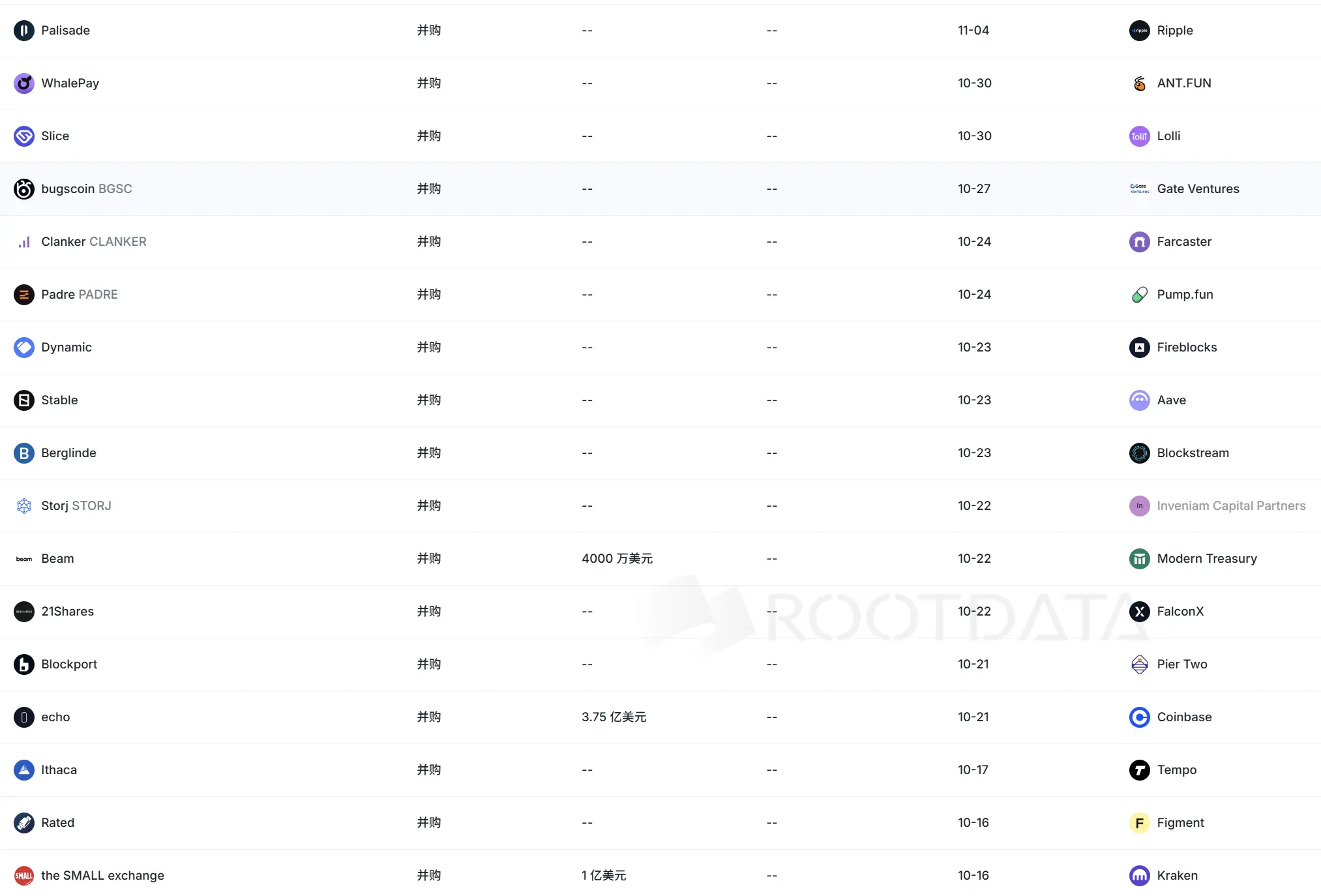
Recent M&A events Source: RootData
In other words, while smaller projects are still struggling with the next round of financing and token issuance, the giants are already using cash to buy time and acquisitions to secure their future.
This trend is not limited to giants like Coinbase; Web2 giants such as Robinhood, Mastercard, Stripe, and SoftBank are also participating, indicating that Web3 is no longer just a game for entrepreneurs and retail investors; it is attracting deep involvement from traditional capital, financial institutions, and even publicly listed companies. M&A has become a bridge for them to enter Web3.
Moreover, the current market conditions provide a significant opportunity for them to increase their M&A investments. Now, with the crypto primary market continuing to languish, the vast majority of crypto projects face challenges in financing and exiting, putting them at a disadvantage in the capital market. Therefore, giants with ample cash or capital market channels can leverage their capital advantage to dominate M&A pricing and structural design. For sellers, accepting equity swaps, partial cash + stock, or strategic cooperation transaction structures is often more prudent than taking a gamble on issuing tokens in the public market. Thus, capital-rich players naturally hold an advantage in M&A negotiations, allowing them to acquire key technologies, users, and licenses at more favorable costs.
2: Is the Golden Era for Web3 Builders Coming?
In the past, the main exit path for many Web3 projects was "issue tokens—price increase—buyback/cash out," a path highly dependent on secondary market sentiment and easily hijacked by price fluctuations. M&A provides project teams with a more stable path: integration by strategic buyers within or outside the ecosystem, obtaining cash/equity, or being incorporated into a larger platform's product line for continued development, allowing teams and technologies to have a smoother path to capitalization without having to pin all their hopes on the "blood-sucking" process of issuing tokens and going public.
The M&A activities of Coinbase, Kraken, and others have, to some extent, broadened the ways Web3 projects and teams can realize their value. In the current capital winter, this has also provided a shot in the arm for more funds to flow into the equity sector of the crypto primary market, bringing confidence to more crypto entrepreneurs.
The rise of M&A in the crypto industry is not coincidental; it is the result of market maturation, capital structure reconstruction, and the combined push of regulatory and user demands. M&A enables technology, users, and compliance capabilities to be reallocated more quickly within the crypto market, allowing leading companies to consolidate and expand their moats through acquisitions, while providing a more robust exit and development path for small and medium-sized projects.
In the long run, this wave of M&A is expected to motivate many crypto projects to evolve from technology communities or marketing companies into genuinely commercialized companies with clear user scenarios and solid technology, refocusing attention on product experience, compliance, and commercial implementation. Undoubtedly, this is beneficial for the long-term healthy development of the industry and accelerates the mainstreaming process.
Of course, M&A is not a panacea. Giants still face many uncertainties in this process, such as integration—how to incorporate the advantages of the acquired party into the acquirer at the organizational, product, compliance, and customer levels. If integration fails, it often means "buying a shell"; there may also be valuation bubbles, negatively impacting the acquirer's cash flow and profitability.
Regardless, this is a significant boon for crypto entrepreneurs and the long-term crypto ecosystem, as the market will provide a more favorable living space for projects that diligently cultivate technology and scenarios. Questions like "How can we exit if you don't issue tokens?" will gradually fade away from the minds of entrepreneurs and builders; their golden era is about to arrive.
The crypto industry in 2025 is at such a turning point. Rather than being a capital game, it is a necessary path toward maturity for the crypto industry.
In the coming years, we may see exchanges no longer just as exchanges, but as one-stop financial supermarkets; wallets not just as wallets, but as users' on-chain financial gateways; stablecoins not merely as stablecoins, but as underlying currencies for cross-border instant settlement.
And all of this begins with this wave of "merger and acquisition."
 Risk warning
 Risk warning