AI bubble crisis approaching? How tech giants are replaying the 2008 financial storm
 Core Viewpoint

 Standing at the crossroads of real innovation and financial illusion.
Written by: Bruce
Introduction: The Hidden Shadows Behind the AI Boom
We are in an exciting era where the AI revolution is permeating every corner of life at an astonishing pace, promising a more efficient and intelligent future. However, recently, a concerning signal has emerged: the world's most prominent AI company, OpenAI, has publicly requested federal loan guarantees from the U.S. government to support its massive infrastructure expansion, which could cost over a trillion dollars. This is not just an astronomical figure but a stark warning. If the financial blueprint supporting this AI boom bears a striking resemblance to the structure of the 2008 financial crisis that nearly destroyed the global economy, how should we view it?
Despite the promising prospects of the AI industry and the potential of technological revolution, unsettling financial pressure signals have recently surfaced in the market. The underlying structure of its capital operations bears a remarkable similarity to several historical financial crises, particularly the 2008 subprime mortgage crisis. This article will delve into the capital cycles, leverage operations, and risk transfer issues behind these warning signs, penetrating the market narrative to stress-test the financial structure supporting current AI valuations. Ultimately, we will assess the nature of the risks, possible outcomes, and propose strategies for investors to respond.
Warning Signs Emerge: Early Alerts Centered Around Oracle
In the current wave of prosperity driven by AI technology, market sentiment is generally optimistic, with tech giants' stock prices hitting new highs. However, just as experienced miners bring canaries into the mines to warn of toxic gases, the abnormal financial indicators of certain companies can often serve as the "canaries in the coal mine" that reveal potential systemic risks in the entire industry.

Canaries in the Coal Mine
The veteran tech giant Oracle is making a high-stakes gamble. In order to challenge the dominance of Amazon, Microsoft, and Google in the AI data center space, it is investing hundreds of billions of dollars at the cost of extremely high debt, including the "Stargate" super data center project in collaboration with OpenAI. Its debt-to-equity ratio has reached an astonishing 500%, meaning its total debt is five times its net assets. In contrast, Amazon's debt-to-equity ratio is only 50%, and Microsoft's is even lower. Simply put, Oracle has essentially bet the entire company and its future value on this AI race.
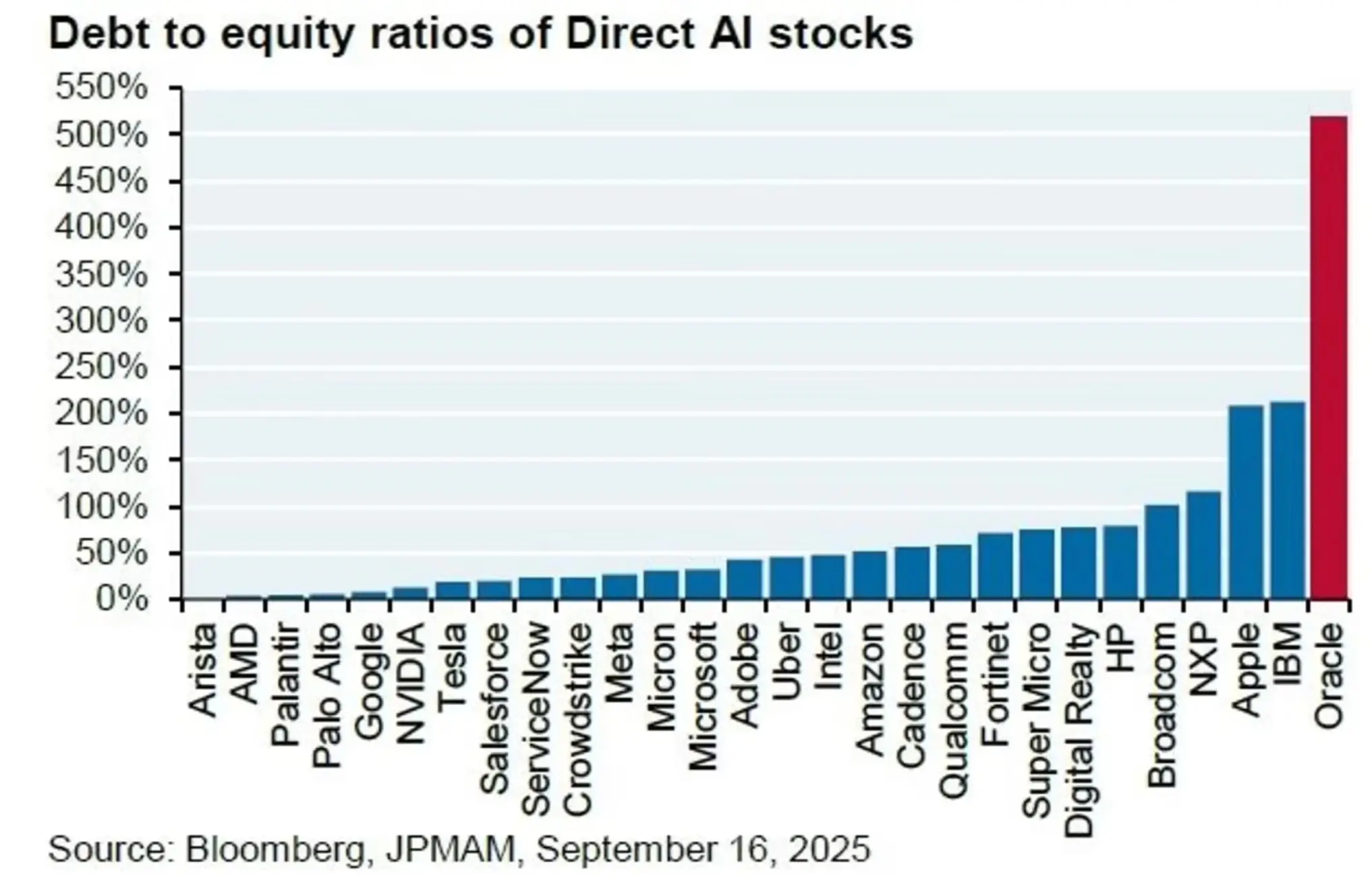
Debt Levels of U.S. Tech Giants
This alarm is known as Credit Default Swap, CDS. The most critical signal recently is the insurance cost set for Oracle's potential "debt default": its CDS spreads have soared to the highest levels in years. We can understand CDS as a form of financial insurance: imagine your neighbor (Oracle) is stacking a large amount of flammable materials (mountains of debt) in their basement every day. You are very worried that their house might catch fire, potentially affecting you. So, you find an insurance company and pay out of your own pocket to buy fire insurance for your neighbor's house. This insurance contract in the financial world is the CDS, and the premium you pay is the price (spread) of the CDS. A soaring premium means that the insurance company believes the risk of fire has sharply increased.
This phenomenon conveys a clear message: the top and most astute financial institutions in the market generally believe that Oracle's default risk is rising sharply, rooted in the "mountains of explosive debt" on its balance sheet. Oracle's debt alarm is like a crack on the surface; although small, it suggests that the tectonic plates deep underground are undergoing violent movements. What kind of structural risks are hidden within this capital operation model driving the entire AI industry?
Deep Financial Structure: The "Infinite Money Loop" Game Among AI Giants
The financial pressures of a single company are just the tip of the iceberg. When we broaden our perspective from Oracle to the entire AI ecosystem, a deeper, structural risk comes to light. The real risk is rooted in a unique capital operation model among AI industry giants, a seemingly alchemical financial game that is, in fact, extremely fragile. This is the closed-loop capital game known as the "infinite money loop," which inflates revenue bubbles out of thin air, constructing a seemingly prosperous yet fragile financial system.
To better understand this model, we can simplify it into a "three friends starting a business" model:
Step One: Chip giant Nvidia (Mr. A) invests 100 yuan in the AI star company OpenAI (Mr. B).
Step Two: OpenAI (Mr. B) immediately pays all 100 yuan to Oracle (Mr. C), nominally to purchase its expensive cloud computing services.
Step Three: Oracle (Mr. C), upon receiving the 100 yuan, quickly uses it all to buy powerful superchips from the original investor, Nvidia (Mr. A).
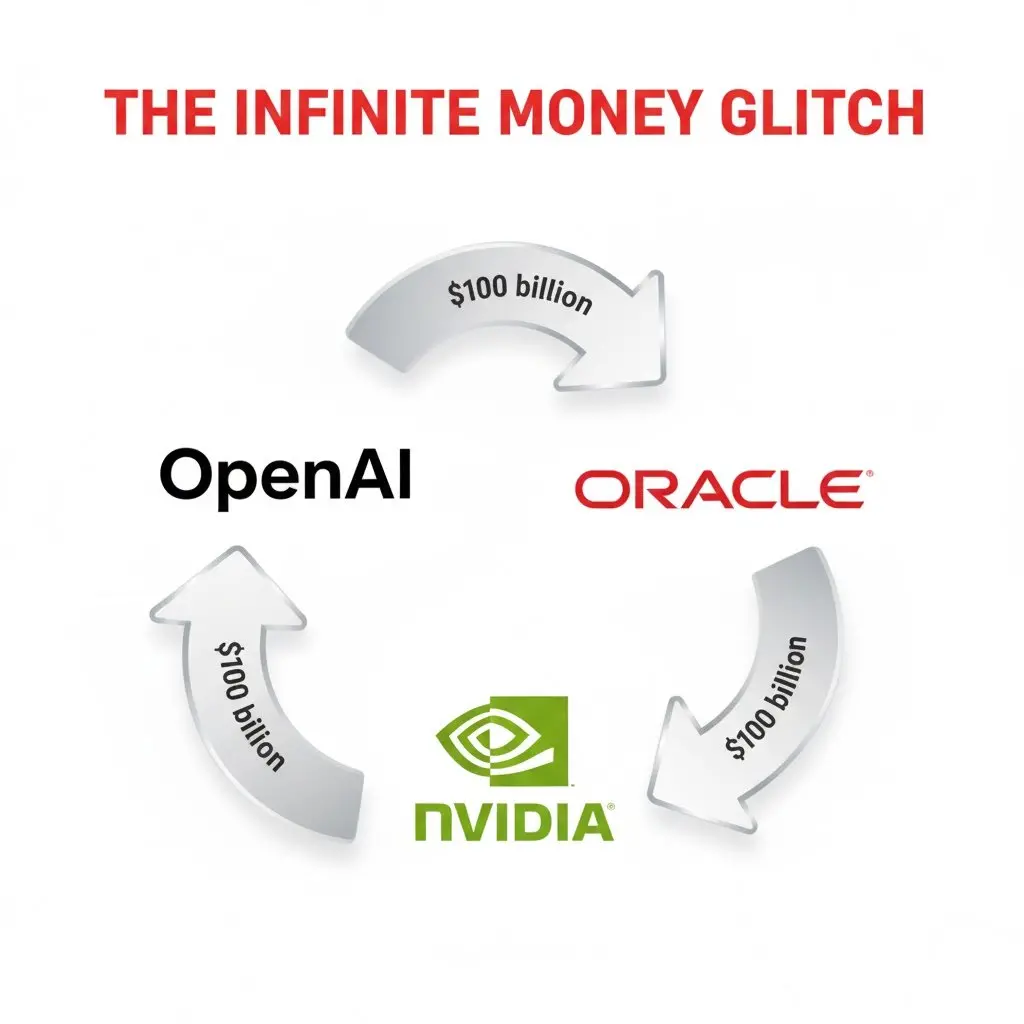
The Game of Infinite Funds
After this round of circulation, the 100 yuan returns to Nvidia's hands. However, despite the funds merely circulating internally without any real purchases from external customers, all three companies' financial statements miraculously show that they each generated 100 yuan in revenue. This makes their financial reports exceptionally bright, strongly supporting their high stock prices and market valuations.
The fatal flaw of this model lies in the fact that the entire game is not built on solid customer demand but entirely relies on the commitments of the participants to each other and the ever-expanding credit. If any link in the cycle breaks—for example, if Oracle cannot repay its loans due to excessive debt—the entire seemingly prosperous system could collapse in an instant. This closed-loop capital cycle that inflates revenue bubbles through internal transactions is not financial innovation; its structure bears a striking resemblance to the operational methods before certain historical financial crises, evoking memories of the storm that nearly destroyed the global economy.
Echoes of History: Five Striking Similarities Between Current AI Financial Structures and the 2008 Subprime Mortgage Crisis
The current financial phenomenon is not isolated. When we piece together Oracle's debt alarm with the capital cycle among AI giants, market observers who experienced the 2008 financial tsunami may feel a sense of "déjà vu." The following systematically analyzes the five key commonalities between the current financial operations in the AI field and the core elements that led to the 2008 global financial crisis, revealing that history may be repeating itself in a new form.
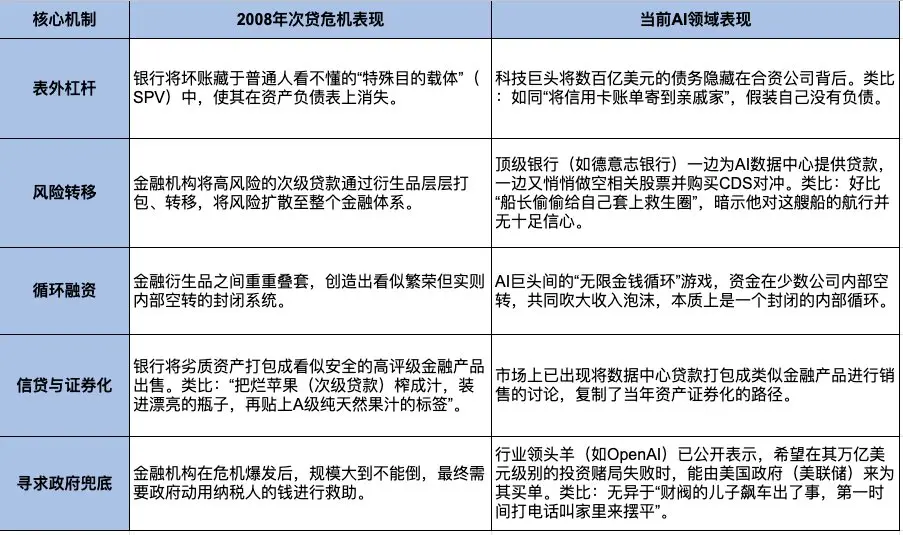
Comparison of the 2008 Subprime Mortgage Crisis and the Current AI Bubble
These five striking similarities paint a disturbing picture. However, history never simply repeats itself. Before we hastily equate the AI bubble with the subprime mortgage crisis, we must answer a core question: at the center of this storm, is the nature of the "assets" serving as collateral fundamentally different?
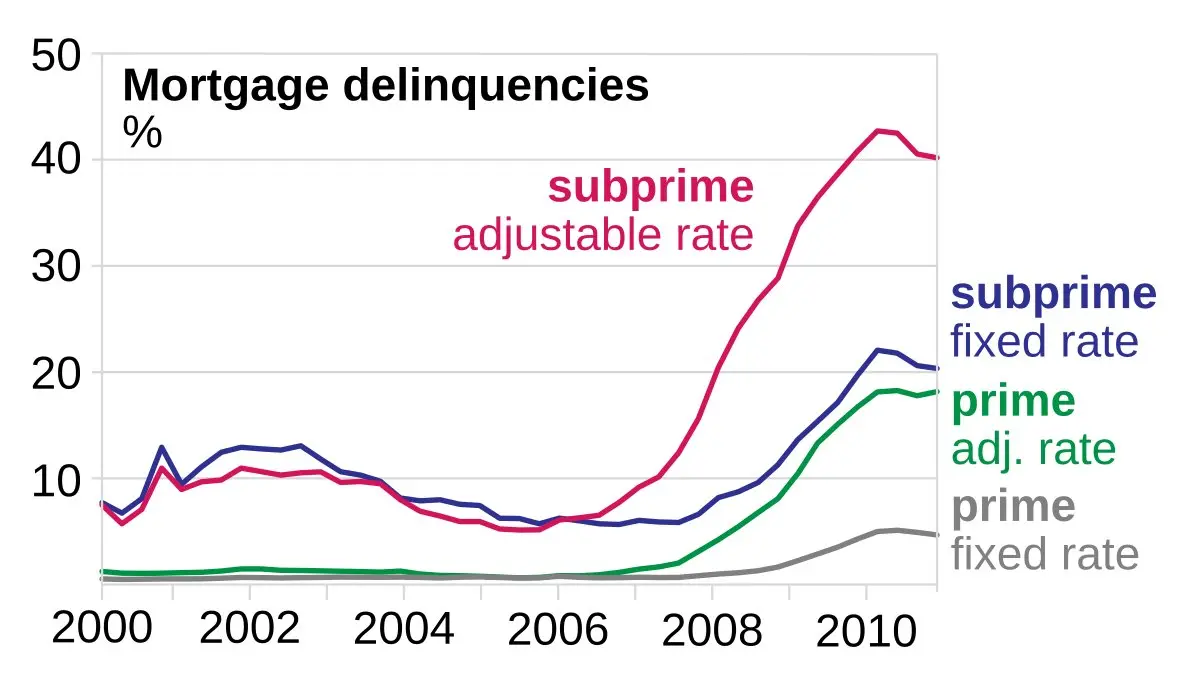
2008 Subprime Mortgage Crisis
Key Differences Analysis: Why This Time May Not Be a Simple Replay of 2008
Despite the aforementioned similarities being alarming, equating the current AI wave with the 2008 subprime mortgage crisis is one-sided. History has rhythm but does not simply repeat. Beneath the astonishing similarities lie three fundamental differences that may determine the ultimate direction and scope of this potential crisis.
The Nature of Core Assets is Different: The core asset in 2008: non-productive residential real estate. For the vast majority of homeowners, the property itself does not generate cash flow to repay loans. The entire game was maintained entirely by a fragile belief: "housing prices will always rise." Once this belief was shattered, the entire credit chain would snap.
Current AI core assets: productive data centers and GPUs. Data centers and GPUs are typical productive assets, akin to "golden egg-laying hens." They are built solely to generate cash flow directly by providing computing power services. Therefore, the key issue shifts from "will asset prices fall?" to "will the speed of asset cash flow generation outpace its financing and operating costs?" This fundamental shift is the key distinction that downgrades this potential crisis from "systemic risk threatening the global banking system" to "a major internal reshuffling in the tech industry."
The Creditworthiness of Borrowers is Different: Borrowers in 2008: subprime credit individuals. The powder keg that ignited the crisis was those with unstable incomes and extremely poor credit histories, who never had the genuine ability to repay debts from the start.
Current AI borrowers: top tech companies. The ones engaging in frenzied borrowing in the AI field today are primarily the wealthiest and most profitable companies in the world, such as Amazon, Microsoft, and Google. Their ability to repay debts is far beyond that of subprime borrowers back then.
Regulatory Environment Differences: We live in a "post-2008" world. After that global crisis, the global financial regulatory system has been patched with a series of important "fixes." Banks are required to hold more capital to cope with potential risks, and regulatory bodies like central banks are now more inclined to "intervene proactively" rather than being caught off guard as they were back then.
Considering these three key differences, we can draw an important conclusion: even if the AI bubble ultimately bursts, its outcome is unlikely to be a systemic financial crisis that destroys the global banking system like in 2008; rather, it is more likely to evolve into another historically famous crisis model: a "2000 Internet Bubble 2.0" in the tech industry.
Risk Assessment and Outlook: A "2000 Internet Bubble 2.0" for the Tech Industry?
Based on the previous analysis of the similarities and differences between the AI financial structure and the 2008 crisis, we can make a more precise qualitative assessment and outlook on the potential risks in the current AI field. The conclusion is: if a crisis does erupt, its pattern will be closer to the bursting of the 2000 Internet bubble rather than the global financial tsunami of 2008.
Based on this judgment, the ultimate outcome of this potential crisis is more likely to be a crisis primarily confined within the tech industry. Once the bubble bursts, we may see a large number of AI companies that rely on "stories" and debt collapse; tech stocks will experience painful declines; countless investors' wealth will evaporate. The "pain will be severe," but it is unlikely to "drag the entire world down." The reason for this relatively limited impact is that the risks are mainly concentrated among equity investors and the tech industry chain, rather than permeating the global banking system's balance sheets through complex financial derivatives as in 2008, thus avoiding a systemic credit freeze.
After clarifying the nature of the risks and possible outcomes, for investors involved, the most critical question is no longer "will it collapse?" but rather "how to respond?"
Investor Response Strategies: Finding Opportunities Amidst Caution
In the face of a potential internal industry crisis, the core task for investors is not to panic and liquidate their positions but to engage in rational risk management and portfolio optimization. Now is not the time to flee but rather to prudently prune the investment portfolio like a savvy gardener. The following three specific, actionable strategies aim to help investors protect their existing gains while preparing for the future.
Strategy One: Review and Categorize AI Stocks Held:
First, you must clearly categorize the AI-related stocks you hold to assess their respective risk levels:
Core Players: Such as Nvidia and Google. These companies have strong fundamentals, and their AI investments mainly stem from their robust profits and cash flow, making them the most resilient participants.
High-Risk Challengers: Such as Oracle. These companies attempt to achieve "curve overtaking" through massive borrowing, which may bring high returns but is extremely fragile, making them the most vulnerable group in a potential crisis.
Investment Warning: For stocks like Oracle that have already gone through a "pump and dump" cycle, do not attempt to "buy the dip" easily until they present a new narrative that can support a higher valuation. The selling pressure from those previously trapped is immense, and the risk of entering at this time is extremely high.
Strategy Two: Think Like a Bank and "Buy Insurance" for Your Portfolio:
- Learn from the hedging mindset of smart financial institutions and "buy insurance" for your investment portfolio. For ordinary investors, the simplest and most effective hedging method is not complex options trading but rather taking partial profits. It is advisable to sell some of the stocks that have risen the most, especially those driven by "narratives," turning "paper wealth" into cash in hand. This move does not reflect a lack of confidence in AI's long-term future but rather demonstrates a mature investor's effort to protect existing gains.
Strategy Three: Diversify Investments, Avoid Putting All Eggs in One Basket:
- It is recommended to transfer some of the profits from AI stocks into more stable asset classes to diversify risks. Viable directions include high-dividend and more defensive assets, or traditional safe-haven assets like gold and government bonds. For those wishing to maintain exposure to the tech sector while seeking to diversify risks, broader index tools like the Nasdaq 100 ETF (QQQ) should be used to replace excessive concentration on a single high-risk stock.
Conclusion: Standing at the Crossroads of Genuine Innovation and Financial Illusion
AI is undoubtedly a technological revolution that will profoundly change all of our lives, and this is beyond doubt. However, its current trajectory is supported by some fragile financial structures. This places us at a critical crossroads. The real question is whether we will build this bright future on the foundation of genuine innovation and sound finances or on a fragile sandcastle built from cyclical credit and financial illusions. The answer to this question will not only determine the ultimate direction of this AI feast but will also profoundly impact the wealth fortunes of each of us in the coming years.
In summary, the AI industry is showing signs of debt-driven financial fragility, and its capital operation model bears unsettling similarities to historical financial bubbles. This requires us to immediately shift the focus of investment strategies from "opportunity-oriented" to "risk management priority." Stay vigilant, but do not panic. The primary task now is to optimize the portfolio structure, lock in realized substantial profits, and comprehensively enhance the quality and risk resilience of holdings.
 Risk warning
 Risk warning