Vitalik Buterin introduces Ethereum (2025 version) in 30 minutes
 Core Viewpoint

 Detailed Explanation of the Vision of "Full Node Regression": From ZK-EVMs to the Future Path of "Lean Ethereum"
It is a limited-scale computer designed specifically for global consensus, extreme robustness, and decentralization, which anyone anywhere in the world can trust to run continuously exactly as programmed.
Below is the full text of Vitalik Buterin's opening speech at Devconnect ARG 2025, compiled from English.
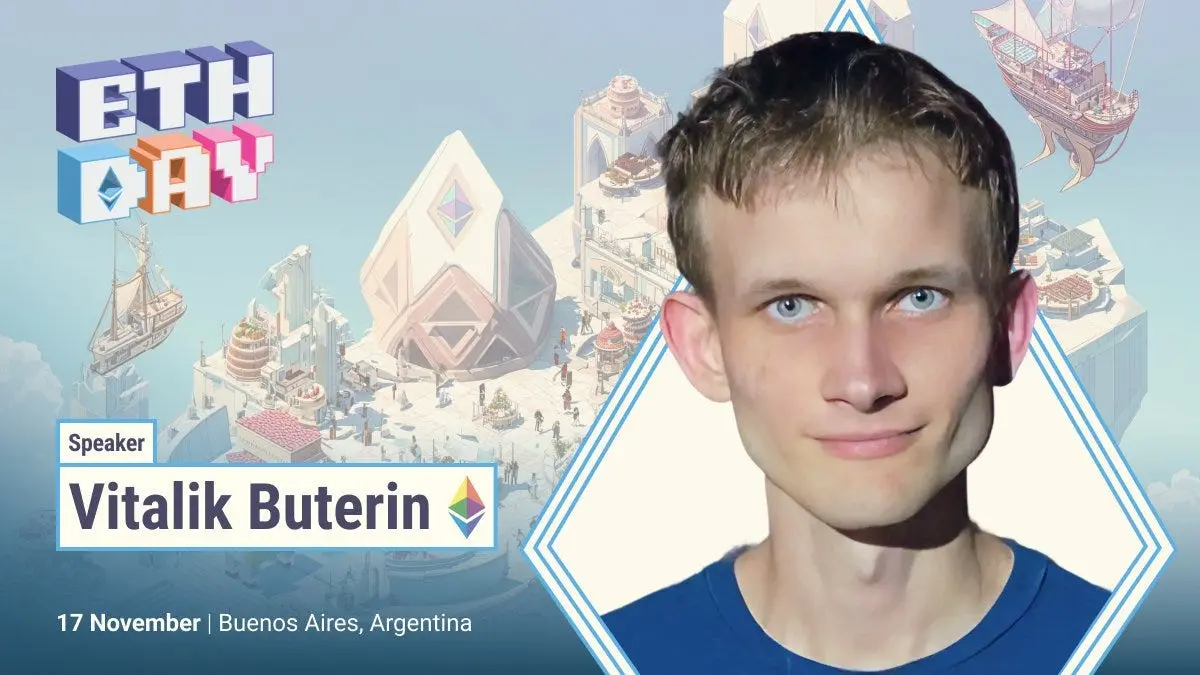
One-Sentence Summary of Ethereum: It Is Not FTX
I want to… summarize Ethereum in one sentence. Who here remembers FTX? (Please raise your hand) How about Mt. Gox? (Please raise your hand) Okay, quite a few people.
I actually don't have too many negative feelings towards Mark Karpeles of Mt. Gox. I think he made a big mistake, but after that, if you look at every action he took, I believe he has been trying hard to learn from it, adapt, and commit to positive-sum security matters.
But FTX, I think it is a perfect example that precisely shows what you would get if you took the principles of Ethereum and then completely flipped them 180 degrees. And it's not me putting his face (SBF) up there. Every FTX advertisement prominently featured SBF's face, five times more noticeable than any other element.
So, to summarize Ethereum in one sentence: It is not something like FTX.
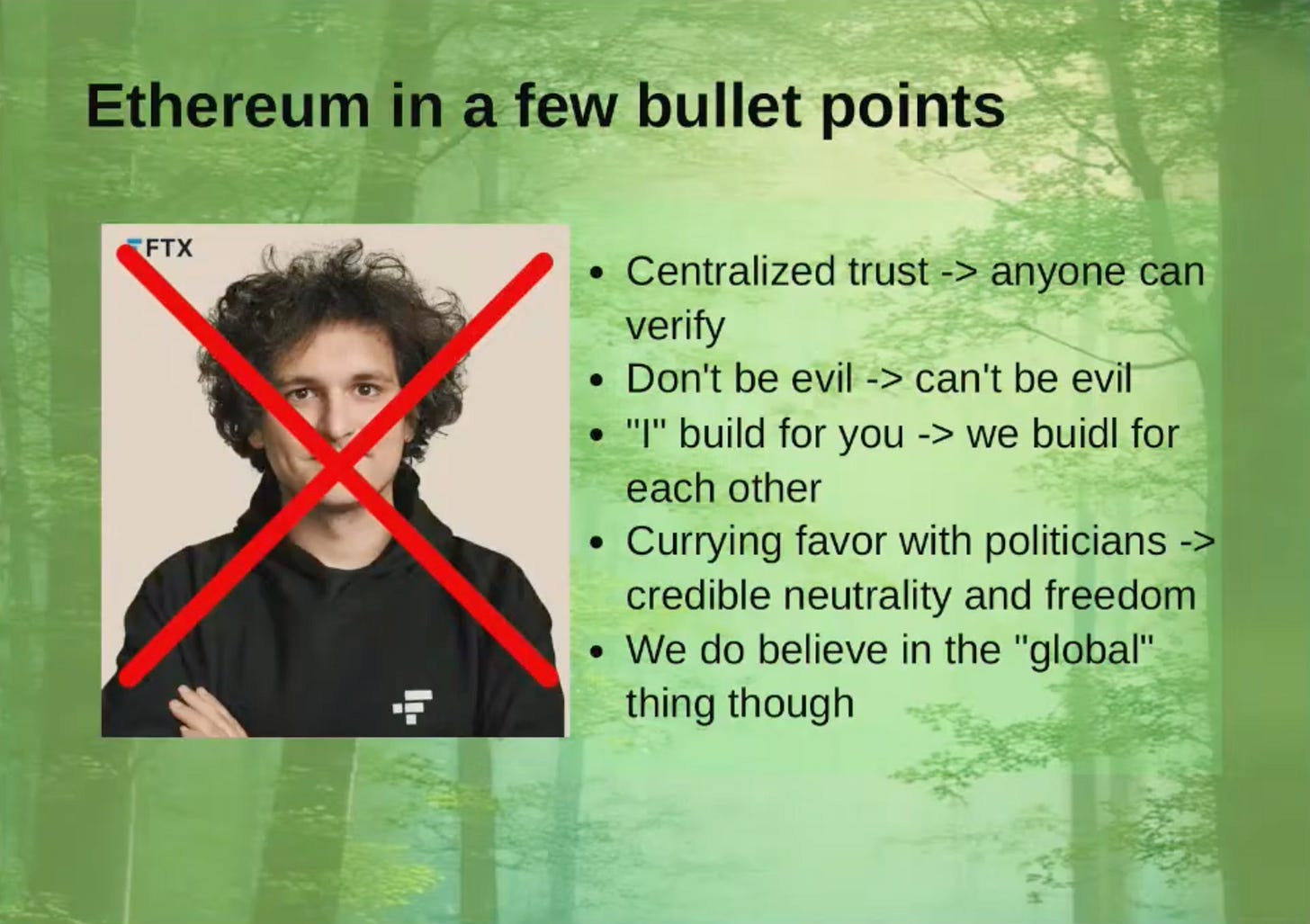
Several key points about Ethereum:
1. From "Centralized Trust" to "Anyone Can Verify"
FTX is a centralized exchange where people put in huge amounts of money. You couldn't verify whether FTX was actually solvent. Of course, it was ultimately proven that it was not.
2. From "Don't Be Evil" to "Can't Be Evil"
"Don't be evil" was Google's famous early idealistic slogan, especially when it was still a small company. It seemed to take pride in being a company that created positive-sum value. Of course, as Google grew, those positive values began to genuinely erode over time, and eventually, this motto was officially abandoned in the past decade, now seeming to have turned into the more mundane "do the right thing."
The approach of the previous generation of technology, and the many consequences we have seen from it, is to stand up and shout: "Trust me because I'm a good person."
And the point of decentralized technology and blockchain is that you don't have to trust them.
3. From "I Build for You" to "We Build for Each Other"
Another significant difference is between "I build for you" and "we build for each other." There is a very subtle but, I think, extremely important distinction between companies and communities.
Another example that comes to mind is Estonia's e-Residency. I am actually a bit hesitant to criticize it because it is indeed very innovative and has many positive aspects.
It was very ahead of its time, allowing you to open bank accounts digitally, vote digitally, and do a lot of e-government. I remember one of the more idealistic visions of that project was Estonia expanding into a digital nation. E-Estonia could be much larger than the physical Estonia with its 1.3 million residents.
The challenge is that it misunderstands what a real community is.
E-Estonia is very successful as a service provider; it is a hub-and-spoke structure. You have a central entity (the Estonian government) providing services. Their services are very valuable and have helped many people around the world (for example, obtaining EU bank accounts).
But it is not a community. The difference between a company and a community is:
A company is a hub-and-spoke structure: there is a center doing things and making money.
A community is where everyone (or a very large number of people) is doing things for each other.
It is open—not just in the OpenAI sense of "open" (having an open API you can use), and not just in the sense of many open LLM works being "open."
It is open in the full-stack sense, open not just for consumption but also for creation.
4. From "Pandering to Politicians" to "Trustworthy Neutrality and Freedom"
Also, (in the old model) "pandering to politicians" has turned into (what Ethereum seeks) "trustworthy neutrality and freedom."
Ethereum is a global network that exists for the world, aimed at protecting the freedom of people around the world. It is not about pandering to a specific company or a superpower at the expense of everyone else.
We truly believe in "globality." If you think the term "globality" sounds too "woke," you can also use terms like "local cosmos" or "cosmolocal." There are many different words, but we are here to impact the world.
What Is "Ethereum, the World Computer"?
So, let's talk about Ethereum, the world computer.
Ethereum is a global, open, censorship-resistant platform for building decentralized applications.
A new block is produced every 12 seconds, and each block contains a bunch of transactions. The blockchain processes slightly under 2 million transactions daily. I think with the increase in the gas limit, it will soon exceed 2 million.
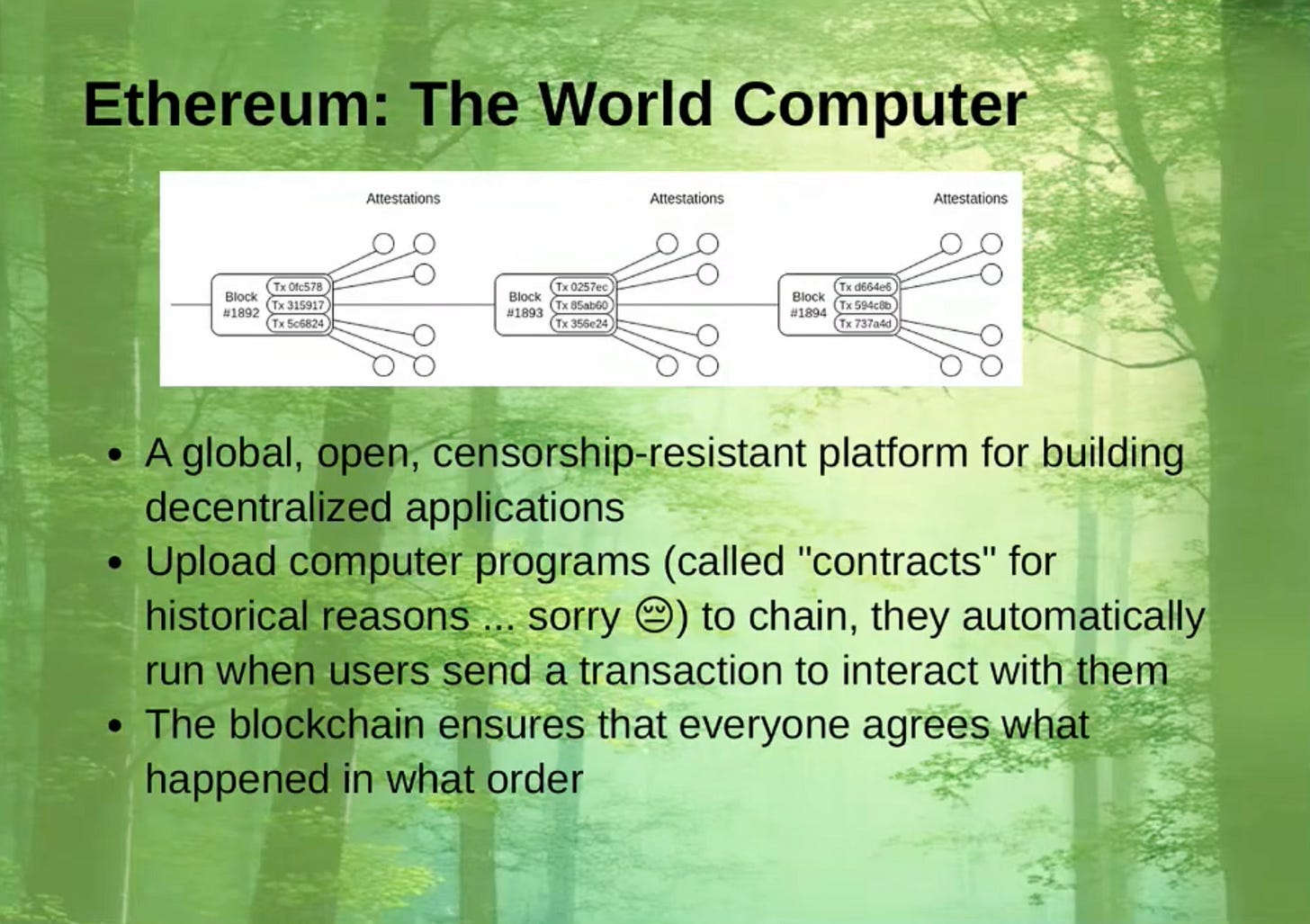
Then there is the consensus mechanism. It used to be Proof of Work, and now it is Proof of Stake. The job of the blockchain is that as a user, anyone can send transactions (basically commands of "what I want to do"), and the blockchain ensures that everyone agrees on what happens (like which transactions were sent and in what order).
Programmability: The Core Distinction of Ethereum
The main distinction of Ethereum from previous technologies is programmability.
Previous blockchains were either single-purpose protocols (used for a specific application) or what I call "Swiss Army knife" protocols—where developers say: "Here are 14 different applications, and we create 14 different transaction types to support them." If someone discovers the 15th application, we would have to hard fork the protocol.
Ethereum embraces programmability. Whatever application you want to build, you can upload a computer program.
Due to some historical reasons (related to Nick Szabo, early cryptography, etc., which you can look up), these programs are called "contracts." They are smart contracts.
Many legal professionals get confused by the term "contract." So just know that "contract" here is a technical term. Just like "Promise" is a technical term in JavaScript.
You upload the computer program to the chain, and when users send transactions to interact with it, these programs run automatically.
So, on a technical level, that's basically it. It is a "world computer": not that it is a computer big enough to handle all the computation in the world (including all the crazy LLM reasoning and cat video generation).
It is a limited-scale computer designed specifically for global consensus, extreme robustness, and decentralization, which anyone anywhere in the world can trust to run continuously exactly as programmed.

What Is Blockchain Good At?
1. Finance and DAOs (Solving Double Spending)
Clearly, the initial and largest category is payment and financial applications. The first blockchain, "Bitcoin," was born as peer-to-peer electronic cash. Even in Ethereum, if you look at the Ethereum white paper, about half (or even more) of the applications that inspired Ethereum are different types of financial applications: issuing assets, asset exchanges, financial derivatives, and even prediction markets.
There are also DAOs (Decentralized Autonomous Organizations). These systems encode the rules of organizations (like companies) on-chain, and then these rules directly control the assets owned by the organization.
Blockchains tend to excel at these things, one commonly mentioned reason being that blockchain solves the double spending problem.
You might ask, why do we need the concept of "consensus"? Why do we need proof-of-stake nodes to vote on what transactions happen in what order?
What happens without consensus? What if we only had a decentralized network like BitTorrent? You can upload files on BitTorrent, and anyone can download them. You could even (theoretically) make the files contain programs and run them automatically.
To understand why that mechanism doesn't work for currency, the simplest question is this "double spending" problem.
The problem is, suppose I have 1 ETH, and I send 0.7 ETH to someone over there. I broadcast this transaction. Then, I simultaneously send another transaction giving 0.7 ETH to another person over here.
In total, I have turned 1 ETH into 1.4 ETH. If people could do this, ETH would experience hyperinflation and become worthless.
If you don't want this to happen, you need a way to arbitrate which transaction happens first. That's the role of the blockchain.
2. Non-Financial Applications
Blockchains are also very useful beyond finance.
Perhaps the most successful non-financial application is ENS (Ethereum Name Service), which I am sure you will hear about in many places this week. You can basically have your own name. You can register an unoccupied .eth domain (I have Vitalik.eth).
This is a username that is recognized as your username across all Ethereum applications, and it is not controlled by any single service provider. It is not like a Google account or a government-issued name.
3. Censorship Resistance and Proofs
Blockchains provide strong guarantees of participation, also known as censorship resistance. They strongly guarantee that if you send a valid transaction (i.e., one that complies with protocol rules), it will be (and quickly will be) packaged. This is valuable in many areas, such as preventing market manipulation in finance.
Blockchains excel at "proof of inexistence," which means proving that a limited number of things have been issued. For example, if you want to issue 1,000 stamps representing community membership, you can prove that you only issued 1,000 and not 10 million, proving that you have not hoarded any.
It also applies to timestamp proofs: proving that something was not created before a certain point in time; or conversely, proving that something was created before a certain point in time. This is useful for video authentication and other use cases.
So, blockchain is a diverse tool that has both financial applications and other interesting "long-tail" applications.
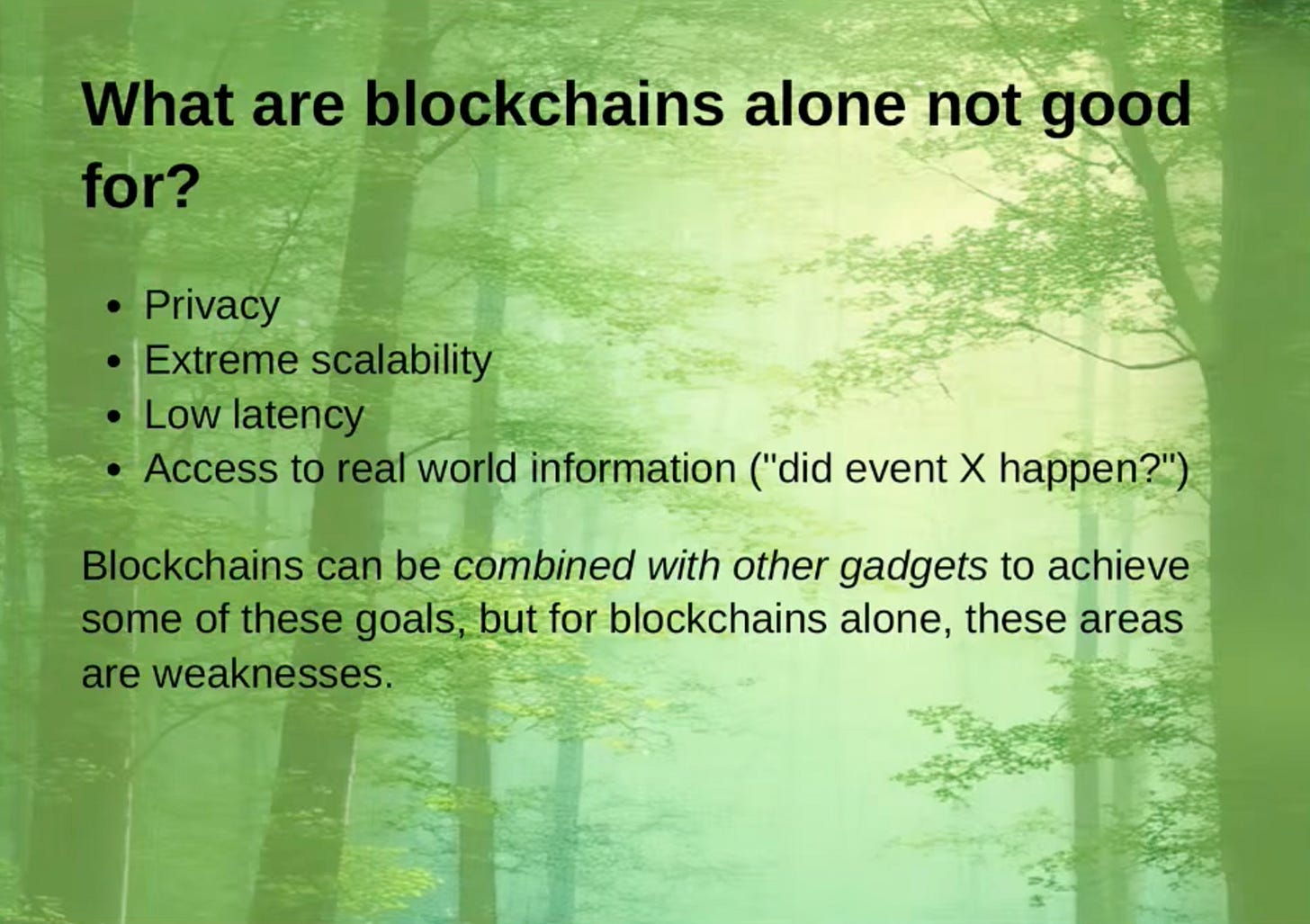
What Is Blockchain Not Good At?
1. Privacy
Zooko of Zcash once famously said that Bitcoin is "Twitter for your bank account." Who here wants all their financial transactions to automatically become tweets?
But you must realize that if the transactions you send on the blockchain are not private, if someone really wants to, they can completely create a Twitter bot that automatically waits for you to send transactions, analyzes them with an LLM, tries to figure out who you sent to, and then tweets it. This is closer to "Twitter for your bank account" than you might imagine.
2. Extreme Scalability
If you want to run an LLM program on Ethereum to generate a cat picture, you might end up spending millions of dollars in transaction fees.
3. Low Latency
This is an inherent cost of decentralization. If you want a geographically distributed, neutral system that everyone in the world can participate in, it cannot have a 50-millisecond latency. If it really did (have such low latency), then all activities would ultimately concentrate in one city.
4. Accessing Real-World Information
This is the "oracle problem." For example, deciding a payment based on whether something happened. Ethereum itself cannot solve this biggest trust issue, which is that you still need someone to tell you the information: Did that thing actually happen?
Blockchains can combine with other "gadgets" to achieve these goals, but for the blockchain itself, these areas are weaknesses.
The Bigger Picture: Web3 and Cryptography
Ethereum is part of a bigger story. This diagram comes from Gavin Wood's vision in 2015, which is the early vision of Web3: Ethereum is one of a set of technologies that together create a freer and more open internet.
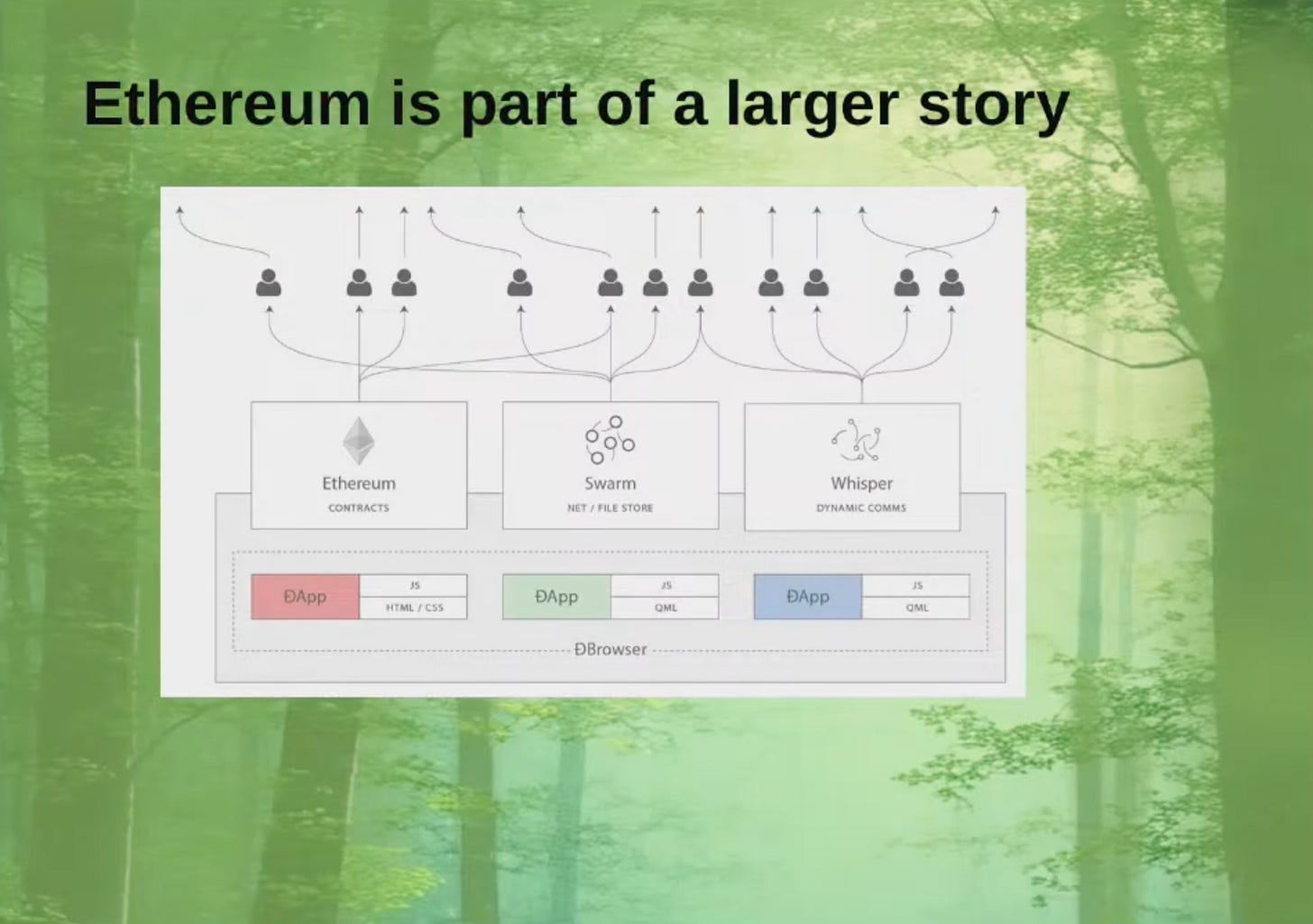
Blockchain is an important piece of this puzzle. But in 2015, there were also some sister protocols being developed (and still are):
Swarm: for distributed storage, handling data that is too large for everyone to download onto the chain.
Whisper: an off-chain peer-to-peer messaging protocol that does not care about consensus.
These protocols continue to evolve: Whisper has become Waku, used in many privacy protocols and instant messaging; the Swarm team is still active, and IPFS is also widely used.
But I think one big thing that has happened is that this "bigger story" has expanded a lot. For me, this bigger story is that there exists a class of technologies called cryptography.
Cryptography makes large-scale collaboration without centralized trust possible.
The most basic forms of cryptography are encryption and signatures.
Encryption: allows you to talk to a friend 10,000 kilometers away, while anyone in between (including infrastructure operators) cannot see the content.
Signatures: allow you to verify whether the information you received truly came from the person it claims to be from.
Recently, we have seen the rise of programmable cryptography, which is a more advanced form. You can not only encrypt and sign, but also:
Perform entire computations on encrypted data.
Prove you possess certain data without revealing the data itself (e.g., ZKPs - Zero-Knowledge Proofs).
Combine data from multiple people for computation (e.g., FHE - Fully Homomorphic Encryption).
(Further out) Obfuscation: taking a program containing your data and only using it to do specific things.
This is a whole set of tools that enables large-scale collaboration without centralized actors. Blockchain complements this in many ways.
The Future of Ethereum
Our high-level goal is:
We want a secure, robust, streamlined, globally decentralized, censorship-resistant network that possesses all the features people have expected from blockchains since the birth of Bitcoin.
But within these constraints, we also want it to be fast and scalable, so that applications that want to benefit from these features truly have the space and capability to do so.
2025-2026: Scalability Arc
The gas limit (a measure of how many transactions Ethereum can handle) has already increased by 50% this year. There is currently a proposal to raise the gas limit to 60 million (currently about a quarter of the nodes are voting in support, and I believe that number will continue to grow).
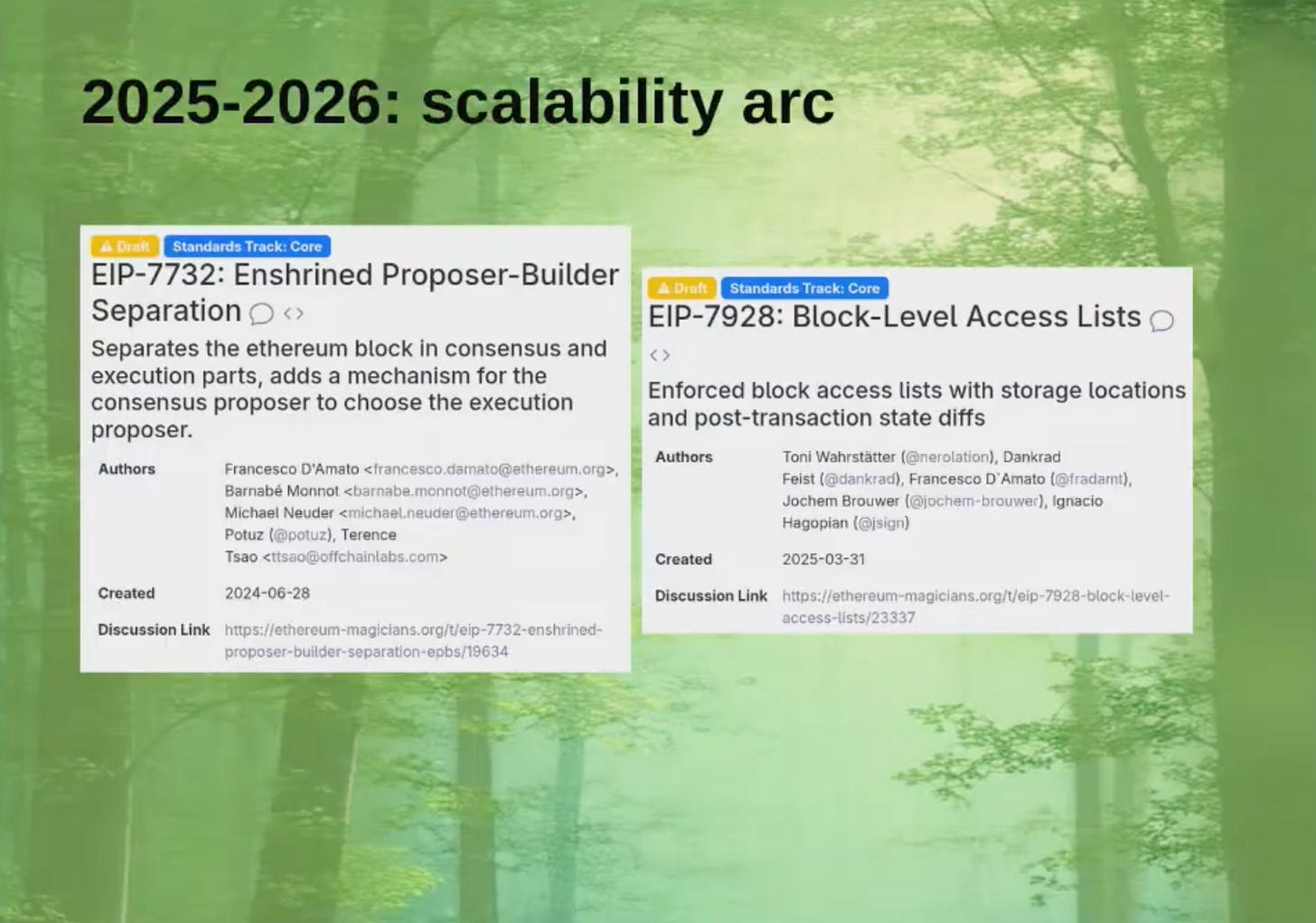
In 2026, we will have a series of EIPs that will enable the Ethereum network to securely handle larger scales while maintaining decentralization and the operational capacity of regular nodes.
EIP-7732 (Native Proposer-Builder Separation, PBS): One of its effects is that it allows nodes to spend a larger portion of their slot time processing blocks without compromising network decentralization (or severely favoring centralized nodes).
Block Level Access List: This basically means that all other nodes, besides the node that originally created the block, can process that block in parallel.
With the "Block Level Access List," this issue is largely solved for every node except the one creating the block, which is really remarkable.
These two things will enable us to achieve a more secure gas limit increase by the end of next year, making Ethereum perform better than it does at the end of this year.
ZK-EVM: The Return of Full Node Culture
Next is something I am very excited about: ZK-EVM and the return of full node culture.
Who here ran an Ethereum full node 5 to 8 years ago?
Who here is running an Ethereum full node today?
Okay, the numbers are about the same, but that is still far from enough.
I remember the last time I synced a full node, it took me four days. Four days is too long. It also takes up over 1 TB of space on your hard drive. And to keep it running, it requires a lot of computation, drains your battery, and can cause your hard drive to fail faster. It is an expensive endeavor.
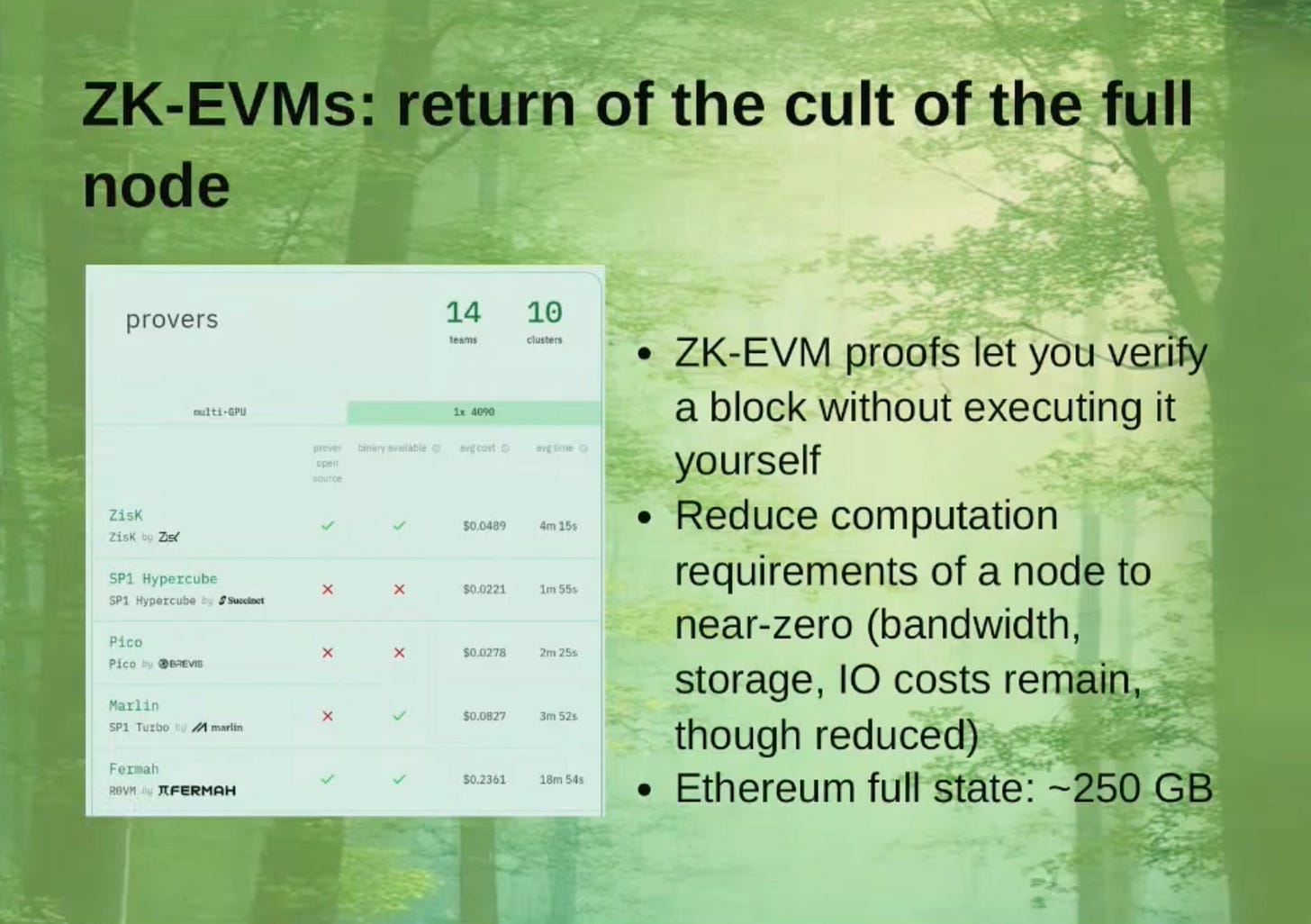
ZK-EVM, based on the zero-knowledge proof technology I mentioned, allows you to verify the correctness of a block without having to execute all the computations yourself.
This is no longer science fiction. It is now about to become a reality in the Alpha stage.
According to data from ethproofs.org, there are now provers capable of proving Ethereum blocks in real-time using dozens of consumer-grade GPUs, and this number is rapidly shrinking every few months.
We can reduce the computational requirements for nodes to nearly zero.
Of course, bandwidth, storage, and I/O costs still exist, but they have also been reduced. In theory, if you have a laptop or even a phone with enough space (like 512GB, which is now available in some phones), you can start considering running a full node.
I believe that in the next one to two years, even as Ethereum scales up, the number of people who can truly run full nodes will increase significantly.
2026 to 2027: Censorship Resistance and Decentralization Upgrades
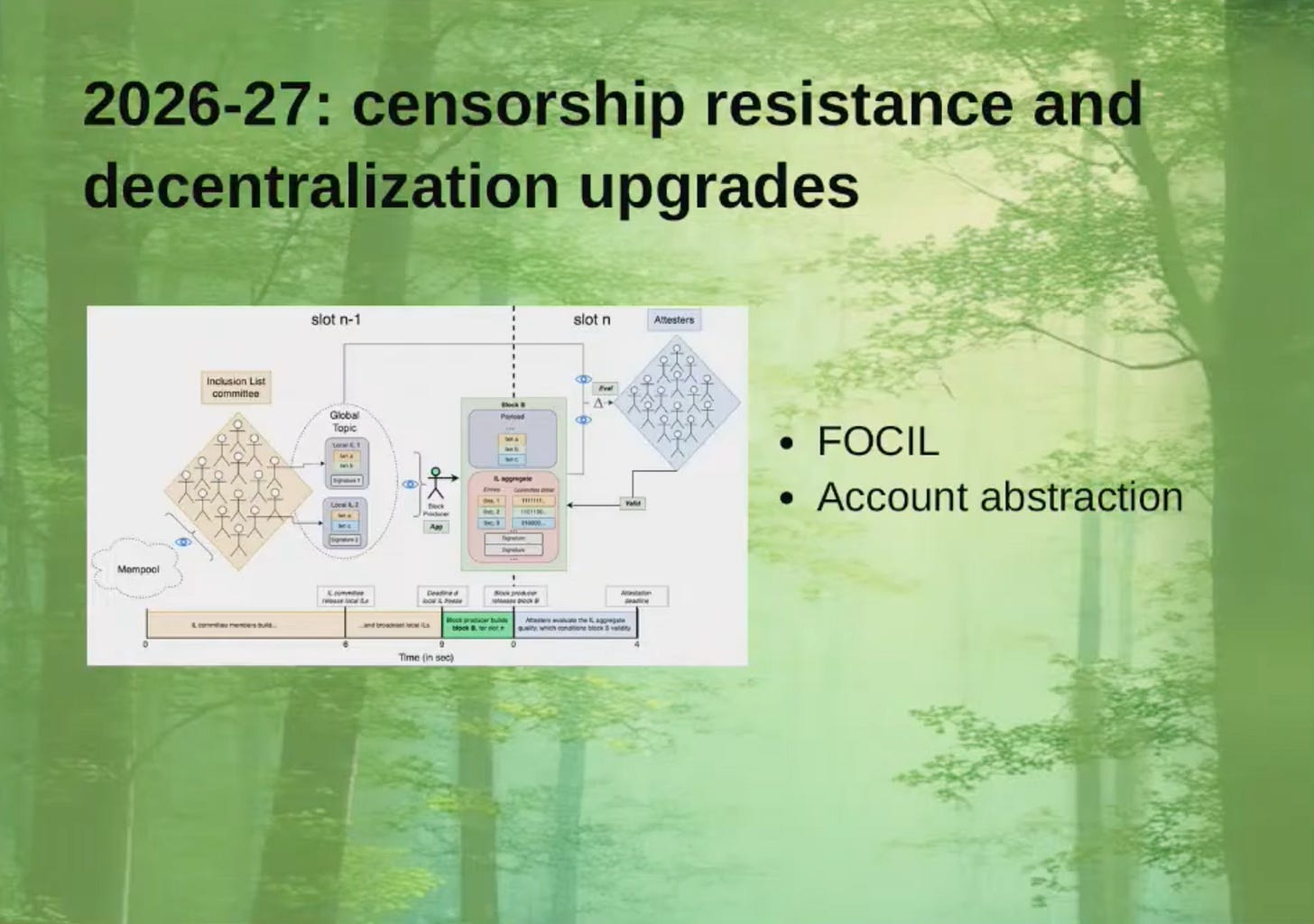
FOCIL: Allows a medium-sized set of nodes to propose "mini-blocks" at each slot. This provides stronger guarantees that your transactions can be quickly packaged.
Account Abstraction: Ongoing work to ensure you can have more powerful smart wallets, better security forms (like key recovery), and even support privacy protocols, all without relying on intermediaries.
Longer-Term: Lean Ethereum
Justin's team has been researching "Lean Ethereum," a long-term effort aimed at making deeper improvements to ensure Ethereum remains efficient and secure in the long run. This involves replacing many suboptimal components with known components that are closer to optimal.
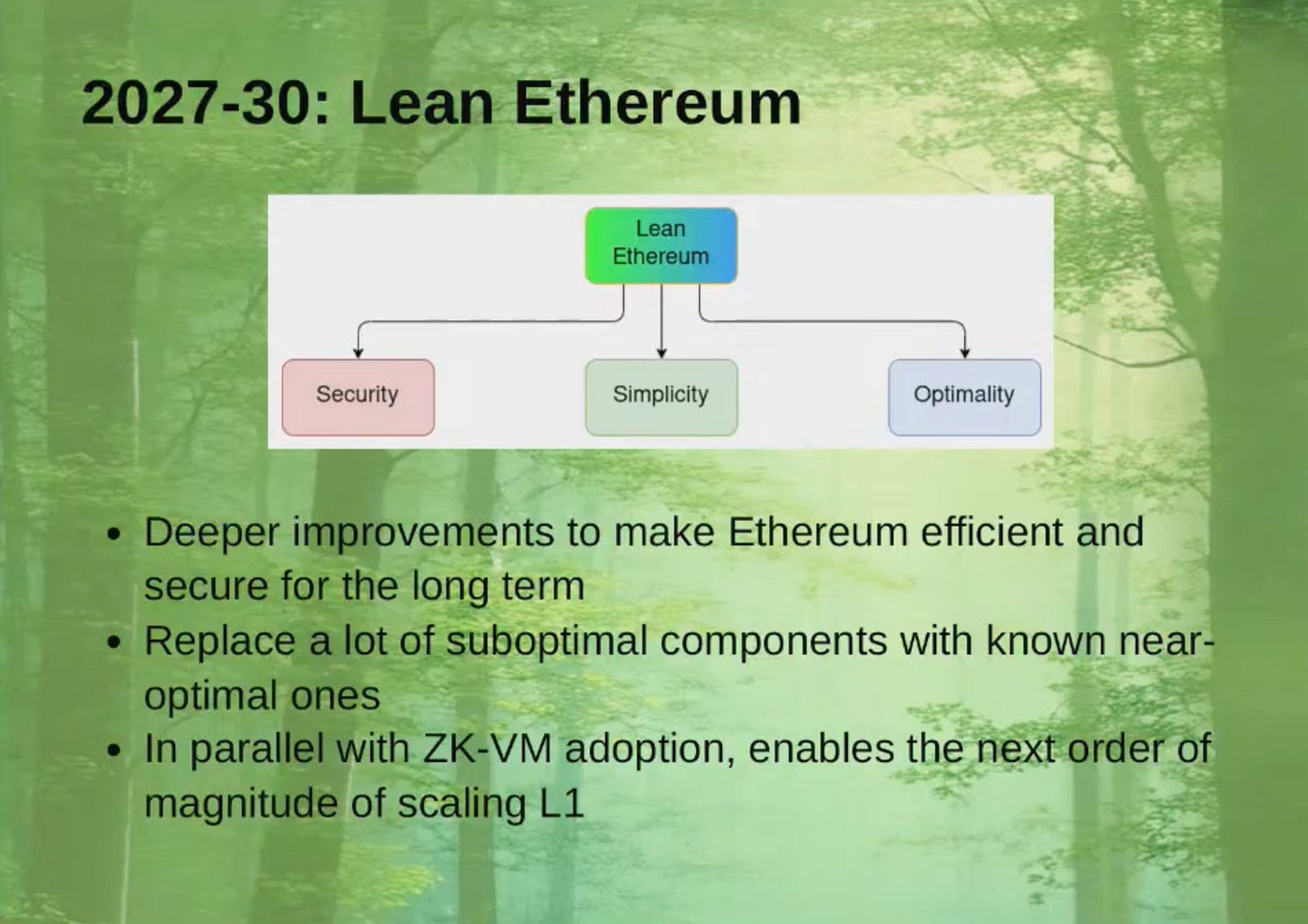
Key points include:
Optimized, fast, ZK-friendly VM (Virtual Machine)
Ubiquitous quantum resistance
ZK-friendly hash functions (currently leading is Poseidon, and we are investing heavily in academic research and bounties to ensure its robustness)
Formal verification of everything
Optimized consensus (faster finality, Fast finality)
We are basically learning from all the lessons of the past five years and truly bringing in those technologies that have only become genuinely possible and available in the past five years.
User-Level Work: Trustless User Experience
This includes privacy and security.
Privacy: Not just on-chain ZK proofs. It also includes protecting you from privacy infringements by RPC nodes (from which you get data), network layer privacy, voting privacy, DeFi privacy, and even private account abstraction.
Security: Light clients (like Helios) are improving. Reducing software supply chain dependencies (the amount of software we must rely on that could cause a total collapse due to bugs). On-chain version control (getting rid of front-end dependencies on servers to prevent everything from being stolen if the server is hacked). Multi-signature, social recovery wallets, hardware wallets.
Interoperability: There are also related activities this week.
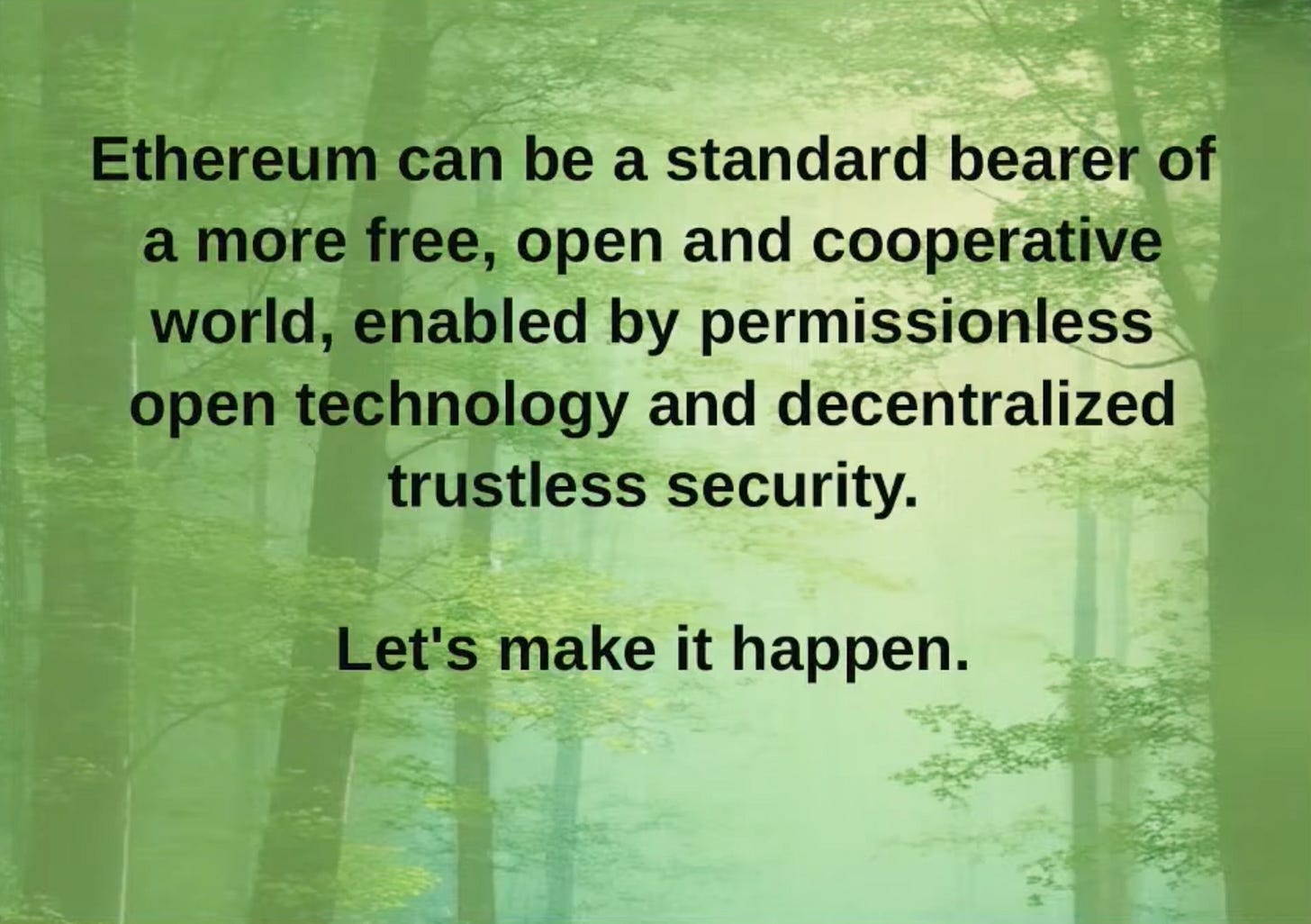
Ethereum can become a banner leading a freer, more open, and collaborative world supported by permissionless open technologies and decentralized trustless security.
This is a powerful technology that is rapidly becoming even more powerful. It is also part of a set of tools whose power is rapidly growing.
I believe the Ethereum community and Ethereum technology can truly help bring this freer, more open, and collaborative world into reality.
Let us work together to achieve this goal.
Thank you.
Q&A Session
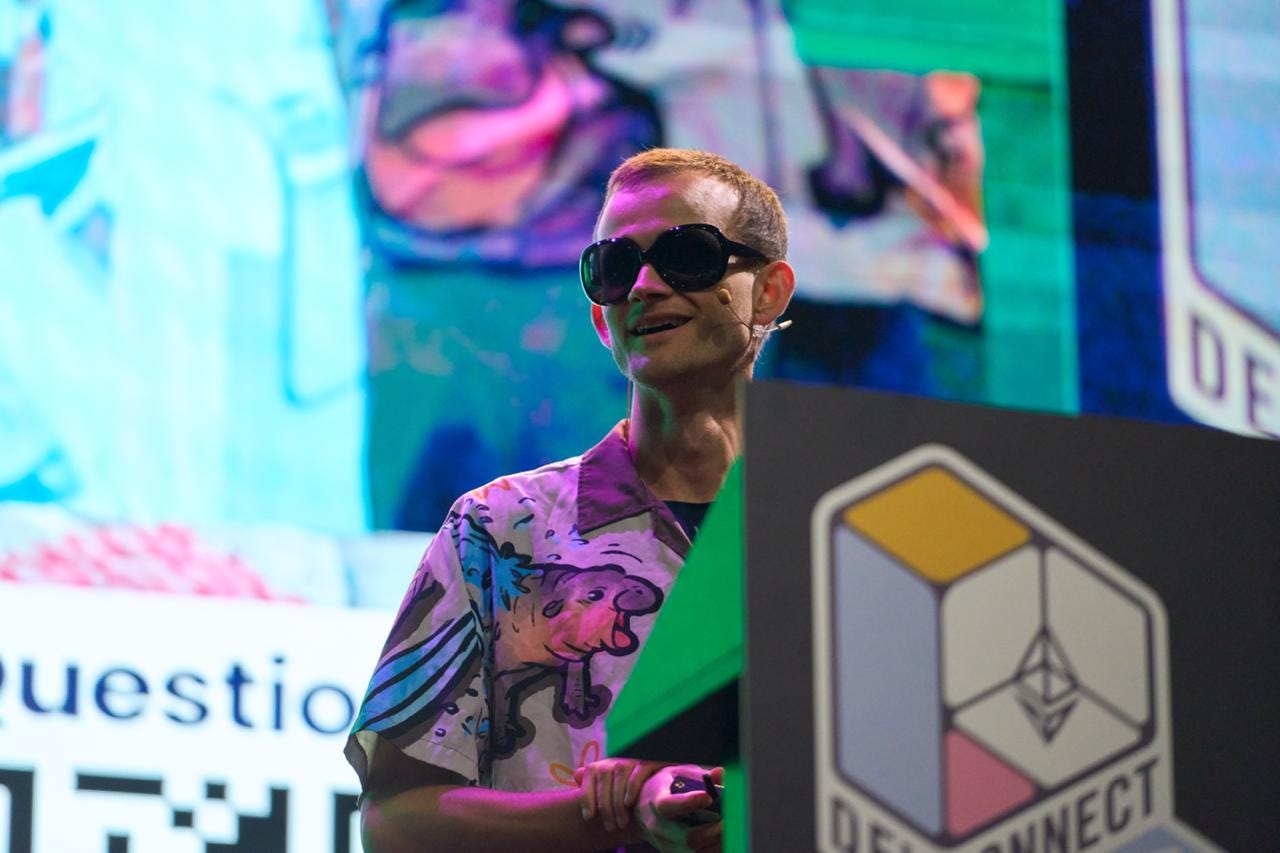
Host: Okay, thank you very much, Vitalik. I think everyone knows what the first question will be, so I’ll just ask it directly. Where can we buy those glasses you are wearing?
Vitalik: I think they are available on Amazon. Unfortunately, we haven't made a decentralized Amazon yet, so… maybe that's a good hackathon idea.
Host: Okay, a direct segue, similar question. What do you think about the relationship between Ethereum and Wall Street?
Vitalik: (…hearing the question…) Wall Street. Well, I think they are a user.
In Ethereum, we are "pro-user."
Host: Great. You talked a lot about what Ethereum can become and its current state. What do you think are the underrated things that people can focus on to extend Ethereum's properties into the real world?
Vitalik: Well, I think there are several different dimensions.
One of them is the real-world adoption of Ethereum itself. The dream started with payments. I remember being very excited in 2013 when there was a "Bitcoin Kiez" in Berlin. (Does anyone remember that?)… In the Kreuzberg district of Berlin, someone convinced 10 restaurants within a few hundred meters to accept Bitcoin at the same time. It became a Bitcoin cultural community. There was a lot of momentum around Bitcoin payments at that time, but it eventually faded for several reasons (I think rising transaction fees were a major reason).
We now have technology that makes payments truly feasible again. And there is a lot of demand to revive crypto payments here in Buenos Aires, where many physical stores even accept ETH and stablecoins on Ethereum.
I think even this real-world use is good.
Another thing is that when you examine this set of underlying technologies, in any field—whether it's communication, governance, or even lower-level stacks like operating systems, or even hardware—you can:
Think with the principles we talked about today. Consider how to make things more open, how to minimize the need for trust, and how to protect users. At the same time, think about some new technologies, including blockchain and cryptography, that allow us to move deeper in that direction than ever before.
Host: What is the most important skill that new and old members of Ethereum need to accept better training or do better?
Vitalik: It depends on who you are, but I think for a community like ours, being well-rounded is always healthy. It is always beneficial to touch on several different aspects of this field.
So I encourage everyone to at least try paying for coffee with ETH this week; if you don’t have a wallet, install one; if you haven’t used a DApp, use one; if you haven’t written a smart contract, try writing one.
If you are willing, you can even try to learn how one of the underlying protocols works.
At the same time, pay attention to how all these technologies interact with the broader world. Argentina has always been a good place for this, with a lot of adoption at various layers of the stack.
Host: Another question is, how did you come up with the name Ethereum?
Vitalik: I think I was browsing a list of elements in a science fiction novel, and I thought that word sounded nice.
Host: Great. What about the logo?
Vitalik: That's an interesting story. I'm not sure exactly what happened, but I think "Ethereum" appeared on that list of sci-fi elements because of a Japanese movie called "Castle in the Sky."
In that movie, one of the core objects is the "Ethereum crystal." The Ethereum crystal is what makes the castle float.
I had no idea about that origin at the time. But after I named it Ethereum, I think our artist might have known about that movie and then made the logo in the shape of the Ethereum crystal.
I remember it was about five years later that I first learned about and watched that movie, and I thought, "Wow, that crystal really looks like the logo."
Host: Awesome. I think that’s all the questions we have. Do you have anything else you want to say to the community? Maybe a lunch recommendation?
Vitalik: Well, eat something good, make sure to drink plenty of water, and spend some time outdoors enjoying the fresh air. You know, air is one of the four elements, and it’s important to keep it clean.
Enjoy the activities this week.
Host: Thank you very much, Vitalik!
 Risk warning Risk warning


Popular articles