The president becomes the dealer: 800,000 investors suffer huge losses, the Trump family cashes out and exits
 Core Viewpoint

 Trump's cryptocurrency empire triggers a political tsunami, with wealth surging and regulatory dismantling being labeled as "Idi Amin-style corruption."
An intended capital marriage aimed at "changing the future of finance" and bringing hundreds of millions of dollars in wealth to the Trump family has now turned into a nightmare for investors, who feel deeply betrayed due to the partner's involvement in a money laundering scandal, plummeting stock prices, and regulatory investigations—something that foreign media might describe as "unprecedented corruption in the White House in American history."
01 Entry: The Trump Family's Cryptocurrency Gamble
In September 2024, after years of keeping a distance from the cryptocurrency industry, Trump suddenly announced that his family would enter this field. His two sons, Eric Trump and Donald Trump Jr., founded World Liberty Financial (hereinafter referred to as WLF), a decentralized finance company that claims to be dedicated to "making finance reliable, open, and aligned with the needs of today's world."
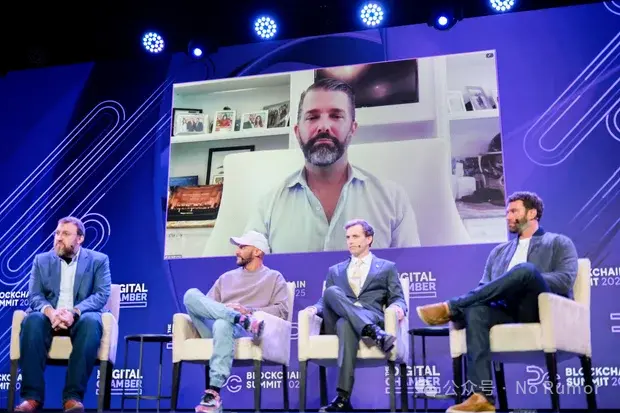
On March 26, 2025, in Washington, during the D.C. Blockchain Summit, Donald Trump Jr. appeared via video screen. Pictured from left to right are World Liberty Financial co-founders: Chase Herro, Zach Witkoff, and Zak Folkman.
This shift is striking. It is worth noting that during his first term, Trump publicly called cryptocurrencies a "scam." However, during the 2024 election campaign, he began to actively court deep-pocketed investors in the cryptocurrency industry, promising to make America the "crypto capital of the world." Cryptocurrency investors poured significant funds into the 2024 federal elections.
WLF's business model is simple and straightforward: issuing a governance token named WLFI. According to its official website, the Trump family owns 22.5 billion WLFI tokens and is entitled to 75% of the proceeds from the sale of this cryptocurrency. In the words of Bloomberg investigative reporter Zach Fox, "Just from World Liberty alone, I estimate the Trump family has made between $400 million and $500 million. This is just one of their many cryptocurrency ventures."
02 Alt5 Sigma Deal: The Hidden Reefs Behind the Glamour
In August 2025, Eric Trump and Donald Trump Jr. rang the opening bell at Nasdaq's New York headquarters to celebrate the announcement of a major deal—the merger of WLF with the Canadian-listed company Alt5 Sigma. "We will forever change the financial industry," Eric Trump declared at the ceremony.
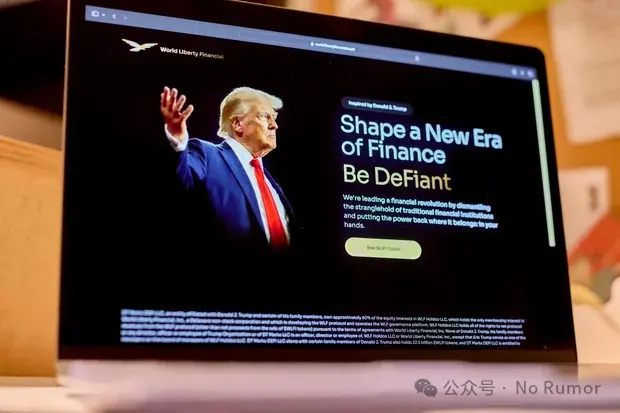
On February 12, 2025, the World Liberty Financial website displayed on a laptop screen.
The structure of this deal was quite complex: Alt5 Sigma issued shares and warrants to WLF in exchange for WLFI tokens worth $750 million; at the same time, it sold 100 million shares to other investors, raising $750 million to buy more WLFI tokens on the open market. This arrangement effectively gave WLF a seat as a publicly traded company, intending to replicate MicroStrategy's successful path of skyrocketing stock prices through massive Bitcoin purchases.
However, trouble soon surfaced. Weeks after the deal was announced, Alt5 suspended its CEO, Peter Tasiopoulos. The company warned employees of potential lawsuits and regulatory investigations. Subsequently, several executives left or were fired. Alt5 Sigma's stock price plummeted 75% within three months, with its market value shrinking from about $700 million before the deal to less than $200 million.
Even more shocking, Alt5 Sigma disclosed in late August that the company had been convicted of money laundering in Rwanda. The ruling, issued in May, involved bank fraud perpetrated by a fraudulent currency service company that had collaborated with the firm in 2023. The documents stated that this ruling and other matters "had not been disclosed to the board previously."
Eric Trump, who had planned to join the Alt5 board, ultimately could not fulfill this wish—Nasdaq warned the company that to comply with listing rules, he could only be designated as a board observer. Investor Matt Chipman expressed his anger: "I feel betrayed… I hope this is not just a money grab for the Trump family. The past three months have been a nightmare."
03 TRUMP Meme Coin: A Carefully Designed "Harvesting Feast"
If WLF's business model still wore the guise of "decentralized finance," then the TRUMP Meme Coin (hereinafter referred to as "TRUMP Meme Coin") launched by Trump on the eve of his inauguration in January 2025 was a blatant, textbook example of "harvesting retail investors."
Step 1: Political Hype, Weaving the Dream of "Crypto Capital"
Let's rewind to 2024. Trump, who had publicly called Bitcoin a "scam" in 2019 and warned that cryptocurrencies were "based on air," suddenly made a 180-degree turn. In July 2024, he delivered a keynote speech at the largest Bitcoin conference in Nashville, boldly declaring, "This afternoon, I will outline my plan to ensure that America becomes the crypto capital of this planet and the world's Bitcoin superpower!" He promised to retain all the Bitcoin held by the government after taking office, "never selling," and vowed to fire SEC Chairman Gary Gensler, who had taken a tough regulatory stance on the cryptocurrency industry.
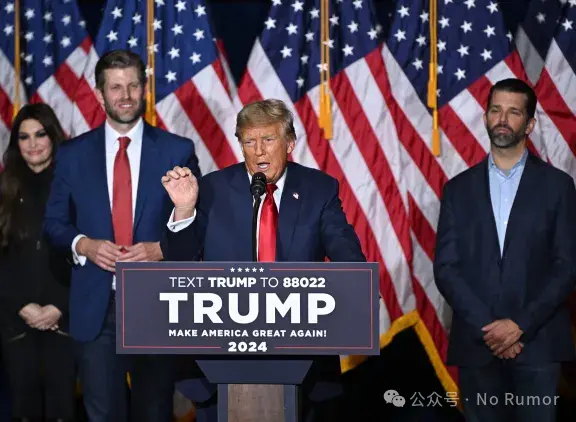
In September 2024, still the "former President of the United States," Donald Trump, along with his two sons Eric Trump (left) and Donald Trump Jr. (right), was promoting World Liberty Financial, as sourced from FORTUNE.
The cryptocurrency industry PAC invested nearly $120 million in congressional elections, helping to defeat critics of cryptocurrencies like Senator Sherrod Brown.
Trump's team raised at least $25 million from cryptocurrency-related donations. The entire industry rallied behind his campaign, while Trump promised to let "those who understand this industry, rather than those who hate it, make the rules."
Step 2: Land Grabbing, Quietly Building the Harvesting Machine
Just before the election in late August 2024, Trump announced that he and his sons were creating a cryptocurrency platform called World Liberty Financial.
At the same time, two key companies were quietly established: CIC Digital LLC (an affiliate of the Trump Organization) and Fight Fight Fight LLC. These two companies would control 80% of the upcoming $TRUMP token supply.
Step 3: Pre-Inauguration, Token Launch
On January 18, 2025, just as cryptocurrency elites gathered in Washington to celebrate Trump's victory at the "Crypto Ball" and party with Snoop Dogg and House Speaker Mike Johnson, Trump suddenly announced the launch of the TRUMP Meme Coin on Truth Social, shocking almost everyone present. A cryptocurrency entrepreneur who attended the event posted a video stating that almost no one knew about it in advance.
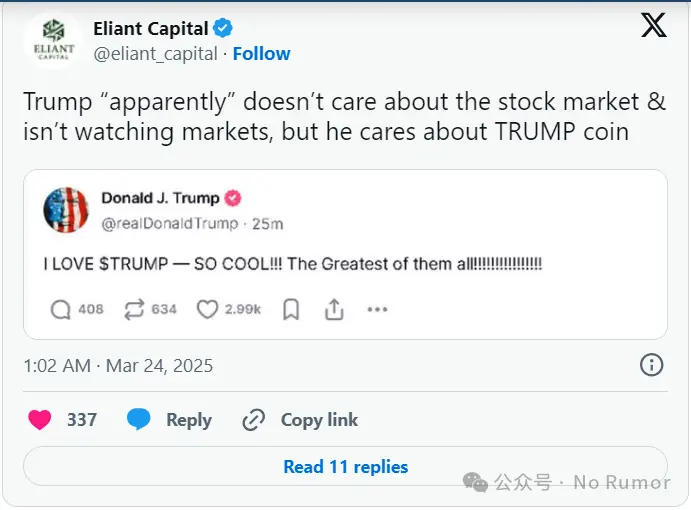
Trump posted on Truth Social: "I LOVE $TRUMP --- SO COOL!!! The Greatest of them all!!!!!!!!!!!!!!!!" After this post, the token price surged over 11% within an hour, rising from about $10 to $12.25.
The timing was "ingenious": As cryptocurrency journalist Zach Guzman pointed out, "Launching a token before officially becoming president is not that complicated for them. If they wait until after taking office to launch, claiming Trump profited from the presidency and violated the constitutional prohibition against bribery would be much easier."
Step 4: "Whales" Jump the Gun, Retail Investors Take the Hit
Bloomberg's analysis of millions of on-chain transactions showed that within the first 48 hours after the token launch, 21 "whale" accounts raked in $214.3 million in profits. One particularly aggressive wallet group known as "Cluster A" received $1.1 million in USDC stablecoin two hours before Trump's post and purchased 6 million $TRUMP tokens at $0.18 each within 90 seconds after the post, controlling 6% of the total token supply.
On January 19, when the TRUMP price soared to a historic high of $78, Cluster A sold 1.7 million tokens within three hours; another related wallet, B, sold 650,000 tokens in just three minutes.
Meanwhile, First Lady Melania Trump's MELANIA token was even more blatant: The Financial Times analyzed that 24 wallet addresses purchased $2.6 million worth of tokens just 2 minutes and 30 seconds before her post announcing the launch, then quickly sold them after the price surged—81% of the tokens were sold within 12 hours of the launch. These addresses collectively made about $100 million in profits.
Step 5: Retail Investors Flood In, Whales Harvest
For those who bought in only after the token price rose above $20, it was a gamble. Bloomberg's analysis showed that in the initial two days of trading, one buyer lost as much as $5 million, while another wallet made over $85 million. The difference in outcomes depended entirely on the timing of entry and trading frequency.
A forensic analysis commissioned by The New York Times concluded that 813,294 wallets lost $2 billion trading this token, while the president's company and its partners profited about $100 million from transaction fees. Fortune magazine noted, "Less than three weeks after its launch, the TRUMP Meme Coin created more losers than winners. For every dollar earned in transaction fees by the creators of Trump's cryptocurrency, investors lost $20."
NBC News reported, citing Chainalysis data, that since its launch in January, trading activity has generated about $324.5 million in transaction fee revenue for insiders. These fees were generated through the token's built-in mechanism— a certain percentage of each transaction automatically flows to a wallet controlled by the project team.
Step 6: Continuous Extraction, Dinner Bait
To stimulate the already plummeting token price, the Trump team launched a "Dinner Contest"—the top 220 investors by token holdings could dine with the president and tour the White House. Just two days after the announcement, this gimmick brought in nearly $900,000 in additional transaction fee revenue for insiders.
Final Result: 90% Plunge, Nightmare for 800,000 People
The token plummeted about 90% from its peak at launch on January 17. Melania Trump's Meme Coin fell by 99%. A self-identified Trump supporter who claimed to have lost money wrote on social media, "That token is a joke."
Cryptocurrency researcher Angela Walch incisively commented, "The cryptocurrency industry put a person in power, and his first act in office was to emphasize and exploit the 'money-grabbing' opportunities in the crypto space. It's simply embarrassing."
Even more concerning is that the Trump team controls 80% of the token supply, which will gradually unlock over three years. Once they start selling, it will inevitably lead to further price crashes, and retail investors will once again be left holding the bag.
04 Foreign Media Perspective: Unprecedented Corruption?
(1) "Worse than Watergate"
The New York Times' analysis article characterized the Trump family's cryptocurrency activities as "unprecedented" in American political history. The article noted, "Looking back at past government scandals—the corrupt aides around President Grant, the oil lease bribery in the Teapot Dome scandal during the Harding administration, even Nixon's Watergate—never has anyone so thoroughly blurred the lines between personal and governmental interests."
The article further analyzed, "World Liberty has become a powerful channel of influence: anyone—whether you, me, or a prince from the UAE—can make Trump wealthy by purchasing the tokens issued by the company. The key is this convenience. For those seeking influence, cash-filled briefcases and Swiss bank accounts have been replaced by crypto tokens that can be quickly transferred between wallets and exchanges."
(2) Congressional Investigations and Political Storms
On November 25, 2025, House Judiciary Committee Minority Leader Jamie Raskin released a significant report titled "Trump, Cryptocurrency, and a New Era of Corruption." The report pointed out that Trump and his family gained hundreds of millions of dollars through a network of cryptocurrency businesses, increasing their net worth by tens of billions—just in the first half of 2025, their cryptocurrency asset sales exceeded $800 million, with the value of their held crypto assets reaching $11.6 billion.
Congressman Raskin's language was severe: "Donald Trump has turned the Oval Office into the world's most corrupt cryptocurrency startup operation center, generating astonishing personal wealth for him and his family in less than a year. Meanwhile, Trump has been pardoning criminals who commit fraud through cryptocurrencies and dismantling regulations that protect legitimate American investors. We still do not know where all the money comes from, but the level of corruption seen within the White House has never been witnessed before in America."
Senators Elizabeth Warren and Jack Reed wrote to the Department of Justice and the Department of the Treasury, requesting an investigation into potential national security risks posed by WLF. They cited a report indicating that WLF had sold $10,000 worth of WLFI tokens to traders linked to North Korean state-sponsored hacking organizations. The letter warned, "This means that with every sale of governance tokens, three-quarters of the money goes directly to President Trump and his family, even when sold to entities associated with North Korea and Russia."
(3) Foreign Investment and Constitutional Crisis
PBS News particularly focused on the issue of foreign governments potentially funneling benefits to the president through cryptocurrencies. In May 2025, the UAE-based investment company MGX invested $2 billion in the cryptocurrency exchange Binance using WLF-issued USD1 stablecoins. Just two weeks later, the White House approved a plan to sell hundreds of thousands of the world's most advanced and scarce AI chips to the UAE, despite national security concerns.
The New York Times commented that this transaction "blurs the lines between private enterprise and government policy to an unprecedented degree." Ryan Cummings, director of the Stanford Institute for Economic Policy Research, stated, "If this is true, this is the largest public corruption scandal in American history, and the gap is staggering."
Former Obama administration White House ethics advisor Norm Eisen pointed out that the launch of the meme coin "represents the most serious conflict of interest in modern presidential history." Even some insiders in the cryptocurrency industry expressed criticism. Notable Bitcoin investor Eric Vorhees called the coin "stupid and embarrassing." Anthony Scaramucci, who served as White House communications director during Trump's first term, described it as "corruption on the level of Idi Amin," stating, "Now anyone in the world can basically click a few buttons to deposit money into the bank account of the President of the United States."
05 Regulatory Vacuum and Institutional Dismantling
Critics point out that the Trump family's ability to profit so brazenly from cryptocurrencies is closely tied to the systematic dismantling of regulatory mechanisms.
A House Democratic report detailed this process: The Trump administration disbanded the Justice Department's National Cryptocurrency Enforcement Team (NCET), repealed investor protection rules adopted during the Biden administration, and terminated federal investigations and enforcement actions against several cryptocurrency companies—including Coinbase, Gemini, Robinhood, Ripple, and Crypto.com, all of which had donated to the president or invested in his companies.
In April 2025, Trump pardoned Binance founder Changpeng Zhao, who had previously pleaded guilty to violating anti-money laundering laws in 2023 and served four months in prison. CBS's 60 Minutes investigation revealed that this pardon occurred after Binance provided crucial support to WLF—support that transformed WLF from a struggling startup into one of the largest stablecoin issuers.
Harvard Law School professor Lawrence Lessig warned that this pardon brought profound national security and governance risks: "Kidnapping is an accurate description of this relationship. Any ordinary American would understand why this is a corrupt relationship."
06 Wealth Rollercoaster: Prosperity or Disillusionment?
The Trump family's cryptocurrency wealth has experienced dramatic fluctuations. Bloomberg's latest analysis shows that due to the volatility in the cryptocurrency market, the family's wealth evaporated by about $1 billion in just a few months—from approximately $7.7 billion in early September to $6.7 billion.
The losses were most severe for the Trump Media & Technology Group (which owns Truth Social). The president's stake in the company has dropped by about $800 million since September. The approximately 11,500 Bitcoins held by the company were purchased when Bitcoin was priced around $115,000, resulting in a cumulative loss of about $25 million.
Eric Trump’s 7.5% stake in an American Bitcoin company saw its stock price drop by more than half since September, erasing over $300 million from the family's wealth. However, Eric Trump downplayed these losses, insisting that the market downturn represents a "great buying opportunity" for investors: "Those who buy at the lows and embrace volatility will be the ultimate winners."
Despite the dramatic fluctuations, cryptocurrencies have still brought enormous wealth to the Trump family. The Wall Street Journal estimated in September that cryptocurrencies have surpassed the real estate portfolio to become the Trump family's most valuable asset. NPR estimated that in the first year of Trump's presidency alone, his family earned over $1 billion from cryptocurrencies—far exceeding the income from other businesses (golf clubs and resorts at $33 million, Trump brand licensing at $23 million).
07 Conclusion: When the President Becomes the "Largest Token Holder"
The New York Times' commentary article summarizes this phenomenon from a historical perspective:
"In American political history, no president has intertwined national power, personal branding, and financial speculation into a global experiment like Trump. The combination of money and power is not new, but when this combination appears in the form of tokens, when the image of the head of state is minted into a tradable asset, when political influence can flow freely on the blockchain—what we face is no longer traditional corruption, but a systemic reconstruction."
The White House has repeatedly denied any conflicts of interest. Press Secretary Caroline Levitt stated in a statement, "The media's ongoing attempts to fabricate conflicts of interest are irresponsible… The president and his family have never participated in, and will never participate in, conflicts of interest."
However, for ordinary investors who suffered heavy losses in TRUMP coins and WLF investments, these justifications seem weak. As one investor said after the Alt5 Sigma deal, "I feel betrayed. The past three months have been a nightmare."
Regardless of how this cryptocurrency adventure ultimately concludes, it has already left an indelible mark on American political history—raising questions about the boundaries of power, conflicts of interest, and what challenges democracy will face when the president becomes the "largest token holder."
Main Sources
• PBS News: "Concerns Arise Over Trump Family's Cryptocurrency Connections" (November 2025)
• House Judiciary Committee Democratic Report: "Trump, Cryptocurrency, and a New Era of Corruption" (November 25, 2025)
• CNBC: "Senators Push for Investigation into Trump-Linked Cryptocurrency Sales to North Korea and Russia" (November 2025)
• The New York Times: Series of Investigative Reports on Trump's Cryptocurrency Empire
• NPR: "How the Trump Family Business Directly Benefits the President" (May 2025)
• Bloomberg, Fortune, Rolling Stone, and other related reports
 Risk warning Risk warning


Popular articles