HTX Research's latest report interpretation predicts the market: from structural dilemmas to the possibilities of attention economy infrastructure

 The Future of Prediction Markets and Attention Assets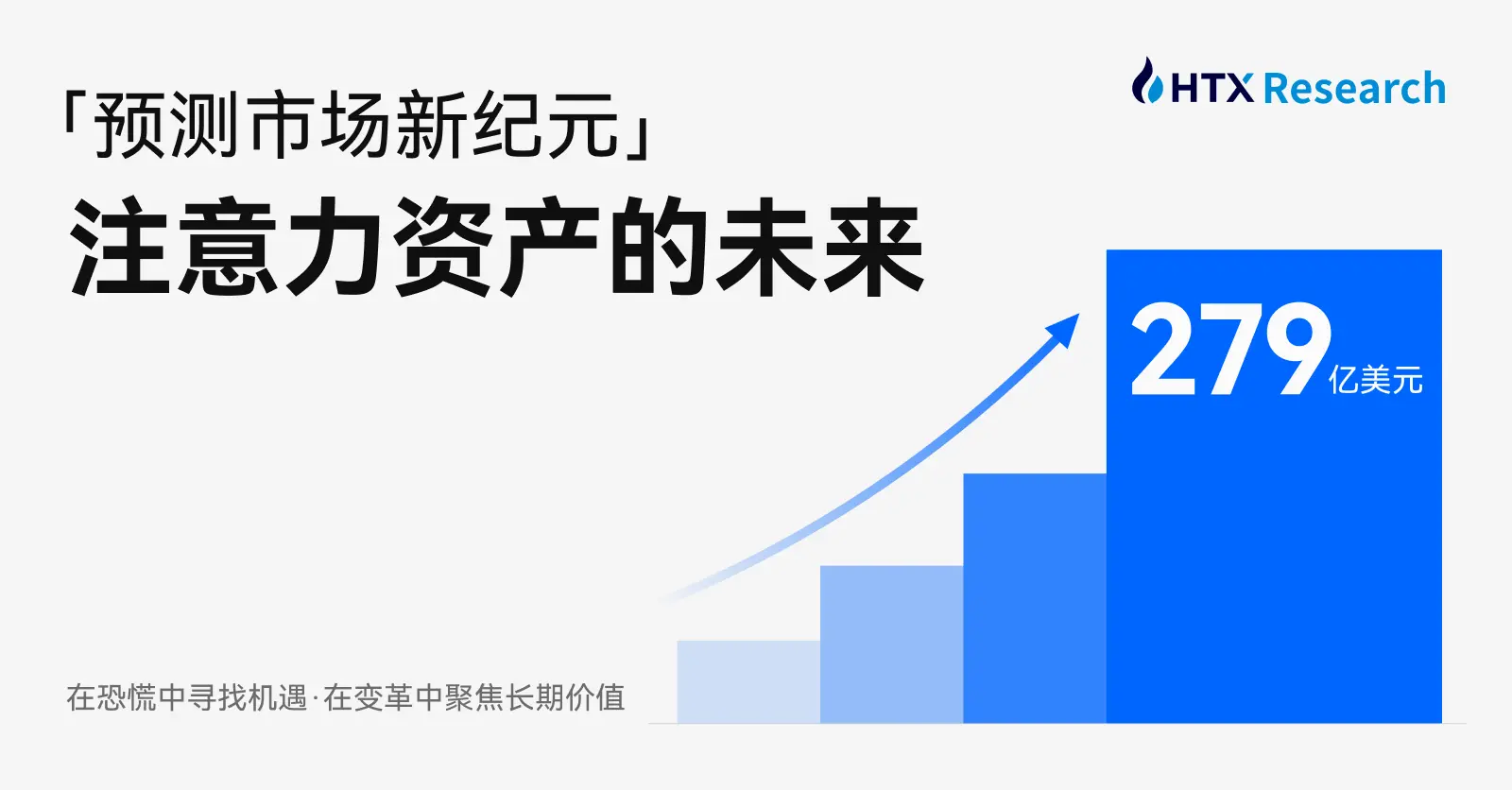
Recently, the exclusive research department of the cryptocurrency trading platform Huobi HTX, HTX Research, released a report titled “Prediction Markets: From Structural Bottlenecks to Infrastructure Revolution and the Future of Attention Assets”, which systematically analyzes the structural foundation, current development status, and potential paths for the transformation of prediction markets into attention assets. The report focuses on the structural constraints faced by prediction markets amid rapid growth, and whether prediction markets can become the core infrastructure for carrying attention assets.
New Forces of Attention Assets: Differences Between Prediction Markets and Memecoins
Prediction markets have seen significant growth over the past year. According to statistics, the cumulative trading volume of global prediction markets reached $27.9 billion in the first ten months of 2025, a 210% increase compared to 2024. Similar to Memecoins, prediction markets are also based on attention as their value foundation and attract a large amount of small capital, but the two represent completely different trading logics.
In prediction markets, traders can make decentralized layouts based on the information they possess and the structure of events, fully aware of their loss boundaries; the odds are public and transparent, making risks predictable. In low-volume events, small traders familiar with domain knowledge can even find arbitrage opportunities arising from information asymmetry.
The participation logic of Memecoins is entirely different. Taking Pump.fun as an example, of the 10,417 tokens created daily, 98.6% are identified by the report as manipulated projects, with an average lifespan of less than three months. In such a market structure, information is primarily concentrated in the hands of project creators, and price trends rely more on social dissemination and short-term emotions rather than event logic or probability judgment.
The probability curves of prediction markets also have social dissemination effects, but the driving forces behind them are event dynamics and market consensus, rather than mere narratives and FOMO. For ordinary traders, this means that the participation logic of prediction markets is closer to "information games," while Memecoins resemble "attention-driven random processes."
Behind Rapid Expansion: Still Fragile Infrastructure
Despite rapid growth, this has not provided a solid foundation for prediction markets, as their true operational methods still expose unresolved structural weaknesses.
Currently, prediction markets still rely on incentive subsidies to maintain liquidity; for example, some platforms need to invest tens of thousands of dollars daily for market-making during peak periods, and liquidity significantly weakens after subsidies decrease. Additionally, since the value of failed event contracts drops directly to zero, the market lacks a mechanism for sustained depth accumulation; the closer to settlement, the more advantageous informed traders become, leading market makers to bear greater risks.
In terms of user experience, the expression methods for events remain relatively singular, with insufficient market discovery, high entry barriers for event creation, and issues with oracle settlement rhythms collectively limiting scale expansion. Overall, although prediction markets demonstrate strong growth potential, their foundational structure is still in a phase of exploration and repair.
Innovative Breakthroughs in the Next Generation of Prediction Markets
In response to structural issues such as insufficient liquidity, limited market discovery, restricted expression capabilities, and challenges in oracle settlement, the industry is exploring new systematic solutions.
In terms of liquidity, Just-In-Time (JIT) mechanisms inject funds only when actual demand arises, improving capital utilization efficiency; continuous combination markets attempt to address the liquidity fragmentation caused by traditional event dispersion, allowing traders to express views within continuous price ranges.
Regarding expression capabilities, the industry is beginning to see various new prediction structures. From perpetual contracts built on prediction market data to binary options structures centered around short-cycle price fluctuations, and innovative mechanisms that trade "probability changes" themselves, prediction markets are gradually breaking through the original binary framework.
Distribution models are also transforming. The event trend charts and probability changes of prediction markets are naturally suited for social dissemination, with new platforms attempting to embed trading entry points into social networks, evolving prediction markets from traditional platform forms into a "financial format" that can spread naturally within information flows.
Although these innovations have not solved all structural problems at once, they demonstrate a clear direction for the prediction market ecosystem toward greater scalability.
Development Potential of Prediction Markets
HTX Research points out that attention assets are becoming the third major asset class after cash flow assets and supply-demand assets. Currently representative attention assets include BAT and KAITO. Data from Huobi HTX shows that BAT recorded an increase of over 30% in the past 30 days, while KAITO became a market hotspot in the first half of this year.
In addition to these projects, HTX Research believes that prediction markets have the potential to become the core pricing infrastructure for attention assets.
Currently, user-generated assets (UGAs) such as NFTs and creator tokens are often priced from scratch, making it difficult to reflect the true level of existing cultural influence or public attention. In contrast, multiple prediction events around the same topic naturally possess price, liquidity, and time dimensions, which can be aggregated into an "attention index."
This mechanism has three key features:
Higher manipulation costs: To influence the attention index, one must actually buy prediction events, incurring capital costs for manipulation.
Can reflect existing attention: There is no need to start from scratch; it can measure themes that already have attention, such as celebrities, sports achievements, and political events.
Bidirectional trading capability: Both the rise and fall of attention can be expressed in financial terms.
If this direction matures, prediction markets will no longer be merely tools for event settlement but may become a key foundational layer connecting culture, social interaction, and finance, providing a pricing basis for new derivatives such as Attention Perpetual Contracts. This means that the mission of prediction markets will expand from "predicting event outcomes" to "measuring and pricing attention itself," thus playing a more strategic role in the future digital economy system.
Conclusion
Prediction markets are at a critical juncture, transitioning from a growth phase to a structural upgrade phase. In the face of their own structural bottlenecks, the industry is continuously seeking breakthroughs through innovations in liquidity mechanisms, expression methods, and distribution models. Meanwhile, as the concept of attention assets becomes clearer, the role that prediction markets carry is also changing—they may become one of the underlying infrastructures at the intersection of culture and finance in the future.
Compared to the emotion-driven Memecoin ecosystem, prediction markets, with mechanisms centered on probability and information, possess stronger sustainability and deeper value expression capabilities. As the structure gradually improves, their position within the digital asset system is expected to continue to rise.
About HTX Research
HTX Research is the exclusive research department under Huobi HTX, responsible for in-depth analysis across a wide range of fields, including cryptocurrencies, blockchain technology, and emerging market trends, writing comprehensive reports, and providing professional assessments. HTX Research is committed to providing data-driven insights and strategic foresight, playing a key role in shaping industry perspectives and supporting informed decision-making in the digital asset space. With rigorous research methods and cutting-edge data analysis, HTX Research consistently stands at the forefront of innovation, leading the development of industry thought and promoting a deeper understanding of the ever-changing market dynamics. Visit us.
If you wish to communicate, please contact research@htx-inc.com.
 Risk warning Risk warning




Popular articles