Why is Dragonfly the biggest winner of this cycle?
 Core Viewpoint

 When many native crypto VCs indulge in narrative-driven and short-term speculation, they face a dilemma of mismatched value capture and risk-taking. The trading instincts, secondary market hedging capabilities, and emphasis on stablecoin cash flow demonstrated by Dragonfly precisely return to the old rules of long-cycle dollar funds.
Author: Zhou, ChainCatcher
In the past year, beneath the fluctuating surface of the cryptocurrency market and the rapid changes in narratives, there are only a handful of projects that have truly been validated and generated value.
However, when we put together the names of the most talked-about projects recently, whether it's the high-performance public chains MegaETH and Monad, the popular stable yield protocol Ethena, or the pioneering prediction market Polymarket, the investment fund Dragonfly is almost always present in their early or key investment lists.
As a seasoned investor in the industry once said, Dragonfly is the biggest winner in this cycle.
Investment Profile and Background of Dragonfly: Driven by Trading Instinct
Dragonfly is a venture capital fund focused on the cryptocurrency space, founded by Feng Bo. As an early investor, Feng Bo has a deep understanding of exchange operations, liquidity needs, and trading scenarios, which gives Dragonfly a financial perspective from the very beginning. He has often mentioned that blockchain should not be simply understood as "a faster internet," but rather as a set of tools for rebuilding the financial stack.
Dragonfly's managing partner Haseeb Qureshi has repeatedly emphasized cross-cycle issues. He believes that the real tough nuts to crack are not the rotation of tracks or narratives, but those systemic pain points that repeatedly emerge across bull and bear markets:
How can performance bottlenecks be overcome? Can on-chain liquidation mechanisms withstand extreme pressure? Does the yield structure have long-term sustainability? How can data be transformed into tradable financial assets? How can institutional funds safely enter the market in the absence of systematic risk hedging?
These questions can easily be overshadowed by the fervent narratives of a bull market, only to be brought back to the table when the market returns to calm.
Recently, Haseeb Qureshi pointed out in “Defending Exponential Growth” that the market often misjudges the value of Ethereum, Solana, and the new generation of L1s (like Monad and MegaETH) because it falls into the "error of linear thinking": they use traditional models such as P/E ratios and revenue metrics to evaluate blockchains, treating exponentially growing companies as stable businesses.
He firmly believes that the pricing logic of L1 projects is similar to biotechnology: with only a 1% to 5% chance of becoming the next Ethereum or Solana, it is rationally sufficient to support their multi-billion dollar valuations (i.e., "probability premium"). Therefore, long-term conviction is the true advantage in crypto investment that most people have forgotten.
Looking back at Dragonfly's investment list over the past three years, a complete chain from underlying infrastructure to upper-layer applications can be clearly outlined:
- Public chains and scalability: Monad (2023 seed round), MegaETH (2024), Prodia (2024), Caldera (2023), etc.;
- Trading infrastructure: Lighter (2024), Level (2024), Orderly (2023 expansion), Bitget (2023 strategic round), etc.;
- Stable assets and yields: Ethena (2023-2024 multiple rounds), Pendle (2023), etc.;
- Data and tools: Kaito (2023 seed/A round), Polymarket (2024-2025 two rounds), etc.
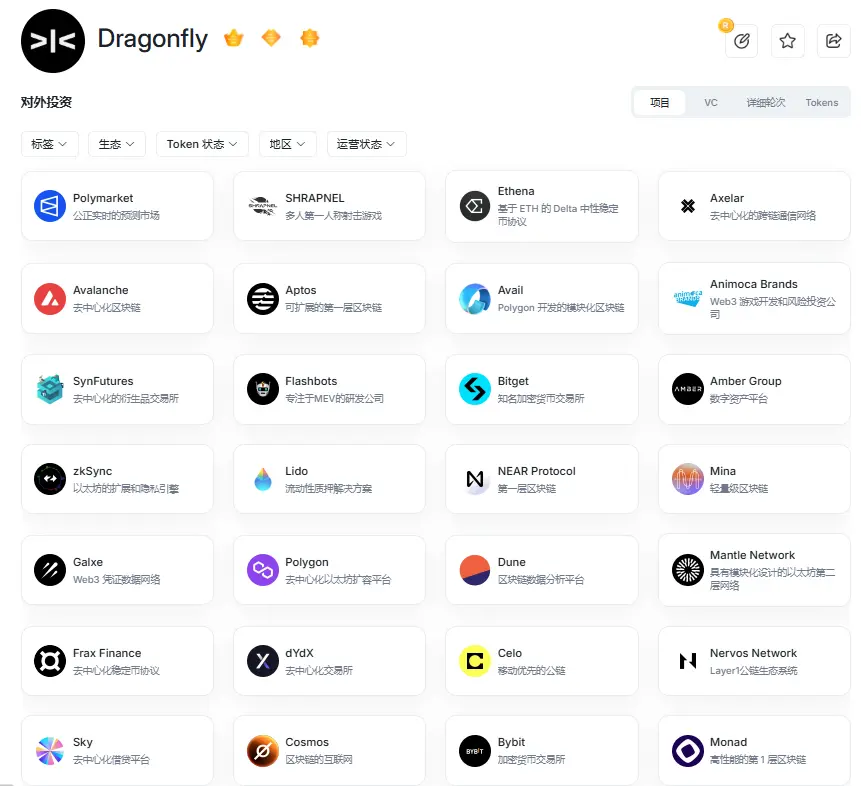
This is not a scattergun strategy, but a clear preference: prioritizing bets on long-term gaps across key links, and then searching for critical pieces in each link.
This deep understanding is directly reflected in Dragonfly's investment preferences; they seem to rarely chase projects that can achieve multiple growth in the short term, but rather care more about whether this mechanism or product will still be valued by the industry five or even ten years later.
Core Differentiation Advantages and Challenges
The underlying logic of Dragonfly's success is supported by two mutually reinforcing pillars of differentiation.
First, Dragonfly has a strong secondary market trading team, which fundamentally distinguishes it from many purely primary market VCs. This layout began as early as 2019, managing over $1 billion in liquidity, creating a moat for its investment decisions. The L2 team can capture the real trading sentiment, capital flow, and narrative rotation in the market earlier; their sensitivity to liquidity, liquidation pressure, and other indicators far exceeds that of traditional primary VCs, allowing them to feed real-world data back into primary decision-making. Haseeb Qureshi has publicly stated that the secondary market is not an exit, but a forward base for investment.
Secondly, Dragonfly invests in several trading platforms like Bitget and Bybit, with the purpose not only in the equity appreciation of the exchanges themselves but also in transforming them into amplifiers for the distribution of stable assets and liquidity channels.
Through strategic layouts in trading platforms, Dragonfly has successfully integrated its supported stable assets (such as Ethena's USDe) into the exchange system. Once stable assets can be used as collateral or the underlying asset for trading pairs on exchanges, it will greatly stimulate user demand and purchases, rapidly expanding the issuance scale of stablecoins.
Indeed, the best time to evaluate a VC is not during a bull market, but when everyone is hesitant to invest. Over the past year, the cooling of the crypto primary market has been evident. According to RootData statistics, there have been 1,058 financing events recorded in 2025 so far, a 46% decrease from the peak of 1,962 in 2022. In an environment where sentiment is retreating, most funds are actively slowing down, and some capital has simply shifted to AI or traditional technology.
In this context, competition for quality projects has intensified. Dragonfly not only needs to compete with well-funded veteran VCs like Paradigm for early star projects but also faces the liquidity impact from traditional financial investment giants entering the space; additionally, leading exchanges are also laying out vertical tracks through their own investment and incubation departments. This poses severe challenges to Dragonfly's project acquisition, ecosystem control, and long-term holding capabilities.
Moreover, as cutting-edge technology fields like AI deeply integrate with crypto, Dragonfly, as a purely crypto-focused investment institution, faces a key challenge: whether its professional depth will be recognized by founders when acquiring cross-border quality projects.
Conclusion
Previously, ChainCatcher interviewed several early crypto investors, mentioning in “The New Cycle and Old Rules of Crypto VC” that when many native crypto VCs are immersed in narrative-driven and short-term speculation, they face the dilemma of mismatched value capture and risk-bearing. The trading instinct, secondary market hedging capability, and emphasis on stablecoin cash flow demonstrated by Dragonfly return to the old rules of long-cycle dollar funds: meticulous management of systemic risks and the search for sustainable revenue models with endogenous growth momentum.
In this light, Dragonfly's ability to become a winner in this cycle is a microcosm of fund managers returning to traditional rules in the new crypto cycle. However, in the face of competition from traditional giants, traditional financial investment behemoths, and leading exchanges, as well as the professional challenges brought by the integration of crypto and cutting-edge technology, Dragonfly must think about how to extend this trading instinct to cross-domain technological infrastructure to maintain its long-term competitive advantage.
 Risk warning
 Risk warning