Raising another $15 billion, a16z is redefining the strategic position of crypto in the United States
 Core Viewpoint

 In a16z's logic, cryptocurrency is not only a financial innovation tool but also a technological system concerning value, ownership, and coordination mechanisms, as well as a strategic technology that impacts U.S. national interests.
Author: Hu Tao, ChainCatcher
On January 9, top VC firm Andreessen Horowitz (a16z) announced the completion of its largest fundraising effort to date: raising over $15 billion for multiple new funds throughout 2025, accounting for more than 18% of the total U.S. venture capital for that year.
Crypto is no longer singled out, but it has not been marginalized
These funds include U.S. Vitality ($1.176 billion), Apps ($1.7 billion), Biohealth ($700 million), Infrastructure ($1.7 billion), Growth ($6.75 billion), and other venture capital strategies ($3 billion). Notably, there is no dedicated crypto fund included, and the last time a16z announced a crypto fundraise was in May 2022, amounting to $4.5 billion, with a total fundraising scale of $8.1 billion across five funds.
It is worth noting that in the official announcement of this financing, a16z devoted considerable space to describing the national narrative and values of the United States, stating, "Among all countries, the U.S. provides the most stable opportunity for people to pursue a better life. Among all systems, the U.S. system offers the most stable opportunities. As a result, over the past 250 years, as the U.S. has risen in the world, the number of people gaining opportunities has exceeded any period in history. This has greatly improved the human condition."
At the same time, a16z also deeply binds its interests with national interests, stating, "If we cannot push national policy in the right direction, the U.S. is likely to lose its position as a global technology leader. Trends in artificial intelligence and cryptocurrency have already shown signs of this. If the U.S. declines in global technology leadership, other fields will soon follow suit. As a leader in U.S. venture capital, the fate of new technologies in America is partly in our hands. The technology sectors we invest in are vibrant, innovative, and face intense competition with China."
Such statements occupy more than half of the announcement, reflecting a16z's choice to firmly align with the U.S. Trump administration in the midst of fierce geopolitical competition, attempting to convince the U.S. government and people that a16z is the best vehicle to defend their collective interests.
Moreover, a16z has also closely linked the narrative of crypto with U.S. national interests in this process. a16z states that their mission is to ensure that the U.S. maintains a dominant position in the technology sector for the next hundred years, starting with winning the future key architectures—artificial intelligence and cryptocurrency. Secondly, these technologies will be applied to drive human prosperity in key areas: biology, health, defense, public safety, education, and entertainment. Ultimately, the U.S. government will adopt these technologies to defend and promote American interests.
In the various segments mentioned by a16z, AI and crypto are listed separately and hold a prerequisite position. This means that although a16z has not launched a dedicated crypto fund this time, it still considers crypto as one of its core strategies.
In its logic, crypto is not only a financial innovation tool but also a technological system concerning value, ownership, and coordination mechanisms, as well as a strategic technology that impacts U.S. national interests. If this system ultimately matures, its influence will far exceed the crypto market itself and may even touch the financial and governance structures of the coming decades.
It is under this judgment that a16z continues to increase its investment in institutional building, compliance pathways, and policy levels, rather than merely staying at the project investment level.
Firm Investment and Optimism in Crypto
In the currently bleak primary market of the crypto industry, most VCs have significantly reduced their frequency of investments, with only 15 firms making more than 20 investments annually, and a16z is one of the most active among them.
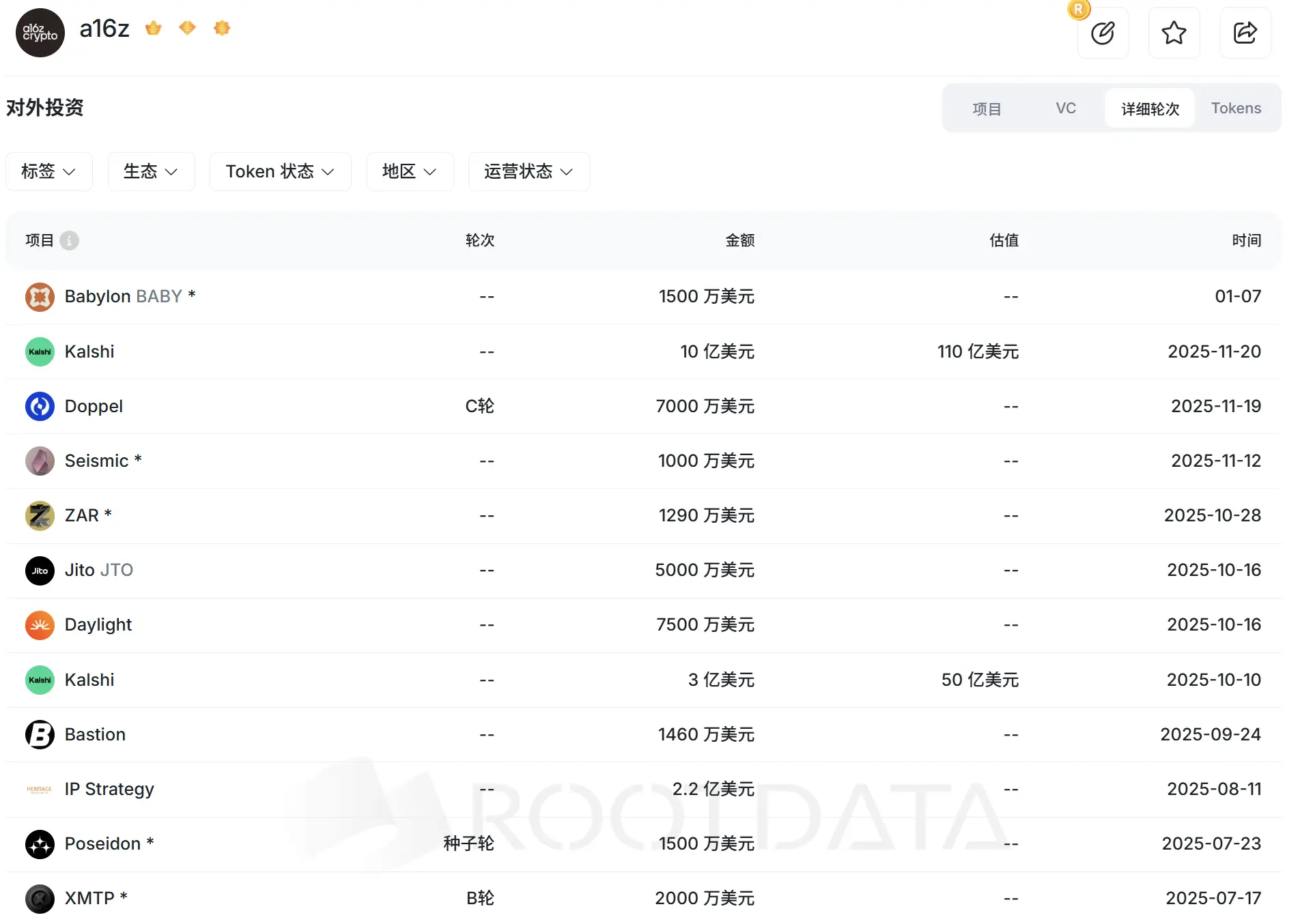
a16z recent investments Source: RootData
According to RootData, in the past year, investments led by a16z Crypto and a16z CSX totaled 49, ranking second among all investors, only behind Coinbase Ventures. Among these, the number of leading investments reached 28, surpassing all crypto VCs.
At the same time, a16z is also expanding globally. In December 2025, a16z Crypto announced the opening of an office in Seoul, South Korea, hiring Monad's Asia-Pacific head, SungMo Park, as its GTM head for the Asia-Pacific region. Through this office, a16z plans to expand its business layout in Asia and enhance new capabilities to support local cryptocurrency companies.
The ongoing investment in funds and personnel also confirms a16z's continued commitment to the crypto field. In terms of industry narrative and belief, a16z has also been vocal, striving to inject more confidence into the market.
For example, a16z crypto engineering partner Jeremy Zhang recently stated that as funding channels mature, digital dollars can directly connect to local payment systems and merchant tools, leading to new transaction models. Workers can receive cross-border real-time payments. Merchants can accept global dollars without a bank account. Applications can settle with users instantly anytime and anywhere. Stablecoins will transition from a niche financial tool to the foundational settlement layer of the internet.
a16z Crypto general partner Ali Yahya believes that privacy will be the most important moat in the cryptocurrency field this year, a key factor in the global financial shift to on-chain, and an element that almost all existing blockchains lack. Once users join a privacy chain, they are unlikely to switch easily, thereby reducing the risk of information leakage. This creates a winner-takes-all situation. Since privacy is crucial for most practical application scenarios, a few privacy chains could dominate most of the cryptocurrency market.
Beyond positive judgments, there are also warnings. a16z Crypto general partner Arianna Simpson stated that currently, aside from stablecoins and core infrastructure, most well-performing crypto companies are transitioning to trading platforms, and this homogenized competition will weaken the market attention of most companies, with only a few winners emerging. Founders who quickly shift to trading may miss opportunities to build more defensive and sustainable businesses.
At the same time, a16z is also one of the important channels for communication between the U.S. government and its regulatory bodies and the crypto industry. On one hand, it has repeatedly visited U.S. government executives to advocate for as open and lenient regulatory policies as possible for the crypto industry; on the other hand, it continuously conveys regulatory signals to the industry.
"The regulation of cryptocurrency market structure—government is closer than ever to passing legislation—aims to eliminate all sorts of distortions this year. If passed, this legislation will encourage transparency, establish clear standards, and replace 'enforcement roulette' with clearer, more structured financing, token issuance, and decentralized pathways. After GENIUS, the number of stablecoins has exploded; legislation around cryptocurrency market structure will bring more significant changes, but this time the changes will target the entire network," a16z Crypto's general counsel Miles Jennings recently stated.
In August last year, a16z and the DeFi Education Fund also applied to the U.S. Securities and Exchange Commission (SEC) for a "safe harbor" provision for blockchain technology. In short, this means that DeFi projects do not need to register as brokers for their applications.
All these efforts ultimately serve a16z's strategic advantage in terms of return on interests. As Packy McCormick, founder of Not Boring, commented, a16z bets that it can help make that future bigger and better than it might otherwise be through policies, platforms, and power, allowing its portfolio companies to win in the process.
This round of fundraising by a16z will not directly lead to a reversal of sentiment in the crypto market, nor can it be seen as the starting point of a new bull market. Instead, it is more like a signal: the crypto industry is entering a phase of deflation and disillusionment.
When the market no longer pays a premium for the "crypto narrative" itself, both inside and outside the industry begin to return to a more fundamental question: can crypto and Web3 truly become the foundation of the next generation of social and financial systems?
a16z clearly still believes the answer is affirmative—only this time, they tightly bind this belief with the U.S. national narrative and national competitiveness, supported by massive capital, global layout, policy lobbying, and continuous vocalization. In an era of increasingly fierce geopolitical competition, a16z's actions are not only a continuation of investment strategy but also a distinct declaration of technological politics.
 Risk warning
 Risk warning




Popular articles