Morning News | Binance Wallet web version launches three new AI features; BitGo listed on the New York Stock Exchange last night; Superstate completes $82.5 million Series B funding;

 Overview of Important Market Events on January 22
整理:ChainCatcher
Important News:
- U.S. State Department Responds to Trump's Desire to Block China from Entering the Cryptocurrency Space: China Actively Participates in the Formulation of International Financial Rules
- BitGo to Go Public on NYSE Tonight, Becoming the First Cryptocurrency IPO of 2026
- CZ: Optimistic About Tokenization, Payments, and AI in the Future
- Binance Wallet Web Version Launches Three New AI Features
- On-chain IPO Platform Superstate Completes $82.5 Million Series B Financing, Led by Bain Capital Crypto
- Coinbase Establishes Independent Advisory Committee on Quantum Computing and Blockchain to Address Future Quantum Threats
- Goldman Sachs Bullish on Gold Again: Raises Year-End Target to $5,400, Sees Potential Above $7,000
What Important Events Happened in the Past 24 Hours?
Trump: Europe Will Face Massive Retaliation if It Sells U.S. Bonds and Other Assets
According to ChainCatcher and Jin10 reports, U.S. President Trump stated that if Europe sells U.S. bonds and other assets, it will face massive retaliation.
Coinbase Establishes Independent Advisory Committee on Quantum Computing and Blockchain to Address Future Quantum Threats
According to ChainCatcher, Coinbase announced the establishment of an independent advisory committee on quantum computing and blockchain to address future quantum threats. The committee brings together world-renowned experts to assess the impact of quantum computing on the blockchain ecosystem and provide clear, independent guidance to the broader community. The committee will publish a position paper on quantum risks, offering defense advice for developers and institutions, and providing real-time analysis on technological breakthroughs.
Coinbase stated that the committee is part of its post-quantum security roadmap, which also includes updating Bitcoin address handling, internal key management systems, and advancing support for post-quantum signature schemes like ML-DSA in multi-party computation (MPC) systems. The committee is expected to release its first position paper on quantum risk assessment and resilience building roadmap early next year.
Committee members include Scott Aaronson, Director of the Quantum Information Center at the University of Texas at Austin; Dan Boneh, Co-Director of the Blockchain Research Center at Stanford University; Justin Drake, Researcher at the Ethereum Foundation; Sreeram Kannan, Founder of EigenLayer; Yehuda Lindell, Chief Cryptographer at Coinbase; and Dahlia Malkhi, Expert in Distributed Systems at the University of California, Santa Barbara (UCSB).
According to ChainCatcher and Cointelegraph reports, the on-chain IPO issuance platform Superstate has completed $82.5 million in Series B financing, led by Bain Capital Crypto and Distributed Global, with participation from Haun Ventures, Brevan Howard Digital, Galaxy Digital, Bullish, ParaFi, and several other cryptocurrency-focused investors.
Superstate will further enter the on-chain capital market, leveraging blockchain technology to innovate the way companies raise funds and go public.
Musk: X Will Upgrade AI Recommendation System, Ads Will Be Based on User Interests
According to ChainCatcher, Musk stated, "X's AI recommendation system will become outstanding by mid-year and reach an amazing level by the end of the year.
Moreover, ads on X will push content that users are genuinely interested in, rather than irrelevant junk ads."
South Korean Prosecutors Lose Large Amount of Seized Bitcoin, Losses May Reach $48 Million
According to ChainCatcher and Ohmynews reports, the Gwangju District Prosecutor's Office in South Korea discovered a significant amount of Bitcoin related to criminal cases missing during a routine check of seized assets, with estimated losses reaching hundreds of billions of Korean won (internal rumors mention about 70 billion won, approximately $48 million).
It is reported that the prosecutors stored Bitcoin-related passwords and other information on mobile storage devices, and the loss may have occurred during the inspection due to mistakenly accessing a so-called "fraud website." The Gwangju District Prosecutor's official response to the matter was "unable to confirm." An internal investigation has been initiated.
Binance Wallet Web Version Launches Three New AI Features
According to ChainCatcher, the Binance Wallet web version has launched three AI features aimed at helping users identify emerging narratives and understand market trends. Among them, the "Social Hype" feature ranks the popularity of BSC, SOL, and Base network tokens by analyzing social data, including a hype leaderboard, real-time social attention distribution, and short-term social activity growth rankings.
The "Topic Rush" feature highlights emerging narratives through AI-generated topic cards and categorizes topics based on historical peak capital inflows into early (below $1,000), rising ($1,000 to $20,000), and viral (above $20,000) stages, while supporting quick purchase and bulk trading strategies.
The "AI Assistant" feature provides information summary components for BSC, SOL, and Base network tokens, covering narrative detection, X platform sentiment insights, narrative scoring, and key event timelines, which users can add to the modular layout of the web version for continuous viewing.
BitGo to Go Public on NYSE Tonight, Becoming the First Cryptocurrency IPO of 2026
According to ChainCatcher, cryptocurrency custody company BitGo Holdings will officially list on the NYSE on January 22 (Thursday) Eastern Time, becoming the first cryptocurrency company to go public in the U.S. in 2026. The stock is priced at $18 per share, higher than the previously announced range of $15 to $17, giving it a market value of approximately $2.1 billion. The issuance is led by Goldman Sachs and Citigroup.
BitGo is publicly selling 11.026 million shares, with additional shareholders selling about 795,200 shares. Financial data shows that the company's revenue for the first nine months of 2025 was $10 billion, with a net income of $8.1 million. CEO Mike Belshe will maintain control of the company with a 56% voting power after the IPO. Currently, BitGo is also the custodian and infrastructure provider for the stablecoin USD1 issued by World Liberty Financial.
According to ChainCatcher, the public offering activity of the Solana ecosystem leverage prediction market platform Space has sparked serious controversy. The project's previously set fundraising target was $2.5 million, but the actual amount raised reached $20 million. In response to community concerns about the excess fundraising, the project team unilaterally redefined the rules, arguing that $2.5 million was merely a "soft cap" rather than a "hard cap," and announced that it would only refund $7.3 million, forcibly retaining most of the excess funds.
The team further defended that the original amount could only sustain operations for a few months and was insufficient to support the multi-year construction of the leverage prediction market infrastructure. This arbitrary change in fundraising limits after the fundraising completion, deviating from initial commitments, has been widely criticized by the community as lacking contractual spirit and disregarding investor rights.
CZ: Optimistic About Tokenization, Payments, and AI in the Future
According to ChainCatcher, Binance founder CZ spoke at the "Financial New Era" panel discussion at the World Economic Forum in Davos, stating that the overall scale of trading platforms has surpassed last year. Currently, the cryptocurrency industry has two mature sectors: trading platforms and stablecoins, and he is optimistic about three new directions for the future:
First, tokenization is a very important direction. By tokenizing certain assets, governments can more efficiently address financial issues, enhance the operational efficiency of the financial system, and thereby promote the development of related industries and trading markets.
The second is payments. In the past, we have tried cryptocurrency payments, but frankly, not many people actually used them. However, there is a trend emerging: traditional payment methods are integrating with cryptocurrency technology. For example, users complete payments using cards like Visa and Mastercard, funds are deducted from their accounts, and merchants receive fiat currency, while settlement and bridging occur through stablecoins and blockchain behind the scenes. This model is gradually being implemented and will definitely develop in the future.
The third direction is artificial intelligence (AI). He believes that the "native currency" of AI Agents should naturally be cryptocurrency, and blockchain is currently the most suitable native technology interface for AI Agents. Today's AI is not yet a true Agent; they do not book flights, reserve restaurants, or complete payments directly; but once AI truly possesses the ability to act and transact, cryptocurrency will become its most natural and native method of payment and settlement.
According to ChainCatcher, VanEck Digital Asset Research Director Matthew Sigel stated on X that VanEck will participate in BitGo's public offering, believing that BitGo is one of the few publicly listed cryptocurrency-related companies whose revenue growth may exceed 50% in the disappointing cryptocurrency market of 2025.
At the same time, they expect BitGo's growth momentum to be less strong than Coinbase's, but revenue is still expected to grow by 26% by 2028. This could enable the company to achieve over $400 million in revenue and over $120 million in EBITDA by 2028. Therefore, they estimate BitGo's fair market value to be $2.4 billion (approximately $21 per share), representing a 30% upside potential from the midpoint of the issuance price range.
In a more optimistic scenario, they believe BitGo's fair market value should exceed $3 billion, with a 12-month target price reaching $26.50 per share, about 65% higher than the midpoint of the price range.
Goldman Sachs Bullish on Gold Again: Raises Year-End Target to $5,400, Sees Potential Above $7,000
According to ChainCatcher, Goldman Sachs has significantly raised its gold price expectations, increasing the target for gold prices at the end of 2026 from $4,900 to $5,400 per ounce. Goldman pointed out that the continued buying by private investors and central banks is driving up competition for limited gold supplies, expecting an average monthly purchase of about 60 tons by central banks this year, while gold ETF holdings are also expected to rebound in the context of Federal Reserve rate cuts.
Against the backdrop of multiple institutions turning optimistic, gold prices have surpassed $4,800 per ounce, reaching a historic high. A survey by the London Bullion Market Association (LBMA) shows that most analysts expect gold prices to reach $5,000 this year.
More aggressive predictions come from ICBC Standard Bank, whose commodity strategist believes that gold prices could rise to $7,150 in extreme scenarios. Institutions generally believe that geopolitical tensions, declining real interest rates, and the trend of "de-dollarization" are continuously strengthening gold's position as the ultimate safe-haven asset globally.
Mask Network Founder Discloses He Is a Minor Shareholder of Neynar, the Acquirer of Farcaster
According to ChainCatcher, Mask Network founder Suji Yan commented on Neynar's acquisition of Farcaster on X, stating: "More robust competition is beneficial. I did hear some rumors earlier, but I never verified them with the Neynar team. We should strengthen cooperation and sincerely congratulate the Neynar team. To disclose, I am a minor shareholder of Neynar, and we are using Neynar's software and technology. They are a very outstanding group of people."
Previous ChainCatcher News reported that Aave founder Stani stated that the governance rights of the social protocol Lens will be transferred to the Mask team, while the original team will serve as technical advisors.
UBS CEO: Blockchain Is the Future of Traditional Banking, Integration Is Inevitable
According to ChainCatcher, UBS CEO Sergio Ermotti stated at the World Economic Forum in Davos, Switzerland this week that blockchain is the future of traditional banking, and the two will integrate.
In 2018, he stated that blockchain was almost a prerequisite for companies to remain competitive, and now asserts that integration is inevitable. He predicted that blockchain would change the industry's cost structure within 5-10 years, and this timeline is approaching.
Ermotti's remarks align with those of Fidelity CEO Abigail Johnson. Johnson criticized traditional financial underlying technologies as primitive and concerning last December, stating that the existing system is built on a complex reconciliation process network based on primitive technologies.
According to ChainCatcher and Jin10 reports, U.S. President Trump stated at the Davos Forum that the U.S. must take measures to prevent China from interfering in the cryptocurrency space to maintain its leading position in the field.
In response, Chinese Foreign Ministry spokesperson Guo Jiaqin stated at a regular press conference on January 22 that China has always actively engaged in multilateral and bilateral monetary and financial cooperation, participated in global macro policy coordination and the formulation of international financial rules, and suggested that specific issues be directed to the relevant Chinese authorities for inquiries.
Meme Popularity Rankings
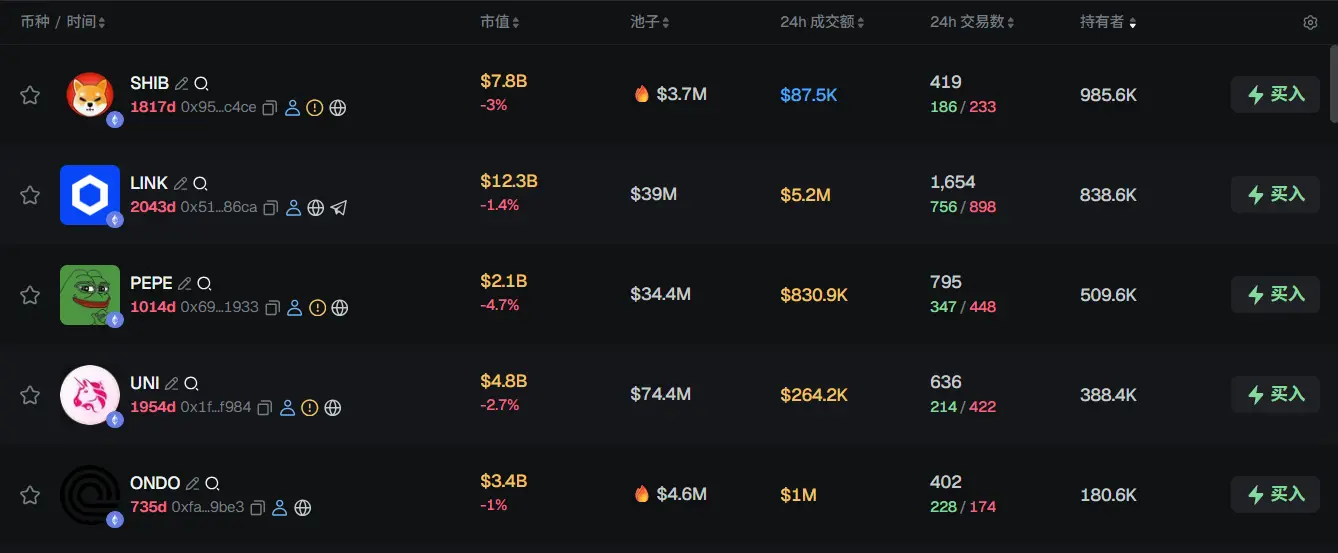
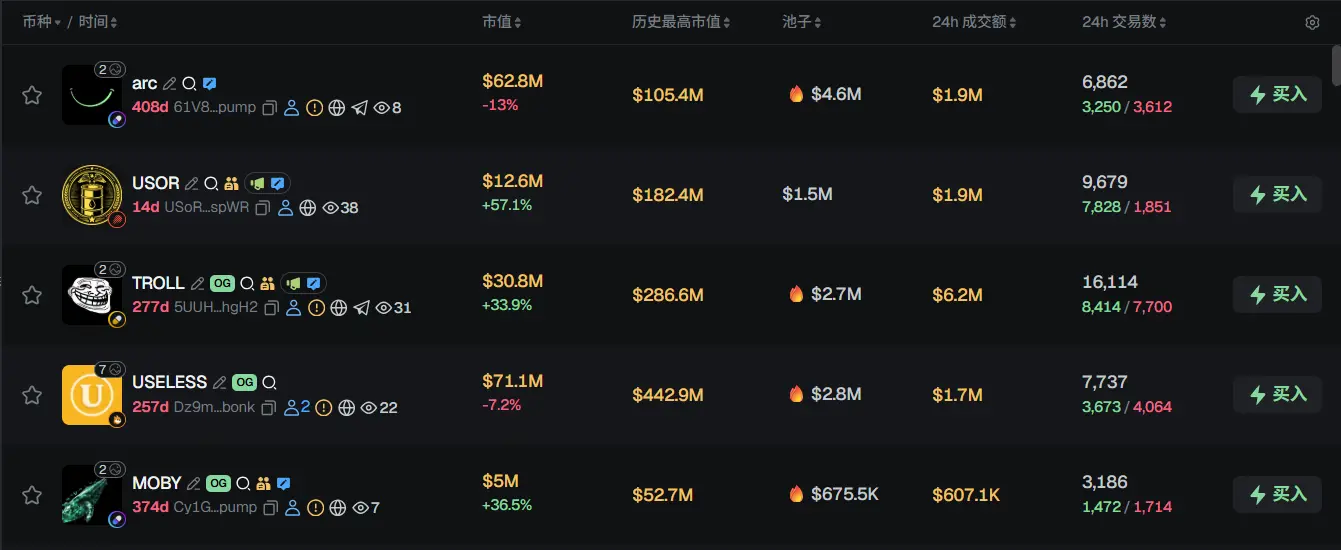
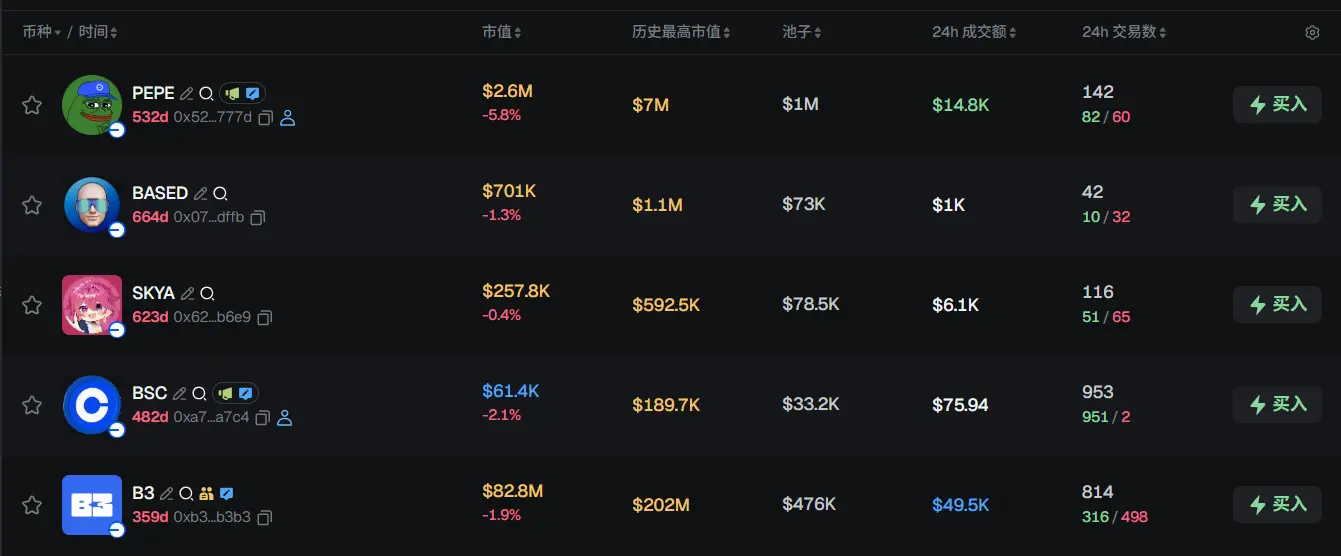
According to the meme token tracking and analysis platform GMGN, as of January 23, 09:00,
The top five popular tokens on ETH in the past 24 hours are: SHIB, LINK, PEPE, UNI, ONDO
The top five popular tokens on Solana in the past 24 hours are: arc, USOR, TROLL, USELESS, MOBY
The top five popular tokens on Base in the past 24 hours are: PEPE, BASED, SKYA, BSC, B3
What Are Some Noteworthy Articles to Read in the Past 24 Hours?
Pantera Capital: Outlook for the Cryptocurrency Market in 2026
2025 is not a year where cryptocurrency market returns are primarily driven by fundamentals. Macroeconomic factors, positioning, capital flows, and market structure are the dominant driving forces—especially for assets outside of Bitcoin.
Reviewing the major macroeconomic and policy turning points of this year helps to understand why market movements feel so discontinuous.
"Lucky Big Player" Hunting Quantitative Robots
In today's stock market, where quantitative trading is all the rage, most people believe these cold algorithmic robots are the ruthless harvesters of Wall Street, continuously extracting the hard-earned money of retail investors who fall victim to emotional misjudgments or information asymmetry at millisecond speeds.
However, in the past 48 hours in an emerging market, several top quantitative robots with nearly perfect return curves collectively broke down, while a mysterious account named a4385 raked in $280,000 from it.
This market is called the prediction market, and a trader named a4385 showcased a meticulously planned hunt against quantitative robots to the world.
Decentralized social protocol Farcaster announced today that Neynar, as a major infrastructure provider, will acquire Farcaster. Farcaster co-founder Dan Romero stated that in the coming weeks, ownership of the protocol contracts, codebase, Farcaster applications, and AI token issuance platform Clanker will be transferred to Neynar.
Romero stated, "Rish, Manan, and the Neynar team have been building on Farcaster from the beginning, and we believe they are the right choice to take over the leadership of Farcaster."
Romero and co-founder Varun Srinivasan will exit daily operations to pursue new ventures. Both are former executives at Coinbase and launched the protocol in 2020.
This article outlines 26 opportunities in key areas for 2026.
These opportunities encompass all user systems, globally accessible markets, entertainment built on new financial primitives, and the infrastructure prepared for building software for AI. But they all share a common thread: they explore how power, access, and ownership should operate in a world where AI is ubiquitous and deeply embedded.
 Risk warning
 Risk warning