The Evolution of Honeypot Finance: Ending the Airdrop Death Spiral
 Core Viewpoint

 Honeypot how to build $HPOT as a deflationary yield engine
As Honeypot Finance approaches the $HPOT Token Generation Event (TGE), we aim to maintain transparency with the community regarding the design of $HPOT and what sets it apart.

This market cycle has revealed a recurring issue in the DeFi space:
Most airdrops do not build communities; they create selling pressure.
Projects fail not because of weak products, but because their token mechanisms force users to sell.
Honeypot has been designed from day one to avoid this outcome.
The Airdrop Death Spiral (Why Token Design Fails)
The same pattern repeats across multiple cycles:
Over-Airdropping
Projects distribute large amounts of tokens to chase early metrics and mining activities.
Instant Dumping
Tokens are sold immediately—not due to a lack of belief, but because users have no other way to realize value.
Momentum Collapse
Liquidity dries up, prices fall, and long-term users lose confidence.
This is not a community issue; it’s a token design issue.
Different Token Models: From Airdrops to Deflationary Yields
Honeypot has not positioned $HPOT as a short-term reward token but has evolved it into a Deflationary Yield Engine—its price structure has been intentionally designed for long-term sustainability from the start.
Internally, this approach is referred to as the Pump Protocol—not driven by speculation, but by mechanisms that support sustainable value accumulation.
Our core design principle is simple:
Users should be able to realize true value without being forced to sell their tokens.
Token Entitlements Mechanism Explained
Earning Without Selling
Traditional airdrops directly distribute $HPOT, creating instant selling pressure.
Honeypot replaces this with the Token Entitlement Model, allowing users to realize value without having to sell $HPOT on the market.
How It Works
1) Token Entitlement
Users' points, participation, and usage behaviors will be converted into Token Entitlement—this is a claim to value, not a reward that can be directly sold.
2) Stablecoin Payouts
Based on TGE valuation, the protocol gradually distributes equivalent earnings in stablecoins rather than directly issuing $HPOT.
3) No Forced Selling
Since users receive stablecoins, there is no need to sell $HPOT to realize value.
4) Alignment of Users, Teams, and Investors
This structure applies equally to users, team members, and investors, ensuring long-term incentives remain aligned.
5) Deflationary by Design
When $HPOT is burned or locked to create value, the circulating supply decreases while real earnings continue to flow in.
Ultimately forming a simple formula:
Real value flowing out → Supply decreases → Stronger price structure
$HPOT Token Distribution
Built for Long-Term Alignment
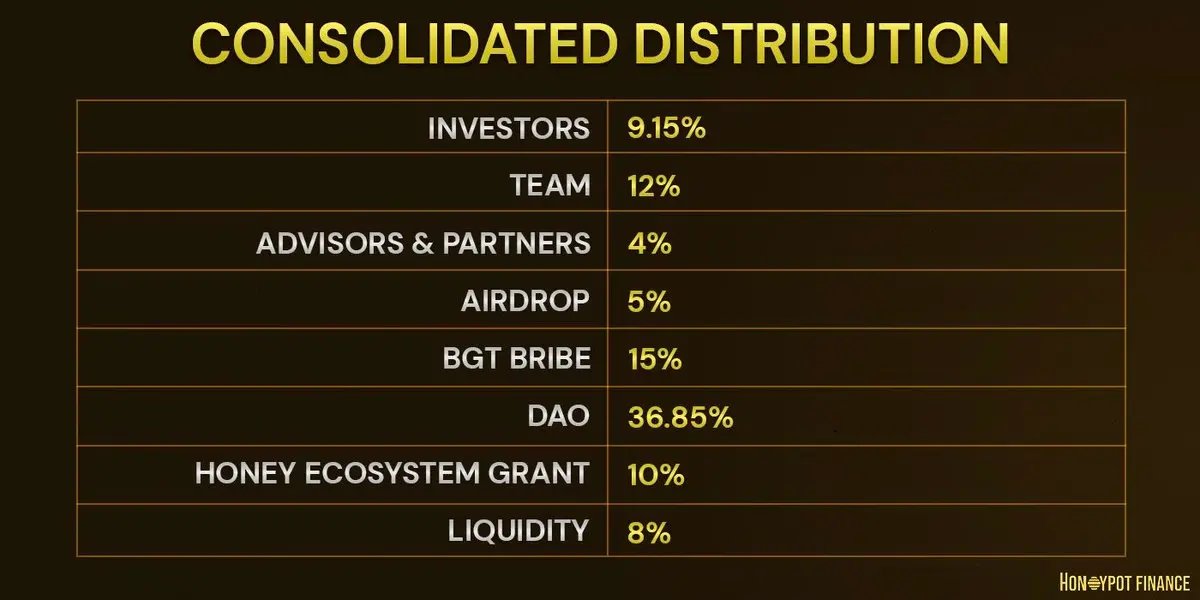
To keep the system clear and understandable, all early funding rounds are classified under the Investors category, representing capital with long-term alignment.
Consolidated Distribution Structure
Signals Conveyed by This Token Structure
- Investors (9.15%): Capital supports growth but will not dominate supply or governance.
- DAO (36.85%): Long-term ownership and protocol governance are at the core.
- Incentive Engine (23%): BGT Bribes and liquidity distribution efficiently drive the flywheel.
- Airdrop (5%): Sufficient to reward users while controlled to avoid market impact.
- Honey Ecosystem Grant (10%): Ensures the ecosystem continues to grow beyond a single product.
How the $HPOT Buyback Mechanism Works
Real Revenue, Real Demand
Honeypot's token design is built on real products, not speculation.
Sources of protocol revenue include:
- Honeypot Perpetuals
- Vault strategies developed in collaboration with partners
- Future roadmap products
These revenues flow into the All-in-One Vault, which is responsible for:
- Funding stablecoin payouts
- Executing $HPOT buybacks
- Supporting long-term deflationary mechanisms
One example is the Vault developed in collaboration with Dirac Finance, whose revenue strategy directly creates buy pressure for $HPOT through buybacks.
Additionally, part of the trading revenue from Honeypot Perp DEX will also be used to buy back $HPOT from the market.
$HPOT Token Flywheel
In addition to the built-in deflationary mechanism,
The system forms a closed loop through the following:
User activity → Protocol revenue → $HPOT buybacks → Supply decreases → Stronger incentives
Why This Is Crucial in the Current Market
In bear markets or early cycle environments, weak token structures quickly expose problems.
Honeypot's design goals are:
- Users receive real dollar value
- $HPOT avoids structural selling pressure
- Buy pressure comes from real product usage
- Scarcity is derived from revenue, not emissions
No Airdrop Death Spiral
No Mercenary Token Economic Models
Only a protocol capable of long-term compounding growth.
This is the evolution of Honeypot.
About Honeypot Finance
Honeypot Finance is an integrated one-stop liquidity hub dedicated to building the next generation of DeFi infrastructure. By combining AMM technology with omnichain liquidity and perpetual contract trading, Honeypot creates a seamless, scalable, institutional-grade ecosystem that enhances capital efficiency, cross-chain accessibility, and sustainable yield generation for users and protocols in the decentralized finance space.
 Risk warning Risk warning