Borrowing the False to Cultivate the True: A Self-Reflection of a Web3 Builder
 Core Viewpoint

 Honeypot Finance's AMM Perp DEX addresses the pain points of traditional AMMs through structured upgrades, including zero-sum games, arbitrage loopholes, and capital mixing issues, achieving a sustainable structure, layered risk control, and fair liquidation processes.
Author: @0xWilsonWu
I finally took some time to catch my breath. Over the past few days, I carefully sorted through my assets and plans, and countless questions flooded in through private messages and comments. Some were concerned about the progress of Honeypot, others inquired about market trends, but more were curious: "What exactly have you experienced in these four years?"
So, I decided to write this long article. There are no secrets to wealth, no motivational platitudes, and not a hint of marketing. This is just my confession, a genuine reflection of my journey from a Web2 coder to a Web3 entrepreneur. Perhaps this is my true "white paper"—not a grand declaration, but a code log soaked in sweat.
From the Cage of Web2 to the Call of Web3
I am a typical nerd, immersed in code, product optimization, and system building, interpreting the world through rational logic. At that time, I believed that as long as the algorithms were precise enough, the world would be orderly.
However, as Trump was erased from Twitter and YouTube, I gradually realized that the world I optimized never truly belonged to the creators. It was monopolized by giants, the rules were skewed, and innovators often became pawns. No matter how sophisticated the algorithm, it could not escape platform censorship and data plunder; no matter how excellent the product, it was merely a garment for others.
The crypto world shone like a beam of light through a crack, entering my sight. At that time, I already held a small amount of BTC as a trial, but what truly ignited my passion was the explosive rise of Luna—it was like a dazzling new star, not only offering a sufficiently high yield but also prompting me to study crypto from various angles. I read the Bitcoin white paper, learned about Ethereum smart contracts, and studied Cosmos and IBC's application chain technology. Decentralization was no longer an abstract concept but a living revolution: no intermediaries, code is law, everything is transparent. But it was also filled with uncertainties: extreme volatility, unclear regulations, and high technical barriers. Here, code was not merely a tool but the creator of rules; individuals could reshape the flow of finance and value from the ground up, rather than relying on the benevolence of centralized institutions.
Ultimately, I decided to go all-in on Web3. This was not an impulsive decision but a profound reflection on the limitations of Web2: the comfort zone of Web2 was like a cage, stifling true innovation; Web3, though chaotic, offered infinite possibilities—it allowed me to transition from an optimizer to an architect, building a digital realm for everyone. If I did not step out of my comfort zone, innovation would have no way out. I began to shift my savings towards crypto assets, with my first major move being a heavy investment in Luna.
The Catastrophe of Luna: Collapse of Faith and Rebirth
Why did I choose Luna for my first true all-in? Because it represented the ultimate ideal of Web3: the Terra ecosystem promised a stable algorithmic stablecoin, UST, combined with an efficient blockchain, aimed at creating a decentralized financial system that could rival traditional banks. At that time, the narrative of Luna attracted me like a magnet—it was not just a speculative tool but a disruption of centralized finance, promising low-cost cross-border payments and unlimited expansion of DeFi. As someone with a developer background, I was drawn to its algorithmic mechanisms: the design of dual-token arbitrage and liquidity incentives made me see the potential of Web3.
Throughout my continuous investment in Luna, I poured in over $500,000 in principal. Initially, everything went smoothly—the price soared, and I made a significant profit, with my account doubling at one point, that excitement made me even more determined. But good times did not last long; the collapse came. In May 2022, UST depegged, and Luna's price plummeted from nearly $100 to a few cents. My account was wiped out, and my ideals turned to dust. I sat in front of the screen, witnessing everything evaporate, and in that moment of despair, it felt like a tide crashing in, my heart was in agony—not just the loss of money, but the collapse of faith. I began to question everything: how could the decentralization of Web3 be so fragile? How could the promise of algorithmic stablecoins vanish in an instant?
The reasons for Luna's collapse were not due to opaque algorithms—the mechanism of Terra was open-source, and the dual-token arbitrage logic was publicly auditable. But the design flaws were glaring: UST relied on Luna as an infinitely supplied "buffer," triggering a death spiral under market panic and large sell-offs. The high yields of the Anchor protocol attracted speculative funds but led to a bank run; liquidity dried up, and social media amplified the panic, further worsening the situation. The entire ecosystem evaporated hundreds of billions of dollars, proving that the experimental risks of algorithmic stablecoins far exceeded expectations.
But the collapse of Luna was not the end; it was a turning point of awakening. It forced me to confront the harsh reality of "decentralization": the market shows no mercy to anyone; it tests your resilience and cognition. The Luna incident exposed the immaturity of Web3—over-leverage, design flaws, herd mentality. But it was in this rubble that I completed the true transition from Web2 to Web3: the stability of Web2 stemmed from centralized control, yet stifled freedom; the ruthlessness of Web3 came from openness, yet rewarded iterators. From the blind pursuit of speculators to the calm analysis of observers, I learned to examine mechanisms rather than narratives.
Rational Return: Healing in the U.S. Stock Market and Cycle Enlightenment
After the collapse of Luna, I chose to temporarily step away from Web3 investments and return to the relatively familiar U.S. stock market for healing. During that time, I desperately needed to regain rationality from emotional fluctuations, so I began studying macro cycles and market structures. Initially, I allocated to industrial metal stocks represented by FCX—it symbolized the recovery of global production post-pandemic and reminded me of the power of cycles: any prosperity stems from accumulation at the bottom.
As the market entered the early stages of recovery, I gradually shifted my positions towards tech stocks—Google, NVIDIA, Meta, AMD, QQQ, QTUM. That was not a blind bottom-fishing; it was a practice based on "cognitive compounding." I firmly believed that knowledge and insights would grow like a snowball. This experience allowed me to re-understand the essence of investing: price is merely the surface of volatility; emotion is the underlying logic of the market.
Luna made me fall from fervor, while the U.S. stock market allowed me not to worry about the hustle of life for a while. Fortunately, I still had about $200,000 in principal that had not been wiped out, which became my fuel for restarting. Through reflection and adjusting my positions, I learned to seek certainty amid volatility. During that time, my belief shifted from "chasing yield" to "chasing certainty."
Returning to Web3: From Observer to Builder
When I looked back at the crypto world, I realized that the failure of Luna was not the end but a mirror reflecting the immaturity and potential of the entire Web3. It made me understand that true innovation lies not in narratives but in mechanisms.
So, when I saw Berachain propose Proof of Liquidity (PoL) and a three-token system, that familiar yet restrained design caught my eye: it retained the power of liquidity incentives while using institutional constraints to avoid self-destruction like Luna. At that moment, I was no longer satisfied with being an observer or investor—I wanted to become a Builder.
Honeypot Finance was born from this turning point. Its original intention was absolutely not a simple startup but a continuation of faith—to build a truly democratic and upgradeable super application, making liquidity no longer a speculative chip but the core engine driving the sustainable growth of the Web3 ecosystem.
Luna made me experience the collapse of faith, the U.S. stock market taught me the reconstruction of rationality, and Honeypot represents my rebirth as a founder.
The Origin of Honeypot: From Pain Points to the Spark of Revolution
During my healing period in the U.S. stock market, I constantly reflected on the chaos of Web3: the proliferation of yield farms, the market flooded with copy-paste projects, inefficient capital, poor composability, and stagnant liquidity. These issues kept me awake at night—why is DeFi still at a toy level? Why can't Web3, like Web2, nurture a complex and large application ecosystem?
I wanted to change this centralized-dominated world. The giants of Web2 control everything, and users are merely data sources; Web3 was supposed to be a democratic utopia but often devolved into a speculative casino. I dreamed of building a democratic, orderly, and upgradeable super app—a modular, DAO-governed DEX that addresses the friction points of DeFi from the ground up.
Thus, Honeypot was born. Not starting from hype, but tackling problems head-on. We built a scalable decentralized exchange from scratch, focusing on real pain points: combating sandwich attacks and MEV. In mid-2023, our Batch A2MM model won an award at the ETH Shanghai Hackathon; that was not just a demo but proof that DeFi can be smarter, more streamlined, fairer, and more scalable.
Honeypot never chases trends. We advocate practical innovation: providing tools for the community, not toys; a simple yet powerful interface serving real financial needs. This is not another DEX clone but an experimental ground for a grander argument: if composability and liquidity are solved, anything is possible.
Later, the frenzy of memecoins brought us new thoughts. The craze exposed the pitfalls of bonding curves—they reward speed over faith, insiders over participants, and are fleeting rather than cultural. We launched Pot2Pump as a fair and scalable meme economy engine. It transforms early participants into local LPs, with liquidity taking root from the start; it kills the extractive design of bonding curves, redirecting volatility into sustainable returns.
Real cases prove: in a high-volume memecoin LP, fee yields can reach 32,000% APR—not inflation, but market activity. Pot2Pump embraces the memecoin meta while guiding a healthy structure aligned with incentives.
The Rise of Hyperliquid: A Successful Practice of Faith
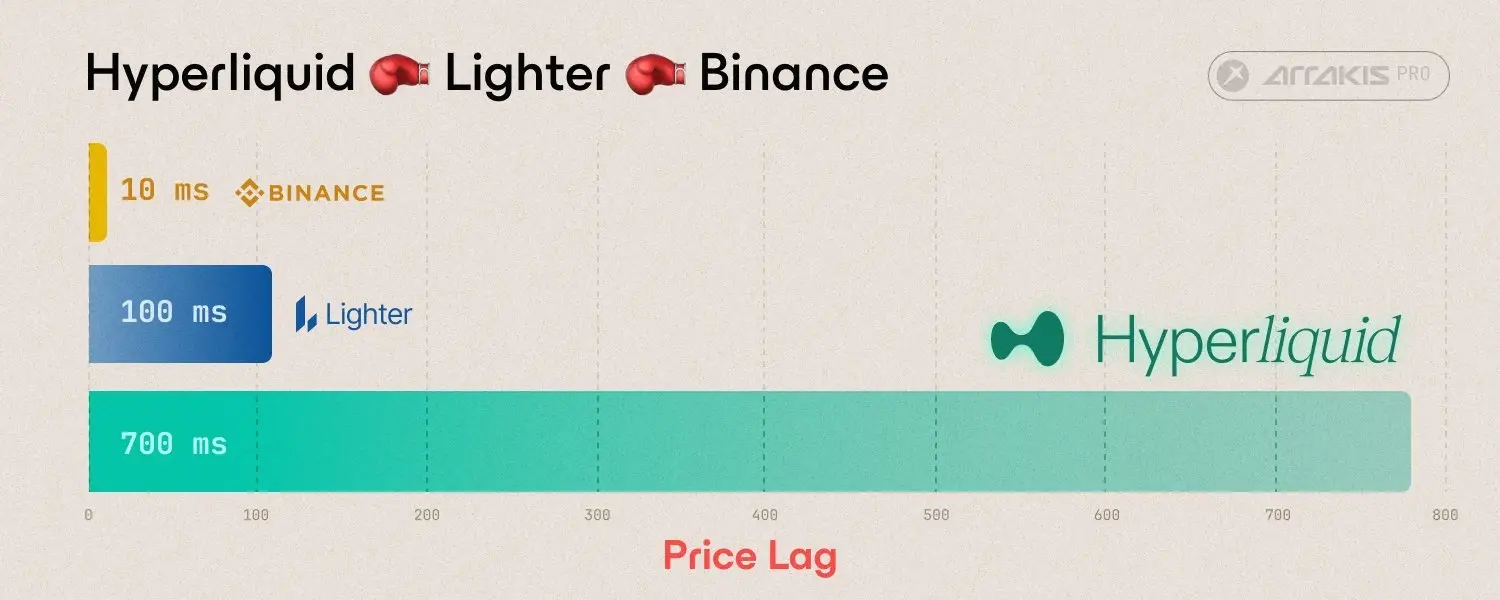
Hyperliquid is a project I have deeply researched and heavily invested in. Although I was not one of the earliest participants, I started at $12-13, leading the community into Hyperliquid and holding firm. At that time, the market was still questioning whether on-chain trading could rival CEX, but I saw its revolutionary potential: Hyperliquid adopted an order book model, providing a seamless experience on-chain, hailed as "the Binance of on-chain."
This project allowed me to earn "peace of mind money" for the first time, rather than mere speculation. Its transparency and efficiency proved that decentralized finance could be efficient and reliable. This is not just a trading platform but a model of Web3 financial infrastructure. It reinforced my belief: going all-in on Web3 is because the technology here can truly empower individuals, break centralized monopolies, and allow everyone to become a participant in the system. My belief has always been simple: we do not need to participate in many projects or opportunities. We just need to seize the big opportunities of certainty. I am very grateful that Web3 has given me such an opportunity to participate.
The Baptism of the October 11 Incident: From Disillusionment to Reforging Belief
The crash on October 11, 2025, was the most unforgettable moment of my journey. Market confidence collapsed in an instant, and even on-chain derivatives faced panic sell-offs. That day, I stayed up all night, staring at the on-chain liquidation curve, repeatedly examining: "How much of the on-chain transparency we pursue has actually been realized?"
The torment of that night made me fully awaken: if the execution logic still relies on human governance or centralized components, then DeFi is just a disguise. This crisis was not a blow but a catalyst. It shifted me from doubt to conviction: the future of Web3 lies in purely on-chain solutions; only in this way can true trustlessness be achieved. This is also the fundamental reason for my all-in—within Web3, I can personally build a purer and more autonomous world.
The Ambition of Honeypot: Evolution Beyond Hyperliquid
Hyperliquid inspired me, and the October 11 incident further fueled my drive to bring trading on-chain. We had been researching AMM Perp DEX for more than half a year before the October 11 incident; if Hyperliquid represents the elegant limit of on-chain order books, I want to make Honeypot the elegantly extreme AMM Perp DEX. In my vision, the relationship between Honeypot Finance and Hyperliquid is like that of Professor X and Magneto—different intentions, yet intertwined in love and conflict.
In matching, we achieve true on-chain execution and settlement synchronization; in risk control, we introduce dynamic margin and separate liquidity layers; in price discovery, we allow AMM to self-adjust, freeing it from price feed dependencies; in governance, we create a closed-loop game among LPs, traders, and protocols.
What I envision is not another exchange but a financial ecosystem capable of self-evolution. Every transaction, every liquidation, every piece of liquidity will become the nourishment for the system's growth. This embodies the essence of Web3: from passive participation to active construction.
Honeypot Finance's AMM Perp DEX addresses the pain points of traditional AMMs through structured upgrades, including zero-sum games, arbitrage loopholes, and capital mixing issues, achieving sustainable structures, layered risk control, and fair liquidation processes. LPs do not interact directly with AMMs but deposit funds into ERC-4626 layered vaults: senior vaults prioritize fee rates and last losses (suitable for institutions), while junior vaults take first losses and offer high yields (suitable for crypto natives). Vault supplies are based on oracle-anchored price bandwidth, ensuring linear and centered slippage. The liquidation sequence is preset and visible, including partial deleveraging, micro-auctions, primary first losses, insurance pools, and limited ADL, ensuring the system remains controllable and predictable amid volatility, isolating shocks.
Borrowing falsehoods to achieve truth? For the past two years, I have been a living example. Coming in from Luna, I experienced the rollercoaster of massive gains and losses—my account once doubled but ultimately faced a near-total liquidation. At that time, I regained my principal through adjustments and recoveries in the stock market, solidifying my belief as a builder. Although I was not the earliest participant in Hyperliquid, I started at $12-13, leading the community into Hyperliquid and holding firm. In April of this year, during the adjustment of the U.S. stock market, at the peak of panic, I led the community to bottom-fish the SPY index at 4800 points and BTC at $75,000, achieving a reversal from the trough to the peak. This tumultuous investment journey was not only a financial success but also a cognitive upgrade—it transformed me from a doubter in Web2 to a steadfast builder in Web3.
Be a Fool's Ally, Not an Opponent
People often ask: "Has the crypto bonanza ended?"
My answer: It has barely begun.
The end of the speculative phase is the beginning of the creation phase. When Web3 shifts from wealth transfer to wealth creation, when fools and smart people share the benefits of the mechanism, that will be the golden age.
And my team and I aim to be the top builders in the industry. I no longer want to participate as an observer but to be a true industry changer, building a future that includes everyone.
Postscript
In a pyramid-structured world, people prefer stories that align with their imagination. I can tell stories too, but the truth is often calm and dull: it is the debugging of code at dawn, failed iterations, and the collapse of risk models.
Wealth is not a miracle but the accumulation of time and the iteration of cognition.
I am just an ordinary person. I have been lost, fallen, and gradually risen again. I seek order in chaos and forge balance amid confusion.
If Honeypot can represent something, change something, I hope it will always symbolize the direction of the future, no matter how many times it falls and dies, it can rise again like a phoenix.
 Risk warning Risk warning