Don't pay attention to these dead projects
 Core Viewpoint

 Be wary of projects that change their core track every three months; true innovation requires deep cultivation, and frequent narrative shifts are often meant to cover up the failures of old businesses.
Author: Chloe, ChainCatcher
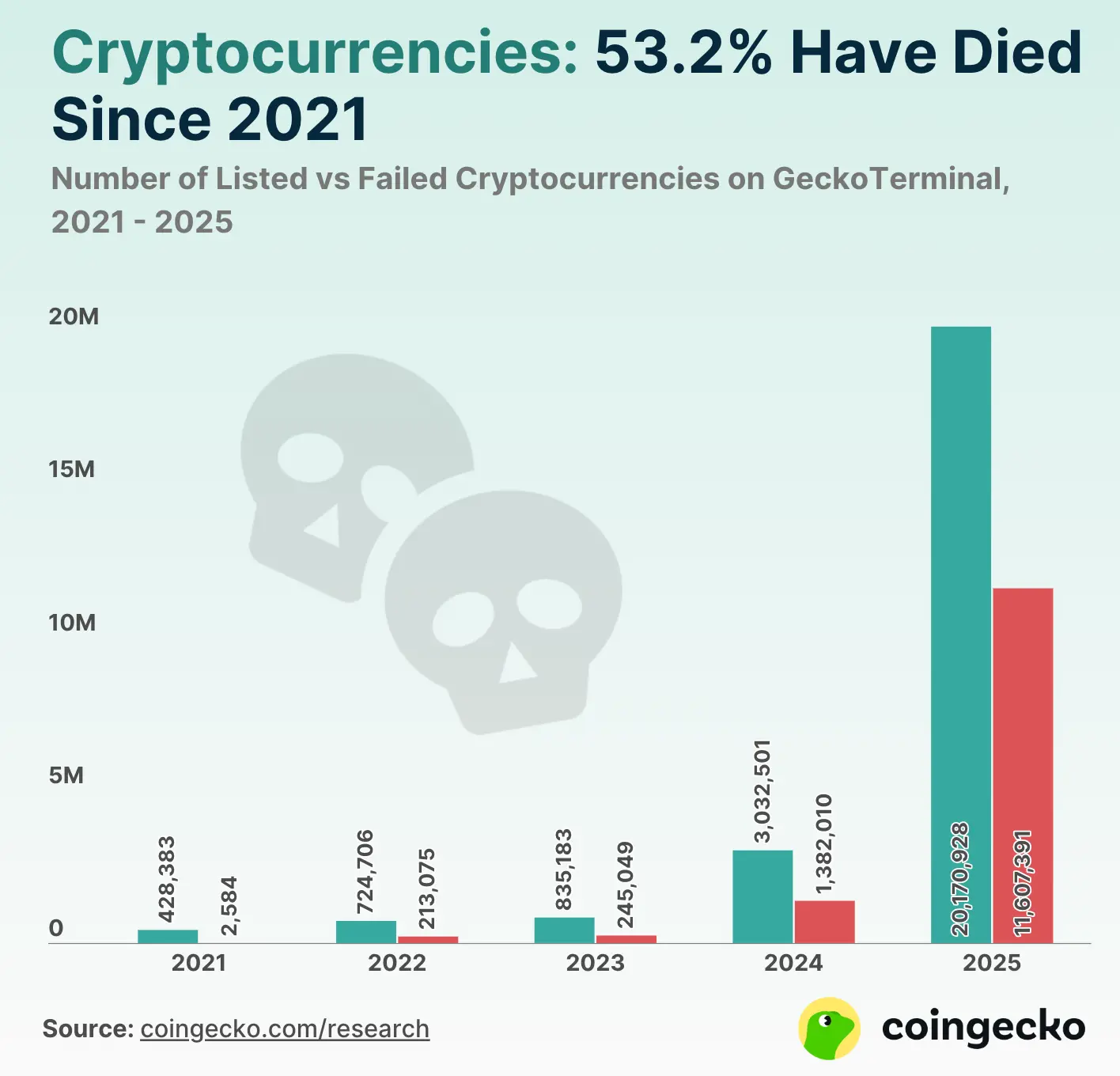
The cryptocurrency market in 2025 witnessed an extreme industry contradiction: according to GeckoTerminal statistics, although the total number of token issuance projects has surpassed 20 million, over 57% of these projects have come to an end. Amid this brutal elimination round, a more insidious type of "zombie project" is spreading, backed by top capital and leading exchanges, frequently changing hot narratives, yet stagnating in actual product, technical delivery, and ecosystem development.
This article will deeply analyze projects suspected of becoming zombies, such as Sleepless AI, Hooked Protocol, Saga, and Dymension, examining their operational characteristics. In 2026, the ability to penetrate narrative fog and identify signs of zombification has become a survival essential for investors.
Token Issuance Equals "Wrapping Up"? The Phenomenon of Project Decline and Zombification
In the early stages of blockchain development, the definition of "Zombie Coins" was relatively simple: long-term dormant, losing trading liquidity, disappearing development teams, and lacking community participation. However, with the maturation of the capital market and deep venture capital involvement, the market has recently exhibited a more insidious absurd phenomenon.
Data shows that in 2021, the number of token issuance projects on GeckoTerminal was only 428,000, but by the end of 2025, this number had skyrocketed to 20.17 million, with as much as 53% of projects facing extinction. At the same time, behind this high turnover and high elimination rate lies a large number of "zombified" projects, which, although traded on exchanges and issuing social media announcements daily, have significant gaps in actual product delivery, on-chain activities, and ecosystem construction.
Sleepless AI: Parasitic AI Narrative? Disconnection in R&D and Delivery
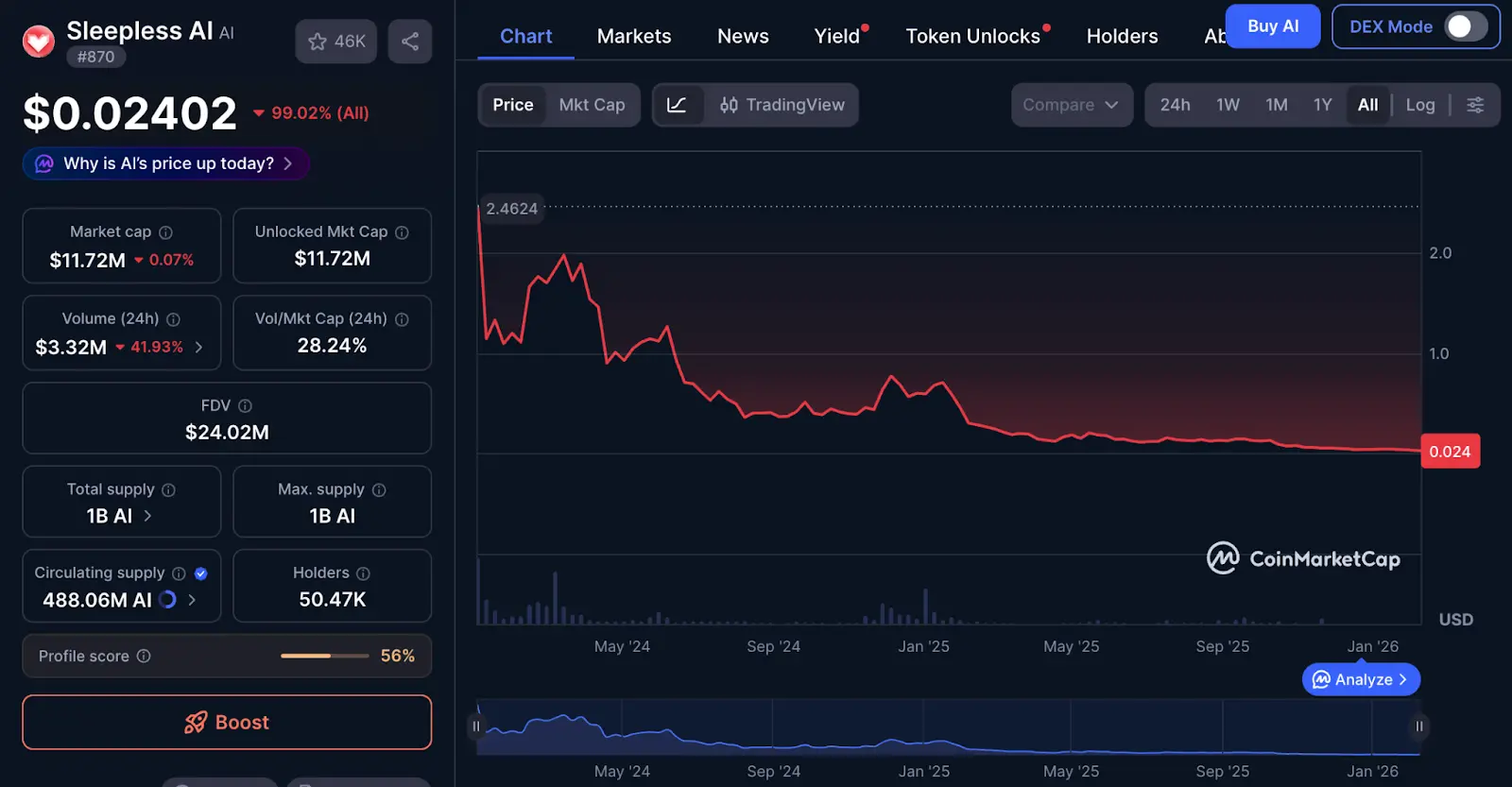
Sleepless AI was once the darling of the market, not only selected by Binance Labs as a standout in the sixth season of its incubation program but also shining in Binance Launchpool's 42nd phase under the halo of "Web3 + AI Virtual Companion." However, entering 2026, its market performance has been contrary to its initial hype: the token price has plummeted from a historical high of $2.46 to around $0.024, a staggering drop of 99%.
1. Disconnection in Technical Transparency and R&D Progress: Although the project claims to utilize AIGC and large language models (LLM) to create a deep emotional support experience, its transparency in actual technical dimensions appears lacking. Observing through public channels, the project has almost no traceable code update records or iterations of core algorithms. Even more concerning for investors is the unclear progress of the Web Dapp originally scheduled for release in Q2 2025.
2. Inefficient Execution of Mobile Strategy: In the "mobile-first" application era, Sleepless AI's product rollout process appears relatively lagging. Its flagship product, "HIM," has yet to successfully launch on the iOS App Store or Google Play Store as of early 2026, with the official website still only offering an Android APK download. For a project aiming for mass adoption, this development efficiency greatly limits user growth and market trust.
3. Narrative Restructuring and Insider Doubts: Accompanying the stagnation of the product is a deep questioning of the project's essence in the market. Some in the market have proposed views suggesting that the project appears to be a "narrative restructuring" of an old Web2 game, leveraging AI concepts and capital relationships to forcibly attach itself to the AI track's popularity in exchange for investment from Binance Labs and traffic benefits from Launchpool. Although such claims are mostly anonymous accusations, combined with its weak technical delivery and the collapse of token prices, this phenomenon of "narrative parasitism" has become an important reference indicator for investors to identify suspected zombified projects in 2026.
Hooked Protocol: Ecological Dilemma After Incentive Drought
Hooked Protocol once rose rapidly in the Web3 social learning track with its Learn-to-Earn model, securing investments from Binance Labs and Sequoia China, and launching as the 29th Launchpad project on Binance. However, as token distribution enters the later stages and subsidy benefits gradually fade, the project is facing severe tests of "real user retention" and "ecological value."
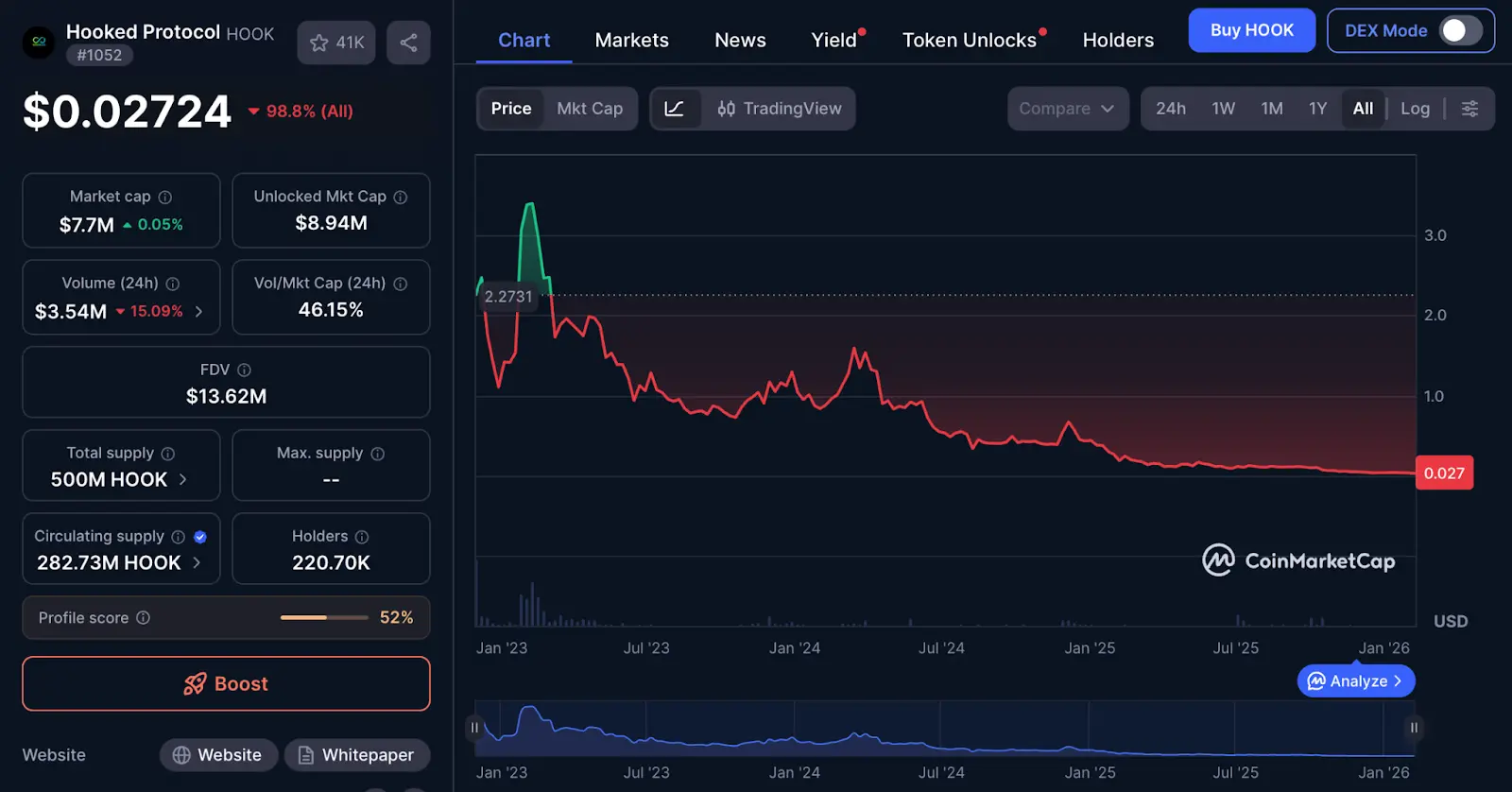
1. From Learn-to-Earn to Incentive Dependency Dilemma: Hooked Protocol's initial success relied heavily on the traffic effect of Binance Launchpad and a robust token subsidy mechanism, which could quickly translate into a large user base in the early stages. However, when the price of the HOOK token fell nearly 99% from its peak, the growth game sustained by subsidies lost its appeal. Historical experience repeatedly proves that after TGE, when incentives disappear, the "massive user base" lacking rigid demand often shrinks rapidly.
2. Marketing-Driven Narrative Transformation: Entering 2025, Hooked attempted to transition to an "AI-driven learning ecosystem" and "educational infrastructure." Although the official statement claims collaboration with 3-7 top universities to develop courses and the launch of the Hooked Coursera Hub in August 2025 in partnership with over 74 Web3 projects, these initiatives resemble mere marketing-level "brand endorsements." Compared to the impressive list of collaborations, substantial breakthroughs in the underlying technology appear lacking.
The current state of Hooked Protocol reveals a core challenge faced by Web3 application projects: if a project's vitality relies on token incentives without converting into commercially resilient native demand, it will struggle to escape the fate of significant token price declines or even zombification. The current sluggish token price and potentially shrinking ecological activity are negative feedback following subsidy-driven prosperity.
Saga: Dual Blow of Lack of Market Demand and Security Vulnerabilities
Saga represents another path to zombification: the shovel sellers cannot find the mines. With its grand vision of "one-click chain issuance," Saga successfully attracted over $1,000 in funding from top institutions like Placeholder, GSR, and Samsung Next, and also successfully launched as the 51st project on Binance Launchpool. However, this powerful automated chain issuance tool seems somewhat lost under the test of real market demand. 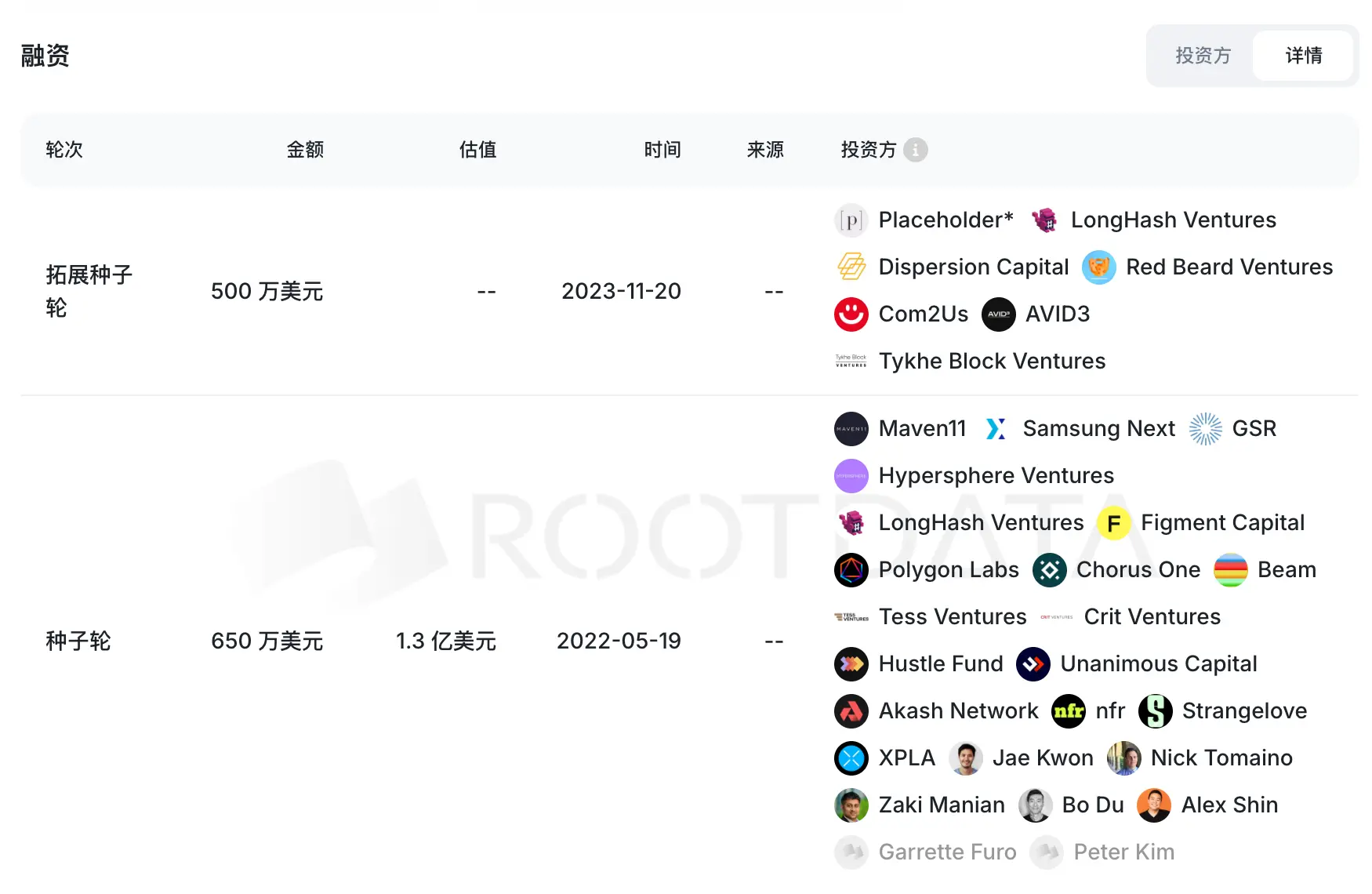
1. Frequent "Path Changes" Exposing Ecological Anxiety: Over the past two years, Saga has demonstrated high narrative flexibility but has also exposed flaws at its ecological core. From initially focusing on a game-specific chain with over 350 cooperative projects to subsequently shifting towards AI infrastructure narratives, this frequent change in narrative essentially reflects the growth anxiety stemming from the old ecosystem's lack of practical applications.
If its core technology "Chainlet" possesses genuine market demand, it should drive token repurchases through continuous developer leasing. However, the reality is that although Saga's list of partners is lengthy, it consistently lacks blockbuster projects to support it, with most partners remaining in the early exploration stage and unable to contribute substantial economic driving force to the protocol.
2. Fatal Blow to Security Reputation: For infrastructure, technical security is the bottom line for survival. SagaEVM suffered a $7 million vulnerability attack in January this year, causing the stablecoin $D to depeg to $0.75, and the TVL evaporated from about $37 million to $12 million. This is undoubtedly a severe blow for a project positioning itself as infrastructure.
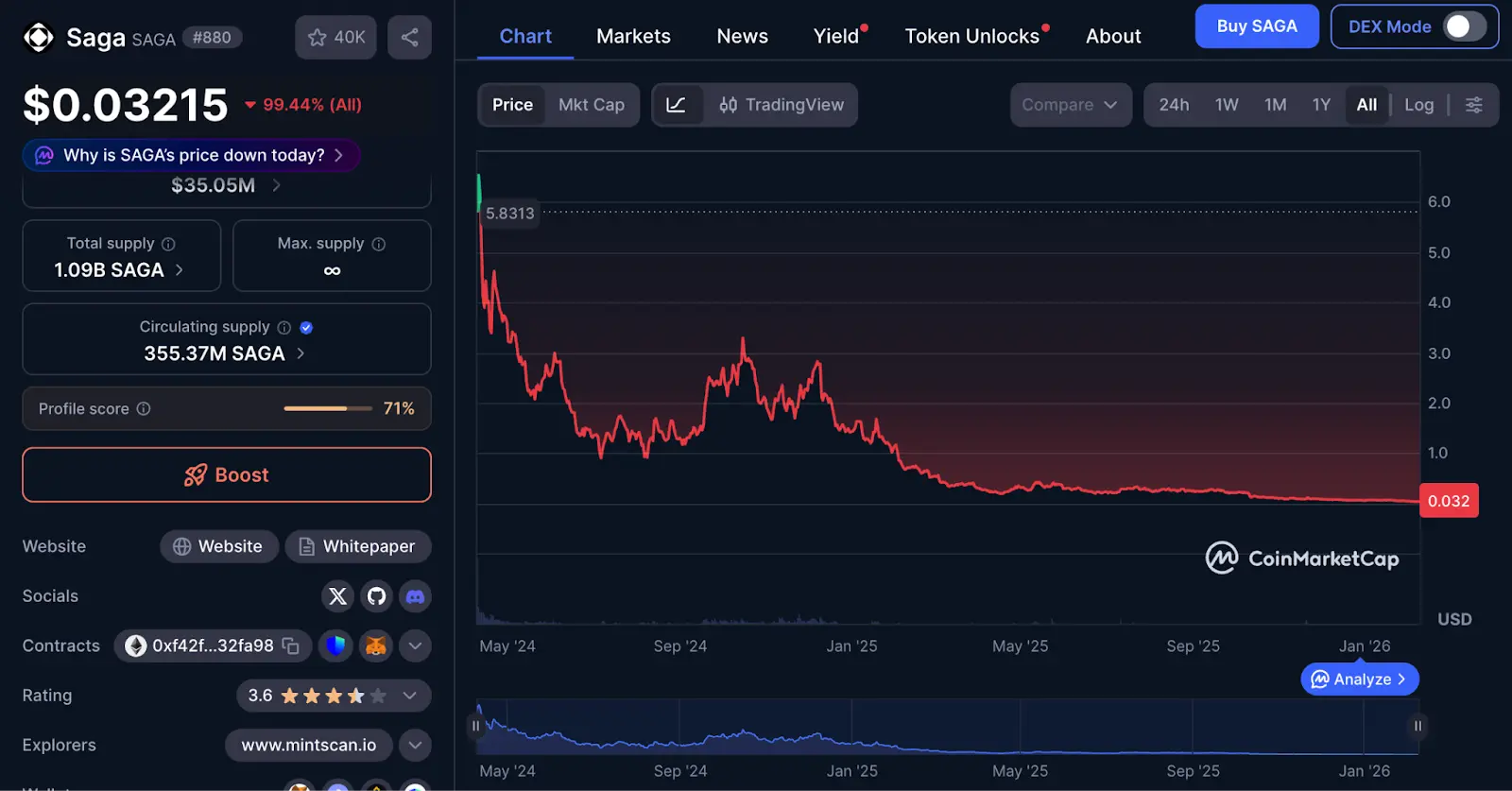
When grand narratives cannot translate into ecological data and technical security has flaws, market feedback is often merciless. Currently, the native SAGA token price has dropped from a high of $6 in 2024 to around $0.032.
Dymension: A Ghost Town Beneath Grand Architecture
Dymension's script is highly similar to Saga's, with its proposed RollApp concept being theoretically attractive, but in the face of actual data in 2026, it resembles a grand ghost town. Although Dymension attempts to establish a benchmark for a modular settlement layer, the real vitality of its ecosystem has yet to meet expectations.
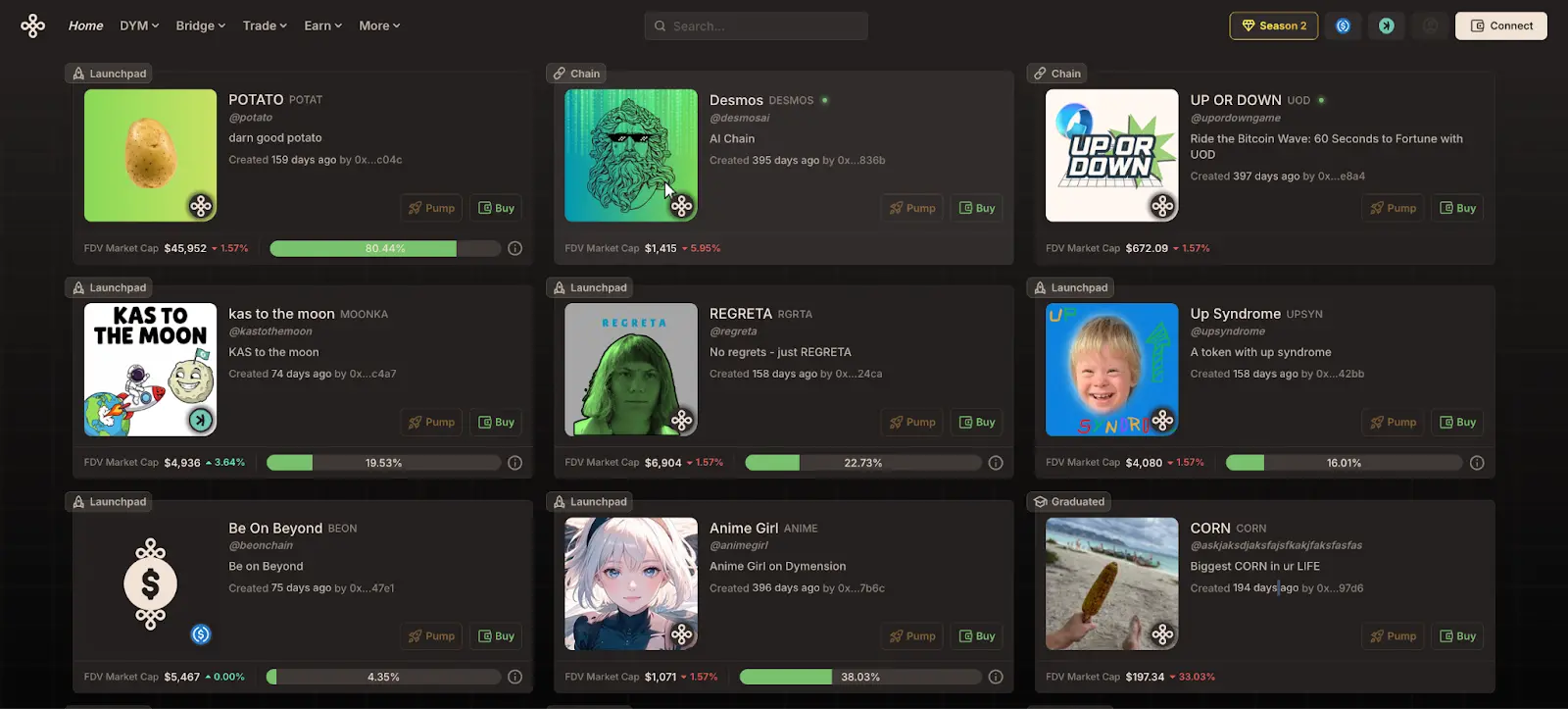
1. Activity Disconnection in the RollApp Network: Dymension once claimed to have deployed over 10,000 RollApps within its ecosystem; however, this data prosperity essentially stems from the lowered "threshold for token issuance and chain issuance." The vast majority of deployed RollApps, aside from the initial token issuance, have no ongoing on-chain transactions or substantial outputs, and many have already disappeared.
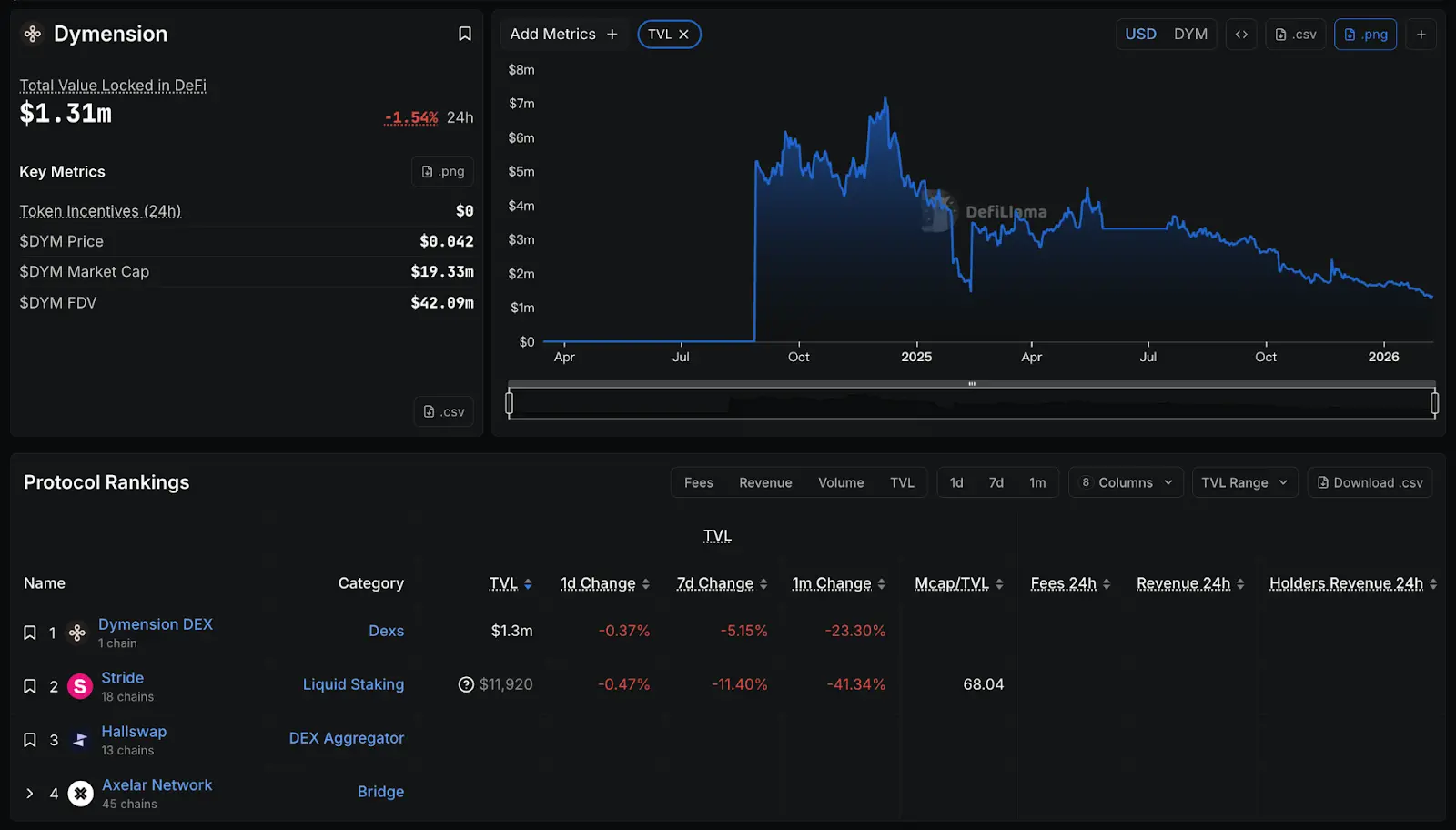
2. Economic Dysfunction of Infrastructure: When Launchpad and development kits cannot translate into a thriving digital economy, the infrastructure itself will fall into value depletion. Dymension's main DEX project and ecological TVL performance are both unsatisfactory, with the overall TVL currently only at $1.3M, starkly contrasting with the market's expectations of its "modular leader" at the beginning of token issuance.
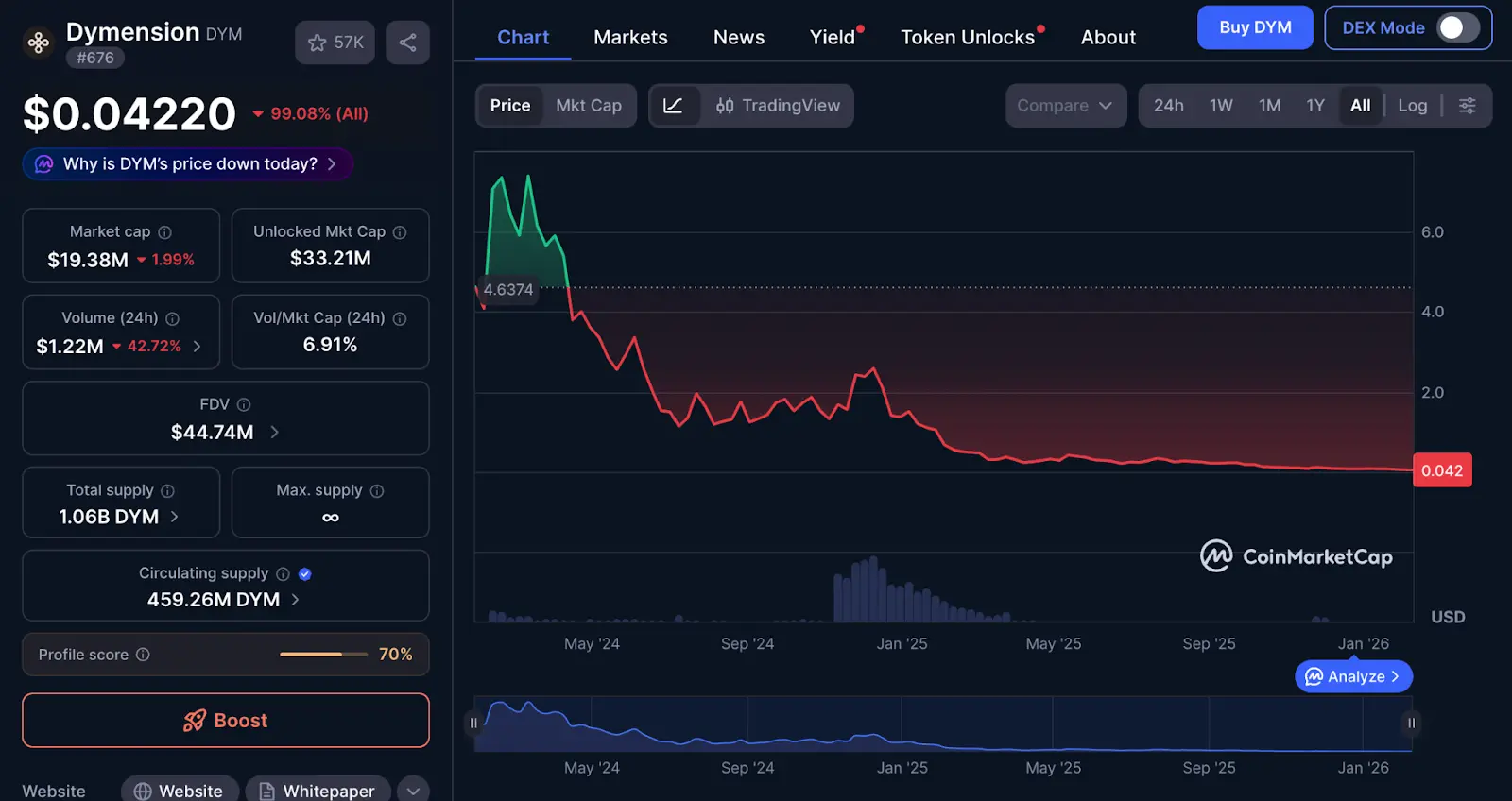
When the infrastructure primarily runs zombie applications and the overall ecological performance deteriorates, the native DYM token price will inevitably be corrected by the market. Currently, the FDV is $45M, and the token price has dropped 99% from its peak of $6, now only at $0.042.
Why Do "Zombie" Projects Keep Emerging?
These projects can maintain a superficial "vitality" due to deep structural issues within the Web3 industry.
1. Capitalization Power Structure for Token Issuance: In recent years, many projects' paths to token issuance have not stemmed from substantial technological breakthroughs but rather heavily relied on "capital, interest relationships, and narrative packaging." These projects, propelled by the combined efforts of VCs and internal executives, enter top exchanges through polished packaging and inflated testnet data. Once the tokens are unlocked, the teams often lose motivation for further development.
2. Ambiguous Team Backgrounds: Some zombie projects share a common characteristic: the backgrounds of core operators and technical leaders are extremely vague. This "black-box" operational model not only allows project parties to avoid bearing credible responsibility when encountering technical bottlenecks or security vulnerabilities but also provides them with very low exit costs. This enables the operating team to quickly rebrand and discreetly reposition themselves in another new narrative after a project stagnates, repeatedly consuming market credibility.
3. Narrative Parasitism Ability: Zombie projects often possess a strong "narrative parasitism" ability. Whenever market hotspots shift, these projects, lacking substantial progress, often engage in "announcement-style transformations" to align their narratives. This not only increases the identification costs for investors but also disperses scarce liquidity into hollow shells lacking output, allowing them to ride the wave of popularity and attract speculative funds.
Conclusion: Investors Should Seek Real Value Bottom Lines in 2026
In the face of a prosperous market woven from twenty million token issuance projects, investors' core logic must shift. In 2026, identifying zombified projects is no longer just a bonus but a defense. The following three core indicators are organized to help readers identify:
First is the verifiability of the team and technical delivery: avoid projects with unclear team backgrounds, no GitHub submission records, low roadmap fulfillment rates, and slow product distribution. Second, the value of data: distinguish between "subsidy-driven activity" and "native demand," checking whether users still show retention willingness after departing from token subsidies. Finally, beware of projects that change their core track every three months; true innovation requires deep cultivation, and frequent narrative switches are often meant to cover up the failures of old businesses.
As the cryptocurrency market matures, the industry needs projects that continuously deliver value before and after token issuance, genuinely addressing market pain points.

 Risk warning