Is Opinion really worth paying attention to?
 Core Viewpoint

 This year, the demand for prediction markets is expected to peak. Opinion has taken the lead on Binance at this time, intending to capture the attention and liquidity that overflows from the prediction market boom initiated by PolyMarket.
Author: Chloe, ChainCatcher
Opinion officially announced the token economics and roadmap for its native token OPN yesterday, and Binance also officially announced that Opinion will be the 72nd Launchpool project. According to the official roadmap, Opinion will conduct its TGE in the first quarter of this year, with a focus on promoting ecological growth and decentralized governance in the second quarter.
However, along with the news of its launch, there were not only cheers but also many data points that raised market skepticism, complaints about the "anti-rollback" airdrop ratio, and criticism of its "fast track to Binance" approach.
Why Now? The Factors Behind Abandoning User Growth for Token Issuance
In the prediction market sector, Polymarket is undoubtedly the current recognized leader. However, despite having high traffic during global elections and sports events, it has never issued a token. This year, as demand for prediction markets peaked, Opinion seized the opportunity to launch on Binance, clearly intending to capture the attention and liquidity spilling over from the market trend initiated by Polymarket, and to establish a significant competitive advantage through user expectations of airdrops.
Additionally, for many retail investors, the Binance endorsement of OPN has made it the preferred choice for betting on this narrative. As the first prediction market token to go on a CEX, the scarcity of OPN has ignited a spark of interest in the crypto industry today.
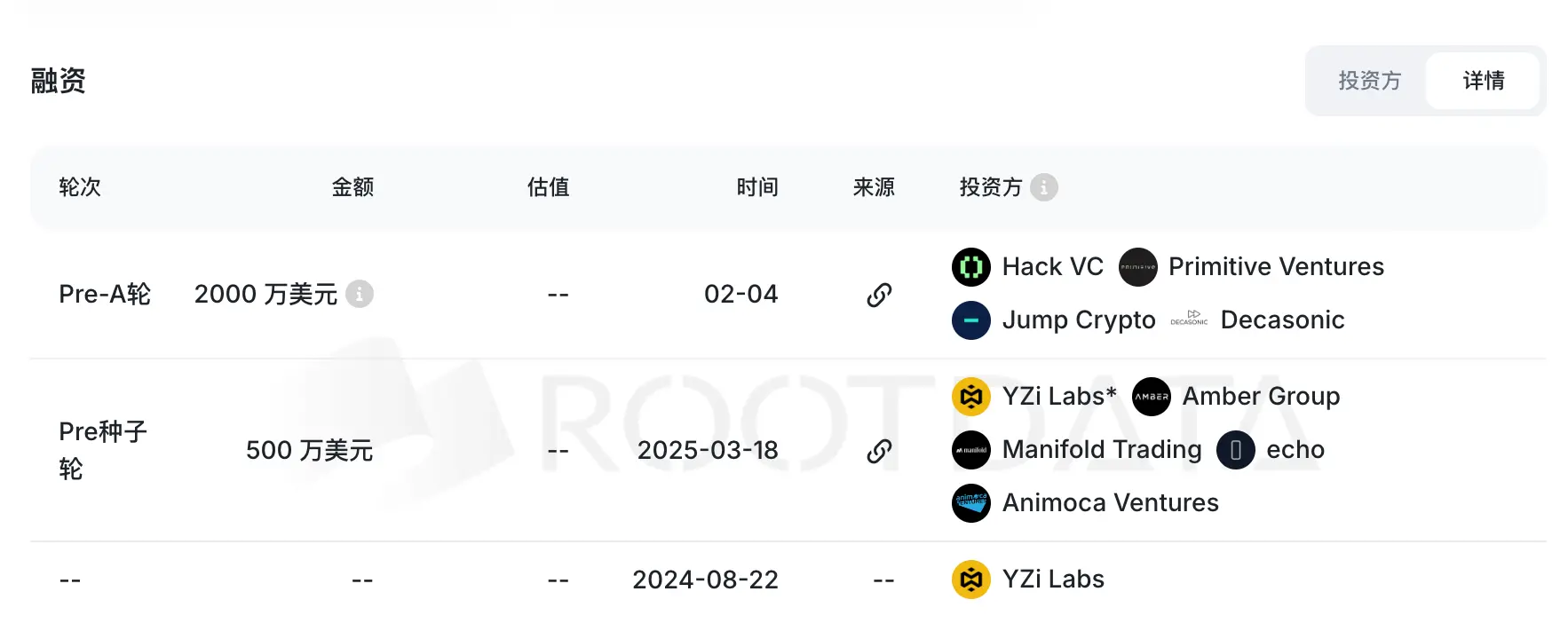
According to RootData, on February 4, Opinion announced the completion of a $20 million Series A funding round, with participation from Hack VC, Jump Crypto, Primitive Ventures, Decasonic, and others. However, @cryptobraveHQ pointed out that insiders revealed that most of the participating parties had refund rights or capital protection agreements, similar in nature to BeraChain's capital protection financing, essentially making it a "pricing round" or "listing round."
Moreover, feedback from peers in VC and exchange listing indicated that it was generally viewed as a typical hype round, pricing round, or a paid listing round. For VCs, rather than gambling on an uncertain future, it is better to complete a swift listing while the AI + prediction market narrative is hot, achieving capital exit.
Huge Data Volume Under Scrutiny, Discrepancy Between Transaction Count and Volume
Perhaps in an attempt to become the "first prediction market token," Opinion's impressive data was met with skepticism from the market right from the start.
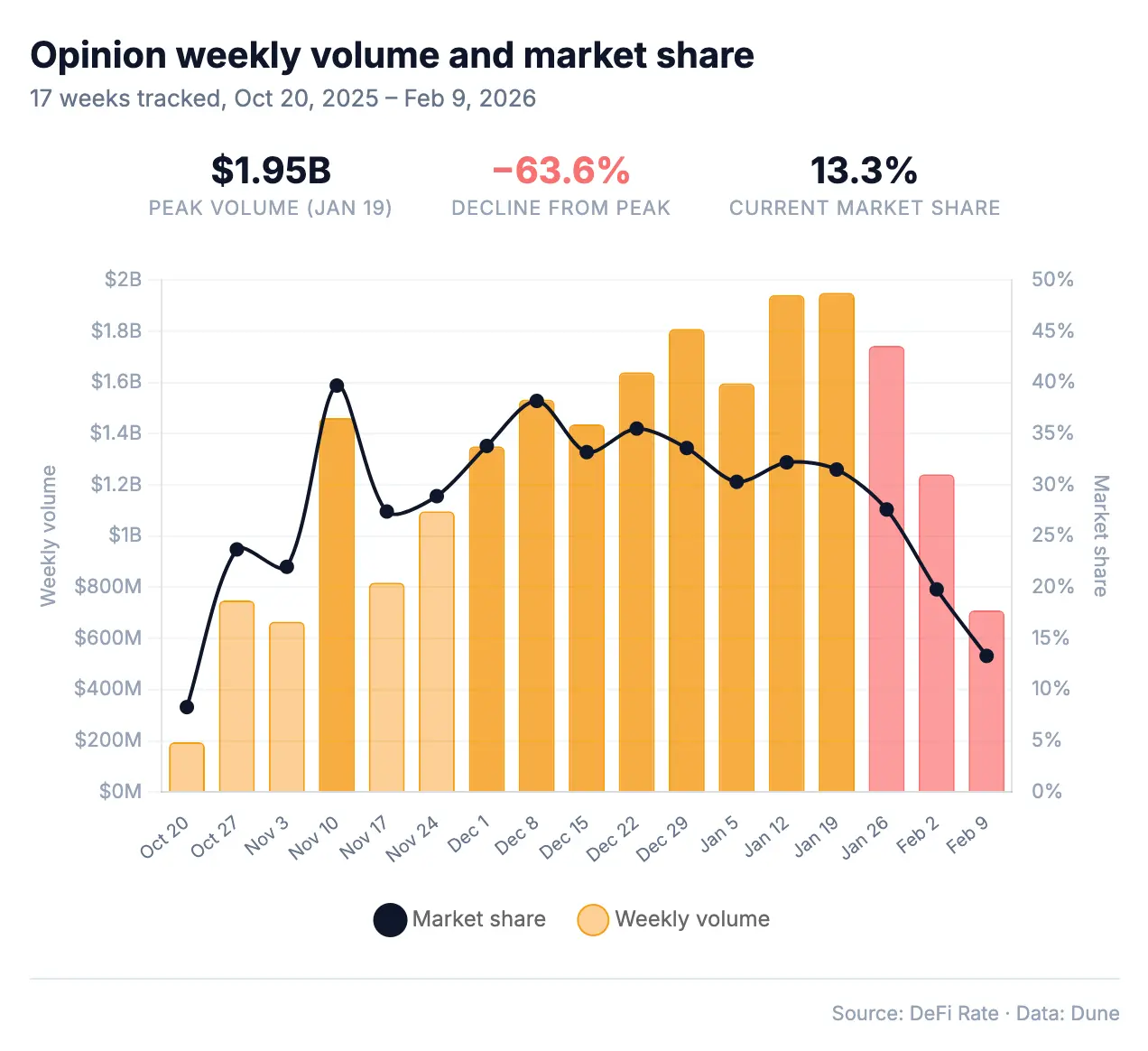
From the publicly available data of Opinion, the transaction volume in January 2026 reached $8.08 billion, accounting for 31% of the entire prediction market industry. A platform that only launched in October 2025 surpassed the transaction volumes of long-established players like Kalshi and Polymarket within a few months, being dubbed the "fastest expanding platform in prediction market history." In response, DeFiRate meticulously analyzed 17 weeks of on-chain data from Dune Analytics (from last October to this February) and found many anomalies that could not be explained by normal platform growth logic.
1. The Huge Discrepancy Between Transaction Count and Volume:
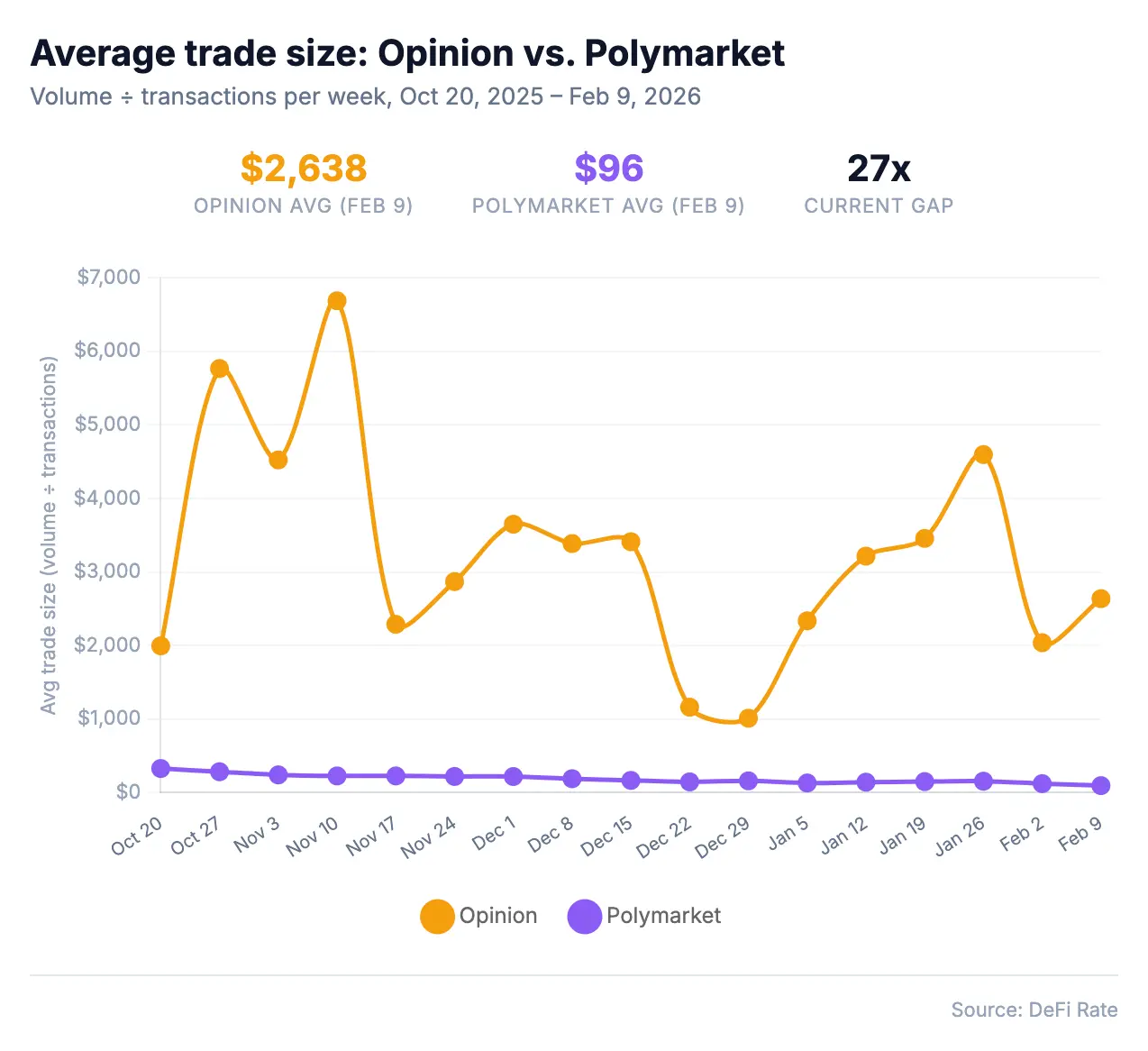
The core issue is not the size of the transaction volume, but the ratio between transaction volume and transaction count. In January 2026, Opinion's $8.08 billion transaction volume came from 3.2 million transactions, averaging about $2,525 per transaction. In the same period, Kalshi generated $9.55 billion from 54.5 million transactions, averaging $175 per transaction; Polymarket produced $7.66 billion from 52 million transactions, averaging $147 per transaction. Simply put, Opinion produced 31% of the industry's transaction volume with less than 3% of the transaction count.
This ratio has never normalized over several weeks of data. The most extreme week was November 10: Opinion produced $1.46 billion in transaction volume from 218,582 transactions, averaging as high as $6,688 per transaction; in the same week, Polymarket generated $952 million from 4.19 million transactions, averaging $228 per transaction. Opinion's transaction count was one-nineteenth that of Polymarket, yet its transaction volume exceeded it by 53%.
By February 9, Opinion accounted for 13.2% of the industry's transaction volume but only contributed about 0.7% of the transaction count, a 19:1 ratio that no other prediction platform has come close to.
2. Abnormal Per Capita Transaction Volume: Do New Users Actually Raise the Average Transaction Volume?
The normal growth logic for platforms is that as the user base expands, new retail investors lower the average transaction volume. Opinion's trajectory is exactly the opposite. According to DeFiRate data, when it launched in October, 20,534 users generated an average transaction volume of $38,537 per person per month; by January, the user count expanded to 101,954, and the average transaction volume doubled to $79,241, with the platform's scale growing fivefold.
Typically, new users would lower the average transaction volume of a platform. However, on Opinion, each batch of new users seems to increase the transaction volume? This is in stark contrast to the natural growth observed on platforms like Polymarket, where the average transaction volume per user grows steadily but slowly (from $4,852/user in August to $11,817/user in January, with user numbers increasing 2.9 times and transaction volume growing 2.4 times).
3. Dramatic Fluctuations in User Numbers, Only Appearing Normal During Holidays?
The user base of Opinion itself is another red flag. Over 17 weeks, the weekly active users surged from 11,124 to 67,913, then plummeted back to 18,098, with a fluctuation range of 6 times. The most significant fluctuation occurred between February 2 and February 9: within a week, the user count dropped from 67,804 to 18,098, shrinking by 73%. In contrast, Polymarket's user base fluctuated only 1.5 times over the same 17 weeks, showing a stable upward trend.
Notably, there is an abnormal return to normal values in the data: during the holiday period from December 22 to January 4. In these two weeks, Opinion's transaction count suddenly surged from the usual 300,000 to 600,000 transactions to 1.4 million to 1.8 million, while the average transaction size simultaneously dropped to $1,000 to $1,163. This was the only moment when Opinion's data profile resembled that of a normal prediction market, but once the holiday was over, the data immediately reverted to its previous abnormal state. 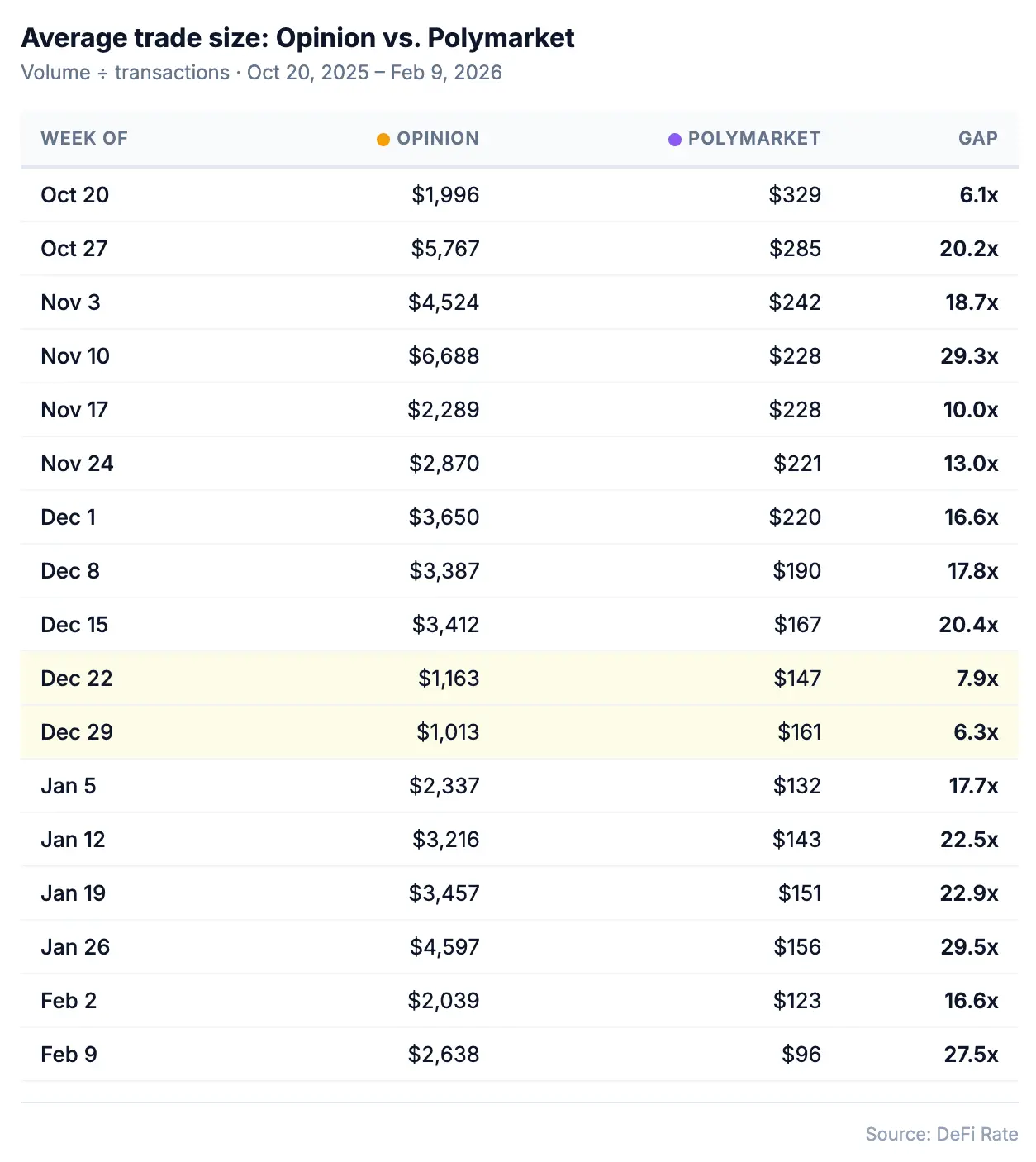
These anomalies are not without explanation. Opinion's points system explicitly states that transaction volume is one of the weights for earning points, directly encouraging users to place larger bets. Coupled with the airdrop expectations before the TGE and a no KYC environment, this creates a strong incentive for volume manipulation.
It is worth noting that researchers from Columbia University estimated in November 2025 that about 25% of Polymarket's total transaction volume over three years came from wash trading, with the sports market reaching as high as 45%. Polymarket does not even have a points system or explicitly calculate rewards based on transaction volume. Opinion, on top of these existing conditions, has a points mechanism that rewards large transactions, making the incentive for volume manipulation significantly present.
Extremely Low Airdrop Ratio, Users Criticize Being "Anti-Rollback"
Additionally, the airdrop distribution announced yesterday sparked strong backlash from the community. Although the official claim is that the total airdrop amounts to 23.5%, with an initial circulating supply of 19.85% at TGE, only 3.5% (about 8.2 million tokens) will be unlocked at launch, with the remainder released linearly over seven months. The rest is either insider trading or supply to Binance.
Compared to Opinion's high fees and complex points system, many users who have undergone months of real trading and incurred high costs find the allocation extremely meager, leading many deep participants to feel they have been "anti-rolled back" by the official team.
The impact of this ratio extends far beyond community sentiment. It also affects other prediction market projects under the Binance ecosystem, leaving users of PredictFun and Probable questioning whether there is really any expectation of returns in the Binance ecosystem's prediction markets.
Opinion's early launch should have endorsed the later entrants in this sector, but the 3% airdrop ratio and data doubts may very well deter potential users of PredictFun and Probable.
Finally, it cannot be denied that Opinion does have innovations at the technical level. Traditional prediction markets require manual review and manual setting of settlement conditions for each market, while Opinion uses AI oracles to complete this process almost instantaneously. This means it can cover scenarios far beyond just elections and sports events; changes in a DeFi protocol's TVL or the listing time of a token can all become a liquid prediction market within minutes.
Additionally, independent researcher Haotian mentioned that even if Opinion's transaction volume inevitably includes some wash trading to earn OPN points, "setting aside wash trading, if a platform has a significant proportion of institutional and arbitrage users in its user profile, it actually indirectly verifies the capacity of its underlying infrastructure."
"It can allow large funds to hedge precisely in the prediction market like derivatives, rather than just gambling at the retail level. This is the goal that future prediction markets 2.0 should strive for."
It can be said that after the TGE, Opinion will face a brutal retention test: after the incentive for points is removed, how many people will still be willing to stay and genuinely use this platform? Can the macro prediction market attract enough institutional users to support organic trading volume?
 Risk warning




Popular articles