Cryptocurrency exchanges are launching a battle for VIP customers
 Core Viewpoint

 The real challenge is that, currently, no institution possesses top-notch crypto liquidity and execution capabilities, clear fiduciary responsibilities and legal protections, as well as professional allocation capabilities across asset classes.
Author: Zhou, ChainCatcher
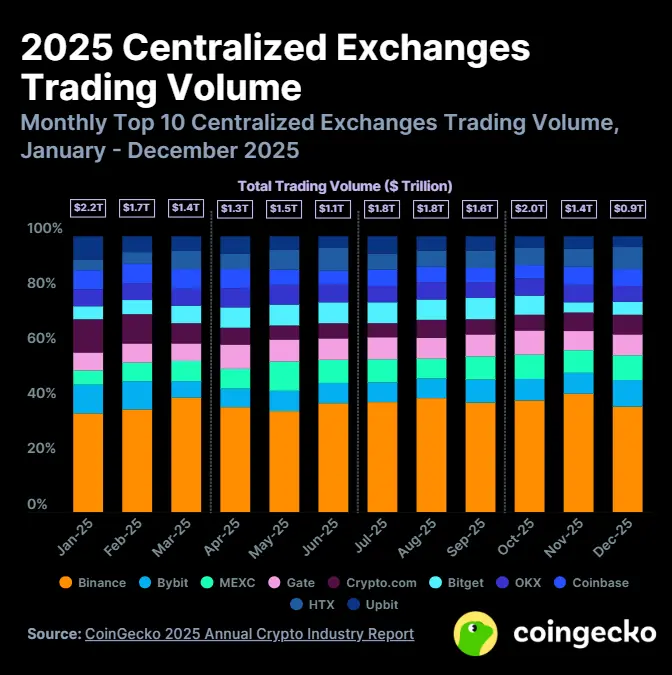
Data shows that the monthly trading volume of cryptocurrencies has declined from a peak of about $2.2 trillion in October 2025 to about $880 billion in March 2026, a drop of over 60%, marking the lowest trading volume since 2022.
The bear market has made the anxiety of exchanges impossible to hide.
On March 18, Binance announced a reduction in VIP thresholds, lowering the entry-level VIP 1 holding requirement from 25 BNB + $500,000 to 5 BNB + $100,000, a decrease of nearly 80%.
At the same time, OKX launched a program for large clients with assets over $100,000, and Bitget set its VIP threshold at $30,000, with various platforms raising the interest rates on their financial products.
Why have VIP clients become a battleground?
The VIP system of exchanges typically covers three types of groups: institutional clients (hedge funds, family offices), market makers, and high-net-worth individuals, commonly referred to as "whales."
Cryptocurrency exchanges exhibit a clear concentration characteristic in trading volume: for example, at Coinbase, a small number of institutional/VIP users usually contribute about 80% of the trading volume, while the majority of retail users contribute less than 20%.
With the arrival of the bear market, the contradictions in this structure began to emerge.
Retail investors were the first to retreat. Although institutional clients are more stable, they have their own asset management logic, shifting more towards hedging, reducing leverage, or moving funds to custodial accounts during the bear market, leading to a significant decrease in active trading frequency.
The ones who truly remain and continue trading are those high-net-worth individuals. They hold large positions, have judgment on market fluctuations, and possess the willingness and ability to actively manage assets, generating considerable trading demand even in a bear market.
These individuals are the last support for income during the bear market, with a single account potentially contributing hundreds of times the fees of an ordinary retail investor. Once they are also forced to leave, the revenue base of the platform will completely collapse.
Internal issues and external strong competitors
It is not easy for exchanges to retain them.
While fees and interest rates are the most direct competitive weapons, they are also the easiest to replicate. MEXC's zero-fee strategy resulted in a 90.9% surge in trading volume in 2025, jumping to third globally, but users attracted by subsidies can also be taken away by higher subsidies. The endpoint of this arms race is a collective compression of profits across the industry.
The deeper issue lies in the profit structure itself. Exchanges are both service providers and product issuers. When platforms recommend financial products to large clients, they often recommend solutions that maximize their own profits, which may not necessarily be the best choice for the client.
Another problem is that trust accumulation among users is slow, but its depletion can happen in an instant. Perhaps most people have yet to recover from the "1011 incident", when a pricing flaw at a certain CEX triggered a chain liquidation, resulting in over 2 million accounts being liquidated globally, one-third of market makers being destroyed, and the balance sheets of trading platforms being severely impacted, leading to a "limping" ecosystem. In the aftermath, many large clients turned to competing platforms like Hyperliquid, and some users have yet to regain trust in centralized exchanges.
In addition to systemic risks, security incidents also leave users feeling apprehensive. In February 2025, Bybit suffered the largest single exchange hack in history, losing about $1.5 billion, with its market share plummeting from 10% to 6%. Many users quickly switched platforms, and their migration costs were far lower than exchanges anticipated; a single security incident was enough to wipe out long-maintained customer relationships in a matter of hours.
However, what is now more challenging is that the competition for exchanges does not only come from peers.
Traditional private banks are systematically entering the market. DBS provides institutional-level custody, 24-hour trading channels, and compliance reporting services for high-net-worth clients through its DDEx platform, with its cryptocurrency holdings surpassing gold. The cryptocurrency trading volume for the entire year of 2025 has maintained rapid growth, significantly increasing compared to previous years.
Family offices are also bypassing exchanges to establish their own allocation channels. The demand for cryptocurrency asset allocation among high-net-worth families in Asia continues to rise, and the number of licensed digital asset wealth management institutions in Singapore and Hong Kong has significantly increased in the past two years, with clients increasingly preferring to enter through regulated independent asset management channels rather than opening accounts directly on exchanges.
On-chain native tools are also encroaching on the territory of exchanges. MetaMask launched the MetaMask Card in 2025, allowing high-net-worth individual users to directly spend their cryptocurrency assets in their wallets, simultaneously launching its own stablecoin mUSD and on-chain perpetual contract trading functions, enabling a complete closed loop of holding, trading, and consumption without leaving the wallet.
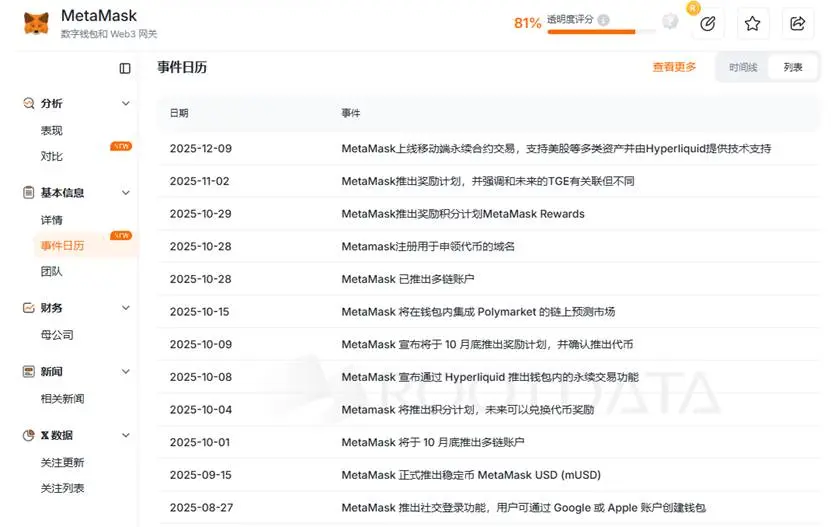
Image source: RootData
These external platforms pose a real threat to exchanges: private banks have fiduciary obligations, legally binding service providers to prioritize client interests; cross-asset allocation capabilities allow high-net-worth clients to see a complete wealth picture in one place; on-chain tools return the initiative of asset management to users themselves. These are structural gaps that exchanges find difficult to bridge with fees and interest rates.
Exchanges are increasingly resembling banks
Faced with external competition and internal pressure, exchanges are moving towards a banking model.
The first step is to lower VIP thresholds. Binance, OKX, and Bitget have successively adjusted their thresholds for large clients, forming a tiered coverage from $30,000 to $100,000, bringing medium-sized users who were previously outside the VIP system into the competition.
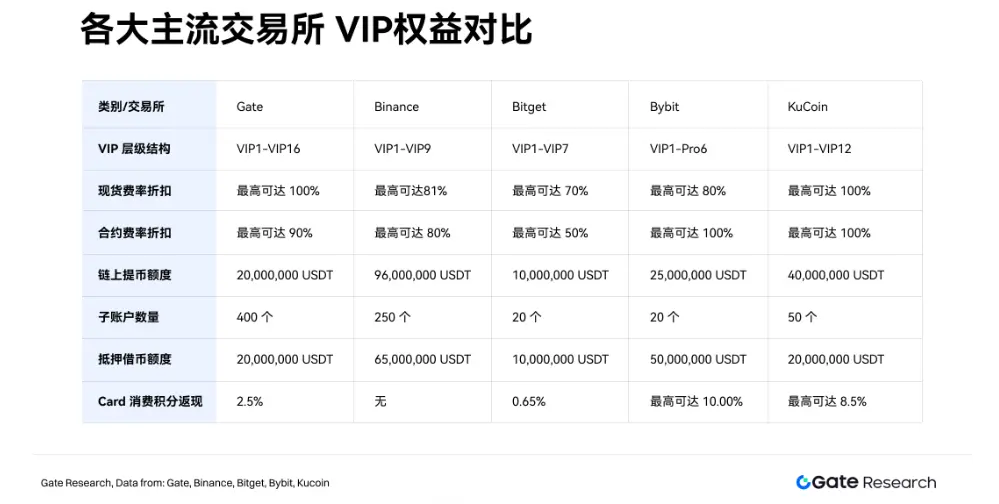
Binance also launched a "VIP Rising Star" level, where holding $30,000 qualifies users for this status, offering customized support and exclusive events, along with an accelerated promotion pathway. This design directly replicates the client cultivation logic of private banks, establishing relationships while client asset scales are still small, so when they grow into true large clients, their willingness to migrate is already very low.
The second step is income products. High-interest financial products, structured products, and Staking aggregation are being launched by various platforms. Some platforms offer annualized interest rates on flexible financial products exceeding 10%, with the common logic being, to keep the money on the platform first.
The third step is service upgrades. Dedicated account managers, invitations to offline private board meetings, customized lending solutions, and priority withdrawal channels—these standard client maintenance methods of private banks are being replicated one by one by exchanges.
Accepting deposits, issuing loans, providing financial products, and charging custody service fees—this logic is being practiced by both Binance and Coinbase, increasingly resembling a bank. However, banks have central banks backing them, deposits are insured, and client assets are legally protected. Exchanges have the deepest liquidity and the largest user base in the industry, yet they have never truly become trusted wealth managers for large clients, and the root cause lies here.
However, the internal competition among exchanges may be a rare dividend period for ordinary users. Just like banks offer free gifts, waive annual fees, and provide points when competing for clients, this battle among exchanges also allows ordinary users to enjoy lower fees, higher financial returns, and better service experiences. But ultimately, the cost will fall on the users; how long this subsidy can last depends on the exchanges' pockets and patience.
Who can truly retain large clients?
The bear market is accelerating this reshuffling.
In the short term, leading exchanges still hold the strongest liquidity moat. Large clients, in extreme market conditions, will still prioritize platforms that "can take the orders," which is difficult to replace in the short term with private banks or on-chain tools.
But in the medium to long term, compliance and fiduciary status will be the real dividing line. Exchanges can desperately lower VIP thresholds, pile up financial interest rates, and replicate private bank services, but they will always struggle to resolve a deep-seated contradiction: they are both trading counterparties and product issuers while wanting to act as wealth managers. This role conflict, combined with frequent security incidents and a lack of a compliance moat, constitutes the biggest barrier to trust for large clients.
The real challenge is that currently, no institution possesses both top-tier cryptocurrency liquidity and execution capabilities, clear fiduciary responsibilities and legal protections, as well as professional allocation capabilities across asset classes. Traditional private banks excel in the latter two points, exchanges lead in the former, and on-chain native tools attempt to bypass all issues through decentralization. All three forces are squeezing towards the middle ground, and the one most likely to win is the player that first truly combines "liquidity + trust."

 Risk warning


Popular articles