JST's third round of repurchase and destruction has been implemented: tens of millions in ecological benefits are being reinvested, initiating a new long-term value Alpha cycle
 Relying on the strong "self-sustaining" ability of JustLend DAO, JST has completed a buyback and burn worth tens of millions of dollars. The deflationary flywheel is operating at full speed, initiating a new cycle of long-term appreciation.
Recently, according to the latest progress disclosed by officials, the third round of repurchase and destruction of JST tokens has been steadily implemented, with a total destruction scale of approximately $21.3 million. As a rare high-frequency, large-scale, and fully transparent deflationary plan in the industry, this move not only significantly reduces the circulating supply in the market but also marks a critical leap in JST's value model towards the "extreme deflation" stage.
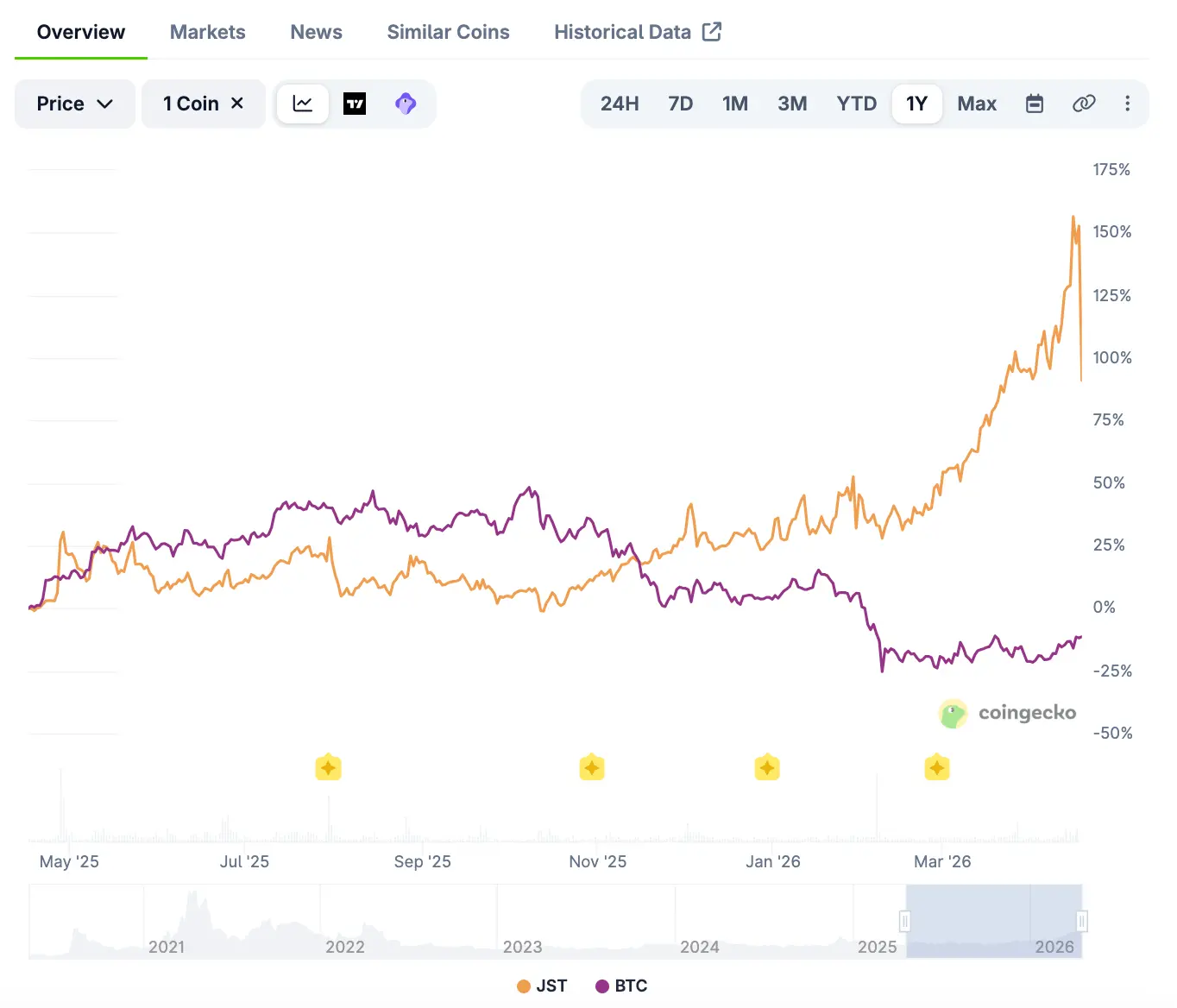
As we enter the volatile market of 2026, when mainstream crypto assets like BTC and ETH face challenges from macroeconomic uncertainties, JST has demonstrated remarkable resilience in reverse growth due to its rigid deflationary mechanism. Data shows that since the launch of the repurchase and destruction plan, the price of JST has continued to rise, outperforming the market. In a market environment where liquidity is becoming cautious, JST, with its absolute scarcity brought about by deflation, has become a value high ground for funds seeking "excess returns (Alpha)."
The third round of repurchase and destruction has been steadily implemented, and JST's deflationary flywheel has opened a new channel for long-term appreciation.
The recently implemented third round of destruction, both in terms of capital scale and market depth, is a milestone in the evolution of JST's value, fully demonstrating the strong "blood generation" ability and ecological interactivity of the JUST ecosystem.
According to the latest announcement, this round executed the destruction of approximately 271,337,579 JST tokens, with a total value exceeding $21.3 million, with repurchase funds sourced from all protocol revenues of JustLend DAO for Q1 2026, as well as about 30% of the existing revenue from the SBM market. It is worth emphasizing that with the completion of the third round of repurchase and destruction of JST, it marks that this mature deflationary mechanism has evolved into a normalized institutional operation.
Looking back to October 21, 2025, the JustLend DAO community officially passed the proposal for the JST repurchase and destruction mechanism, clearly stating that the existing revenue of the protocol, future net income, and the portion exceeding $10 million from the USDD multi-chain ecosystem income would be fully used for repurchase and destruction.
Under the guidance of this mechanism, the decentralized community organization Grants DAO of JustLend DAO has steadily advanced: the first round destroyed 559,890,753 JST, the second round destroyed 525,000,000 JST, and with the implementation of this third round, as of now, the total amount of JST destroyed in the first three rounds has officially exceeded 1,356,228,332 tokens, accounting for 13.7% of the total supply of JST.
For investors, the continuous rise in the destruction ratio means that every JST they hold represents an increasing ecological interest. This large-scale reduction in supply has an objective and direct effect on boosting the token's value. In recent market fluctuations, when many DeFi protocols faced price pressure due to selling pressure from liquidity mining, JST, with its sharp contraction in supply and rigid support from buying, has charted a beautiful independent curve.
The real feedback from the market perfectly confirms this deflationary logic. As of April 16, CoinGecko data shows that, supported by a robust protocol fundamental, JST's total market capitalization has exceeded $500 million. Since the launch of the JST repurchase and destruction plan, the token price has shown a reverse growth momentum, demonstrating unique "Alpha attributes" during market fluctuations. JST has completely opened up its long-term appreciation space in the market through endogenous deflationary drive.
From the core engine of JustLend DAO to the explosion of USDD, exploring the funding engine of JST's extreme deflation.
The underlying logic of why JST can continuously invest huge amounts of funds for repurchase during market volatility stems from the strong "internal circulation" blood generation ability of the JUST ecosystem. Data from April 13 shows that the overall TVL of the JUST ecosystem has strongly surpassed $11.2 billion, accounting for approximately 42% of the total DeFi on the TRON network. This level of capital accumulation makes the JUST ecosystem an indispensable financial base on the TRON network. It is this massive ecological scale and high-frequency on-chain interactions that provide a continuous and highly certain funding base for JST's extreme deflation.
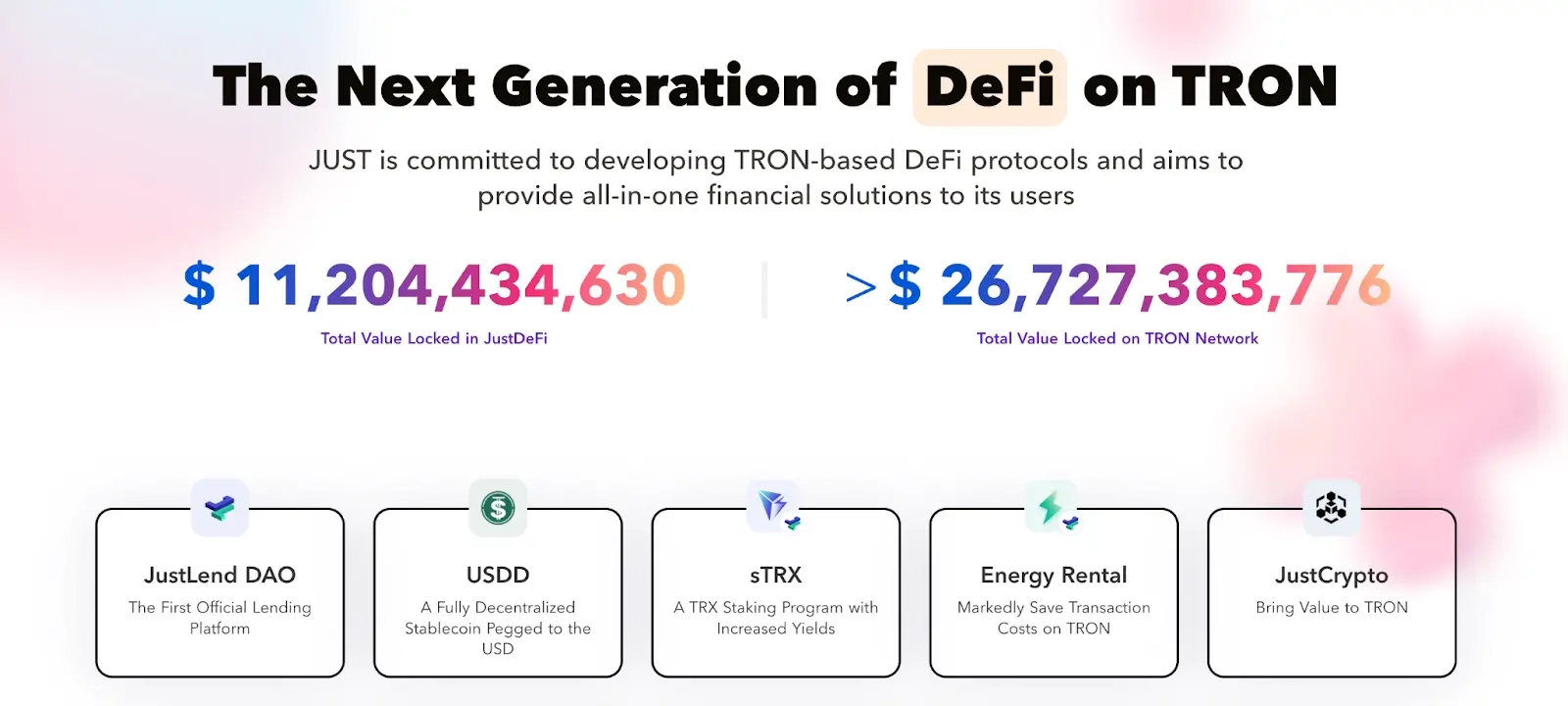
As the core of the JUST ecosystem, JustLend DAO's performance is particularly eye-catching. JustLend DAO is a leading decentralized lending protocol on the TRON network, with its TVL consistently stable above $6 billion, a total supply exceeding $3.6 billion, and a net income of $10,972,770 in Q1 2026.
Relying on a large liquidity volume, its core staking lending (SBM) business has demonstrated strong profitability conversion ability. According to the disclosed revenue data, the SBM market has transferred a total income of $10,340,249 directly for JST repurchase. This injection of tens of millions of dollars is not only a concentrated explosion of long-term value accumulation in the SBM market but also makes it undoubtedly the strongest engine driving JST's extreme deflation.
Additionally, the TRX liquid staking (sTRX) business, as the main source of income for the protocol, also provides continuous and stable cash flow support for the ecosystem. As of April 13, the total locked amount of sTRX has surpassed 9.4 billion TRX, with an average annualized return of about 6.17% over the past week. This not only greatly enhances the capital utilization efficiency of the underlying assets on the TRON network but also brings users objective and sustainable revenue sharing.
Moreover, JustLend DAO's unique energy leasing business further locks in deep on-chain funds. This feature precisely addresses the energy consumption pain points faced by developers and ordinary users when executing smart contracts. Currently, the average daily leasing scale of JustLend DAO's energy market remains stable at the hundred billion level, with renting 100,000 energy costing only 5.1 TRX. Compared to directly burning TRX to pay network fees, this mechanism significantly reduces the high transaction friction costs for users. This underlying essential service, which combines "ultra-high concurrency" and "extreme cost-effectiveness," further solidifies the funding base for JST's repurchase and destruction.
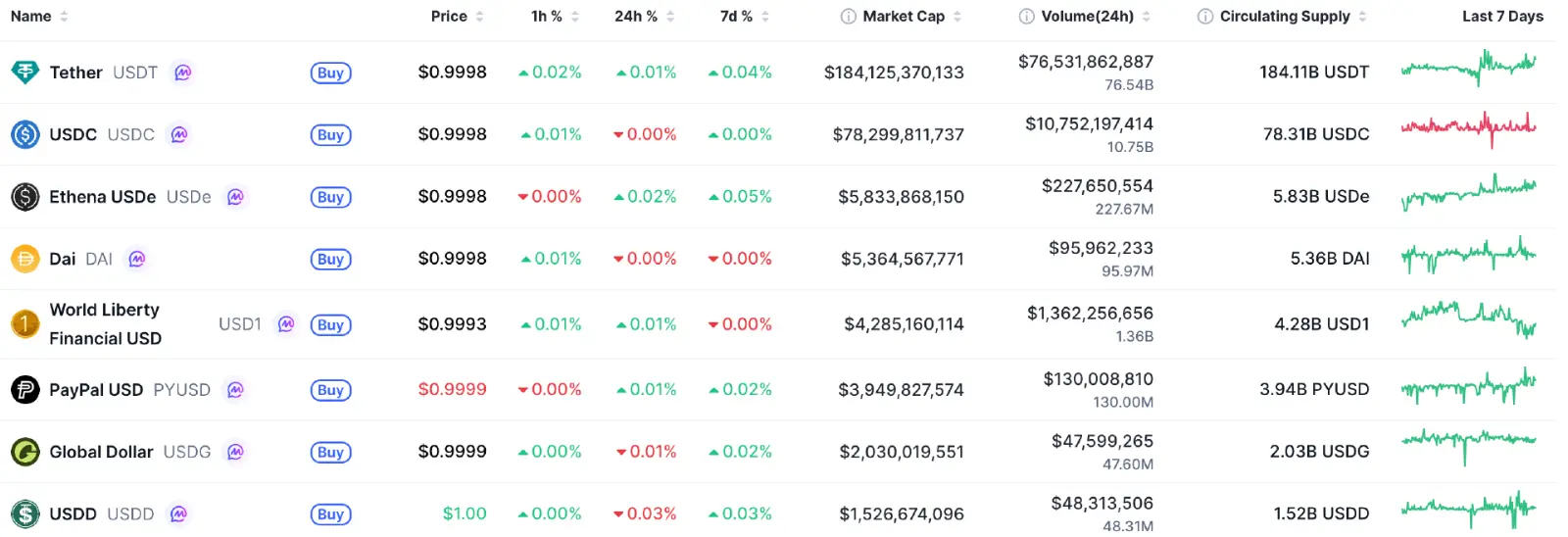
As another core cornerstone of the JUST ecosystem, the strong performance of the decentralized over-collateralized stablecoin USDD is noteworthy. Although the current USDD multi-chain ecosystem revenue has not yet reached the $10 million repurchase threshold set by the mechanism design, and thus has not been included in this round of destruction funds, the continuous explosive growth of its core data indicates that this potential profit engine is ready to take off. Entering 2026, USDD is ushering in a comprehensive explosion period of ecological development. As of April 13, the circulation of USDD has surpassed $1.46 billion, and the total TVL across the network has also exceeded $2.13 billion. CoinMarketCap data shows that USDD has entered the top ten stablecoins in the global crypto market, firmly holding the 8th position.
This leap in market position is attributed to its continuously enriched application scenarios and asset depth. Recently, the USDD ecosystem launched two WBTC vaults. This feature allows users to directly mint USDD on the TRON network using BTC-backed collateral. With a stable fee rate as low as 2.5%, a very low collateral rate of 130%, and a minimum threshold of 1,000 USDD (approximately 0.02 WBTC), it greatly activates users' idle assets and enhances capital utilization. Thus, the USDD collateral pool now fully supports diverse core assets such as TRX, sTRX, USDT, and WBTC, building a highly resilient over-collateralized network.
More importantly, the JUST ecosystem has constructed a highly explosive "dual-engine driven" repurchase matrix. Currently, the continuous lending profits from JustLend DAO serve as the core driving force, providing ample ammunition for JST's ongoing deflation. At the same time, the rapid expansion of the underlying reserve assets of USDD is accumulating massive potential. According to the mechanism design, once the multi-chain ecosystem revenue of USDD crosses the $10 million baseline threshold, this substantial excess dividend will serve as a new driving engine, flowing into the JST destruction fund pool.
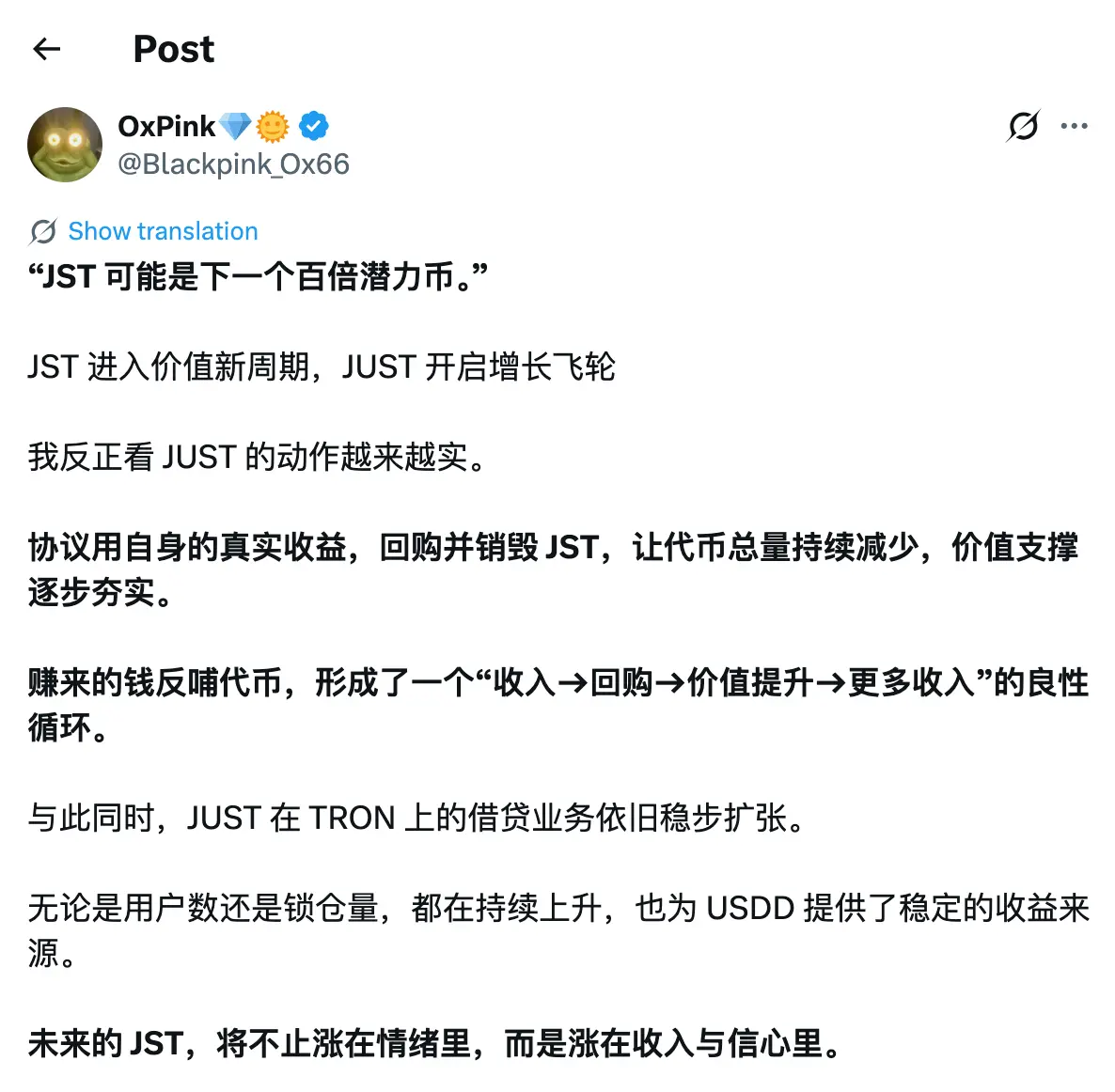
This "current support + future explosion" mechanism design activates a self-reinforcing "positive flywheel." Well-known KOL in the crypto industry @Blackpink_Ox66 stated on social media: "JST may be the next hundredfold potential coin." He keenly pointed out that JUST's actions of repurchasing and destroying tokens with its real earnings are becoming increasingly tangible, and this virtuous cycle of "income feeding back to tokens" is continuously solidifying its underlying value. As he summarized: "In the future, JST will not only rise in sentiment but will rise in income and confidence."
Looking at the development trajectory of decentralized finance, true asset accumulation often stems from the blood generation ability at the protocol's core. The smooth advancement of JST's third round of repurchase and destruction is not only an important sign of the normalization of its deflationary mechanism but also a core manifestation of the JUST ecosystem's realization of a virtuous value closed loop. As the market gradually returns to rationality, with an ecological scale exceeding $10 billion in TVL, and the diverse profit matrix constructed by JustLend DAO and USDD, the JUST ecosystem has successfully transformed stable protocol cash flows into long-term asset premium expectations for the token. Looking ahead, as the TRON DeFi landscape continues to expand, this endogenous deflation model, which does not rely on external leverage, will further solidify the supply-demand structure of JST, providing the most solid certainty support for its long-term value discovery in the crypto market.
 Risk warning

Popular articles