Morning Report | Anthropic plans to raise $50 billion; Arbitrum DAO votes to approve the release of frozen ETH proposal; Multi Investment completes approximately $616 million financing
 Overview of Important Market Events on May 8th
整理:ChainCatcher
Important News:
- HYPE Treasury Company Hyperliquid Releases Financial Report: Net Loss of $165 Million for the Nine Months Ending March 31
- Anchorage CEO: About 20 Banks and Tech Giants Are Queuing to Issue Stablecoins Through the Company
- Arbitrum DAO Votes to Approve Release of Frozen ETH Proposal
- Anthropic Plans to Raise $50 Billion, Valuation May Reach $900 Billion
- OpenAI Chip Project $18 Billion Financing Hits Snag, Lenders Are Cautious About AI Infrastructure Returns
- Bitwise to Take Over Superstate's $267 Million Tokenized Crypto Arbitrage Fund
- Multi Investment Completes Approximately $616 Million Financing to Increase Investments in Blockchain and Web3
What Important Events Happened in the Last 24 Hours?
Deutsche Bank Increases Stake in Strategy Stock to 785 Million Shares, Valued at $140 Million
According to ChainCatcher, Deutsche Bank, with total assets of $2.1 trillion, disclosed an increase in its stake in Strategy stock by 53,215 shares, valued at $9.5 million, bringing its total holdings to 784,919 shares, with a total value of $140 million.
Multi Investment Completes Approximately $616 Million Financing to Increase Investments in Blockchain and Web3
According to ChainCatcher, Swiss investment firm Multi Investment announced the completion of 480 million Swiss francs (approximately $616 million) in financing, with assets under management exceeding 3 billion Swiss francs, aiming to further advance its portfolio diversification strategy, focusing on high-growth areas such as fintech, deep tech, blockchain, and Web3.
Multi Investment plans to increase investments in these strategic areas before the third quarter of 2026, with multiple transactions currently under evaluation, while also rapidly expanding its influence in related emerging ecosystems.
Coinbase CEO Has Cashed Out Approximately $550 Million Through COIN Over the Past Year
According to ChainCatcher, tracking system OpenInsider shows that from May 2025 to present, Coinbase founder and CEO Brian Armstrong has sold over 1.5 million shares of COIN, totaling approximately $550 million.
Additionally, Coinbase announced its Q1 2026 financial report today, showing a net loss of $394 million, with total revenue dropping to $1.41 billion.
Zcash CEO: Quantum Recoverable Wallet to Launch Within a Month, Full Quantum Protection by 2027
According to ChainCatcher, at the Consensus 2026 Miami conference, Zcash Open Development Lab CEO Josh Swihart announced that Zcash will launch a quantum recoverable wallet within a month and achieve full post-quantum status within 12 to 18 months.
Additionally, the independent scaling solution aims to achieve Mastercard/Visa-level throughput within a similar timeline. On the user side, Electric Coin Company's wallet has implemented cross-chain swaps from assets like BTC, SOL, and USDC to privacy-focused ZEC through integration with Near Intents, with approximately $600-700 million in funds flowing through this route since its launch. The Near ecosystem's 30-day processing volume is close to $800 million, with Ethereum, Solana, and Zcash being the main chains.
Moreover, the project community is discussing reducing Zcash's block time from 75 seconds to 25 seconds, and cross-chain bridges with Solana and Hyperliquid have gone live. The token holder voting feature will also be launched to serve the existing consensus model of the project. Currently, Zcash's shielded pool accounts for 30% of its circulation, reaching a historical high. Analysts believe that if this ratio continues to grow with price increases, this round of growth will be driven by real adoption rather than mere speculation.
Bitwise to Take Over Superstate's $267 Million Tokenized Crypto Arbitrage Fund
According to ChainCatcher, Bitwise Asset Management and Superstate jointly announced that Bitwise will take over the investment management responsibilities of the Superstate Crypto Carry Fund (USCC), which is a tokenized spot arbitrage strategy fund managing approximately $267 million in assets. The transaction is expected to be completed by June 1, and the fund will be renamed Bitwise Crypto Carry Fund, while retaining existing codes, smart contracts, and token addresses.
Bitwise will be responsible for portfolio management, while Superstate will continue to operate the on-chain infrastructure, including tokenized issuance and digital transfer agency services. This is Bitwise's first tokenized fund, and it marks the second time this year that Superstate has transferred a fund to a large asset management company, following Invesco's takeover of its $967 million tokenized treasury bond fund USTB.
Superstate is shifting from fund operations to focus on its tokenized infrastructure platform FundOS, and Coinbase Asset Management's Crypto Yield fund also went live on this platform last week.
Arbitrum DAO Votes to Approve Release of Frozen ETH Proposal
According to ChainCatcher, Arbitrum DAO voted to approve the release of the frozen ETH proposal, with a support rate of 90.96%. The proposal includes a request for Arbitrum governance to approve the release of 30,765.67 ETH frozen by the Arbitrum Security Committee on April 21, and to transfer the funds into a 3/4 multi-signature wallet jointly controlled by Aave Labs, KelpDAO, EtherFi, and Certora, which will be specifically used for recovery work after receiving the ETH frozen by Arbitrum.
Anthropic Plans to Raise $50 Billion, Valuation May Reach $900 Billion
According to ChainCatcher, AI company Anthropic is considering launching a new round of financing this summer, with a maximum scale of $50 billion and a pre-financing valuation of approximately $900 billion, potentially surpassing OpenAI to become the highest-valued AI company globally.
Currently, institutions such as Dragoneer, General Catalyst, and Lightspeed Venture Partners have expressed investment intentions. Sources reveal that Anthropic's annualized revenue is about to exceed $45 billion, growing nearly fivefold from $9 billion at the end of last year; this round of financing is expected to be completed within two months and pave the way for an IPO within the year.
According to ChainCatcher, The Information reports that OpenAI has been unable to complete approximately $18 billion in financing from external lenders, which was originally planned to support the early deployment of its custom chip project developed in collaboration with Broadcom. The project plans to deploy OpenAI's self-developed chips with 10 gigawatts of computing power, which is a core strategy for the company to reduce its reliance on Nvidia, with the original agreement announced in October 2025 having a total hardware construction scale of about $500 billion.
The background of the financing setback is that lenders are becoming increasingly cautious about AI infrastructure deals secured by OpenAI's expected revenues, compounded by recent reports that OpenAI has not met internal growth targets, further heightening investor concerns. More broadly, capital expenditures for large-scale enterprise AI in 2026 are estimated to reach $600 to $720 billion, but Nvidia's accounts receivable are nearing $33 billion, indicating that buyer settlement cycles are generally extended. OpenAI currently faces three paths: restructuring this batch of financing, changing lenders, or scaling back chip deployment.
According to ChainCatcher, Tydro, the largest lending protocol under Kraken's Ink Layer 2, announced yesterday that it would keep the market suspended until the migration to Chainlink price oracle is completed. On May 4, the risk management agency Chaos Labs notified Tydro that its oracle provider had been attacked, with the attack mode resembling that of a state-level attacker, recommending an immediate suspension of all markets.
Tydro stated that there were no abnormal price pushes to its market before or after the suspension, and user positions were unaffected. About 48 hours later, Chaos Labs confirmed that the compromised keys had been rotated, technically allowing for recovery, but Tydro chose to remain suspended until the second oracle push was in place. Once the Chainlink migration is completed, a 48-hour time lock will be triggered, and a four-hour grace period will be set to allow borrowers with health factors below 1 to repay or add collateral without being liquidated. Tydro is a white-label deployment of Aave v3, and the total market size has recently exceeded $700 million.
According to ChainCatcher, Binance founder Zhao Changpeng stated at the Consensus conference that he hopes to restart Binance.US to allow U.S. users to regain access to global crypto liquidity. He pointed out that cryptocurrency is one of the few markets where Americans cannot obtain optimal prices, while Binance has the best liquidity in that market.
Zhao noted that U.S. crypto policy has changed over the past year and a half, and the U.S. is now in a leading position globally, with many developers and crypto companies that previously left are returning. Zhao also stated that BNB Chain's exposure in the U.S. is insufficient, while other Layer 1 blockchains have done more marketing and community building in the U.S., and the restricted access to BNB for institutions has instead provided opportunities for investors.
He believes that AI agents need to transact through crypto payment rails, and that blockchain is more suitable for automating cross-border payments than credit cards or banking systems, with BNB Chain positioned as the payment infrastructure for AI agents.
Anchorage CEO: About 20 Banks and Tech Giants Are Queuing to Issue Stablecoins Through the Company
According to ChainCatcher, Anchorage Digital CEO Nathan McCauley stated at the Consensus conference that since the passage of the GENIUS Act, about 20 financial institutions and large tech companies are queuing to issue their own stablecoins through Anchorage.
He stated that Anchorage has won authorization for all major stablecoin issuances in the market, with clients including banks looking to achieve specific goals and stablecoin issuers with distribution channels. McCauley believes that agency commerce is reshaping the industry landscape, and that stablecoins and digital assets are reconstructing money itself, a trend that is still severely underestimated by the market.
Slow Mist: High-Risk Vulnerability Dirty Frag Exposed in Linux System, Users Must Upgrade Promptly
According to ChainCatcher, Slow Mist's Chief Information Security Officer 23pds disclosed that the Linux system has been exposed to a privilege escalation vulnerability named Dirty Frag, with complete details and exploit code made public. This vulnerability allows any local low-privilege user to directly obtain root privileges on almost all mainstream Linux distributions, representing a deterministic logic flaw that does not rely on complex race conditions, has a high success rate, and does not cause kernel crashes, posing significant danger. Linux users are advised to upgrade their systems promptly.
According to ChainCatcher, the on-chain detective ZachXBT, who claims to be an "anti-fraud fighter," is increasingly being pointed to another identity by on-chain behavior analysis: he is not a lone righteous messenger, but more like a "public spokesperson" for a premeditated short-selling team. Multiple "preview-style revelations" have triggered token price crashes, with accusations of pre-positioning short positions and coordinated efforts behind the scenes.
At the same time, ZachXBT himself is also embroiled in serious controversy. In 2025, he received 50% of the supply of the meme coin ZACHXBT, driving it up to an $88 million market cap before withdrawing nearly $4 million in liquidity, personally creating a "case investigation-style rug pull." Additionally, he has long accepted airdrops from project parties and rights protection coins without exception, dumping and cashing out every time; he earns over ten million dollars a year under an anonymous identity but has consistently refused to disclose his wallet and profit chain.
An anonymous account questioned as a market manipulator is now turning around to "judge" the industry—whether it is a voice of justice or a smokescreen for the next short-selling opportunity remains to be seen.
According to ChainCatcher, HYPE Treasury Company Hyperliquid Strategies disclosed its Q3 financial report on Thursday, currently holding approximately 20 million tokens. Since its establishment in December 2025, the company has invested $216 million to acquire about 7.3 million HYPE tokens. Hyperliquid Strategies went public last year through a merger with Sonnet BioTherapeutics, focusing on accumulating HYPE tokens through staking, yield optimization, and ecosystem participation to maximize shareholder value.
In addition to buying HYPE, the company also deployed $10.5 million to repurchase approximately 3 million shares of PURR stock at an average price of $3.42 per share. The company maintains a cash position of $103 million for future treasury deployments, repurchases, and other corporate expenses.
For the nine months ending March 31, a net loss of $165.4 million was recorded. The announcement stated that the loss was "primarily attributed to" a $64 million unrealized net loss on HYPE tokens, a $35.6 million one-time write-down related to the acquisition of the legacy Sonnet business, and an increase of $60.5 million in deferred income tax expenses. For the three-month period ending March 31, staking income reached $2.6 million, with interest income increasing by $1 million, and operating expenses amounting to $7.2 million.
Meme Popularity Rankings
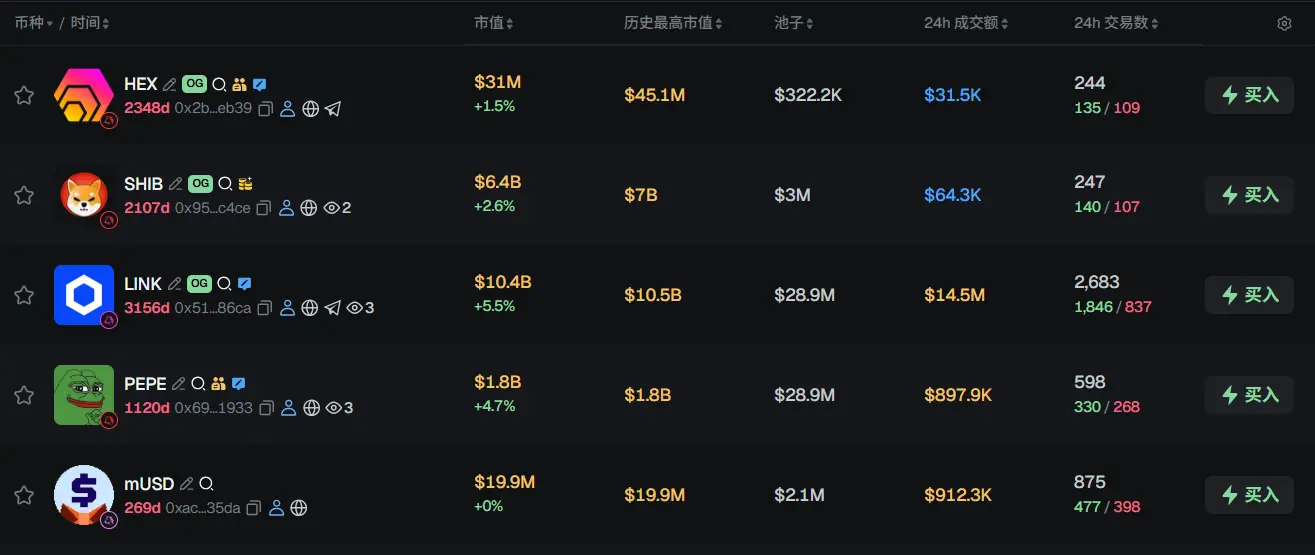
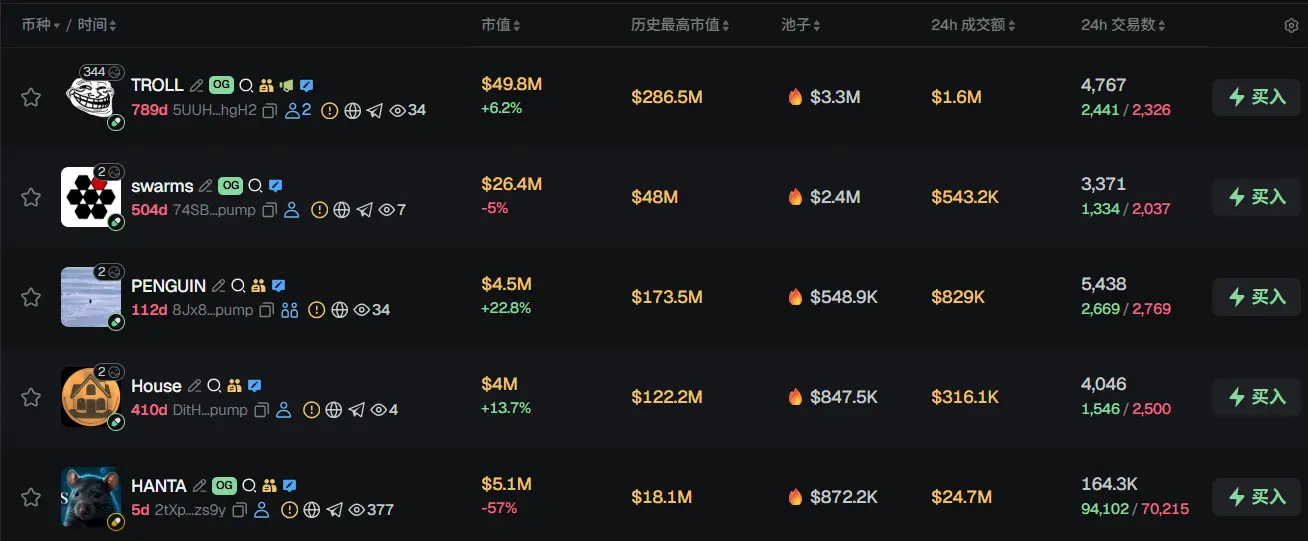
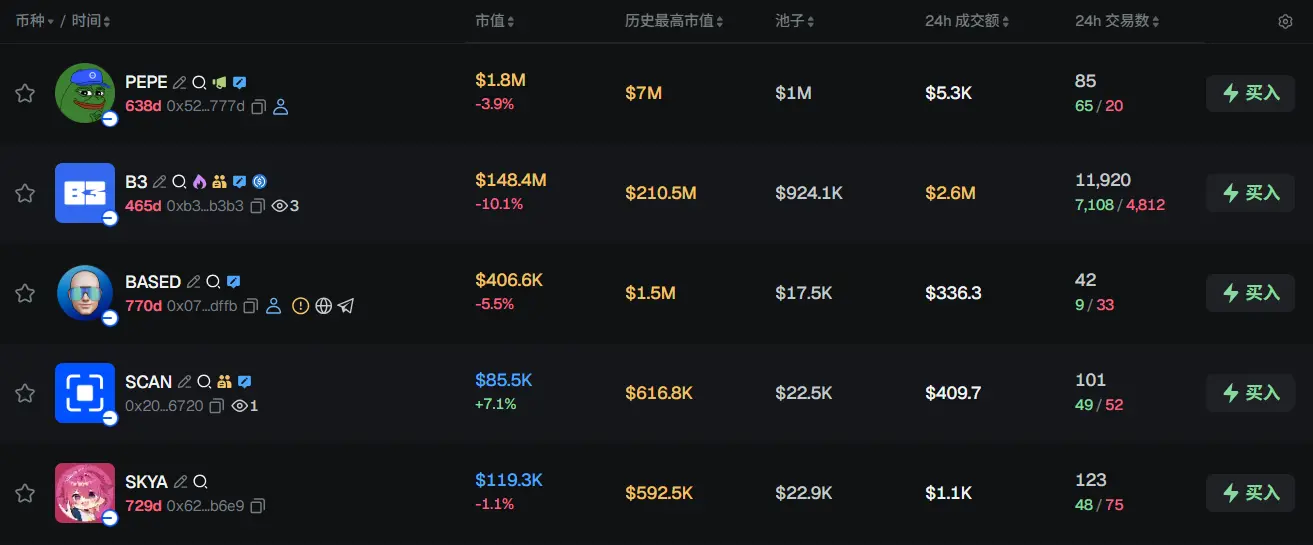
According to meme token tracking and analysis platform GMGN, as of May 9, 09:00,
The top five popular ETH tokens in the past 24 hours are: HEX, SHIB, LINK, PEPE, mUSD
The top five popular Solana tokens in the past 24 hours are: TROLL, swarms, PENGUIN, House, HANTA
The top five popular Base tokens in the past 24 hours are: PEPE, B3, BASED, SCAN, SKYA
What Are Some Noteworthy Articles to Read in the Last 24 Hours?
On May 7, after U.S. stock market hours, Coinbase released its Q1 2026 financial report. The data shows that the company's total revenue was $1.41 billion, a year-on-year decline of 31%.
Affected by unrealized losses on held crypto assets, the company recorded a net loss of $394 million, with a loss per share of $1.47, while the company achieved a net profit of $66 million in the same period last year.
After the financial report was released, Coinbase's stock price fell about 4.7% in after-hours trading, with a cumulative decline of over 15% this year.
Berkshire and SoftBank, "One Will Die"**
On May 2, 2026, in Omaha. This time, only a little over half of the 18,000 seats were filled—previously, Berkshire's shareholder meeting was a ticketed event with long queues, and hotels outside the venue were fully booked.
This time, 95-year-old Buffett did not host as in previous years; new CEO Greg Abel stood in front of the main screen, answering investors' questions about why Berkshire holds nearly $400 billion in cash.
In the same week, 6,000 miles away in Tokyo, Masayoshi Son's team was doing something else: packaging SoftBank Group's unprofitable AI assets to prepare for a new company called Roze AI, targeting a valuation of $100 billion, planning to go public in the U.S. in the second half of 2026.
The reason is simple: SoftBank must continue to find money to fund OpenAI's $64.6 billion check, which could eventually roll up to nearly $100 billion.
a16z Crypto Partner: Crypto Is Being Repackaged by Financial Institutions, Its Potential Will Far Exceed Expectations
The financial industry has superficially digitized, but the underlying systems still remain in the old era of paper, reconciliation, and system fragmentation. Wall Street is beginning to use blockchain to transform back-end systems, not for the sake of decentralization, but because it can solve old problems of multi-party coordination. And when the composability of on-chain assets is brought in, this transformation will ultimately go further than Wall Street expects.
 Risk warning