Crypto ETF Weekly | Last week, the net inflow of Bitcoin spot ETFs in the U.S. was $631 million; the net inflow of Ethereum spot ETFs in the U.S. was $70.3 million

 The U.S. SEC has postponed the review of the first batch of prediction market ETFs, which are linked to real events such as election outcomes and economic recessions.
Compiled by: Jerry, ChainCatcher
Performance of Crypto Spot ETFs Last Week
U.S. Bitcoin Spot ETF Net Inflow of $631 Million
Last week, the U.S. Bitcoin spot ETF had a net inflow over three days, totaling $631 million, with total assets under management reaching $10.661 billion.
Five ETFs were in a net inflow state last week, with the inflow mainly coming from BlackRock's IBIT, which had a net inflow of $596 million.
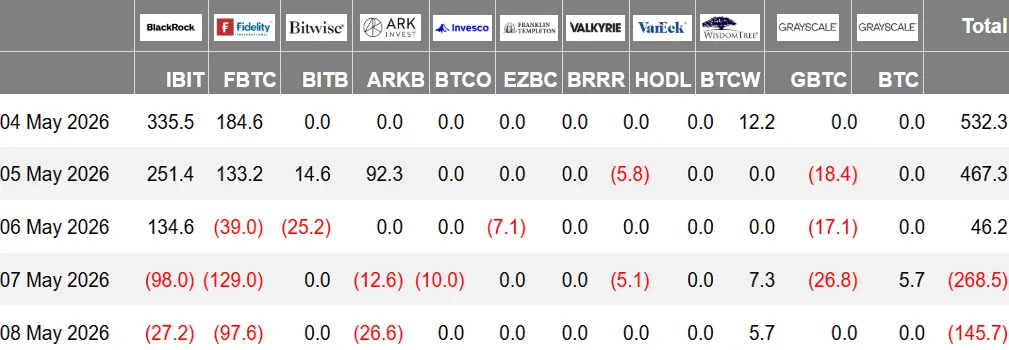
Data Source: Farside Investors
U.S. Ethereum Spot ETF Net Inflow of $7.03 Million
Last week, the U.S. Ethereum spot ETF had a net inflow over four days, totaling $7.03 million, with total assets under management reaching $1.373 billion.
The inflow last week mainly came from BlackRock's ETHA, which had a net inflow of $10 million. Three Ethereum spot ETFs were in a net inflow state.
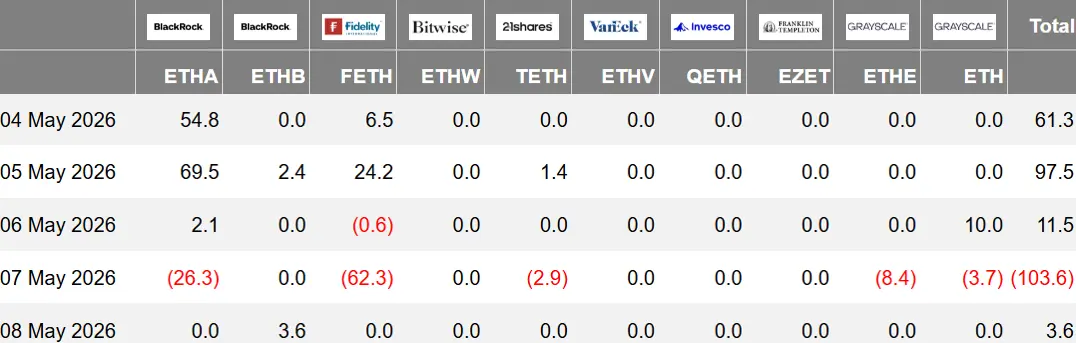
Data Source: Farside Investors
Hong Kong Bitcoin Spot ETF Net Inflow of 15.57 Bitcoins
Last week, the Hong Kong Bitcoin spot ETF had a net inflow of 15.57 Bitcoins, with total assets under management reaching $32 million. The issuer, Jia Shi Bitcoin, reduced its holdings to 211.01 Bitcoins, while Huaxia increased to 2,590 Bitcoins.
The Hong Kong Ethereum spot ETF had no capital inflow, with total assets under management at $6.849 million.
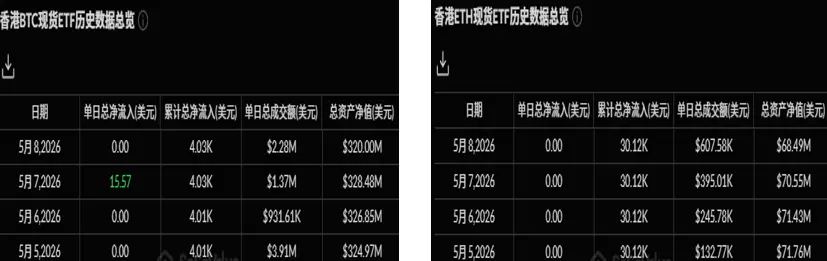
Data Source: SoSoValue
Performance of Crypto Spot ETF Options
As of May 8, the nominal total trading volume of U.S. Bitcoin spot ETF options was $976 million, with a nominal total long-short ratio of 2.90.
As of May 7, the nominal total open interest of U.S. Bitcoin spot ETF options reached $27.89 billion, with a nominal total long-short ratio of 1.51.
Market activity for Bitcoin spot ETF options has increased in the short term, with overall sentiment leaning bullish.
Additionally, the implied volatility is at 41.81%.

Data Source: SoSoValue
Overview of Crypto ETF Dynamics Last Week
Market analysis reports show that Coinbase and Kraken together account for 22% of all AI citations in crypto categories, with Coinbase at 13% and Kraken at 9%, leading by more than three times over other U.S. trading platforms.
Gemini ranks third with 5.5%, Robinhood Crypto ranks fourth with 5%, and BlackRock's spot Bitcoin ETF IBIT ranks fifth with 4.5%, dominating questions related to "Bitcoin ETF." The analysis points out that the influence of hardware wallets in AI responses is diminishing; while Ledger and Trezor still dominate questions about "best crypto wallets," AI is increasingly inclined to recommend regulated trading platform custody solutions for "best crypto asset storage methods."
The report suggests that the "self-custody narrative" that emerged after the FTX incident is no longer the dominant framework for AI citations. Furthermore, AI is rapidly shaping the landscape of retail crypto financial brands in the U.S., stating that "when users ask ChatGPT where to buy Bitcoin, platforms prioritized by AI will have the opportunity to define the industry landscape for the next decade."
According to Reuters, the U.S. Securities and Exchange Commission (SEC) has delayed the review of the first batch of prediction market ETFs, causing the planned launch of over 24 products to be postponed. Insiders revealed that the SEC is requesting issuers to further clarify product mechanisms and information disclosure details, and this delay is expected to be temporary.
Issuers such as Roundhill Investments, Bitwise Asset Management, and GraniteShares submitted applications in February this year to launch ETFs linked to real-world events like election outcomes, economic recessions, tech layoffs, and oil prices.
According to SEC rules, ETF applications typically become effective automatically 75 days after submission unless the regulatory agency intervenes. Currently, Roundhill has set May 5 as the effective date, and products from Bitwise and GraniteShares are also expected to launch around the same time. The market is closely watching whether the SEC will ultimately approve these products that open up the "event contract" asset class.
Bitwise Chief Investment Officer Matt Hougan stated, "This is a rapidly maturing field, and regulation is maturing in tandem," noting that innovative products like Bitcoin ETFs have also undergone lengthy review processes but ultimately succeeded in launching.
Views and Analysis on Crypto ETFs
Nate Geraci, President of The ETF Store, stated on platform X that U.S. SEC Commissioner Hester Peirce mentioned in a speech the attempt to balance regulation and innovation. Nate Geraci emphasized that this seems to refer to prediction market ETFs, which may be launched soon.
Bitcoin fell below the $80,000 mark last week, ending a five-day streak of net inflows into spot ETFs, as the market's rebound momentum from February's lows showed signs of cooling. The U.S. April non-farm payroll data added 115,000 jobs, exceeding the expected 62,000, with the unemployment rate remaining at 4.3%. Although the overall data is strong, it did not significantly alleviate market concerns about macroeconomic uncertainty, instead reinforcing expectations of "energy-driven inflation limiting rate cut space."
In terms of capital flows, the spot Bitcoin ETF saw a net outflow of $277 million on Thursday, ending a previous cumulative inflow of $1.69 billion; the Ethereum ETF also recorded a net outflow of $104 million on the same day, indicating a short-term cooling of institutional risk appetite. Geopolitically, tensions between Iran and the U.S. have escalated again, leading the market to reprice risks in the Strait of Hormuz, with oil prices rebounding, partially offsetting the support previously provided to risk assets by falling oil prices.
The derivatives market shows a more long-term hawkish outlook, with interest rate futures pricing in over a 50% probability of rate hikes beyond 2027, potentially delaying the easing cycle until 2028. On-chain data indicates that the recent rise in Bitcoin was mainly driven by institutional spot buying and short covering, with retail participation remaining low, and funding rates maintaining moderate levels, resulting in a weak market momentum structure. Analysts believe that if retail funds do not return, BTC may still face the risk of testing the support range of $75,000 to $78,000.
Nic Puckrin, co-founder and CEO of Coin Bureau, posted on platform X that Bitcoin has surpassed the $80,000 mark, reaching a nearly three-month high, and has re-entered several key technical and on-chain indicator ranges, including the middle of the CME gap ($79,000 to $84,000), the bull market support zone, and has risen above the realized price for short-term holders and the true market average.
Nic Puckrin analyzes that if Bitcoin's price can stabilize in the current range, the next levels to watch include the ETF average cost range of about $83,000 and the upper edge of the CME gap at about $84,500. Overall, Bitcoin's short-term trend is entering a key validation stage, and the market may welcome a more volatile trading window.

 Risk warning