Blockchain Capital Partner: The structure of on-chain dual-layer capital is still in the early stages of value discovery
 Core Viewpoint

 How can the on-chain economy build a capital structure that promotes open innovation while also considering institutional scale?
Author: Spencer Bogart, General Partner at Blockchain Capital
Compiled by: Hu Tao, ChainCatcher
The on-chain economy possesses a series of truly unique characteristics, including programmability, composability, and global distribution. This means anyone can build, anyone can publish, and anything can freely access all content built by others. Protocols will be tested in production environments using real funds in a globally scaled adversarial setting. Ultimately, this has led to an ecosystem that innovates faster and is more open, surpassing anything previously seen in the financial sector in terms of speed and openness.
However, when it comes to truly large pools of capital, these characteristics also present a challenge. Institutional investors and investment committees with fiduciary responsibilities need to be able to assess the risks of their investment environment. The permissionless nature of on-chain infrastructure, along with newer, untested protocols that may yield unexpected results, makes this risk assessment more difficult than in more controlled environments.
For the on-chain economy to fully realize its potential, it requires both open innovation and substantial capital. I believe we are beginning to see pathways to achieve both.
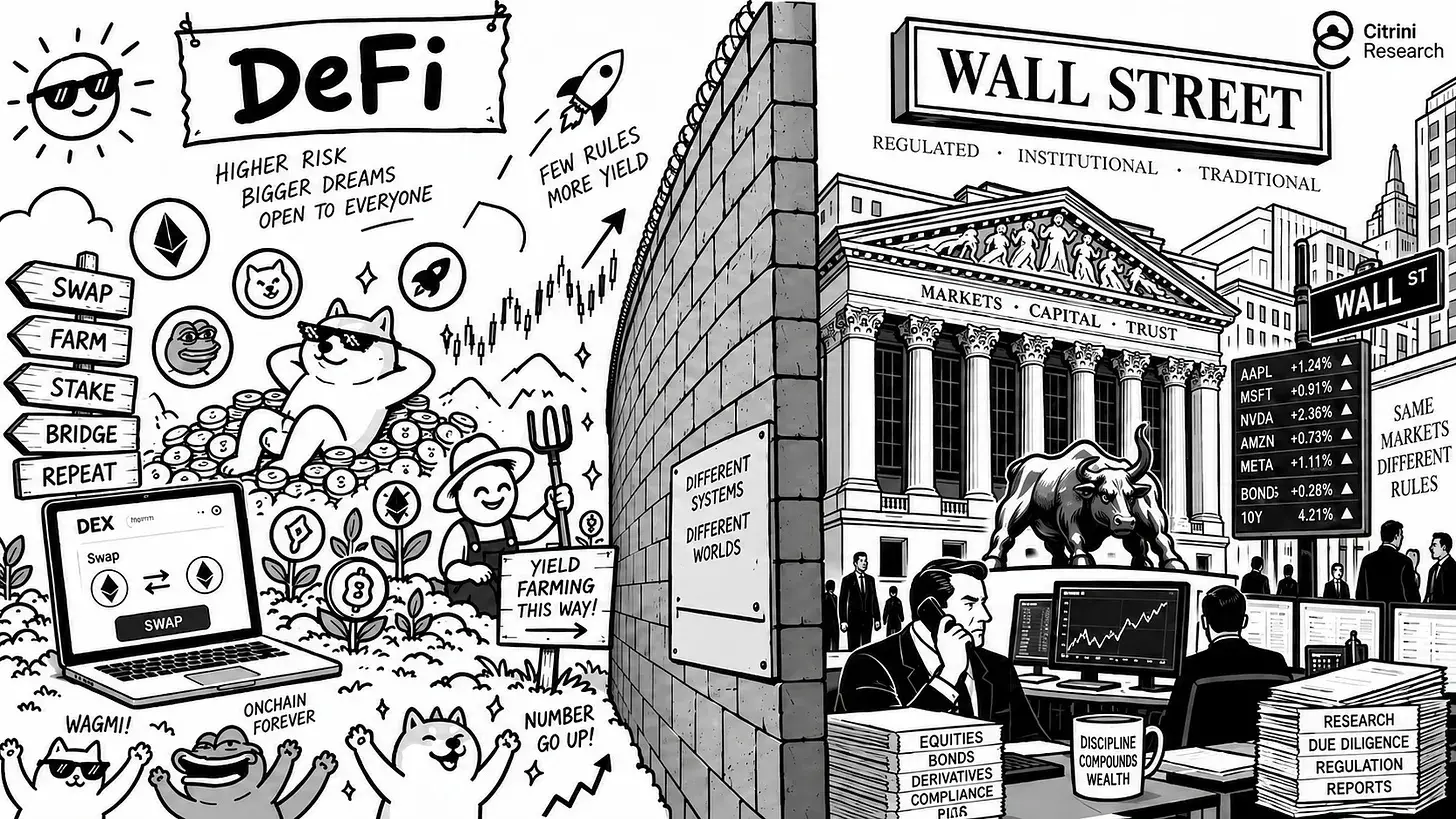
What is currently forming is a dual-layer architecture.
The first layer is our existing permissionless environment, where composability and open innovation drive the development of the ecosystem. This layer will not disappear and should not disappear.
The second layer consists of a series of chains, whether L2 chains, L1 chains, or other types of chains, most of which are based on the same codebase and security infrastructure but differ in how they handle risk distribution at the tail end. The security models of these chains include the ability to pause or freeze transactions in the event of extreme occurrences. For institutional capital, this capability is a risk management feature that makes the entire risk exposure controllable.
We are seeing this today in secondary organizations: some secondary organizations have established security councils with certain freezing powers. We recently witnessed the application of this mechanism in practice, as Arbitrum's security council intervened in the Kelp DAO incident and recovered funds.
These two layers serve different purposes, and that is key. The permissionless layer is a crucible where protocols are built under real pressure, utilizing real funds in an adversarial environment. The resulting protocols are stronger. The institutional layer, on the other hand, allows for the large-scale deployment of funds that have formal authorization and compliance requirements.
The intersection and integration between them are particularly important.
A protocol that has been honed over years in a specific environment is likely to have withstood the test of real security incidents, demonstrated reliable operational capabilities across various market conditions, and established a mature governance system. Today, it has a reliable pathway to extend its influence to the institutional level. It can be deployed at the institutional level and access a deeper pool of capital than what purely crypto-native environments can offer.
The lifecycle becomes: build and publish permissionlessly. Accept testing in a public environment. Prove its capabilities. Then expand to the institutional level and acquire funding at a completely different scale.
This is indeed an excellent architecture. The open and experimental side of the ecosystem continues to leverage its advantages, constantly launching new protocols and taking initial risks with crypto-native capital, pushing boundaries. Meanwhile, the institutional layer provides ample liquidity and stability, thereby raising the ceiling for what successful protocols can achieve. In this world, the rewards for earning institutional trust are also significantly higher. The motivation for innovation is thus enhanced, as the rewards for success are richer than ever before.
However, the real challenge lies in how to address the cold start: the blockchain most favored by institutional capital may not be the one where the best applications currently reside. The highest volume and most proven protocols can create profound network effects on blockchains that do not provide security guarantees. How to resolve this issue—whether the best protocol choices should deploy instances on institution-facing blockchains, or whether new protocols should be built targeting institutional architecture from the start, or whether institutional capital will ultimately accept existing blockchains—will be one of the dynamics worth watching.
But the overall architecture feels quite reasonable. The on-chain economy is constructing a true capital structure, with different pools of capital flowing into a shared ecosystem. The permissionless foundation continually creates new things. The institutional layer provides depth. And the connection between the two allows the entire system to operate.
 Risk warning


Popular articles