Who can make money in the era of Agents?
 Core Viewpoint

 The next billion users will be Agents, but the crypto world has not yet found their wallets.
Author: Jonah Burian
Compiled by: Jiahua, ChainCatcher
Many speculate that the next billion users of blockchain will be Agents. But few have asked a further question: in that world, who will make money?
Every previous theory of value capture in the crypto space has assumed that users are human. The "Fat Protocols" theory posits that protocols are best at monetizing human users.
However, the "Fat App" theory that my colleagues and I discussed in "How to Capture Value" and "The Great Revaluation" argues that the application layer can do better. But Agents change the nature of user identity, rendering existing theories ineffective.
Fat Protocol Theory
In 2016, @jmonegro proposed "Fat Protocols." For nearly a decade, it has been the dominant theory of value capture in the crypto space.
The core idea is that in the traditional internet, value accumulates at the application layer (e.g., @Google, @facebook), while the underlying protocols (TCP/IP, HTTP) capture almost no value. The crypto world will completely reverse this situation. Blockchain openly shares data, leading to the gradual commodification of applications.
Since using the network requires consuming protocol tokens, the tokens will capture the speculative value generated as usage increases. The success of each application will drive demand for tokens. The growth rate of the underlying protocols will exceed that of any applications built on top of them.
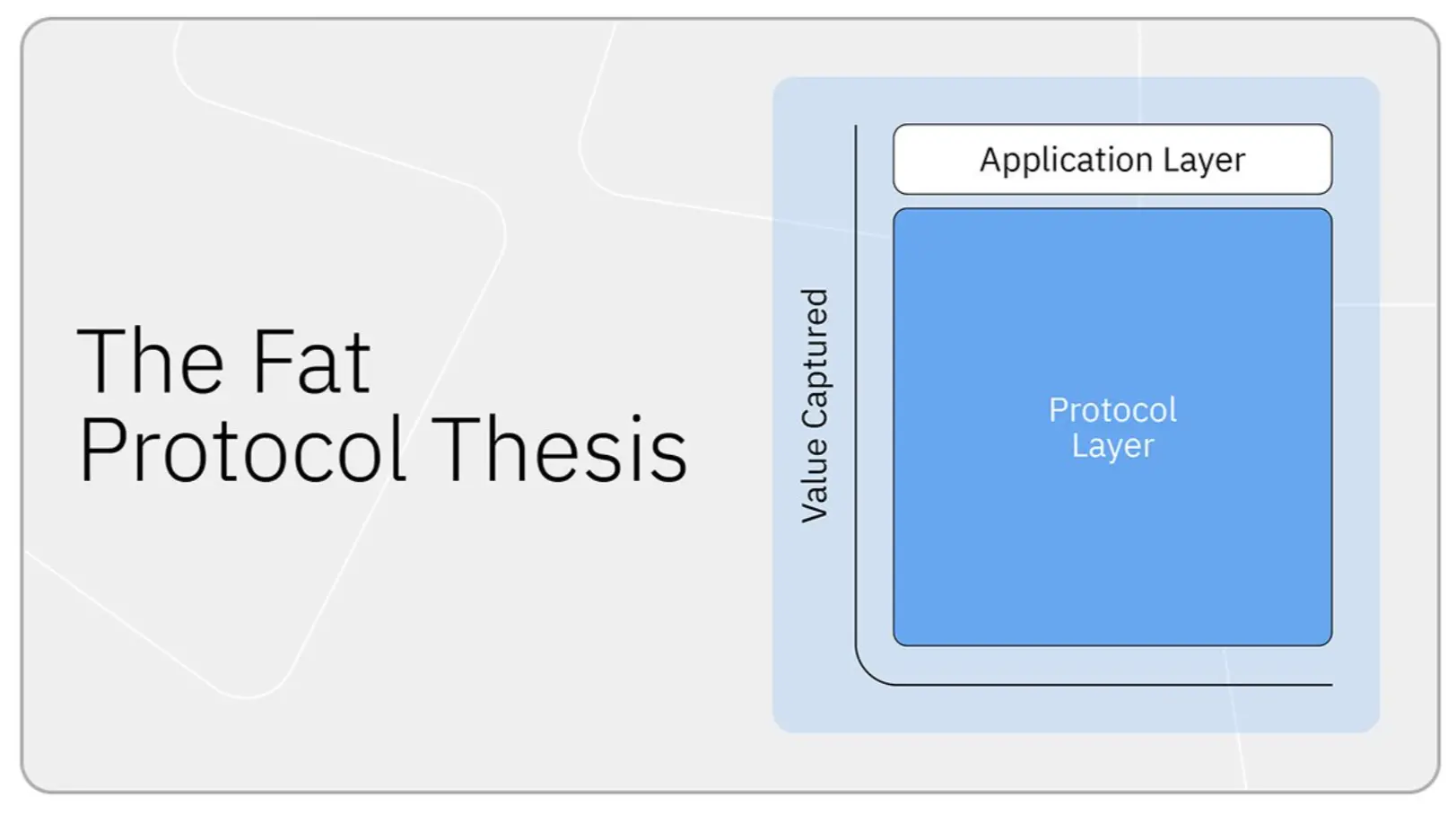
For years, this assertion seemed correct. The value of Bitcoin and Ethereum far exceeds that of any companies built on them.
This model is entirely applicable when the protocol itself is scarce, costly to build, and difficult to replace. Bitcoin and Ethereum in 2017 were indeed very scarce, with no dozens of general-purpose L1s (Layer 1 networks) competing for the same workload.
The block space was so limited that holding the underlying assets felt like holding a part of every application that needed those assets.
Today, every layer of the infrastructure tech stack has reliable alternatives: multiple high-throughput L1s, dozens of L2s, and fiercely competitive modular settlement layers and data availability (DA) layers. Block space has shifted from being constrained to being abundant.
As cross-chain bridges and aggregators make the underlying chains nearly invisible to users, the switching costs for users have collapsed. Infrastructure has become interchangeable, and interchangeable commodities can only compete on price. The result is that the pricing power of protocols has vanished along with their scarcity.
Fat App Theory
By 2026, the entities capturing most of the economic benefits will be applications, not protocols: for example, @phantom, @coinbase, @Polymarket, @Pumpfun, etc.
In my view, the reason is that the most valuable assets in the crypto world are user relationships.
If you control the user interface and transaction flow, you control the distribution channels and can profit from almost any on-chain product that users interact with: swaps, lending, staking, minting, and fiat on-ramps. This may also explain why funds are so obsessed with neobanks.
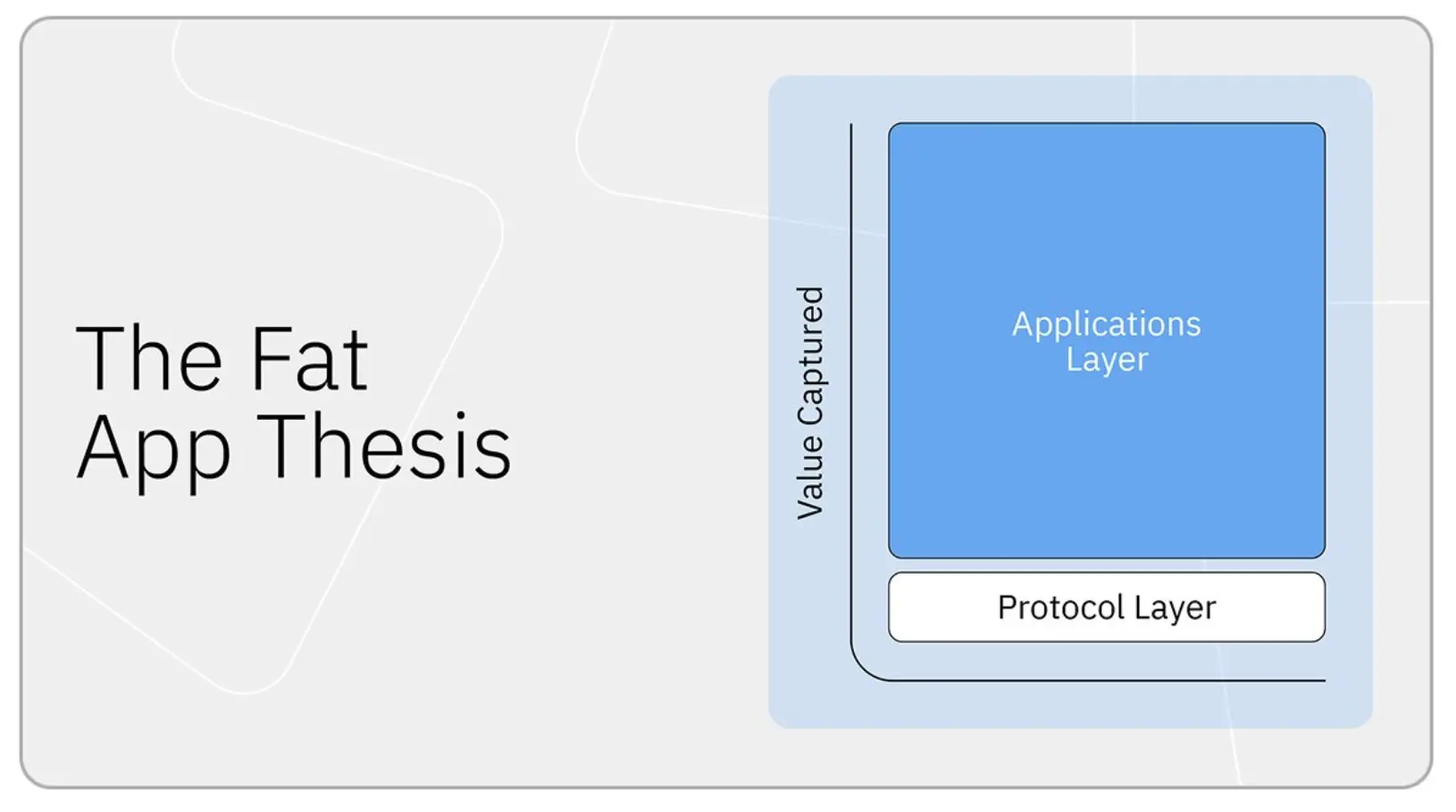
Applications have also pushed infrastructure into pure price wars, forcing infrastructure profit margins to be compressed to marginal costs. I documented this strategy in "How to Capture Value." The same dynamics are playing out in the stablecoin space, which I have discussed in other articles.
Asset prices are reflecting this theory. Spencer and I refer to this shift as "The Great Revaluation": during this cycle, value begins to accumulate at the layer that controls users.
Why Agents Will Disrupt This Logic
The Fat App theory assumes that users are humans who value UX, branding, and convenience. But Agents do not care about these at all. They directly call APIs, have no brand loyalty, and switch between platforms at zero cost.
When users become software, controlling user relationships is no longer an impenetrable moat. The front-end moat that the entire Fat App theory relies on is becoming ineffective.
So in the era of Agents, who will capture value?
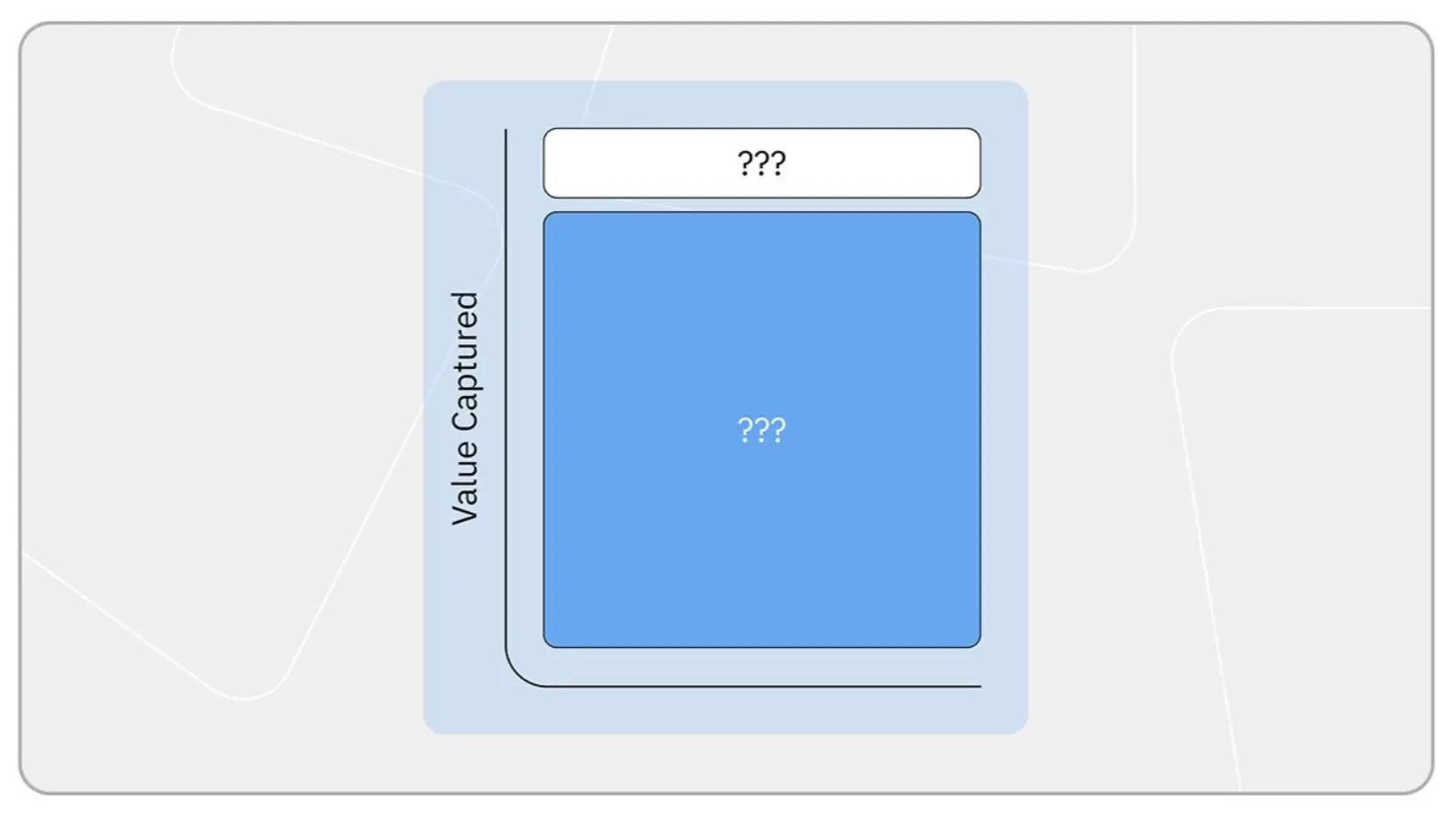
Applications Moving Towards "Headless"
In one future scenario, the winners at the application layer will maintain their winning status by stripping away the front-end interface (i.e., "headless").
Wallets and aggregators have already completed the most challenging construction work: integration with dozens of protocols, routing logic, authentication, and fiat on-ramp infrastructure.
The logical next step is to open this tech stack as an API for Agents, allowing them to route through it—just as humans do today through @phantom or @JupiterExchange.
In this world, the Fat App theory still survives. It just loses the front end. Companies that succeed in the human era will transform into pure back-end infrastructure for Agents. We have already seen traditional SaaS companies like Salesforce moving in this direction.
The Resurgence of Protocols
In another scenario, Agents completely skip the middle layer.
If integration becomes simple enough (well-documented APIs, standardized RPCs, predictable execution semantics), Agents have no real reason to pay aggregators to do what they can do themselves. The advantage of aggregators in the human era was UX and handling routing complexity.
But Agents do not need UX, and routing is a problem that can be solved through engineering, and Agents are becoming increasingly adept at handling such issues.
If the world evolves in this direction, the Fat Protocol theory will see a resurgence.
The Collapse of Pricing Power Across the Tech Stack
Perhaps Agents will exert commoditization pressure in every corner. They are absolutely rational, always routing to the cheapest trading platform with zero friction and no loyalty.
Applications have lost the ability to charge humans a UX premium. Aggregators and infrastructure have also lost pricing power, as there is no longer any inherent inertia from humans to protect them from the impacts of price wars.
In this scenario, no party in the tech stack captures much profit. The profit margins across the entire supply chain are forced to compress to marginal costs, with the remaining value belonging to the owners of the Agents or the target users served by the Agents.
Crypto technology becomes a utility, and it is hard to make big money in the utility space.
Agents Create Unprecedented Activity
A simple understanding of this is: Agents are doing everything humans do, only faster and in larger quantities. Even if profit margins are compressed, the overall pie is still growing.
I think there is an even more interesting version.
Agents make a class of previously unfeasible activities feasible: for example, continuously rebalancing portfolios at an execution cost of less than a cent, machine-to-machine commercial activities between Agents, and entirely new markets that exist because pricing and trading speeds far exceed the limits that humans can keep up with.
Current on-chain activity data does not reflect these, as we assume there must be human participation.
If this is indeed the change brought by Agents, then the question shifts from "how should the existing pie be divided" to "how much new economic activity will flow onto the chain, and which layers are ready to serve it."
An Unnamed Business Model
In every cycle, we try to guess the flow of value and tend to believe that existing business models will continue into the future. This assumption often causes us to miss new models that have yet to emerge.
When the internet was first established, no one foresaw the birth of the attention economy. At that time, the idea that "auctioning user attention slices to advertisers would become the dominant business model, and a single company could capture a significant share of global advertising spending" was extremely foreign. It only seems inevitable in hindsight.
Artificial intelligence appears to be one of the biggest technological disruptions in recent decades. In a world dominated by Agents, some value capture may flow to business models that are not even mentioned today. And the groups capturing this value may not be those currently being focused on by the market.
Key Points to Watch
The most likely outcome is not one system completely replacing another. For a long time, humans and Agents will coexist as users in the crypto world, each with distinctly different value capture landscapes.
As long as humans interact with the chain, the Fat App theory still applies: consumers willing to pay for UX, branding, and convenience will continue to pay a premium to the applications that control this layer of relationships. The aspects of trading involving Agents, regardless of which of the above scenarios becomes reality, will be governed by a different independent theory.
For builders, I think a question worth pondering repeatedly on the Agents side is: what can make an Agent choose you over routing directly to the next cheapest alternative? UX may not be the answer. Liquidity, latency, settlement guarantees, and so on, may be the key.
 Risk warning



Popular articles