Pre-IPO, Tokenized, or Real Stocks: How Many Roads Lead Crypto Users to Wall Street?

 Pre-IPO Launchpad, tokenized US stocks and contract trading, as well as RealStocks, which provides real US stock trading through licensed brokers, these three layers of products cover the complete path for crypto users to participate in the US stock market.
In the first half of 2026, U.S. stocks became one of the hottest keywords in crypto. In early May, MEXC launched a beta version of real U.S. stock trading, making them the first crypto exchange to roll out such a feature. After more than 20,000 users participated in beta testing, MEXC officially launched RealStocks on June 1. Binance and Gate soon followed with their own U.S. stock offerings, while Bitget debuted its tokenized RWA platform, Reality. Within nearly the same window, leading exchanges collectively pushed their product lines into the heart of traditional finance.
This was no coincidence. Crypto users have been paying increasingly close attention to U.S. equities. SpaceX's valuation surging toward $2 trillion and NVIDIA's earnings making global headlines generate as much buzz in crypto communities as BTC halvings once did. Yet for a long time, crypto users who wanted exposure to U.S. stocks either had to navigate a traditional brokerage or settle for tokenized products on crypto platforms. The former comes with high friction; the latter has always lacked the core benefits of real stock ownership.
Rather than committing to a single approach, MEXC built a three-layer product matrix: Pre-IPO Launchpad, tokenized stocks and futures, and RealStocks, which offers real U.S. stock trading through a licensed broker. Together, these three layers cover the full spectrum of how crypto users can participate in U.S. equity markets.
Layer One: Accessing Scarce Pre-IPO Opportunities
SpaceX is valued at roughly $2 trillion, while OpenAI and Anthropic sit squarely in the IPO spotlight. Yet in traditional markets, everyday investors have virtually no way to participate before an IPO. Primary-market allocations go to institutions and high-net-worth individuals; retail investors typically have to wait until after listing.
MEXC's Pre-IPO products open a window. Take SpaceX: users can subscribe through the Launchpad and engage in price discovery well before the company goes public. This is fundamentally an economic-exposure instrument rather than actual stock ownership, and users do not hold shareholder rights. But its significance is clear: for the first time, a crypto exchange extended its reach to the most sought-after asset class in traditional finance.
For crypto users, with several tech giants potentially staging clustered IPOs in 2026, the value of Pre-IPO products will only grow. This first layer still sits at a distance from actual U.S. equities, but it solves a critical problem: giving crypto users access to the world's most closely watched assets at the earliest possible moment.
Layer Two: Accessing U.S. Stocks the Crypto-Native Way
If Pre-IPO products offer distant exposure, tokenized stocks and U.S. stock futures bring users one step closer.
MEXC's tokenized stocks let users trade tokenized versions of listed equities such as NVIDIA and Tesla the same way they would trade any other token, settled in stablecoins and available around the clock. These tokens are typically pegged 1:1 to real stock prices by third-party issuers; what users hold is the economic interest represented by on-chain tokens. U.S. stock futures, meanwhile, offer derivatives-side tools with leverage, a product logic crypto users already know well. Combined, the two let users participate in U.S. stock price movements in a fully crypto-native manner.
This is where most industry players are focused. Bitget's Reality platform issues tokenized U.S. stock RWA assets, launching roughly 30 stocks with plans to expand to 100. Ondo issues tokenized securities on-chain, and Gate's earlier xStocks product also took the tokenization route. These products lower barriers and deliver a decent trading experience, but they share a clear limitation: users are not buying real stocks and hold neither equity nor dividend rights.
At this layer, MEXC has likewise built a complete suite of tokenized stock and futures trading tools with 0 fees. But MEXC did not stop here.
Layer Three: Real Stocks, Zero Distance
On June 1, 2026, MEXC officially launched RealStocks. This is the most critical step in the three-layer matrix and the one that opens a fundamental gap with most other U.S. stock products in the industry.
Through its partner broker Atomic Vaults, users can trade real U.S.-listed company stocks directly on the MEXC platform. Atomic Vaults is a FINRA-licensed broker-dealer in the United States, backed by Peter Thiel's Founders Fund and Cathie Wood's ARK Invest, and provides clearing and custody services to global financial institutions and digital asset platforms.
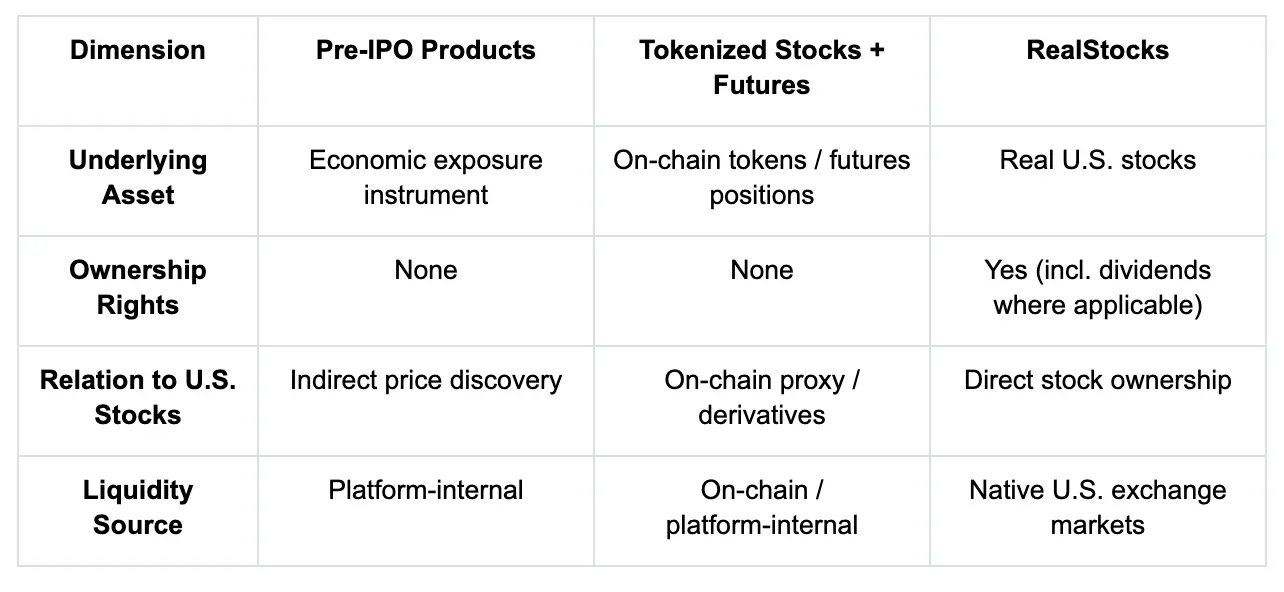
The core difference between RealStocks and the first two layers is straightforward: users hold real stock assets, enjoy dividend rights where applicable, and trade with liquidity sourced from native U.S. exchange markets. Not economic-exposure certificates, not on-chain token proxies, not futures positions, but real U.S. stocks purchased through a licensed broker.
The differences across the three layers can be summarized in one table:
On the experience side, RealStocks preserves the low-friction characteristics of a crypto platform. Users deposit with USDT at a 1:1 rate with no FX conversion loss and place orders within MEXC's familiar interface. Tradable assets span more than 7,000 stocks and ETFs across NYSE and Nasdaq. Most importantly, trading fees are currently zero during the launch period. Over 20,000 users validated the product during the beta phase, and the official version has further refined both the trading workflow and user experience.
Compared to similar products on other exchanges, RealStocks also offers the most comprehensive trading toolkit, including full candlestick charting with drawing tools, a stock screener, fund-flow data, and stock-related news. By contrast, buying U.S. stocks through a traditional brokerage means navigating cross-border transfers, currency conversion, and multiple layers of commissions, resulting in low capital efficiency and an experience worlds apart from crypto trading. RealStocks retains the operating logic crypto users are accustomed to, while delivering the same real ownership rights available to traditional investors.
Beyond the product itself, MEXC has rolled out multiple campaigns to lower the entry barrier: a SpaceX airdrop worth 200,000 USDT, a million-dollar stock prize pool, and real-time market-data subsidies, helping users complete the journey from discovery to participation at minimal cost.
Competitive Landscape and Differentiation
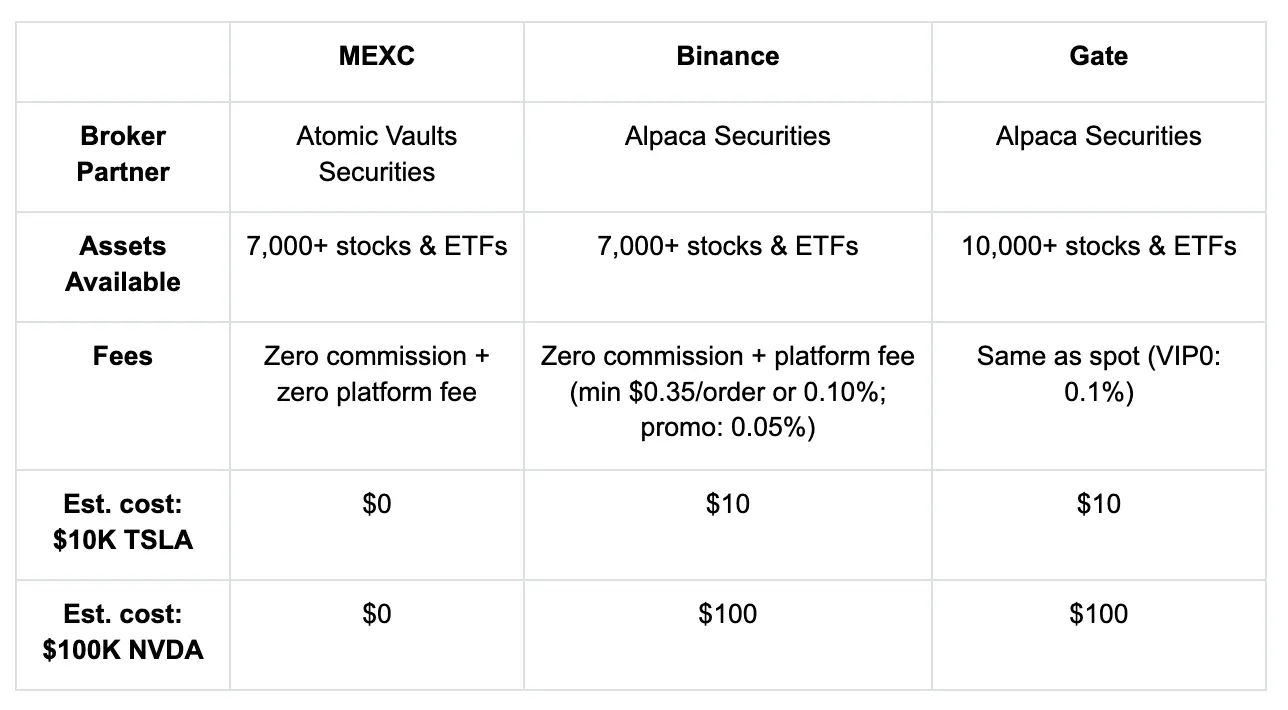
Around the same time, Binance and Gate launched their own real U.S. stock trading products. While the product formats are converging, each platform is charting a different course in terms of fee structures, infrastructure choices, and UX details.
Fees are the difference users feel most immediately. Binance, for instance, charges a 0.10% platform fee (minimum $0.35 per order), reduced to 0.05% during a limited-time promotion. That makes the effective cost non-trivial on small orders and significantly different on large ones. Gate's fees follow its VIP tier structure, matching spot-trading rates, with VIP0 at 0.1%. MEXC, meanwhile, has launched with fully 0 fees during the current period, meaning zero commission and zero platform fees, the most competitive fee policy among exchanges currently offering real U.S. stock trading.
On the brokerage side, Binance and Gate have both integrated Alpaca Securities, while MEXC chose Atomic Vaults Securities as its partner. Each platform's choice of brokerage infrastructure opens different possibilities for future product expansion.
MEXC also holds a more fundamental differentiator: comprehensive coverage across all three product layers. Platforms focused solely on tokenization lack real-stock capabilities; those offering only real stocks lack Pre-IPO and futures tools. MEXC simultaneously provides Pre-IPO products, tokenized stocks and U.S. stock futures, and real U.S. stock spot trading, three layers addressing three scenarios and forming a complete pathway from indirect participation to real ownership.
In sum, MEXC has entered this round with fully 0 fees, product maturity validated by over 20,000 beta users, and end-to-end coverage from Pre-IPO to real U.S. stocks, establishing a clear early-mover advantage.
Conclusion
From Pre-IPO products to tokenized stocks and futures to RealStocks, MEXC's U.S. stock product matrix traces the full arc from distant to direct. Each of the three layers functions independently, but together they point in the same direction: enabling crypto users to achieve comprehensive participation in U.S. equity markets from a single platform.
2026 is shaping up to be a landmark year for U.S. IPOs, with heavyweights like SpaceX, OpenAI, and Anthropic all in the pipeline. A platform that simultaneously covers Pre-IPO access, tokenized trading tools, and real U.S. stock trading is positioned right at the gateway of this opportunity wave. What will ultimately determine the competitive landscape is who can let crypto users complete the entire journey, from crypto assets to global assets, all on one platform.
Disclaimer
This article is for informational purposes only and does not constitute investment advice. Trading involves risk; please consult a professional before making any investment decisions. Some exchanges' U.S. stock-related services are available only to users in certain jurisdictions; some countries or regions may be unable to access these services due to local laws and regulations. Past performance does not guarantee future results, and all investments involve risk, including the possible loss of principal.
 Risk warning