Stablecoins vs Deposit Tokens: On the surface, they seem like opposing sides, but in reality, they are interconnected
 Core Viewpoint

 Great powers compete for standards, while small countries build barriers.
Author: Charlie
Many friends who follow the stablecoin field must have been puzzled last week about why, at this point in time, two alliances suddenly emerged: stablecoin vs tokenized deposits?
On one side are traditional payment giants like Stripe, Coinbase, Visa, and Mastercard, who are approaching the launch of a new stablecoin platform. Stripe has acquired Bridge, Mastercard has bought BVNK, and Coinbase is the largest distribution channel for USDC, owns the Base network, and has also launched payment services.
On the other side, major U.S. banks like JPMorgan Chase, Bank of America, Citi, and Wells Fargo plan to launch a nationwide tokenized deposit network through The Clearing House, aiming to go live in the first half of 2027, expressing bank deposits on-chain to serve 24/7 settlement, corporate treasury, liquidity management, and cross-border payments.
The trigger for this alliance formation is, of course, related to regulation, as the CLARITY Act begins to clarify the previously ambiguous boundaries of interests.
Stablecoins could previously wrap themselves in a large narrative: faster dollars, cheaper cross-border payments, a more open financial network, and better on-chain liquidity.
But when they really start to enter mainstream finance, the questions become specific: Can stablecoin balances generate yields? If issuers cannot pay interest, can wallets, exchanges, merchants, or membership programs provide rewards? If they cannot pay interest like bank deposits, do rewards based on transaction behavior count as circumventing regulation?
The CLARITY Act, promoted by the Senate Banking Committee, brings this contradiction to the forefront.
According to relevant legal analysis, the bill allows bona fide activity-based or transaction-based rewards, but the premise is that these rewards cannot be economically equivalent to bank deposit interest, and it requires the SEC, CFTC, and Treasury to continue to delineate the boundaries between prohibited interest-like returns and permitted transaction-based rewards within a year.
This line seems highly technical, but it actually determines the profit pool of the entire stablecoin market.
If stablecoins can only be payment tools, banks can accept them as a new rail and may even participate in settlement themselves.
If stablecoins can become a high-yield checking account through rewards, rebates, merchant incentives, and membership benefits, then banks are not just competing with crypto companies for payment fees, but are defending their deposit franchise.
For banks, deposits are not a product; they are the mother of all products. Credit cards, mortgages, loans, wealth management, corporate treasury, foreign exchange, cash management all grow from account relationships.
So, large banks must step up.
But the way large banks step up is interesting; they do not directly say they want to jointly issue a competitor to USDC, but instead choose tokenized deposits.
This choice itself is political language. The discourse power of stablecoins lies with crypto, while the discourse power of tokenized deposits lies with banks.
The former speaks of open dollars, while the latter speaks of regulated bank currency.
The former emphasizes programmability and global liquidity, while the latter emphasizes balance sheets, deposit attributes, and regulatory acceptability.
Banks do not misunderstand stablecoins; rather, they want to retranslate the issues raised by stablecoins into a system language that they are more familiar with and can control.
Here, JPMorgan's position is particularly delicate. JPMorgan did not just realize today that on-chain dollars have value; it has been running for years through Kinexys and JPM Coin.
But if JPMorgan jumps out and says that the future standard for on-chain deposits in banking will use its network, it will be difficult for Bank of America, Citi, and Wells Fargo to genuinely support it.
Of course, there are common interests among large U.S. banks, but common interests do not equate to a willingness to accept one bank as the de facto standard setter for clearing.
And the Federal Reserve will not allow the U.S. banking system to return to the era of fiefdoms from decades ago, which is why it has been emphasizing interoperability over the past year.
Thus, forming an alliance through The Clearing House is politically more important than technically.
The Clearing House is already a clearing infrastructure jointly owned by the banking industry. Placing the tokenized deposit network here equates to packaging "JPMorgan's first-mover advantage" as "the banking industry's common defense line."
This is not the technically optimal solution but the optimal solution for alliance governance.
So, on the surface, this is two official announcements delineating the boundaries between the stablecoin camp and the banking camp.
But the more I think about it over the weekend, the more I feel this is not a battle between Chu and Han. In the Chu-Han contention, there were only Liu Bang and Xiang Yu at the end, while at this stablecoin table, no two people can represent all interests.
Visa and Mastercard are in the Cao camp but have their hearts in Han; they cannot do without banks, yet they fear being bypassed by the next generation of settlement layers.
Stripe and Coinbase seem to be in the open stablecoin camp together, but one wants to capture money movement for enterprises and merchants, while the other wants to capture wallets, liquidity, and on-chain execution layers.
Coinbase and Circle are even less equal allies; Coinbase has always held a stronger position in the distribution and economic sharing of USDC.
JPMorgan already has on-chain deposit infrastructure but has to pull other large banks along, packaging its first-mover advantage as a common banking standard.
Looking further out, Tether is not focused on the central plains (the compliant U.S. market), and chains like Ethereum, Solana, Base, BNB, and Tron are not part of the traditional financial etiquette.
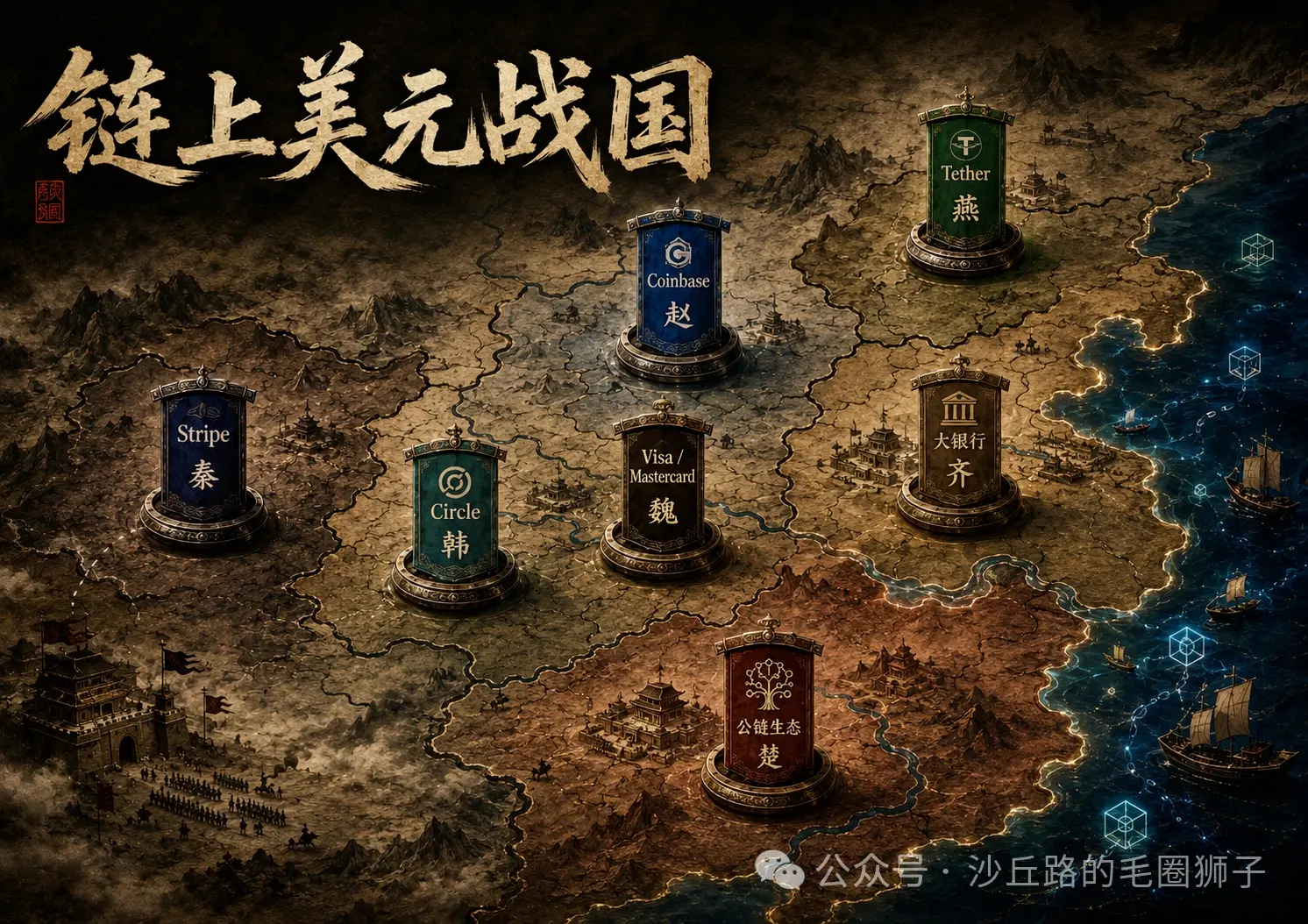
This is more like the Warring States.
On the surface, it appears as two armies facing off, but in reality, it is seven states forming alliances and counter-alliances. Everyone is forming alliances, and everyone is also wary of their allies.
The alliances of the Warring States were not formed because the six states loved each other, but because no one wanted to be the first to be consumed by Qin.
So who is Qin? I think Stripe resembles Qin the most.
Not because it is currently the largest in stablecoins, but because it most resembles a force that wants to redefine the system through engineering, productization, and APIization.
What was truly terrifying about the Qin state was not a particular battle, but its counties, military achievements, laws, logistics, and measurements.
Stripe's approach is similar. It does not necessarily have to issue the largest stablecoin itself, but it wants to define how enterprises issue coins, how they receive payments, how they settle, how they manage balances, how they handle merchant acceptance, and how they integrate into the global payment stack.
The significance of Stripe acquiring Bridge is not just that it bought a stablecoin infrastructure company, but that it turned stablecoin issuance into a Stripe-like capability.
Bridge's Open Issuance states very directly: enterprises can launch and manage their own stablecoin, controlling minting, burning, reserves, and product experience.
The threat to issuers like Circle does not come from a new coin but from the commodification of the act of "issuing stablecoins": once issuance capability becomes an API, what is truly valuable is not the coin but distribution, compliance, liquidity, merchant relationships, and routing.
Stripe's endgame may not be to become the largest issuer but to become the operating system between all issuers and enterprises: you can issue your own coin, use USDC, use USDT, connect to bank tokenized deposits, use cards, use ACH, use Base or Solana, but the entry point, reconciliation, risk control, compliance, merchant relationships, and developer experience should all ideally remain with Stripe.
The Qin state unified the world by first standardizing measurements. Stripe does stablecoins by first standardizing interfaces.
Visa and Mastercard are more like the Wei state.
Wei was a traditional strong state in the central plains, with a mature system and an important geographical position, and strong early reforms, but by the mid to late Warring States period, it was most afraid of being caught in the middle of new and old forces.
Visa and Mastercard are now in this position; they control the most core acceptance network of the old payment world, card-issuing bank relationships, risk control rules, dispute resolution, and brand trust, but they also know very well that if stablecoin settlement and agentic payments directly bypass the card network, they will be downgraded from "payment network rule makers" to "an optional interface."
So Visa/Mastercard will not truly betray banks. They cannot do without banks for issuing cards, accounts, KYC, credit, and regulatory relationships. But they also cannot just stand behind banks.
Visa has already expanded its stablecoin settlement pilot to nine chains, including Base, Polygon, Canton Network, Arc, Tempo, as well as existing Ethereum, Solana, Avalanche, and Stellar; Mastercard is also continuously advancing in stablecoin capabilities and related infrastructure acquisitions.
This indicates that their strategy is not to bet on a single stablecoin or a single chain, but to turn both stablecoins and chains into settlement options.
For Visa/Mastercard, what matters most is not the card itself, nor a specific payment method, but acceptance, rules, risk allocation, and routing power.
As long as transactions still need to be accepted, authorized, settled, held accountable, refunded, and compliant, they still have value.
In other words, Visa/Mastercard do not want to become dinosaurs in the stablecoin world; they want to become the roads and checkpoints in the stablecoin world.
Large banks are like the Qi state.
Qi is rich, with developed commerce and abundant resources, but the internal coordination cost is high.
The banking system has the deepest deposit pool, the strongest regulatory relationships, and the most core corporate treasury clients, but it is also most easily held back by its own institutional inertia.
They cannot easily restructure like Stripe, nor can they drift outside of mainstream U.S. regulation like Tether.
Their advantages are trust and balance sheets, but their disadvantages are also trust and balance sheets.
The fundamental goal of the bank alliance is not to prevent the existence of stablecoins but to prevent stablecoins from turning the banks' most core deposit relationships into part of someone else's growth flywheel.
This is also why the regulatory boundaries of rewards/yield are so critical.
If a consumer or enterprise only uses stablecoins for cross-border payments, banks can still say this is competition in payment rails.
But if users, due to rewards from Coinbase, Stripe wallet, merchant wallet, or some agentic finance account, keep cash that originally existed in banks long-term in stablecoin balances, then banks face not just a decrease in payment costs but a rewriting of their liabilities.
Coinbase is like the Zhao state.
Zhao has cavalry, strong mobility, and has long been positioned between the central plains and the frontier.
Coinbase's advantage is not a single coin but mobility: exchange liquidity, wallets, Base, institutional custody, developer ecosystem, U.S. compliant identity, and ordinary users' entry perception of crypto.
It can bind with Circle, or collaborate with Stripe/Visa/Mastercard; it can benefit from USDC, or develop Coinbase Business; it can make Base the entry point for on-chain applications, or push protocols like x402 towards agentic payments.
Coinbase's participation in the new stablecoin alliance is not a "betrayal of Circle."
The relationship between Coinbase and Circle has never been that of two completely equal allies moving forward hand in hand. Circle and Coinbase entered a Collaboration Agreement in 2023, where Circle is to pay Coinbase for its role in USDC distribution and ecosystem growth.
According to the agreement, Coinbase retains 100% of the interest income generated by USDC on the Coinbase platform, while off-platform and DeFi ecosystem USDC income is shared 50/50 with Circle.
Coinbase has veto rights on new USDC-related partnerships, with the initial term of the agreement lasting until August 2026, and unless illegal or both parties mutually decide not to renew, it will automatically renew.
So Coinbase is not suddenly changing its mind. It has always been the party with strong distribution in the USDC economic structure.
This also explains why Coinbase must multi-home.
USDC is important to it, but Coinbase's endgame is not to be a channel for Circle but to become the entry point for on-chain dollars.
In the future, whether the popular stablecoin is USDC, PYUSD, RLUSD, some Stripe-issued stablecoin, bank deposit token, or merchant coin, Coinbase hopes to be part of liquidity, wallets, on-chain execution, and developer ecosystems.
Circle is like South Korea.
South Korea is not unimportant, but its geographical position is too dangerous, caught between strong nations, and any side's cut will hurt.
Circle's problem is not that USDC is not growing; on the contrary, USDC remains one of the most important compliant dollar stablecoins globally, and Circle itself is actively pushing USDC towards exchanges, clearinghouses, banks, neobanks, payment companies, and multiple chains.
USDC natively supports 20 blockchains, including Ethereum, Solana, Base, Arbitrum, Avalanche, Polygon, Stellar, Sui, etc., and relies on exchanges and markets like Coinbase, Binance, Kraken, and OKX for distribution.
But this is precisely the problem.
Circle appears to be at the center of the stablecoin stage, but its core capabilities are being dismantled: issuance capability is being productized by Stripe/Bridge, distribution is controlled by Coinbase, compliance narratives are absorbed by banks, settlement is diversified by Visa/Mastercard, and on-chain execution is taken away by Base, Solana, and Ethereum.
USDC can continue to grow, but Circle may not be able to capture a profit pool that matches that growth.
Therefore, Circle must transform from an issuer to a network. It cannot just prove that USDC is the most compliant, transparent, and suitable stablecoin for institutions; it must also prove that it has distribution independent of Coinbase, deeper enterprise treasury integration, more native use cases with banks and payment companies, and its own CPN and stablecoin network capabilities.
Otherwise, it will become a high-quality option on someone else's menu rather than the menu itself.
Tether is like the Yan state.
Yan is far from the central plains, often not at the center of etiquette and law, and thus has its own space for survival.
Tether does not need to rush to join the mainstream U.S. finance alliance because its advantages come precisely from outside the central plains: offshore dollar demand, the global south, exchange liquidity, capital-controlled markets, low-cost paths like Tron/BNB, and sufficient path dependence.
The clearer U.S. regulation becomes, the more USDC, bank tokenized deposits, and compliant stablecoins are suitable for institutions and U.S. scenarios.
But in many markets where banks are inefficient, dollars are scarce, regulation is gray, and users only care about quickly obtaining digital dollars, USDT still has strong vitality.
Tether's strategy is likely not to enter the gates (one could see USAT as a cooperative probe with the Trump administration) but to continue collecting taxes outside the gates.
While others compete over whose standards can be accepted by Washington, it competes over whose wallets already contain USDT.
Finally, there is the Chu state, which represents the public chain ecosystem.
The public chain ecosystem is not marginal. It is more like the Chu state: culturally not belonging to the central plains' etiquette, yet vast, with complex military types, abundant resources, and not entirely unified internally, but anyone wanting to unify the world cannot ignore it.
Ethereum, Solana, BNB, Tron, Polygon, Canton, and even Base, Tempo, and Arc, which have marital ties with other major powers, are not part of the centralized culture of traditional finance.
They have their own languages, developers, wallets, gas, MEV, validators, sequencers, bridges, DEX, DeFi, and community cultures.
The central plains see them as wild, while the Chu people see the central plains as corrupt.
Banks and card organizations want to turn chains into pluggable settlement rails, but chains are not just rails. Chains have their own application layers, asset networks, and liquidity gravity.
Ethereum wants to become the settlement layer for institutional assets and tokenized finance.
Solana wants to become the on-chain highway for high-frequency, low-cost consumer payments and agentic transactions.
Base wants to leverage Coinbase distribution, USDC liquidity, and U.S. compliant user entry.
BNB and Tron continue to capture the global south, exchanges, and USDT liquidity.
Chains like Canton, Tempo, and Arc, which are more focused on institutional and payment customization, attempt to translate Chu culture into a system language acceptable to the central plains.
Stripe wants to standardize interfaces but cannot own all scenarios.
Visa/Mastercard want to preserve rule networks but cannot prevent all new rails.
Banks want to protect deposits, but enterprises and agents will demand faster and more flexible capital flows.
Coinbase wants to be the entry point for on-chain dollars but cannot monopolize all enterprise scenarios.
Circle wants to transform from an issuer to a network but must break free from reliance on a single distribution.
Tether continues to collect taxes outside the gates but may not be able to enter institutional compliance scenarios.
The public chain ecosystem is as vast as the Chu state but also needs to translate its language for the central plains to understand.
This is the essence of alliance and counter-alliance.
In the short term, both alliances will strengthen their narratives.
The stablecoin alliance will say it represents open networks, global payments, developer innovation, and agentic commerce.
The bank alliance will say it represents safety, regulation, deposits, corporate treasury, and system stability.
Both sides will continue to tug around the rewards/yield boundaries of the CLARITY Act because this line determines whether stablecoins are payment instruments or deposit substitutes.
In the medium term, the two alliances will begin to connect with each other.
Visa/Mastercard will support both bank deposit tokens and various stablecoins.
Stripe will connect banks, chains, issuers, and enterprises.
Coinbase will continue to benefit from USDC while promoting Base, Coinbase Business, and x402.
Circle will strive to break free from single distribution reliance, moving itself from issuer to network.
Large banks will criticize stablecoin rewards while integrating stablecoin settlement under customer demand.
Public chains will shift from competing for TVL to competing for stablecoin flow.
In the long term, the market will not unify into one coin or one chain.
Corporate treasury may use tokenized deposits and tokenized money market funds.
Platform payouts, agentic commerce, and API payments may use stablecoin rails.
Offshore dollars and exchange liquidity will continue to use USDT extensively. Institutional settlement and tokenized assets will lean towards networks that are easier to interpret as compliant.
High-frequency consumption, agent calls, and low-cost transactions will leave space for Solana, Base, BNB, Polygon, and others.
The ultimate winner will not necessarily be the one who issues the largest stablecoin.
Issuance rights will be commodified, chains will become multi-hosted, wallets will become agent-based, and compliance will become protocol-based.
The real tax is not on the coin but at every point where value flows from one system to another.
This is also why Visa will simultaneously expand to multiple chains, and why the x402 Foundation's list includes Adyen, AWS, American Express, Base, Circle, Cloudflare, Coinbase, Google, Mastercard, Microsoft, Polygon, Shopify, Sierra, Solana, Stripe, thirdweb, and Visa.
It shows that although the seven states have their own agendas, they must sit at the same table regarding the new standards of agentic payment and agentic finance.
Agentic commerce is just the first layer; it talks about agents buying things for people, booking services, calling APIs, paying for content, purchasing data, and completing checkouts.
Agentic finance goes deeper, discussing agents managing funds for people and enterprises: determining which rail to use for payments, when to exchange currencies, when to redeem money market funds, when to convert USDC into deposit tokens, when to use cards, when to use stablecoins, when manual approval is needed, and when to execute automatically.
Traditional payment systems are designed for people.
People will open apps, enter card numbers, click checkout, complete 3DS, accept subscriptions, process invoices, and view bank statements.
But agents should not be forced to mimic human clicks on web pages.
The objective function of an agent is cost, speed, success rate, compliance, accountability, refundability, auditability, and programmability.
It will not be inherently loyal to any one chain, issuer, bank, or card network. It will only choose the optimal path under given policies.
This is why the endgame of stablecoins is not just payments but routing.
Without agentic finance, the stablecoin war will likely be absorbed by the old payment systems.
Consumers may not even realize they are using stablecoins; merchants only know that money arrives faster, and Stripe, Visa, Mastercard, PayPal, and banks will package the underlying settlement rail into the original product experience. Stablecoins will become a better backend component.
But if agentic finance is established, stablecoins will not just be payment tools but the settlement language of the machine economy.
API calls, model calls, data purchases, ad placements, supply chain procurement, cross-border payouts, corporate cash management, automated reimbursements, real-time taxation, tokenized asset allocation may all require a value transfer method more suitable for machine calls than cards, ACH, or wires.
This is also the real opportunity for entrepreneurs.
Major powers compete for standards, while smaller powers build checkpoints.
What truly drives institutional change in the Warring States era is often not the kings but the wandering scholars, legalists, strategists, craftsmen, merchants, and military achievers.

 Risk warning