








GPT-5.6 goes online late at night, ChatGPT and Codex officially merge, marking the end of an era
 Core Viewpoint

 GPT-5.6, with peak coding capabilities and exceptional cost-effectiveness, is officially launched. ChatGPT and Codex have historically merged and evolved into ChatGPT Work, fully announcing the arrival of the Agent era.
Author: Digital Life Kazek
Today, GPT-5.6 has finally officially launched during OpenAI's live broadcast.
In addition to GPT-5.6, ChatGPT has also welcomed what I believe is the biggest upgrade since its inception in 2022.
You can see hints of the interesting changes from OpenAI's live broadcast teaser animation, where ChatGPT and Codex merge today, at this moment.
Thus, the brand new ChatGPT has arrived.

Codex has completely disappeared, officially merging with the ChatGPT application. In the future, there will be no Codex application, only ChatGPT.
However, when you open the new ChatGPT interface, you will find that the original ChatGPT interface is also gone. The entire UI belongs to the original Codex, with only a small chat tab remaining, proving that the original ChatGPT once existed.

I suddenly feel a bit sentimental.
Thus, the Chat era that began with ChatGPT on November 30, 2022, has completed its mission of public enlightenment today. The merger of ChatGPT and Codex marks the arrival of a new era, which is called:
Agent Era.
Let's discuss them one by one.
1. GPT-5.6
First, let's talk about the core, GPT-5.6.
This time there are three models: the new flagship model Sol, the balanced model Terra suitable for daily work, and OpenAI's so-called most cost-effective model Luna.
Our main focus will be on GPT-5.6 Sol, as it essentially represents the current pinnacle of intelligence that OpenAI can release to the public.
To gauge the strength of this model, just look at Anthropic's actions. After the release of GPT-5.6 Sol, they directly decided to reset their quotas…

I may not have anticipated a new model as much as I do now, eagerly awaiting the launch of GPT-5.6.
The reason is quite simple: my AI news website AIHOT, although I have done everything I can, such as changing the IP address and hiding behind edge proxies, implementing some DDoS protection, and setting up blocking strategies and JS challenges.
However, I am constantly attacked by various means, from initial ordinary attacks to almost all DDoS now, and various distributed CC attacks.
Yesterday alone, I was hit four times. The morning attack was not defended against, leading to a crash, but the three rounds in the afternoon were successfully defended.

At this stage, Claude Fable 5 is completely unusable because most of the words are sensitive. When discussing DDoS, it directly switches me to Opus 4.8. Although Fable 5 has outstanding intelligence and planning abilities, it still has some execution issues, often missing many details and, like the Claude series, has some hallucinations.
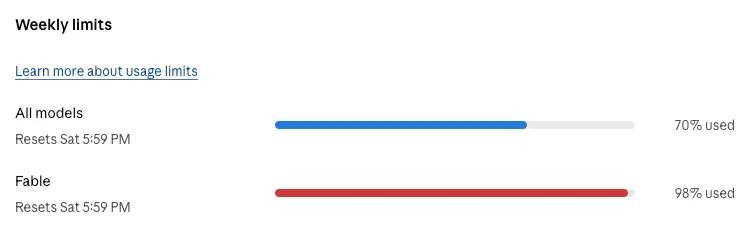
The biggest drawback is its cost; the quota runs out quickly…
GPT-5.5 has actually been the one I use the most recently.
However, it also has significant issues. Its planning and proposal capabilities are very average, lacking comprehensive thinking. It knows what to do from the start, has a very low hallucination rate, and executes code very well, fixing bugs effectively. However, it often lacks comprehensiveness, and its planning and proposal abilities are a bit too obvious as a shortcoming.
It often makes me very frustrated.
In terms of security strategy, it is even full of loopholes. The plans it creates are riddled with holes, and I still have to rely on my remaining 10% quota of Claude Fable 5 to reset rules and provide a safety net.
These seven days of high-intensity offense and defense, along with an average of 16 hours of coding daily, have led me to evaluate Fable 5 and GPT-5.5 as follows.
Fable 5 is indeed a director-level genius, but you know, management often has some imprecision in execution details. The tool usage and proactivity are too strong, often completing everything without regard, but ultimately deviating from what you want in some details.
On the other hand, GPT-5.5 is like a senior engineer. It is indeed good at execution, but as one netizen vividly described, "GPT-5.5 is like the person who suddenly stands up in a conference room to draw on the whiteboard while you are still describing the chaos; it has already started dismantling the plan."
Now I am stuck here, with Claude Fable 5's quota used up, and GPT-5.5 can only handle medium-sized project execution.
So in this context, you should understand why I am so eager for GPT-5.6.
Because I really hope they can push the entire coding capability forward another step, and I strongly support OpenAI in defeating the clueless Anthropic.
After OpenAI released the preview on June 26, GPT-5.6 finally arrived early this morning.

I immediately set GPT-5.6 Sol to the highest Ultra setting.
After five hours of high-intensity parallel development, I feel I have some personal experience with GPT-5.6. If I were to describe it in one sentence, it would be:
The most bucket-level model in today's world, low cost, extremely high cost-performance ratio, with planning and proposal capabilities comparable to Fable 5 on some non-giant tasks (I can't even handle giant tasks, which are far beyond my capability), with an extremely low hallucination rate and high precision in agent capabilities and coding execution. The interaction experience with Codex and remote coding is excellent, and browser control is more stable, etc.
However, front-end aesthetics and content creation remain significant challenges; this area indeed cannot compare to Claude. But aside from that, I can't think of any reason to continue using Claude.
Moreover, GPT-5.6 Sol is included in the subscription plan, and in the future, subscribers will have access!
OpenAI is awesome! Codex is awesome! GPT is awesome!
As usual, let's briefly go over GPT-5.6's official benchmark scores.
In the Agents' Last Exam covering 55 fields of long-term professional workflows, GPT-5.6 Sol scored 53.6, breaking the record and surpassing Claude Fable 5 (adaptive reasoning) by 13.1 points.
Even using the medium reasoning mode, it still leads Fable 5 by 11.4 points at about a quarter of the estimated cost.
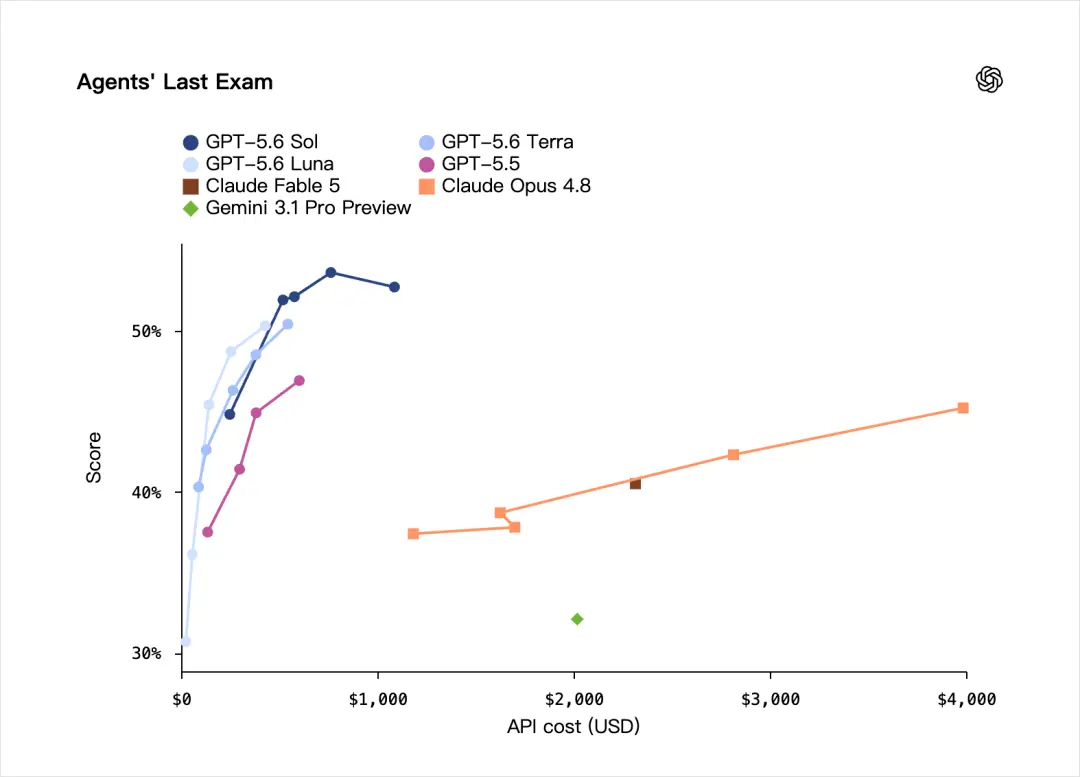
I think this is a milestone. Fable 5 is indeed strong, but that economic effect almost represents that we can hardly use it on a large scale in daily life.
GPT-5.6 has achieved execution effectiveness at an extremely low cost.
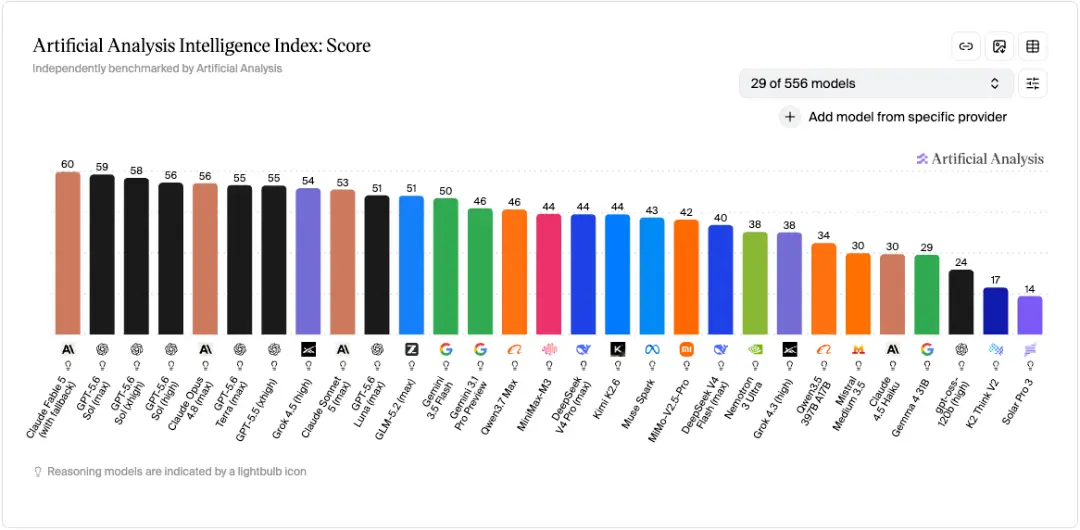
In AA's intelligence index, GPT-5.6 is only one point lower than Fable 5, but the task completion time is reduced by 61%, and the estimated cost is cut by about half.
In the coding field, this advantage is even more outrageous.
In the Artificial Analysis programming intelligence index, GPT-5.6 Sol, using maximum reasoning capability, scored 80, setting a new technical benchmark, 2.8 points higher than Fable 5, while output tokens were reduced by more than half, time was cut by more than half, and costs were lowered by about one-third.
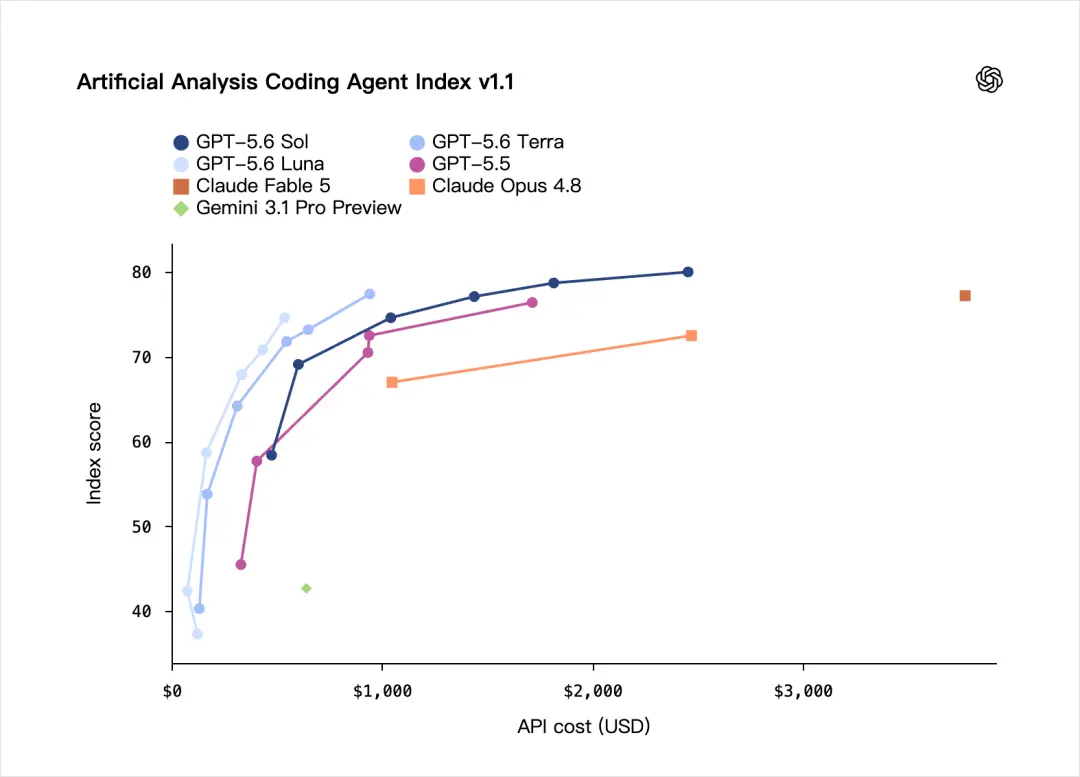
From this chart, you can also see that for daily tasks, raising the reasoning intensity to high is usually sufficient for bug fixing.

For large tasks, set it to very high.

For extremely large refactoring or critical tasks (like my AIHOT protection), or when your tokens are running out, occasionally setting the reasoning level to Ultra is the most efficient way to utilize tokens.
And you know, when I saw GPT-5.6 Sol score 73.5% on ExploitBench, measuring the progress from encountering vulnerable code to executing any code, it was under comparable output token budgets.
What does this mean? It means that with an extremely low cost, you can achieve almost the same network security effect as Fable 5!!!
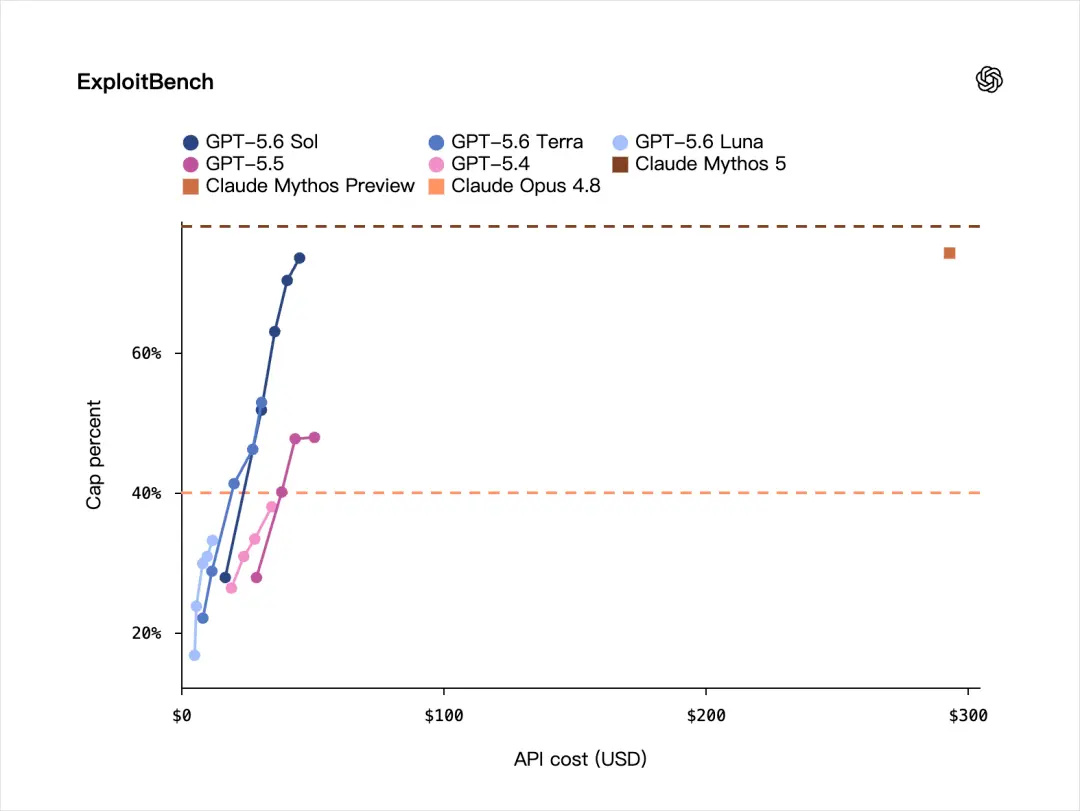
To be honest, when I saw this, my eyes lit up, and I was so excited that I couldn't sleep.
Moreover, in my practical tests, although there are occasional prompts about network security prohibitions.

When I indicated that it was for optimizing my edge proxy's protection strategy, it smoothly executed the task without any obstruction.
The task I provided was this; since I used voice input, I mistakenly input EO as EU, but these are minor issues:
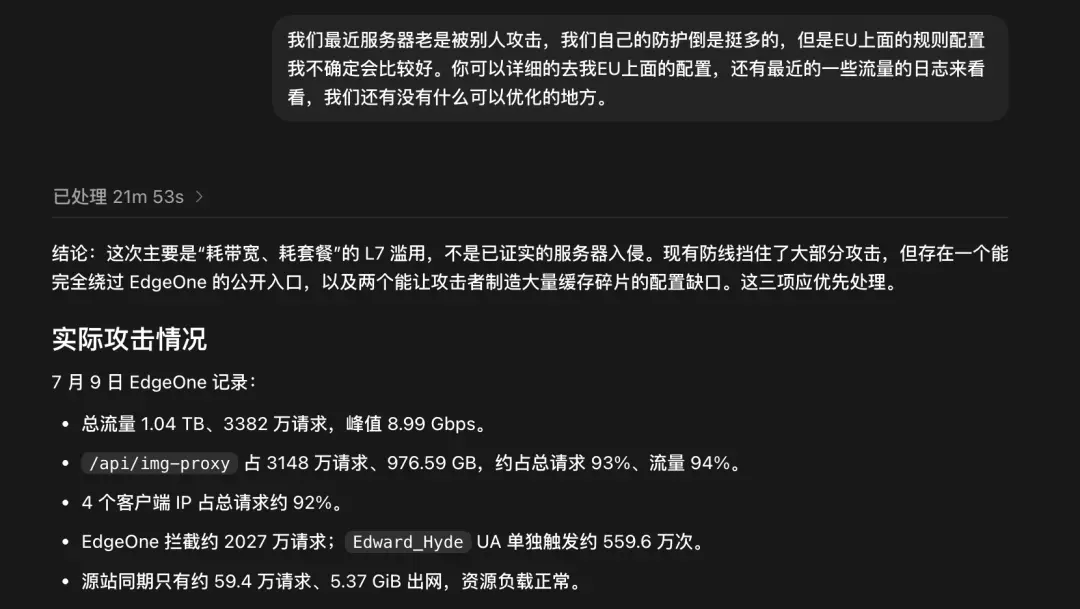
I directly set it to Ultra and used fast mode, almost entirely browser-controlled. After nearly 21 minutes, it provided me with a very detailed review report.
I am on the $200 Pro plan, and the token consumption was about 20% of the 5-hour quota, with around 2-3% of the weekly quota used. I must say, this is much more comfortable than Fable 5.

Keep in mind, this was 21 minutes of full Chrome control in fast mode, with 1.5 times the consumption, plus Ultra!
If it were Fable 5, believe me, playing like this, Fable 5 + Ultracode wouldn't even have a fast mode; a single session could easily consume 8-10% of your weekly quota.
It's outrageous.
And the quality is extremely high.
Because the foundational rules of my edge proxy were set by Fable 5, and later GPT-5.5 applied some patches and made several optimizations, but it felt like it couldn't optimize much and couldn't find any issues.
However, GPT-5.6 Sol directly identified a bunch of problems that neither of them had thought of before.
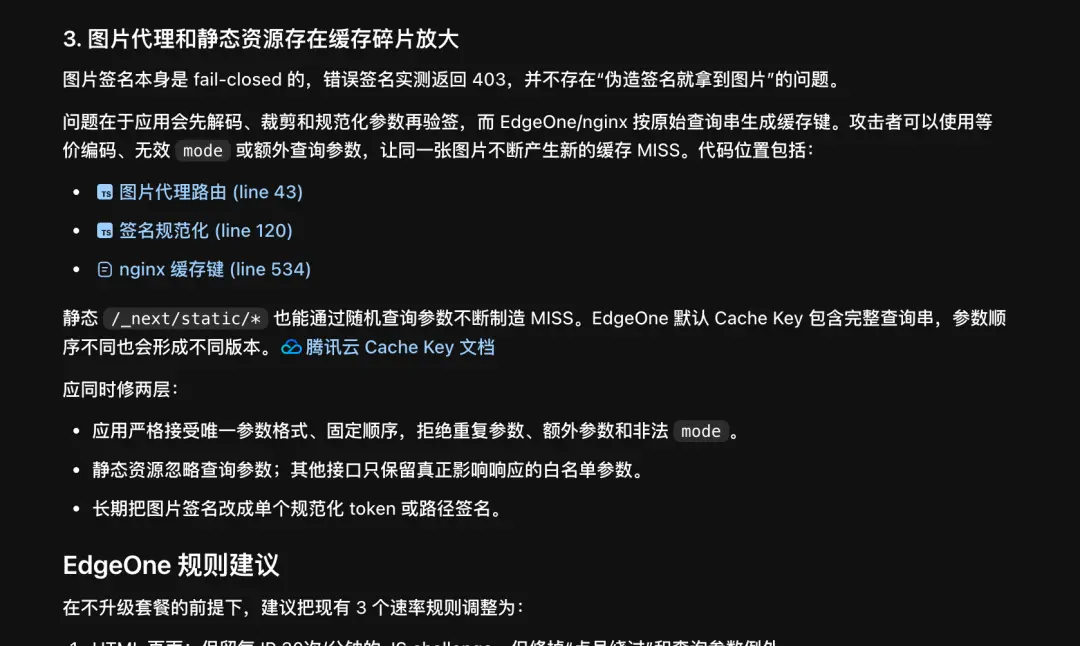
I won't post the full text because there are too many vulnerabilities…
It directly pulled out 11 tasks.
In any case, I was amazed and let GPT-5.6 Sol handle the fixes directly.
It was very stable, processing everything clearly without any bugs. We'll see the actual protection effect when attacked tomorrow.
There is also a plan that can show some differences in personality and characteristics between GPT-5.6 Sol and Claude Fable 5.
For example, I have a long-standing pain point: to provide AIHOT users with a seamless reading experience without needing magic. So I created a detail page for each news item, like this.

However, while the idea for this detail page is good, there are huge implementation problems because I need to capture all the source site's information intact and restore it as closely as possible to the original reading experience.
But you should know that I currently monitor hundreds of diverse websites behind the scenes, and I have tried every possible way to handle it, yet I still often capture some strange things.
Like this.
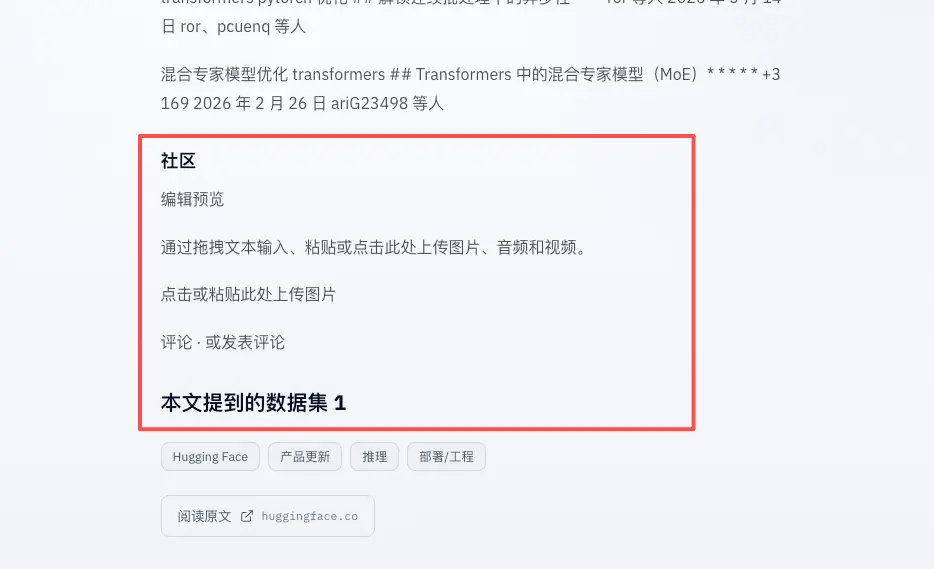
And this.

Trying to adapt to all web pages, cleaning them up to look good and almost identical to the source site, while retaining formats, hyperlinks, code libraries, charts, etc., is too difficult because there are just too many forms of web pages behind it. I previously developed with Opus 4.8 and GPT-5.5, and the results were basically a pile of garbage.
But I still want to solve this need so that AIHOT users can have the best experience when browsing information.
So I threw this requirement to both GPT-5.6 Sol and Claude Fable 5.
Let them both come up with plans.
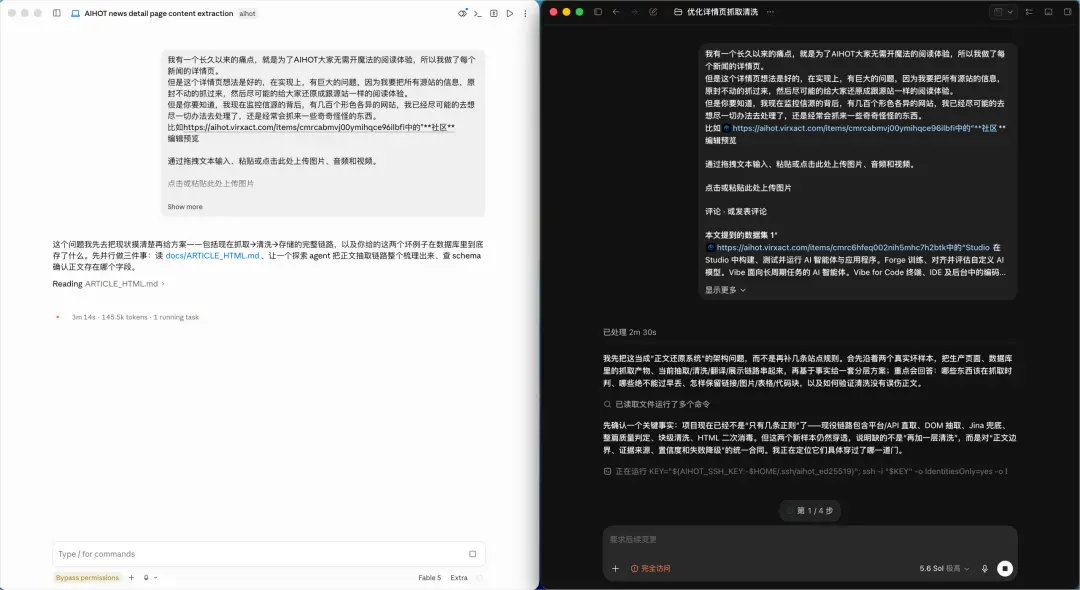
They both used the same CLAUDE.md because my AGENTS.md directly soft links to CLAUDE.md, so almost all variables are the same; the only difference is the model itself.
In the end, after the output, I must say that GPT-5.6's plan, in terms of detail, I even feel it considered more comprehensively than Fable 5, which is indeed an interesting point.
For example, initially, there are classifications at the source level; many are not directly scraped but come through APIs and RSS.
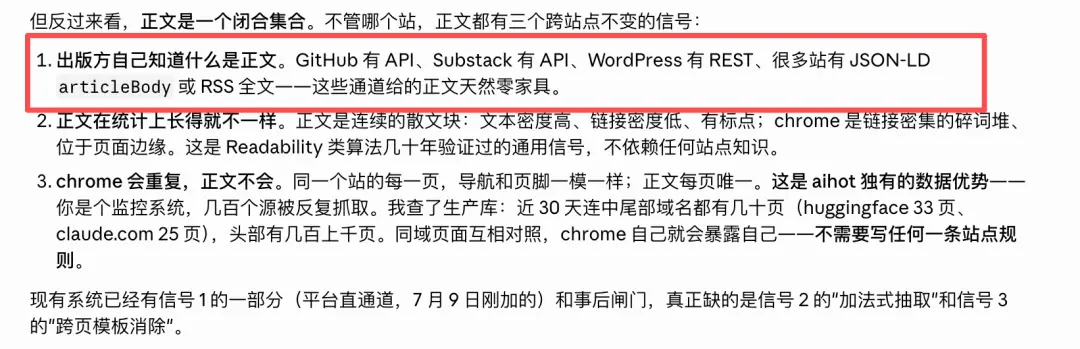
These have clear main texts.
In GPT-5.6's considerations, it also thought of this part, but it did not treat that rule as a must-follow like Fable 5.
Instead, it raised questions.
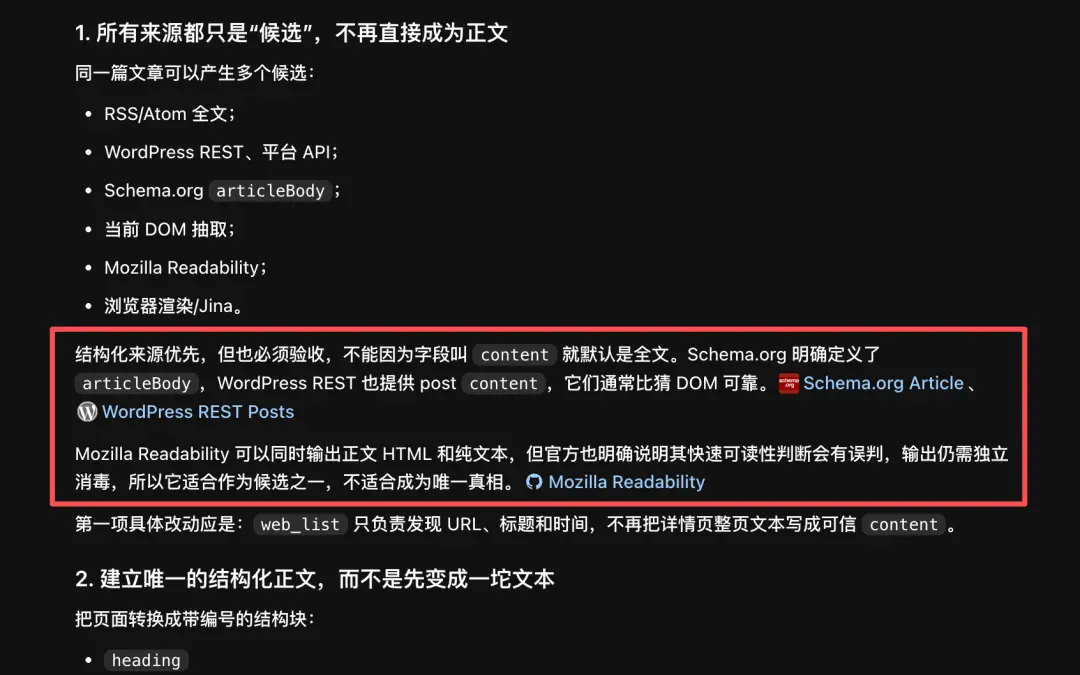
So, we cannot trust them; all sources are just sources. We must do structured main text extraction ourselves, even if it comes from RSS and API outputs, we need to consider it this way.
Fable 5 actually missed this detail.
Including content that has repeatedly appeared on a same-domain website recently, which is likely navigation or fixed CTAs, can be standardized for statistics, and duplicates can be identified and deleted directly.
Both GPT-5.6 and Fable 5 considered this point, but still, the issue remains that in the initial output, GPT-5.6 considered it more thoroughly.
Moreover, there is something even more outrageous: I feel that the readability of the content output by GPT-5.6 this time is stronger than that of Fable 5. I can read its plan, but with Fable 5, perhaps I am too inexperienced; its information density is too high for me to digest.
In the end, I chose to let GPT-5.6 Sol execute the final task in target mode.
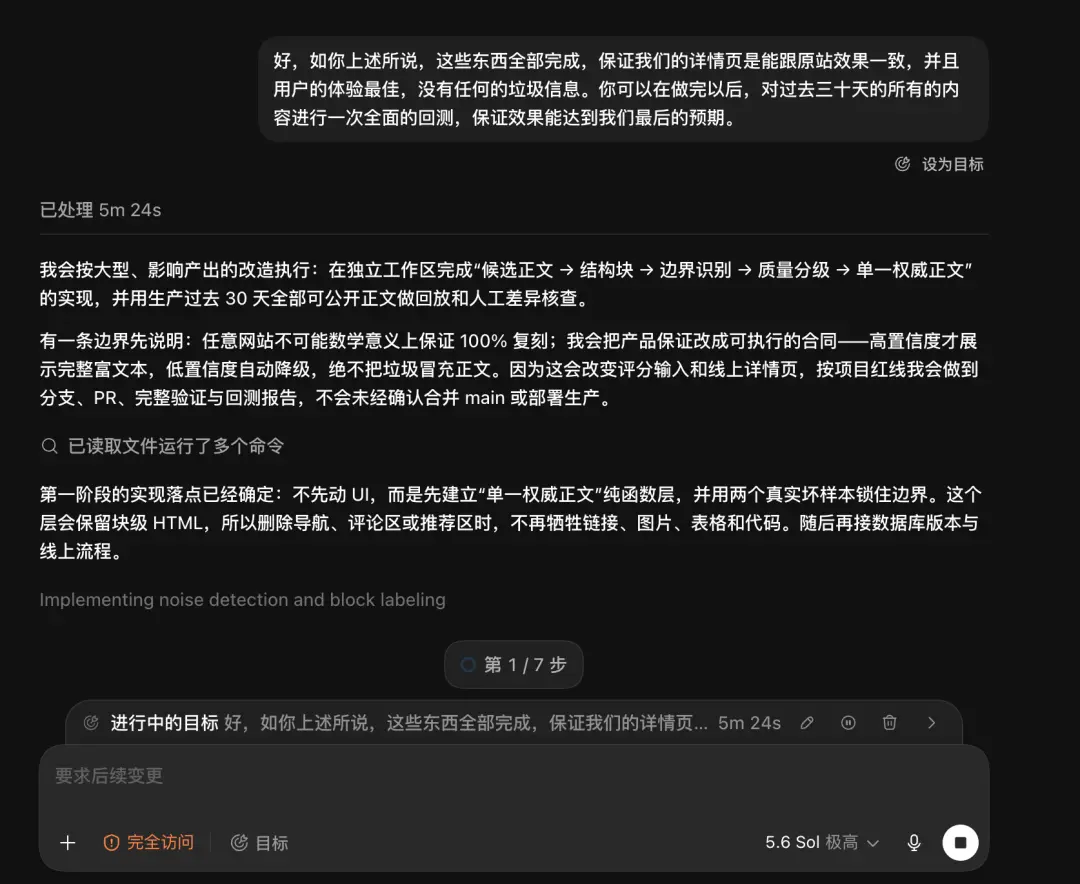
To be frank, this task is a bit complex, and I have no confidence that Claude Fable 5 can stably and accurately handle so many details over a long period. It is still prone to hallucinations, forgetting changes here and there, and constantly overturning itself during adversarial reviews, which is very troublesome.
However, the hallucination rate of GPT-5.6, in my testing, feels as consistent as ever, almost at the level of intercontinental missiles, hitting the target precisely. Coupled with the target mode, it always completes tasks with extreme precision, which is truly delightful.
Although there are occasional strange low-level errors like GPT-5.5 that cause some loops in certain stages, the frequency is lower, and they can be resolved faster without affecting the final output.
As for the previous task, by the time I published this article, it had been in development for nearly 2 hours but was still not finished, mainly due to the time-consuming process of reviewing and optimizing each piece.

However, during its testing process, I saw some pages that were still excellent, and I am now looking forward to the effect after it is deployed on AIHOT.
Then, regarding front-end aesthetics, there has indeed been a significant improvement compared to GPT-5.5, but it is still a bit far from Claude.
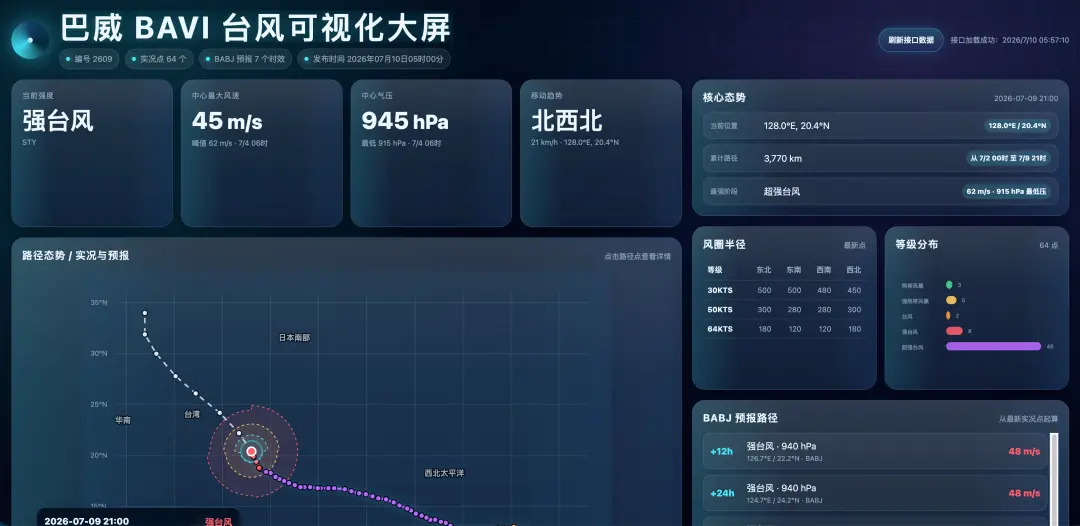
For example, with the typhoon approaching, I casually wrote a prompt:
Call an interface to get data on Typhoon Bawei and generate a single HTML file for visualization.
The result from GPT-5.5 was like this, just Emmmmmm.
But GPT-5.6 Sol produced this.
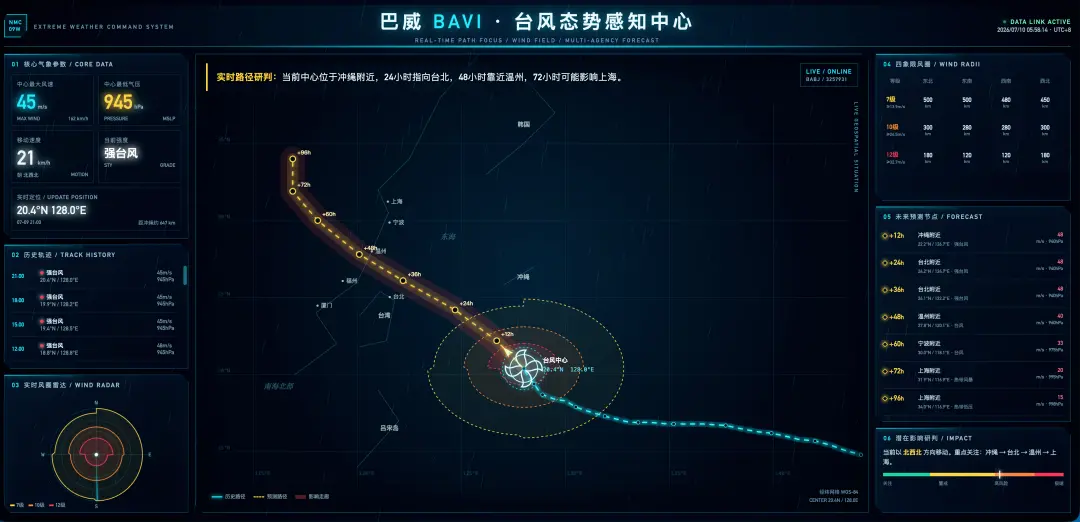
The front-end effect has indeed evolved a lot; at least it won't produce AI Slop anymore.
Currently, Plus and Pro users can use GPT-5.6 Sol, while free and Go users can only use GPT-5.6 Terra.
The highest Ultra reasoning level is only available to $100 and $200 Pro users, and Plus users cannot access it.
Currently, GPT-5.6 is billed per million tokens.
Sol is $5 for input / $30 for output; Terra is $2.5 for input / $15 for output; Luna is $1 for input / $6 for output.
GPT-5.6 also introduces a more predictable prompt caching feature, including support for explicit cache breakpoints and a minimum cache lifecycle of 30 minutes.
For GPT-5.6 and subsequent models, cache writes are billed at 1.25 times the model's non-cache input price, while cache reads continue to enjoy a 90% discount on cache input.
2. ChatGPT Work
This is an update I did not expect.
As mentioned at the beginning, ChatGPT and Codex have merged.
Now, you can directly switch between Work and Codex in the upper left corner.

It's essentially the difference between Cowork and Claude Code.
Although Codex is a general agent, some professionals may know that it can write code and handle office tasks without any issues.
However, there is still a major market challenge, which is a mental barrier. When you say you can develop or write code, many users still feel that the entry barrier is high.
So, from a mental perspective, separating Work and Code might be the best approach. Although they are fundamentally the same, users need to recognize that.
You can see this with WorkBuddy in China, which now has millions of daily active users; who can argue against that?
OpenAI's products indeed have something special. Their brilliance lies in not choosing to launch Codex Work but directly transforming ChatGPT, the giant with a billion weekly active users, into ChatGPT Work. You see, this makes it much easier to understand.
Moreover, the migration of past ChatGPT users to this new version is completely logical.
However, if you ask about the difference between this Work mode and Codex, I think it can be considered negligible.
The biggest mental feature might be that in this menu bar, the elements leaning towards Code have been replaced with the Doc, PPT, and Excel trio, making it feel more like a work assistant.

I casually used GPT-5.6 Sol to create a PPT using its own plugins.
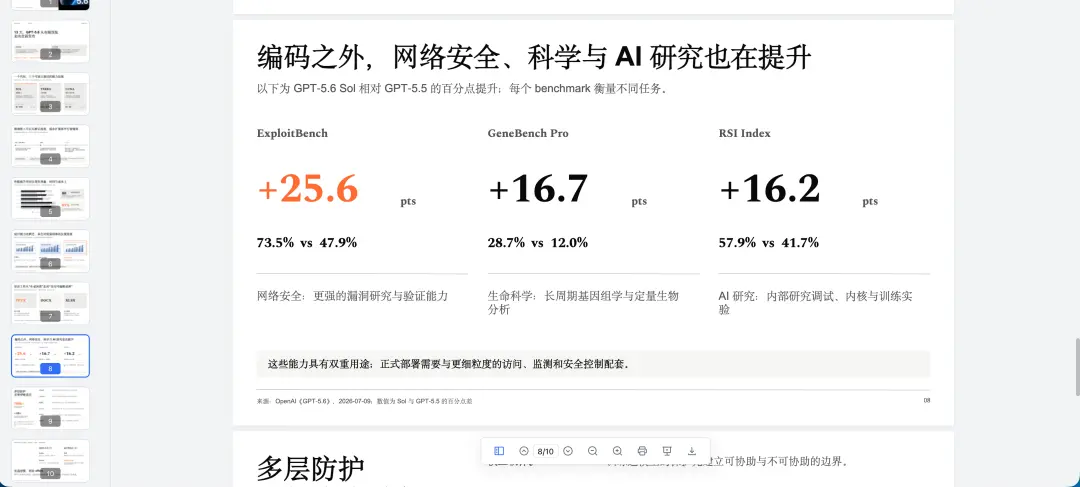
What can I say, the aesthetic sense of the GPT series, perhaps only a brand new generation of pre-trained models in GPT-6 can improve it…
It's just for viewing.
However, for tasks involving data analysis and handling tables, it is indeed incredibly strong, reaching new heights.
If conditions allow, I recommend everyone to download the ChatGPT application and use it to help with work. This might be the highest cost-performance ratio and best quality Work-type agent product available today.
The previous ChatGPT Chat mode, which is just chatting, has been hidden in a small tab, as if its historical mission has been completed.
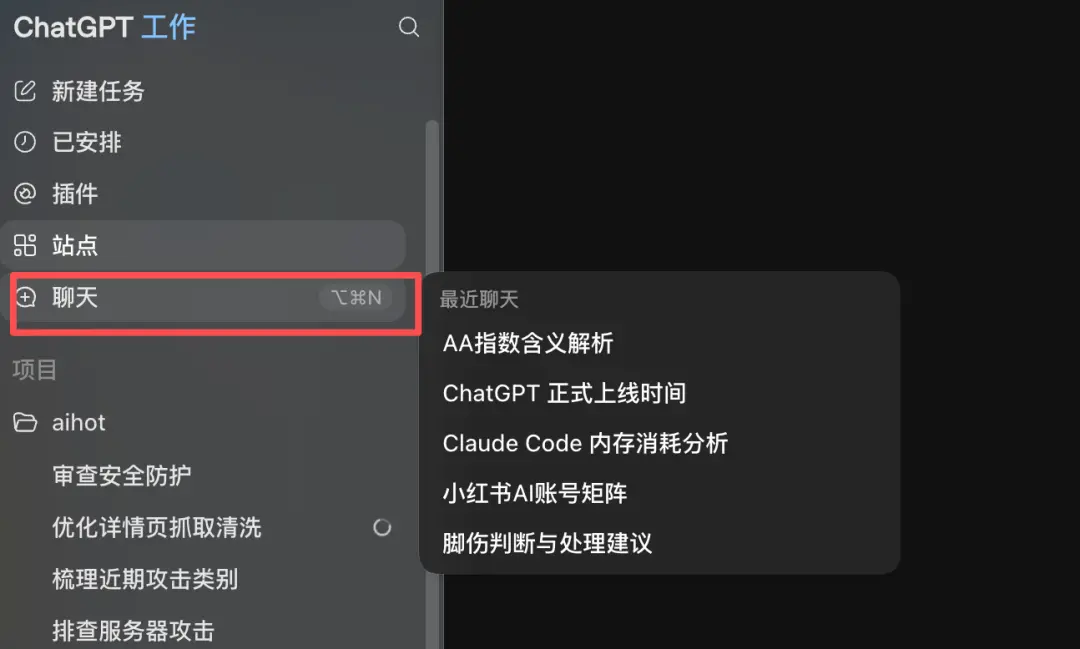
After clicking, a pop-up will appear in the lower right corner; this small interface is ChatGPT Chat.

Additionally, there is a fun new feature for Work scenarios.
A new function called "Sites" has been added.
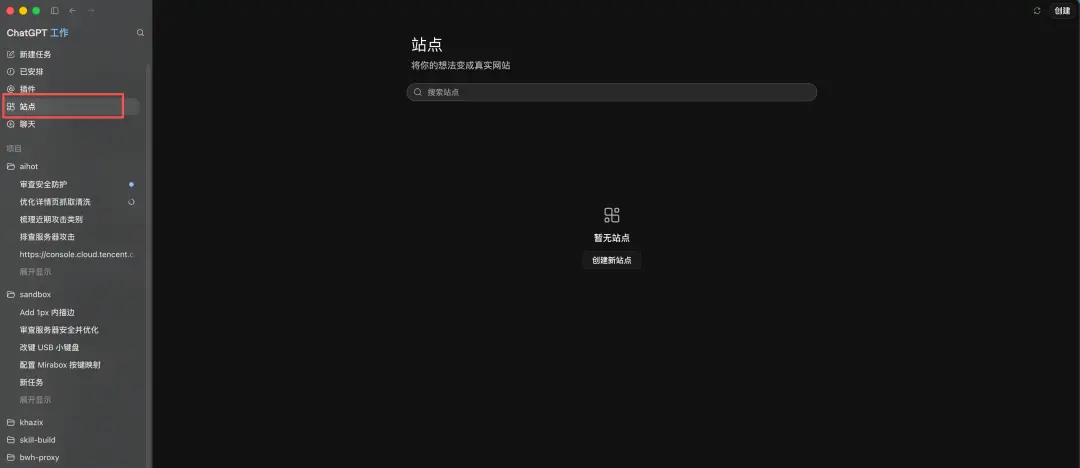
We all know that for many non-developers, creating a product and deploying it online for others to use can be a very troublesome task.
So OpenAI has created this feature to address that need.
At its core, it packages their own Skill called Sites.

After you finish creating something, you can simply say a prompt like "deploy it using Sites."

It will help you deploy it online and give you a domain name that you can share with your friends and colleagues.

This is extremely user-friendly for the general public.
Final Thoughts
I believe this time, OpenAI has once again proven their vitality through their products and models.
This company is still the same OpenAI as before.
Once, OpenAI was the dragon-slaying youth facing Google. As time progressed, they gradually transformed from warriors into the evil dragon atop a pile of gold and silver.
They began to receive criticism, and no one liked them anymore. Everyone said OpenAI should perish.
However, with the rise of Anthropic, OpenAI was beaten down for a while.
It walked down from its throne, watching a new evil dragon occupy the throne that once belonged to it.
Then, it picked up its shield and retrieved the sword that had begun to rust.
It slashed at the Sora that had sent it to the arrogant throne, cutting it off.
It decided to return to the masses, to create the models that the people wanted and the products that the people liked.
Until a few months later, today, it has returned to the throne that once belonged to them, standing before the evil dragon called Anthropic.
It said, this time.
It's your turn.
 Risk warning



Popular articles





