How much premium is Wall Street willing to give AI storage? Tonight, SK Hynix's debut on the US stock market may reveal the answer
 Core Viewpoint

 As the leader in HBM with a market share exceeding 56%, SK Hynix's listing in the U.S. is seen as a "referendum" on the sustainability of AI demand. Despite the volatility of its underlying stock and limited arbitrage conversion, due to its valuation being significantly discounted compared to its U.S. counterparts, institutions expect that the ADR will show a premium of 5% to 30% relative to Korean stocks, becoming a new barometer for testing the valuation debate of AI on Wall Street.
Author: Wall Street Watch
SK Hynix's American Depositary Receipts (ADR) debuted on Nasdaq on Friday. This largest-ever issuance of foreign companies' stocks in the U.S. is becoming a litmus test for Wall Street's enthusiasm for AI investments.
According to a previous article from Wall Street Watch, the issuance price of SK Hynix's ADR was set at $149 per share, approximately 3.1% higher than the company's closing price of common stock in Seoul on Thursday, raising about $26.5 billion, surpassing Alibaba's 2014 record of $25 billion for a U.S. IPO. The institutional purchase multiple exceeded 7 times, with buyers including major global long-only funds and sovereign wealth funds, indicating strong demand that has attracted market attention. The ADR will start pre-issue trading on Friday under the code "SKHYV" and will officially list as "SKHY" on July 13.
However, the real highlight of this event is not the scale of financing, but the premium relative to Korean stocks after the ADR listing ------ it will directly reflect how much extra price American investors are willing to pay for the core targets in the AI storage sector. Institutions expect a divergence in premiums ranging from 5% to over 30%, and the debate over the valuation of the AI sector will be validated to some extent in the pricing of this emerging trading target.
Bill Birmingham, Managing Director of REX Financial, pointed out that the core of this listing is more like a "referendum" on three questions: How long can the memory shortage last, whether AI-driven demand is sustainable, and whether "listing in the U.S. can end the market's debate on the reasonable valuation range for storage stocks."
The Largest Issuance of Foreign Companies in U.S. History
This ADR issuance totaled 177.9 million shares, amounting to approximately $26.5 billion, breaking Alibaba's record that had stood for over a decade. SK Hynix is the second-largest company by market capitalization in South Korea, second only to Samsung Electronics, with a market value of about $1 trillion on the Seoul Exchange. According to the Financial Times, this ADR size is less than 3% of the company's total market capitalization.
SK Group Chairman Chey Tae-won personally attended the listing ceremony in New York and will meet with global investors to discuss expanding AI storage cooperation with major clients. Reports indicate he may also meet with executives from technology companies such as Nvidia and Tesla. SK Hynix stated that the purpose of this U.S. listing is to help the company achieve a valuation that better reflects its core position in AI infrastructure in the global capital market.
The issuance was co-managed by Bank of America, Citigroup, Goldman Sachs, and JPMorgan, with nine other institutions participating in the underwriting.
HBM Leadership Supports Investor Enthusiasm
SK Hynix occupies a unique position in the field of AI-related storage chips, which is the core logic for attracting U.S. funds.
According to the company's filings with the U.S. Securities and Exchange Commission (SEC), SK Hynix holds a 56.4% market share in the high-bandwidth memory (HBM) chip market, making it an indispensable component for high-end AI chips like Nvidia's GPUs. Shay Boloor, Chief Market Strategist at investment firm Futurum Equities, stated that SK Hynix is "the purest public market target for HBM bottlenecks, and its business ties with Nvidia are deeper than its competitors," adding that "the purity of HBM is higher than Samsung, and its current leadership in HBM is stronger than Micron."
David Fetherstonhaugh, an investment strategist at VistaShares, noted that this listing "is a clear positive signal for U.S. and global funds that previously could only indirectly invest in SK Hynix through proxy targets." He also expects that the initial inflow of funds from ETFs and other proxy instruments into the ADR may create short-term price pressure.
From a fundamental perspective, SK Hynix and Samsung's valuations in Seoul are at a discount compared to their U.S. counterparts. According to Visible Alpha data, Micron Technology's expected price-to-earnings ratio for 2028 is about 6 times, while both SK Hynix and Samsung are only at 4 times. U.S. investors may view part of this discount as an entry opportunity, thereby pushing up the ADR's premium relative to Korean stocks.
The Premium Range Becomes the Biggest Suspense, with Clear Divergence in Institutional Expectations
The reasonable range of the premium on the first day of ADR trading is the most fiercely debated focus in the market.
According to a memo obtained by Bloomberg sent to institutional clients, Morgan Stanley's sales and trading department estimates the initial premium range to be between 5% and 10%, noting that if the ADR is included in U.S. indices or ETFs, there is potential for further expansion of the premium. However, some institutional investors have more aggressive expectations, believing the premium could exceed 30%.
Independent analyst Travis Lundy, who published research on Smartkarma, stated:
"No one can know how much this premium is worth each day before the ADR undergoes sufficient market calibration. History shows that premiums can rise, but they will not be maintained at extremely high levels for long."
The TSMC ADR provides the most valuable historical reference case. According to research by Goldman Sachs analysts, ADRs typically do not differ from the underlying stock price by more than 5%, but Bloomberg data shows that the average premium for TSMC ADRs over the past month was about 16%, and it has even exceeded 20% multiple times over the past three years. The Financial Times noted that this premium peaked during the smartphone demand explosion in 2009 and narrowed to zero two years later. SK Hynix does not have decades of ADR trading history like TSMC for reference, making pricing more challenging.
High Barriers to Arbitrage Trading, Asymmetric Constraints in Conversion Mechanism
Compared to TSMC, SK Hynix's ADR arbitrage trading faces a more complex operational environment.
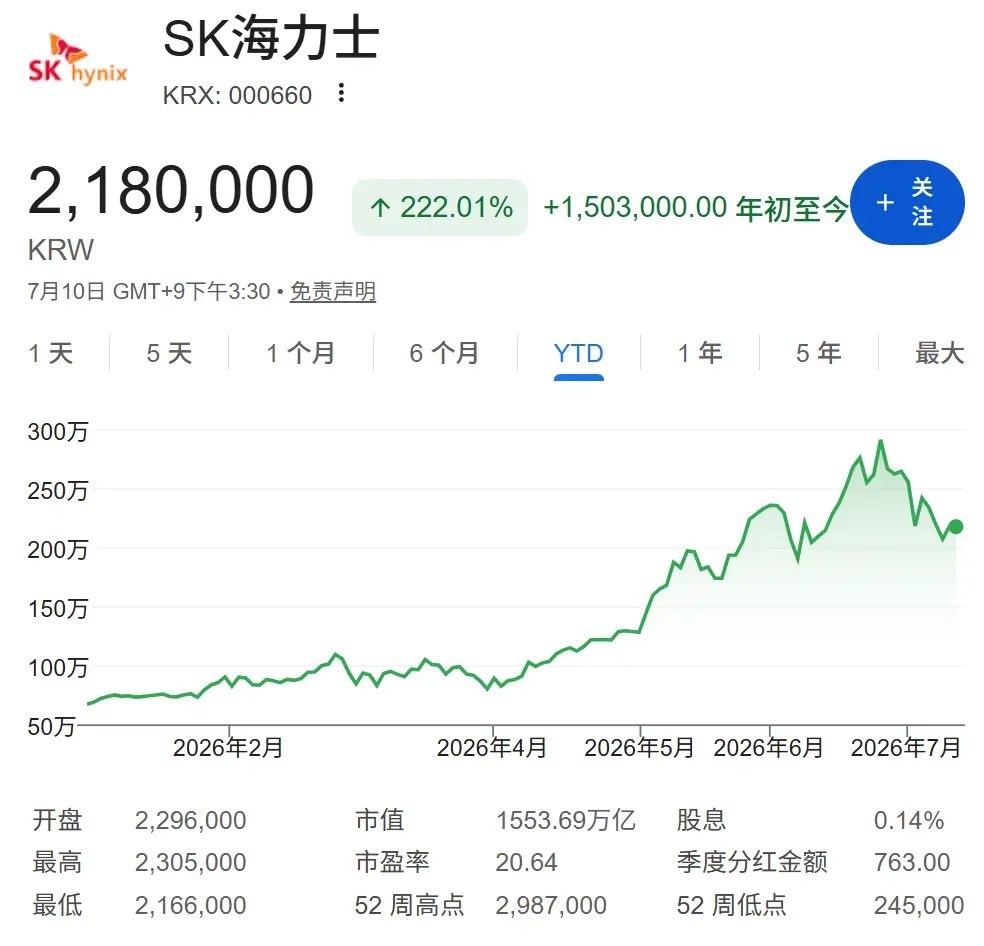
The stock of SK Hynix is extremely volatile. Data shows that this year there have been over 50 trading days where the stock price fluctuated by more than 5% in a single day; nevertheless, the cumulative increase this year has exceeded twofold. Alex Au, Managing Director of Hong Kong's Alphalex Capital Management HK Ltd., who has engaged in TSMC ADR spread trading for many years, stated:
"Given the volatility of SK Hynix, the risk of the spread is much higher. Therefore, for traders looking to capture the premium, you need a higher return to compensate for the risk."
The asymmetry in the conversion mechanism further restricts arbitrage opportunities. According to a document from July 6, ADR holders can cancel their ADRs and exchange them for stocks listed in Seoul, but the reverse operation ------ converting common stock into ADRs ------ may require approval from Korean regulatory authorities, which is not straightforward. This mechanism differs from TSMC's ADR, limiting the operability of two-way arbitrage.
However, Bill Birmingham, Managing Director of REX Financial, pointed out that the core significance of this listing is not in price discovery, but more like a "referendum" on three questions: How long can the memory shortage last, whether AI-driven demand is sustainable, and whether "listing in the U.S. can end the market's debate on the reasonable valuation range for storage stocks."
Behind the Listing: The Capital Logic of AI Investment Expansion
The funds raised from this U.S. listing will be directly injected into SK Hynix's massive AI-related capital expenditure plans.
The company is currently building advanced chip packaging facilities in Lafayette, Indiana, which received $458 million in funding support from the Biden administration through the CHIPS and Science Act. Meanwhile, SK Hynix and Samsung Electronics are cooperating with the South Korean government's national investment plan, which totals about $880 billion, to increase investments in the domestic AI and semiconductor industries.
Despite strong AI demand, the inherent cyclicality of the memory industry remains a risk variable that investors need to weigh. Boloor stated that SK Hynix is "the biggest beneficiary if HBM scarcity continues to exceed expectations, but if the memory cycle ultimately reverses, the downside risk cannot be ignored ------ and this reversal may not occur until 2028 at the earliest." Birmingham suggested that investors should focus on the contract pricing trends in 2027 to assess the sustainability of demand.
SK Hynix's U.S. stock may be a better tool for measuring the temperature of the AI boom rather than merely an investment target itself.
 Risk warning