Bitget UEX Daily Report|U.S. Secretary of Commerce urges Korean storage giant to expand production in the U.S.; Waller forms expert team to review monetary policy framework; SK Hynix listed on Nasdaq today

 Bitget UEX Daily Report
# 1. Hot News
Federal Reserve Dynamics
Federal Reserve Chairman Walsh forms external expert team to comprehensively review monetary policy framework
- Kevin Walsh announced the establishment of five independent working groups (Inflation, Balance Sheet, Employment, Data, Communication), led by renowned economists and former central bank officials (including Chetty, Anderson, Mankiw, etc.), aimed at assessing whether tools, analytical methods, and frameworks are suitable for the rapid transformation of the economy.
- The working groups will submit fact-based analyses to the FOMC, emphasizing a "steadfast" commitment to price stability and full employment.
- Market Impact: The review signals that the Federal Reserve is proactively adapting to AI and structural changes, strengthening short-term expectations for policy flexibility, helping to stabilize interest rate path pricing and reduce excessive hawkish concerns.
International Commodities
US-Iran conflict escalates again as Trump announces end of ceasefire and resumes strikes
- Trump stated that the ceasefire has ended due to Iran's continued attacks on vessels in the Strait of Hormuz; US forces will strike at least 170 Iranian military targets within 48 hours, with Iran retaliating against US bases. Israel shares intelligence on "Iran's new assassination plan for Trump," and Trump temporarily changes planes after the NATO summit (preventive security measures).
- Pakistan and Qatar continue to mediate, with US officials stating that technical negotiations are ongoing, and Iran must never possess nuclear weapons. Some Republican lawmakers are concerned that rising oil prices could hinder midterm elections.
- Market Impact: Geopolitical risks are driving short-term oil price volatility and safe-haven sentiment, but actual supply shocks are limited. The decline in oil prices indicates that market expectations for rapid escalation are cooling, providing temporary support for precious metals.
Macroeconomic Policy
US temporarily refrains from imposing tariffs on commercial aircraft and jet parts; OpenAI officially launches GPT-5.6 and negotiates adjustments with the government
- The Department of Commerce decided not to impose tariffs after completing its investigation and instead will negotiate with trade partners; if no effective agreement is reached within 180 days, Trump may take further action. OpenAI released the Sol/Terra/Luna model series, which was adjusted after consultations with Lutnik, Basant, and others, and will be opened to the public in phases.
- Former Federal Reserve Chairman Bernanke joins Anthropic's long-term interest trust, responsible for overseeing AI's social impact and board appointments.
- Market Impact: The delay in tariffs alleviates pressure on the aviation supply chain, and signals of AI regulatory collaboration are favorable for large model companies' long-term certainty, while highlighting the government's deep involvement in AI infrastructure.
# 2. Market Review
Commodity & Forex Performance (Real-time Update)
- Spot Gold: $4120/oz, -0.09%
- Spot Silver: $60.02/oz, +0.14%
- WTI Crude Oil: $71.95/barrel, -0.18%
- Brent Crude Oil: $76.00/barrel, -0.24%
- US Dollar Index (DXY): 100.819, -0.14%
Despite the escalation of the US-Iran conflict (Trump's resumption of strikes, plane changes, and assassination intelligence) raising geopolitical concerns, crude oil only recorded a slight decline. Analysts generally believe that the market has fully absorbed the risk premium—actual supply shocks are limited, combined with weak global demand and the easing expectations brought by Pakistan and Qatar's mediation. Institutions like Goldman Sachs have previously lowered the oil price center for 2026, and the current price action confirms the narrative of "manageable conflict." Gold slightly fell, while silver slightly rose, showing divergence: safe-haven buying was offset by the strong performance of US tech stocks and a rebound in risk appetite, while silver was supported by industrial demand; analysts from MUFG noted that the Fed Chairman Walsh's framework review and meeting minutes show policy divergence, with higher-for-longer expectations limiting the upside for precious metals. The US dollar index weakened in tandem, reflecting the dominance of risk asset rebounds. The overall linkage logic is clear—geopolitical disturbances remain, but macro liquidity and institutional consensus on "limited escalation" dominate short-term pricing, putting pressure on crude oil and causing precious metals to fluctuate within a range.
Cryptocurrency Performance
- BTC: $63100, 24h up 1.5%
- ETH: $1744, 24h up 0.25%
- Total Cryptocurrency Market Cap: $2.26 trillion, 24h up about 1.7%
- Market Liquidation Situation: Total liquidation of about $175 million in 24h, with short liquidations of about $108 million
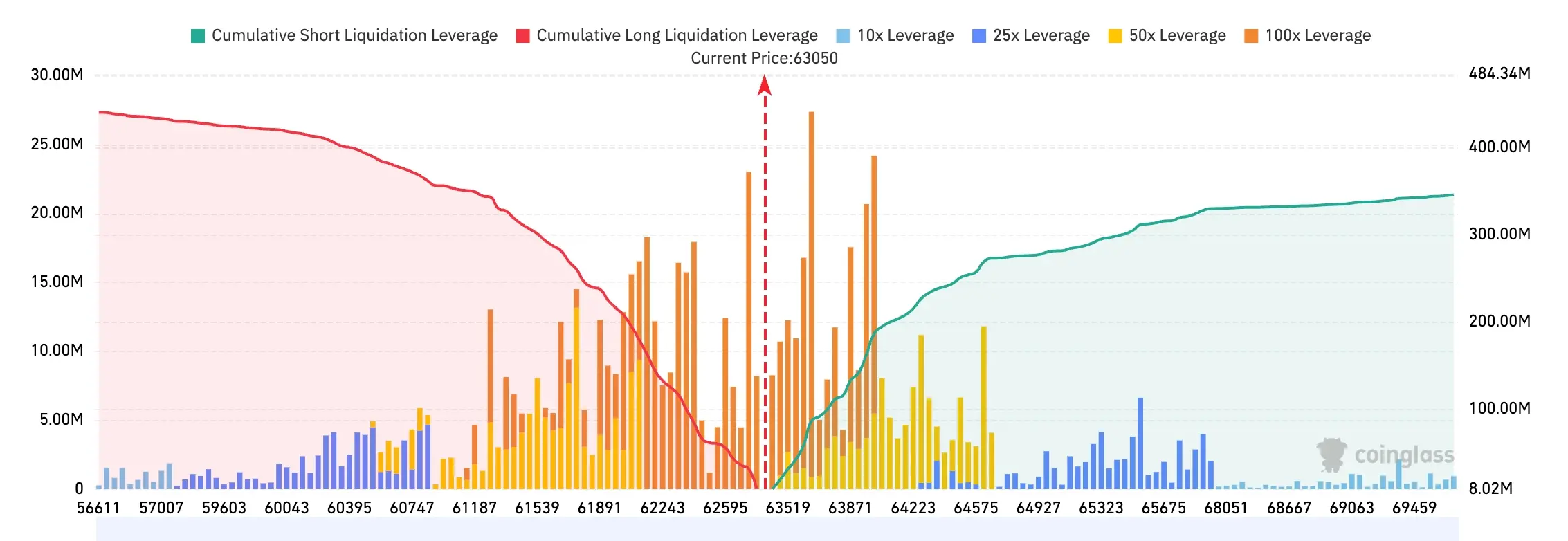
- Bitget BTC/USDT Liquidation Map: Current BTC price is about $63,050, with a large number of short liquidations concentrated in the $63,500--$64,500 area, where the leverage positions are densest around $63,800--$64,000. If this range is broken, it may trigger a new round of short squeeze. There is a noticeable long liquidation zone between $62,000--$62,800, but the overall cumulative liquidation scale below is weaker than above, indicating that short-term market liquidation pressure still leans towards the upside.
- Spot ETF Net Inflow/Outflow: BTC spot ETF saw a net outflow of $0.15 million yesterday, with a current 24h dynamic net outflow of $0.15 million.
Driver Analysis: BTC performed relatively strongly, ETH remained flat, and total market cap moderately rebounded, reflecting resilience in risk appetite amid geopolitical disturbances. The ETF saw a slight outflow yesterday, with manageable leverage liquidation and a relatively balanced long and short position, indicating that market deleveraging has been completed in phases. On the macro level, the Fed's framework review and the strong performance of tech stocks provide support, but the decline in oil prices and stabilization of the dollar limit significant upward movement. The overall trend is tilted towards oscillation and repair, with BTC leading ETH's divergence continuing the "institutional preference for large-cap coins" characteristic, while technical focus is on the release of upper liquidation pressure.
US Stock Index Performance
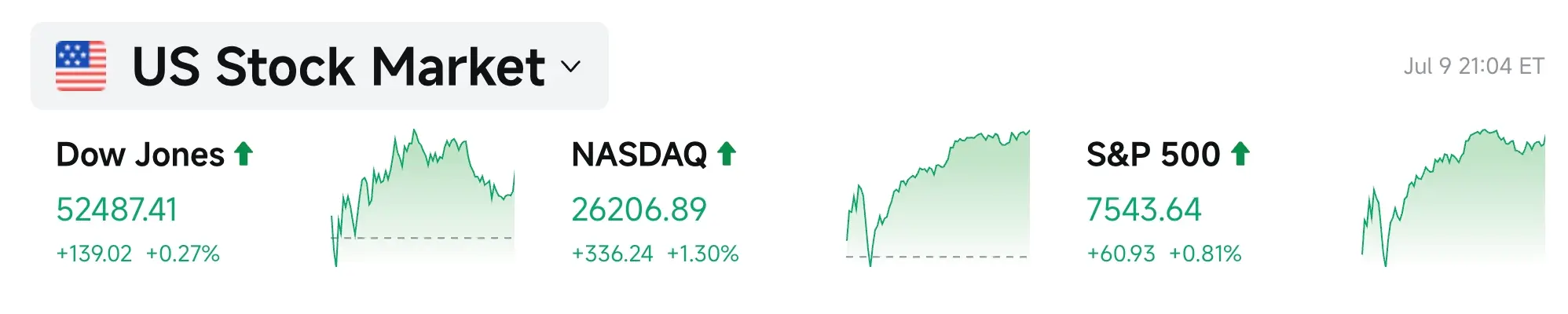
- Dow Jones: 52487.41 (up 0.27%), continuing to rise moderately
- S&P 500: 7543.64 (up 0.81%), broad-based steady rise
- NASDAQ: 26206.89 (up 1.30%), driven significantly by technology and chip sectors
Tech Giants Dynamics
- NVDA: about $203.50, -0.8%
- AAPL: about $316.00, +0.4%
- MSFT: about $392.00, +1.3%
- GOOGL: about $357.00, -1.4%
- AMZN: about $245.00, +0.4%
- META: about $615.00, +4%
- TSLA: about $407.00, +3.2%
- SPCX: $152, +2.6%
- MU: $991.64, +4.52%
Performance Summary and Driver Analysis: The tech sector overall strengthened but showed significant divergence: storage and AI infrastructure (MU, AMD, AVGO) led the gains, benefiting from the Secretary of Commerce urging Korean companies to expand production capacity in the US and Micron's $250 billion investment plan; META's surge was due to Zuckerberg denying overcapacity and emphasizing the commercial potential of cloud business; TSLA was boosted by guidance on Optimus mass production. NVDA's slight pullback reflects valuation digestion and competitive concerns, while GOOGL is under pressure from specific events. The differences in driving factors are clear—policy and capacity implementation favor storage, while company strategic narratives benefit META/TSLA, rather than a unified "AI optimism" logic.
Sector Movement Observation
Storage Chip Sector rose over 3%
- Representative stocks: Micron Technology (MU) rose 4.52%, AMD rose nearly 6%
- Driving factors: US Secretary of Commerce Lutnik publicly urged SK Hynix and Samsung to expand US storage capacity, coupled with Micron's significant increase in domestic investment, alleviating AI HBM/storage shortage expectations, leading to rapid inflow of funds.
Semiconductor Equipment rose about 2%
- Representative stocks: Broadcom rose over 3%
- Driving factors: Continued expectations for AI capital expenditures rising, coupled with the upcoming IPO of SK Hynix boosting sentiment.
# 3. In-depth Analysis of US Stocks
1. SK Hynix - NASDAQ Secondary Listing Launch
Event Overview: SK Hynix's ADR was finally priced at $149 per share, raising about $26.5 billion (slightly reduced from the previous target of about $28-29 billion), with oversubscription exceeding 7 times, showing extremely strong institutional demand in the AI storage sector. The lead underwriters are Bank of America, Citigroup, Goldman Sachs, and JPMorgan, with an expected commission pool exceeding $140 million. The stock will begin trading on July 10 under the SKHYV code in a when-issued manner, transitioning to the regular trading code SKHY on July 13. Concurrently, US Secretary of Commerce Lutnik publicly urged SK Hynix and Samsung to expand US storage chip capacity to alleviate the global shortage of key AI components, stating, "I hope to bring competitors to set up factories in the US," even if Micron's CEO may not welcome it. The prospectus shows that the funds raised will mainly be used for new factory construction and equipment expansion to match the explosive demand for high-bandwidth memory (HBM) and other AI needs.
Market Interpretation: Wall Street generally views this as one of the largest foreign company IPOs in history (second only to SpaceX), with institutions seeing it as a "core target in the AI supply chain," and the valuation is expected to be reassessed due to US stock liquidity and analyst coverage (previously, there was significant discount in Korean stocks). Several investment banks pointed out that the oversubscription and high commissions reflect long-term optimism about the tight supply-demand situation for HBM, but there are also voices warning that large-scale listings may trigger institutions to sell related stocks like Micron and NVIDIA to adjust their portfolios, causing short-term sector volatility. Lutnik's statement is interpreted as accelerating the implementation of the US "chip reshoring + ally capacity sharing" policy, benefiting global storage leaders but increasing competitive pressure on Micron.
Investment Insight: Liquidity and volatility on the first day of listing will be extremely intense, while in the long term, it will benefit from the dual drive of localized production capacity in the US and the AI HBM super cycle, with a focus on its market share competition with Micron.
2. Meta Platforms - Zuckerberg denies overcapacity and promotes cloud business
Event Overview: Zuckerberg explicitly denied the "overcapacity" narrative in his latest statement, saying, "I don't know anyone in the industry who thinks they have overcapacity," and confirmed that Meta is seriously considering renting out some AI infrastructure to external companies, stating that the cloud business "definitely has commercial potential." The company also officially launched the paid version Muse Spark 1.1 model (the first AI model charged to enterprises), with aggressive API pricing (about $1.25 per million tokens, far lower than competitors), and provides new users with a $20 free credit. Zuckerberg emphasized that the model performs excellently on agentic tasks, coding, and tool usage benchmarks (e.g., MCP Atlas 88.1%), and criticized peers for pricing being "too extreme." The previous shareholder meeting had revealed that "cloud business is definitely on the table," with external companies inquiring weekly about purchasing computing power or API services.
Market Interpretation: Institutions generally interpret this as a key turning point for Meta from "purely burning money on AI investments" to "potentially high-profit cloud/API revenue." Multiple analysts believe that aggressive pricing is likely to capture developer market share, creating network effects similar to the advertising business; simultaneously, denying overcapacity and confirming cloud plans effectively alleviates market concerns about "overbuilding" with a capital expenditure of $145 billion. In the short term, stock price elasticity is significant, and some investment banks have raised their confidence in Meta's AI monetization path, believing it can leverage advertising cash flow advantages to engage in price wars.
Investment Insight: If the cloud business is realized, it will reshape Meta's valuation logic, evolving from "social + advertising" to "AI infrastructure + models," with clear short-term catalysts but requiring observation of actual contract signing progress.
3. Micron Technology - Over $250 billion investment in the US before 2035
Event Overview: Micron officially announced on July 9 that it will increase its total investment in the US to over $250 billion (by 2035), an increase of about $50 billion from previous commitments, aiming to raise the US DRAM production capacity share to 40%. On the same day, a ceremony for the "first shovel of concrete" at the New York Clay super factory (the largest semiconductor manufacturing base in the US) was held, with the Idaho factory expected to produce its first wafers by mid-2027 and the second factory to be operational by the end of 2028. The New York project is expected to create 50,000 jobs (including 9,000 direct positions), totaling over 90,000 nationwide. CEO Sanjay Mehrotra thanked Trump, Lutnik, and other government officials for their support, emphasizing that "data and memory are the cornerstones of the modern economy," and simultaneously added up to $3 billion in supply chain strengthening funds.
Market Interpretation: This move is viewed by Wall Street as the most direct response to the US "CHIPS Act" and Trump's "manufacturing reshoring" policy, as well as a "first-mover layout" in response to Lutnik's urging of Korean companies to expand production. Institutions generally give positive evaluations: the implementation of capacity will significantly enhance Micron's global share and profit margin stability in AI HBM and advanced DRAM, while also creating jobs and supply chain security premiums. Some analysts pointed out that large-scale investments may temporarily suppress free cash flow, but under long-term tight supply-demand conditions (with an explosion in AI demand), it will translate into pricing power and valuation reassessment. The stock price surged over 4% on the day, reflecting the market's rapid pricing of dual catalysts from policy and demand.
Investment Insight: Long-term capacity and policy dividends are clear, benefiting from sentiment and sector rotation in the short term; focus on the progress of the first wafer production in 2027 and changes in HBM market share.
4. Tesla - Optimus Gen3 mass production red line issued
Event Overview: According to multiple supply chain sources including LatePost, Tesla recently issued specific parts procurement guidelines for Optimus Gen3 to suppliers, requiring production capacity to increase to 1,000 units per week by September, and further to 2,000-2,500 units per week by the end of the year (corresponding to an annual supply capacity of about 100,000 units). Musk had previously approved the latest Gen3 design in an executive meeting, meaning it has officially moved out of the laboratory after more than three years of development. The supply chain saw hundreds of orders in August about two months in advance, with the Fremont factory set to start mass production first (initially slower), while a dedicated factory in Austin is also under construction (long-term planning for tens of millions of units capacity).
Market Interpretation: Institutions and supply chain analysts generally believe this is a key node for Optimus to transition from "concept demonstration" to "real mass production realization." Nomura, UBS, and others had previously raised short-term shipment expectations (about 25,000 units in 2026), and this hard target further validates execution capability. The market interprets this as the robot business beginning to contribute substantial revenue expectations (with a target price of about $20,000 per unit), likely becoming a new pillar for TSLA's valuation shift from "automotive + energy" to "embodied intelligence." Short-term supply chain order realization boosts sentiment, but uncertainties remain regarding yield and costs in the initial ramp-up of mass production.
Investment Insight: The turning point from narrative to delivery for robots is approaching; if production capacity meets standards in September, it will significantly enhance long-term valuation anchors; short-term volatility is still influenced by automotive deliveries and macro factors.
5. Oracle - Credit rating downgraded to investment-grade edge
Event Overview: S&P Global Ratings downgraded Oracle's long-term issuer credit rating from BBB to BBB- (the lowest investment grade) on July 9, with a stable outlook. The main reason is the rapid expansion of AI infrastructure business leading to increased overall business risk and significantly weakened cash flow: capital expenditures are expected to soar to $90-95 billion in fiscal year 2027 (previously expected at about $60 billion), and free operating cash flow deficits may expand to about $42 billion. The company's debt has reached about $160 billion, while customer concentration risks (OpenAI, xAI, Meta, etc.) have increased. Nevertheless, Oracle's cloud contract backlog remains as high as $638 billion, and the stock price rose against the trend on that day.
Market Interpretation: Institutional views are notably divided: rating agencies emphasize the structural impact of "AI burning money" on the financial flexibility of traditional software giants, warning investors to pay attention to the vulnerabilities of high-leverage expansions; however, most buy-side analysts focus more on its massive cloud backlog and first-mover advantage in AI infrastructure, believing that short-term cash flow pressures can be covered by long-term contracts, and the downgrade instead creates buying opportunities. Some investment banks pointed out that this is a typical pain point of "heavy asset transformation" in the AI era, and similar phenomena may occur in other traditional tech companies.
Investment Insight: Under the prolonged AI investment return cycle, companies with high debt expansions face rating and financing cost pressures; focus on its FCF turning point and customer contract conversion rates, as structural opportunities may exist amid short-term volatility.
# 4. Cryptocurrency Project Dynamics
Bloomberg reported that South Korean memory chip maker SK Hynix completed the issuance of American Depositary Receipts (ADRs), raising a total of $26.5 billion at $149 per share, issuing a total of 177.9 million ADRs, surpassing Alibaba to become the third-largest IPO in US history, second only to Alibaba's $25 billion record. The issuance price was about a 3% premium over the closing price of Seoul stocks on Thursday, with oversubscription exceeding seven times, and nearly half of the ADRs were subscribed by the top ten order accounts, with demand approaching $200 billion. SK Hynix holds a 57% share of the global HBM market, and this issuance coincides with the investment boom in AI infrastructure, as the company will participate in the $880 billion investment plan led by the South Korean government alongside Samsung Electronics. The ADR is expected to begin regular trading on July 13.
According to CoinDesk, in just the month of June, the US spot Bitcoin ETF saw a net outflow of $4 billion, led by BlackRock's IBIT, with funds shifting towards AI trading and SpaceX IPO opportunities. Bitcoin fell about 14% in the second quarter, dropping below $60,000, marking the third consecutive quarter of losses. However, this outflow pales in comparison to the $20 trillion private credit market. Redemption requests in the second quarter reached $15.6 billion, with 10 out of 16 business development companies exceeding the 5% quarterly limit, and most investors received only partial payments. Fitch expects redemptions to continue in the coming months, and unmet requests will keep many companies under pressure.
Bitcoin ETFs have strong liquidity, and outflows directly affect BTC prices; private credit BDCs, on the other hand, are illiquid long-term instruments. The simultaneous redemptions of both reflect widespread market concerns about liquidity and risk. The energy market is also sending signals of risk aversion, with the US Strategic Petroleum Reserve at its lowest since 1983. QCP Capital summarized: "Different fields, same pattern: the market's buffer space is narrowing." It pointed out that the strategic petroleum reserve is bottoming out, Strategy has sold BTC to pay dividends for the first time, and private credit redemptions have broken thresholds, all indicating that risk assets face a more challenging environment.
Insiders revealed that the unified version of the US Clarity Act may be announced as early as next week, merging the work results of the Senate Banking Committee and the Agriculture Committee, and is expected to be submitted to the full Senate for a vote during the week of July 20.
Bitwise Senior Investment Strategist Juan Leon stated that the current Bitcoin bear market is fundamentally different from previous cycles, with institutional adoption accelerating. Bitwise clients are divided into two categories: investors who have held Bitcoin for more than two years view the decline as a "buying opportunity," while other large capital investors are still waiting for clearer regulatory signals. Leon described this round's 50% decline as Bitcoin's "mildest structural bear market," compared to declines of 78% in 2022 and 84% in 2018, stating that "the bottom is rising in each cycle."
Ark Invest, led by Cathie Wood, purchased 217,896 shares of Circle stock on Thursday, valued at about $13.7 million, while CRCL fell 1.65% to $63.01 that day. Ark also sold 85,319 shares of Robinhood stock, valued at about $9.8 million, with HOOD rising 1.39% to $115.11 that day.
# 5. Today's Market Calendar
Data Release Schedule
|-------|----|-------------|-----| | 00:00 | US | WASDE Report | ⭐⭐⭐ | | 01:00 | US | Baker Hughes Oil/Total Rig Count | ⭐⭐ |
Important Event Forecast
- SK Hynix NASDAQ listing trading begins: All day - Sentiment barometer for the storage sector
- Follow-up statements and mediation progress on the US-Iran conflict: Anytime - Source of oil price and safe-haven asset volatility
Institutional Views:
In the past 24 hours, US tech and storage sectors have been strong, oil prices have declined, precious metals have strengthened, and cryptocurrencies have oscillated and repaired. Well-known investment banks generally hold a positive but cautious view: most believe that while the US-Iran conflict is disruptive, it has not changed the main line of AI capital expenditure, and storage and computing-related targets (MU, AMD, SKH-related) have received dual catalysts from policy and demand; Bank of America and others reiterated that NVIDIA's fundamentals have not reversed, and the valuation discount is enticing; they are more bearish on oil in the short term as geopolitical premiums fade. In terms of cryptocurrencies, institutions generally point out that ETF outflows and liquidations are manageable, and BTC's relative resilience shows that institutional allocations are still in place, but further clarity on macro data is needed. The overall consensus is to "seek structural opportunities amid divergence," rather than a comprehensive rebound in risk appetite.
Disclaimer: The above content is compiled by AI search, with human verification for publication, and should not be considered as any investment advice. The data in the text inevitably contains deviations; please refer to real-time market data.
 Risk warning