








Bitget UEX Daily Report|The energy sector rises, optical communication concept stocks strengthen; the Dow Jones Industrial Average falls more than 570 points; BTC spot ETF records net inflows for three consecutive days (July 9, 2026)

 Bitget UEX Daily Report
# 1. Hot News
Federal Reserve Dynamics
No significant new developments from the Federal Reserve
- Today, several officials including New York Fed President Williams and Dallas Fed President Logan will speak. The market is particularly focused on their views on the inflation path, labor market resilience, and the potential transmission effects of geopolitical events on inflation through energy prices.
- Institutions generally believe that the Fed's policy path in the short term remains highly data-dependent. Geopolitically driven oil price increases may temporarily raise inflation expectations, but have not changed the overall direction towards rate cuts unless energy prices continue to rise significantly and translate into core inflation pressures. Market Impact: Trump's statements have reduced the extreme downside risk for risk assets in the short term, somewhat boosting market risk appetite, but persistent geopolitical uncertainty will maintain high volatility and potentially disrupt inflation expectations and the Fed's policy response function through energy price channels. Institutions recommend closely tracking the subsequent developments' impact on the September FOMC meeting's interest rate path, as well as the transmission strength of oil prices to core PCE.
International Commodities
Oil prices fluctuate at high levels after Trump's cooling remarks, geopolitical premiums remain
- Trump's hardline stance on the Iran ceasefire agreement triggered a sharp rise in oil prices, followed by cooling remarks that caused prices to fluctuate violently at high levels. The daily volatility of WTI and Brent crude oil significantly expanded, indicating the market's high sensitivity to Middle Eastern supply risks.
- Traditional safe-haven assets like gold and silver slightly retreated, mainly due to Trump's statements leading to a temporary recovery in risk appetite, while a stronger dollar index exerted pressure on precious metals. However, both remain within historically high absolute price ranges, indicating that long-term demand for safe-haven and inflation hedging has not significantly diminished.
- The market continues to pay attention to Middle Eastern supply chain risks, particularly the security status of key energy shipping routes like the Strait of Hormuz, as well as the potential impacts of geopolitical events on global energy trade flows, inventory levels, and refining capacities. Market Impact: After a short-term spike, oil prices have partially retraced, alleviating extreme inflation concerns, but geopolitical uncertainty will still maintain relatively high volatility in energy prices and potentially disrupt the Fed's policy path through cost-push inflation channels. Institutions believe that the complex interplay between oil prices, risk assets, and the dollar index will continue, recommending close attention to the transmission strength of energy prices to core inflation and their impact on the September FOMC interest rate decision.
# 2. Market Review
Commodity & Forex Performance
- Spot Gold: Approximately $4,079/ounce, -0.05%
- Spot Silver: Approximately $58.50/ounce, -0.08%
- WTI Crude Oil: Approximately $74/barrel, +1.11%
- Brent Crude Oil: $78.9/barrel, +1.14%
- Dollar Index (DXY): 101.002, -0.06%
Driving Factors Analysis: Trump's threatening then cooling remarks directly boosted oil price volatility, with geopolitical risk premiums dominating energy and precious metals trends. The dollar index strengthened due to risk aversion, exerting pressure on gold, but long-term inflation and safe-haven demand still provide support. Institutions believe that short-term oil prices are easily driven by events, while gold oscillates within a high range, focusing on whether the situation in the Middle East further cools or escalates. Inter-asset linkage shows some divergence between risk assets and safe-haven assets, necessitating caution against event shocks in short-term trading.
Cryptocurrency Performance
- BTC: Approximately $62,165, -2.12%
- ETH: Approximately $1,738, -2.18%
- Total Cryptocurrency Market Cap: $2.22 trillion, -1.8%
- Market Liquidation Situation: Approximately $317 million liquidated in 24h, with long positions primarily accounting for $262 million
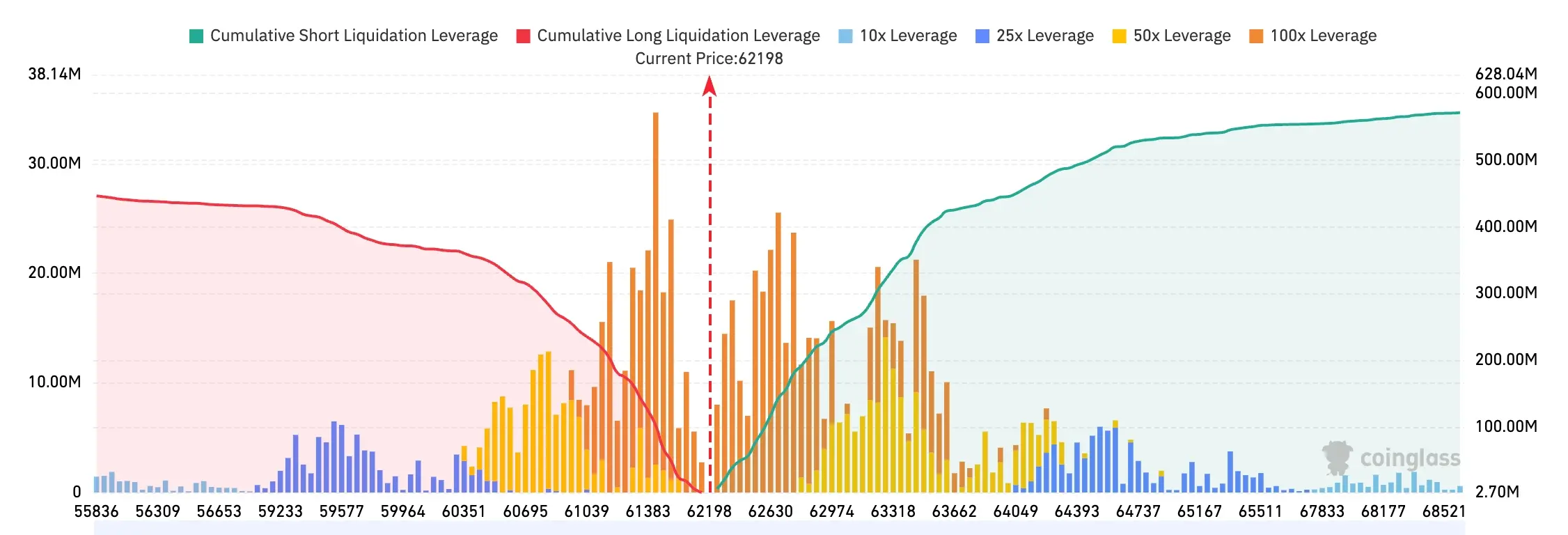
- Bitget BTC/USDT Liquidation Map: Current BTC price is approximately $62,198, with the area of $62,600--$63,400 being the most concentrated for short liquidations. If the price continues to rebound and breaks through this range, it may trigger concentrated short covering, pushing the market further upward. The area around $61,000--$62,000 has a significant number of long liquidations; if the price falls below the current support range, it may trigger a chain liquidation of longs, potentially enhancing short-term downward momentum.
- Spot ETF Net Inflow/Outflow: BTC spot ETF recorded a net inflow of approximately $21.5 million yesterday, with a current dynamic net outflow of $25.8 million within 24h.
Driving Factors Analysis: Geopolitical events have created phase pressure on risk assets, with BTC finding support around $62,000. The predominance of long liquidations indicates that the market remains biased towards a bullish structure. Continuous net inflows into ETFs provide significant support for spot prices, and institutional capital allocation intentions have not significantly reversed. Technically, BTC oscillates in the $60,800-$64,500 range in the short term, while ETH shows relative resilience but lacks independent catalysts. The overall trend remains dominated by macro risk sentiment and dollar movements, with short-term attention needed on Trump's subsequent statements and developments in the Middle East's situation affecting the leveraged market.
US Stock Index Performance

- Dow Jones: Closed at 52,348.39 points (-1.09%), under pressure for two consecutive days
- S&P 500: Closed at approximately 7,483 points (-0.28%), key support level at 7,450-7,480 range
- Nasdaq: Closed at approximately 25,871 points (+0.2%), with some rebounds in the tech sector providing support
Tech Giants Dynamics
- NVDA: $196.93 (+0.71%)
- AAPL: $310.66 (-0.64%)
- MSFT: $388.84 (+0.54%)
- GOOGL: $367.03 (+0.16%)
- AMZN: $245.98 (+0.75%)
- META: $615.58 (+2.55%)
- TSLA: $394.06 (-2.19%)
Performance Summary and Driving Analysis: There is a clear divergence within the sector. META leads the gains (+2.55%), benefiting from resilient advertising business and AI investment expectations; NVDA shows a slight rebound, indicating that the AI theme still attracts some capital amid volatility; AAPL and TSLA are under pressure, with TSLA's significant decline possibly influenced by geopolitical and macro risk appetite fluctuations. MSFT, AMZN, and GOOGL perform relatively steadily. Overall, tech giants did not experience a uniform decline, reflecting the market's unchanged confidence in the long-term logic of AI capital expenditure, but short-term geopolitical events and a strong dollar exert pressure on overvalued stocks. Institutions believe that the divergent trend will continue, recommending attention to differences in fundamentals and capital flows.
Sector Movement Observation
Energy Sector rises (driven by oil prices)
- Representative stocks: Chevron (CVX) rose over 2% during the session, Diamondback Energy (FANG) led with over 3% increase, ExxonMobil (XOM) followed with about 1.5% rise, Occidental Petroleum (OXY) rose over 2.5%
- Driving Factors: Trump's announcement of the "end" of the Iran ceasefire agreement directly boosted geopolitical risk premiums, with market concerns over disruptions in the Middle Eastern supply chain and tight crude oil supplies. The sharp rise in WTI crude oil prices significantly outperformed the broader market for upstream oil and gas companies. The energy sector became one of the few leading sectors on July 8.
Optical Communication Concept Stocks strengthen
- Representative stocks: Ciena rose over 5%, Credo Technology rose nearly 5%, Astera Labs rose nearly 3%, Lumentum rose over 1%, Coherent rose nearly 1%
- Main Driving Factors: The explosive demand for high-speed optical interconnection in AI data centers, the ramp-up of 800G/1.6T optical modules and CPO technology, and continued high Capex from cloud giants, with funds spreading from GPUs to the connectivity layer.
# 3. In-Depth Analysis of US Stocks
1. ExxonMobil (XOM) - Trump's Iran remarks boost oil prices, upstream performance sensitive in the short term
Event Overview: On July 8, Trump announced the "end" of the Iran ceasefire agreement, directly triggering a sharp rise in WTI crude oil prices, making the energy sector one of the leading sectors of the day. As the world's largest publicly traded oil and gas company, ExxonMobil's upstream exploration and production and downstream refining businesses are highly sensitive to oil prices. During the session, XOM followed the rise in oil prices but closed slightly down to about $141.13 due to overall market selling pressure. The market is closely tracking changes in Q3 inventory data and the potential impact of Middle Eastern supply chain risks on the company's capital expenditure plans. Market Interpretation: Institutions like JPMorgan and Barclays believe that the short-term spike in oil prices will contribute additional profits to XOM's upstream business, but if Trump successfully cools the situation, the geopolitical premium may quickly dissipate. Several investment banks have raised short-term ratings for the energy sector while emphasizing that the duration of the event is a key variable determining Q3 performance elasticity. In the long term, XOM's low-carbon transition layout and stable high dividend policy still hold allocation value. Investment Insight: There are clear short-term event-driven trading opportunities; it is recommended to focus on low-buy windows during oil price pullbacks and combine with hedging strategies for allocation.
2. Nvidia (NVDA) - Resilience of AI capital expenditure highlighted amid geopolitical volatility
Event Overview: Trump's geopolitical remarks triggered fluctuations in market risk appetite, leading to clear divergence in the semiconductor sector. As the absolute leader in AI GPUs, Nvidia's data center business growth has not been directly impacted by geopolitical events. On July 8, the Nasdaq showed a slight rebound, with NVDA demonstrating relative resilience. The market continues to focus on the shipping progress of the Blackwell platform and AI capital expenditure guidance from major hyperscalers. Some profit-taking pressure has emerged amid volatility, but the core demand logic remains unchanged. Market Interpretation: Institutions like Goldman Sachs and Morgan Stanley maintain buy ratings, pointing out that "the construction of AI factories is the largest infrastructure expansion in human history," and the capex supercycle is still ongoing. Even if short-term geopolitical uncertainties suppress risk appetite, long-term training and inference demand remains solid. Analysts emphasize that NVDA's dominant position in the GPU ecosystem is unlikely to be shaken in the short term. Investment Insight: Attention can be paid to the allocation value after pullbacks amid volatility, avoiding chasing highs, suitable for long-term investors in the AI trend.
3. Microsoft (MSFT) - Cloud and AI recurring revenue buffer against geopolitical shocks
Event Overview: Microsoft has shown strong resilience against the backdrop of a significant drop in the Dow and a pullback in the S&P 500. Its Azure cloud business and recurring revenue structures from Office 365 and Copilot are less directly impacted by geopolitical events. The continuous advancement of AI infrastructure and enterprise-level cloud services means that even in a risk-averse environment, institutional capital still favors its diversified business and stable cash flow. On July 8, tech-weighted stocks rebounded, with MSFT providing significant support. Market Interpretation: Institutions believe that Microsoft's strong cash flow and highly diversified business (cloud + AI + consumer software) significantly reduce the risk from single geopolitical events. Investment banks generally maintain overweight ratings, emphasizing its core position in global AI infrastructure and the ongoing adoption of enterprise-level AI. Investment Insight: Suitable as a defensive allocation option to reduce overall volatility in a portfolio, stable investors can hold long-term.
4. Chevron (CVX) - Oil price rise directly benefits, upstream and LNG business significantly impacted
Event Overview: Following Trump's remarks on Iran, Chevron and other upstream-weighted energy stocks performed strongly during the session, with some periods seeing increases of over 2%. Chevron's upstream exploration and production and LNG liquefied natural gas businesses are highly sensitive to oil and gas prices, with geopolitical premiums directly translating into short-term performance elasticity. The market is focusing on its Q3 production data and Middle Eastern project progress, as well as the impact of low-carbon investments on long-term returns. Market Interpretation: Several investment banks point out that the short-term spike in oil prices brings additional profits to CVX's upstream and LNG businesses, but the event-driven nature is evident; if the situation cools quickly, the premium may rapidly recede. Institutions have raised short-term ratings for the energy sector while reminding to continuously track the potential impact of evolving geopolitical events on capital expenditure and dividend policies. Investment Insight: Short-term event-driven opportunities are prominent; it is recommended to reassess allocations during high oil prices for profit-taking or pullbacks and pay attention to the use of hedging tools.
# 4. Cryptocurrency Project Dynamics
- Glassnode released a report indicating that Bitcoin remains in a deep value area five months below the real market average and short-term holder cost basis. Long-term holders have realized losses accounting for 43% of the total realized value, peaking at $280 million per day, the highest since December 2022; ETF net outflows have eased from June's peak, but on a monthly basis, there are still net outflows, with daily trading volumes between $650 million and $950 million, down about 80% from the peak in October 2025. Derivative positions have cautiously shifted to long, with the put/call ratio at the lowest level in 2026, but the options market remains defensively skewed, with spot prices far below the maximum pain point of $66,000.
The report believes that bottoming conditions are in place—on-chain supply redistribution is underway, institutional outflows are slowing, and derivatives are de-risking—but confirmation signals have yet to arrive. The market still needs surrender pressure to further cool, stable institutional capital flows, and recovery of the real market average to confirm a change in the pattern.
Cathie Wood's Ark Invest bought 181,847 shares of SpaceX stock on Wednesday, valued at approximately $27 million. SPCX fell 0.81% that day, closing at $148.26, with a cumulative decline of 13.5% over the past five trading days.
Wall Street Journal reporter Nick Timiraos stated that the minutes from the Federal Reserve's June meeting show that the differences among officials mainly stem from differing judgments about future economic trends, rather than fundamental conflicts over interest rate hike or cut strategies. Two possible scenarios have formed within the Fed: if inflation remains high, almost all officials believe that higher rates need to be maintained, or even further tightening of policy; but if inflation quickly falls back to the target level of 2%, almost all officials also believe that current rates can be maintained, or even cuts in the future. He believes that the phrase "quickly falls back to 2%" is very critical, reserving policy adjustment space for the Fed.
SpaceXAI released a new artificial intelligence model named Grok 4.5, developed in collaboration with AI programming startup Cursor, aimed at narrowing the gap with competitors like Anthropic and OpenAI. Grok 4.5 is designed to handle complex, long-running tasks including software engineering, legal, and financial services, and enhances cybersecurity capabilities.
According to Bloomberg, South Korean memory chip giant SK Hynix's listing on Nasdaq received over seven times the subscription. This issuance involves 177.9 million American Depositary Receipts (ADRs), attracting demand from global long-term funds, sovereign wealth funds, and institutional investors in the technology sector. Bloomberg calculates that the issuance scale is approximately $24.5 billion, expected to become the second-largest foreign company listing in US history, second only to Alibaba's $25 billion.
According to the latest report from TASS, a senior Iranian official stated that due to threats from the US side, Iran has officially suspended negotiations with the US regarding a final solution. Previously, it was reported that negotiations between the US and Iran would take place on July 11 in Pakistan, discussing sanctions, frozen Iranian funds, and nuclear issues.
# 5. Today's Market Calendar
Data Release Schedule
|----------|----|-----------|------| | 08:30 ET | US | Initial Jobless Claims | ⭐⭐⭐⭐ | | 10:00 ET | US | Existing Home Sales | ⭐⭐⭐ | | All Day | US | Several Federal Reserve officials speaking | ⭐⭐⭐⭐ |
Important Event Forecast
- Trump's Subsequent Statements: Continuously track the latest developments in the Middle East's impact on oil prices and risk assets.
- Federal Reserve Officials Speaking: Pay attention to the latest signals regarding the inflation path and policy rates.
July 9 (Thursday)
- New York Fed President Williams will speak at 21:00;
- Initial jobless claims for the week ending July 4 will be released at 20:30.
July 10 (Friday)
- Dallas Fed President Logan will speak at 01:30;
- SK Hynix ADR is tentatively scheduled to be listed on Nasdaq on July 10 ★★★★
Institutional Views:
Several investment banks believe that Trump's cooling remarks have temporarily alleviated some of the most pessimistic geopolitical scenarios, but tensions in the Middle East still constitute a lasting risk premium. The volatility of oil prices and gold will continue to dominate short-term pricing, and a stronger dollar index may exert phase pressure on risk assets. In the cryptocurrency market, continuous net inflows into ETFs are seen as an important positive signal, with BTC receiving dual support from institutional and leveraged funds in the current range. Overall, the market is in an "event-driven + data verification" phase, recommending maintaining flexible positions and focusing on the adjustments to Fed policy expectations from initial jobless claims and existing home sales data, as well as the impact of Trump's subsequent diplomatic dynamics on energy and safe-haven assets. Short-term volatility may persist, while long-term allocations can still focus on AI capital expenditure and institutional capital inflows.
Disclaimer: The above content is compiled by AI search, with human verification for publication, and does not constitute any investment advice. The data in the text may inevitably contain deviations; please refer to real-time market data.
 Risk warning

Popular articles





