Report on the Current Development Status of the Stock Perpetual Contract Market (July 2026)
 Core Viewpoint

 The cryptocurrency industry officially bids farewell to the single development model that solely relies on native crypto assets and fully embarks on the evolution and upgrade towards a global multi-asset integrated trading platform.
Author: Hu Tao, ChainCatcher
Since 2026, stock perpetual contracts have rapidly become a new battleground for competition among cryptocurrency exchanges. The logic behind this is not complicated: when the narrative around crypto-native assets lacks freshness and the trading activity of altcoins declines, exchanges need to introduce new sources of volatility and tradable assets to maintain user trading frequency and fee income. Stocks, indices, commodities, foreign exchange, and even valuations of unlisted companies have thus been packaged into perpetual contracts that can be settled in stablecoins, support leverage, and allow for round-the-clock trading.
From a deeper strategic perspective, this round of expansion signals the transformation of crypto trading platforms from single-asset exchanges to multi-asset trading platforms.
I. Overall Overview
Since 2025, the cryptocurrency market has shown a trend of declining trading activity. When Bitcoin enters a relatively stable period, the wealth effect of altcoins weakens, and the quality of new coin issuances declines, user trading frequency typically decreases.
According to industry data, the average monthly trading volume of the top 11 centralized perpetual exchanges dropped to $4.7 trillion in 2026, down from $7.1 trillion in 2025. Against the backdrop of sluggish trading in crypto assets themselves, major exchanges urgently need to find new growth points to stimulate user trading desire and increase platform revenue.
Traditional stock perpetual contracts have emerged as a key breakthrough in this context. These products combine traditional financial market (TradFi) stock assets with the flexible mechanisms of crypto perpetual contracts—no expiration date, 24/7 trading, high leverage, USDT settlement—providing crypto-native users with a convenient channel to gain exposure to stock prices without needing to open a securities account.
Specifically, stock perpetual contracts provide exchanges with three new demands:
Bringing traditional market hotspots such as US stock earnings reports, AI, semiconductors, and IPOs into crypto accounts;
Allowing users to trade directly using USDT or USDC without converting to fiat currency or opening a securities account;
Increasing turnover through leverage, short selling, and round-the-clock trading.
Therefore, stock perpetual contracts are not simply a replacement for traditional securities accounts but rather a horizontal reuse of existing perpetual contract infrastructure by exchanges: matching, margin, liquidation, funding rates, copy trading, and market-making systems can continue to be used, with the platform mainly adding external price indices, corporate action processing, and risk control capabilities.
Arthur Hayes, co-founder of BitMEX, predicts that by the end of 2026, all mainstream centralized and decentralized exchanges will offer stock perpetual contract trading.
According to the RootData stock perpetual contract exchange rankings as of July 21, nearly 30 cryptocurrency trading platforms have launched stock perpetual contract markets. Based on a formula that considers comprehensive trading volume, open interest, spreads, fee rates, and funding rates, Binance, MEXC, and Bybit rank in the top three.
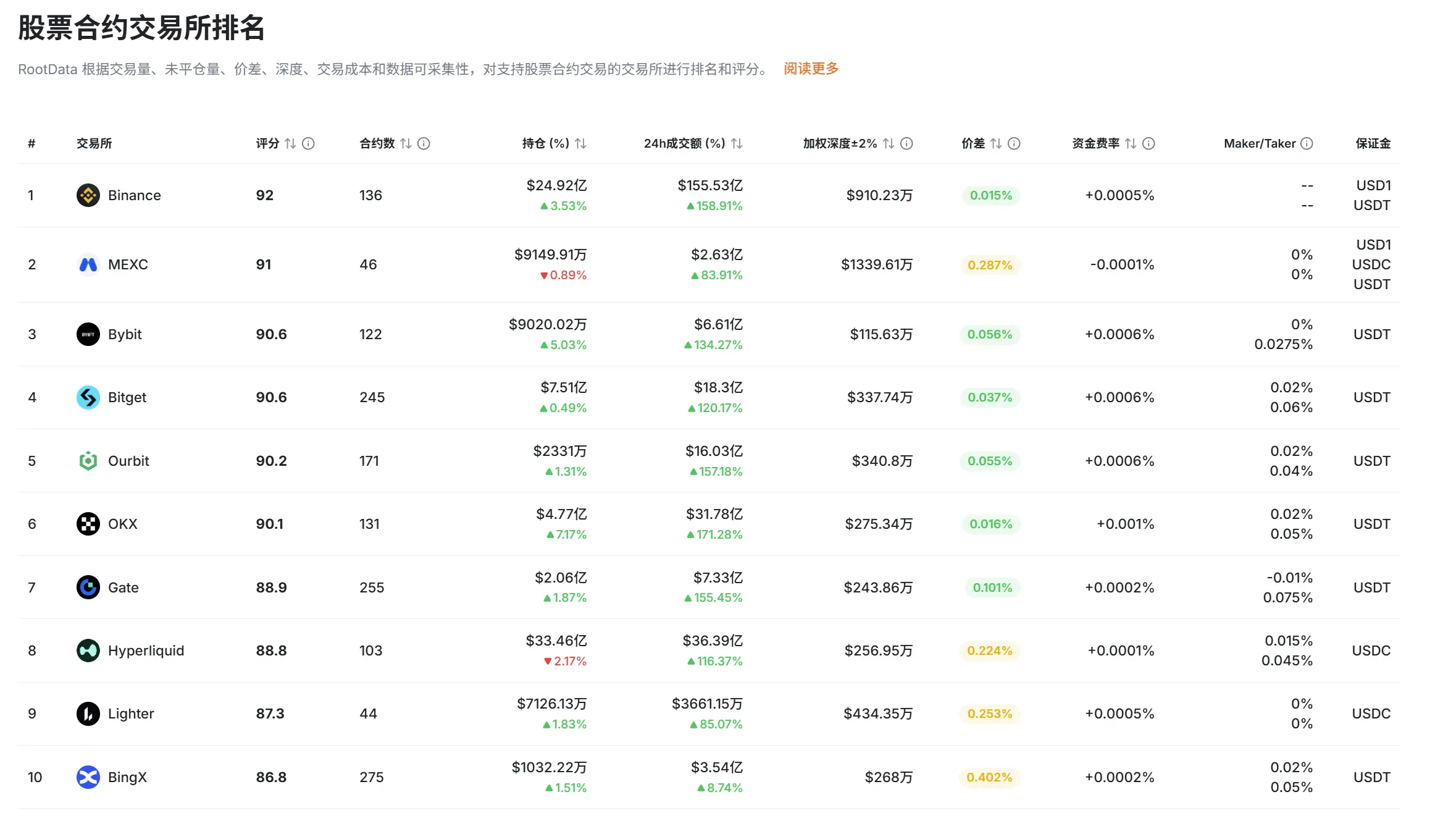
The rankings show that most exchanges have launched over 100 contracts, with BitMart, BingX, and Gate leading the way, each exceeding 250. However, a high number does not necessarily mean high liquidity; most stock perpetual contract trading pairs on these platforms have very low trading volume and depth, ranking in the lower tier.
More specifically, exchanges such as MEXC, BingX, KuCoin, Phemex, BitMart, HTX, and MSX had spreads exceeding 0.2% as of the statistical cutoff time, which severely harms the user experience and actual benefits for large capital users. This reflects that the microstructure of the crypto market still has many shortcomings, such as insufficient liquidity, an immature market-making system, and imperfect arbitrage mechanisms, leading to price deviations and high trading costs.
In terms of trading volume, Binance, Hyperliquid, and OKX rank in the top three, each with daily trading volumes exceeding $3 billion. Established exchanges like Coinbase, Kraken, HTX, Crypto.com, and BitMEX lag significantly behind, with daily trading volumes below $50 million.
Additionally, second and third-tier exchanges like XT.COM and Bitunix are quite active in the stock perpetual contract market, not only ranking high in core indicators like trading volume and open interest but also placing in the top ten overall.
Overall, the competitive landscape of the stock perpetual contract market is rapidly differentiating, with exchanges of different tiers forming clear strategic distinctions, potentially rewriting the existing exchange landscape.
II. Major Market Trends
1. Explosive Growth in Trading Volume
The trading volume of stock perpetual contracts is showing exponential growth. According to the "TradFi on Crypto Exchanges Report 2026" released by CoinGecko:
In 2025, the total trading volume of TradFi perpetual contracts was $104.21 billion.
In the first five months of 2026, this figure has surpassed $1.32 trillion, more than 12 times last year's total.
The monthly trading volume of tokenized stocks across 13 major exchanges increased from $831 million in July 2025 to $34 billion in May 2026, expanding nearly 40 times.
For example, as of July 21 at 3 PM (UTC+8), the trading volume of several stock perpetual contract markets such as SNDK, MU, and SKHY exceeded $1 billion in the past 24 hours, second only to BTC and ETH, and significantly higher than assets like SOL, ZEC, and HYPE.
Meanwhile, the stock perpetual contract market has become an important source of trading volume, accounting for over 10% in most exchanges. During special market conditions, the short-term share of some exchanges' TradFi markets can reach around 30%.
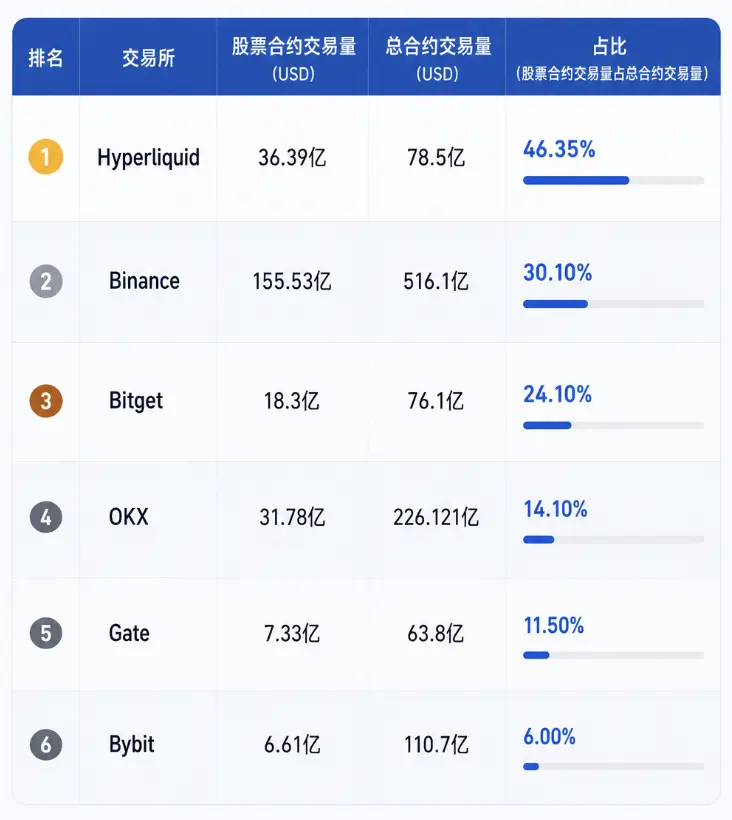
Statistical time: July 21, 3:00 PM
Even with such astonishing growth rates, the trading volume of tokenized stocks is still less than 1% of the total volume of traditional stock markets. This significant gap indicates that the market is still in its early stages, with vast growth potential ahead.
2. Market Expansion from US Stocks to Asian Stocks
Initially, the stock perpetual contracts launched by cryptocurrency exchanges were mainly concentrated on US-listed companies such as Tesla, Nvidia, Apple, Amazon, Coinbase, and Strategy, with severe product homogeneity and trading times focused on US stock market opening hours.
However, starting in the second quarter of 2026, leading exchanges have systematically shifted towards the Asian market, now covering major stocks and ETFs in South Korea, Japan, and Hong Kong on a large scale, marking the upgrade of this market from "US stock derivatives" to "global stock derivatives."
For example:
OKX launched Samsung, SK Hynix, and Hyundai stock perpetual contracts in June 2026, with SKHYNIX/USDT settled in USDT.
Bitget's updated TradFi product list in July now includes contracts related to Asian stocks such as Tencent, Xiaomi, Meituan, NetEase, SMIC, Sony, Tokyo Electron, and SK Hynix.
Binance's TradFi products now cover US tech stocks, semiconductor companies like TSMC, and ETFs in the Japanese and Korean markets.
This means that stock perpetual contracts are no longer just a "crypto version of US stock trading," but are forming a 24/7 derivatives network settled in stablecoins that covers major global stock markets. Asian traders can hedge or speculate on local leading stocks during their domestic stock market's off-hours using stablecoins on crypto exchanges, without bearing exchange rate risks (as contracts are priced in USDT).
At the same time, arbitrage opportunities between different markets are beginning to emerge—for example, the basis between SK Hynix's closing price on the Korean KOSPI and the Binance contract price can reach 3-5% during certain periods, attracting quantitative teams to enter the market. This trend is expected to continue, potentially expanding to European, Southeast Asian, and Latin American markets, ultimately forming a truly global stock perpetual contract ecosystem.
III. Risks and Challenges
Despite the rapid growth of the stock perpetual contract market, its development still faces multiple structural challenges.
First is the fragility of price discovery and arbitrage mechanisms. Since the underlying assets of stock perpetual contracts are traded on traditional exchanges while the contracts themselves trade 24/7 on crypto platforms, when the spot market is closed (especially at night and on weekends), contract prices lack effective anchoring mechanisms.
Data from Tiger Research shows that in June 2026, the average price of Binance's Samsung Electronics perpetual contract was 0.93% higher than that of Hyperliquid, and the price difference for the SK Hynix contract even reached 1.03%, peaking at 2.3% in extreme cases. This cross-exchange price difference can further widen during periods when the spot market is closed, imposing high real-time monitoring requirements on arbitrage funds.
Second is the differentiation in liquidity and the immaturity of the market-making system. Although leading platforms like Binance, Hyperliquid, and OKX can achieve daily trading volumes exceeding $1 billion, many second and third-tier platforms have severely insufficient depth in their stock perpetual contract markets.
Spreads on platforms like MEXC, KuCoin, and Phemex generally exceed 0.2%, meaning that large capital users face significant trading costs and slippage risks. Market makers have a mature ecosystem in traditional stock markets, but in the stock perpetual contract market on crypto platforms, the motivations for market maker participation and risk management tools are still inadequate.
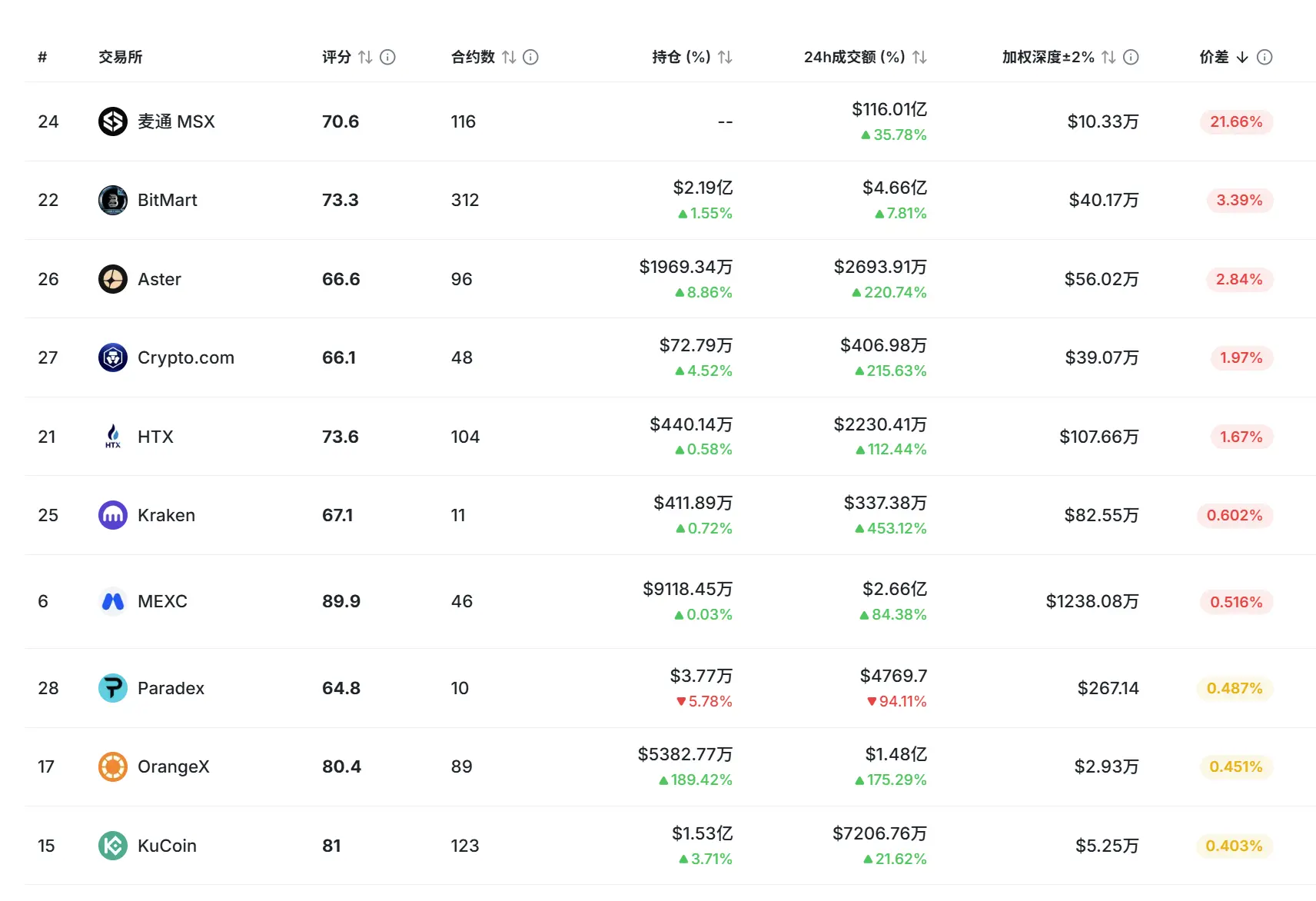
Some exchanges with high spreads
Third is the ambiguity of compliance boundaries. Stock perpetual contracts exist in a gray area from a regulatory perspective. On one hand, these products do not involve the actual delivery of stocks and theoretically fall under the category of derivatives; on the other hand, they track traditional stock assets that are strictly regulated and offer leveraged trading to global users (including retail investors outside the US market).
In March 2026, the SEC and CFTC signed a memorandum of understanding regarding the regulation of "super apps," laying the groundwork for a unified compliance framework for cross-asset category platforms, but specific implementation details remain unclear. For exchanges, balancing innovative expansion with compliance risks will be a long-term challenge.
IV. Case Studies
1. Binance
Binance is one of the first mainstream exchanges to lay out TradFi perpetual contracts. As of July 20, 2026, Binance supports 130 stocks and TradFi-related perpetual contracts, with an open interest of approximately $2.326 billion and a 24-hour trading volume of about $16.392 billion, earning a comprehensive score of 91.6, ranking first in the RootData list.
Binance's core competitiveness lies in its mature "multi-assets mode." This mode allows users to use crypto assets like BTC and ETH as margin to trade stock perpetual contracts, achieving seamless switching between crypto assets and traditional financial assets within the same account system.
Since the second quarter of 2026, Binance has been intensively launching TradFi perpetual contracts at almost weekly intervals: on May 15, it launched US stock contracts for Lumentum, Oracle, Disney, Uber, Cisco, Home Depot, etc.; on June 2, it launched stock perpetual contracts for Samsung, SK Hynix, and Hyundai; on July 10, it added GE Vernova, Vertiv, Snowflake, Applovin, and others.
This high-frequency new product strategy, combined with its existing crypto derivatives market-making system, allows Binance to quickly form a deep order book in the stock perpetual contract market.
2. Hyperliquid
Hyperliquid, as a leading decentralized trading platform, is one of the core players in the stock perpetual contract space, consistently ranking in the top five of the RootData stock perpetual contract exchange list and being the only DEX platform in the industry's top tier. As of July 2026, Hyperliquid's stock perpetual contract daily trading volume consistently exceeds $1 billion, with TradFi asset contract trading volume accounting for 30% of the platform's total trading volume, becoming a core revenue growth point.
Compared to centralized exchanges, Hyperliquid's core differentiated advantage lies in its technical architecture and trading mechanisms. The platform relies on a purely decentralized order book and a self-developed high-performance clearing engine, achieving 24/7 uninterrupted trading of stock perpetual contracts, no custodial fund risks, and anonymous trading, which highly aligns with the trading preferences of crypto-native users.
At the same time, the platform's core team has a background in traditional high-frequency trading institutions, having built a mature pricing and risk control system, using the EMA exponential moving average algorithm to optimize pricing during non-trading hours, effectively narrowing cross-platform price differences. As of June 2026, its pricing stability for contracts of Asian tech stocks like SK Hynix and Samsung Electronics during spot market closures is superior to that of most small and medium trading platforms, with spreads controlled within 0.3%, far below the industry average.
In terms of product layout, Hyperliquid focuses on scarce differentiated targets, being the first to lay out perpetual contracts for pre-IPO companies in the primary market, filling a gap in the industry. In May 2026, the platform launched a SpaceX pre-IPO perpetual contract with a reference price of $150, corresponding to an implied valuation of over $1.78 trillion for the company, achieving over $100 million in trading volume within 24 hours of launch; in July, it further launched a pre-IPO perpetual contract for Changxin Technology in China, becoming one of the first crypto platforms to lay out derivatives for unlisted tech companies in China, accurately capturing the heat and arbitrage demand of the primary market, forming a core product barrier distinct from traditional exchanges.
V. Conclusion
The rise of stock perpetual contracts is essentially a key strategic breakthrough for cryptocurrency exchanges after the narrative around crypto-native assets has exhausted and trading increments have peaked. It is also a hallmark product of the deep integration between the crypto industry and traditional financial markets. This round of track explosion is not merely an expansion of product lines but a profound reconstruction of the business model and development logic of crypto exchanges, marking the industry's formal farewell to a single development model that solely relies on crypto-native assets and fully opening the evolution and upgrade towards a global multi-asset comprehensive trading platform.
From a market performance perspective, stock perpetual contracts, with advantages such as round-the-clock trading, stablecoin settlement, no-threshold asset allocation, and flexible leveraged trading, quickly capture the traditional financial market's hot traffic, achieving exponential growth in trading scale and becoming the most core incremental track in the crypto industry. The market landscape has evolved from early competition based on the number of targets to a comprehensive strength competition based on pricing ability, liquidity depth, cross-market risk control, global product layout, and compliance systems, with leading platforms continuously solidifying their barriers while small and medium platforms focus on niche tracks, resulting in a fully formed layered competitive landscape in the industry.
In the long run, as diverse targets such as US stocks, mature Asian stock markets, and pre-IPO primary markets continue to expand, the boundaries between traditional finance and the crypto market will continue to dissolve. However, at the same time, structural issues such as pricing mechanism defects, liquidity differentiation, and ambiguous global compliance will continue to constrain the standardized development of the industry in the long term. In the future, platforms that can balance product innovation, trading experience, and compliance risk control while building a global multi-asset trading system will continue to seize industry incremental dividends and rewrite the existing competitive landscape of the global crypto trading market.
 Risk warning


Popular articles