Google's Q2 free cash flow turned negative for the first time, raising full-year capital expenditures to a maximum of $205 billion, with cloud business experiencing an explosive 82% growth
 Core Viewpoint

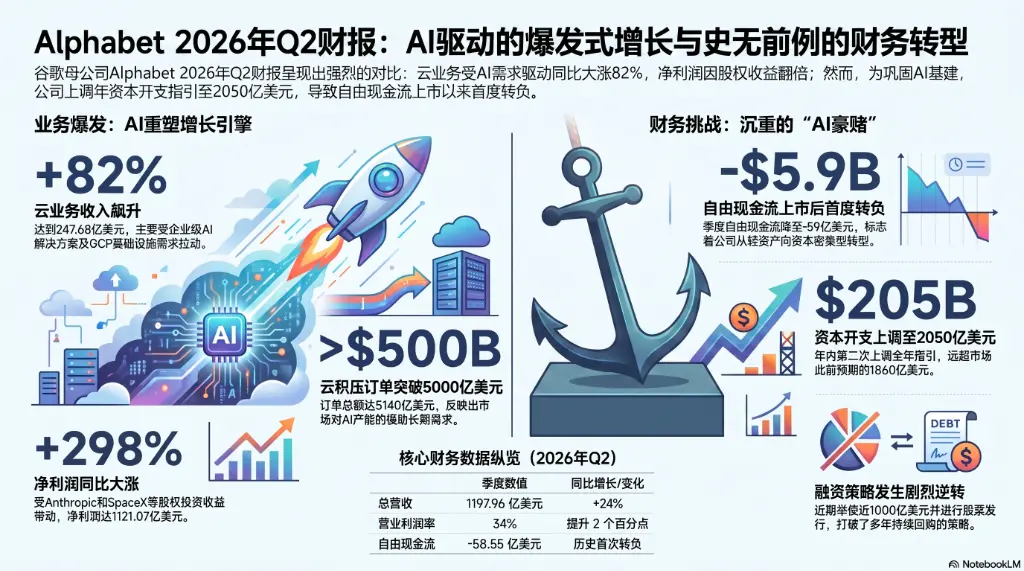
 In the second quarter, Google's parent company Alphabet reported revenue of $119.8 billion, a year-on-year increase of 24%; operating profit was $40.8 billion, a year-on-year increase of 30%; driven by a surge in equity earnings from companies like Anthropic and SpaceX, net profit soared to $112.1 billion, a year-on-year increase of 298%. Free cash flow turned negative for the first time in the second quarter, reaching -$5.9 billion. During the earnings call, the company once again raised its full-year capital expenditure guidance for 2026 to $195 billion - $205 billion, higher than the previous expectation of $180 billion - $190 billion, and Google's stock fell over 4% in after-hours trading.
Author: Yang Chen, Long Yue
Google's parent company Alphabet announced its second-quarter results, with cloud business revenue significantly exceeding Wall Street expectations, and cloud backlog orders surpassing $500 billion for the first time. However, market focus quickly shifted to another aspect: this is the first time in decades since Google's IPO that free cash flow has turned negative, while the company raised its full-year capital expenditure guidance for the second time this year, raising investor concerns about whether the AI gamble can deliver corresponding returns.
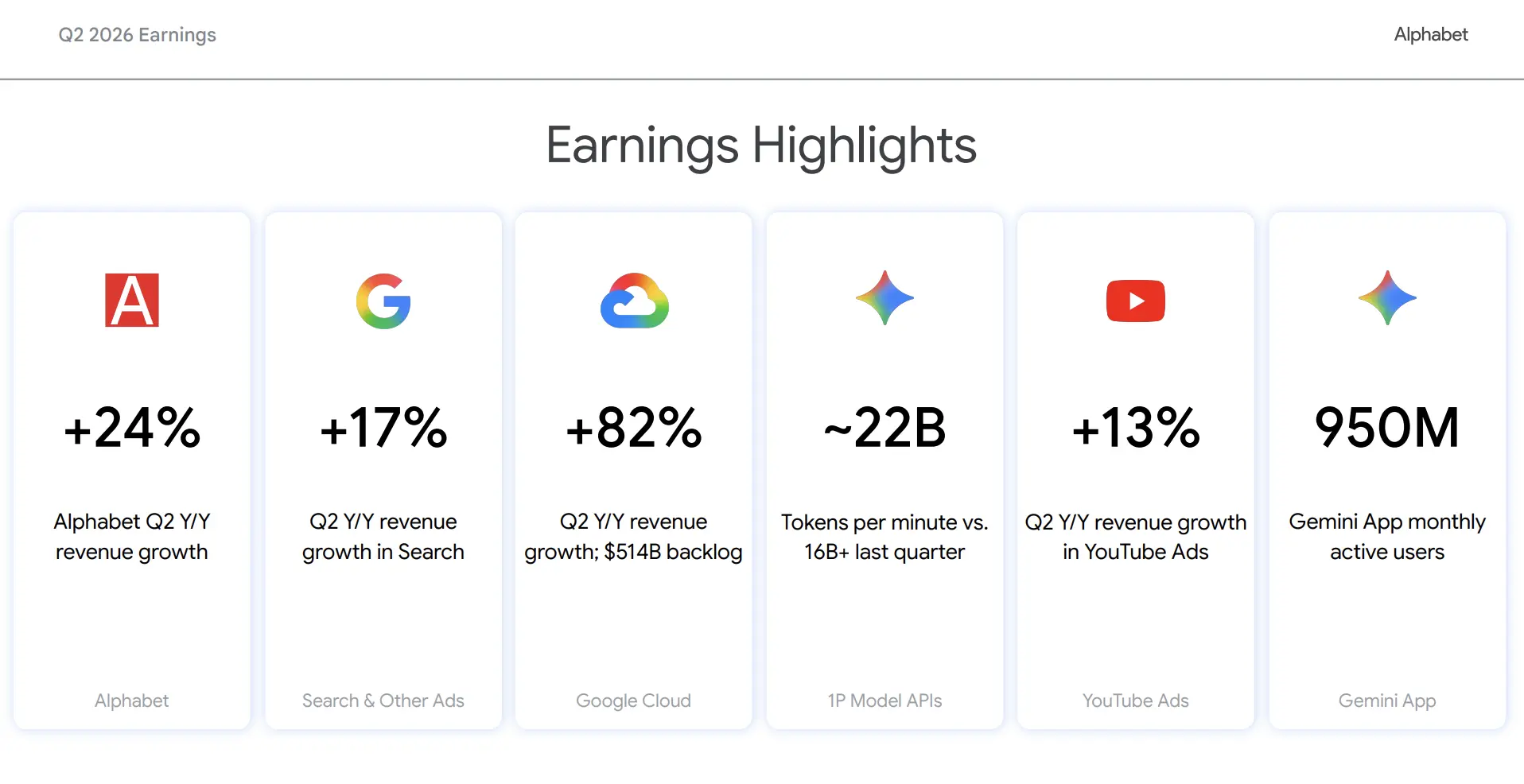
For the second quarter ending June 30, Alphabet achieved revenue of $119.796 billion, a year-on-year increase of 24%; growth was 23% at constant exchange rates, marking the twelfth consecutive quarter of double-digit revenue growth. Operating profit increased by 30% year-on-year to $40.77 billion, with an operating margin up 2 percentage points to 34%.
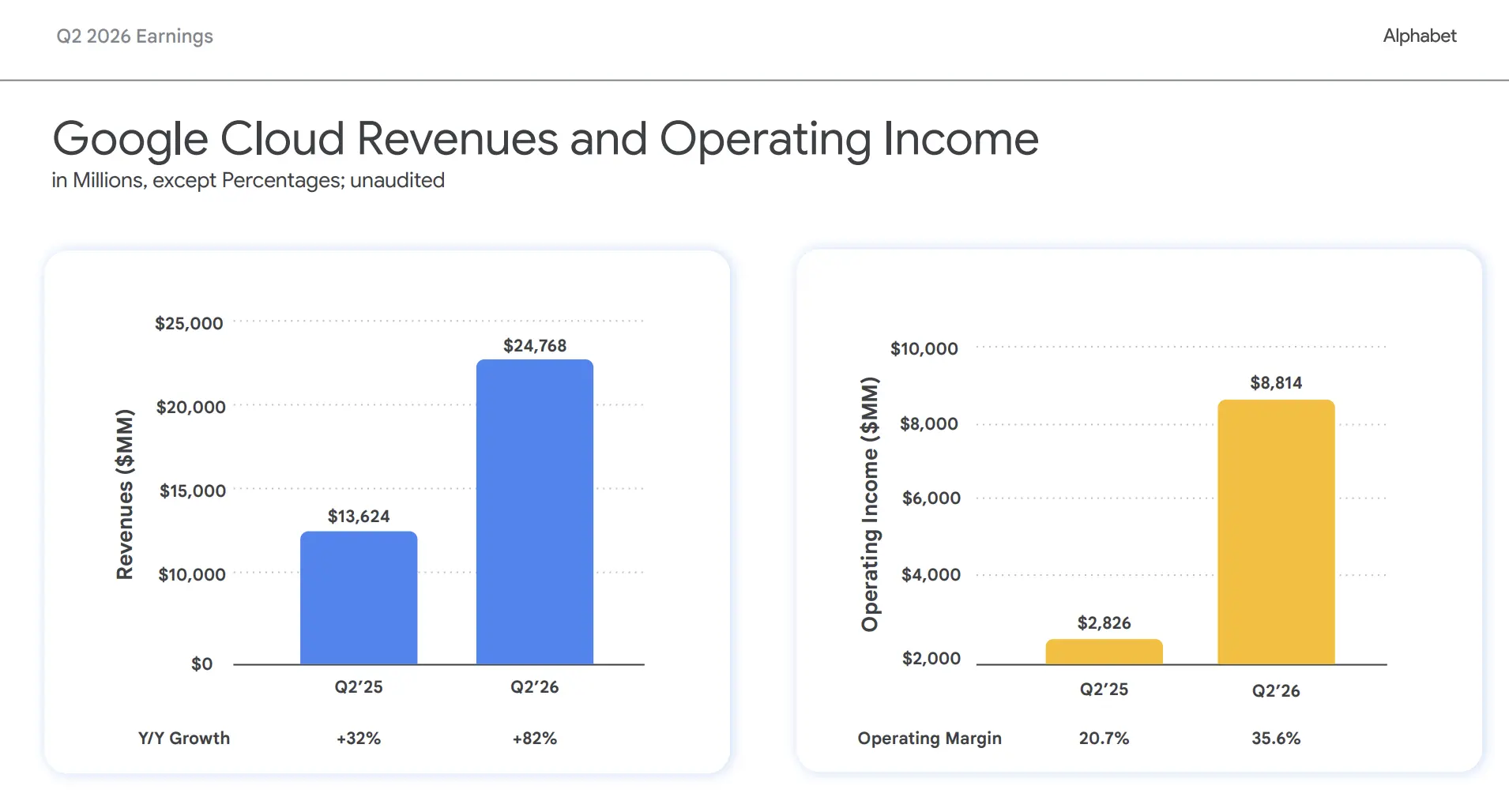
Among them, Google Cloud revenue reached $24.768 billion, exceeding market expectations of $22.46 billion, and soaring 82% year-on-year, achieving the fastest growth rate in recent years, indicating that AI investments are continuously translating into commercial returns. Search advertising revenue was $63.27 billion, slightly below the market expectation of $63.28 billion.
Alphabet holds stakes in several companies, including Anthropic and SpaceX. Due to a significant increase in unrealized gains from equity securities, the investment income for the quarter was nearly $100 billion, driving net profit attributable to common shareholders up 298% year-on-year to $112.107 billion.
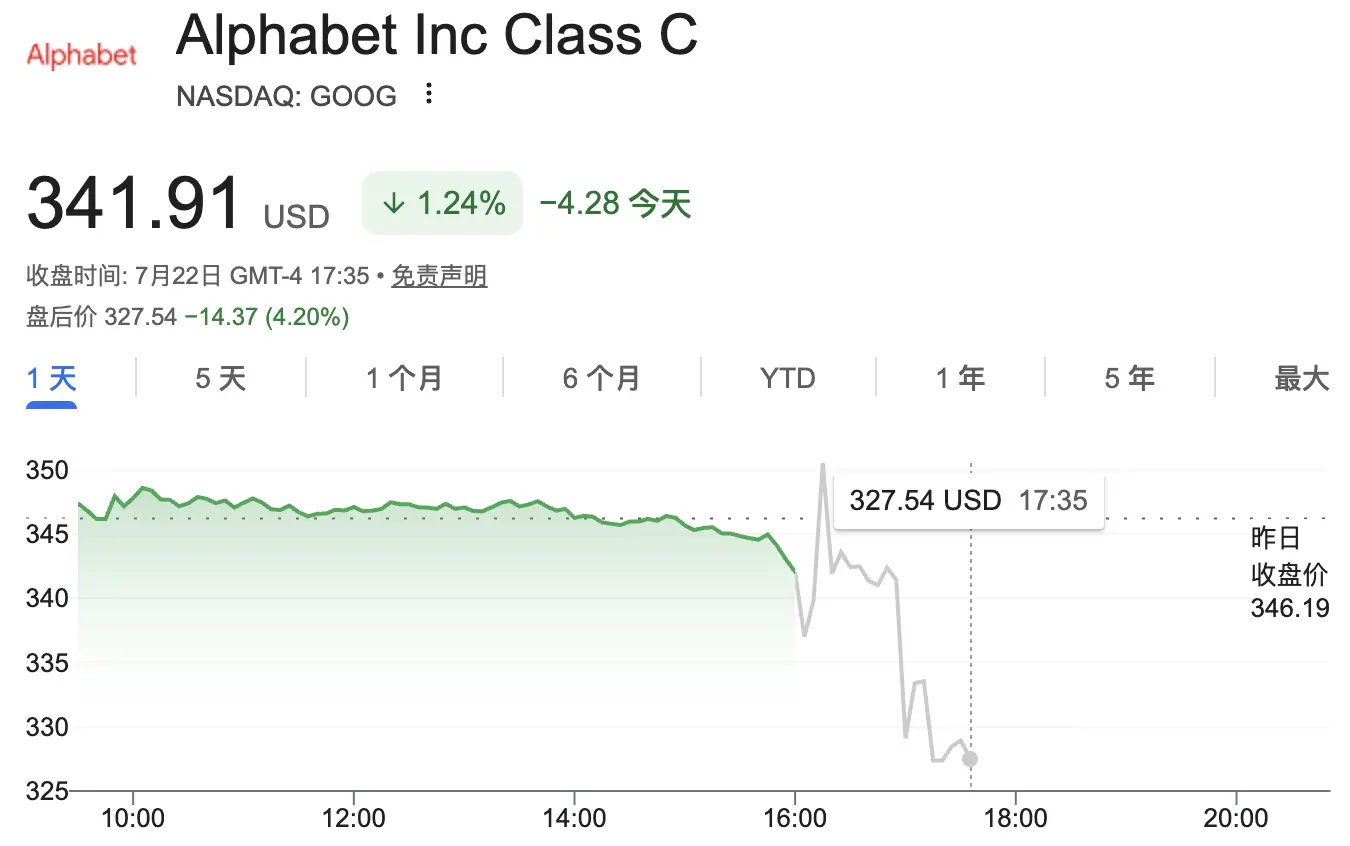
After the earnings report was released, Google's stock price fluctuated slightly. During the earnings call, Google raised its full-year capital expenditure guidance to between $195 billion and $205 billion, up from the previous estimate of $180 billion to $190 billion. Following the announcement, market concerns about whether the massive capital expenditure can deliver corresponding returns caused Google to drop 4.2%.
Free cash flow turns negative for the first time, capital expenditure raised again
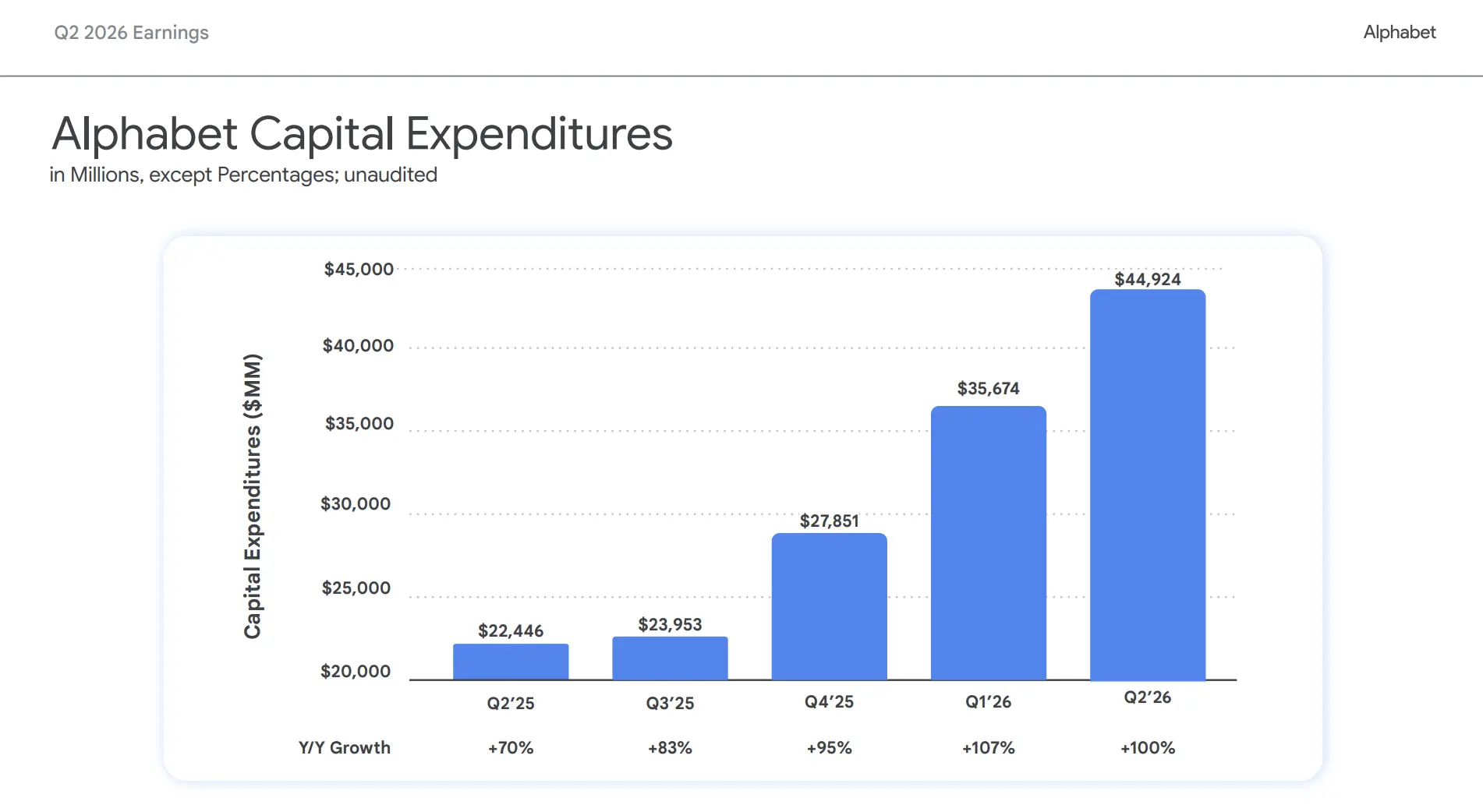
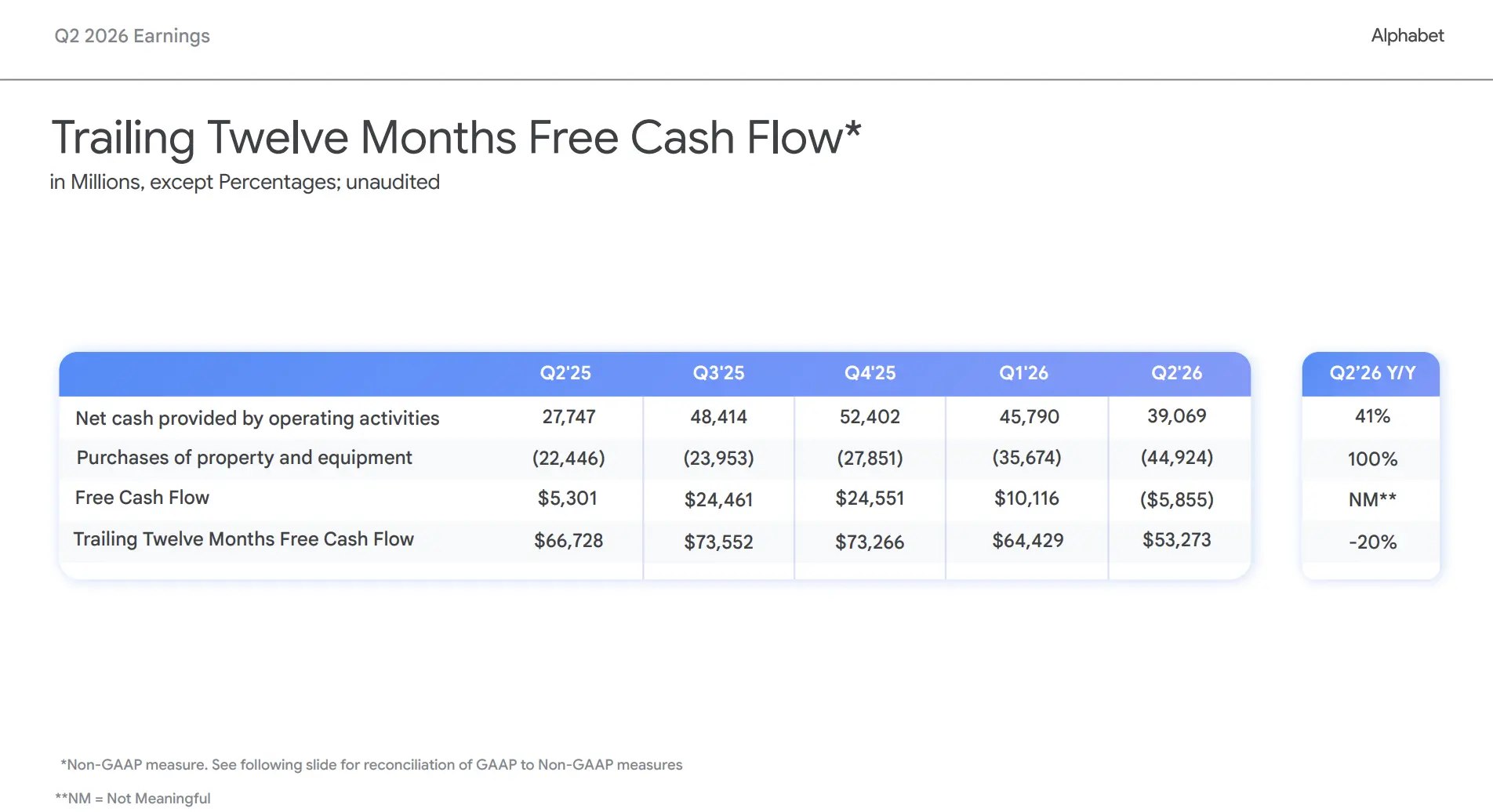
Alphabet's capital expenditure for the second quarter reached $44.924 billion, far exceeding $22.446 billion in the same period last year, directly leading to a negative free cash flow of -$5.855 billion (approximately -$5.9 billion) for the quarter—this is the first time in decades since Google's IPO that quarterly free cash flow has been negative.
Free cash flow is a measure of the cash available for debt repayment or shareholder returns after covering operating costs and capital expenditures, and has always been a core metric for Wall Street to assess the financial health of tech companies.
During the earnings call, Chief Financial Officer Anat Ashkenazi announced that the full-year capital expenditure guidance for 2026 was raised to $195 billion to $205 billion, higher than the previous expectation of $180 billion to $190 billion, and exceeding analysts' previous estimate of about $186 billion. This is the second time this year that Google has raised its capital expenditure guidance—in April, it had already raised the expectation from previous levels to a maximum of $190 billion.
Ashkenazi stated, "We expect free cash flow to remain under pressure, driven by our investments in technology infrastructure, which enable us to seize AI opportunities and continue to deliver substantial returns."
However, after the announcement, the stock price fell. Investors are concerned that Google is rapidly transforming from a light-asset company to a capital-intensive one. To support the massive investment in AI infrastructure, Alphabet recently borrowed nearly $100 billion and completed its first stock issuance in over twenty years in June, raising approximately $85 billion—this marks a stark reversal from its previous strategy of consistently repurchasing shares for many years.
Investing.com senior analyst Thomas Monteiro bluntly stated, "The further increase in capital expenditure is not beneficial for Alphabet. Coupled with the rising interest rate environment and ongoing tight supply and demand for AI infrastructure, the logic of 'self-sustaining through operating cash flow' is beginning to waver."
However, Dec Mullarkey, managing director of asset management firm SLC Management, holds a relatively optimistic view: "The market hopes to see large-scale cloud providers striving for AI leadership, but not at the expense of eroding profits. Currently, Alphabet is still maintaining this balance."
Ashkenazi added that the company will comprehensively utilize operating cash flow, debt, and equity financing to support expenditures and clearly stated that it will not issue additional shares beyond the announced scope, while emphasizing the maintenance of a robust balance sheet.
Google Cloud becomes the largest growth engine
By business segment, Google Cloud continues to be Alphabet's fastest-growing business.
In the second quarter, Google Cloud revenue reached $24.768 billion, an 82% year-on-year increase, further accelerating from previous growth. The company stated that the growth mainly comes from Google Cloud Platform (GCP) enterprise AI solutions, enterprise AI infrastructure, and sustained demand for core cloud services. Meanwhile, Google Cloud's operating profit reached $8.814 billion, significantly up from $2.826 billion in the same period last year, showing a marked improvement in profitability.
The cloud business backlog (the amount of contracted but unrecognized revenue) increased to $514 billion, expanding from approximately $460 billion in the previous quarter, and surpassing $500 billion for the first time. The company indicated that more than half is expected to be recognized as revenue within the next 24 months, covering a "broad mix of customers."
Monteiro stated that the cloud business's better-than-expected performance clearly indicates that the company's AI investments are "translating into rapidly growing profitable revenue, with related contracts being realized immediately after capacity is built."
Although Google Cloud still lags behind Amazon AWS and Microsoft Azure, it has become one of Alphabet's fastest-growing businesses due to strong demand for AI infrastructure from AI startups and enterprise customers.
In contrast, the traditional advertising business continues to maintain steady growth:
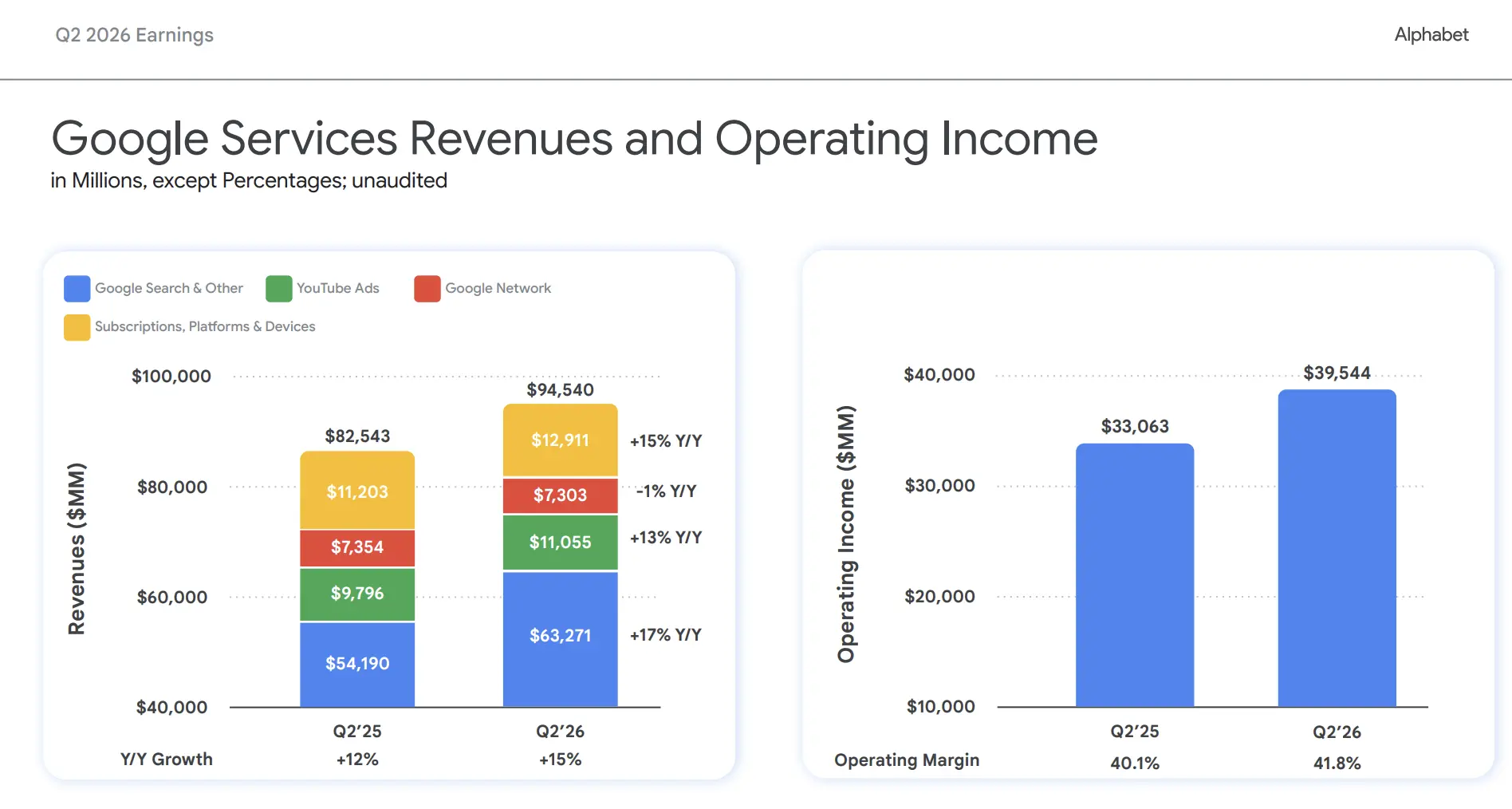
- Google Search and other business revenue was $63.271 billion, a year-on-year increase of 17%;
- YouTube advertising revenue was $11.055 billion, a year-on-year increase of 13%; during the 2026 World Cup, over 1.7 billion unique users watched related videos on the platform, further driving traffic growth;
- Google subscription, platform, and device business revenue was $12.911 billion, a year-on-year increase of 15%.
Overall, Google Services business revenue reached $94.54 billion, a year-on-year increase of 15%.
CEO: AI investments are reshaping the entire Google, focusing on Gemini 4
Alphabet CEO Sundar Pichai stated that the company's AI investments are redefining the entire business. He told investors, "It feels like we are at the very early stages of a long-term structural transformation across multiple areas… Over the past year, we have become increasingly optimistic about future opportunities."
He revealed that nearly 90% of the Fortune 100 companies are currently using Gemini Enterprise; the Gemini model processes 22 billion API tokens per minute, and the monthly active users of the Gemini App have reached 950 million. eMarketer chief analyst Nate Elliott pointed out, "Gemini is just one step away from becoming Google's third consumer-grade AI product with a billion users (alongside AI Overviews and AI Mode)."
In terms of the model roadmap, Pichai shifted focus to the next-generation flagship model Gemini 4, calling it "a larger next-generation frontier model," which is currently prioritizing computational power for training, and stated that the pace of Google model releases will accelerate. The delayed release of Gemini 3.5 Pro had previously raised doubts about Google's competitiveness in AI programming and other fields, with Anthropic and OpenAI gaining a significant advantage in the developer community.
Meanwhile, AI capabilities continue to drive growth in Google search query volume, and demand for the company's cybersecurity products remains strong, with the newly launched Gemini 3.5 Flash Cyber performing outstandingly in cost efficiency. Additionally, during the 2026 World Cup, over 1.7 billion unique users watched related videos on YouTube, further driving platform traffic growth.
Pichai stated that the company's "differentiated full-stack AI strategy" is continuously creating quantifiable business value for consumers, enterprise customers, and partners.
Continuing to ramp up AI infrastructure
To meet the growing demand for AI computing power, Alphabet further strengthened its financing in the second quarter.
In June, the company completed the issuance of Class A shares, Class C shares, and mandatory convertible preferred shares, raising a net of $49.6 billion; simultaneously, it issued $20.3 billion in senior unsecured bonds; and established an ATM stock issuance plan of up to $40 billion, which had not yet been initiated by the end of the second quarter. These measures have led Alphabet to accumulate nearly $100 billion in debt recently.
Due to the significant increase in capital expenditure, free cash flow turned negative at -$5.855 billion for the quarter, but free cash flow over the past 12 months still reached $53.273 billion. Meanwhile, the four major hyperscale cloud providers (Google, Meta, Microsoft, Amazon) are expected to exceed $725 billion in total capital expenditure in 2026, and the overall free cash flow of the tech industry has fallen to a ten-year low.
Overall, this earnings report presents a distinct "duality": explosive growth in the cloud business and backlog orders exceeding $500 billion confirm that AI investments are beginning to yield commercial returns; however, the first negative free cash flow and the second increase in capital expenditure this year have kept the market highly alert to the sustainability of this AI arms race. Whether Google can continue to walk the tightrope between competing for AI leadership and maintaining financial health will be the core issue of greatest concern to investors in the coming quarters.
 Risk warning


Popular articles