How inflated is the U.S. non-farm payroll in August?
 Core Viewpoint

 Barclays believes that the non-farm payrolls in August contain exaggerations, with strong growth partly stemming from a technical rebound in the leisure hotel and local education sectors, rather than reflecting a sustained improvement in labor demand. The birth-death model adjustments have also caused statistical biases. The three-month average of private non-farm payrolls at 75,000 is more valuable for reference. Barclays maintains its baseline forecast of a 25 basis point rate hike in September.
Author: Wall Street Insights
Barclays believes that the August non-farm payroll data is strong but contains exaggerations, and the probability of a rate hike in September has marginally increased.
Wall Street Insights mentioned that on September 4, the U.S. Bureau of Labor Statistics released data showing that non-farm payrolls increased by 162,000 in August, far exceeding Barclays' forecast of 25,000 and the market consensus expectation of 55,000. The data for the previous two months was revised upward by 55,000, with the July figure corrected from -23,000 to +21,000.
According to news from the trading desk, after the employment data was released, Barclays Bank's Marc Giannoni team published a research report, pointing out that some of the strong growth is due to a seasonal rebound in the leisure and hospitality industry and local education employment, rather than reflecting a sustained improvement in labor demand, and this month's data contains certain exaggerations regarding the actual strength of the labor market.
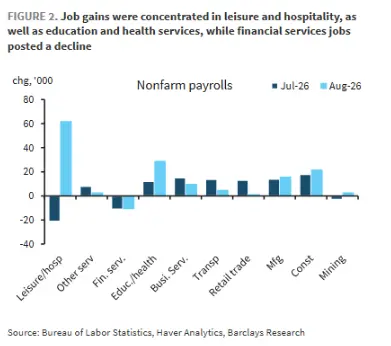 (Employment growth is mainly concentrated in the leisure and hospitality industry, as well as in education and healthcare services, while jobs in the financial services sector have decreased.)
Barclays maintains its baseline forecast of a 25 basis point rate hike in September and notes that the inflation data to be released next week will be a key variable.
Although the bank expects the month-on-month core CPI and core PCE for August to be around 0.23%, given that Federal Reserve Chair Waller emphasized the need to maintain "sufficient and sufficiently rapid" confidence in bringing inflation back to target, Barclays believes that moderate inflation readings are insufficient to rule out the possibility of a rate hike in September.
Employment growth exceeds expectations, but statistical factors cause significant disturbances
In August, non-farm payrolls increased by 162,000, higher than Barclays' forecast of 25,000 and significantly above the market consensus expectation of 55,000. The three-month average growth rate rose to 71,000 per month, still above Barclays' estimated "break-even" growth rate (approximately 0).
However, the team believes that this growth contains a certain technical "overstatement":
- Leisure and Hospitality: Jumped by 62,000 in a single month after declining for two consecutive months, this month represents a technical rebound;
- State and Local Education Employment: Increased by 42,000 in August, a correction from the significant decline in July (-58,000);
- Government Sector: Contributed a total of 35,000 jobs, with local education departments being the main source.
Private sector employment added 127,000 jobs, with the service sector contributing 86,000, manufacturing adding 16,000, construction increasing by 22,000, and mining adding 3,000.
Barclays emphasizes that the three-month average growth rate of 75,000 per month in private non-farm employment is a "cleaner" indicator for measuring potential labor demand, and suggests using this as a reference benchmark instead of the monthly data affected by noise.
Birth-death model adjustment factors cause statistical bias
The Barclays report points out that the August non-farm data was also influenced by the birth-death adjustment method.
Compared to the same period in 2025, the birth-death adjustment's drag on employment in August this year decreased by about 32,000, which somewhat inflated this month's reading.
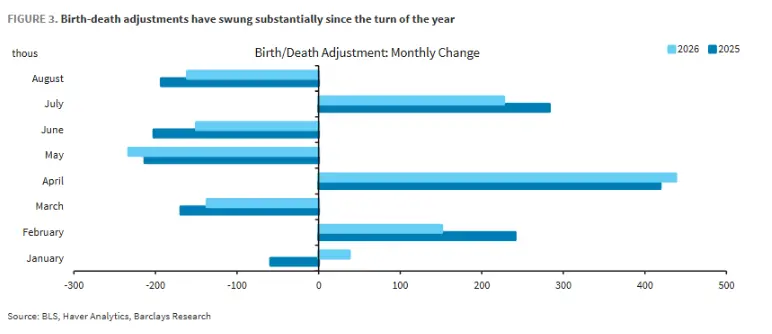 (Since the beginning of the year, the birth and death adjustments have shown significant fluctuations.)
However, looking at the three-month average from June to August, the adjustments for 2025 (-37,000) and 2026 (-28,000) are roughly equivalent, with monthly fluctuations tending to offset over time.
Barclays believes that this volatility may stem from the BLS's methodological adjustments implemented since January, which use employment information from existing sample firms to estimate the employment effects of new firms. Although the new procedure aims to reduce the magnitude of benchmark revisions, the actual monthly impact is difficult to predict.
Unemployment rate slightly rises, labor supply remains volatile
The unemployment rate in August rose slightly by 5 basis points, with the unrounded precise value being 4.141% (4.090% in July), but it still rounds to 4.1%.
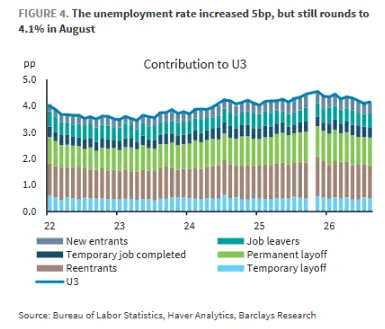 (The unemployment rate in August rose by 5 basis points but still rounds to 4.1%.)
The reason for the rising unemployment rate is that, although the household survey showed an increase of 569,000 in employment, the labor force expanded by 683,000, a larger increase.
The labor force participation rate rose by 0.2 percentage points to 61.6%, mainly driven by a significant jump of 0.8 percentage points in the participation rate of the 16 to 24 age group, with the group aged 55 and above also contributing a 0.3 percentage point increase.
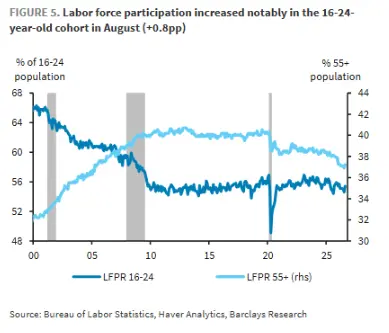 (In August, the labor force participation rate for the 16-24 age group significantly increased.)
However, the most meaningful prime-age labor participation rate (ages 25 to 54) remained unchanged at 83.4%.
Barclays' analysis further points out that the approximately 0.2 percentage point decline in participation rate since May is mainly due to a decrease in willingness to participate within various age groups, rather than due to an aging population structure.
This phenomenon is highly consistent with the narrative of labor supply pressure brought about by tightening mobility restrictions and is an important basis for the team's judgment of "limited break-even employment growth rate."
Labor income significantly improves, purchasing power marginally increases
Barclays believes that the employment report brings positive signals on the income side:
- Average Hourly Earnings (AHE): Increased by 0.27% month-on-month and 3.3% year-on-year, higher than July's month-on-month increase of 0.16%;
- Average Hours Worked: Increased by 0.1 hours to 34.4 hours;
- Private Sector Wage Income: Increased by 0.67% month-on-month, the fastest growth rate since January (0.78%);
- Three-month annualized wage income growth rate: Reached 4.7%, higher than the 3.7% as of May this year, still indicating positive growth in real income after accounting for inflation.
However, Barclays' wage growth model assigns a lower weight to the signals given by this month's average hourly wage data, maintaining a judgment of a base wage growth rate of 0.26% per month (annualized 3.1%), which is within the range of 3.0% to 3.5% that the Federal Reserve considers consistent with the 2% inflation target.
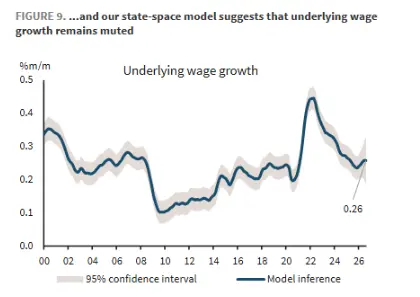 (Barclays' model indicates that potential wage growth remains weak.)
This estimate takes into account the upward trend in the Q2 employment cost index and data from the Atlanta Fed's wage growth tracker. The team also points out that the current 4.7% income growth rate is difficult to sustain, and it is expected that the growth rate of real consumer spending will slow to a seasonally adjusted annual rate of 1.5% in the second half of the year.
Probability of a rate hike in September marginally increases, inflation data becomes the next key node
Based on the above analysis, the report concludes that the August employment data marginally strengthens the case for a 25 basis point rate hike by the FOMC in September, aligning with Barclays' baseline expectation.
The rationale for supporting a rate hike is: Employment growth continues to exceed break-even levels, and improvements in wages and hours worked support labor income. The only weakness is the moderate rise in the unemployment rate, but this seems somewhat disconnected from the strong job creation.
Market attention has now turned to next week's inflation data. Barclays expects core CPI and core PCE to record a month-on-month increase of 0.23% in August.
Although this reading is generally moderate, given that Federal Reserve Chair Waller has repeatedly emphasized the need to establish greater confidence in bringing inflation "clearly and at a sufficient speed" back to target, the team believes that a 0.23% inflation reading is insufficient to rule out the possibility of a rate hike in September.
In summary, for fixed income and interest rate traders, a rate hike in September remains a highly probable baseline scenario, putting pressure on short-term rates; inflation data will be the last key piece of the puzzle this month.

 Risk warning