Waller's "no increase" forms "6 to 5"! The key factor in determining whether the Federal Reserve will raise interest rates in September is actually: Powell?
 Core Viewpoint

 Bianco Research founder Bianco stated that Waller has expressed a preference to maintain interest rates, and the voting pattern for the Federal Reserve's September meeting currently stands at 6 votes (to maintain) against 5 votes (to raise). The position of Governor Powell remains unclear, and he may become the key figure in making the final decision. With less than two weeks until the meeting, the probability of a rate hike is actually close to 50/50, and Powell's silence has become a source of uncertainty.
Author: Long Yue
With less than two weeks until the Federal Reserve's interest rate meeting on September 16, the voting pattern is highly contentious, and Powell's silence is becoming the biggest suspense in the market.
Jim Bianco, founder of Bianco Research, pointed out on social media that, aside from the macro data game, the voting situation is becoming a key factor influencing the current direction of the Federal Reserve's policy. He wrote:
I have always believed that observing the Federal Reserve now is about counting votes.
With Federal Reserve Governor Waller recently leaning towards maintaining interest rates, Bianco has summarized the current voting pattern as: 6 votes (to maintain) against 5 votes (to raise), with 1 vote still unknown—that is the former chairman Powell (Powell's term as chairman of the Federal Reserve expired on May 15 of this year, and he continues to serve as a Federal Reserve governor).
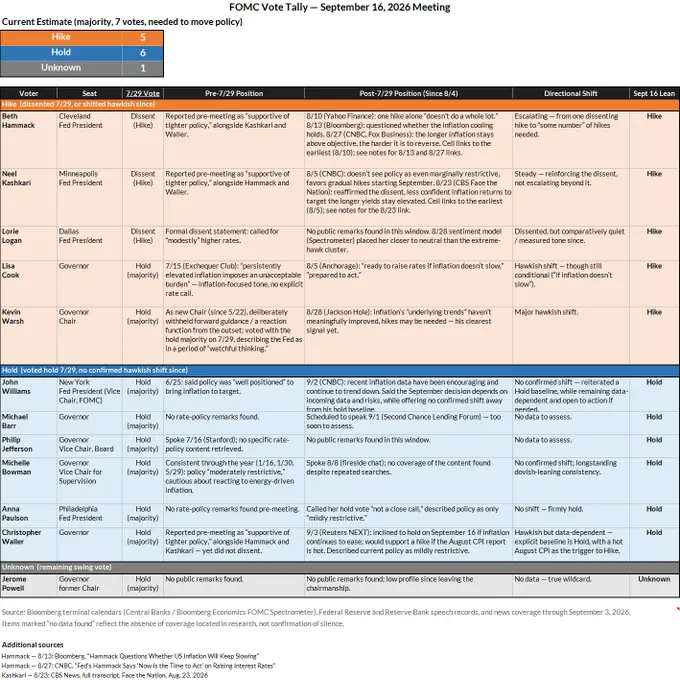
Bianco's personal vote tally
Powell: Deliberately Low-Key, Yet a Key Variable
Bianco pointed out that Powell has not made any public statements since the May press conference, "He wants to fade out of the public eye."
In Bianco's view, this strategy has its background: Trump's continuous criticism of the Federal Reserve has raised concerns among the committee about its independence, leading FOMC voting members to gradually shift towards more clearly anchoring their positions through public statements.
However, Powell's silence has now created uncertainty. Bianco wrote:
If everyone votes according to public statements, Powell's vote becomes crucial.
Probability of Rate Hike: Actually 50/50
Bianco's conclusion is direct and clear:
This is why, with less than two weeks to the meeting, the probability of a rate hike is actually 50/50.
On August 30, he had previously predicted that the voting result on September 16 would be 7 to 5, but the direction remains uncertain—"I just don't know if it's 7 to 5 for a hike or 7 to 5 to maintain."
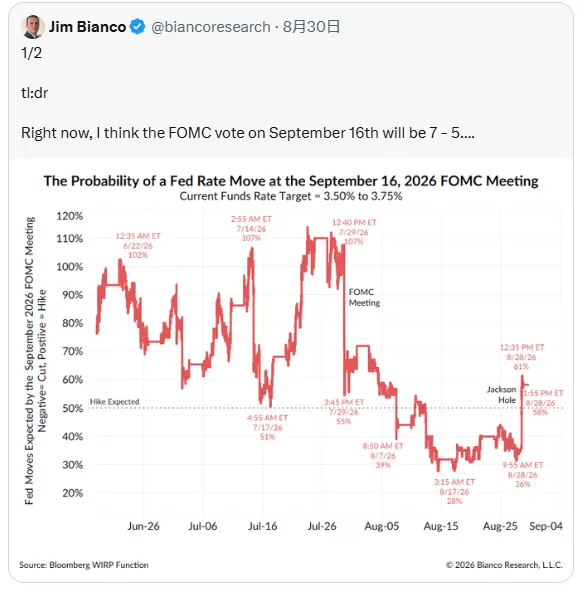
Currently, with Waller leaning towards the maintain camp, the maintain side temporarily leads 6 to 5, but Powell's vote can still break the tie, leaving the final result undecided.
Bianco believes that Trump's continued pressure on the Federal Reserve is an important background for understanding the current vote differentiation.
He stated that it is precisely due to concerns about independence that FOMC members have begun to prefer clarifying their positions through public statements rather than relying on internal discussions to reach a consensus. This allows the outside world to relatively clearly track policy direction through "vote counting."
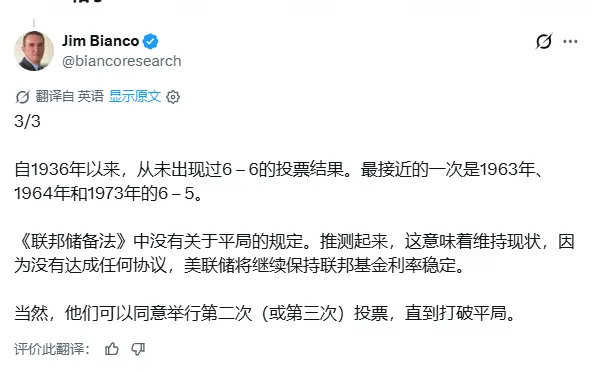
Since 1936, there has never been a 6-6 voting result. The closest instances were 6-5 in 1963, 1964, and 1973. The U.S. Federal Reserve Act does not have provisions for a tie. He wrote:
Speculatively, this means maintaining the status quo, as no agreement has been reached, the Federal Reserve will continue to keep the federal funds rate stable. Of course, they could agree to hold a second (or third) vote until the tie is broken.
 Risk warning