Visa's latest research: Behind 110 million transactions, Agent payments are reshaping internet commerce
 Core Viewpoint

 Visa and Artemis discovered through analyzing real transaction data from x402 and MPP that AI agents have begun to autonomously purchase digital services such as APIs, data, and computing power. A new payment model characterized by high frequency, low amounts, and no manual checkout is emerging. Although agent payments have already reached a preliminary scale, identity verification, expenditure control, compliance, and dispute resolution are still immature. The core value in the future may be more in the hands of distribution, trust, and payment infrastructure.
Author: Tim Conard (Head of On-Chain Data at Visa), Lucas Shin (Data and Research at Artemis)
Compiled by: Jiahua, ChainCatcher
Introduction
Artemis is an analytical platform in the field of on-chain data, used by institutions such as Visa, Grayscale, Pantera, VanEck, Tether, and Circle to understand what is happening on-chain and off-chain. This report utilizes Artemis Analytics' proprietary dataset, covering real transaction activities on x402 and the Machine Payments Protocol, fraud-adjusted metrics, and ecological growth conditions.
The goal at the inception of Visa was not just to create a network for cards, but to build a global value exchange system that does not rely on any specific technology or form. Agentic commerce is the new frontier on this evolutionary path. As software begins to discover, evaluate, and purchase goods and services on behalf of users and businesses, new infrastructure will emerge to support trust, authorization, settlement, and control at machine speed.
This new category has the potential to change how payments are initiated, routed, and embedded in digital workflows. This research, completed in collaboration with Artemis Analytics, examines the protocols, standards, data, and market structures that are forming around agent payments today, aiming to help payment networks, card issuers, acquirers, fintech platforms, and corporate teams understand how this new transaction landscape is developing, and where the most significant opportunities and challenges may arise.
1. What is Agentic Commerce
1.1 Defining Agentic Commerce
Agentic commerce is an emerging economic form: software can continuously and automatically discover, evaluate, and execute transactions, with transaction scales and operating methods that exceed the original design scope of traditional payment infrastructures.
The degree of autonomy varies. Some workflows still require human review or approval for purchases, while others operate fully automatically once configured. Agents can buy SaaS seats, book travel, automatically process accounts payable, replenish physical inventory, and outsource creative work, often without human intervention at the moment of ordering.
Within this broad scope, a new subclass has emerged: machine-native transactions under one dollar. An AI agent calls an API, receives an HTTP 402 response (Payment Required), evaluates the price, makes the payment, and then consumes the resource. The entire cycle takes milliseconds, requiring no checkout page, no pre-stored card, and no browsing session—just a wallet or a card, a budget, and a goal.
For payment service providers, agentic commerce encompasses various new transaction types, with economic models, risk control requirements, and infrastructure needs that differ from traditional e-commerce.
The hallmark of AI moving from chatbots to autonomous agents is its ability to plan and handle multi-step tasks, call external tools, evaluate results, and autonomously adjust execution strategies. Agents built on cutting-edge models like Claude, GPT, and Gemini are now deployed in production environments across various business verticals. Over the past year, these agents have become highly capable in writing code and conducting research, but they are inherently limited by the question of "can they obtain something."
By enabling agents with payment capabilities, this limitation is lifted:
- An IT agent adds fifty seats on a SaaS platform after personnel changes.
- An administrative agent reorders printer toner and break room supplies when inventory runs low.
- A research agent queries five financial data providers for a company's filing documents, spending a few cents each, and selects the most complete data set.
- A marketing agent pays ten image generation service providers five cents each to render the same product image and selects the best output.
Agent payments span two distinctly different types of transactions. The first type is macro transactions, where agents execute high-value, consumer-like purchases on behalf of individuals, such as booking travel, managing subscriptions, and procuring supplies. These transactions resemble traditional e-commerce, with agents acting as proxies for human intent. The second type is micro transactions, characterized by high frequency and low value, initiated by the agent itself, such as API calls, data queries, computing power access, and tool usage.
Both types exist and are growing, but micro transactions are where new payment architectures are most needed, and where new protocols are filling the gap.
In the past twelve months, two open-source payment protocols have launched to support the second type of agent payments. x402 (held by the Linux Foundation, incubated by Coinbase and Cloudflare) has processed over $135.7 million in transaction volume since its launch in May 2025, with 178.3 million transactions. The Machine Payments Protocol (developed by Stripe and Tempo, with contributions from Visa) has settled over $38,000 since its launch in mid-March 2026, with approximately 184,600 transactions.
The above figures represent the original on-chain cumulative metrics, with adjustments for volume manipulation and testing detailed in the methodology section and Chapter 4.
1.2 Why Now
In 1997, online commerce was just beginning. Amazon had been selling books for two years, and PayPal did not yet exist. When designing the underlying protocols for commercial internet, engineers reserved the 402 status code (Payment Required), envisioning a future where payments could be as native to the internet as loading web pages.
This infrastructure was never built. Card channels, with fixed fees, made transactions under one dollar unfeasible, leading to the failure of all micro-payment startups in the 2000s, as the cost of processing a payment exceeded the value of the transaction itself. With no viable way to charge directly for content and services, advertising became the default business model for the internet.
The real change is not just an infrastructure upgrade, but the first emergence of scaled, machine-native payment demand in the market.
The most critical advancement is that AI has crossed a capability threshold. Since the mid-2025 release of Claude 4.5 and GPT Codex 5.2, agents have been able to discover unfamiliar APIs, understand what they offer, evaluate prices, and decide whether to pay, all autonomously and at machine speed, without requiring human approval for each transaction.
This capability has given rise to an organic demand that did not exist before: programmatically and on-demand acquiring APIs, data, computing power, and services. Agents need to continuously and in bulk make payments, without the friction of needing registered accounts, pre-negotiated contracts, or manual checkout processes.
New settlement infrastructure has emerged in response to this demand signal. Next-generation blockchains have improved the cost and settlement speed of digital payments by several orders of magnitude. Chains like Tempo, built specifically for payments, can now achieve sub-cent fees and 500-millisecond settlements. Established chains like Base and Solana have reduced gas costs to fractions of a cent, making micro-payments in the range of $0.01 to $1.00 economically viable for the first time.
The key is that this infrastructure itself has not created the demand for agentic commerce. Dedicated chains have existed for years without spontaneously developing a usage-based billing API market. The real driver of market formation is the actual demand generated by increasingly capable AI agents.
In addition to better settlement economics, blockchain channels have also become easier to integrate, without exposing underlying complexities: account abstraction, MPC wallets, passkeys, and gasless transactions increasingly push these channels to the background, making them invisible to end users, merchants, and corporate teams.
Coinbase launched x402 in May 2025, and Tempo launched MPP in March 2026. Within months, both protocols have generated real production traffic. Capable agents have created demand, and new protocols and channels have made servicing this demand economically viable.
For existing institutions, the risk of inaction is disintermediation. If a few platforms simultaneously control the demand and transaction routing for agent payments, they can pull payment flows outside the existing networks, especially in categories where micro-payments are dense and traditional card economic models are weakest. Once this segment scales outside the traditional payment stack, existing institutions that only participate through high-value agent transactions may miss out on the most frequent portions of the emerging agent economy.
Players who can combine the native speed of protocols with the trust, compliance, and distribution capabilities of existing institutions are best positioned to define the next generation of agent payment infrastructure.
2. Transaction Forms and New Architectural Needs
2.1 A New Transaction Model
Agent payments may seem to have little in common with human commerce. A person might make only a few purchases in a day, each one carefully considered, and the merchants are ones they have known for a long time. An agent executing a research task might make hundreds of purchases in an hour, each costing a few cents or even less, each from a different supplier it has just discovered.
Three dimensions define the form of agent transactions: frequency, amount, and relationship. In human commerce, transactions are low-frequency, medium to high-value, occurring between parties with existing relationships, such as an account, a subscription, or a stored payment method.
In the micro transaction category of agentic commerce, transactions are high-frequency, low-value, occurring between parties with no prior relationship. An agent discovers a service, evaluates the price, makes the payment, and then moves on. Payment is the only interaction between the buyer and seller.
For most of internet history, e-commerce has enabled direct payments for physical goods and larger purchases, but the value of digital content and services has often been exchanged indirectly. Users pay for content with attention (advertising) or bundled access (subscriptions).
Agentic commerce makes direct, usage-based exchanges possible at any price point, with payments tied to single queries, single tool calls, or single data requests, down to fractions of a cent. In that world, work and payment become inseparable.
As agentic commerce scales, the growth in transaction volume is likely to far outpace the growth in transaction amounts. An agent session that costs only a few dollars could generate hundreds or even thousands of independent payments, so any system using a per-transaction authorization mechanism must complete far more authorization decisions to handle the same transaction amount as today.
2.2 Why Agent Micro-Payments Need New Architecture
The card technology stack is specifically built for human commerce: fewer transaction counts, larger average transaction values, and pre-established merchant relationships. The high-frequency, sub-dollar (transactions under one dollar) micro-payments in agentic commerce have transaction characteristics that are fundamentally different from traditional card payments, thus requiring new architectural layers to be added on top of the existing card payment system.
The differences manifest across several dimensions. Card channels are optimized for fiat currency purchases, second-level authorizations, day-level settlements, and manual verification processes. The machine-native micro-payment segment presents new requirements: sub-cent payment economics, near-instant confirmations, machine-readable receipts, and the ability to conduct high-frequency transactions without prior merchant relationships.
Subscription models and usage-based billing can circumvent some of these constraints, but at the cost of requiring account registration, pre-negotiated pricing, and maintaining a sustained business relationship. This model is effective for known customers but ineffective for an agent that "discovers a service, pays once, and then moves on."

Requirements for machine-native micro-payments | Source: Artemis, data as of May 2026
The above chart illustrates where machine-native micro-payments require new architecture, but cards are not a rigid, static technology stack. They are flexible infrastructure that can be expanded and built upon, and industry leaders are actively exploring this.
Visa's Trusted Agent Protocol (TAP), Visa Intelligent Commerce (VIC), and the Visa Card Specification for MPP are demonstrating how card infrastructure can be transformed to support agent-initiated transactions, from higher-value agent purchases down to machine-native payment flows.
Thus, new micro-payment protocols are not intended to replace bank cards but to cover small transaction scenarios that were previously unserviceable due to high costs, on top of the existing card payment system.
This is precisely why new payment protocols are necessary and emerging. They make payments the first and only interaction between buyers and sellers, giving rise to a new class of merchants: API providers, tool servers, developers selling microservices, and data providers charging per query. These businesses require machine-readable payment flows, near-zero access friction, and transaction economics that still hold at very small amounts.
3. In-Depth Analysis of Payment Protocols
3.1 Common Foundations
HTTP 402 has been part of the web standards since 1997. Its design intent is to allow a server (such as a webpage) to inform a client (such as a user) that a resource exists but requires payment to access. x402 and MPP are the first two protocols to build production-level payment infrastructure on this dormant status code that has been around for nearly thirty years.
Both protocols follow this basic process:
- The client sends an HTTP request to the server.
- The server returns a 402 status code and a set of payment requirements: price, accepted currencies, and where to pay.
- The client evaluates the terms, attaches payment, and resubmits the request with proof.
- The server verifies the payment and delivers the resource.
The entire exchange occurs directly within the interaction of the HTTP request and response, without redirecting to a payment page or having a separate checkout process or merchant integration. The way payments work is similar to authentication on the web today, occurring through headers in the HTTP request. Any server that returns a 402 can become a paid endpoint, meaning any agent with funds can natively pay it.
3.2 MPP: Two-Party Settlement
Trust Model. MPP has no intermediaries. Agents pay the server directly, and the server delivers the resource.
Settlement. The main settlement channel is Tempo, a blockchain built specifically for payments, with finality around 500 milliseconds and fees below one-thousandth of a dollar. Tempo also supports gasless transactions, meaning agents or servers can cover each other's gas fees, reducing friction for new participants.
MPP also natively supports cards through Visa's Card Specification and Stripe's integration, and it supports the Lightning Network within the same protocol. A server can offer multiple payment options simultaneously, allowing agents to choose their preferred channel using the same protocol process. This design pushes more value toward the platform layer, tool layer, and trust layer above the transaction.
Payment Types. MPP currently supports two payment methods. The first is charge, a one-time payment where the agent pays, and the server delivers. A single charge can be atomically split among up to ten recipients within a single transaction, enabling marketplace models and revenue sharing at the protocol level.
The second is session, a streaming payment channel where the agent deposits funds into an on-chain escrow, and the server incrementally delivers value. Agents issue off-chain receipts during the service consumption process, authorizing the server to claim funds corresponding to the delivered value. The server can verify these receipts at microsecond speed, avoiding the need for on-chain calls for each request, making the session's operating speed approach that of a standard API call. Unused funds can be refunded to the agent, and the server settles receipts in bulk at the end of the session.
Governance. MPP is being developed on the IETF standard track (draft-httpauth-payment). The IETF (Internet Engineering Task Force) is responsible for most core technology standards that drive the internet, including HTTP itself, TLS (the encryption behind HTTPS), and DNS. Entering the IETF standard track means the protocol will undergo a formal, public review process, allowing any engineer or organization to participate, comment, and propose modifications. This makes MPP the only agent payment protocol developed through "the same process that produced foundational internet protocols." The specifications are publicly available and designed to be vendor-neutral.
3.3 x402: Three-Party Settlement
Trust Model. x402 introduces a third party in the exchange, called the facilitator. When an agent pays for a resource via x402, the funds first go to the facilitator, which holds the funds, verifies whether the server has delivered what was promised, and only releases the money to the seller upon confirmation.
Settlement. x402 is an open payment protocol designed to operate on any chain that deploys a facilitator, not limited to a specific set of blockchains. In practice, current activity is concentrated on Base, Solana, and Polygon, with Base handling the vast majority of transaction volume. Payments on these chains settle on-chain in stablecoins, primarily USDC.
The facilitator architecture itself is also agnostic to channels. While current facilitators primarily settle on-chain, this architecture is compatible with facilitators that settle through traditional channels such as ACH, SEPA, or card networks. This structure makes the facilitator a key monetization and trust layer in the x402 model.
Payment Types. x402 currently supports standard fixed-price payments and a consumption-based billing model called Upto. When using Upto, the agent authorizes a maximum amount and only pays for the portion actually consumed. This is designed for agents that do not know in advance how much resource they will use.
Governance. x402 was initially created by Coinbase as a proprietary specification. In April 2026, the protocol's stewardship was transferred to the Linux Foundation, which established the x402 Foundation as a vendor-neutral governance body. The x402 Foundation was initially driven by Coinbase, Cloudflare, and Stripe, with early supporters including Visa, Amazon Web Services, American Express, Base, Circle, Fiserv Merchant Solutions, Google, KakaoPay, Mastercard, Merit Systems, Microsoft, Polygon Labs, Shopify, and the Solana Foundation.
The shift to open governance under the Linux Foundation signals the intention to solidify x402 as a shared industry standard rather than a project of a single company.
3.4 What These Differences Mean
Both protocols are new and evolving. The chains, payment methods, currencies, and functionalities described above reflect the current state that has gone live.
Both architectures are designed to be extensible: the facilitator model of x402, which is agnostic to channels, means that integrating a new facilitator can add any new settlement channel; MPP's multi-channel design means that new payment methods can be supported at the protocol level. As both protocols mature, their feature sets will continue to expand.
4. What the Data Shows
Unless otherwise noted, all metrics in this chapter have been adjusted according to Artemis Analytics' proprietary methodology.
4.1 x402: 11 Months of Real-Time Data
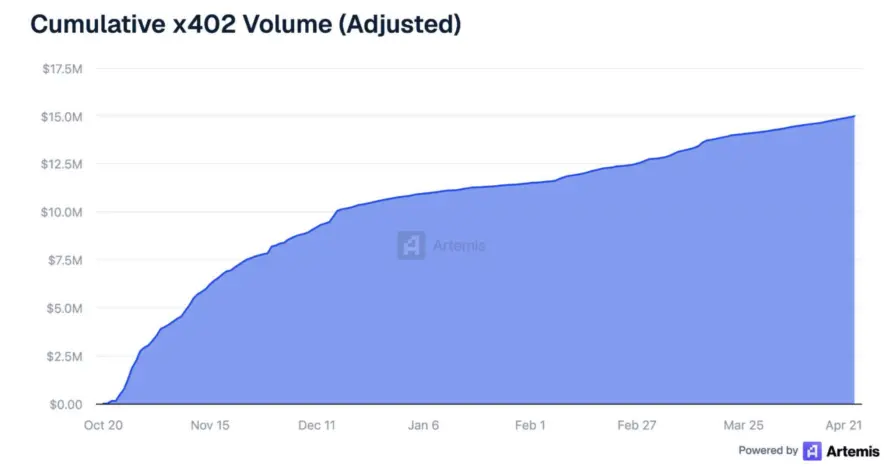
x402 Cumulative Transaction Volume (Adjusted), October 20, 2025, to April 21, 2026 | Source: Artemis
Since its launch in May 2025, x402 has processed $15 million in adjusted transaction volume, with an adjusted transaction count of 109.6 million. Activity surged sharply in October 2025, with monthly transaction counts rising from about 40,000 to 3.8 million. In November 2025 alone, the protocol processed approximately 38 million transactions.
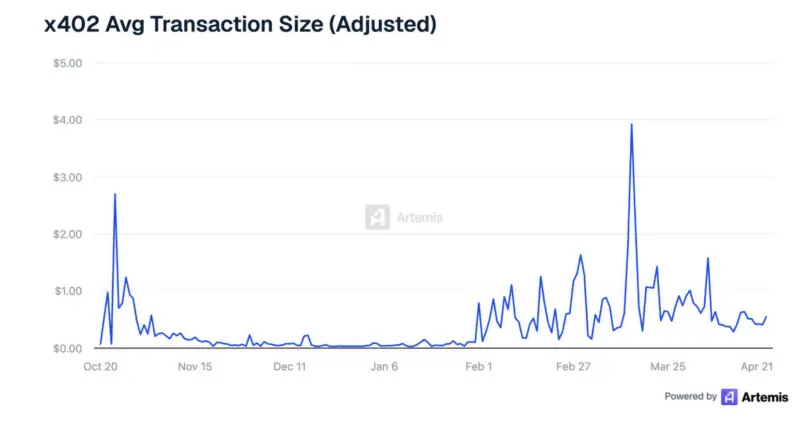
Average Transaction Amount for x402 (Adjusted) | Source: Artemis
Transaction counts and volumes have diverged significantly over time. November 2025 was the peak month in terms of transaction count, with 38 million transactions generating $5.15 million in adjusted transaction volume. March 2026 presented a completely different picture, with $1.64 million in adjusted transaction volume corresponding to only 2.1 million transactions, marking the highest average transaction amount recorded in a month.
The top 1% of buyers (about 4,000 wallets) accounted for approximately 90% of the adjusted transaction volume and about 50% of the adjusted transaction count. This concentration has driven up the average transaction amount. However, broader trends still indicate that the payment scale and workflow combinations supported by x402 are broader than what the term "micro-payment" itself implies.
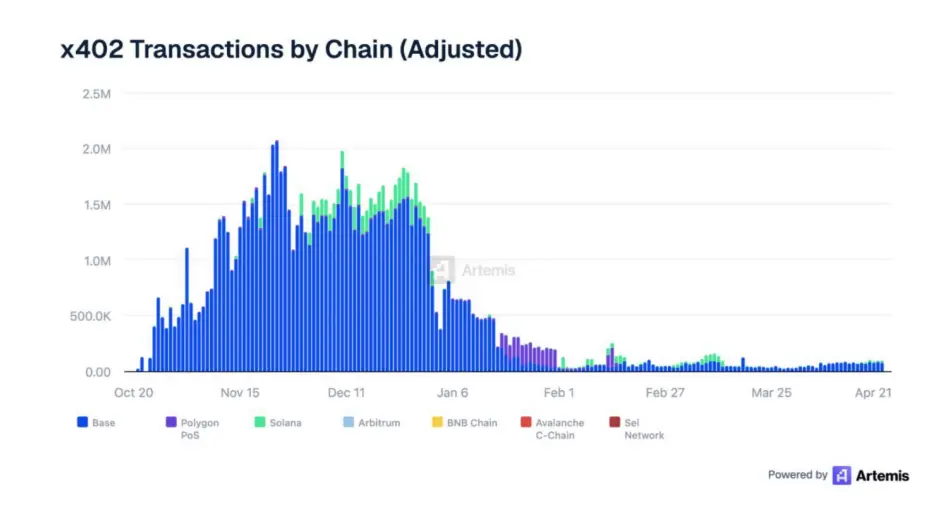
Transaction Counts by Chain for x402 (Adjusted) | Source: Artemis
On-Chain Distribution. Base overwhelmingly dominates this ecosystem, accounting for about 90% of adjusted transaction counts and 93% of adjusted transaction volume. Solana ranks second by transaction count, with Polygon in third. At this stage, x402 is clearly a Base-centric market, with activity from other chains being meaningful but still secondary.
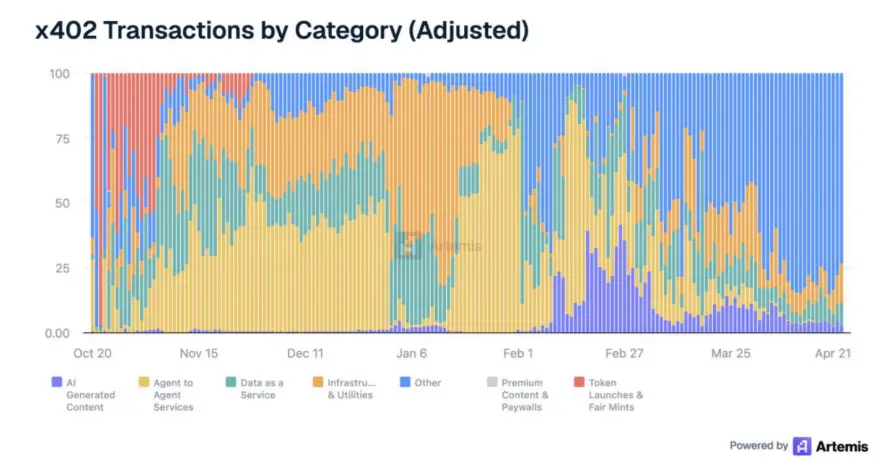
Category Distribution of x402 Transaction Counts (Adjusted) | Source: Artemis
Category Distribution. By transaction count, Agent-to-Agent Services is the leading category, reflecting the high-frequency, low-value transaction model that defines machine-native commerce.
This category captures chain-based workflows: one agent pays another agent for a sub-task, such as data retrieval, task execution, or inference, meaning a single user request can generate a series of transactions. The long tail of unclassified endpoints accounts for most of the transaction volume, highlighting the fragmentation on the supply side and the need for better discovery and aggregation tools.
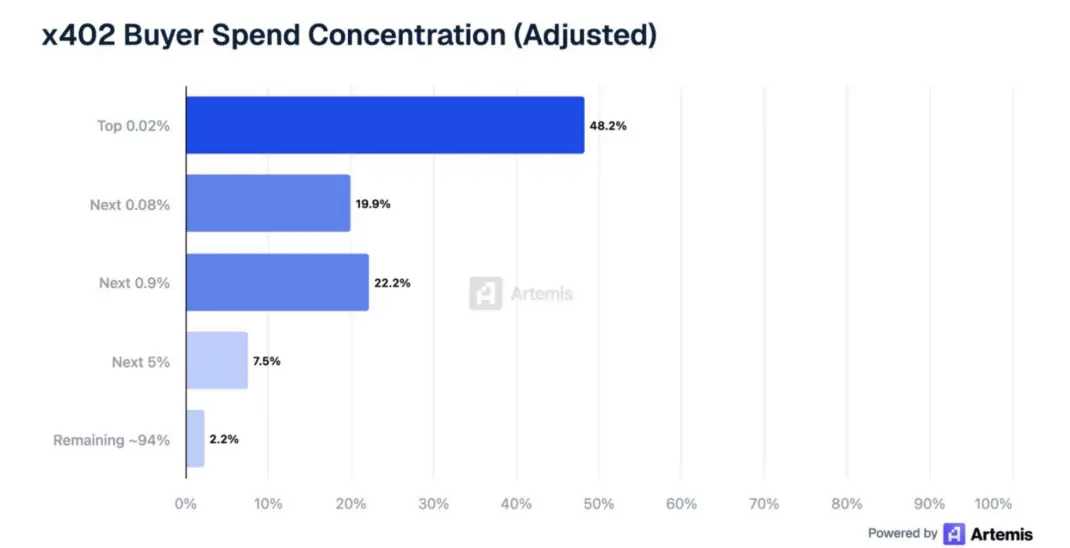
Buyer Spending Concentration for x402 (Adjusted) | Source: Artemis
Buyer Concentration. Dollar spending is highly concentrated among a narrow group of buyers. Less than 0.02% of buyers generated about 48% of the adjusted transaction volume. This is consistent with the characteristics of an early market: even as the overall participant base expands, a relatively small number of mature participants drive most economic activity. To date, x402 has over 422,000 adjusted buyers.
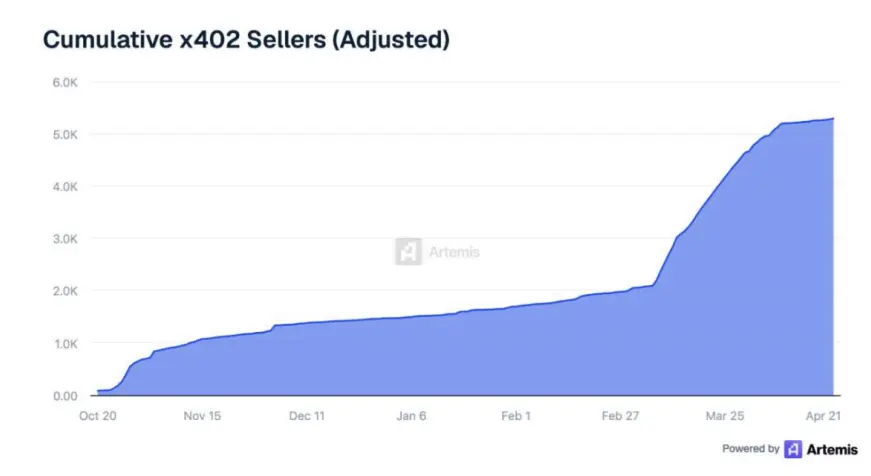
Cumulative Seller Count for x402 (Adjusted) | Source: Artemis
Supply Side. x402 has recorded about 5,300 adjusted sellers (i.e., merchants) to date. Traditional merchant onboarding often takes weeks and requires a payment processor, whereas on x402, any developer can deploy a receivable endpoint and start accepting payments immediately.
Two tailwinds indicate that the supply side of resources consumable by agents will continue to expand: first, AI is lowering the barriers to creating digital products, meaning more individuals and agents will become merchants; second, new web services and applications are increasingly designed for agents, being API-first, instantly accessible, and priced per request.
4.2 Machine Payments Protocol: 33 Days Post-Launch
MPP launched in mid-March 2026 and had just over a month of activity at the time of this analysis. Given that the protocol is still in its early stages, the significance of granular splits is not as pronounced as with x402, and the focus here is on overall activity and the emerging structural differences between the two payment types in MPP.
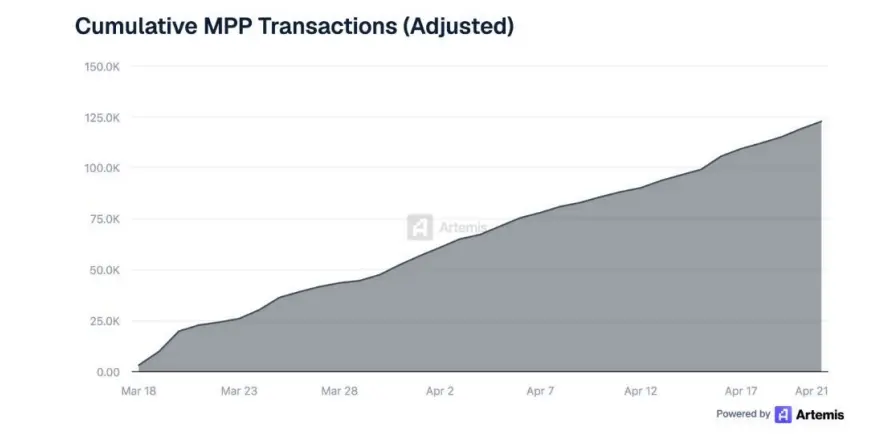
Cumulative Transaction Counts for MPP (Adjusted), March 18 to April 21, 2026 | Source: Artemis
Since its launch, MPP has processed approximately $25,000 in adjusted transaction volume, with about 115,000 adjusted transactions. Transaction growth has been stable and roughly linear from day one, averaging about 4,000 adjusted transactions per day.
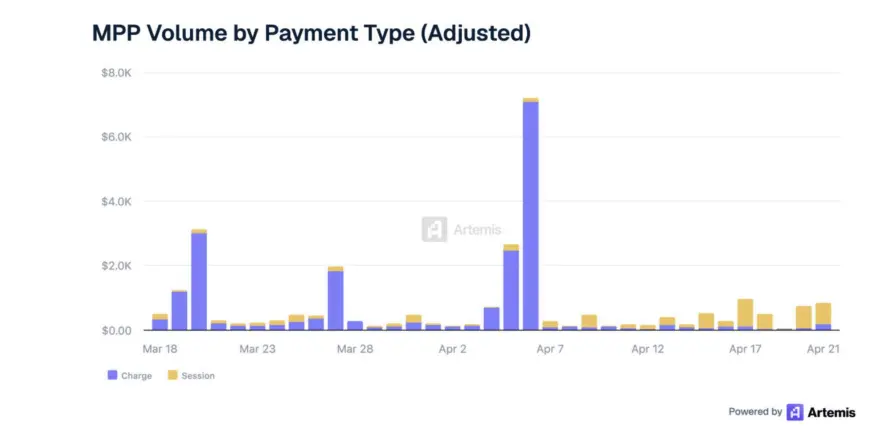
Adjusted Transaction Volume for MPP by Payment Type (Charge vs. Session) | Source: Artemis
Charges account for 97% of adjusted transaction counts. Sessions have significantly larger single transaction amounts, but still represent a small portion of overall activity. As described in Section 3.2, sessions allow agents to deposit funds into an on-chain escrow channel and pay incrementally as they consume services. Since servers settle accumulated receipts in bulk rather than on a per-request basis, even if the underlying usage is granular, single session transactions will appear larger than charges. Early session activity indicates that this model is being trialed but has not yet achieved widespread adoption.
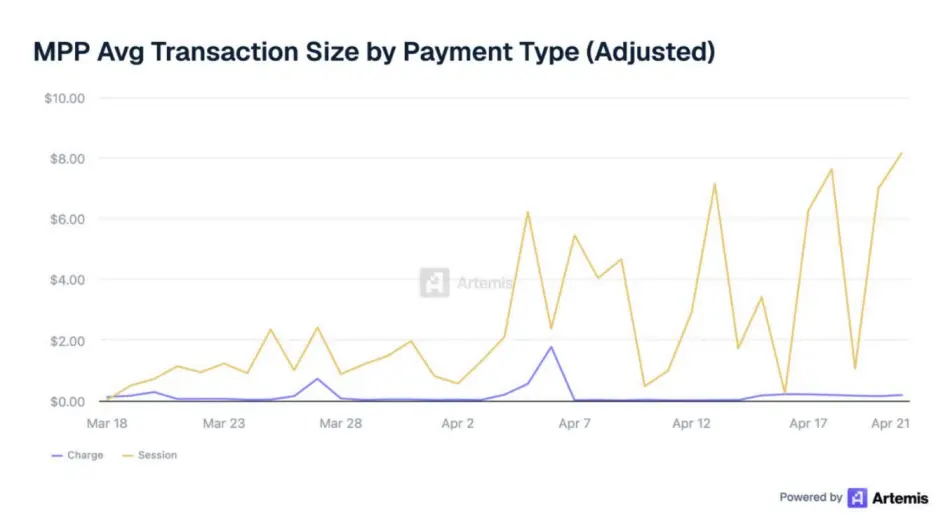
Average Transaction Amount for MPP by Payment Type (Adjusted) | Source: Artemis
Transaction volume is gradually accumulating, with most transactions still in the sub-cent range. The average transaction amount for charges has remained stable around $0.17 during this period, while the average transaction amount for sessions is $2.15. The upward trend in session amounts likely reflects developers experimenting with larger deposit amounts while testing the streaming payment model.
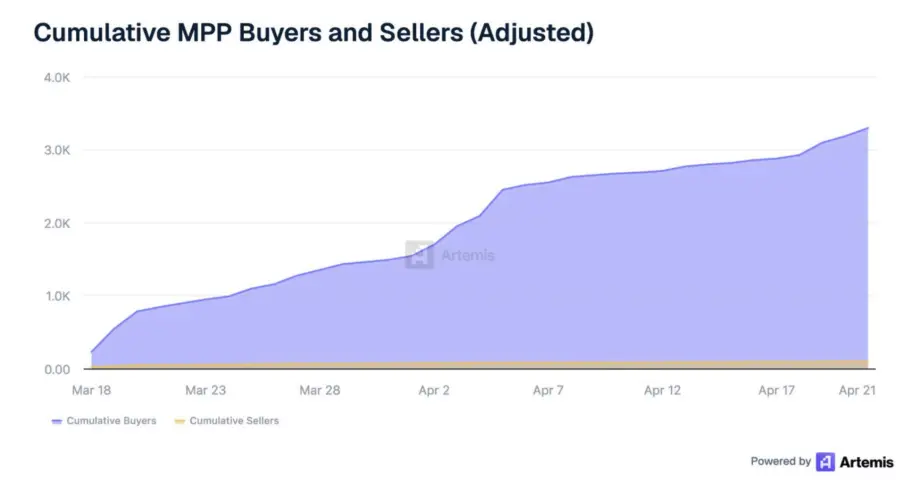
Cumulative Buyer and Seller Counts for MPP (Adjusted) | Source: Artemis
To date, MPP has recorded over 2,800 adjusted buyers and 90 adjusted sellers. The approximately 32:1 buyer-to-seller ratio indicates that demand is outpacing supply, with more agents trading on a still limited set of available endpoints. The supply side remains underdeveloped. x402 also had a similar scale of seller count in its initial months before it began to accelerate sharply.
5. Trust, Identity, Spending Control, and Dispute Resolution
5.1 Trust in Agents is the Toughest Issue
Traditional commerce assumes buyers are human, possessing intent, judgment, and accountability. Agentic commerce raises questions about all three. Buyers are segments of software acting on authorization, making decisions at machine speed, often without real-time human oversight. This creates a trust issue that no protocol can fully resolve on its own.
Risk of Wrong Purchases. The simplest failure mode is that an agent buys the wrong thing. The agent misunderstands the task, selects the wrong service, or pays too high a price for a resource. In human commerce, buyers typically catch errors before checkout or dispute them afterward.
Autonomously operating agents may not even realize an error has occurred, and at machine speed, a misconfigured agent can execute hundreds of poor transactions before anyone notices, creating an unmanageable burden of reconciliation, refunds, and disputes at scale.
Adversarial Attacks. Prompt injection, or malicious input that manipulates agents to perform unauthorized actions, remains an active area of research with no complete solutions. An attacker who compromises the reasoning process of an agent can redirect purchases, steal funds, or trigger unauthorized spending across multiple interconnected services. The attack surface grows with autonomy: the greater the freedom of agent transactions, the more damage a compromised agent can inflict.
Attribution of Responsibility. When an agent makes an unauthorized purchase, it may not be clear who is responsible at first. The person granting permissions, the platform hosting the agent, the model provider that misled the reasoning, and the merchant that accepted the payment all have valid claims and defenses. Existing legal and regulatory frameworks are not designed for this chain of delegation, and clear precedents may not exist.
Cascading Failures. As agentic commerce matures, agents will increasingly transact with other agents rather than directly with merchants. A compliant agent might pay a document review agent to analyze a contract, which in turn pays a legal research agent to retrieve relevant case law, and then the latter pays a database agent to fetch court documents.
This chain of agent-to-agent transactions creates value through specialization but also introduces risks through interdependence. If any agent in the chain delivers poor results, every upstream agent has already paid for work based on that output. Correcting this error requires disputes to be passed back along the chain. This multi-hop payment chain has no counterpart in traditional commerce, nor are there existing mechanisms to untangle them.
5.2 Current Solutions
The trust challenges outlined above are being addressed at multiple levels of the tech stack, with players on both the crypto-native and card-native sides taking action.
Protocol Layer. Payment protocols like x402 and MPP are embedding trust directly into the transaction mechanisms. The third-party facilitator approach allows for verification of delivery before funds are released, escrow mechanisms ensure buyers only pay for consumed value, and consumption-based billing authorizations limit exposure by capping spending for single requests. These are all protocol-level safeguards, but their effectiveness depends on which protocol and payment type the buyer and seller choose to use.
Identity Layer. The ecosystem remains fragmented. Most agents authenticate using API keys or wallet addresses, which can verify access rights but say nothing about historical records or reliability.
Public registries like x402scan and MPPscan provide basic endpoint discovery. Coinbase's Bazaar registry maps merchants to receiving addresses. The goal of ERC-8004 (Trustless Agents Standard) is to allow agent reputations to carry across networks, enabling merchants to verify an agent's transaction history before deciding whether to transact.
On the card side, Visa's TAP, Mastercard's Agent Pay, and Stripe's ACP help anchor agent identities to existing authorization frameworks, inheriting decades of accumulated KYC and risk control infrastructure, but all are tied to card channels.
Strategy Layer. Programmable spending controls are emerging simultaneously in both ecosystems. Coinbase Agentic Wallets on Base offer gasless transactions with programmable limits, while strategy layers like Turnkey, Privy, and Safe directly encode whitelists, spending caps, and merchant routing into wallet infrastructure. On the card side, tokenized receipts with issuer-customized spending rules serve the same purpose through familiar infrastructure.
5.3 Unresolved Issues
Currently, there is no universal agent identity standard that can connect emerging crypto-native channels with existing traditional channels. Reputation established in one ecosystem cannot transfer to another.
Dispute resolution lacks existing mechanisms. Chargeback windows and evidence requirements were originally designed for human speed and clear buyer intent. When an agent executes thousands of transactions per hour, the concept of "a disputed order" cannot map to hundreds of sub-cent API calls.
Furthermore, legal liability remains ambiguous. No jurisdiction has established clear precedents for how liability is distributed among the person granting permissions, the platform hosting the agent, the model provider, and the merchant.
These gaps represent both the most significant risks in today's agentic commerce and the clearest value-adding opportunities for existing institutions in the traditional payment ecosystem.
6. Standard Landscape
6.1 The Agentic Commerce Tech Stack
Agentic commerce requires coordination across multiple infrastructure layers, from how agents communicate to how money moves. No single standard can cover the entire tech stack, and this landscape is evolving rapidly.
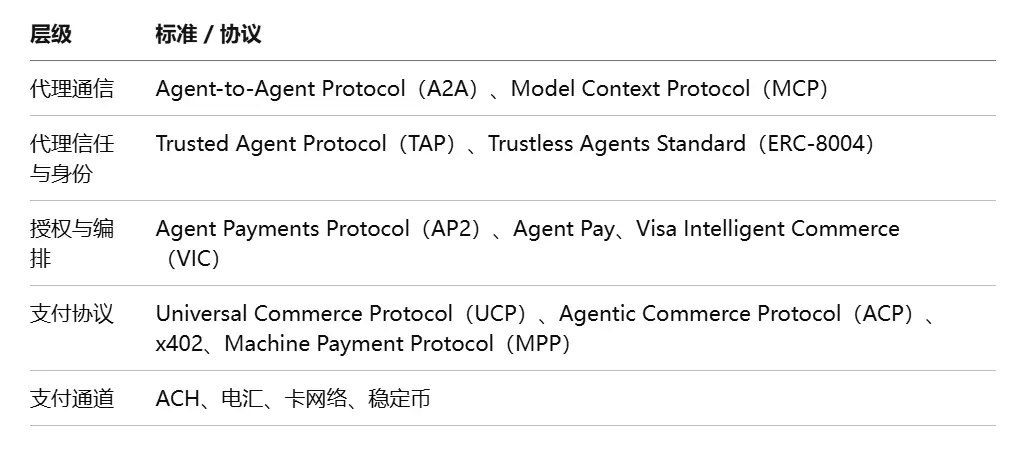
Standard landscape of agentic commerce, emerging protocols at various levels | Source: Artemis, data as of May 2026
These standards together form the infrastructure stack that is taking shape for agentic commerce, from communication and identity to authorization and payment execution.
6.2 Card-Native Protocols
x402 and MPP define how agents pay for machine-native resources, while parallel to this, another set of protocols is emerging for scenarios where "agents act on behalf of human consumers and complete transactions through existing card infrastructure."
Visa TAP. The Trusted Agent Protocol allows merchants to verify that a certain AI agent is indeed authorized to act on behalf of a user through cryptographically signed HTTP messages. TAP adds a standardized trust layer on top of existing web and merchant infrastructure, enabling merchants to handle agent-initiated transactions without major changes to their payment stacks. Created in collaboration with Cloudflare, with input from Shopify, Microsoft, and Stripe, TAP launched in October 2025, with early adopters including Nuvei, Adyen, and Stripe. For the traditional payment ecosystem, TAP is the most direct path from existing card infrastructure to agent-initiated commerce.
ACP (Stripe + OpenAI). The Agentic Commerce Protocol allows agents to complete purchases through existing merchant checkout processes, using card payments. Agent platforms and merchants must pre-approve each other for transactions to occur, forming a curated market where only vetted participants can transact. Payments are processed by Stripe, with OpenAI charging merchants an additional fee on top of standard processing costs.
UCP (Google/Gemini + Shopify). The Universal Checkout Protocol allows agents to complete purchases directly within Google's product interfaces, such as Search AI Mode and the Gemini app. Merchants retain full ownership of customer relationships and remain the recorded merchants in all transactions. This protocol was jointly developed by Google and Shopify, with over 20 participating entities, including Etsy, Wayfair, Target, and Walmart, supporting REST, MCP, AP2, and A2A integrations.
VIC (Visa). Visa Intelligent Commerce is a single integration entry point launched in April 2026, allowing merchants, acquirers, and agent platforms to participate in agentic commerce. This platform is protocol-agnostic, supporting TAP, x402, MPP, ACP, and UCP through a single integration. It offers tokenization, passkey-based authentication, and programmable spending controls, allowing users to set amount limits, merchant categories, or require real-time approvals. For merchants, VIC eliminates the need to integrate with each individual agent protocol. For the payment ecosystem, it positions Visa as a connective layer between agents and existing commercial infrastructure, with over 100 partners already onboard, 30 of which are actively building in the VIC sandbox.
AP2 (Google + 60 Partners). The Agent Payments Protocol introduces cryptographically signed mandates as the basis for agent authorization. Intent Mandates record the conditions under which agents can purchase on behalf of users, Cart Mandates record specific items and prices for a transaction, and Payment Mandates authorize the final payment. This protocol is agnostic to payment channels, supporting cards, bank transfers, and cryptocurrencies. AP2 is designed as an extension of both A2A and MCP, positioned as an authorization layer that can be built on top of various payment protocols. Partners include Mastercard, American Express, PayPal, Adyen, Coinbase, and Salesforce.
Agent Pay (Mastercard). Agent Pay uses Mastercard's tokenization technology to create payment receipts exclusive to agents. Consumers authorize agents to act on their behalf within set parameters, and agents complete purchases using tokenized versions of the consumer's cards. Spending limits, merchant categories, and other guardrails are programmable and directly tied to the receipts.
6.3 Convergence and Conditions for Scaling
The lines between crypto-native protocols and card-native protocols have begun to blur. MPP now simultaneously covers on-chain crypto payments and fiat payments through shared payment tokens, while Visa's Card Specification SDK is designed to extend protocols into card-based agent commerce. The practical effect is that a single machine payment framework can increasingly support both stablecoin processes and card transactions.
For card networks and issuers, this opens a path into agent payment flows without requiring merchants to adopt an entirely separate tech stack. Conversely, Stripe's support for x402 payments made with USDC on Base in March 2026 has integrated stablecoin-native payment flows into a broader agent commerce ecosystem.
The direction points toward convergence rather than competition: bank cards are better suited for agents representing humans in traditional consumption, while stablecoins are more suitable for machine-native micro-payments, and hybrid workflows may utilize both channels simultaneously.
For this convergence to move beyond the early adoption phase, three things need to happen:
- Interoperability between standards needs to mature. Over time, agents should be able to combine AP2-style authorization mandates, payment execution from x402 or MPP, and trust and card-side verification from TAP or similar systems within a single workflow, without needing custom integrations for each combination.
- Regulatory frameworks need to catch up with technology. How to handle agent-initiated transactions, liability attribution, and cross-border agent commerce remains unresolved, especially as these systems begin to operate across multiple payment channels and jurisdictions.
- Existing institutions need clear roles. These institutions, which handle the majority of global payments, need to clarify their position in the tech stack: whether they are issuers of agent receipts, processors of agent transactions, or providers of the trust and dispute infrastructure that is currently lacking in crypto-native protocols.
7. Application Scenarios
7.1 Overview
Today, the highest transaction volume scenarios are lead completion, data scraping, inference and inference routing, and web search. Lead completion is one obvious high-value workflow, where agents pay per query to pull personal or company profiles, verify emails, and complete CRM data.
In addition, a growing tail of services is emerging: social media intelligence (scraping data from LinkedIn, X, and Reddit), image and video generation endpoints, Google Maps queries, call API, and agent-based search.
One example illustrates the direction of this: a facial recognition endpoint where an agent uploads a picture and receives the highest probability identity match results across the web. Such niche but high-value services are never worth the expense of a complete SaaS product, but as an API that can be discovered and called on a per-request basis, it makes perfect sense. As the ecosystem matures, this type of creative long-tail scenario is likely to emerge in large numbers.
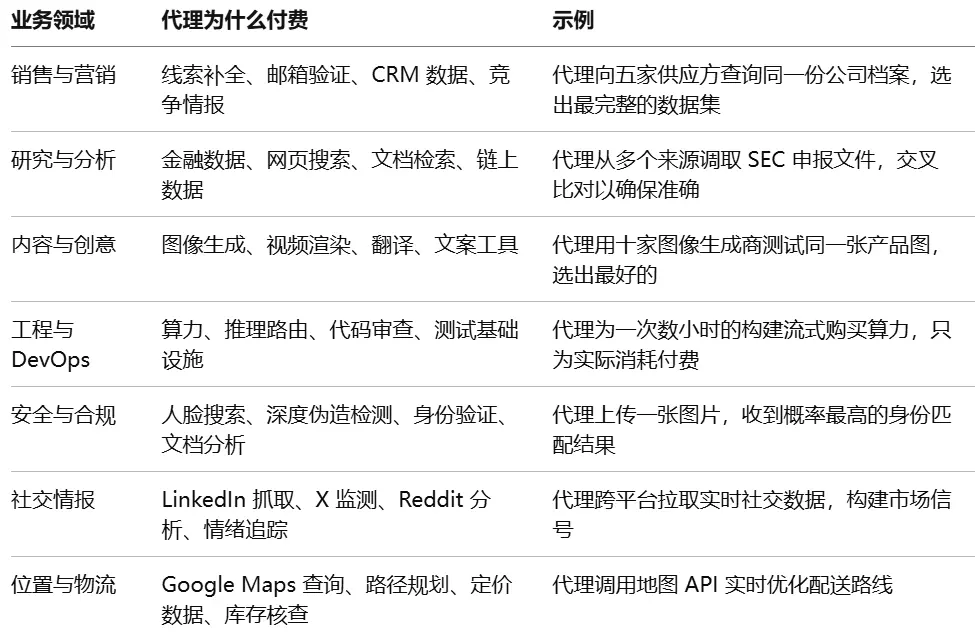
Why agents are paying, early categories of machine-initiated spending | Source: Artemis, data as of May 2026
7.2 Per-Query Services
A research agent building company profiles can spend a few cents querying multiple data providers, comparing results, and selecting the best one. The total cost may be less than one dollar.
In traditional models, the same workflow often requires subscribing to a single supplier, with no ability to compare prices at the moment of need. This is one of the clearest business forms released by low-friction payments. Agents have no accounts, no pre-negotiated contracts, and no long-term relationships with sellers. They discover endpoints, make payments, evaluate outputs, and then move on.
This model's applicability extends far beyond data completion. Developers can expose document parsers, translation services, code review tools, or other MCP-accessible functionalities as paid endpoints. Agents can discover and call these tools on demand, without providers needing to build an entire SaaS business around them. This lowers the barrier to becoming a merchant in the machine economy and gives rise to a long tail of specialized, pay-per-use services.
This model has already begun to be productized. AgentCash, built by Merit Systems, packages wallet management, merchant discovery, and access to over 420 paid APIs into a single integration for agent frameworks like Claude Code. This platform allows agents to access hundreds of paid services without configuring each one individually, abstracting away the complexity of protocol-level payments on x402 and MPP.
7.3 Streaming and Metered Services
Not all agent payments are single request-and-response transactions. Some workflows require continuous access to a resource over time. A coding agent might continuously consume computing power for several hours, while a monitoring agent might continuously receive market data, paying only for the portion of the data stream it actually uses.
MPP's session is designed for this model. Agents deposit funds, consuming and paying incrementally, with the ability to stop at any time if the task ends or quality falls below expectations. Merchants are compensated based on the delivered usage, and buyers do not need to commit to a fixed subscription for scenarios with fluctuating demand. This model is more suitable for agent workflows that are continuous, unpredictable, and closely tied to task completion.
7.4 Agent-to-Agent Services
A hallmark scenario in agentic commerce is agents transacting directly with other agents. A single user request can trigger a series of machine-to-machine purchases, with one agent delegating sub-tasks to specialized services: searching, data completion, computing power, execution, each being paid programmatically at the moment of need.
This is a completely new commercial front. There are no checkout pages, no shopping carts, and no manual approval steps between purchases. Workflows run continuously, with each agent evaluating and paying for the next service in the chain. As mentioned in Chapter 4, this is already the largest activity category for x402 by transaction count.
This is one of the clearest examples of commerce created by agents themselves. Payments are directly embedded in the execution process of work, allowing specialized services to be coordinated and transacted in real time.
8. Economic Models and Value Attribution
8.1 Monetization Models
The scenarios outlined above share a common characteristic: high frequency, low value, and no prior relationship between buyers and sellers. The economic models serving this type of commerce are very different from traditional payments, and the positions capturing value in the two payment standard ecosystems (x402 and MPP) are currently different.
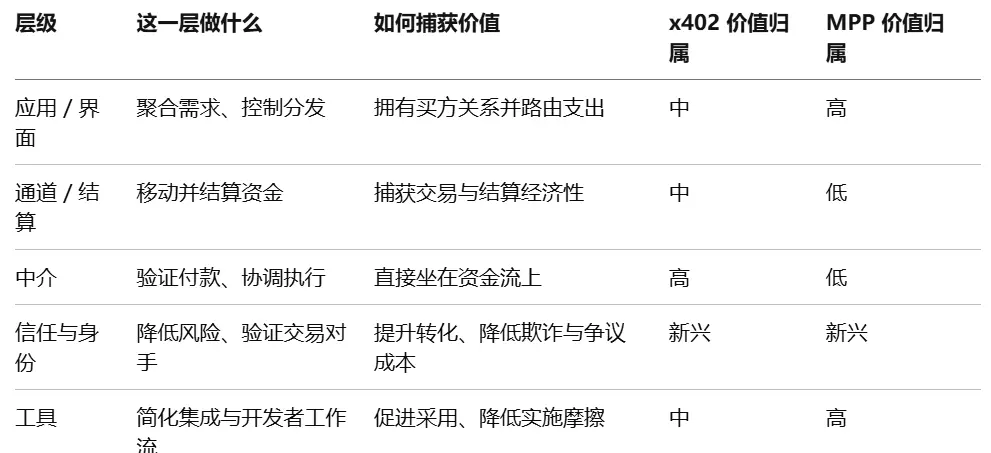
Value attribution in agentic commerce, comparison between x402 and MPP ecosystems | Source: Artemis, data as of May 2026
In x402, transaction volume flows through the facilitator layer, where intermediaries can charge processing fees for verification, settlement, and related trust functions. In MPP, value attribution at the transaction layer is less, with more attributed to the surrounding ecosystem: platforms aggregating demand, tools simplifying integration, and trust or discovery layers that help buyers and sellers transact with confidence.
This difference shapes the expansion strategies of the two ecosystems. x402 monetizes the intermediary role in the flow of funds, while MPP pushes the monetization focus toward distribution, routing, and trust. For existing institutions, the key question is where sustainable economics will ultimately land.
8.2 Sustainable Advantages
Agentic commerce makes it exceptionally easy for new merchants to enter the market. Developers can place an existing API behind a 402-compatible paywall with relatively low integration costs, and the same basic logic applies to the broader machine payment ecosystem. This is an intentional design. The construction goal of x402 and MPP is to lower the access friction on the supply side, making it easier for new services to monetize.
Ease of entry does not equate to sustainable economics. When new endpoints can be quickly launched and competitive supply is easily replicated, value shifts from individual merchants to layers that are harder to replicate. In the e-commerce space, similar dynamics have pushed sustainable value toward platforms and payment infrastructure, rather than the long tail of merchants they empower; in agentic commerce, the strongest structural advantages lie in distribution, trust, and infrastructure.
Whoever controls how agents discover and route to services controls demand. Whoever builds identity and reputation systems that help agents choose between competing suppliers can reduce fraud and improve conversion. And whoever provides settlement, compliance, and dispute infrastructure embeds themselves in the transaction flow itself.
This is precisely where the traditional payment industry has a natural advantage. The capabilities that payment networks, issuers, and acquirers have built over decades are exactly what is needed as agentic commerce scales: identity verification, spending policy execution, fraud detection, cross-border settlement, and merchant risk assessment.
New protocols offer programmability, speed, and a cost structure that traditional card channels struggle to match for very small transactions. However, they currently do not provide the trust infrastructure, regulatory coverage, or merchant distribution capabilities at the scale of existing institutions.
9. Compliance and Regulatory Considerations
9.1 How These Protocols Correspond to Existing Regulation
Agent payment protocols cannot cleanly correspond to existing payment regulations.
In an x402-style model, facilitators may temporarily hold funds, verify delivery conditions, and then release payments to sellers. Depending on how this role is designed and how a jurisdiction interprets it, it may touch upon frameworks for money transmission, payment processing, escrow, or related licenses. The MPP-style direct connection model reduces the role of dedicated intermediaries but raises another question: when no party is clearly positioned between buyers and sellers, who bears the regulatory obligations associated with the transaction?
Cross-border complexities add another layer of uncertainty. An agent within one jurisdiction may pay a server in another jurisdiction, while the infrastructure or service providers may involve even more jurisdictions. Existing cross-border payment frameworks are built on the premise that counterparties are identifiable, legal jurisdictions are clear, and transaction flows are slow, whereas agent transactions compress these premises. For payment service providers, this means that compliance frameworks may shift from backend functions to a source of competitive differentiation.
9.2 Stablecoin Compliance
The early settlement paths of both protocols have made stablecoin regulation directly relevant to the future of agentic commerce. In the U.S., the GENIUS Act establishes a federal licensing and reserve framework for issuers of payment stablecoins, providing a clearer regulatory foundation for stablecoin-based payment flows than previously existed.
For x402, activity has been closely associated with USDC, especially on Base, giving this ecosystem a relatively pro-institution starting point. However, x402 itself is not necessarily limited to a single stablecoin or single chain; specific implementations can vary with facilitators and networks.
For MPP, the current implementation includes crypto-native settlement mechanisms like pathUSD on Tempo, but the protocol's scope is broader than any single channel and is also designed to support payment methods tied to fiat currencies, such as shared payment tokens.
For traditional payment audiences, the importance of stablecoin compliance lies in determining whether these funds can be integrated into regulated financial infrastructure. If stablecoin settlements have clear regulatory status, they become a more viable channel for banks, acquirers, and processors to build upon. If regulatory handling remains fragmented across jurisdictions, the speed of institutional adoption will slow.
9.3 Special Considerations Related to Agents
Existing KYC and anti-money laundering frameworks are designed around human customers. In agentic commerce, this premise breaks down.
The core compliance question becomes: who is the "customer" that is truly relevant for identification, monitoring, and oversight purposes? Is it the person granting permissions to the agent, the platform operating the agent, the entity funding the wallet, or some combination of the three? Regulatory handling on this point remains unresolved.
Tax and reporting obligations face similar challenges. An agent may execute thousands of small transactions across multiple jurisdictions in a single session, creating reporting burdens that existing systems were not designed to handle. Buyers and sellers may have limited visibility into each other's identities, locations, or legal statuses.
For payment service providers evaluating this market, the infrastructure needed to make agent transactions traceable, auditable, and reportable at scale may itself become an important layer of value creation.
10. Outlook
10.1 Future Opportunities
Agentic commerce has begun to operate, but it is still in the early stages of development. Protocols exist, transaction models are visible, but surrounding infrastructure remains underdeveloped. This creates several clear growth and investment opportunities:
Hybrid Settlement of Cards and Stablecoins. One of the most direct opportunities for issuers and acquirers is hybrid settlement: using cards on the front end and stablecoins on the back end. The cardholder experience remains unchanged, while settlements shift to stablecoin channels, supporting faster collections, continuous settlement windows, and lower cross-border costs.
This allows existing institutions to share the speed and cost advantages of stablecoin infrastructure without requiring merchants or consumers to change their behavior. As agentic commerce scales, hybrid settlement is likely to become an attractive path for those institutions looking to tap into machine-initiated payment flows through their already operational infrastructure.
Convergence of Protocols and Interoperability. x402 and MPP currently operate as independent ecosystems, with different settlement channels, trust models, and merchant bases. Over time, agents will need to route transactions between protocols without requiring custom integrations for each protocol.
Early signs of convergence are already emerging: MPP simultaneously supports crypto and card-associated payment flows, while Stripe's support for x402 payments made with USDC on Base has integrated stablecoin-native payments into a broader payment infrastructure. An interoperability layer that helps agents choose the correct protocol for each transaction type could become an important control point in the tech stack.
Cross-Border Agent Commerce. Cross-border activity is likely to be a default feature of agentic commerce rather than a niche edge case. Agents can initiate transactions across jurisdictions, bypassing the traditional identity and residency anchors that existing compliance systems rely on. However, the infrastructure for handling compliance, currency conversion, and jurisdiction routing at machine speed remains immature. For payment networks with global coverage, this is a natural extension of existing capabilities and one of the clearest differentiation value opportunities in the near term.
Agents Becoming Merchants. Today, agents primarily act as buyers, but over time, they will also become sellers. As the costs of building and deploying software continue to decline, more developers, companies, and workflows will be able to expose specialized services directly to agents. This will significantly expand the supply side of the ecosystem, bringing more endpoints accessible to agents, more niche services, and more transaction volume flowing through the payment channels supporting them.
10.2 Conclusion
Agentic commerce is taking shape. x402 and the Machine Payments Protocol are processing real transactions, and merchants and agent platforms are beginning to build on top of them, while the surrounding standard landscape is starting to converge around a set of common needs: trust, identity, authorization, and settlement.
The transaction models emerging in this market are high-frequency, sub-dollar, autonomous, and often cross-border. Protocols address speed, programmability, and cost. However, to scale into the regulated financial system, the elements that existing payment players have spent decades building—trust infrastructure, compliance frameworks, merchant distribution, and dispute resolution—are still needed.
This gap defines the opportunity, and Visa has already positioned itself on both sides of the market. TAP and Visa Intelligent Commerce connect card infrastructure to higher-value agent transactions, while the Card Specification SDK for MPP and participation in the x402 Foundation extend Visa's reach into machine-native micro-payments.
The breadth of this coverage reflects the convergence judgment that runs throughout: macro and micro transaction models may start in independently operating ecosystems, but over time, they are likely to connect through shared trust, identity, and settlement layers.
This market is still in its early stages, with many key infrastructures yet to be defined. Those institutions that participate now in building trust mechanisms, spending controls, and protocol interoperability are most likely to maintain a core position after agentic commerce moves toward scaling.
 Risk warning



Popular articles