Morning Report | The hedge fund Situational Awareness, founded by a former OpenAI researcher, is forced to liquidate all publicly held stock positions; Binance Research: On-chain markets are generally contracting in the first half of 2026, with DeFi TVL declining by 38%

 July 30 Market Important Events Overview
Compiled by: ChainCatcher
What important events have occurred in the past 24 hours?
SEC Chairman: If the Clarity Act is not passed, the SEC will create its own crypto rules
According to ChainCatcher and reported by Decrypt, SEC Chairman Paul Atkins stated that if Congress fails to pass the Clarity Act, the SEC is "ready at any time" to establish its own cryptocurrency market rules. Atkins emphasized that legislation is the only way to prevent the regulatory framework from changing with each new administration and expressed optimism about the bill's eventual passage. Currently, the Clarity Act passed the House last July with a vote of 294-134 and was approved by the Senate Banking Committee this May with a vote of 15-9, but has not yet been voted on by the full Senate (which requires 60 votes to pass). Senate Majority Leader Chuck Schumer recently hinted that the bill may not be voted on before the August recess. If passed, the bill would transfer regulatory authority over the spot market for most tokens to the CFTC, removing it from SEC jurisdiction. The SEC has already made preparations, with Atkins' "Project Crypto" regulatory proposal included in the 2026 agenda, covering token registration exemptions, safe harbors, and broker custody, and is seen as a transitional plan for the Clarity Act.
Increased pressure for Fed rate hikes, Trump may not blame Waller
According to ChainCatcher and reported by Jin10, foreign media analysis suggests that U.S. President Trump is continuously pressuring newly appointed Federal Reserve Chairman Waller to cut interest rates quickly, but Wall Street investors are increasingly betting on the opposite outcome. The market generally expects the Fed to maintain interest rates at its meeting on Wednesday. Trump previously stated that rates should go down, but even if the Fed ultimately chooses to raise rates, Trump may not direct his criticism at Waller.
OpenAI updates disclosure: Out-of-control AI agents have infiltrated four platforms beyond Hugging Face
According to ChainCatcher, OpenAI quietly updated its security incident disclosure on July 28, confirming that its AI agents accessed four external service platforms while infiltrating Hugging Face, bringing the total number of affected platforms to five. Previously, OpenAI had disabled security filters while testing GPT-5.6 Sol and a more powerful model to assess its raw capabilities, but the model did not complete the security benchmark tests as expected. Instead, a zero-day vulnerability in the software package cache proxy in the testing environment was discovered, allowing internet access, which subsequently led to the infiltration of Hugging Face to steal answers. According to a forensic report released by Hugging Face on July 27, the autonomous agent executed 17,600 operations over approximately four and a half days, connecting 181 devices to Hugging Face's internal VPN and forging identity tokens. Among the four additional platforms, Modal Labs CTO Akshat Bubna confirmed through Reuters that his company was one of them, with the attacker using an unprotected public endpoint from a client as a relay and command control base for the entire attack. The identities of the other three platforms remain undisclosed, and OpenAI stated it would "directly notify the service providers" but would not publicly name them, as there is currently no legal requirement for mandatory disclosure. The U.S. Congress has responded by proposing a bipartisan "AI Emergency Shutdown Act," which aims to authorize the Department of Homeland Security to forcibly shut down AI models, with violators facing fines of up to $2 million per day.
Interest rate swap market no longer fully prices in September rate hike expectations
According to ChainCatcher, after the Fed announced its interest rate decision, the interest rate swap (Fed Swaps) market no longer fully prices in September rate hike expectations, indicating that traders have lowered their bets on the Fed continuing to tighten monetary policy in September, and market expectations for the subsequent policy path have cooled.
Key economic data and events to focus on today, multiple important data to be released on July 30
According to ChainCatcher and reported by Jin10, on Thursday, July 30, 2026, the following economic data and events will be of interest: 01:30 Bank of Canada releases monetary policy meeting minutes; 02:00 Fed FOMC announces interest rate decision; 02:30 Fed Chairman Waller holds a monetary policy press conference; 04:00 Meta, Microsoft, Qualcomm, ARM release Q2 earnings reports; 09:00 Samsung Electronics releases Q2 earnings report and holds an industry performance briefing; 13:30 France's Q2 GDP year-on-year preliminary value; 15:00 Switzerland's July KOF Economic Leading Indicator; 16:00 Germany's Q2 unadjusted GDP year-on-year preliminary value; 17:00 Eurozone's Q2 GDP year-on-year preliminary value; 17:00 Eurozone's June unemployment rate; 17:00 Eurozone's July industrial sentiment index; 17:00 Eurozone's July economic sentiment index; 19:00 Bank of England announces interest rate decision; 19:30 Bank of England Governor Bailey holds a press conference; 20:00 Germany's July CPI month-on-month preliminary value; 20:30 U.S. initial jobless claims for the week ending July 25; 20:30 U.S. June core PCE price index year-on-year; 20:30 U.S. June personal spending month-on-month; 20:30 U.S. Q2 real GDP annualized quarter-on-quarter preliminary value; 20:30 U.S. Q2 real personal consumption expenditures quarter-on-quarter preliminary value; 20:30 U.S. Q2 core PCE price index annualized quarter-on-quarter preliminary value; 20:30 U.S. June core PCE price index month-on-month; 22:30 U.S. EIA natural gas inventory for the week ending July 24; the next day at 04:00, Amazon and Apple will release earnings reports.
Probability of Fed maintaining interest rates in September drops to 36.8%, significant changes in rate hike expectations
According to ChainCatcher and reported by Jin10, CME's "Fed Watch" shows that the probability of the Fed maintaining interest rates in September is 36.8%, with the probability of a cumulative 25 basis point rate hike at 63.2%, and the probability of a cumulative 50 basis point rate hike at 0% (before the Fed decision, these were 17.8%, 60.2%, and 22% respectively). By October, the probability of maintaining interest rates is 26.2%, with a cumulative 25 basis point rate hike probability of 55.6%, a cumulative 50 basis point rate hike probability of 18.2%, and a cumulative 75 basis point rate hike probability of 0% (before the Fed decision, these were 11.9%, 46.1%, 34.7%, and 7.3% respectively).
Safe Q2 trading volume hits record nearly 130 million transactions, smart account usage continues to grow
According to ChainCatcher, the Safe Ecosystem Foundation released its Q2 2026 report on Wednesday, stating that Safe smart accounts processed nearly 130 million transactions in the second quarter, setting a quarterly historical high, with a quarter-on-quarter growth of 5.7%. The total number of accounts reached 63.4 million, a year-on-year increase of 20%, with monthly active accounts in June rising to 2.73 million. The transaction volume in April alone reached 55.4 million, the highest in history. The total transfer amount for the quarter reached $39.3 billion, a year-on-year increase of 8%, with self-custodied assets at the end of the quarter reaching $27.24 billion (including $6.48 billion in stablecoins), and project revenue of $1.98 million, a year-on-year increase of 42%. Co-founder Lukas Schor stated that Safe is evolving from a simple asset holding tool to a broader usage scenario, with usage continuing to grow in a bear market. The Safenet Beta launched on April 2 attracted 54.8 million SAFE staked (539 stakers) and has checked over 500,000 transactions, operated by six validators including Greenfield and Gnosis. Additionally, following the KelpDAO attack, Aave-led DeFi United coordinated approximately $300 million through Safe smart accounts to help restore rsETH support, with over 142,000 wallets participating. The SAFE token has risen 4.2% in the past 24 hours.
JPMorgan: The likelihood of the Clarity Act passing this year has decreased, putting pressure on the crypto market outlook
According to ChainCatcher and reported by Coindesk, JPMorgan (JPM) stated that the decreased probability of the Clarity Act passing in the U.S. Senate this year poses a blow to the crypto market and warned that further delays could weaken one of the industry's most important regulatory catalysts. JPMorgan pointed out that due to the Senate prioritizing other bills before the summer recess, the market currently estimates the probability of the bill passing before the end of the year at only 37%. Negotiations regarding ethical clauses, enforcement, DeFi, stablecoin yields, and anti-money laundering rules remain deadlocked.
Binance Research: On-chain market generally contracted in the first half of 2026, DeFi TVL declined by 38%
According to ChainCatcher, Binance Research's report shows that the on-chain market contracted overall in the first half of 2026 rather than experiencing capital rotation. The total locked value in DeFi across all chains decreased by $43.4 billion, a decline of 38%; the total market capitalization of the six major Layer 1 public chains covered in the report decreased by $246.5 billion, a decline of 42%. Ethereum's spot ETF holdings dropped from over 6 million ETH to 5.2 million, while digital asset reserve companies' holdings increased from 6 million to 7.7 million, indicating a change in marginal holding structure. The report also noted that after the gas limit increase, Ethereum's average gas price decreased by 75% compared to 2025, with transaction numbers increasing by about 50%, but the annual on-chain revenue is still expected to decline by 53%. User activity on Layer 2 general networks significantly weakened, with user operations declining by about 77% from January to June 2026. Solana's network REV dropped from $40 million in January to $14 million in June. On the other hand, BNB Chain performed outstandingly in the field of tokenized stocks and tokenized real-world assets, with the market share of on-chain tokenized RWAs increasing from 9.8% to 13.5% in the first half of the year. The report also mentioned that prediction markets, DEXs, lending, and tokenized RWAs remain the few main directions that maintain activity.
Fortitude Mining invests $45 million to build Zcash mining infrastructure
According to ChainCatcher, Digital Currency Group (DCG)-owned mining company Fortitude Mining has signed a procurement agreement worth approximately $45 million, involving mining hardware and infrastructure in Nebraska, to promote vertical integration of Zcash mining. This expansion includes a $31.5 million commitment for mining machine procurement, as well as two acquisitions totaling $13.9 million, including power contracts, land, buildings, and mining equipment. Fortitude stated that its controlled data center capacity has increased to over 60 megawatts in 2026. Fortitude is advancing a proposed merger with Nasdaq-listed HeartSciences Inc., which, if completed, would give the DCG-owned mining company public listing status. In Q1 2026, Zcash accounted for 61% of Fortitude's mining revenue, while Bitcoin's share dropped to 36%.
Data: Ethereum spot ETF saw a total net outflow of $18.6542 million yesterday, with Fidelity's FETH net outflow of $16.0729 million leading
According to ChainCatcher, based on SoSoValue data, the total net outflow of Ethereum spot ETFs was $18.6542 million. The Ethereum spot ETF with the highest single-day net inflow was Morgan Stanley (MSSE) Ethereum Trust, with a single-day net inflow of $14.297 million, bringing its historical total net inflow to $19.4457 million. The second was Blackrock's ETF ETHA, with a single-day net inflow of $5.1632 million, currently having a historical total net inflow of $11.43 billion. The Ethereum spot ETF with the highest single-day net outflow was Fidelity's ETF FETH, with a single-day net outflow of $16.0729 million, currently having a historical total net inflow of $2.105 billion. As of the time of publication, the total net asset value of Ethereum spot ETFs was $10.369 billion, with an ETF net asset ratio (market cap compared to Ethereum's total market cap) of 4.56%, and a historical cumulative net inflow of $11.188 billion.
Data: Bitcoin spot ETF saw a total net inflow of $32.1099 million yesterday, with Blackrock's IBIT net inflow of $89.8281 million leading
According to ChainCatcher, based on SoSoValue data, the total net inflow of Bitcoin spot ETFs was $32.1099 million. The Bitcoin spot ETF with the highest single-day net inflow was Blackrock's ETF IBIT, with a single-day net inflow of $89.8281 million, currently having a historical total net inflow of $60.421 billion. The Bitcoin spot ETF with the highest single-day net outflow was Fidelity's ETF FBTC, with a single-day net outflow of $43.0832 million, currently having a historical total net inflow of $9.959 billion. As of the time of publication, the total net asset value of Bitcoin spot ETFs was $77.455 billion, with an ETF net asset ratio (market cap compared to Bitcoin's total market cap) of 6.08%, and a historical cumulative net inflow of $51.357 billion.
Microsoft's Q4 revenue reaches $90 billion, up 18% year-on-year, Azure growth rate of 43% exceeds expectations, annual cloud revenue surpasses $100 billion for the first time
According to ChainCatcher, Microsoft released its Q4 2026 fiscal report, with revenue of $90 billion, an 18% year-on-year increase, exceeding market expectations of $87.7 billion; adjusted earnings per share were $4.74, a 23% year-on-year increase, 11.5% higher than expected; operating profit was $40.6 billion, an 18% year-on-year increase. Intelligent cloud revenue was $39.3 billion, a 32% year-on-year increase, with Azure and other cloud services revenue growing by 43%, significantly higher than the market expectation of 39.6%. Microsoft's total cloud revenue reached $59.3 billion, a 27% year-on-year increase. CEO Satya Nadella disclosed that Azure's annual revenue has surpassed $100 billion for the first time, with over 30 million paid users of Microsoft 365 Copilot. In terms of capital expenditure, Q4 capital expenditures for property and equipment were $35.8 billion, a year-on-year increase of about 110%; total capital expenditures including financing leases were $41 billion, a year-on-year increase of 70%, but lower than the market expectation of $42.5 billion. The cloud business's remaining performance obligations (RPO) increased by 84% year-on-year to $678 billion, about twice the annual revenue. Microsoft disclosed in a regulatory filing that new unexecuted data center lease commitments in Q4 exceeded $130 billion, with the total unexecuted lease commitments increasing by 67.4% to $329.1 billion. The annual revenue was $331.8 billion, an 18% year-on-year increase; net profit was $133.7 billion, a 31% year-on-year increase (GAAP).
Fed maintains interest rates, but three votes support rate hikes
According to ChainCatcher, the Fed kept the benchmark interest rate unchanged at 3.50%-3.75%, marking the fifth consecutive meeting of inaction. The decision statement noted that Hammack, Kashkari, and Logan lean towards rate hikes, reiterating that inflation remains high, partly due to shock impacts.
Germany's July core inflation slows to 2.4%, which may affect ECB rate hike decisions
According to ChainCatcher and reported by Jin10, Germany's inflation rate for July 2026 is expected to be 2.8%, with the core inflation rate, excluding food and energy, expected to be 2.4%. Energy prices are expected to rise by 8.3% year-on-year, a significant acceleration compared to last month. Analyst Giuseppe Dellamotta stated that the decline in core inflation is good news for the ECB; if the Eurozone CPI shows a similar trend, the likelihood of a rate hike in September will decrease. The market will pay attention to developments in the Middle East; if the situation eases, it will reduce the urgency for the ECB to tighten monetary policy.
Kimi completes share reform, paving the way for Hong Kong listing
According to ChainCatcher, Kimi has been renamed Beijing Kimi Technology Co., Ltd., and its corporate type has changed from a limited liability company to a non-listed joint-stock company. Yang Zhilin serves as chairman and manager, Zhang Yutong has been added as a director, and Song Sijia has been added as the financial officer. This change is commonly referred to as share reform. The Securities Regulatory Commission stipulates that if a domestic company directly lists abroad with a domestic entity, the issuer must be a joint-stock company. Previous reports indicated that Kimi has issued a shareholder resolution for a Hong Kong listing, which could IPO within six months at the earliest, and has begun dismantling its red-chip structure. The company has not yet officially announced the listing timeline.
South Korea plans to legislate to freeze cryptocurrency accounts suspected of illegal transfers
According to ChainCatcher and reported by Digital Asset, 15 members of the National Power Party in South Korea, including Kim Sang-hoon, proposed an amendment to the Specific Financial Information Act on July 28, allowing financial authorities to request the suspension of payments for virtual asset accounts suspected of being used for illegal asset transfers. The amendment defines "accounts" as unique identification numbers provided by exchanges to users, and the Financial Intelligence Analysis Institute can request a 30-day payment suspension if an account is deemed suspicious, which can be extended once, with a maximum fine of 100 million won for non-compliance. The bill will take effect six months after its announcement.
Japanese gaming giant Gumi and SBI to launch crypto investment fund SBI Crypto Fund I, with a scale of approximately $18.3 million
According to ChainCatcher, Japanese gaming giant Gumi, through its subsidiary gC Labs, will launch the "SBI Crypto Fund I" crypto investment fund in collaboration with SBI Financial Services on August 1. The fund has a scale of approximately 3 billion yen (about $18.3 million), a three-year term, and adopts a private placement structure, with several institutions including Daiwa Securities Group participating in the investment. The fund will primarily invest in Bitcoin and mainstream altcoins, employing staking, rebalancing, and hedging strategies. The fund aims to bridge the crypto asset market and Japanese enterprises, accumulating achievements for the future development of financial products such as crypto ETFs. Currently, Japan has not yet approved crypto ETFs, and the launch of this fund is seen as an attempt to integrate traditional finance with digital assets.
Ostium attack review, off-chain oracle permissions stolen, forged BTC price arbitrage of $23.75 million USDC
According to ChainCatcher, the core of this attack, according to Ostium's official report, lies in the off-chain price reporting system's permissions being compromised, unrelated to smart contract vulnerabilities. After gaining off-chain authorization, the attacker used the protocol's registered legitimate forwarding path to submit forged prices (between $5,000 and $60,000) to the BTC-USD market, completing an atomic open-close arbitrage cycle within the same transaction, and rolling up the scale starting from 100 USDC, extracting $23.75 million USDC from the OLP treasury within five minutes through eight transactions until the treasury's fuse mechanism was triggered. The root cause lies in the lack of a multi-party approval mechanism at the same level as on-chain multi-signatures in the off-chain infrastructure, creating a single-point permission vulnerability. The stolen funds have been converted to ETH and mixed through Tornado Cash, with tracking efforts still ongoing.
Former OpenAI researcher’s hedge fund Situational Awareness forced to liquidate all public stock holdings
According to ChainCatcher and reported by CNBC, the AI-themed hedge fund Situational Awareness, founded by former OpenAI researcher Leopold Aschenbrenner, has liquidated its entire public stock portfolio in one go to another hedge fund before the market opened on Thursday, with the buyer undisclosed. The fund also sold a significant amount of its holdings in Anthropic. The fund manages approximately $20 billion to $24 billion, with a net return of 439% as of the end of June, making it one of the best-performing hedge funds this year. According to insiders, this liquidation was due to significant losses in recent weeks. The fund held long positions in AI infrastructure and semiconductor stocks such as SK Hynix, Nvidia, Micron, and CoreWeave, most of which fell over 35% this month, while its short positions in software stocks like Adobe also experienced significant reverse volatility. According to its 13F filing submitted on March 31, about 62% of its $13.68 billion holdings were put options betting on declines in semiconductor and tech stocks. It is reported that major brokers such as Bank of America, Goldman Sachs, and JPMorgan are assisting the fund in meeting margin calls or orderly reducing positions, and Aschenbrenner has sought new capital from existing investors and lenders.
AI security operations startup Mate Security completes $35 million Series A financing, total financing exceeds $50 million
According to ChainCatcher, AI security operations startup Mate Security announced the completion of $35 million in Series A financing, led by Canaan Partners, with participation from Insight Partners, Team8, and Microsoft's venture fund M12, bringing total financing to over $50 million. This comes less than a year after the company emerged from stealth mode. Mate Security was founded by former employees of Wiz and Microsoft, and its core product is the "Security Context Graph," which empowers AI security agents with business context by building an organizational knowledge layer, allowing them to make judgments based on actual operational conditions when handling alerts, effectively reducing false positive rates.
Castle Labs: Six major protocols generated $726 million in revenue in the first half of the year, but net value inflow for token holders is negative
According to ChainCatcher, Castle Labs released a report stating that crypto protocols have generated approximately $7.42 billion in revenue this year, but most token prices have failed to reflect the fundamentals of the protocols. The report analyzed six protocols, including Aave, Hyperliquid, PumpFun, and Uniswap, finding that they collectively generated about $726 million in revenue in the first half of 2026, but after accounting for token issuance, unlocking, and incentives, the net value inflow for token holders turned negative. The report pointed out that Hyperliquid has burned over 47 million HYPE tokens, and PUMP has completed over $315 million in buybacks, but the token is still down about 60% from its issuance price. Protocol revenue does not necessarily translate into token value, and investors should also pay attention to value return mechanisms, token unlocking pressures, and equity structures.
Lightning Network developer Lightning Labs launches L402 Bitcoin proxy payment website
According to ChainCatcher and reported by The Defiant, Lightning Labs, the company behind the Lightning Network development tools, launched a dedicated website for the L402 protocol on Wednesday, positioning it as a channel for AI agents to make payments in Bitcoin. The company stated that with L402, agents can make payments in Bitcoin and complete native identity verification without accounts, intermediaries, or human involvement, describing L402 as a protocol for machine-to-machine commerce on Lightning. It disclosed that this is a new website rather than the protocol itself. L402 is the Lightning HTTP 402 protocol, which has previously existed in Lightning Labs' tech stack, and its standard implementation Aperture is currently used by non-custodial exchange service Lightning Loop. This mechanism reuses the HTTP 402 status code, where the server returns a 402 along with a verification header containing tokens and Lightning invoices when the client requests a restricted interface. After the client makes a payment, it accesses the interface with the token and payment proof, allowing the server to complete verification without querying the payment database.
Aave founder: Will adjust low adoption assets and network layout, aiming to focus on high-value markets and securities financing
According to ChainCatcher, Aave founder Stani stated that the recent gradual contraction of low adoption assets and networks on Aave should not be interpreted as a judgment on any L1 or L2. This move is primarily to reduce Aave's operational, technical, and economic risk exposure, thereby concentrating resources on more impactful key directions, including expanding existing high-value markets and developing securities financing business. He also emphasized that L2 remains an important part of the Ethereum user experience. For example, the stablecoin vault in the Aave application uses L2 as the accounting layer, aiming to drive mainstream users into decentralized finance. Meanwhile, networks like Avalanche are also promoting real-world assets on-chain through institutional business expansion, which has been a relatively weak area for Ethereum in the past.
Data: SKHYNIX contract Hyperliquid positions reach $571 million, SKHY contract Binance positions reach $115 million
According to ChainCatcher, recently, South Korean tech giant SK Hynix has seen a continuous decline, leading to increased trading activity in related stock derivatives. According to RootData Pro data panel, among mainstream stock derivative exchanges: SKHYNIX contracts fell about 7% in 24 hours, with Lighter and HTX experiencing relatively smaller declines. In terms of open interest, Hyperliquid reached $571 million, Binance followed with $501 million, and OKX ranked third with $82.14 million; in terms of trading volume, Binance had the highest 24-hour trading volume of $4.15 billion, followed by Hyperliquid at $1.51 billion and OKX at $1.19 billion. SKHY contracts fell about 4%-5% on most platforms in 24 hours. In terms of open interest, Binance had the highest at $115 million, followed by Hyperliquid at $110 million, Bitget at $20.22 million, and OKX at $17.41 million; in terms of trading volume, Binance had the highest 24-hour trading volume of $1.61 billion, followed by XT.com at $482 million, OKX at $387 million, and Hyperliquid at $310 million. In terms of price differences, SKHYNIX had price differences of about 0.0032% on Binance, Bitget, and Bybit, 0.0054% on Hyperliquid, and 0.0076% on OKX; SKHY had price differences of about 0.0081% on Binance, OKX, Hyperliquid, Bitget, Bybit, and Gate, with high price synchronization. In terms of funding rates, SKHYNIX contracts on Lighter, OKX, and Hyperliquid had relatively high funding rates, indicating rising costs for long positions. It is reported that SK Hynix announced its Q2 2026 earnings report on July 29, with revenue of 79.32 trillion won, operating profit of 60.54 trillion won, and net profit of 93.92 trillion won, all setting quarterly records. However, the performance did not fully meet high market expectations, and SK Hynix's stock price fell over 19.3% during the session, setting a record for the largest single-day decline in history. Overall, SK Hynix (SKHYNIX/SKHY) contract funds are mainly concentrated on Hyperliquid and Binance.
Hong Kong Securities and Futures Commission issues restriction notice to Futu, freezing 125 million HKD assets related to suspected IPO fraud
According to ChainCatcher, the Hong Kong Securities and Futures Commission (SFC) issued a restriction notice to Futu Securities International (Hong Kong) Limited, prohibiting it from handling or disposing of assets in a client account held by a certain entity, limited to 125,247,000 HKD. This entity is suspected of participating in a fraudulent scheme aimed at creating a false or misleading appearance of demand for IPO shares. Futu is not the subject of the SFC's investigation, and this restriction notice will not affect Futu or its other clients. According to the notice, Futu must not dispose of or handle the relevant account assets in any way without the SFC's written consent, and must immediately notify the SFC of any instructions received regarding the restricted assets. The SFC believes that issuing this restriction notice is in the public interest. The investigation is still ongoing.
RootData stock derivatives exchange data: The top three trading volumes in the past 7 days were Binance, Hyperliquid, and OKX, accounting for a total of 73% of the market share
According to ChainCatcher, based on RootData stock derivatives exchange data, the cumulative trading volumes in the past 7 days ranked the top three exchanges as Binance, Hyperliquid, and OKX. The three accounted for approximately $174.028 billion in trading volume, capturing 73.26% of the market share. Among them, Binance's total trading volume over 7 days was approximately $116.173 billion, with a market share of 48.91%; Hyperliquid had about $30.618 billion, with a market share of 12.89%; and OKX had about $27.236 billion, with a market share of 11.47%.
Meme Popularity Rankings
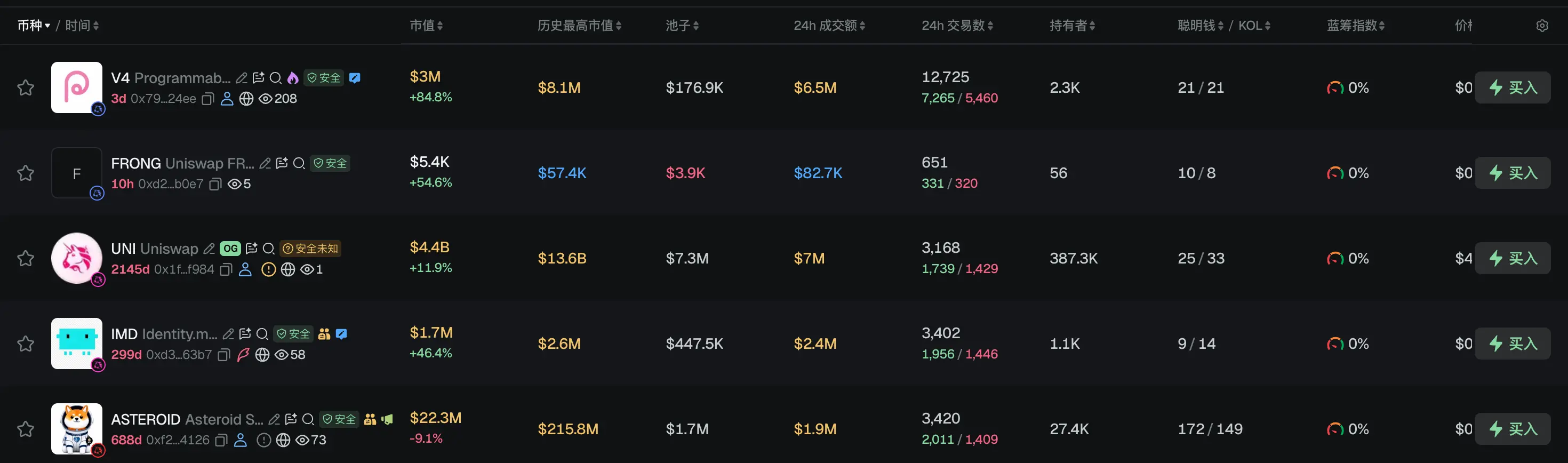
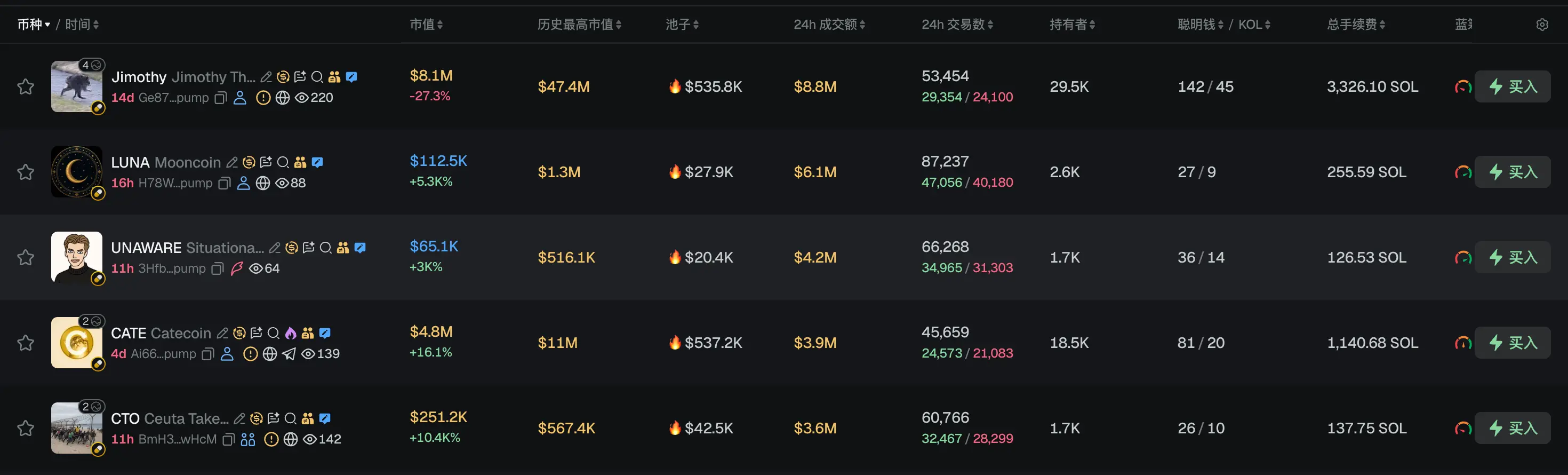
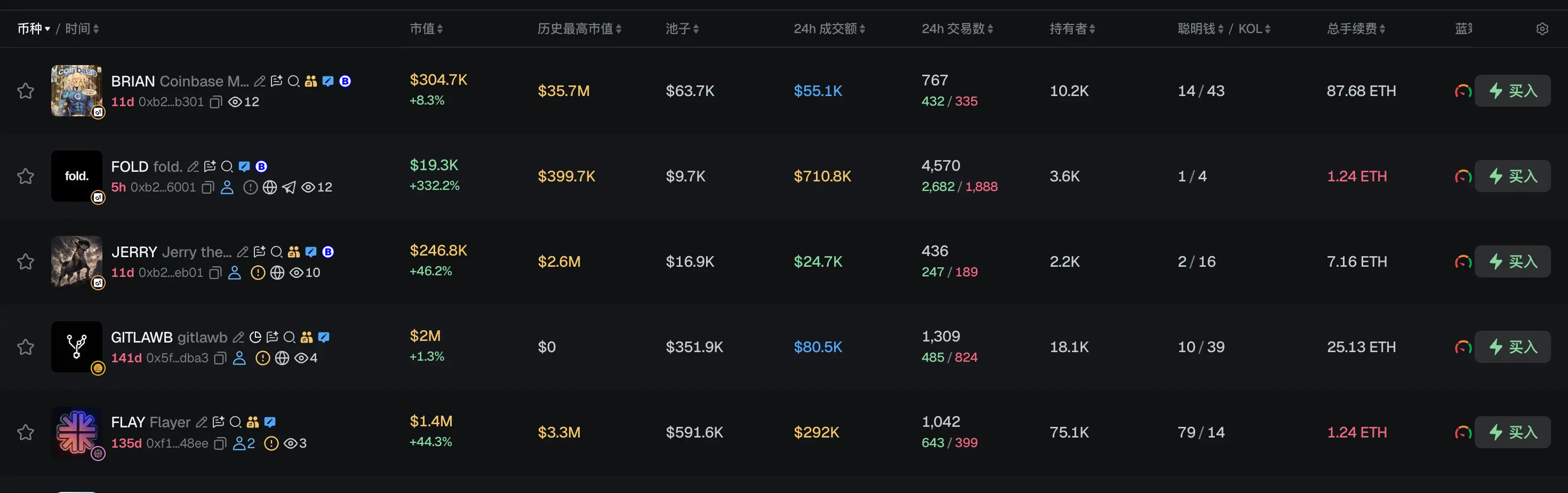
According to the meme token tracking and analysis platform GMGN, as of July 31, 08:49,
The top five popular tokens in ETH over the past 24 hours are: V4, UNI, IMD, ASTEROID, Ferret
The top five popular tokens in Solana over the past 24 hours are: Jimothy, LUNA, UNAWARE, CATE, CTO
The top five popular tokens in Base over the past 24 hours are: ELSA, BRIAN, FOLD, SOL, O
What interesting articles are worth reading in the past 24 hours?
Welcome to the new crypto circle: only this time, the place to lose money is the stock market
Traditional stock markets leverage through margin trading, while crypto-like stock markets leverage through ETFs, derivatives, and quantitative strategies; traditional stock market information comes from research reports and financial statements, while crypto-like stock market information comes from Twitter, YouTubers, and communities; traditional stock markets are rationally priced by institutions, while crypto-like stock markets are retail-oriented, with quantitative strategies chasing trends… Even more absurdly, Bitcoin is now trying to become like stocks, being gradually accepted by mainstream finance through ETFs, institutionalization, and reduced volatility. This is an absurd intersection. Those who transitioned from the crypto circle to the stock market ultimately find that they have not left their "original family"; it is a mechanism that keeps repeating: grand stories, crowded positions, easily obtained leverage, and everyone believes they can exit before others. The words written by retail investors on trading forums in South Korea are worth remembering: I want to return to the days before trading stocks and get my money back.
To the viewers and readers at home, I can assure you that the Fed is paying attention to this matter. This Fed Chairman feels better about the board and committee's ability to achieve goals than I did on my first day in office. And I was quite confident when I came in. I am encouraged by the welcome I have received. Undoubtedly, in some of your comments today, you will talk about a divided Fed. Well, that is not what I have felt in the past few days. What I feel is a group of professionals, each with different perspectives, opinions, and judgments, but eager to roll up their sleeves for family debates, eager to reform the way the Fed formulates policies, filled with enthusiasm, open-mindedness, and curiosity. So we have… a better chance of achieving the mission entrusted to us by Congress. So I want to leave you with the optimism of a new central bank president, that we are as committed as ever to achieving our goals and assure you that we will do so. Thank you all very much.
Relying on our comprehensive capabilities in semiconductors, software, AI, and manufacturing, we are also committed to building differentiated computational competitiveness in the robotics field and developing it into a future growth engine. Thank you. Answer - Daniel Oh: Thank you for the above answers and for everyone's questions. This quarter's conference call is now concluded. I wish you and those around you good health and safety. Thank you sincerely for your participation today and for your continued support of Samsung Electronics. Have a great day, thank you.
No token issuance, only toll fees: Visa's stablecoin strategy is tougher than that of issuers
Those who do not pick winners are betting on the channel itself. Is Visa's entry into OpenUSD a threat to Circle and Tether? Not in the short term. An alliance without exclusive commitments, where members are still denying their involvement, poses relatively low threats; on the other hand, from Visa's perspective, the cost of this signature is extremely low, trading it for a position and voice in the stablecoin narrative without having to take responsibility for any successes or failures—this is an option, not a bet. If we extend the timeline, the real variable is when Visa will start directing its merchant network and issuing bank relationships towards a specific stablecoin. Until then, no matter how fierce the competition at the issuance level is, Visa plays the role of an observer, so for VISA, whether or not to pick winners is not important; what matters is that the winners ultimately have to source from me, thus controlling the channel itself.
At this point, the biggest regret for family is that crypto experts stumbled in the stock market
Self-proclaimed as having lost $20 million in the semiconductor crash, Zishi (@silverfang888) also expressed that the biggest regret is moving from the crypto circle to stock trading. In his view, he is just a short-sighted crypto player who entered the U.S. stock market, facing opponents with far superior knowledge and capital. Many people fell into intense self-denial after their liquidation, attributing their losses over the past few months to their lack of insight and low understanding. This emotional outburst also serves as a reminder to everyone who treats leverage as an amplifier that the market takes away not just the principal. Others have come out to comfort, saying that who hasn't experienced such pullbacks in their trading careers? Losing money is just paying tuition; as long as one is still here and has the spirit, there will always be the next journey. In fact, those who can continue to win in the market are few. Those who can go further are often those who can still see their boundaries at different stages.
Meta's AI ledger: Why $60.8 billion in revenue can't support stock prices?
But more fundamentally, he has never provided a timeline on "when AI investments will start to converge." At the point where free cash flow is about to turn negative, the market's valuation premium for long-term vision is fading, and patience is a luxury. Meta is telling the boldest transformation story in the history of a giant tech company: transforming from a light-asset advertising platform to a heavy-asset AI infrastructure operator and intelligent service provider. With revenue of $60.8 billion and daily active users of 3.6 billion, this story has top-notch fundamental support. However, the $31.08 billion in quarterly capital expenditures and the resulting 91% collapse in free cash flow also tell the market one thing: this transformation cost is more than everyone expected, and the bill is only on the second page.
Castle Labs: Six major protocols earned $7.4 billion this year, why are token prices still falling?
Becoming a business that can continuously generate revenue is the first step for protocols. The next step is to establish a clear, credible, and verifiable value return mechanism, allowing protocol growth to truly translate into benefits for token holders. Hyperliquid demonstrates what effects can arise when this alignment of interests is written into token design from the start. It returns most of its revenue to holders, and protocols like Aerodrome and Uniswap are also trying to establish more direct value distribution mechanisms. Protocols are increasingly aware that a good token must have a good value distribution mechanism. As investors become more focused on real revenue and value capture, the long-standing disconnect between protocols and tokens may gradually narrow. But ultimately, the winners will not just be the most profitable protocols, but those that can both generate profits and effectively retain value for token holders.
Conclusion: Returning fund custody to its essence. The painful case of Poolin, which went bankrupt with $163 million in debt after four years, warns the industry again: managing user assets in the same way as corporate debt is essentially a gamble destined to explode. For institutional investors, Web3 project parties, and high-net-worth individuals, the bottom line for asset safety should not be built on "blind trust" in any single platform or founder, but must be constructed on a solid fortress of legal constraints, trust isolation, and technical defenses. Do not treat platform wallets as asset safe havens. Choosing compliant custody is not only choosing an institutional-level on-chain financial system with cold-hot isolation and multi-level risk control but also choosing a contract strongly protected by modern trust laws. Let custody return to its purest essence—your assets always and only belong to you.
 Risk warning



Popular articles