SuperEx Report: Private Wealth Management Monthly Report

 SuperEx Report: July 2026 Private Wealth Management Monthly Report
July Market Summary
In July 2026, the crypto asset market gradually recovered from the deep risk-averse sentiment in June, but the rebound was not uniform. At the beginning of July, BTC was around $60,003.76, and in mid to late July, it briefly broke through $65,000, reaching $66,505.12 in the historical snapshot on July 21 from CoinMarketCap; however, it fell back to $62,813.75 by the end of the month due to profit-taking, fluctuations in ETF fund flows, macro interest rate uncertainties, and geopolitical risks. According to CMC's snapshots at the beginning and end of the month, BTC rose about 4.68% for the entire month, but retreated about 5.55% from its intra-month high to the end of the month.
ETH performed better than BTC. The CMC snapshot price on July 1 was $1,608.96, and on July 31 it was $1,860.35, marking an increase of about 15.62% for the month. This indicates that July was not merely a standalone rebound for BTC, but rather a structural recovery in the market after an oversold condition, with some mainstream assets like ETH, BNB, and TRX outperforming, while high-volatility assets like SOL remained under pressure.
For private wealth clients, the core insight for July is that market risk appetite has somewhat recovered, but a stable unilateral upward trend has not yet formed. BTC has proven that there is phase support around $60,000, but the $65,000-$66,500 range remains a key confirmation area. In terms of asset allocation, liquidity management, gradual position building, and reducing leverage should continue to be emphasized, while idle funds should be managed separately from directional positions.
Market Review
The July market can be divided into three phases.
The first phase is the early-month recovery: After the decline in June, BTC found buying support around $60,000. On July 1, the CMC snapshot price for BTC was $60,003.76, and for ETH it was $1,608.96, with the market still in a cautious state. The market cap of USDT was about $18.4471 billion, and USDC was about $7.3180 billion, indicating that stablecoins remain the core tool for capital parking.
The second phase is the mid-month breakout: As ETF fund flows marginally improved from the outflow state in June, BTC rebounded above $65,000. Reports from CoinDesk indicated that BTC reached an intra-month high of about $65,500 around July 16; the CMC historical snapshot on July 21 further showed BTC reaching $66,505.12, with ETH at $1,928.38 on the same day. This phase indicates that the market was not in a weak sideways trend, but rather experienced a clear rebound in risk appetite.
The third phase is the end-of-month pullback: From July 23 to 24, BTC ETFs saw consecutive net outflows, causing BTC to fall back from above $66,000, with the CMC snapshot on July 24 dropping to $64,098.50. By July 31, BTC further retreated to $62,813.75. In other words, the accurate description of BTC in July should be "failed to hold above $65,000 after breaking through," rather than "did not break through $65,000."
The performance of major assets is as follows, calculated based on CMC snapshots from July 1 and July 31:
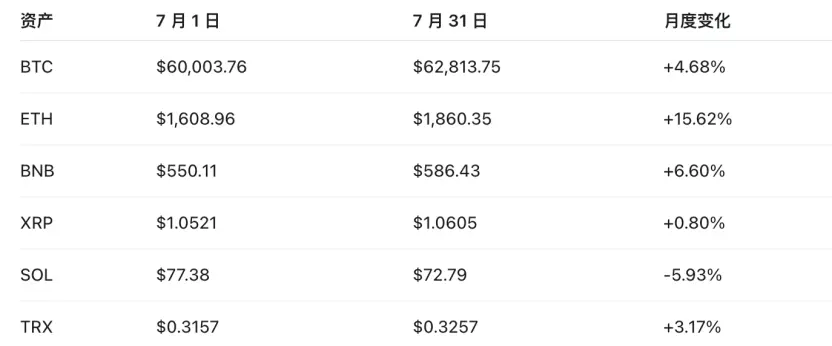
Overall, the July market was not a comprehensive bull market, but rather a "mainstream asset recovery + high-volatility asset differentiation." The relative strength of ETH reflects that some funds have been reallocated to high-liquidity mainstream assets; the decline of SOL indicates that the market remains cautious about high-beta assets.
Institutional Funds and ETF Trends
In July, BTC ETF fund flows significantly improved compared to June, but volatility remained high.
According to TFTC data, the U.S. spot BTC ETF recorded a net inflow of about $172.4 million in July, over 22 trading days, with 13 days of net inflow and 9 days of net outflow; the largest single-day outflow occurred on July 13, at about -$424.7 million. On July 20, 21, and 22, net inflows of $226.9 million, $203.1 million, and $69 million were recorded, respectively, contributing to BTC's breakthrough above $65,000; however, outflows on July 23, 24, and 31 weakened the continuity of the breakout.
ETH ETF fund flows were more stable. According to daily total data published by Farside Investors, the net inflow for the U.S. spot ETH ETF in July was about $347.4 million. Combined with ETH's approximately 15.62% increase for the month, it can be seen that ETH's performance in July was supported not only by price recovery from oversold conditions but also by institutional fund reallocation.
This indicates that institutional attitudes towards digital assets have not shifted to a complete retreat, but rather have become more price-sensitive and rhythmic: when BTC is at a low or the risk-reward ratio improves, ETF funds will flow back in; but when prices approach key resistance zones, profit-taking and cautious funds will quickly increase.
Macroeconomic and Policy Environment
The macro environment in July remained complex. The Federal Reserve kept the federal funds rate unchanged in the 3.50%-3.75% range during the July meeting, but this was a meeting with clear divisions. Both Kiplinger and Barron's reported that three FOMC members supported a 25 basis point rate hike, reflecting that inflation, energy prices, and geopolitical risks continue to exert pressure on policy.
For the crypto market, this means that the liquidity environment has not clearly turned accommodative. The rebound in July was more of a phase recovery for risk assets after consecutive declines, rather than a trend increase confirmed after a loosening cycle. If subsequent inflation data rises again, or the market re-prices the probability of a rate hike in September, BTC and ETH may still face valuation pressure.
Therefore, private wealth allocation should not only look at price rebounds but also observe three lines: whether ETFs continue to see net inflows, whether BTC can stabilize above the $65,000-$66,500 range, and whether U.S. Treasury yields and dollar liquidity ease.
Stablecoins and Fund Structure
Stablecoin data did not show large-scale new fund inflows. CMC snapshots indicate that the market cap of USDT fell from about $18.4471 billion on July 1 to about $18.3271 billion on July 31, a decrease of about 0.65%; the market cap of USDC fell from about $7.3180 billion to about $7.1942 billion, a decrease of about 1.69%. In terms of the combined total of USDT and USDC, the market cap of leading stablecoins slightly contracted.
This contrasts with market price performance: BTC and ETH rebounded, but the supply of stablecoins did not expand simultaneously, indicating that July was more about the reallocation of existing funds rather than a large influx of external new funds. For wealth management, this means that positions should remain flexible and not interpret a phase rebound as a full return of liquidity.
SuperEx Secondary Market and Product Observation
According to publicly scraped data from the CoinMarketCap SuperEx exchange page, as of August 4, 2026, SuperEx's 24-hour spot trading volume was approximately $1.03 billion, equivalent to about 16,202 BTC.
On the financial product side, publicly available information from SuperEx's financial sector shows that SuperEx's wealth management covers both current and fixed-term products:
The publicly disclosed annualized range for fixed-term products is 3%-10%, including:
7-day fixed-term product with an annualized rate of 3%
60-day product at 4.1% or 4.5%
180-day product at 6%
365-day product at 6.5% or 10%
Currently, SuperEx's wealth management sector is being upgraded, and users can still view assets, subscribe to financial products, and manage income details within the SuperEx APP, continuing to enjoy interest-earning services.
Public information on SuperEx's quantitative fund shows:
The estimated annualized reference value for Daily Earnings is 10.83%
The estimated annualized reference value for Quarterly Earnings is 17.11%
These products are suitable as yield enhancement tools for idle USDT, but should not be simply equated with directional assets like BTC and ETH; their core value lies in reducing portfolio volatility and improving capital utilization efficiency.
SuperEx Private Wealth Perspective
We maintain a "cautious but not pessimistic" judgment for August.
BTC has proven strong support around $60,000 in July, but more stable fund flow confirmation is still needed above $65,000-$66,500. If BTC can regain and maintain above $66,500, the market is more likely to further challenge the $68,000 level or even higher; if it falls below $62,000-$60,000 again, it indicates that the July rebound was more of a technical recovery.
The relative strength of ETH is worth noting. If ETH ETFs continue to see net inflows, ETH/BTC may undergo phase recovery, driving the performance of some L2, staking, RWA, and stablecoin infrastructure-related assets. However, before a clear shift in macro interest rates, high-beta altcoins should maintain low positions and high selection standards.
Stablecoins, RWA, compliant payments, on-chain settlements, and institutional custody remain the medium to long-term main lines. Compared to chasing short-term hotspots, private wealth clients are more suited to establish a combination structure of "core assets + yield assets + opportunity assets": BTC and ETH as core liquidity assets, USDT wealth management and quantitative strategies as yield enhancement, and a small amount of high-certainty thematic assets as offensive allocations.
August Allocation Suggestions
BTC Observation Range: Focus on whether it can stabilize above $65,000-$66,500; watch for support at $62,000 and $60,000 below.
ETH can moderately increase its focus weight, especially regarding ETF fund net inflows and continuous net inflow situations.
Maintain stablecoin reserves, considering the uncertainties of the Federal Reserve's September policy.
July BTC has shown "pullback after breakthrough," indicating that volatility near key pressure points can easily amplify, so contract positions need to be cautious.
Idle funds can consider SuperEx Earn or quantitative products for yield enhancement, but the functional boundaries between "stable yield tools" and "directional trading positions" should be distinguished.
Altcoins should be selectively chosen. Prioritize projects with good liquidity, clear narratives, and verifiable actual income or user growth, avoiding chasing low liquidity targets after rebounds.
Risk Warning
This report is for market research and informational reference only and does not constitute any investment advice, financial advice, or trading invitation. The prices of digital assets are highly volatile, and investors may face principal losses. The historical or estimated returns of wealth management, quantitative, and other yield products do not represent future performance; specific returns, subscriptions, redemptions, and risk rules are subject to the real-time pages and product terms of the SuperEx platform.
About SuperEx
As the world's first Web3-based cryptocurrency exchange, SuperEx is committed to building the Web3 ecosystem. Over the years, SuperEx has launched a series of comprehensive products and services, including SuperEx DAO, SuperEx Web3 Wallet, Super Start, SuperEx P2P, SuperEx Stock Markets, SuperEx Copy Trading, SuperEx Earn, and SuperEx DAO Academy, creating a comprehensive ecosystem covering major core areas of Web3.
Currently, SuperEx has served over 10 million users and has more than 600,000 social media community users across 166 countries and regions. The platform supports spot and contract trading for over 1,000 cryptocurrencies. Through seamless integration with Super Wallet, SuperEx combines the trading efficiency of centralized exchanges (CEX) with the security of decentralized exchanges (DEX) while providing decentralized asset custody.

 Risk warning