A relatively objective analysis of Coinbase
 Core Viewpoint

 From my perspective, the essence of Coinbase's problem is the issue of opportunity cost.
Author: Zhao Haibei
Introduction
1/ Regardless of the decline in market share, bloated management, and poor product strength, we can easily conclude that Coinbase is not a good company. The price divergence of Robinhood relative to Coinbase over the past few months can further reinforce this perception. However, the information above has more or less already reflected in Coinbase's current price. No matter how good a company is, we cannot obtain excess returns from "good" itself, because the reasons for its goodness do not belong to me. The process of buying a company and paying the price smooths out the excess returns at the corporate level, and the same applies to poor companies.
2/ Crypto is in a bear market cycle lasting four years. Looking back in 1-2 years, Coinbase is likely to be priced higher than it is now. Discussing whether to buy Coinbase is of little value. From my perspective, the essence of Coinbase's problem is the issue of opportunity cost (relative to other Crypto assets like BTC). In the following sections, I will try to reason as objectively as possible.
Basic Facts
1/ After Coinbase's Q2 financial report, the binary risk of renewing the contract with Circle has been lifted. If no modifications are negotiated, the contract will automatically renew for three years.
2/ In Coinbase's revenue composition, non-trading business can be broken down into: stablecoins + other businesses. Other businesses include: blockchain staking + subscriptions + holding Crypto income + interest income. In fact, this part of the income is highly correlated with the cycles of Crypto itself, and cannot simply be understood as non-cyclical income. I would categorize it as trading-related businesses.
An Arithmetic Problem
Coinbase's Q2 stablecoin revenue was $292 million, with the company's own USDC balance contributing $28 million. The total USDC economic revenue for Q2 was approximately $320 million. During the same period, trading revenue was $599 million, and total revenue was $1.22 billion.
The average market value of USDC in Q2 was approximately $77 billion, with Coinbase's product accounting for 26%; Circle's platform had a daily average share of 19.5%. According to the agreement, over the past year, Coinbase has roughly captured about 50% of the overall economic benefits of USDC.
Considering that Circle's revenue from stablecoin issuance also includes long-term options like Arc and CPN, but similarly, Coinbase's role as a channel partner has a stronger proportion and voice. We can roughly estimate that the two can offset each other, calculating at a 1:1 ratio. Thus, of Coinbase's $38.5 billion market value, about $15 billion corresponds to the stablecoin business, while the remaining $23.5 billion corresponds to trading, staking, subscriptions, lending, and other non-USDC businesses.
Based on Q2 annualized figures, Coinbase's stablecoin business is approximately 11.7x gross revenue, and after deducting about $11.9 million in USDC rewards, it is about 18.7x; non-USDC business is about 6.5x revenue (TTM revenue valuation for non-USDC business is about 5x PS).
Thus, the question converges to: is the non-stablecoin business at 6.5x PS worth it (compared to BTC)? As a comparison, our opportunity cost can be directly buying Circle (longing stablecoin income) + BTC (longing Crypto market trading-related income).
First, let's cite a typical voice: historically, Coinbase has not outperformed BTC for several years, so I might as well just buy BTC.
This logic has two flaws:
1/ Just because it hasn't outperformed in the past doesn't mean it won't in the future. Using historical prices to infer future prices is no different from technical analysis, which dulls sensitivity to marginal changes.
2/ Just because it hasn't outperformed in the past doesn't mean there aren't phase-specific excess returns. There are plenty of companies that haven't outperformed BTC historically, but that doesn't mean these companies lack trading opportunities.
We can first review the historical performance of Coinbase relative to BTC:
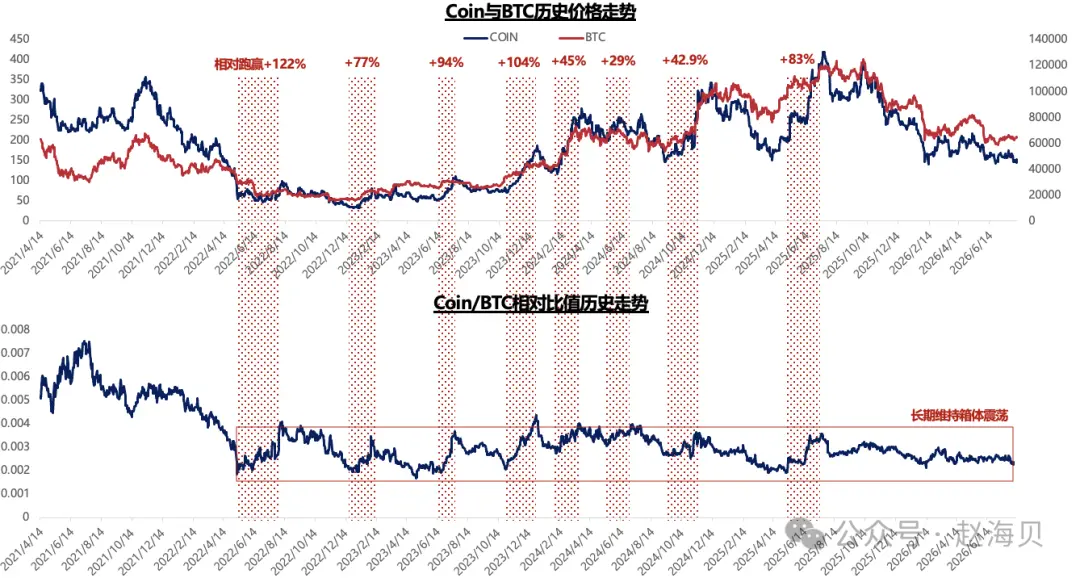
Excluding the short-term overvaluation after going public, Coinbase has historically outperformed BTC in excess returns on eight occasions.
First Outperformance: 2022/5-2022/8 (+122%)
On May 11, market panic over bankruptcy risks further amplified after performance disclosures, with COIN falling about 21.6% relative to BTC on that day. In June, an 18% layoff reduced fixed costs, and BlackRock chose Coinbase Prime, alleviating bankruptcy risks—a typical turnaround logic.
Second Outperformance: 2022/12--2023/2 (+77.1%)
The FTX crisis brought COIN into bankruptcy trading, bottoming out at the end of December; in January, 950 layoffs and a 25% reduction in quarterly expenses led to an 11.4% increase in COIN relative to BTC on that day. In February, a collective lawsuit against securities was dismissed, resulting in a 25.2% single-day relative increase, alleviating legal risks.
Third Outperformance: 2023/6--2023/7 (+94.2%)
On June 6, the SEC sued Coinbase, causing COIN to drop 16.9% relative to BTC on that day. Subsequently, BlackRock and others chose Coinbase for custody and monitoring in their spot ETF applications. In July, Ripple's victory led to a 20.3% single-day increase in COIN relative to BTC, opening market imagination with regulatory easing.
Fourth Outperformance: 2023/10--2023/12 (+104.2%)
The probability of spot BTC ETF approval rose rapidly, with Coinbase benefiting directly from its roles in custody, Prime, and monitoring. At the same time, Binance's plea and hefty settlement strengthened Coinbase's listing and compliance premium in the U.S., forming a double boost from ETF expectations and improved competitive landscape.
Fifth Outperformance: 2024/2--2024/3 (+45.9%)
After the approval of the spot BTC ETF, the market initially worried that the ETF would siphon off Coinbase's high-rate retail trading. In February, the company announced its first quarterly profit since 2021, with trading revenue rebounding and expenses declining. The day after COIN's earnings report, it rose 8.3% relative to BTC, shifting market logic from "ETF replacing exchanges" to "ETF expanding crypto asset scale, volume, and institutional income."
Sixth Outperformance: 2024/5--2024/7 (+29.3%)
FIT21 passed through the House, and the spot ETH ETF advanced, coupled with Stripe's integration with Base and USDC, and the U.S. Marshals choosing Coinbase Prime, continuously reinforcing its compliance infrastructure positioning. However, during this phase, COIN only rose 12.3%, while BTC fell 13.2%, reflecting regulatory trends.
Seventh Outperformance: 2024/10--2024/11 (+42.9%)
On October 31, the earnings report fell short of expectations, causing COIN to drop 12.7% relative to BTC and form a low point. On November 6, after Trump's election victory, COIN rose 31.1%, and BTC rose about 9%, with a single-day relative increase of 20.3%. The market concentrated on pricing the SEC's enforcement shift, advancing crypto legislation, and easing restrictions on staking and token listings, reflecting regulatory trends.
Eighth Outperformance: 2025/5--2025/7 (+83.8%)
After the May earnings report, expectations of slowing trading revenue formed a low point. Subsequently, Coinbase was included in the S&P 500, with a 22.5% increase relative to BTC the day after the announcement. In June, the passage of the GENIUS Act in the Senate brought another 16.1% single-day relative increase, reflecting regulatory trends. Coupled with Circle's explosive listing, pricing rose simultaneously.
Interestingly, the common perception of coin stocks is that they are leveraged BTC. However, backtesting shows this is not the case. During bear markets, COIN has often outperformed BTC in phases (3/8), while in bull markets, it has frequently underperformed BTC. In the logic above, we can easily see that Coinbase's excess returns are more derived from phase-specific regulatory trends (6 out of 8 times, the main driver was regulatory events).
In the long term, the relative price of Coinbase and BTC generally maintains a box oscillation. Considering the market's expectations for Clarity falling short, Coinbase at the bottom of the box is not a bad target for ambushing regulatory events.
But What Structural Changes Are There?
A respected teacher of mine once said: The essence of Crypto is to attract retail investors for PVP games through PVE narratives.
I believe the PVE narrative is also a cause, fundamentally driven by the overflow of funds, meaning that capital leads and narratives follow.
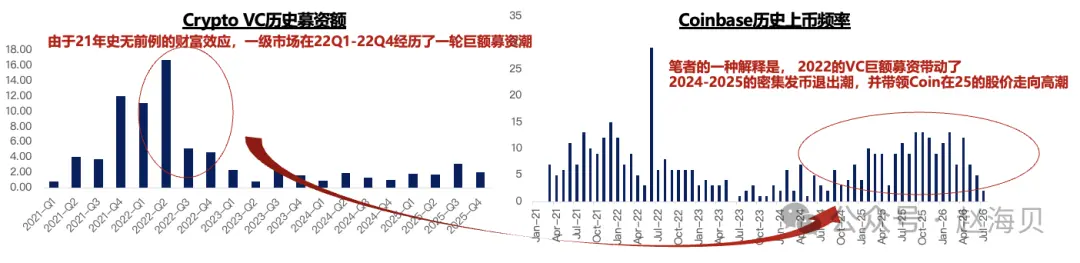
As shown in the figure, under the unprecedented wealth effect driven by 2021, the primary market of Crypto experienced a massive fundraising wave from Q1 to Q4 of 2022, directly reflecting in the concentrated wave of token exits in 2024-2025, leading to a peak in trading-related revenue for COIN in 2024-2025.
This also means that if we speculate, the fundraising amount in 2024-2025 may not be sufficient to support the next round of Shitcoin Summer, directly impacting Coinbase's main revenue in the next round.
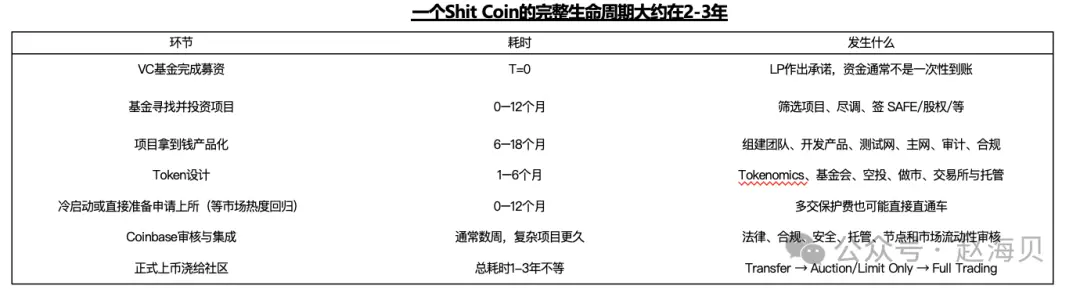
What Other Structural Changes Are There?
If we look at the trend of Coinbase's non-stablecoin revenue, we will find a significant decoupling from BTC's price in Q1-Q3 of 2025:
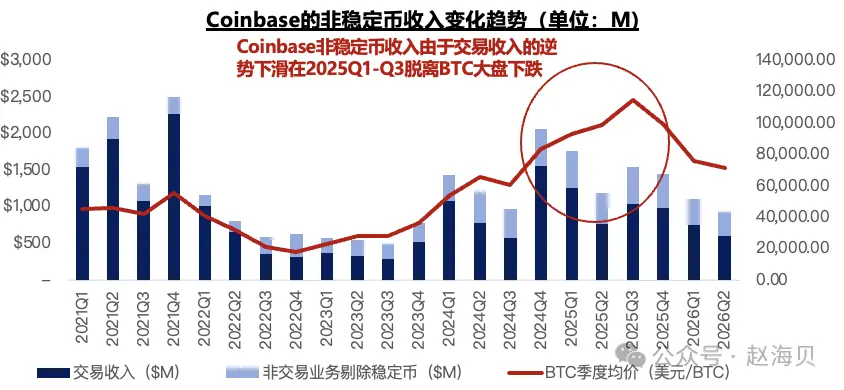
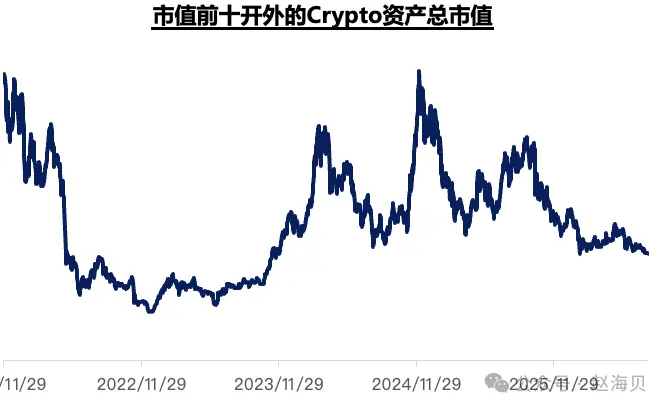
The reason is that altcoins, retail turnover, and insufficient volatility have led to Coinbase's revenue elasticity being weaker than BTC's. If we look at the total market capitalization of Crypto assets outside the top ten (the altcoin market), we find that it is strongly correlated with Coinbase's non-stablecoin revenue:
So why are major coins like BTC/ETH not as correlated? The core reason is that regulatory clarity has reduced the scarcity of compliant trading channels. Coinbase's high-rate retail spot profits, which it previously obtained through licenses, fiat entry, and security, are gradually being siphoned off by institutional trading like ETFs.
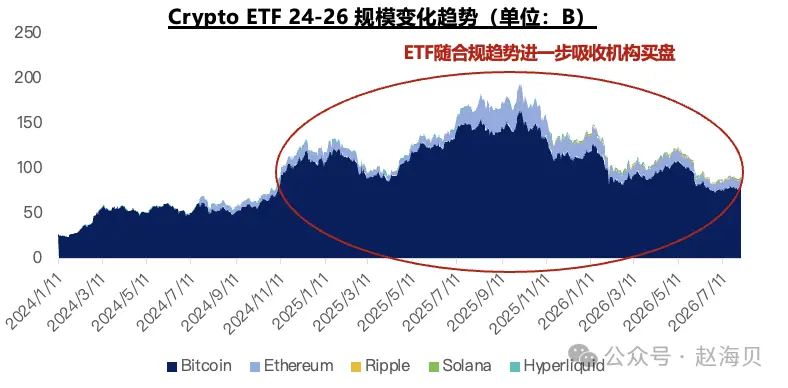
Similarly, under the differentiation of competitors like Robinhood, Coinbase's trading take rate also shows a clear downward trend:
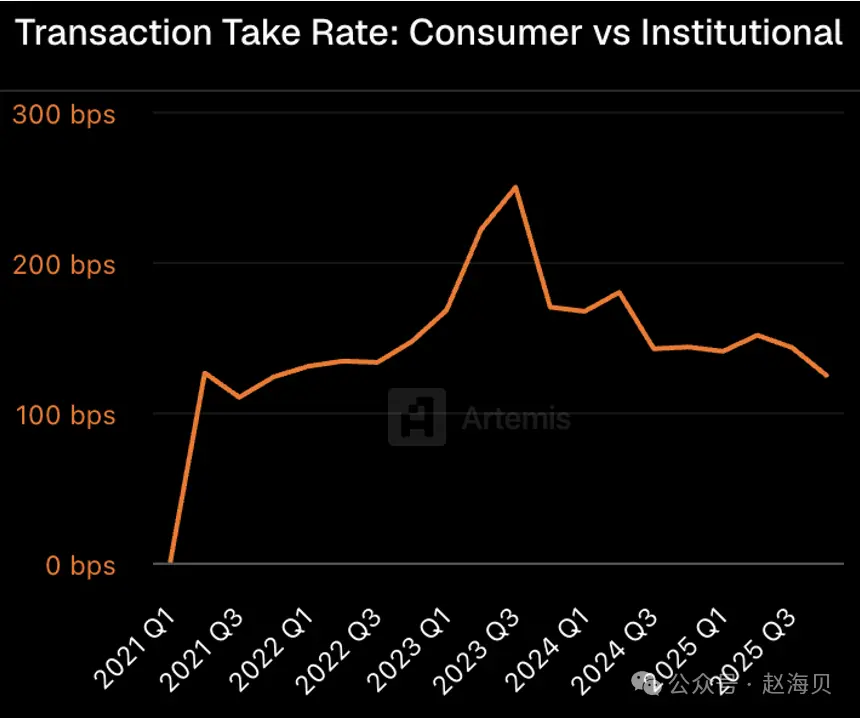
In the above, we discussed two structural issues related to trading-related revenue: 1/ The end of the altcoin summer leads to a narrowing of market space for the next bull market, and 2/ Increased competition leads to a decline in Coinbase's market share. Under this logic, I believe we can at least conclude that Coinbase does not have long-term holding (over four years) value.
Strategy
1/ Clarity is currently priced by the Street as unlikely to pass within the year. If you have a differentiated understanding of Clarity and other compliance events, Coinbase at this price level (lower non-trading income PS) can be a relatively safe tool for expressing your views. Compared to Circle, Coinbase is less sensitive to channel sharing and interest rates. If Clarity passes, both are likely to see significant short-term increases (you can refer to the recent price movements after Clarity's hints, but I won't elaborate due to space constraints).
2/ Compared to the Circle + BTC = 1:1 allocation combination, Coinbase can be understood as a tool for longing altcoin turnover in a bull market. However, in the long term, the altcoin market is likely to underperform BTC (fundraising cannot keep up), and Coinbase's share in this is a given fact. It is inferred that Coinbase will likely underperform the Circle + BTC 1:1 combination in the long run.
3/ Although the ratio of Coin/BTC has long been in a box oscillation, running flat does not mean one should hold Coin. Coin bears a higher volatility on a unit return basis, and the risk-reward ratio essentially leads to a long-term underperformance compared to BTC.

 Risk warning