Token issuance platforms earn tens of millions monthly, trading tools make daily profits: The "water seller" business in the Meme industry chain
 Core Viewpoint

 The meme market is cooling down, but platforms are still making huge profits: Pump.fun earns 34.68 million dollars a month, GMGN nearly 20 million, Axiom over 14 million—token issuance platforms and trading tools are dividing every transaction of "P Little General."
Author | Odaily Planet Daily Asher
Since the beginning of this year, the overall performance of the crypto market has been sluggish, with altcoins experiencing significant declines. The previously active secondary Alpha community and airdrop community have seen a noticeable drop in discussion enthusiasm, but Meme is one of the few exceptions.
Compared to the previous bull market, this year has seen few instances of a Meme token quickly surpassing a market cap of $50 million or even $100 million shortly after its launch, and the myth of getting rich quickly has gradually become a foreign concept. However, the Meme market still occasionally sees new hotspots. From CASHCAT, which became popular on the Robinhood Chain, to the recent stock Meme coin MarsCoin on the BNB Chain, they continue to attract considerable community attention.
The hotspots remain, and platforms and wallets for creating and trading Memes are naturally still in use. So, as the opportunities for "P Little Generals" to get rich through Memes become increasingly scarce, how much can these platforms still earn by relying on users to continuously issue tokens and trade?
Odaily Planet Daily will analyze the revenue sources of the main platforms in the Meme track from two dimensions: token issuance platforms and Meme trading tools, as well as the revenue situation over the past 30 days. (The data below is sourced from DefiLlama.)
Pump.fun, catering to the first round of trading demand for new coins
Pump.fun: Revenue over the past 30 days exceeds $34 million
Although the Meme market is far from the bull market, Pump.fun can still earn over $30 million a month, with its profitability even surpassing Hyperliqud. As of August 11, Pump.fun's revenue for the past 30 days was $34.68 million. During the same period, the platform's trading volume was $1.718 billion.
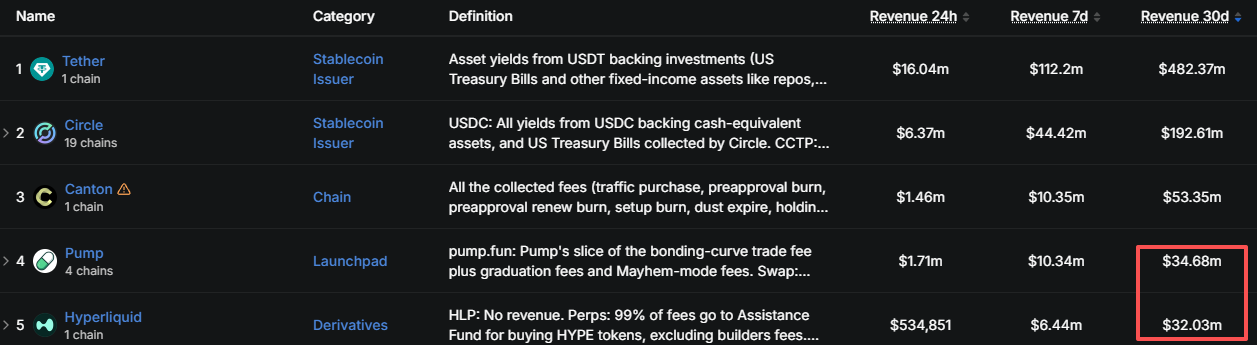
The core of Pump.fun's revenue comes from the continuous trading of new coins on the platform. Currently, creating tokens is free for users, but buying and selling during the Bonding Curve phase requires a transaction fee. According to Pump.fun's latest fee structure, the total fee rate for each transaction on the Bonding Curve is 1.25%, of which 0.95% goes to the protocol and 0.30% is allocated to the token creators. Additionally, when tokens graduate from Pump.fun to PumpSwap, a graduation fee of 0.015 SOL is charged.
Flap: Revenue over the past 30 days exceeds $5.58 million, with 90% from BNB Chain
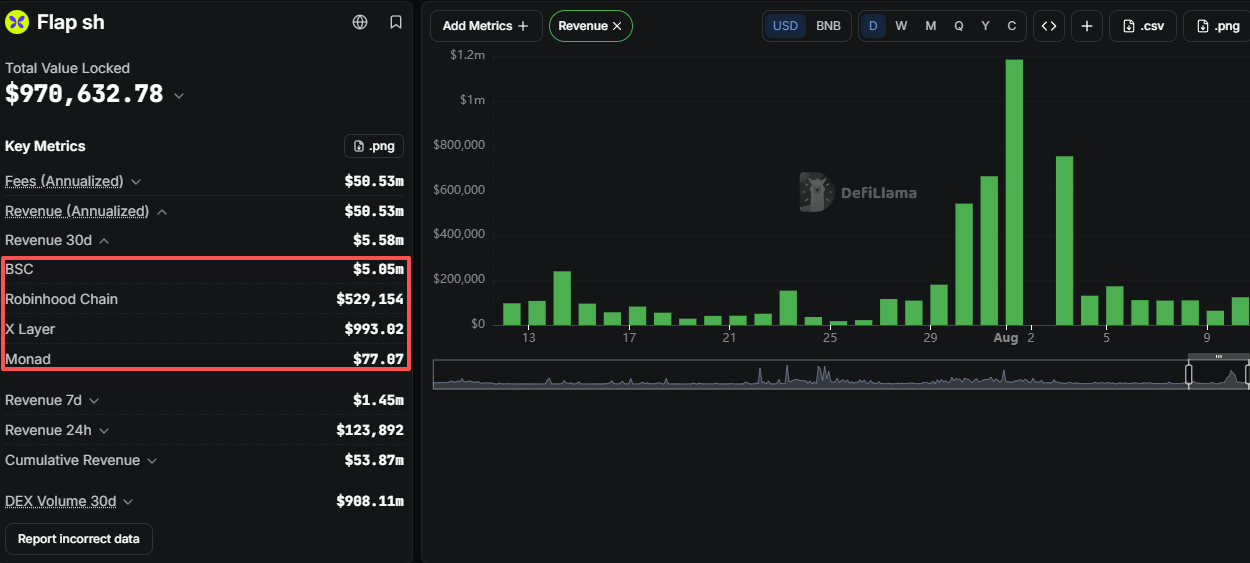
The recent stock Meme craze on the BNB Chain has also allowed Flap to benefit from a wave of bonuses. As of August 11, Flap's revenue for the past 30 days was $5.58 million, of which $5.05 million came from BNB Chain, accounting for over 90%; Robinhood Chain contributed $529,000. During the same period, the platform's trading volume was $908 million.
Similar to Pump.fun, Flap also uses the Bonding Curve mechanism, where newly issued tokens migrate to DEX after completing the curve phase. The difference is that Flap supports the issuance of Tax Tokens in addition to regular tokens, allowing creators to set transaction tax rates for the tokens. The recently popular stock Meme coin MarsCoin was issued as a Tax Token through Flap (Note: The revenue statistics from DefiLlama only include the protocol fee portion and do not account for the transaction tax set by the Tax Token itself).
In terms of revenue, Flap's most direct source of income still comes from the transaction fees generated during the Bonding Curve phase for new coins. Currently, the base protocol fee rate on BNB Chain, Robinhood Chain, X Layer, and Monad is 1%, and the platform collects fees from users for each buy and sell transaction on the Bonding Curve.
Pons: Revenue over the past 30 days nearly $5 million, once the leading token issuance platform on Robinhood Chain
After the Meme popularity surged on the Robinhood Chain, Pons quickly became one of the main Meme issuance platforms in the ecosystem. On July 15, Pons issued over 15,000 tokens in a single day, ranking first among token issuance platforms on Robinhood Chain for the first time, and maintained its lead for about half a month until it was recently surpassed by Pool.trade and Flap (in the chart below, green represents Pons; pink represents Pool.trade, and purple represents Flap).
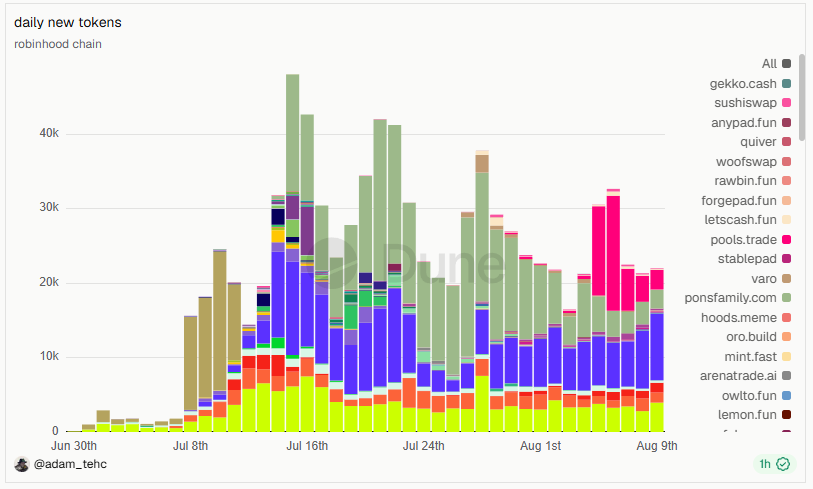
The rapid growth in token issuance directly translated into platform revenue. As of August 11, Pons generated $18.76 million in fees over the past 30 days, of which approximately $4.99 million belonged to the protocol. Based on its V1 phase transaction fee of 1%, the platform's total trading volume is roughly estimated to be around $1.8 billion.
Pons is the native token issuance platform on the Robinhood Chain, allowing users to directly create and trade Meme coins. The platform has recently launched V2, where new coins first complete early trading through the Bonding Curve, and after meeting graduation conditions, they enter Uniswap V4, with subsequent transaction fees still distributed according to the rules set by Pons.
Pons' revenue mainly comes from two aspects: token issuance and trading. In V1, each token creation requires a payment of 0.0005 ETH, and the platform charges a 1% fee for token issuance transactions, with approximately 70% allocated to the token creators and about 30% retained by the protocol. After the launch of V2, revenue sources further cover issuance fees, trading fees during the Bonding Curve phase, and trading fees generated after tokens graduate to Uniswap V4 (also following the distribution ratio of approximately 70% for creators and about 30% for the protocol).
It is worth mentioning that Pons will use a portion of the protocol revenue for PONS buybacks and burns. According to official documentation, it is currently planned that 80% of the protocol transaction fees will be used for buybacks and burns of PONS, with the remaining 20% allocated for infrastructure and team operations.
GMGN, earning "P Little Generals" transaction fees with efficient trading tools
GMGN: Revenue over the past 30 days nearly $20 million, mainly from Robinhood Chain
Compared to token issuance platforms, GMGN does not participate in token creation but provides market data, monitoring, and order tools around Meme trading, earning revenue from user transactions.
As of August 11, GMGN's trading volume over the past 30 days was $2.584 billion, generating $23.87 million in fees, and after deducting referral rebates, the final revenue attributed to GMGN was approximately $19.81 million. Among this, Robinhood Chain contributed $11.67 million in revenue, while BNB Chain and Solana contributed $4.93 million and $2.41 million, respectively, with Robinhood Chain becoming GMGN's largest revenue source.
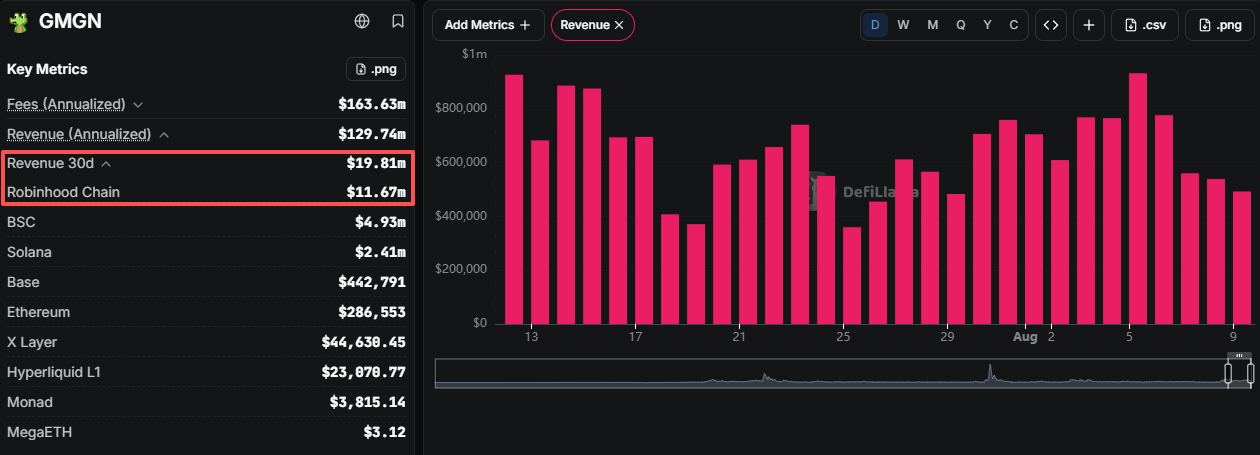
GMGN's revenue model is also more straightforward than that of issuance platforms—the platform charges a 1% fee on the transaction amount for each trade completed through GMGN (some of the fees are redistributed to users through referral rebates and other means). For example, if a user buys a Meme coin worth 1 SOL, GMGN will charge 0.01 SOL; copying trades is also charged at this standard.
Axiom: Revenue over the past 30 days exceeds $14 million, with revenue almost entirely from Solana chain
Similar to GMGN, Axiom is also a commonly used on-chain trading tool for Meme players, providing token discovery, market analysis, wallet tracking, X monitoring, and one-click buying and selling functions, with its core market still on Solana.
As of August 11, Axiom's trading volume over the past 30 days was approximately $1.337 billion, generating $23.91 million in fees, and after deducting referral rebates and user trading cashback, the final revenue was approximately $14.67 million. Among this, $23.84 million in fees came from Solana, while BNB Chain contributed only about $66,000, with revenue almost entirely from Solana chain transactions.
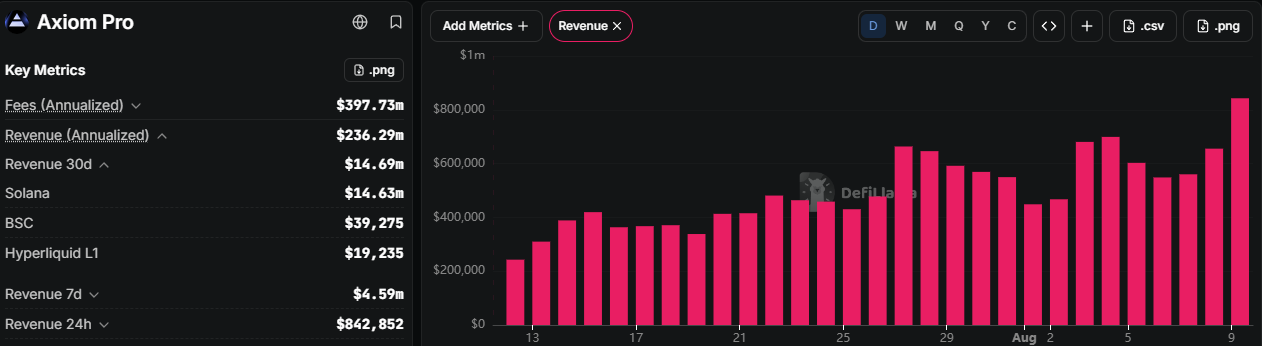
Axiom's revenue primarily comes from transaction fees deducted from each trade completed by users through the platform. Axiom's base trading fee rate is 1%, and it has also set up a cashback mechanism linked to trading volume, where the higher the user's trading level, the higher the cashback ratio, with the actual net fee rate currently around 0.75% to 0.95%. Additionally, Axiom also pays a portion of the fees to referrers.
fomo: Revenue over the past 30 days nearly $8.8 million, with revenue from Solana spot trading
Last weekend, a rumor about "Pump.fun spending heavily to poach competitor fomo" went viral in overseas Meme communities (related content can be read: $20,000 signing fee + $30,000 monthly salary, the story behind Pump.fun poaching FOMO). As of August 11, Fomo generated $9.48 million in fees over the past 30 days, of which approximately $8.79 million belonged to the protocol; during the same period, the spot trading volume was approximately $617 million, along with about $360 million in perpetual contract trading volume.
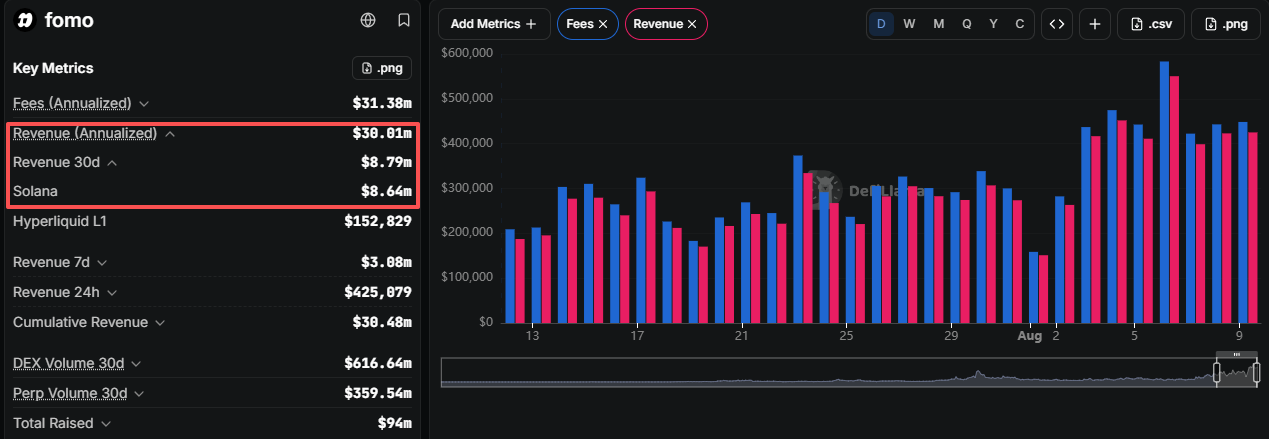
Unlike GMGN and Axiom, which lean towards professional on-chain trading terminals, fomo emphasizes social trading, allowing users to view other traders' operations, leaderboards, and real-time trading dynamics within the platform, and directly complete buying and selling of Meme and other tokens as well as copy trading. Currently, its spot trading is mainly concentrated on Solana, with approximately $8.64 million in revenue from Solana spot trading over the past 30 days, while Hyperliquid perpetual contracts contributed about $153,000.
fomo's revenue also primarily comes from trading commissions. According to the platform's latest service terms, spot trading is charged a minimum of 0.5% of the transaction amount, with a minimum fee of $0.95 per transaction; perpetual contract trading incurs an additional platform fee of 0.05%. Due to the prevalence of small, high-frequency trades among Meme players, the minimum charge of $0.95 per transaction also constitutes an important source of fomo's revenue.
 Risk warning