Can Robinhood Chain become the new growth engine for Robinhood?
 Core Viewpoint

 For Robinhood, the real opportunity may not be in creating a blockchain, but in bringing tens of millions of users into on-chain finance.
Author: AJC, Research Manager at Blockworks
Compiled by: Jiahua, ChainCatcher
Key Points
Despite Robinhood's overall business reaching new heights, its crypto business is declining. In the second quarter of 2026, crypto business revenue fell 38% year-over-year to $100 million, accounting for only 8% of the company's total revenue; retail crypto trading volume decreased by 36% year-over-year; the proportion of crypto assets in Robinhood's total custodial assets also dropped to a historic low of 7%.
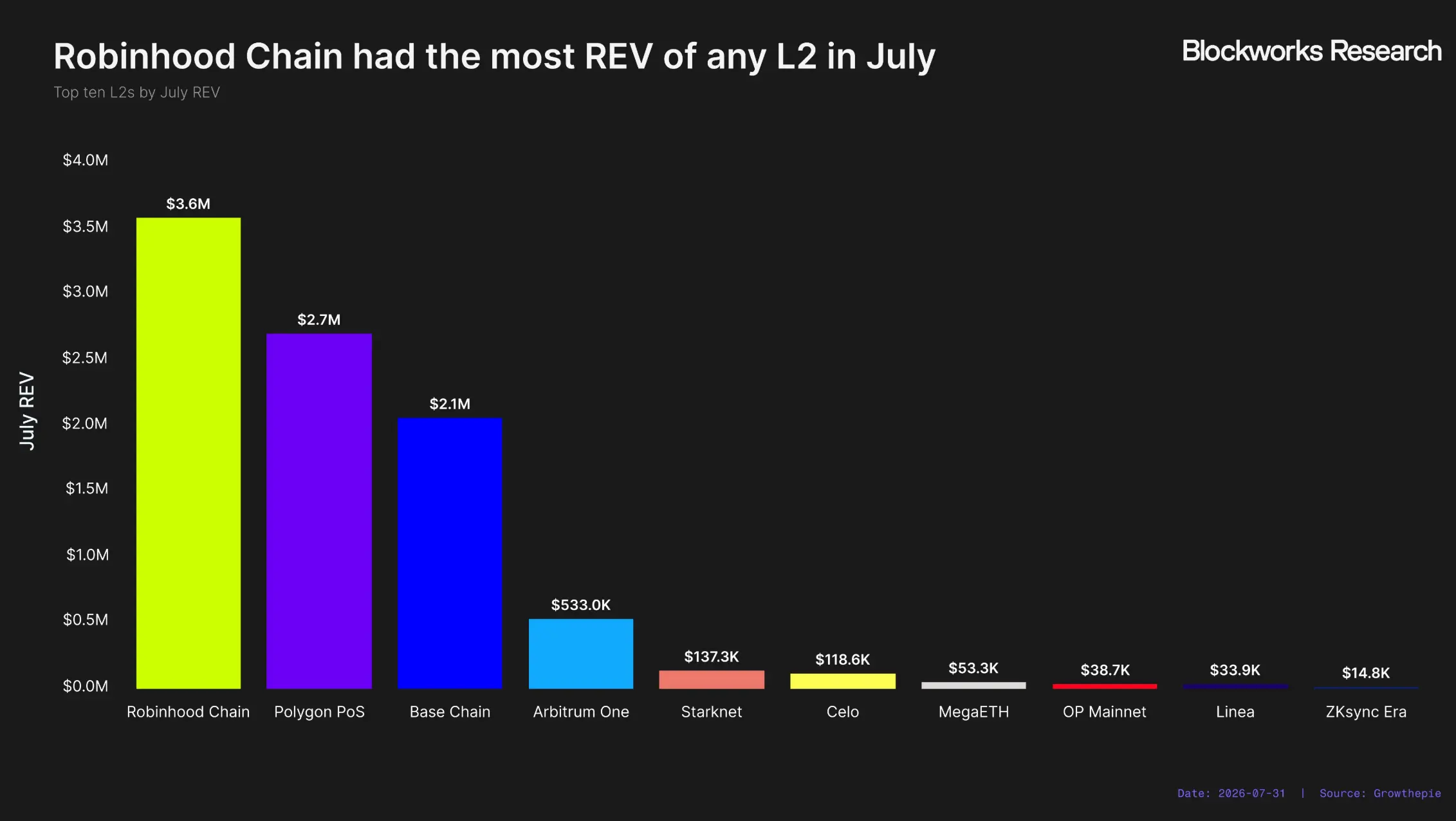
Robinhood Chain achieved one of the strongest L2 launch performances in recent years. In July, the network generated $3.6 million in Real Economic Value (REV), accounting for 38% of the total L2 chain revenue tracked by growthepie, surpassing established networks like Polygon and Base.
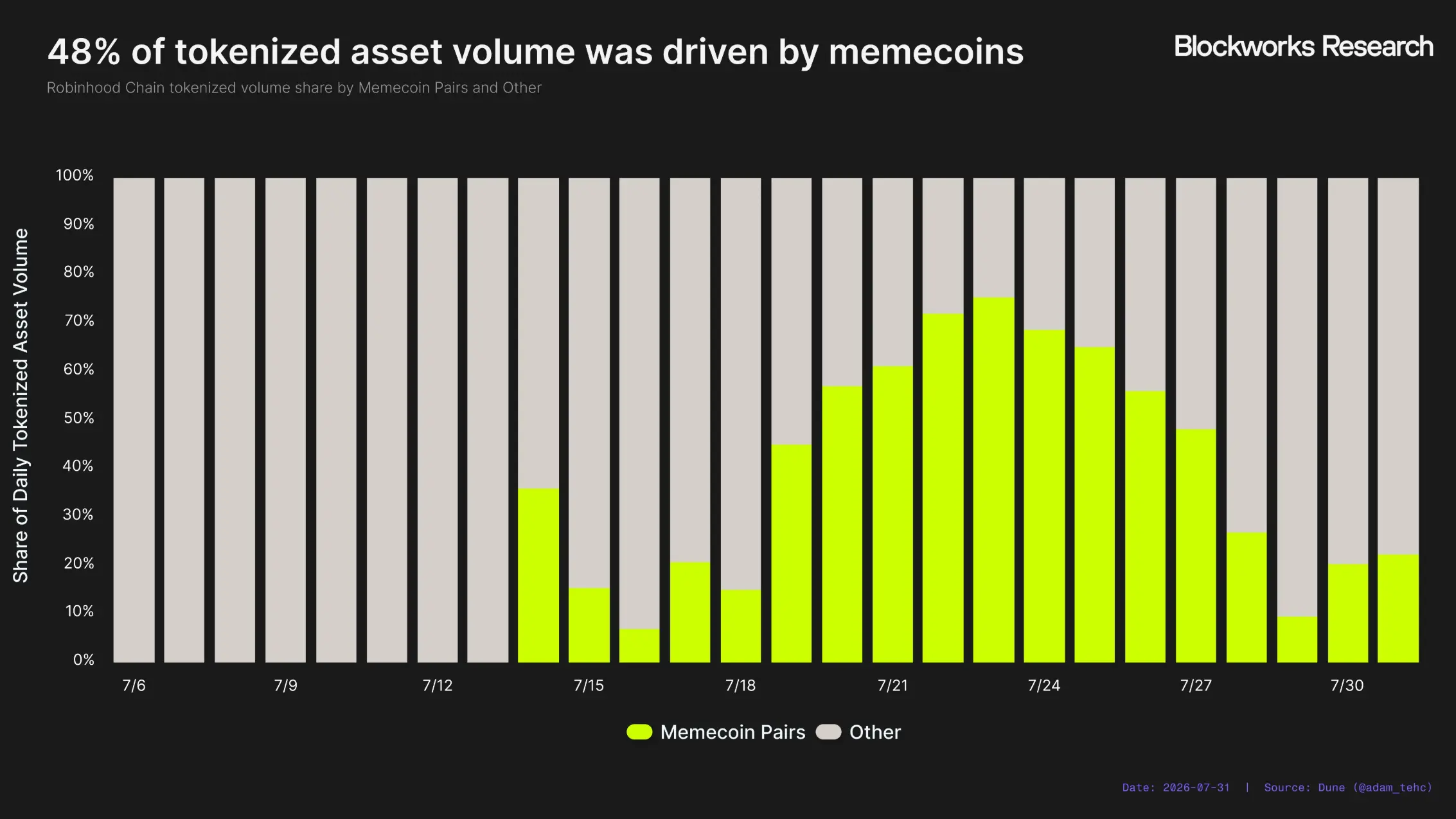
The main driving force behind Robinhood Chain's early activity is not RWA, but Meme coins. In July, Meme coins accounted for 51% of spot trading volume, while RWA only accounted for 5%. Meanwhile, 48% of RWA trading volume came from liquidity pools composed of RWA and Meme coins.
Robinhood's clearest monetization opportunity actually lies above the infrastructure layer. USDG is currently expected to generate $10.5 million in annual interest income, while Morpho has demonstrated the distribution value of directly entering the main Robinhood app.
In contrast, Lighter, which only connects to Robinhood Wallet, has generated perpetual contract trading volume from its Robinhood deployment that accounts for only 0.2% of Lighter's total trading volume.
Robinhood Chain is currently not substantial enough to have a meaningful impact on Robinhood's overall performance. The known revenue sources total approximately $54.8 million annually, equivalent to 14% of Robinhood's annual crypto revenue.
If Robinhood Chain wants to truly become an important business, Robinhood needs to scale USDG, commercialize the user entry point of the main app, or use Robinhood Chain as a funnel for users to enter other high-value products.
Introduction: Robinhood's Crypto Business at a Crossroads
Few companies represent the rise of retail investors better than Robinhood. Robinhood has almost become synonymous with retail investing, and its business has rapidly expanded as a result.
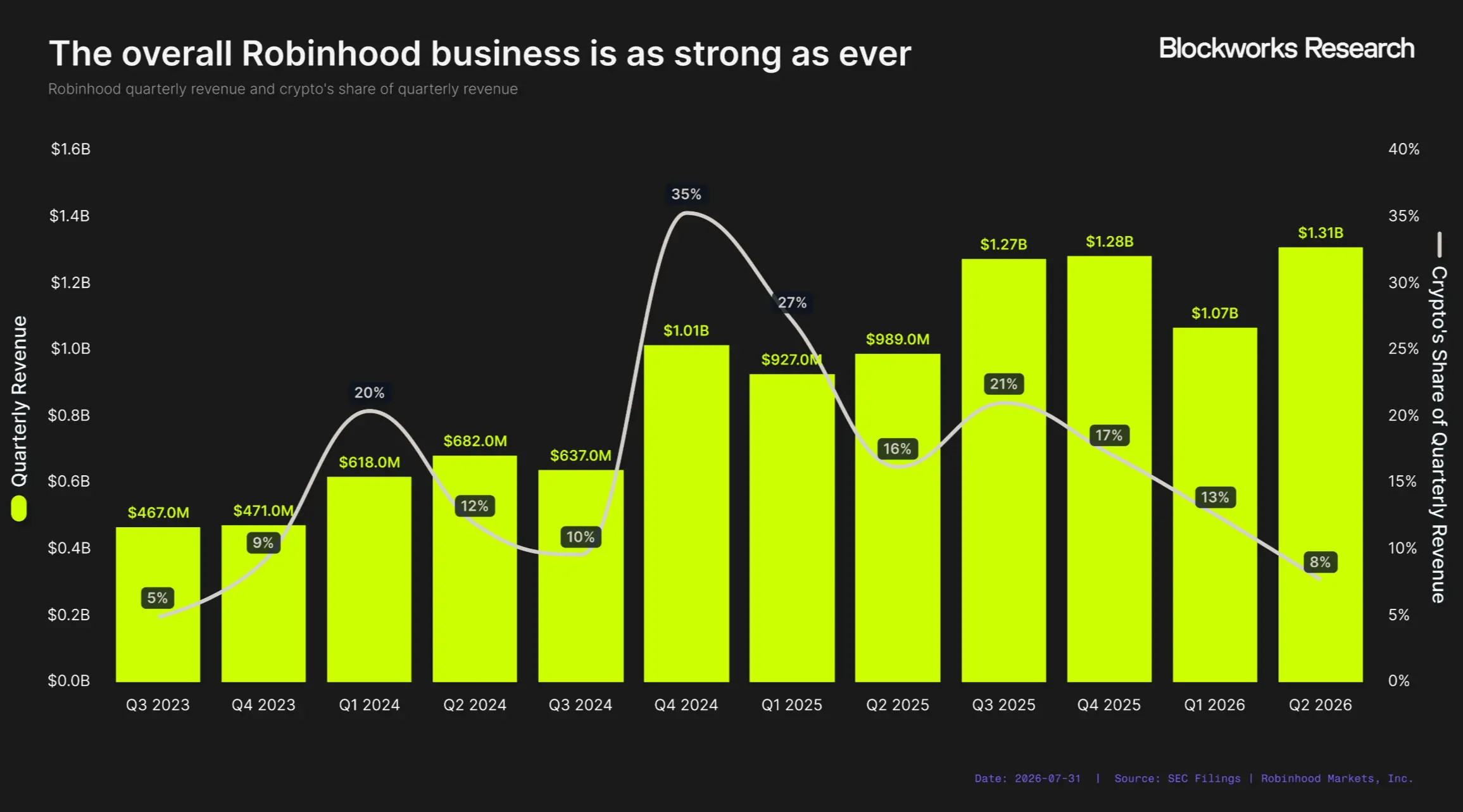
In the second quarter of 2026, Robinhood's quarterly revenue reached $1.31 billion, a historic high, up 32% year-over-year and 92% compared to the second quarter of 2024. The growth was driven not only by core trading businesses like stocks and options but also by an expanding product matrix.
Currently, Robinhood has 13 business lines with annualized revenues exceeding $100 million. In fact, all trading revenue business lines achieved double-digit year-over-year growth in the second quarter, with one exception: cryptocurrency.
Crypto business once accounted for more than a third of Robinhood's total revenue, but now it has become negligible. In the second quarter of 2026, only 8% of Robinhood's quarterly revenue came from cryptocurrency, the lowest level since the third quarter of 2023.
The proportion of crypto business in Robinhood's revenue has dropped so low that the event contract business launched last year generated more revenue in the second quarter than cryptocurrency, with the former at $156 million and the latter at $100 million.
The issue is not just the declining share of crypto business in Robinhood's revenue. Overall, Robinhood's core user base's interest in cryptocurrency is waning. This phenomenon is not unique to Robinhood, but the extent of the decline is still surprising.
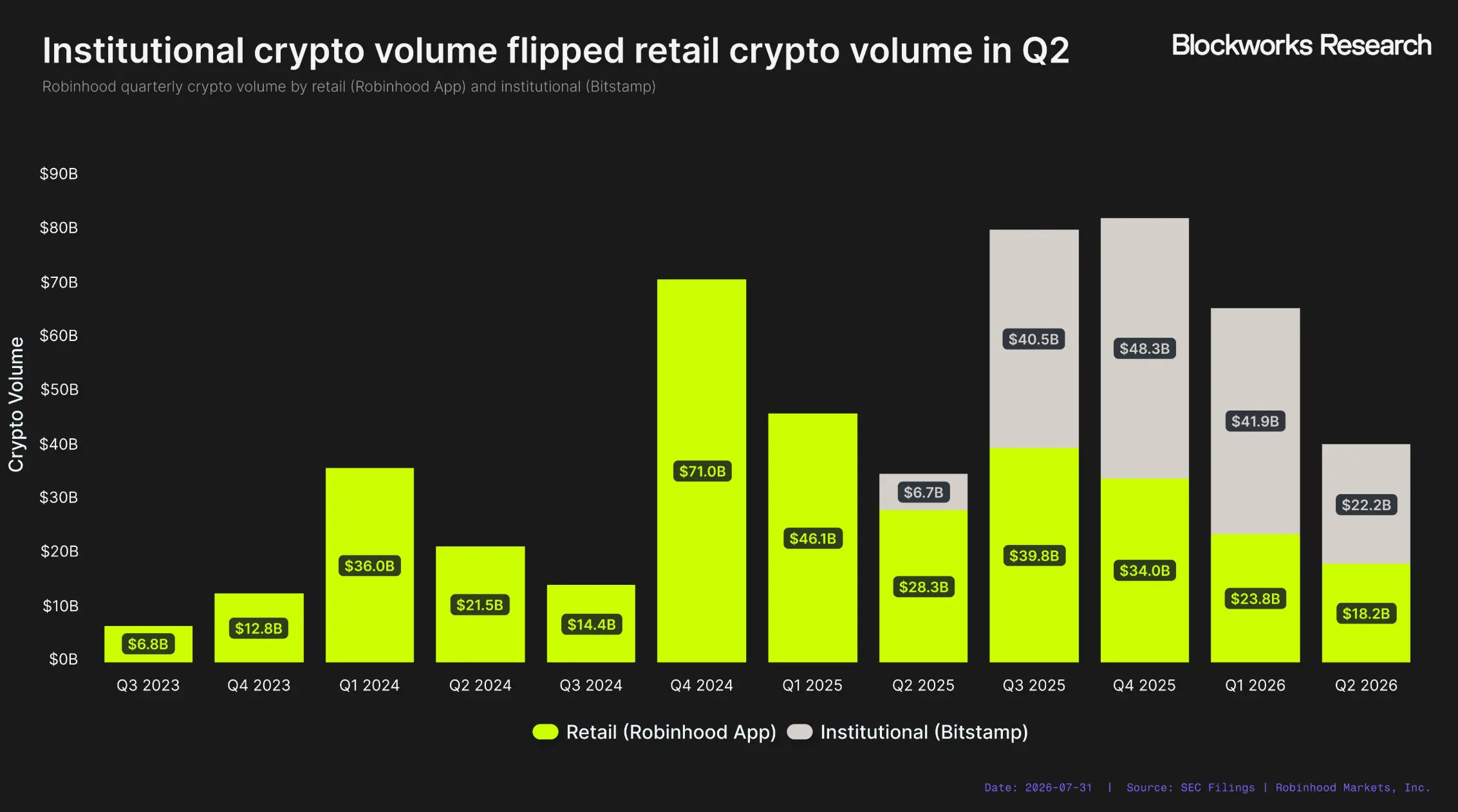
Trading activity illustrates this best. In the second quarter of 2026, retail crypto trading volume within the Robinhood app was only $18.2 billion, down 36% year-over-year, marking the lowest quarterly level since the third quarter of 2024. The decline was so significant that institutional trading volume completed through Bitstamp surpassed Robinhood's retail trading volume for the first time.
However, institutional trading is also not strong. Bitstamp's trading volume for the quarter was $22.2 billion, the second-lowest quarterly level in its history.
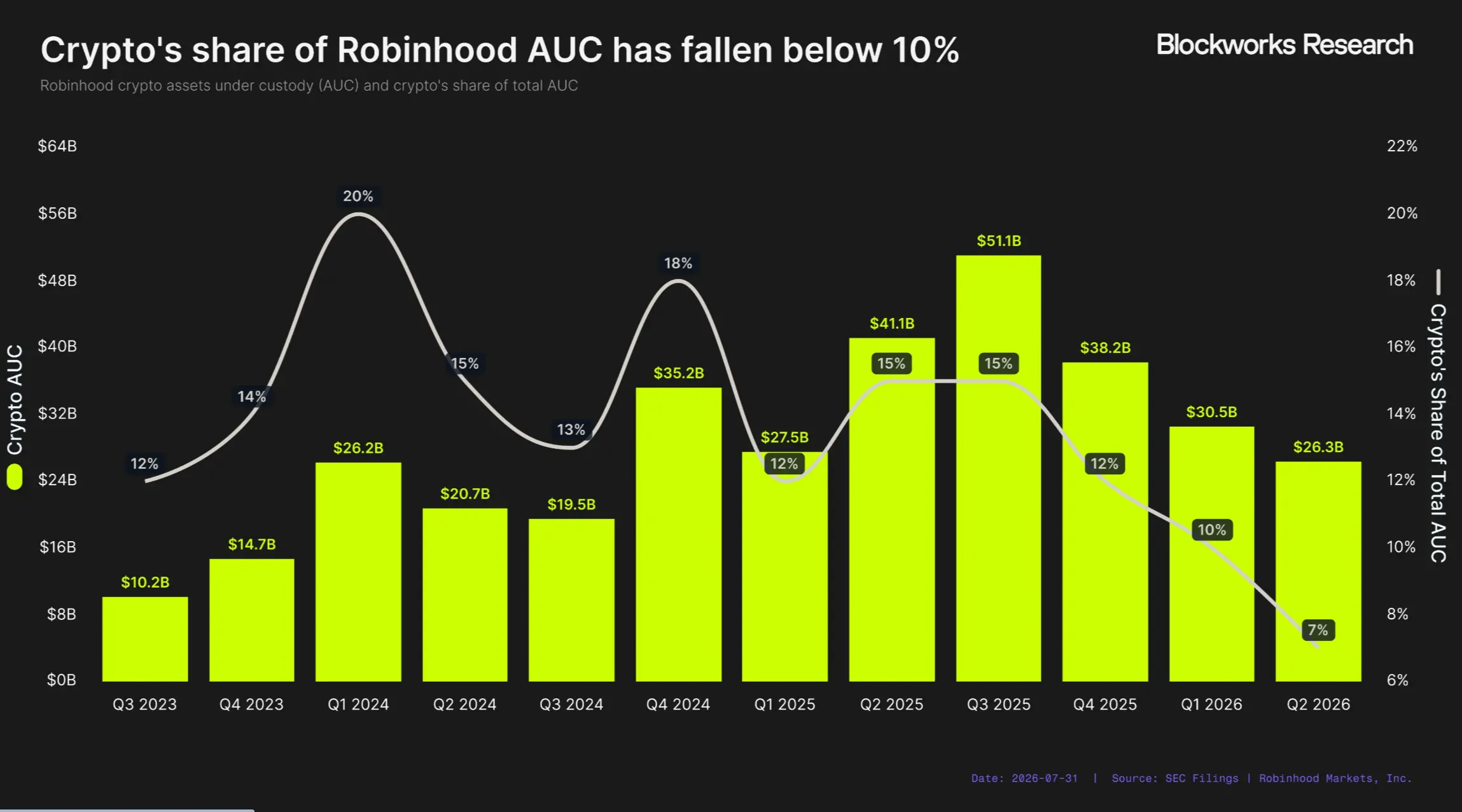
Trading volume is not the only crypto metric where Robinhood is showing weakness. In the first quarter of 2024, the scale of crypto assets held by Robinhood was $26.2 billion, accounting for 20% of the company's total custodial assets. More than two years later, the scale of crypto assets has barely changed, at $26.3 billion, but its proportion in Robinhood's total custodial assets has dropped to 7%, marking a historic quarterly low.
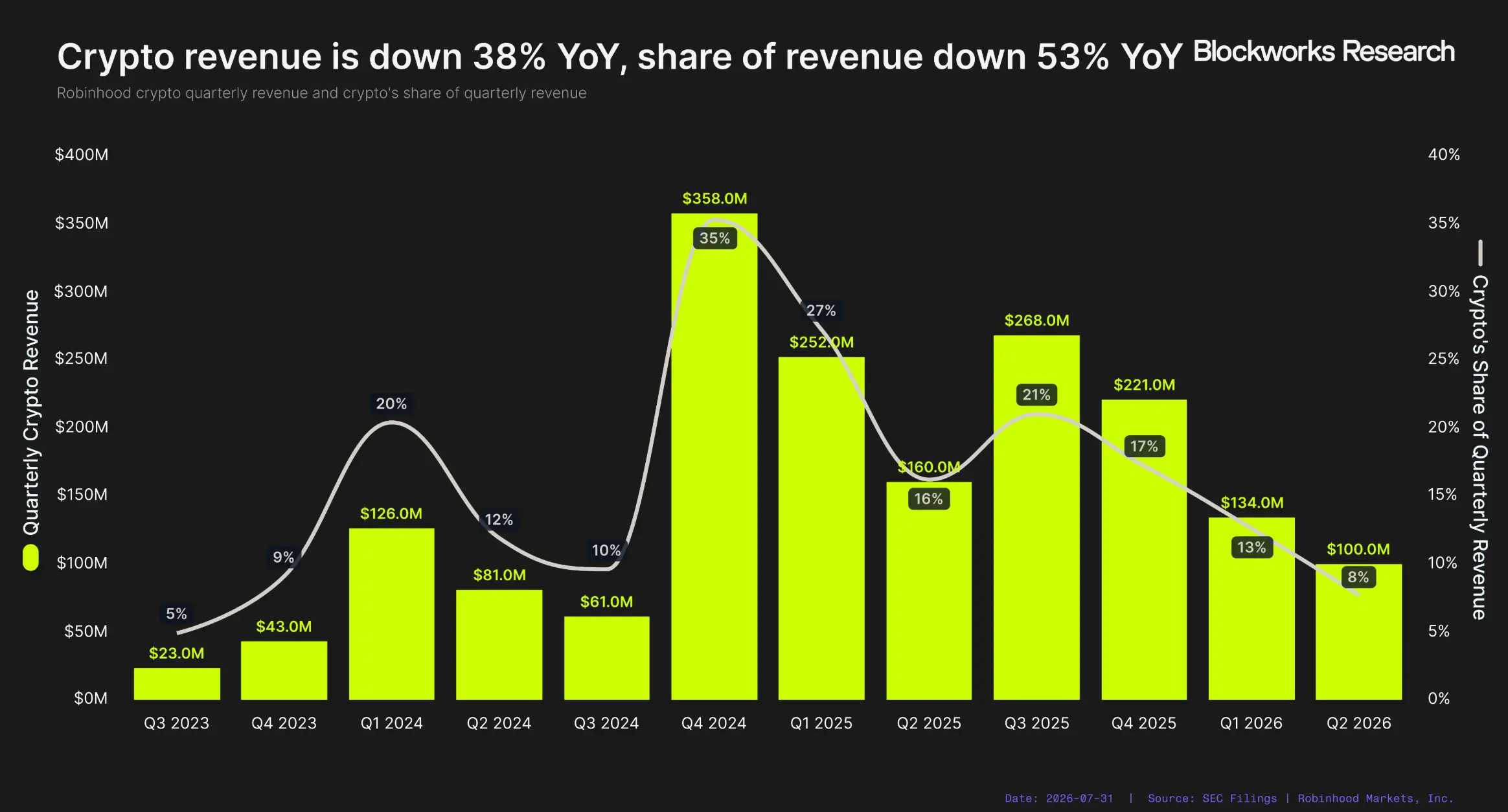
Against this backdrop, Robinhood's crypto revenue is naturally affected. In the second quarter, crypto business revenue fell 38% year-over-year, and its share of Robinhood's total revenue decreased by 53%. Simply put, Robinhood overall is still growing, but its crypto business is not.
However, Robinhood has not exited the crypto space as a result. On the contrary, the company has made its largest crypto bet to date by launching Robinhood Chain.
Robinhood no longer wishes to rely almost entirely on trading revenue but is attempting to build a broader and more sustainable crypto business. The real question is whether Robinhood Chain can make crypto business a significant growth driver for Robinhood again.
How Much Monetization Potential Does Robinhood Chain Have?
At the World Is Flat event held on July 1, 2026, Robinhood officially launched the Robinhood Chain mainnet. This is a Layer 2 (L2) blockchain built by Robinhood itself, designed to support the company's expanding on-chain ecosystem. Since then, Robinhood Chain has achieved one of the fastest launch speeds among blockchain projects in recent years.
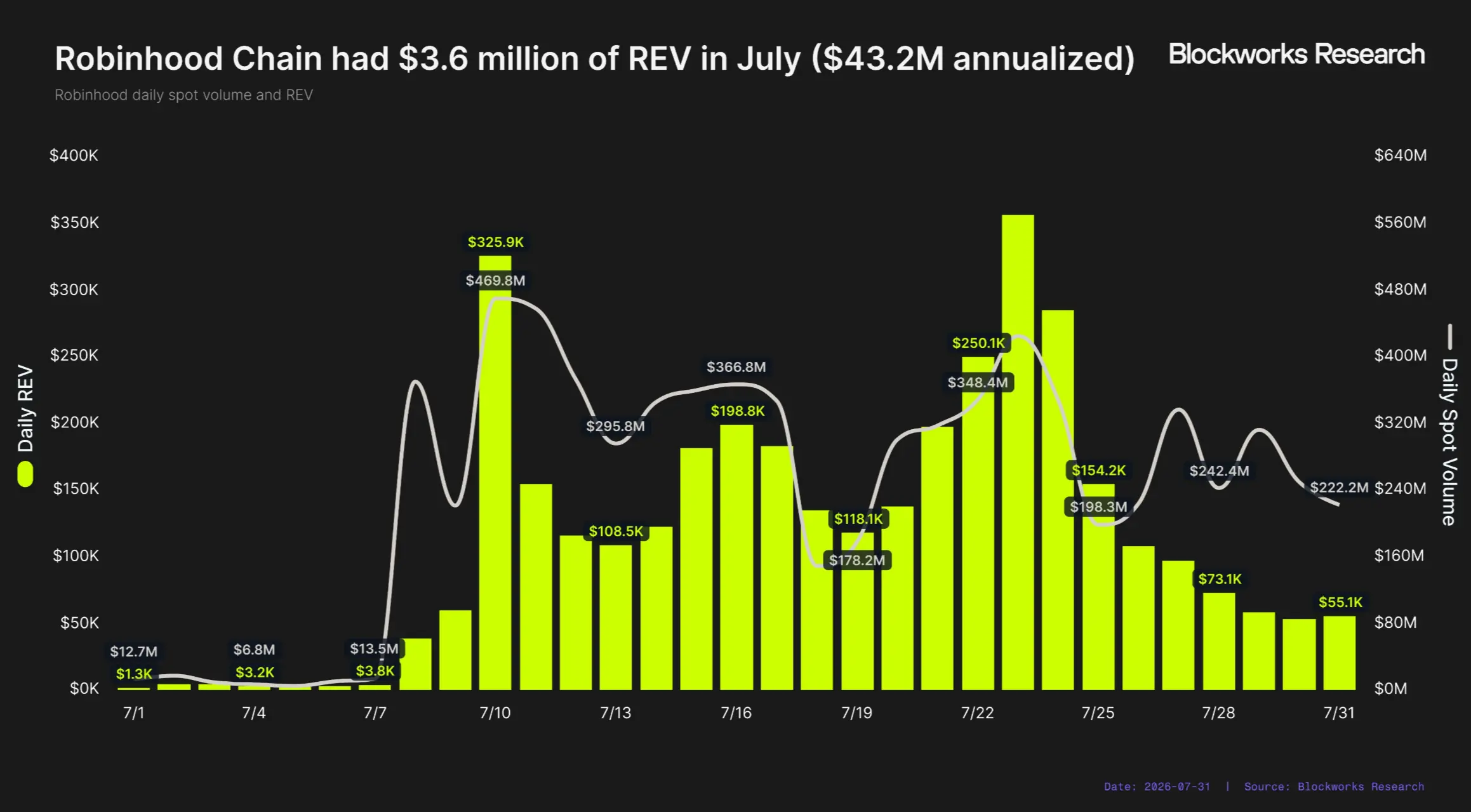
In its first month, Robinhood Chain generated $3.6 million in Real Economic Value (REV). It is still too early to determine whether this level of activity can be sustained, but if the first month's data is annualized, Robinhood Chain's annualized REV would reach $43.2 million.
This is a good start, but this figure alone is far from enough to reverse the decline in Robinhood's crypto revenue.
Even so, Robinhood Chain's launch performance is still impressive. In July, Robinhood Chain's chain revenue ranked first among all L2s, surpassing Polygon's $2.7 million and Base's $2.1 million.
Among all L2s tracked by growthepie, Robinhood Chain accounted for 38% of chain revenue. In other words, Robinhood Chain has become the L2 with the highest chain revenue, but 62% of the revenue in the market still flows to other networks. Even if the entire L2 market's chain revenue no longer grows, Robinhood Chain can still increase revenue by continuing to expand its market share.
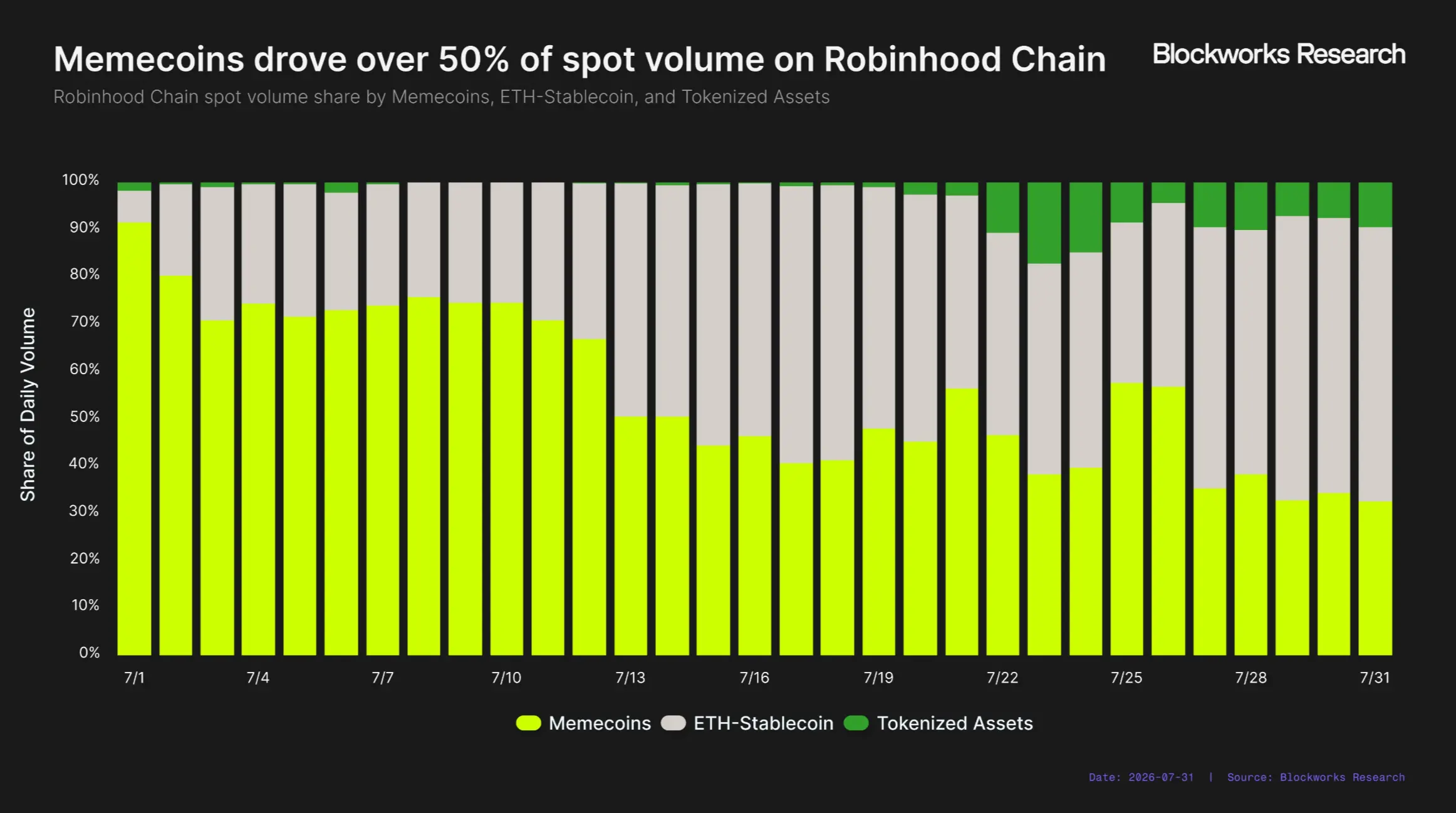
However, the early success of Robinhood Chain has an important prerequisite. A significant portion of the activity currently comes from Meme coins, which have historically been one of the main sources driving on-chain REV.
Robinhood does not seem to reject this situation, as founder Vlad Tenev has publicly expressed support for Meme culture multiple times. Even so, the extent to which Meme coins drive activity on Robinhood Chain remains noteworthy.
In July, Robinhood Chain processed a total of $6.93 billion in spot trading volume, of which $3.55 billion came from Meme coins, accounting for 51%. In contrast, RWA, which is the official focus of Robinhood Chain's promotional use cases, contributed only $313.2 million, accounting for 5% of total trading volume.
Moreover, the real impact of Meme coins on trading activity in Robinhood Chain may be even higher than this figure.
For example, in the case of RWA, the Meme coin issuance platform LONG() promoted a strategy that combines Meme coins with tokenized stocks or ETFs to create liquidity pools, thereby linking the price movements of Meme coins to the underlying RWA.
For instance, if the underlying RWA rises by 5%, the price of the Meme coin would also rise by 5% even if no one buys or sells that Meme coin. Therefore, a portion of trading volume that appears to belong to RWA is actually also driven by Meme coins.
From July 6 to July 31, 48% of RWA trading volume came from liquidity pools pairing Meme coins with RWA.
Meme coins can indeed become a powerful source of chain revenue, but historically, they have rarely been able to sustain themselves over the long term. Meme coin activity is highly cyclical; Ethereum, Avalanche, TRON, and Base have all experienced periods of extreme speculative activity, followed by funds and trading moving elsewhere.
Robinhood Chain may be able to retain some of this activity, but one month of data is clearly insufficient to draw conclusions. It remains uncertain whether Meme coins can become a sustainable source of REV for Robinhood Chain, or if Robinhood Chain is merely the latest stop in this round of capital rotation, with funds ultimately returning to Solana.
Looking at the bigger picture, relying solely on Robinhood Chain's REV is unlikely to revive Robinhood's crypto business.
The entire industry's network revenue is in a structural decline. For first-generation smart contract platforms, block space was once a lucrative business, but as block space becomes increasingly commoditized, new chains are finding it more difficult to generate large-scale revenue from transaction fees.
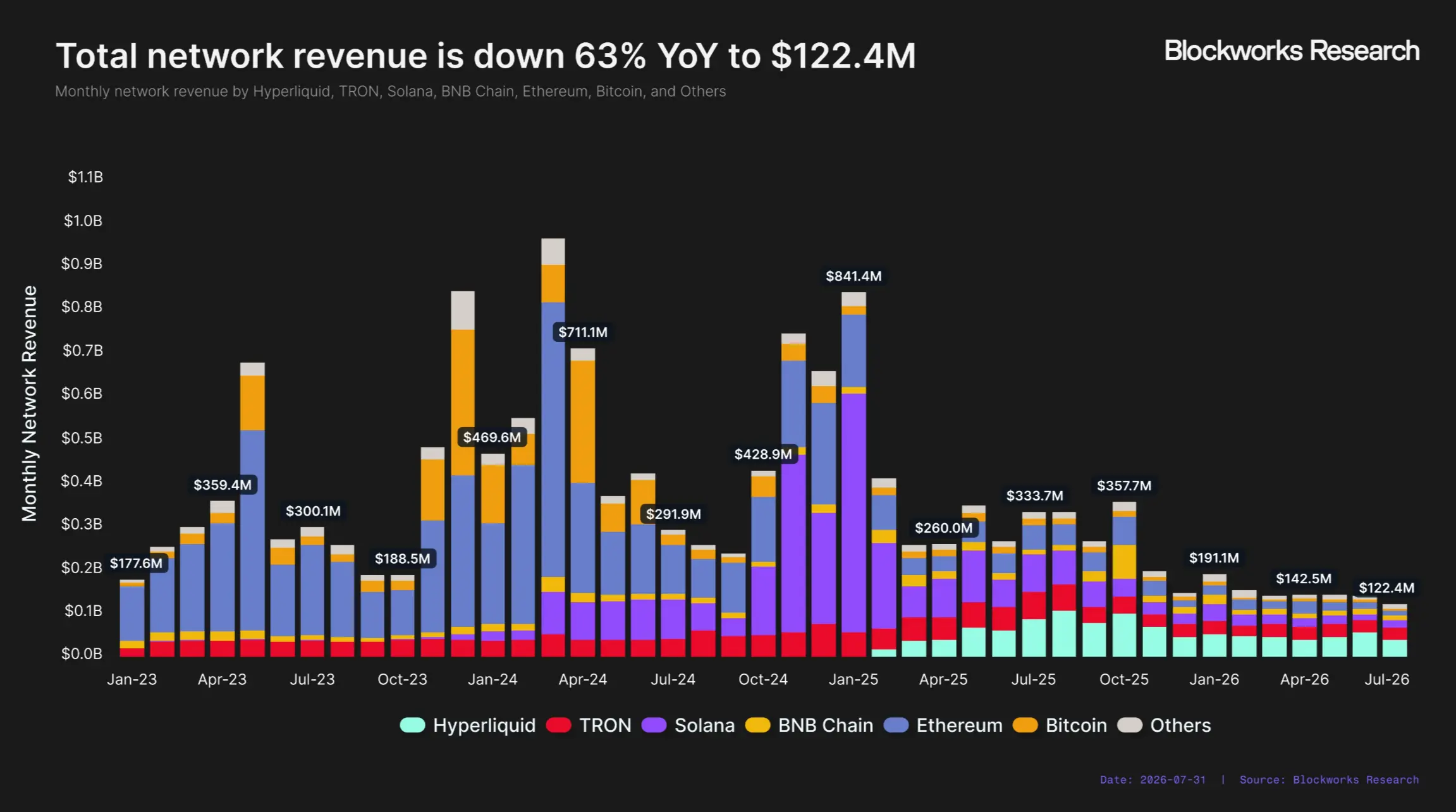
In July, the blockchains tracked by Blockworks generated a total of $122.4 million in network revenue, the lowest monthly level in three and a half years. In comparison, network revenue in July 2025 was $333.7 million, a year-over-year decline of 63%.
Moreover, this decline cannot be entirely attributed to the current market environment. In July 2023, during the previous bear market, various chains were still able to generate $300.1 million in network revenue.
As mentioned earlier, Robinhood already has 13 business lines with annualized revenues exceeding $100 million. It is hard to imagine that Robinhood Chain could join this group relying solely on network revenue.
Even if Robinhood can continue to expand its share of L2 activity, chain revenue will ultimately be limited by the overall market size, with an annual revenue ceiling of about $100 million.
To break through this ceiling, Robinhood must bring its existing user base onto the chain. However, Robinhood's users are primarily located in the United States, and under the current regulatory environment, most of these users cannot directly use Robinhood Chain through the Robinhood App, so this process is likely to take time.
If Robinhood hopes for Robinhood Chain to become the next business line with over $100 million in annual revenue in the short term, it must seek monetization methods beyond network revenue.
Commercialization at the Application Layer
The monetization focus in the crypto industry is gradually shifting from the infrastructure layer to the application layer. Solana is a good example.
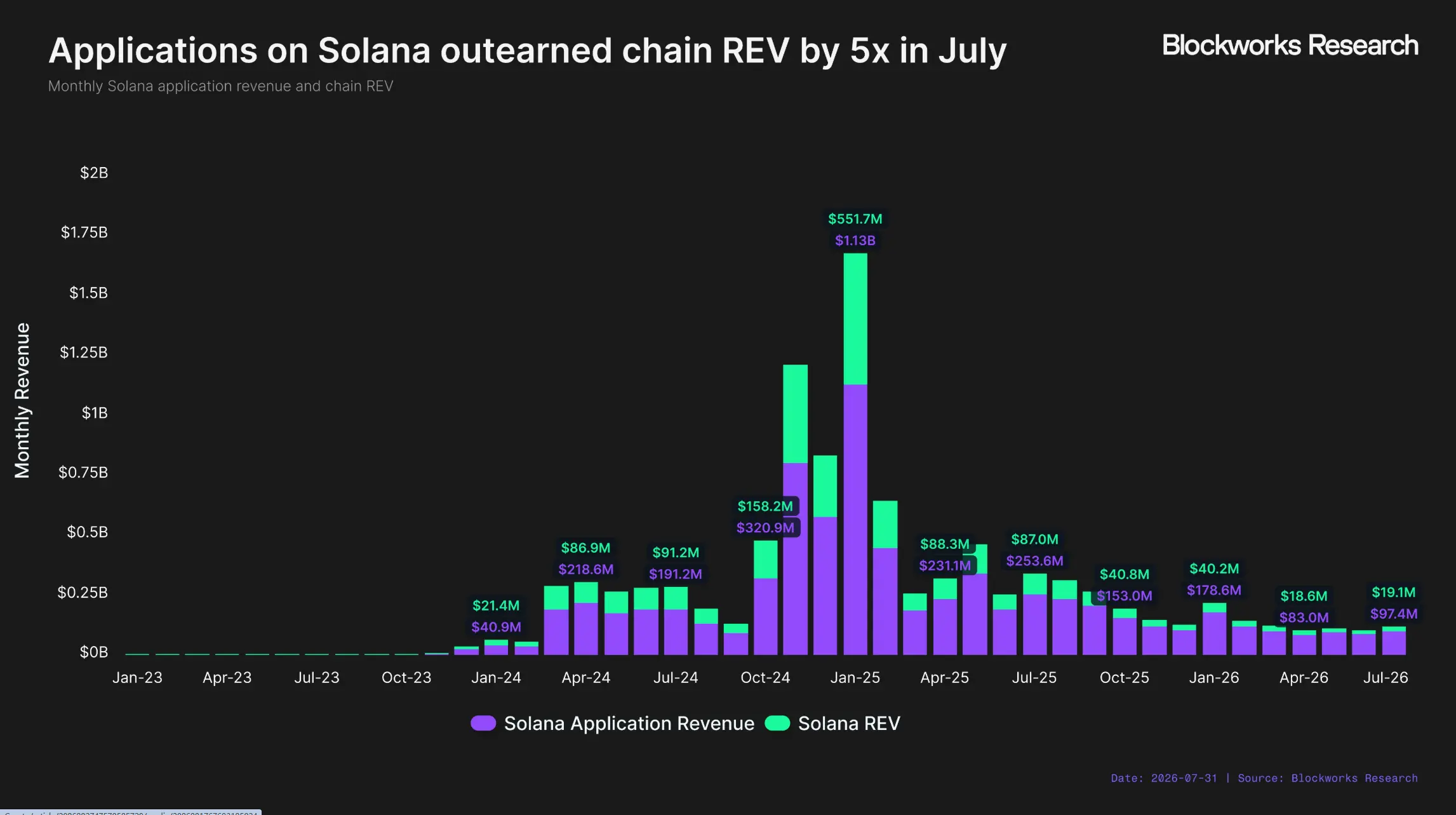
In January 2024, when Solana began to recover, Solana applications generated a total of $40.9 million in revenue that month, while the Solana network itself generated $21.4 million in REV, with a ratio of 1.9 times.
By January 2025, at the peak of the Solana bull market, application revenue reached $1.13 billion, while Solana's REV was $551.7 million, maintaining a ratio of about 2 times.
However, after that, the gap between the two quickly widened. By July 2026, for every $5 in revenue generated by Solana applications, the underlying network could only earn $1 in REV.
From a broader perspective, applications are taking an increasingly larger share of the value they create, while the proportion that the underlying blockchain can capture is decreasing.
If Robinhood wants Robinhood Chain to become the next business line with over $100 million in annual revenue, it must directly participate in the commercialization of on-chain applications. Robinhood has not officially announced that this is its strategy, but a series of current actions point in this direction.
The most obvious example is Robinhood's stablecoin strategy.
Unlike most blockchains that rely on Circle's USDC or Tether's USDT as their main stablecoin, Robinhood chose USDG as the native stablecoin for Robinhood Chain. This way, Robinhood gains an additional source of income, which is the interest income generated by USDG's reserve assets.
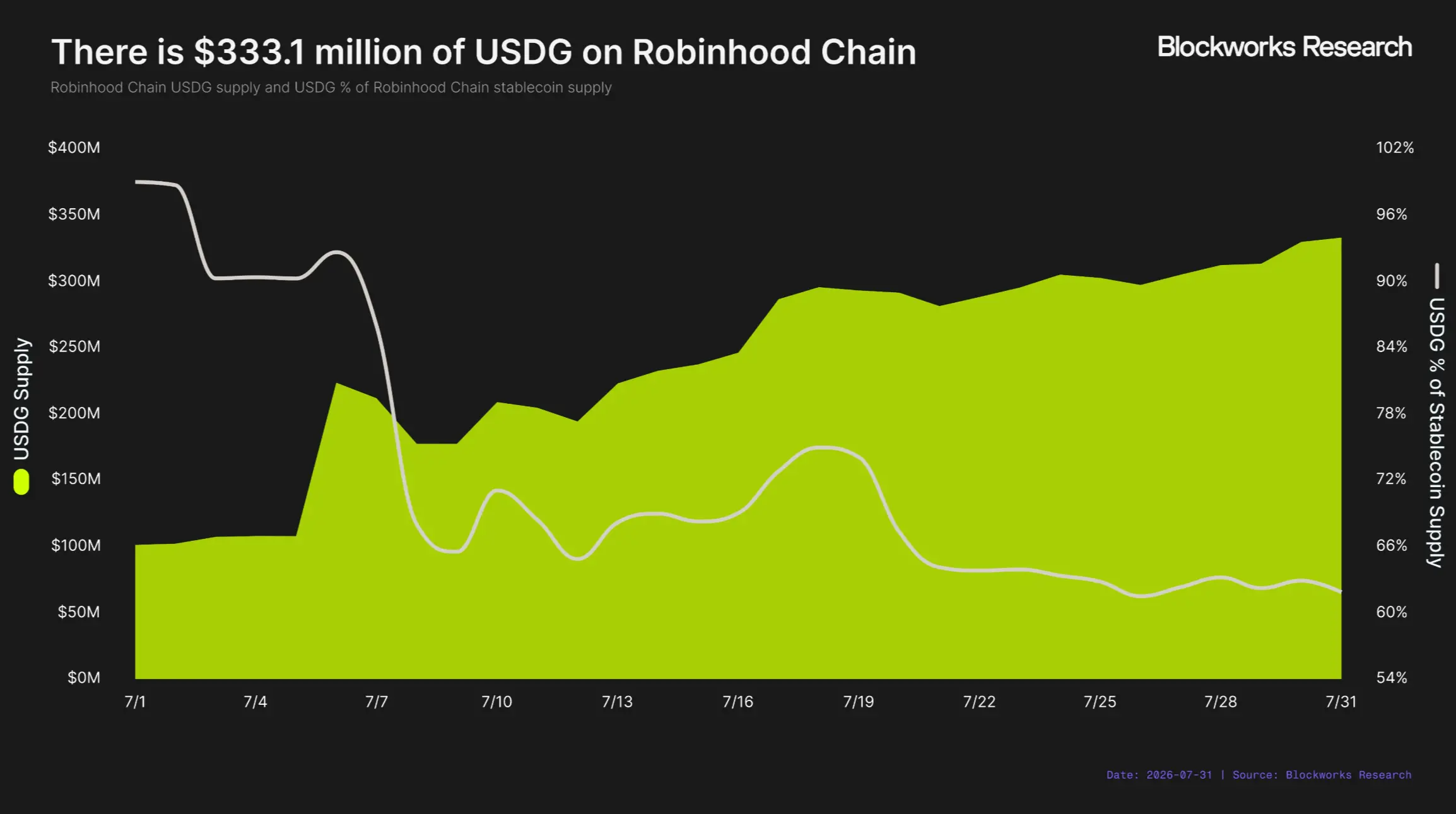
As of the end of July, the market cap of USDG on Robinhood Chain reached $333.1 million. Assuming the yield on the underlying reserve assets is 3.5%, with 90% of the related interest income belonging to Robinhood, USDG could bring approximately $10.5 million in annual income to Robinhood.
Expanding the supply of USDG further should not be difficult, and it can also establish a more stable source of income.
If the supply of USDG reaches $1 billion, which is a reasonable target since there are currently 11 blockchains with at least $1 billion in stablecoin supply, USDG could generate $31.5 million in annual income, nearly matching Robinhood Chain's current chain revenue.
In addition to stablecoin integration, Robinhood Chain also seems to be looking for other revenue from the application layer. Lighter has deployed a customized perpetual contract DEX on Robinhood Chain and will share trading fees with Robinhood on a 50/50 basis. As part of the collaboration, Robinhood Wallet, which is a self-custody wallet independent of the main Robinhood app, will directly provide Lighter perpetual contract trading within the application.
Additionally, it is rumored that Morpho also paid a fee to enter the Robinhood App. This is distinctly different from the common model in the industry, where blockchains provide incentives to attract applications to deploy on their networks, rather than applications paying fees to the companies behind the blockchain.
How Much is Robinhood's Distribution Capability Worth?
The viability of the entire application layer strategy ultimately depends on how valuable Robinhood's distribution capability is.
If protocols are willing to pay to reach Robinhood users, then Robinhood can commercialize its user entry point.
From current cases, protocols on Robinhood Chain can mainly obtain user distribution from Robinhood through two channels:
- Entering the main Robinhood App like Morpho
- Entering the independent Robinhood Wallet like Lighter
The distribution capability of the main Robinhood App has been validated, but the actual distribution value of Robinhood Wallet is still far from clear.
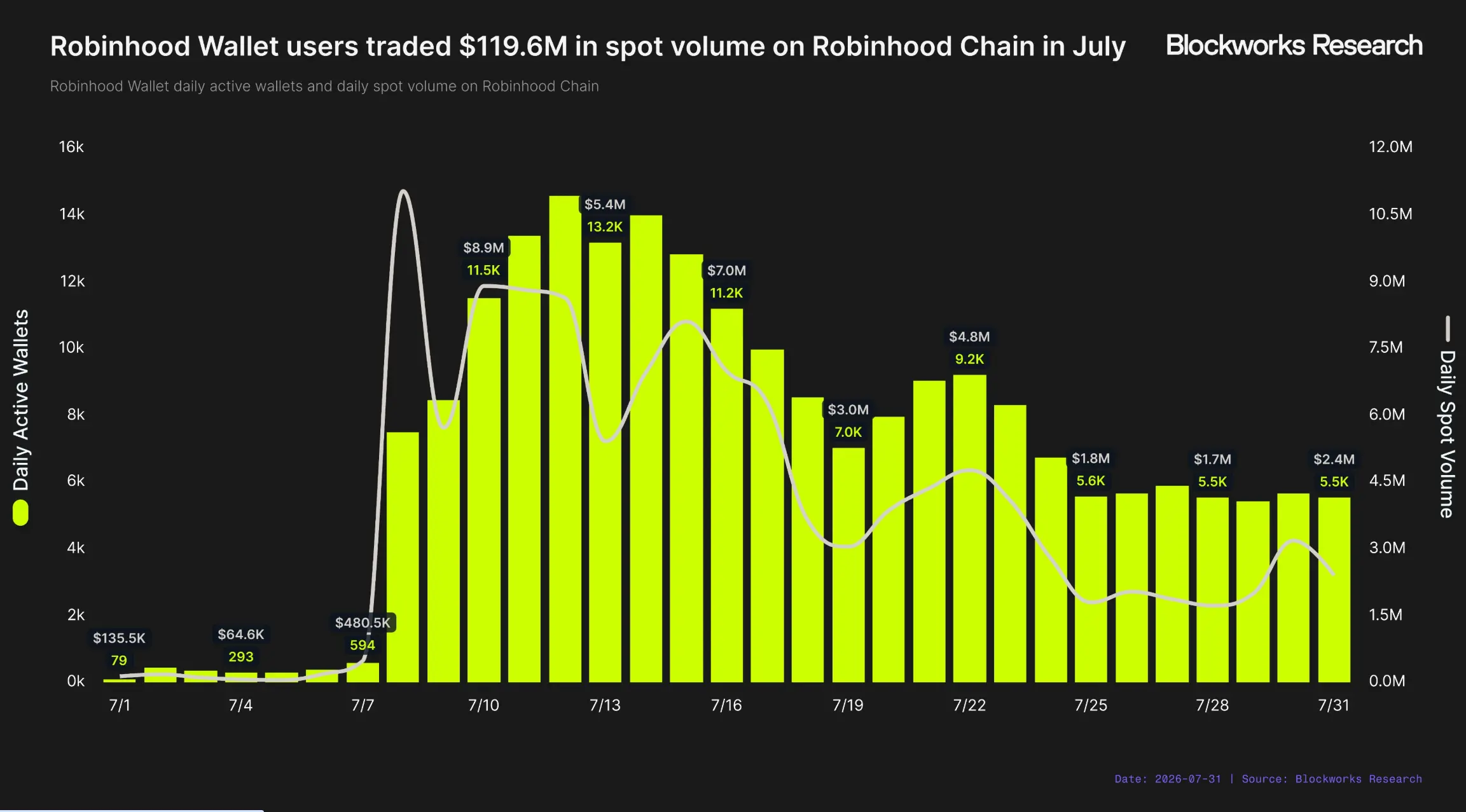
Looking only at the activity on Robinhood Chain, Robinhood Wallet users contributed $119.6 million in trading volume in July.
On July 8, the daily trading volume peaked at $11 million, but then continued to decline, averaging only $2.1 million per day in the last week of the month.
In July, the average daily active wallet count for Robinhood Wallet was slightly below 7,000. It is important to note that this analysis did not filter out "witch" addresses, so the actual number of independent users may be lower.
Compared to the broader wallet and trading application ecosystem on Robinhood Chain, Robinhood Wallet is still a relatively small player.
In July, the tracked wallets and trading applications generated a total of $3.08 billion in trading volume, of which Robinhood Wallet accounted for only $119.6 million, with a market share of less than 4%.
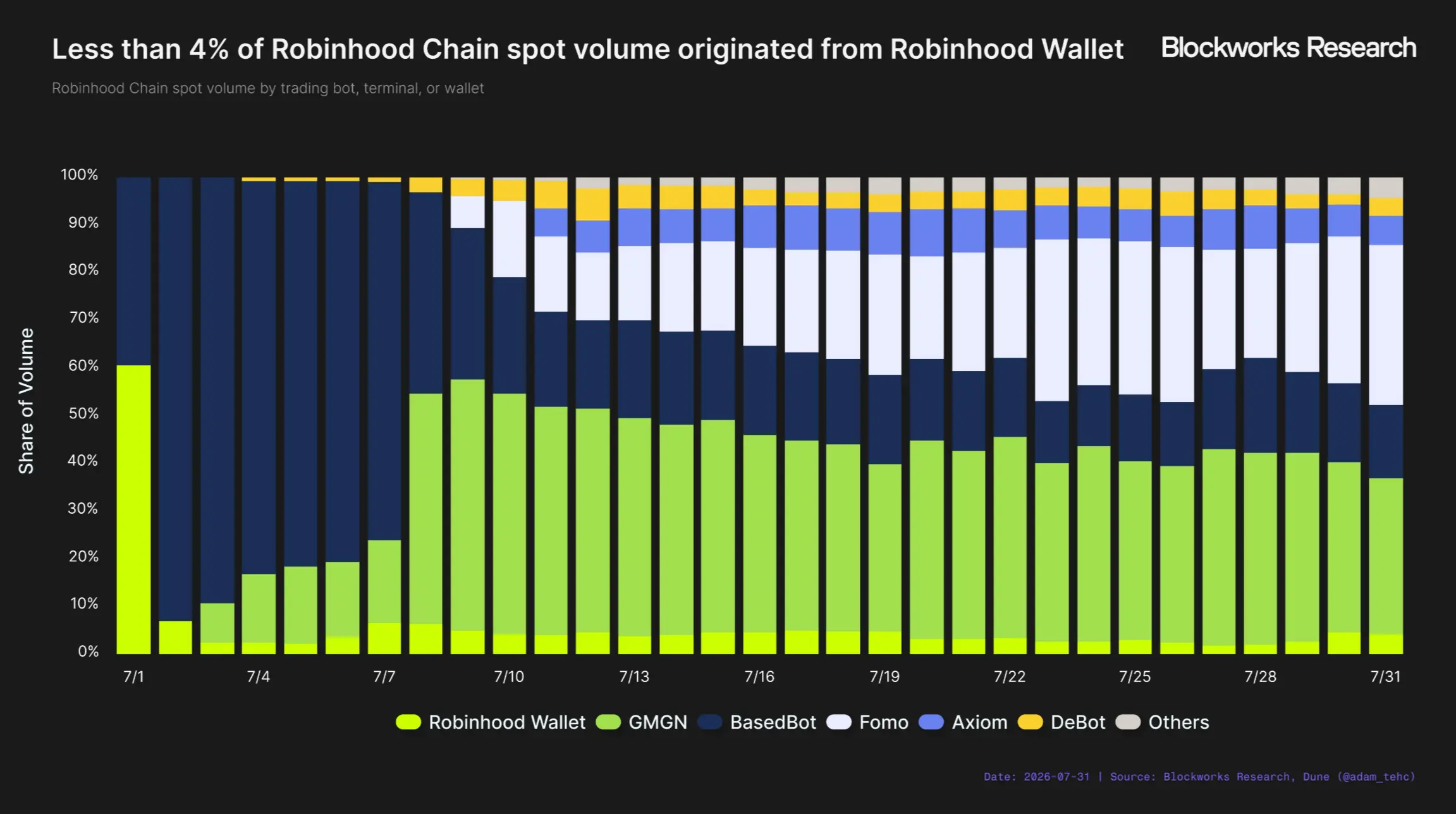
However, the trading volume of these applications is largely driven by high-frequency and professional users. Based on the average daily active wallet count, Robinhood Wallet ranks fourth among tracked applications, while it ranks sixth based on trading volume.
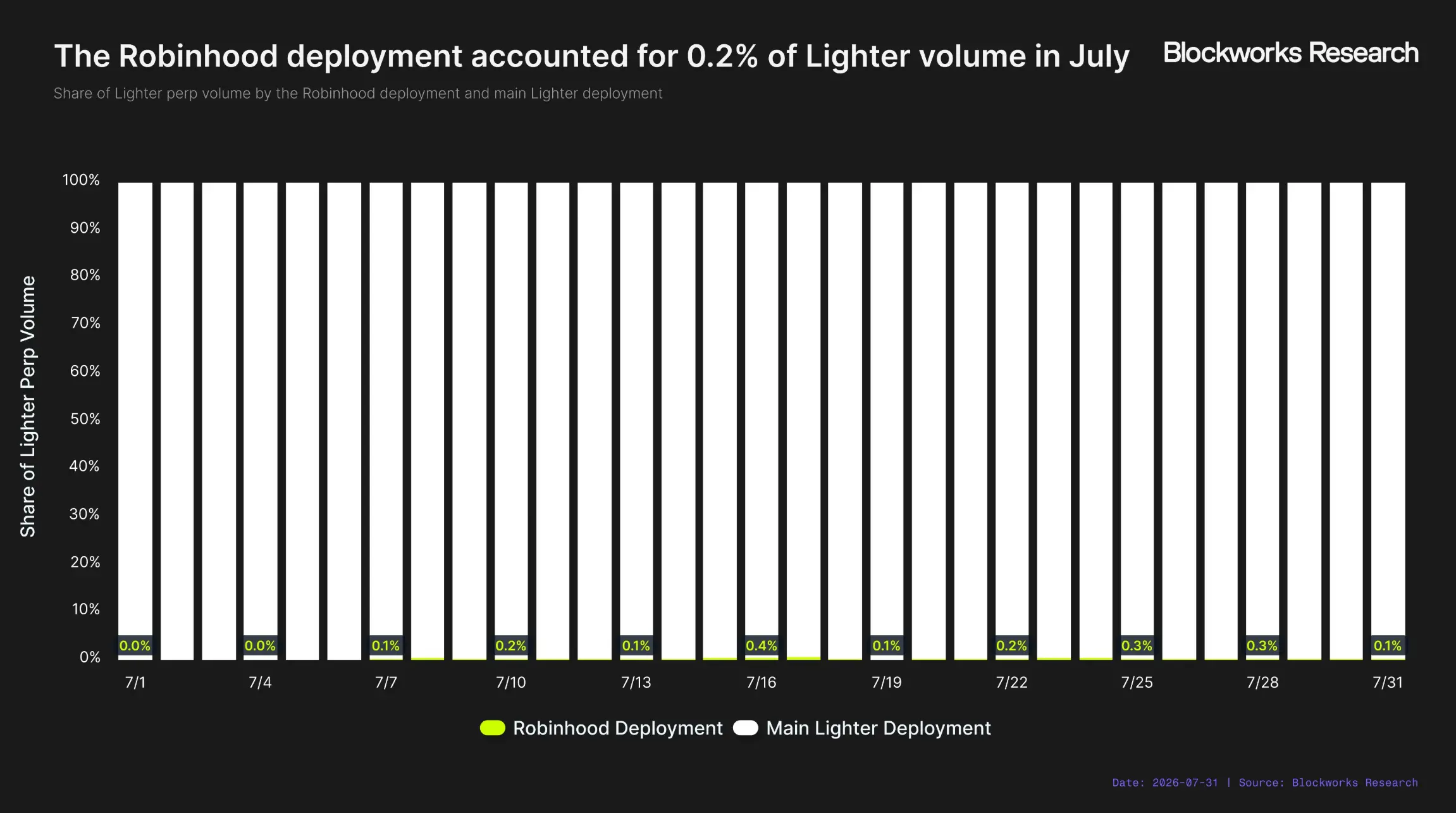
Lighter's integration further demonstrates the limitations of Robinhood Wallet's distribution capability.
Since integrating with Robinhood Wallet, Lighter's deployment on Robinhood has only contributed 0.2% of its total perpetual contract trading volume. In July, this portion of trading volume was $86.8 million, even lower than the spot trading volume generated through Robinhood Wallet that month.
More concerning is that Lighter is also directly incentivizing Robinhood Wallet users to engage in perpetual contract trading. Lighter has provided 11 million LIT tokens for this purpose, currently valued at approximately $25 million.
In other words, the already limited trading volume is still generated under incentive-driven conditions. Without these rewards, the actual trading volume would likely be even lower. As it stands, it is hard to argue that merely gaining access to Robinhood Wallet's distribution could bring significant value to the protocol.
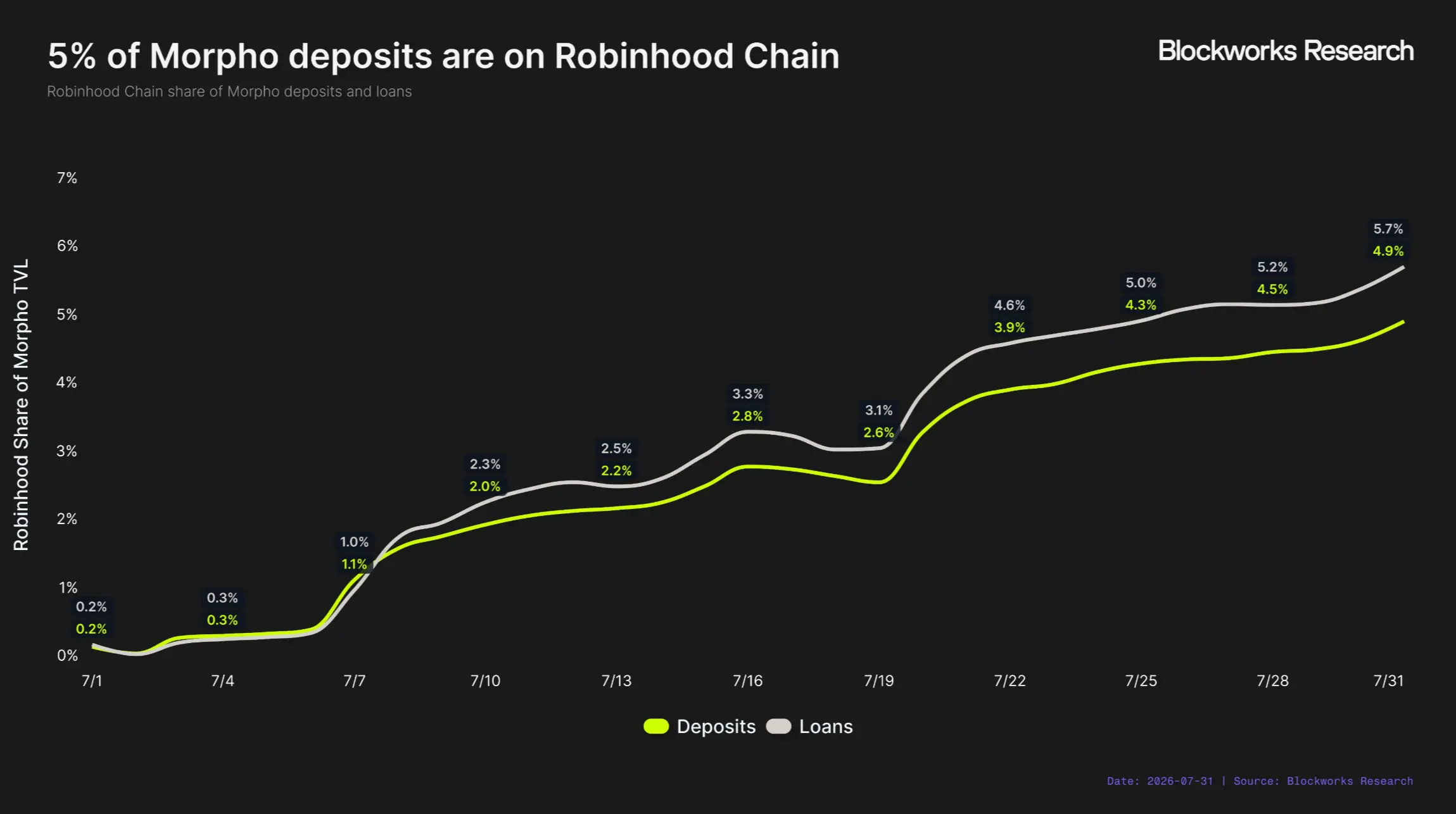
While Robinhood Wallet's distribution capability may be limited, the Robinhood main App is clearly not. Morpho is the most obvious case.
Robinhood users can directly deposit stablecoins into Morpho through the main App and earn an incentivized 7% APY. As of the end of July, Morpho's deployment on Robinhood Chain accounted for 5% of Morpho's total deposits and contributed nearly 6% of loans.
Just one month after launch, Robinhood Chain has already become Morpho's third-largest deployment network by TVL.
It must be acknowledged that this portion of TVL is also driven by incentives. However, even so, the difference in distribution effectiveness between gaining access through the Robinhood main App and Robinhood Wallet remains very clear.
Although this is not a completely like-for-like comparison, the proportion of Robinhood Chain in Morpho deposits is 25 times that of Robinhood's deployment in Lighter's perpetual contract trading volume.
Thus, the initial assessment of Robinhood's distribution capability shows a clear polarization.
For protocols that can directly enter the Robinhood main App, this distribution capability seems very valuable. However, gaining distribution solely through Robinhood Wallet is much less attractive.
Unless entry into Robinhood Wallet can serve as a springboard for future entry into the main App, it is hard to understand why protocols would be willing to sacrifice significant economic benefits just to gain access to Robinhood Wallet's user entry.
Of course, this conclusion is currently based on only two early cases.
Robinhood has not officially indicated that application layer distribution transactions will become a broader strategy for the company, nor is it clear how far the company intends to promote this model.
But at least for now, the differences between the two are already very apparent. The true value of Robinhood's distribution capability lies not just in connecting projects with the Robinhood brand or deploying on Robinhood Chain, but in whether it can directly reach users of the Robinhood main App.
Conclusion
This report begins with a core question: Can Robinhood Chain make crypto business a significant growth driver for Robinhood again?
Early data has provided a fairly clear answer.
As a blockchain, Robinhood Chain's launch performance has been very successful, but it has not yet become a meaningful source of revenue for Robinhood's business.
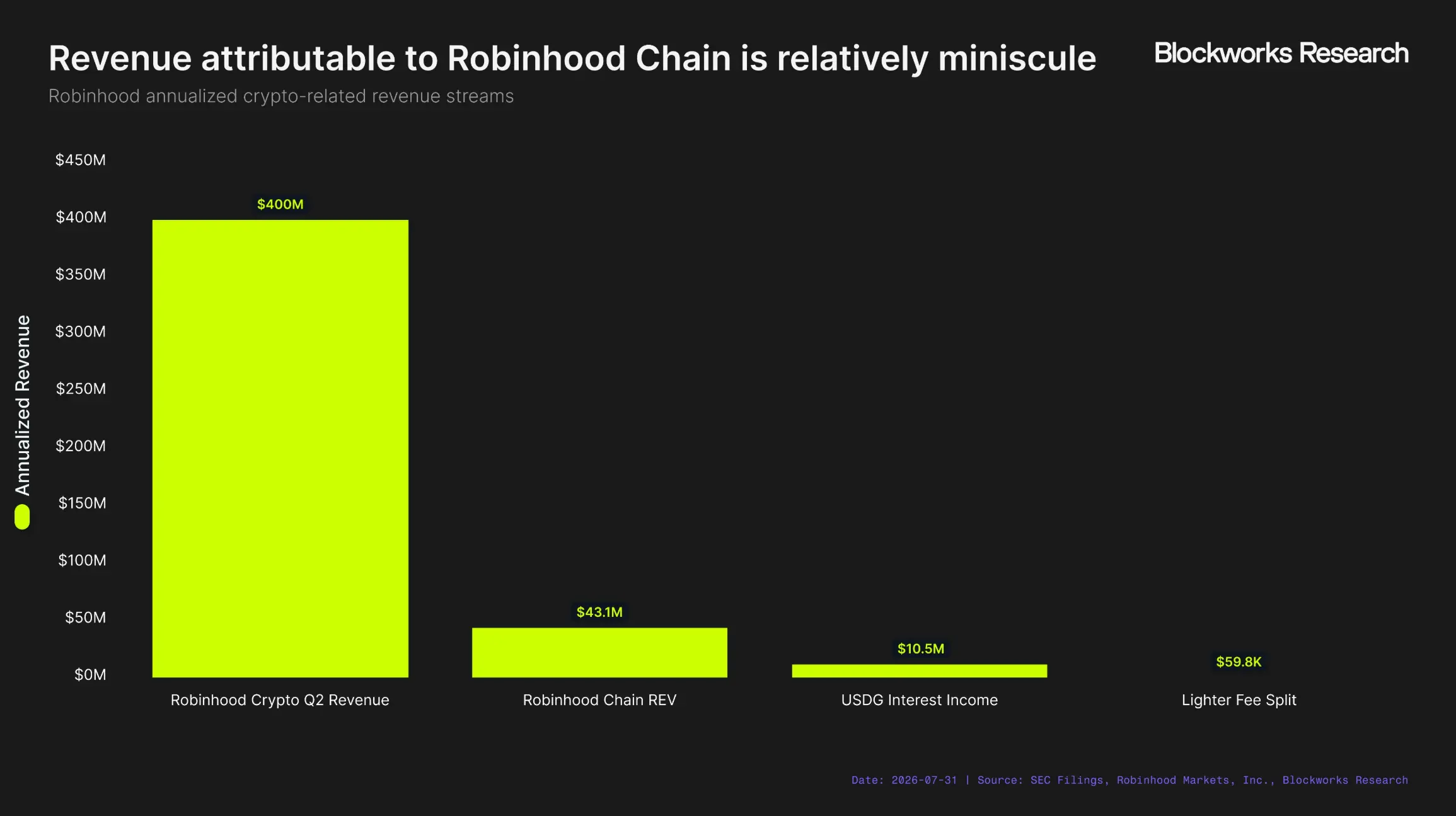
Robinhood's crypto revenue in the second quarter was $100 million, equivalent to an annualized $400 million.
In contrast, the currently quantifiable revenue sources related to Robinhood Chain, including chain REV, USDG interest income, and Robinhood's share of fees from Lighter, total only about $54.8 million annually, roughly equivalent to 14% of Robinhood's annual crypto revenue.
Of course, this comparison simply annualizes the data from the first month of Robinhood Chain's launch and should not be viewed as its long-term revenue potential.
The conclusion is clear: relying solely on network revenue will never have a substantial impact on Robinhood's performance. Block space has become too commoditized, and the overall L2 revenue market is too small.
If Robinhood Chain wants to make crypto business a significant growth driver for Robinhood again, the company must earn from economic activities above the infrastructure layer.
Stablecoins are currently the clearest path. Tether and Circle have already proven that the interest income generated by stablecoin reserve assets can be a highly profitable business.
Assuming a yield of 3.5%, if Robinhood can retain all related interest income, then for every $1 billion increase in USDG supply, it could bring Robinhood $35 million in annual revenue.
If the supply reaches $10 billion, this figure would grow to $350 million per year, which could nearly match Robinhood's current total annual crypto business revenue.
This will clearly not happen quickly, but considering Robinhood's own business scale and user base, this goal is not unimaginable.
Application distribution is another very attractive opportunity.
Robinhood has something that almost all other blockchains lack: the ability to directly reach a large retail investor base.
If protocols are willing to pay integration fees to access these users or share revenue with Robinhood, then Robinhood can commercialize its distribution capability without having to rely entirely on transaction fees generated by the blockchain itself.
Early results indicate that this model is effective when protocols can directly enter the Robinhood main App. In contrast, the distribution value provided by Robinhood Wallet is much more limited.
Another possibility is that Robinhood never intended for Robinhood Chain to be measured as a business line that needs to be independently profitable.
Robinhood Chain could also serve as a user funnel. It first attracts users into the on-chain world through tokenized assets and then brings these users into the broader Robinhood ecosystem, allowing them to trade stocks, options, cryptocurrencies, and other financial products.
In this model, the value of Robinhood Chain may not necessarily be directly reflected in network revenue but may manifest as higher user activity and revenue in Robinhood's other businesses.
At this stage, the answer to the question posed at the beginning of the report remains negative.
Robinhood Chain has not yet become a significant growth driver for Robinhood, and relying solely on network revenue will never achieve that.
If this answer is to change in the future, Robinhood will need to scale USDG and commercialize the user entry point of the main Robinhood App through application layer distribution partnerships.
Otherwise, the financial value of Robinhood Chain is likely to be primarily reflected in indirect forms, serving as an entry point that directs users to those financial products that already support Robinhood's business and have higher value.
 Risk warning