Why is the endpoint of payment the account?
 Core Viewpoint

 Payment solutions Move Money, Account solutions Manage Money. The payment industry is shifting from "a one-time event" to "a relationship": whoever controls the Account is closer to the customer's next financial action.
For many "old payment users" in China, the most familiar regulatory classifications in the past were internet payment, mobile phone payment, card acquiring, prepaid cards, etc. People were accustomed to understanding what a payment company could "do" based on (online/offline) channels, products, and payment scenarios.
Later, domestic payment regulation was reclassified based on the essence of the business: Stored-value Account Operation and Payment Transaction Processing. The underlying judgment criteria are quite fundamental: Are you accepting the prepaid funds from the payer or not?
For many existing payment institutions, this rebranding may not immediately change daily operations. The way payments were originally processed will not suddenly be restructured just because the license name has changed.
However, from a legal and regulatory perspective, it formally delineates a very important boundary: Processing Money and Holding Money are not the same thing. One helps customers complete a fund transfer. The other means that the customer's money has entered your system.
Once you truly engage in cross-border payments, the perception of this boundary becomes even stronger.
Hong Kong has an independent Stored Value Facility (SVF) regulatory system; under Singapore's Payment Services Act, it further distinguishes between Account Issuance, E-money Issuance, and other Payment Services. As soon as customer balances begin to form and customer funds are held, responsibilities such as Safeguarding, fund isolation, Ledger, AML, Sanctions, Fraud, and bankruptcy isolation will significantly increase.
Thus, after engaging in overseas payments, it becomes increasingly evident that:
Remittance is one logic, Acquiring is another logic, and Payment Processing is yet another logic.
Once you start dealing with Account, Wallet, Stored Value, or Multi-currency Balance, the nature of the matter changes. Because you are no longer just: Move Money; you begin to: Hold Money.
Account is often the most challenging and significant capability in payment business. Licenses are heavier, Compliance is more stringent, Safeguarding is more critical, Ledger requirements are higher, system construction is more complex, and operational responsibilities are greater.
But this brings about a very interesting paradox:
Since Account is so difficult, why are today's large Payment Companies desperately moving towards Accounts?
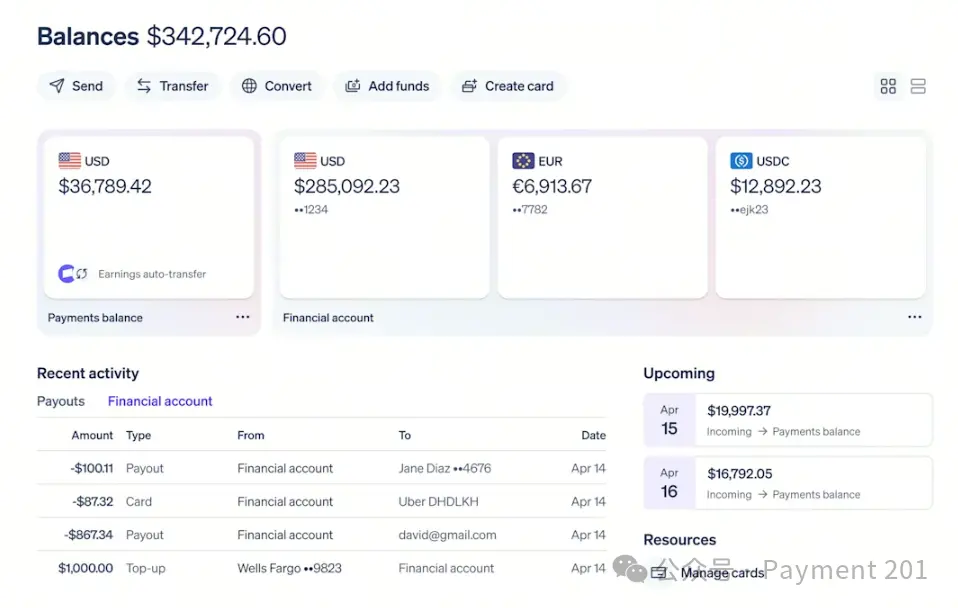
Stripe has already extended from Payment to Financial Accounts, Cards, Financing; Adyen has moved from Payment Processing to Business Accounts, Issuing, and Capital; Airwallex has expanded from cross-border payments and FX to Global Accounts, Multi-currency Balance, and Treasury.
Why?
Because Payment and Account address completely different issues. Payment is a one-time event, while Account is a state.
Payment resolves: how money moves. Account determines: where the money is before it moves; who it belongs to after moving; how much is left; where it can go next.
Thus: Payment helps customers move money once. Account allows you to participate in every subsequent movement of that money.
This is why, as one delves deeper into the payment industry, there is an increasing desire to tackle the most difficult and significant task: Account.
1. Payment is an Event, Account is a State
From a user experience perspective, a Payment may only last a few seconds: click to pay, authorize, succeed, and finish. But from the underlying financial system perspective, this is merely a Money Movement, ultimately reflecting changes in account and ledger states.
Assuming A pays B 100 dollars. Payment describes the arrow in between: Movement. But what the financial system truly needs to record and maintain long-term are the states at both ends of the arrow: State.
Who owns how much money? Is the fund Available or Pending? What Currency is it? Which Legal Entity does it belong to? Has it been Settled? When can it move again?
These questions essentially belong to:
Account + Ledger.
Payments can occur on completely different Rails, but ultimately they must reflect changes in Balance and Ledger. Cards need to be accounted for, Bank Transfers need to be accounted for, Wallets need to be accounted for, and Stablecoins also require Ledger to record Balance and Ownership.
Payment Methods can continuously evolve, but the financial system cannot escape two fundamental propositions:
Money Ownership and Ledger State.
Over the past twenty years, the payment industry has excelled at optimizing that "arrow." Faster, cheaper, higher success rates, smoother Checkouts, and smarter Routing.
However, as Payment itself matures, the truly commercially valuable question shifts from:
How does money move from A to B?
to:
Who controls the Accounts at both ends, A and B?
2. Why does Account represent a deeper business relationship?
If we only look at a single transaction, Payment is certainly important.
But if we consider a customer's lifetime value over the next five or ten years, Account represents a completely different depth of relationship.
1. Payment creates Transaction Relationships, Account creates Financial Relationships
A large enterprise can use Stripe today, add Adyen tomorrow, and then bring in a Local PSP the day after. Large Merchants adopting Multi-PSP is already a very mature industry practice.
Different Providers: different rates, different Authorization Rates, different Local Coverage, different Risk Appetite. Enterprises also need to reduce single-point risks through multiple channels.
Thus, Payment inherently possesses strong Routing attributes.
A Transaction can switch from Provider A to Provider B. A PSP may lose traffic in the next transaction due to success rates, prices, or Routing Strategy. This means that a purely Payment Relationship is not as solid as imagined.
However, if a company further integrates: receiving payments; balances; payments; FX; Corporate Cards; Supplier Payments; financing; Treasury; all into the same system, the relationship undergoes a qualitative change.
Replacing a Payment Gateway may just be a technical integration.
But migrating Accounts, Balances, Payments, Cards, FX, and Treasury is akin to: Finance Infrastructure Migration.
So:
Payment is a transaction, Account is a relationship.
Payment Companies moving towards Account is not merely to sell another Product Module. What they are truly trying to change is: their ecological position in the customer's financial relationship, from a participant in a single Transaction to the owner of a long-term Financial Relationship.
2. Payment only appears in a moment, Account covers the complete lifecycle of funds
Pure Payment Providers primarily participate at the moment when Money Movement occurs. But the lifecycle of enterprise funds extends far beyond a single Payment.
Before money comes in:
Where is it collected from? Through what Rail? In what Currency does it enter?
After money comes in:
Where is it Held? Is it immediately converted to FX?
When funds move:
Which Rail is taken? How is Routing done?
After the transaction is completed:
When is Settlement? Continue Payout or retain Balance? Pay suppliers? Issue salaries? Use Corporate Cards? Conduct Intercompany Transfers? Or enter Treasury Management?
Thus, a once-isolated Payment action is extended into a complete chain of fund life:
Collect → Hold → Convert → Pay → Spend → Finance
This is also why today leading payment companies' product boundaries are becoming increasingly similar: behind Payment is Account, behind Account is FX, and further back are Cards, Capital, and Treasury.
The underlying business logic is very direct:
Payment earns revenue generated from Money Movement.
Account competes for the value generated during the period funds remain, as well as the subsequent financial actions.
Once a Payment is completed, the Processing Fee is essentially determined. However, as long as the funds remain within the Account system, they may continue to connect to: FX, Payout, Card Spend, Financing, Treasury, and even more Financial Product Distribution.
The depth of these two business models is not the same.
3. Transitioning from Transaction Economics to Balance Economics
There is also a layer of value that is often overlooked when discussing Payment: Balance.
I previously analyzed the cross-border payment data for LianLian, Payoneer, and Wise for the first half of 2025.
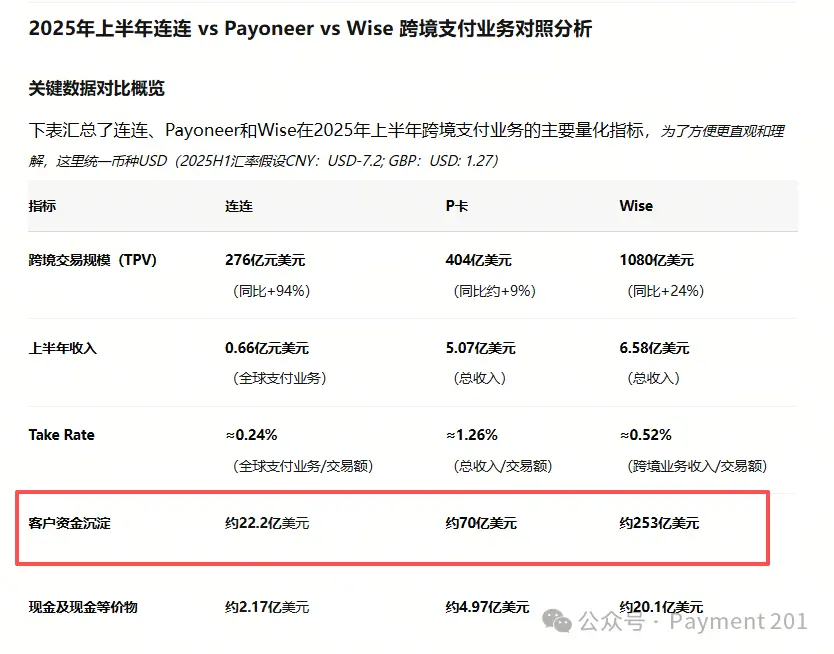
At that time, in addition to looking at TPV, Revenue, and Take Rate, I specifically pulled a metric: customer fund retention. According to the unified criteria at that time, the corresponding customer fund scales for the three institutions were approximately: 2.22 billion dollars, 7 billion dollars, and 25.3 billion dollars. These figures are worth pondering. Of course, adding up to over three hundred billion dollars does not mean that payment companies have their own funds, nor does it imply that these institutions can freely use customer funds for investment. Different Jurisdictions, different Licenses, different Safeguarding Structures, and Banking Agreements impose completely different constraints on how customer funds are stored, whether they can be invested, the ownership of returns, and Yield Pass-through.
However, even considering all these differences, this set of data still reveals a very important commercial change:
When a Payment Company begins to manage tens of billions or even hundreds of billions of Customer Balances, it is no longer just processing Transactions. It begins to manage: Balance.
Once you enter Balance, the economic model changes.
- The pure Processing model revolves around: Transaction Economics. A transaction occurs, generating Processing Revenue, and the transaction ends.
- But the Account model begins to enter: Balance Economics. A Balance that remains in the system long-term can continue to connect to: FX, Payout, Card, Liquidity Management, Treasury, Financing, Yield Product, and other Economics formed around fund retention with Banking Partners.
Thus, Account brings not just a few more Product Revenues.
At a deeper level:
The economic model of Payment revolves around Transactions, while the economic model of Account begins to revolve around Balance.
Transitioning from Transaction Economics to Balance Economics may be the most underestimated business model upgrade in the process of Payment Companies moving towards Account.
4. Payment sees transactions, Account begins to see operations
PSPs certainly possess a wealth of high-value data. TPV, Approval Rate, Refund, Chargeback, Ticket Size, Transaction Frequency. This data can tell you how well this Merchant has been selling recently. It essentially belongs to: Payment Data.
However, as an institution continues to delve into Account, the data it sees begins to change. How much money came in today? How much was paid out today? What is the real-time Balance? What are the different Currency Positions? Which Entity is experiencing continuous net outflows? Is Working Capital becoming tight? Is Cash Flow stable?
Data transitions from: Payment Data to: Cash Flow Data.
This change is very important.
Because Payment Data tells you how well the company is selling today. Account Data begins to tell you how well the company is operating today.
Once Transaction Data and Cash Flow Data connect, higher-level services can naturally grow out of: Lending, Working Capital, Risk Assessment, Cash Flow Forecast, Treasury Services.
Thus: Payment sees transactions, Account sees operations.
This is also the layer of value that is most easily underestimated in Account.
5. Account has the opportunity to become a Financial Operating System
If a company only uses your system for acquiring, you are a Payment Provider.
But if it opens your system every day: checking Balance; managing Multi-currency Position; executing FX; paying suppliers; issuing Corporate Cards; managing Expenses; obtaining Financing; conducting Treasury;
You have entered the Core Workflow that the enterprise Finance team truly uses every day.
At this point, what is being sold is no longer Payment, but a complete: Financial Operating System.
Thus, payment companies continuously expand product boundaries, not simply "doing whatever is profitable."
What they are truly competing for is:
Who becomes the default entry point for daily fund operations of enterprises.
3. Banks have been doing Accounts for hundreds of years; what has Fintech reinvented?
Since Accounts are so important, haven't banks been doing this for hundreds of years? What has Fintech reinvented today?
The answer is:
Many times, they have not reinvented Bank Accounts, but rather redefined Account Architecture and Account Experience.
Today, what is referred to as Account in the industry may correspond to completely different levels.
A Legal Bank Account is a true legal bank account, with the bank bearing corresponding Balance Sheet, capital, liquidity, and regulatory responsibilities.
A Payment Account or Wallet records customer balances and fund rights under the payment system.
A Virtual Account primarily serves Identification, Collection, and Reconciliation; it may have an independent Account Number, but the underlying structure may not correspond to an independent legal bank account.
A Ledger Account records internally within the platform: who owns how much money; how much is Available; how much is Pending; when can it be Settled.
Therefore, much of what Fintech is truly doing is not recreating the Bank Balance Sheet, but rather abstracting the originally complex underlying structure.
In the past, a global enterprise might need to maintain separate: US bank accounts, European bank accounts, UK bank accounts, different Currency Balances, FX accounts, Corporate Cards, and multiple payment systems.
Today, a Fintech can repackage these into: one Global Account, one Multi-currency Balance, one set of APIs, and one Dashboard.
What customers see is a simple:
Account Layer.
But underneath, it may connect to: multiple Banking Partners; various Local Clearing Networks; SWIFT; different Currencies; different Legal Entities; different Safeguarding Structures.
Thus, what Fintech is truly doing is:
Re-softwareing complex financial infrastructure.
It may not necessarily take away the bank's Balance Sheet.
But it begins to compete for: Interface, Ledger, Workflow. And most importantly: Customer Relationship.
However, there is often an overlooked downside to softwareing Accounts
The front-end Account can be abstracted, but the underlying Banking Dependency does not disappear.
A Global Account may appear to the customer as: one Dashboard, one set of APIs, dozens of Currencies, dozens of Countries.
But beneath it, it may actually rely on: Sponsor Bank, Safeguarding Bank, Settlement Bank, Local Clearing Bank, Correspondent Bank. Even different markets may have completely different Banking Partners.
Thus, a very real problem arises:
Fintech can have Account Interfaces but may not necessarily own the final Balance Sheet.
If the underlying bank adjusts its Risk Appetite; exits a certain type of Industry; tightens a specific Country; raises Compliance Thresholds; or terminates a Bank-Fintech partnership, the seemingly stable Account Layer may require re-routing, account migration, re-KYC, or even a complete reconstruction of the fund chain.
Therefore, the Account business has a very important paradox:
Fintech hides the complexity of banks but does not eliminate the dependency on banks.
Furthermore:
Software can abstract Banking Complexity but cannot software Balance Sheet Risk.
A truly mature Account Platform's moat is never just APIs and Dashboards.
It also includes:
Banking Partner Depth.
Multi-bank redundancy.
Safeguarding Structure.
Liquidity Management.
Reconciliation.
And whether, after a bank exits, the Flow can be quickly migrated to another Infrastructure.
Thus:
Having an Account Relationship does not equate to having Account Sovereignty.
A truly powerful Account Infrastructure must address two things simultaneously: the front-end: Customer Experience, and the underlying: Banking Resilience.
4. Why is cross-border payment especially prone to transition from Payment to Account?
Applying this logic to Cross-border Payment becomes even more evident.
Domestic Payment often faces a relatively simple single-currency Movement. For example: CNY → CNY. Consumers pay, and merchants ultimately receive RMB, concluding a Payment.
However, the funds of global enterprises do not operate this way.
A company may simultaneously receive: USD, EUR, GBP, JPY, SGD, KRW. After receiving these funds, they do not immediately convert everything into the headquarters' Functional Currency.
What enterprises truly need to manage is:
Where is the money now?
Which Entity does it belong to?
What Currency is it?
Which funds should remain locally?
Which can be netted?
Which Entity lacks Liquidity?
When should FX be done?
When should repatriation occur?
Thus, the real complexity of cross-border payments ultimately lies not just in: Money Movement, but in: Money Position.
Assuming a Chinese global enterprise:
European revenue in EUR.
American revenue in USD.
Japanese revenue in JPY.
Suppliers primarily need CNY.
Overseas advertising platforms require USD.
The Singapore team needs SGD.
Different Legal Entities also need to retain Working Capital.
At this point, the Finance team is no longer simply asking: "How do I send this international remittance out?"
Instead, they are asking:
Should EUR be converted now? How much USD should be retained? Which regions can be Natural Hedge? Where can netting occur? Which Entity needs Liquidity Injection? When should FX be done? Where is a Liquidity Buffer needed? When should repatriation occur?
This is no longer simple Payment.
This is: Treasury.
Thus, Cross-border Payment Companies are naturally more inclined and urgent to transition to Account than single-currency PSPs.
Because what customers ultimately need is not just a:
Payment Rail.
But a complete:
Global Money Management Infrastructure.
Therefore:
In cross-border payments, Payment resolves Movement, while Account begins to manage Position.
Further down:
Account → FX → Liquidity → Treasury
This is almost a natural product evolution path. A truly mature Cross-border Payment Company finds it hard to remain solely focused on Transfer in the long term.
5. Banks are moving up, PSPs are moving down
If we place the global payment industry of the past decade on a vertical value chain, we will find two forces moving towards each other.
Banks moving up, PSPs moving down.
Recently, during discussions with JPM leaders, we also talked about this trend.
In the past, banks were strongest at the foundational level of the financial system: Accounts, Balance Sheets, Clearing, Liquidity, Compliance, possessing truly scarce financial infrastructure.
However, banks have a natural problem: they have Balance Sheets but may be moving further away from Business Scenarios.
What enterprises truly open every day may not be Internet Banking.
But rather: ERP, e-commerce backends, SaaS, Treasury Management Systems, PSP dashboards, various Enterprise Software.
The customer's Business Workflow occurs at the top, while the bank's Balance Sheet is at the bottom.
If banks only guard their Balance Sheets but gradually lose Client Interfaces and Distribution, they may be continuously compressed into:
Backend Financial Utility.
Thus, banks must move up:
API Banking.
Virtual Accounts.
Embedded Finance.
ERP Integration.
Treasury Integration.
Receivables and Payables embedding.
Essentially, it is all about the same thing: banks want to get closer to customers.
On the other hand, PSPs face the opposite problem. They start off very close to customers. Checkout is theirs, Payment Experience is theirs, Merchant Relationships are also theirs.
However, once a Payment Company reaches a certain scale, it realizes another reality: having Distribution does not necessarily mean having a sufficiently deep Financial Relationship.
Processing Margins are under long-term pressure, Gateways can be replaced, Payment Methods are becoming increasingly standardized, large Merchants will adopt Multi-PSP, and Transactions can be routed at any time.
If they remain at the top level forever, they can easily become a: comparable price, switchable traffic, replaceable Processing Layer. Thus, PSPs must move down. From Payment, into Account, Ledger, FX, Cards, Treasury, Financing.
Essentially, it is the same thing: PSPs want to get closer to funds.
Thus, the global payment industry has formed a very interesting symmetrical structure:
Banks have funds but want more customer entry points. PSPs have customer entry points but want more funding relationships.
Where do both sides ultimately meet?
I believe it is in three areas: Account, Data, Flow.
Account determines: who has the long-term Financial Relationship.
Data determines: who truly understands customer operations.
Flow determines: who controls the path of funds and the subsequent Distribution of financial products like FX, Treasury, Financing, etc.
This also explains why this is not a simple Product Strategy.
Many times, it is:
Something that must be done.
If banks do not move up, they may lose Distribution and Client Interfaces. If PSPs do not move down, they risk remaining in a highly competitive environment, easily routed, with margins under constant pressure from Transaction Processing.
Both sides are looking for the same thing:
Stronger customer stickiness, larger profit margins, more complete data.
And:
Higher Financial Share of Wallet.
Thus, today the product boundaries of banks and PSPs are becoming increasingly blurred, not because the industry suddenly lost its division of labor.
But because:
Both sides are moving towards the most valuable position in the middle of the value chain.
Banks hope to:
Move from Balance Sheet to Relationship.
PSPs hope to:
Move from Transaction to Relationship.
Ultimately, what both are competing for is the same thing:
Primary Financial Relationship.
6. What is truly being contested is not an Account, but the Primary Financial Relationship
In the past, when evaluating a Payment Company, we were accustomed to looking at: TPV, Take Rate, Authorization Rate, Payment Method Coverage, and how many Countries it covers.
These metrics are certainly still important. However, today we may need to add a more critical question:
How much Financial Relationship does this company actually control with its customers?
Traditional banks excel at: Deposit Relationships. Funds are genuinely retained within the bank system, and the bank controls the Balance Sheet.
PSPs initially mastered: Transaction Relationships. Customers found them when they needed to make Payments.
However, what Account Platforms are truly attempting to seize is: Operating Relationships. How much money was collected today? How much Balance is left? When is the payment due? What currency should be exchanged? Where should funds be retained? Which Entity lacks Liquidity?
These daily Money Decisions, if increasingly concentrated on the same platform, bring that platform closer to the customer's true:
Primary Financial Relationship.
A clear hierarchy is emerging:
Legal Banking Relationships and Operating Financial Relationships no longer necessarily belong to the same institution.
The Balance Sheet, Clearing, and Liquidity behind a company may still come from traditional banks like JPM, Citi, HSBC, etc. However, the Interface that the Finance team truly opens and operates funds on a daily basis may come from Stripe, Adyen, Airwallex, or another Financial Platform.
Banks possess Balance Sheets, while Fintech may possess Interfaces and Workflows. Both are important. But the point where commercial value truly begins to be redistributed is:
Who becomes the primary entry point for managing customer funds.
Because once this entry point is obtained, it is not just about this one Payment. It also includes: the next FX, the next Payout, the next Card, the next Financing, the next Treasury Decision. This is the true commercial value of Account.
Of course, this does not mean that all PSPs will ultimately become Banks.
As one delves deeper into Account and Treasury, one will find that traditional financial infrastructure remains heavy: Settlement, Liquidity, Credit, Compliance, Risk Capital, Balance Sheet. These capabilities cannot be created out of thin air by a pretty Dashboard or a few sets of APIs.
What is more likely to emerge in the future is a further restructuring of the financial value chain:
Bank: Balance Sheet + Regulatory Trust + Liquidity
Fintech: Technology + Ledger Architecture + Orchestration
Payment Network: Money Movement Infrastructure
Platform: Business Scenario + Distribution
The most valuable positions will increasingly appear at the intersections of these capabilities. Who possesses the Account Interface? Who sees Cash Flow? Who controls Flow? Who decides where the next Money Movement goes?
Thus, the financial concept of Account, which has existed for hundreds of years, becoming the core of competition between Payment and Fintech, is not because everyone suddenly realized "accounts are a good business."
What everyone is truly competing for has never been: an Account Number.
But rather: the control of funding relationships.
7. Will Stablecoins make Accounts disappear?
Finally, there is a more forward-looking question:
If Accounts are so important, will the current form of Accounts always exist?
Not necessarily.
When we talk about Accounts today, we usually think of: Bank Accounts, Payment Accounts, Virtual Accounts, Internal Ledgers.
However, Stablecoins, Tokenized Deposits, and Programmable Ledgers are raising a more fundamental question:
Does Money State have to be recorded in traditional Bank Ledgers?
Not necessarily.
The State of traditional Bank Accounts is recorded in: Bank Core Ledgers. The State of Payment Accounts is recorded in: Payment Institution Ledgers. The State of Stablecoins can be recorded in: Blockchain Ledgers.
In the future, the "Account" that enterprises see may not always be a traditional Account Number. It could be a set of Wallets, a Tokenized Deposit, a Programmable Balance, or even a set of Money Positions controlled by Smart Contracts.
But this does not overturn the logic of Accounts discussed in this article.
On the contrary.
What Stablecoins change is the form of Account existence, not the problems that Accounts solve.
Because regardless of whether the Money State is ultimately recorded in: Bank Core; Fintech Ledger; or Blockchain,
The financial system always needs to answer the same questions:
Whose money is this? Where is it now? Who has the right to move it? Where can it go next?
Thus, what may truly change in the future is: Account Form. What will not easily disappear is: Account Function.
And what all financial institutions are truly competing for remains: Account Relationship.
As for Neobanks, they represent another form of change.
Neobanks have not reinvented Money State; they are essentially redesigning Account Experience, Interface, and Customer Relationship.
Some Neobanks hold Banking Licenses themselves, with the underlying Balance Sheet and Ledger in their hands; others rely on Sponsor Banks, EMIs, or Banking-as-a-Service, presenting users with a complete "account experience," while the underlying true Legal Accounts and Balance Sheets still reside with partner financial institutions.
Neobanks further illustrate one thing: the front-end experience of Accounts, legal accounts, Ledgers, and Balance Sheets are increasingly able to be held by different institutions separately. In the future, Accounts may no longer be a product "fully packaged" by one institution; they are more likely to become a set of financial capabilities that are re-split and re-combined.
However, regardless of how technological forms and institutional boundaries change, the ultimate competition remains unchanged:
Whoever controls the Account Relationship is closer to the customer's next financial action.
Conclusion: Payment is the entry point, Account is the relationship
Accounts are heavier, more difficult, and carry greater regulatory responsibilities. Why do people continue to move into them?
Because:
Payment solves Move Money, Account solves Manage Money.
Payment is a transaction, Account is a relationship.
Whoever controls the Account is closer to the customer's next Payment, FX, Financing, and Treasury Decision.
Thus, the true value of an Account has never been that Account Number.
But rather:
It is inherently closer to the customer's next financial action.
 Risk warning