The faster the payment, the more you need credit?
 Core Viewpoint

 Payment mobile money, liquidity scheduling money, credit allows future financial capacity to support today's payment in advance.
Author: Steven, Payment 201
In the payment industry, there has always been a time lag that is both obvious and overlooked by many. A merchant's funds may only settle on T+1, but the recipient demands payment today; a marketplace has just completed consumer collection, and the seller has already clicked to withdraw; a cross-border payment company has just received USD in the United States, but the beneficiary in Mexico hopes to receive MXN in just a few seconds.
From the user's perspective, these matters are simple: Payment completed.
But from the perspective of treasury and balance sheets, the issue is entirely different: the money hasn't arrived yet, so why can it already be paid out? During those hours, or even that day, whose money is being used?
The most direct answer is that the payment company itself pays first. If the corresponding funds only arrive tomorrow, but the PSP completes the payout from corporate cash today, this is primarily a Self-funded Prefunding: the PSP absorbs the timing gap using its own balance sheet.
However, there are two frequently conflated issues here.
First, the PSP paying with its own money does not automatically mean it has "issued a loan" to the customer in a legal or product sense. From the treasury's perspective, it primarily reflects Balance Sheet Usage and Funding Exposure.
Second, and more realistically:
The PSP handles a lot of money every day, but that doesn't mean all that money can be used for prefunding.
Customer funds, corporate cash, and credit capacity are three completely different things. Once payment reaches a certain scale, credit gradually shifts from being a financial product to a part of payment infrastructure, essentially because these three sets of figures start to mismatch increasingly.
1. Just because the PSP handles a lot of money doesn't mean it can use all that money for prefunding
This point is very intuitively visible from the balance sheet of a listed payment company.
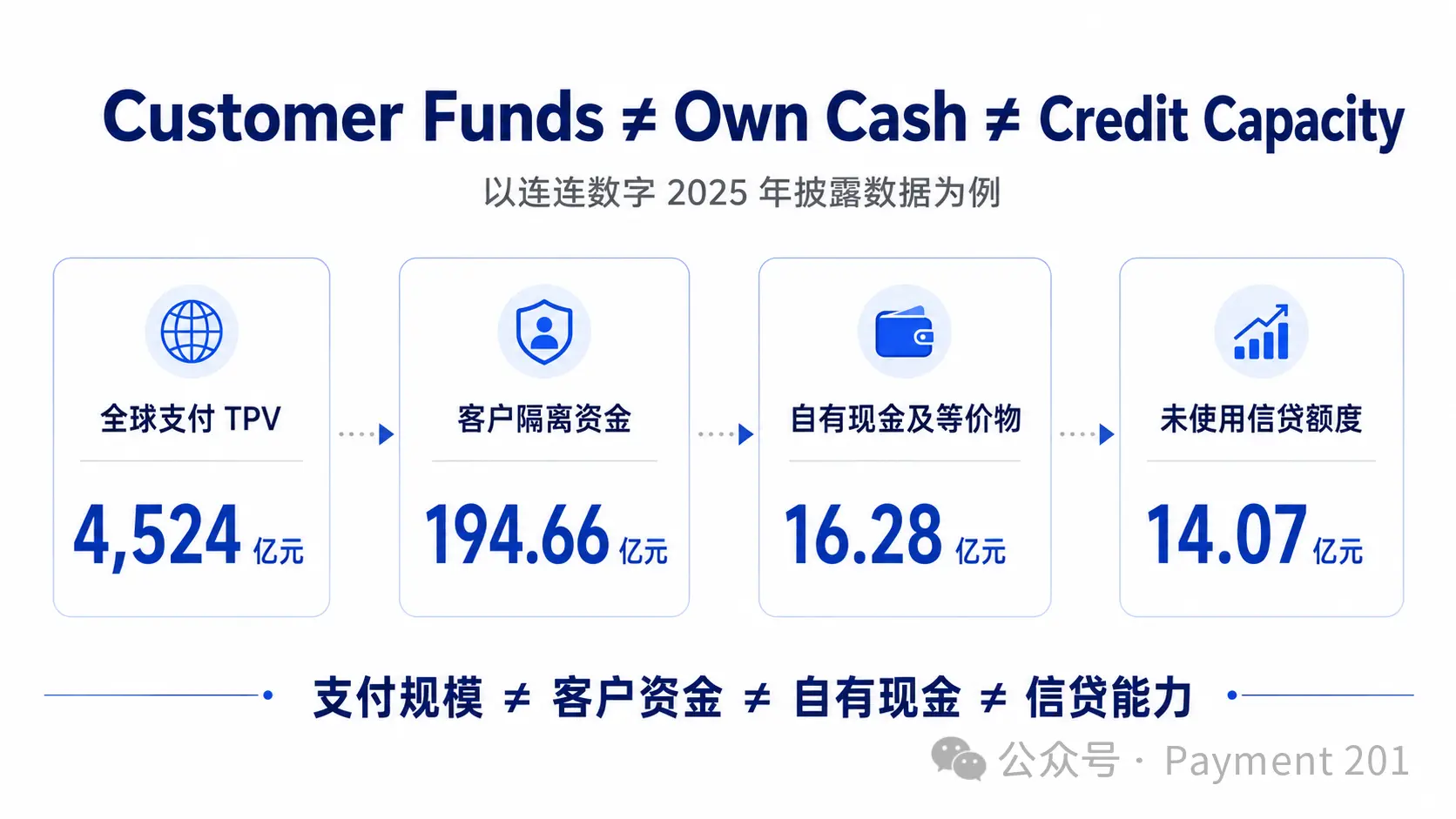
Taking LianLian Technology as an example, in the full year of 2025, its Global Payment TPV reached 452.4 billion RMB, a year-on-year increase of 60.7%.
But looking further down the balance sheet, as of the end of 2025, the company had Cash and Cash Equivalents of approximately 1.628 billion RMB, Total Equity of approximately 3.072 billion RMB; meanwhile, Customer Segregated Funds were approximately 19.466 billion RMB.
When these figures are put together, they most intuitively illustrate one thing:
Customer Funds and Corporate Liquidity are two different things.
A payment company can handle hundreds of billions or trillions of funds each year, but it neither needs nor can possess an own balance sheet of the same scale as its annual TPV. This is the very foundation that allows the payment business to scale.
On the other hand, as long as there is a misalignment between payment obligations and cash arrival, the money that can actually be used to complete payments in advance is not "all the money handled by the platform."
Instead, it is:
Its own corporate liquidity and pre-arranged external funding capacity.
LianLian also disclosed approximately 1.407 billion RMB of unused bank credit lines during the same period. Of course, this does not mean that these credit lines are necessarily used for payment prefunding, but it illustrates another layer of financial capacity well:
The actual funding capability that a payment company can call upon is not just equal to the cash on hand.
Thus, there are three sets of figures in the payment industry that are particularly easy to confuse:
Customer Funds determine how much you manage.
Own free cash determines how much you can prefund.
Credit Capacity determines how much more you can commit when your own free cash is insufficient.
And the third layer is what this article really wants to discuss.
2. If the money hasn't arrived, why can it already be paid out?
Assuming a marketplace needs to pay a seller 100 million at 10 AM today, but the corresponding consumer funds are not truly available until the afternoon or even the next day (which could be due to various reasons, including acquiring settlement cycles, business architecture C2B2B2C/B arrangements, bank review efficiency, etc.).
From the product page, this is just a payout.
But starting from 10 AM, the platform has already formed a 100 million payment obligation, while the cash that truly corresponds to this obligation has not yet entered a freely usable state.
Thus, a segment appears:
Funding Gap.
If the marketplace chooses to wait, then this time is borne by the seller—when the money is truly available, that is when the payment occurs.
However, if the product promises T+0, same-day, or even instant payout, the platform is actually actively taking this waiting time away from the seller.
The problem does not disappear; the time is just borne by someone else.
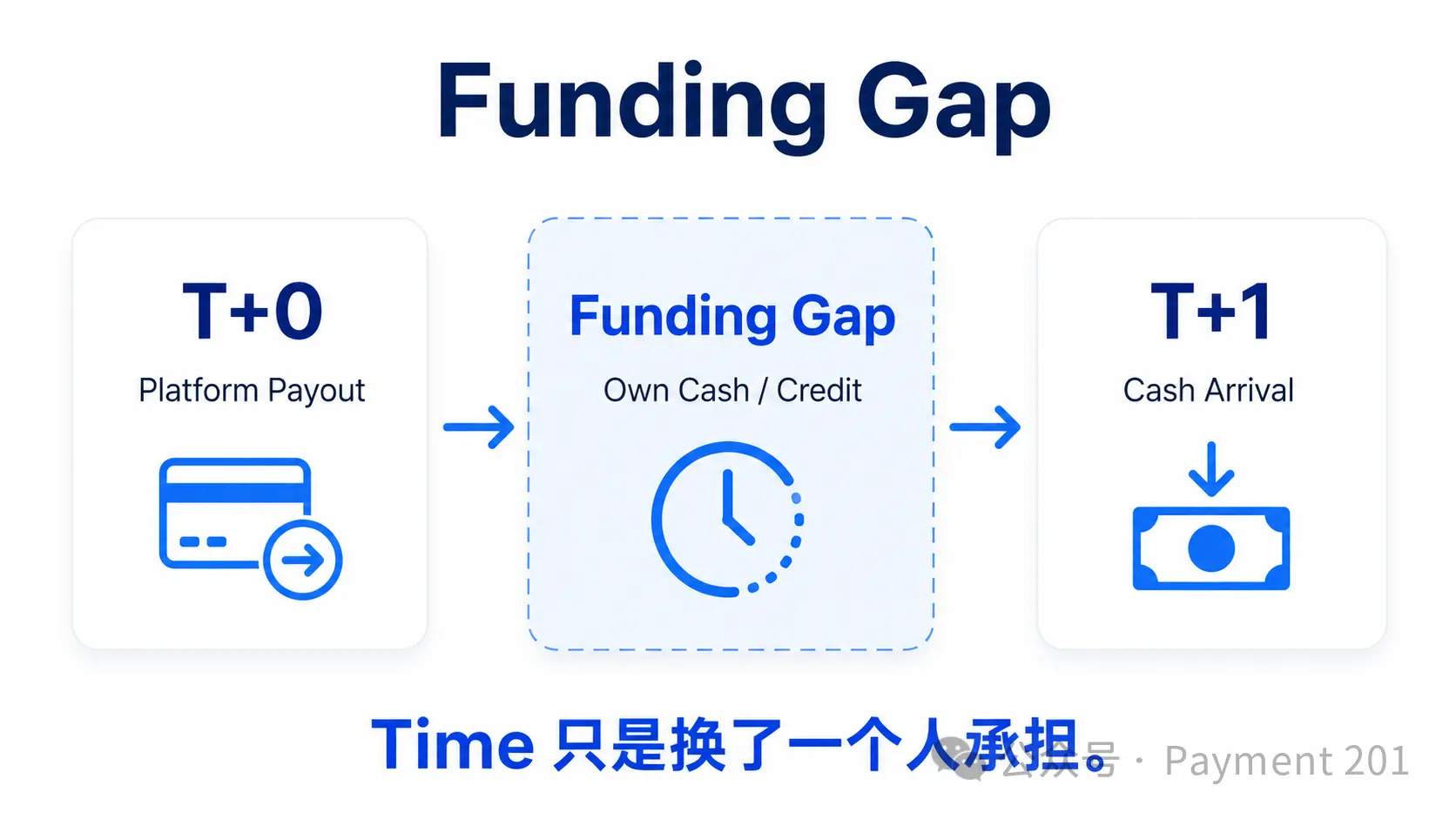
The simplest solution is, of course, for the platform to pay first. If corporate cash is sufficient, complete the payout today, and then restore its cash position after the corresponding funds arrive tomorrow.
This is primarily a Balance Sheet Decision.
The platform chooses to use its own capital to exchange for a better payment experience.
When the scale is small, this matter may not even feel like credit exists. A treasury buffer may solve it.
But if daily payment volume increases from 10 million to 100 million, and then to 1 billion, the funds required for the same day's timing gap will quickly expand.
More importantly, even if the PSP has money, it does not mean that doing this long-term is a good capital allocation.
To cope with peaks that may only occur a few times a year, permanently keeping hundreds of millions in the account is itself a very expensive opportunity cost.
Thus, the question quickly becomes:
What if own free cash is insufficient or it simply isn't worth continuing to use own free cash?
One option is to retract the payment experience.
Delay payouts, increase prefunding requirements, lower volume limits, or in extreme cases, even suspend certain payments.
Another option is:
Find another balance sheet.
Bank credit lines, overdrafts, intraday facilities, settlement financing, private credit…
So the first encounter between payment and credit is not that the PSP has launched a loan product.
Instead:
Payment begins to cross time.
3. Where is the difference between liquidity and credit?
This is easily confused with liquidity.
Assuming Mexico needs 20 million MXN today, but there are only 5 million in the local account. If the group's Hong Kong account has enough USD and can complete FX now, then transfer the corresponding MXN position to Mexico, this is primarily: Liquidity Management.
The corporate balance sheet has not increased as a result. Money has merely been moved from one currency, location, and position to another.
Liquidity addresses: how to allocate existing resources.
But if the total own liquidity currently available to the group can only provide 80 million, while today a payment obligation of 100 million has already formed, then the remaining 20 million cannot simply be solved by moving money from A to B.
Now the real question becomes:
Where does this gap come from?
The company can certainly prepare an additional 20 million cash permanently, which is still self-funded.
But if it does not want to permanently occupy its capital for all possible peak demands, it needs banks, credit providers, or other capital providers to provide additional funding capacity.
So the more accurate relationship is not simply:
Liquidity → Credit.
But rather:
Liquidity addresses how to use existing resources.
Funding addresses where to fill the gap.
Credit is one important way to obtain additional funding capacity.
This distinction is very important because self-funded prefunding does not equal borrowing, nor does it mean the PSP has issued a credit product to the customer.
However, as payment scales up, relying solely on own free cash to cover all peak demands will inevitably lead to decreasing capital efficiency.
At this point, what credit truly provides is not just "lending you more money."
But rather: Elasticity.
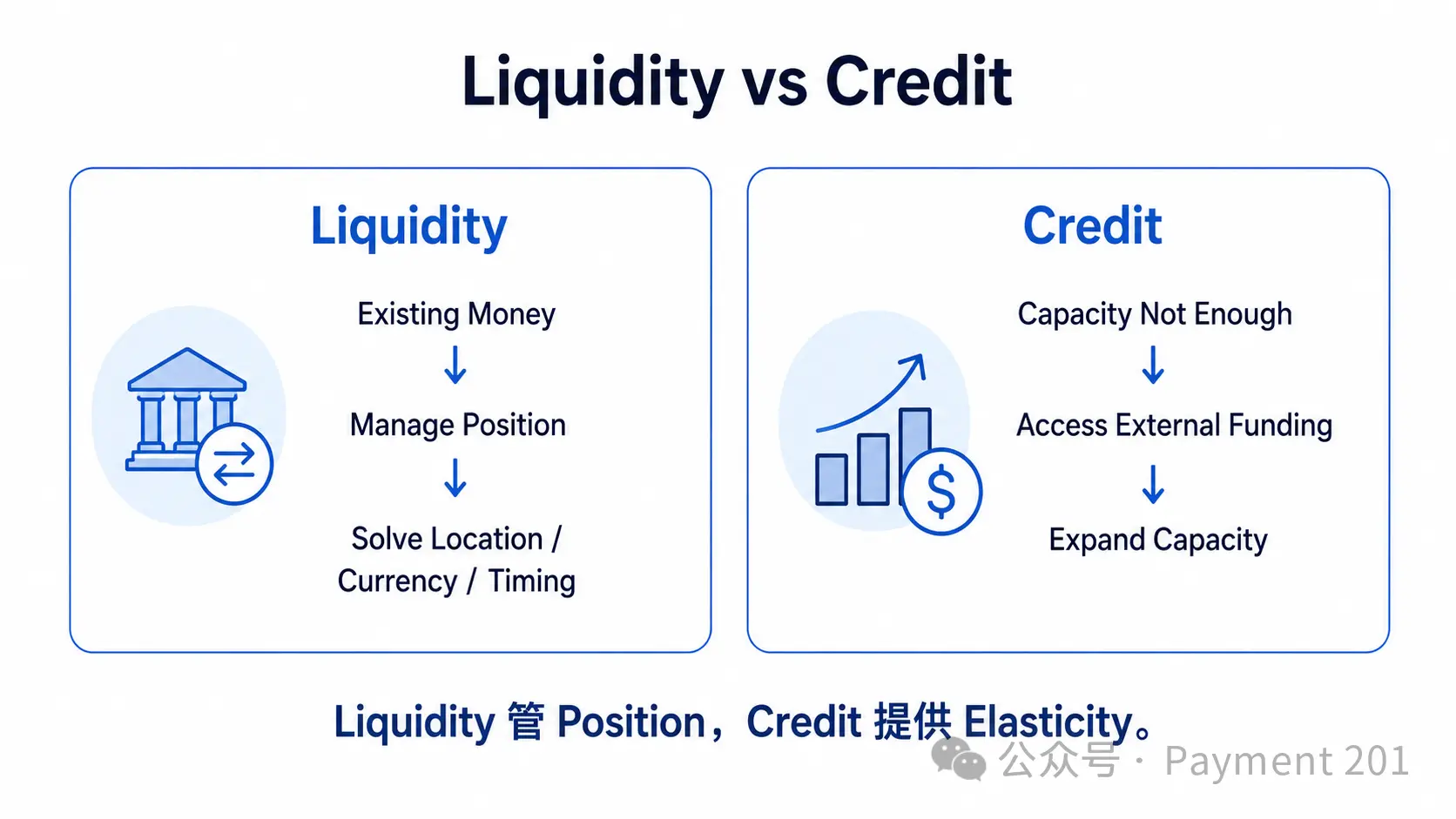
Liquidity determines how existing money is used. And credit determines when existing money is insufficient: whether capacity can temporarily increase.
4. The experience of instant payment is often paid for by the balance sheet in the background
Over the past decade, the payment industry has been doing one thing: making money move faster. T+3, T+2, T+1, same-day, T+0, and now increasingly instant payments represent a clear evolutionary path from the user's experience.
However, there is a very counterintuitive issue in financial infrastructure:
The speed at which the recipient receives money does not mean that upstream cash arrival is equally fast.
In the past, merchants received money on T+1, while PSPs also obtained corresponding settlements on T+1, so the timing on both sides roughly matched. Today, to compete, platforms have moved merchant payouts to T+0. But if the underlying settlement is still T+1, then a funding gap that did not originally exist appears.
Thus, the industry appears to be continuously eliminating settlement time. In reality, many times, it is merely taking that time away from customer experience and placing it back into the financial institution's balance sheet.
The user experience of instant payment is often paid for by the balance sheet in the background.
The more real-time payment becomes, the timing risk does not simply disappear. It is merely redistributed; the seller does not wait, the platform does. The merchant does not wait, the acquirer does. If the client is unwilling to prefund, the PSP must decide: bear it themselves or find someone else to bear it.
This logic has even been directly turned into a product.
For example, YouLend's instant settlement/instant payout essentially allows merchants to receive funds corresponding to receivables earlier when a sale has already occurred, but normal settlement has not yet been fully completed.
It is essentially the productization of the question posed at the beginning of the article:
Sale happened, cash hasn't fully followed.
But the merchant:
Gets paid anyway.
The time that originally needed to be waited has been consumed by financing.
Stablecoins also do not automatically make this problem disappear.
Blockchain can transfer 24/7, but fiat banking, FX, redemption, local clearing, and traditional funding markets do not necessarily synchronize 24/7.
So:
24/7 Settlement ≠ Zero Funding Requirement.
One could even think in reverse: in the past, if a payment couldn't be processed on Saturday, users would default to waiting until Monday. If in the future, Rail can also achieve instant settlement on Saturday morning, then another question immediately arises:
Where does the liquidity and funding for that Saturday morning come from?
The more real-time Rail becomes, the more the backend team cannot rely solely on saying, "wait for the money to arrive."
5. Ultimately, payment scale competes on credit elasticity
With a daily volume of 1 million, where 10% has a timing gap of a few hours, only 100k needs to be temporarily covered. With a daily volume of 1 billion, the same 10% timing mismatch means 100 million.
However, real payment networks never operate along a smooth curve every day.
Paydays, promotions, bank holidays, weekends, FX volatility, settlement delays, and banking disruptions can suddenly create payment obligations far exceeding normal levels in a market within a few hours.
Thus, large PSPs cannot simply pile up cash permanently in dozens of markets based on historical peak volumes.
Theoretically, this is safe, but economically it is extremely expensive.
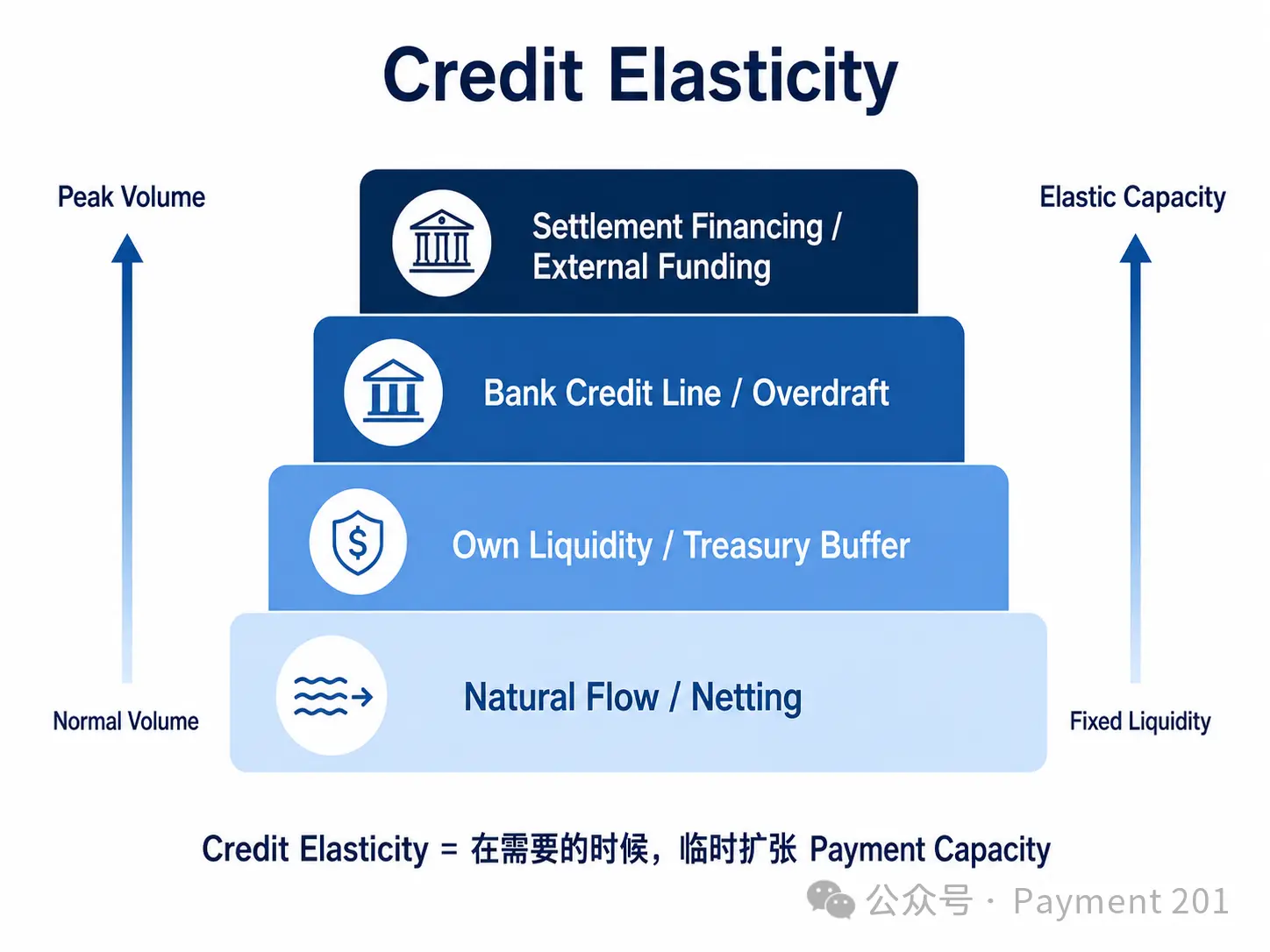
A mature payment network will ultimately require a layered capacity for funding capability.
Normal flows can be digested through natural flow, netting, and own liquidity; ordinary fluctuations are borne by treasury buffers; only larger gaps begin to call upon bank credit lines, overdrafts, intraday facilities, or even settlement financing or other external funding.
Therefore, once the scale truly expands, a payment network needs more than just a fixed liquidity pool. It requires a form of: credit elasticity.
Liquidity capacity answers: under normal circumstances, how much can I pay today? Credit elasticity answers: when things suddenly become abnormal, how much more can I pay?
This is why players like Huma/Arf and MANSA are worth paying attention to.
What they are truly trying to change is not the payment rail but rather the capital deployment model behind the payment network.
In the past, it was more about: pre-positioned capital. Treasury would borrow money first, adjust funds first, prepare balances in various markets, and then wait for the payment system to consume these positions.
However, Huma/Arf and MANSA represent a direction that is closer to:
Payment occurs → Liquidity/Credit is called → Settlement is completed → Capital is recovered.
That is:
On-demand Financial Capacity.
After the merger of Huma and Arf, one of the core scenarios is cross-border payment financing, reducing some payment institutions' reliance on static prefunding through on-demand liquidity; MANSA directly provides settlement-time liquidity for PSPs, EMIs, remittance institutions, etc.
What I find most noteworthy is not whether these companies use stablecoins.
But rather:
Credit capacity is beginning to shift from static existence to dynamic invocation.
If this model can scale further, it will change not only funding costs but also the entire treasury architecture. Payment companies will no longer need to permanently prepare the same scale of cash for all possible demands across all corridors.
Own free cash gives you basic capacity, credit gives you elasticity.
6. Why do companies that master payment flow naturally move towards credit?
What has been discussed earlier is: credit for payment, that is, how credit supports payment flow.
But there is another direction between payment and credit:
Credit from payment.
This also explains why platforms like Stripe, Adyen, PayPal, and Block, which master payment flow, easily grow into merchant financing and working capital.
The reason is not complicated.
Traditional lenders do underwriting and need to understand a company's revenue, cash flow, seasonality, growth, customer concentration, and future repayment ability.
Payment companies see this information every day. TPV, transaction frequency, average ticket size, refunds, chargebacks, sales trends, seasonality… If combined with account and settlement relationships, they can even further see cash inflow, cash outflow, account balance, supplier payments, and working capital cycles.
These are not financial statements submitted by enterprises once a year.
But rather continuously occurring:
Real-time business activity.
Thus, payment data naturally becomes:
Underwriting data.
However, what makes payment companies truly special in credit is not just that they have more data.
More importantly:
They often also control cash flow.
Assuming a merchant generates 100k in sales daily through the platform, and the platform provides it with 1 million in working capital.
Repayment does not necessarily require the merchant to actively wire transfer every month.
It can completely occur directly in the future:
Settlement → Deduction → Repayment.
Stripe Capital is a very typical structure. Stripe combines processing volume and payment history to form financing offers, while repayment can be directly completed proportionally from future Stripe sales; at the same time, Stripe's merchant relationship, payment flow, and the entity ultimately providing the balance sheet do not necessarily have to be the same company.
This model is particularly worth referencing.
Because it illustrates that having a credit product does not mean you must own the final balance sheet.
The payment platform can be responsible for:
Flow + Data + Distribution.
While banks or other capital providers are responsible for:
Funding + Risk Capital.
This is also one of the biggest structural differences between payment companies and traditional lenders:
Payment companies not only see cash flow, but often also control cash flow.
On one side, flow addresses underwriting, while on the other side, it directly becomes the repayment rail. Thus:
Underwriting → Disbursement → Repayment
begins to be entirely embedded in flow.
From this perspective, the entry of payment companies into credit is not just a product expansion.
It has a very strong infrastructure logic behind it:
Flow itself is both data and the repayment rail.
7. Ultimately, credit will return to the balance sheet
If a payment platform already has flow, data, and customer relationships, why not do all the credit themselves?
Because data and balance sheets are two completely different capabilities.
Payment platforms are better at:
Flow / Data / Distribution / Customer Relationship / Repayment Control.
Banks and institutional capital are better at:
Funding / Credit Capacity / Risk Capital / Balance Sheet.
The resources both sides possess are not the same.
Therefore, what is most worth observing in the future of payment + credit may not be that more and more PSPs become banks.
Rather, it may be that the entire credit stack is becoming increasingly clear:
Payment Platform: Flow + Distribution
Credit Infrastructure: Underwriting + Orchestration
Bank / Private Capital: Balance Sheet
Stripe Capital already shows this structure: credit products can be embedded in the payment experience, but the ultimate financing provider does not necessarily have to be the payment platform itself.
Huma/Arf and MANSA are trying to bring similar decoupling further into payment settlement itself.
In the past, bank credit lines and payment systems were often two relatively independent infrastructures.
In the future, credit capacity itself may increasingly connect directly to payment flow, dynamically invoked when settlement truly occurs.
Thus, the real question to ask in the future is not: "Which PSP has started offering loans?" but rather: Who controls the flow? Who decides credit? Who ultimately provides the balance sheet?
These three things increasingly do not need to occur within the same company.
Payment companies have flow.
Banks and capital markets have balance sheets.
And credit:
Is the layer that connects flow and balance sheets.
Conclusion: Credit is not a branch of payment, but the price of time
Returning to the question posed at the beginning of the article:
If the money hasn't arrived, why can it already be paid?
When the scale is small, the answer may be very simple: the PSP pays first, which is primarily self-funded prefunding.
As the scale increases, it can be managed through treasury adjusting positions within its global balance sheet.
However, as payment obligations become more real-time, volumes increase, and own free cash cannot expand indefinitely, external funding must begin to be sought.
Thus, payment, liquidity, funding, and credit are actually layers that go deeper.
Payment addresses:
Money movement.
Liquidity addresses:
How existing money appears in the right place at the right time.
Funding addresses:
Where to fill the gap when existing positions are insufficient.
And credit further addresses:
How to bring additional financial capacity forward based on future repayment ability.
This repayment ability can come from future cash flow, receivables, collateral, or the institution's own credit profile.
So:
Liquidity manages positions.
Credit provides elasticity.
Going one layer deeper, what truly determines how large the entire network can grow remains:
Balance Sheet.
This is why the payment industry will ultimately get closer to credit.
Not because all PSPs want to become lenders in the end.
But because the more real-time payment becomes, the larger the volume, and the more complex the settlement chain, the more there is a need for someone to answer a particularly practical question:
The money hasn't arrived today, but payments cannot stop. What should be done?
If one's balance sheet is sufficient, they bear it themselves.
If not, they must call upon someone else's balance sheet.
Of course, the so-called "Credit is the price of time" does not mean that credit only charges for time. What is truly priced is the credit risk, liquidity cost, capital consumption behind this timing gap, and the price that fund providers are willing to bear for this uncertainty.
Thus, credit has never been just a loan product; it is more like a layer of financial capacity that can dynamically expand when the payment network faces time, peak volume, and settlement mismatch.
In this sense:
Customer funds determine how much you manage.
Own free cash determines how much you can prefund.
Credit capacity determines how much more you can commit when your own cash is insufficient.
And the fundamental fact at the bottom of the payment industry has always remained unchanged:
Payment volume can far exceed the PSP's own balance sheet, but when cash arrival and payment obligations are not synchronized, this gap must ultimately be borne by a certain balance sheet.
Payment moves money, liquidity allocates money, and credit allows future financial capacity to support today's payments in advance.
Ultimately, what a balance sheet determines is not how many transactions you have processed historically.
But rather, when the money has not truly arrived—
How much are you still willing to commit?
 Risk warning