Betting on the Frontier: Why the Best Crypto Investments Are Born in Bear Markets
 Core Viewpoint

 The best investment opportunities are often hidden in the worst emotions.
Author: Jocy Lin, IOSG
This article is compiled from Jocy's keynote speech at Money Frontier 2026 in Hong Kong. For ease of reading, we have made moderate edits while staying true to the original meaning and corrected any verbal slips and abbreviations.
I. Opening: Know the White, Guard the Black
Hello everyone, I am very pleased to be invited by the Benmo community to gather with you here in a bear market.
The theme I want to share this time is very interesting------Contrarian Investing, Betting on the Frontier: Why Investments in a Bear Market Often Yield the Greatest Returns.
Let me briefly explain the background. This should be the fourth bear market I have experienced. This time, many people's feelings are very obvious, but it is also very different from previous ones. I really like a saying from the "Tao Te Ching": "Know the white, guard the black": knowing what is bright, yet willing to stay in the dark to persist. This itself is a virtue.
Before going on stage, many friends asked me: Is IOSG still investing?
We are still investing. The current feeling is very similar to 2018 and 2019------many people do not know how to invest. IOSG will continue to invest in the crypto market; we do not want to become "the last gatekeeper of Asian crypto VC." We hope more investors will join Web3 to help more Asian entrepreneurs move towards a better future.
Today, I will first clarify the big picture with three "appetizers"------Bitcoin, stablecoins, and Ethereum------and then discuss four directions regarding the real businesses we see making money on the front lines.
II. Bitcoin: Four-Year Cycle, Overcoming All Narratives
Let’s talk about Bitcoin first.
The recovery from the low point in 2022 has been driven by several catalysts unique to Bitcoin: the collapse of Silicon Valley Bank in 2022, the hype around spot ETFs pushing the price to $60,000, and Trump’s election pushing it to about $120,000. By the end of 2025, most of these catalysts will have been fully priced in.
Since then, the situation has changed. After 2025, as the AI cycle begins, assets related to AI, gold, and Nvidia are all strengthening. Logically, these conditions should be favorable for Bitcoin, but Bitcoin has stopped responding to them, having dropped 29% from the beginning of the year to now.
Why is this happening? Borrowing a phrase from the Benmo community's "Bitcoin Divine Power," it is very interesting: The four-year Bitcoin cycle has once again overcome all more complex narratives. The cyclical framework previously pointed out that Bitcoin would peak in October 2025, and that is precisely the case; the subsequent bear market also began in October 2025.
Many people may argue that the four-year cycle could just be a coincidence. However, we see that many crypto OGs reinforce this four-year cycle: as long as enough investors expect the market to peak at some stage in the cycle, they will reduce their positions at roughly the same time------collective behavior, in turn, creates the cycle they expect. This also explains why Bitcoin continues to decline despite favorable macro conditions. The number of people who believe "AI, gold, and the market" can support Bitcoin is actually decreasing.
Therefore, I believe the cycle still holds. In the coming months, the focus is no longer on explaining "why Bitcoin is underperforming," but on identifying whether the next accumulation phase has already begun.
Here, I also want to share some internal data research from IOSG. We have tracked the duration of each cycle, and the results are astonishingly consistent: since 2015, the uptrend has been around 1060 days. Based on this, we have provided several possible scenarios for this cycle:
- Scenario 1: Bitcoin may bottom out in the $45,000--$60,000 range by the end of October this year (2026);
- Scenario 2: A bit lower, dropping to $40,000--$55,000 in Q1--Q2 of 2027;
- Scenario 3: Various other versions.
To be honest, there will be many versions of predicting cycles, but our internal data research points to the first version.
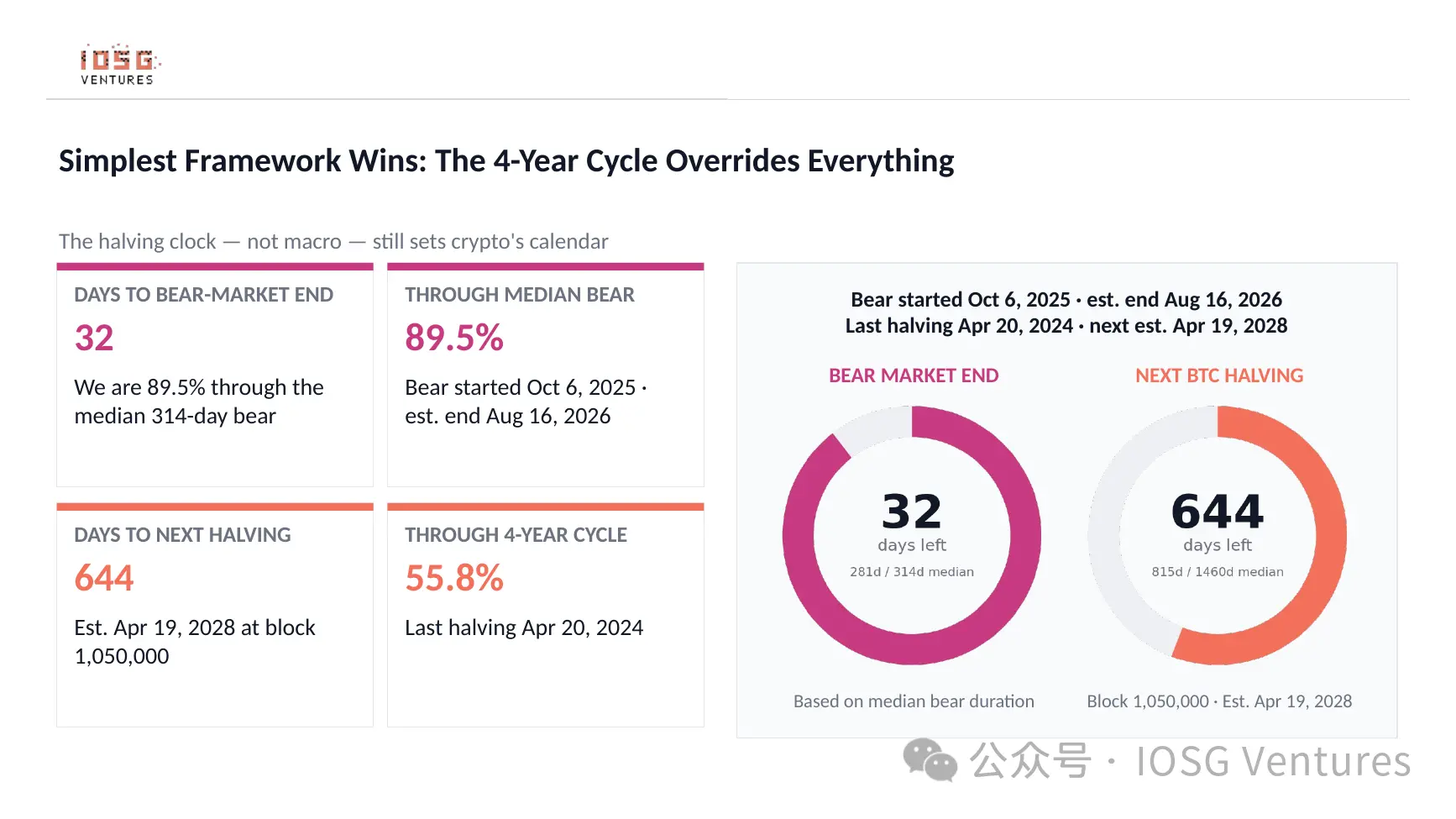
▲ Four-Year Cycle and Bottom Scenarios
III. Stablecoins: A Year as Important as 1975 and 2001
The second "appetizer" is stablecoins. This year is a big year for stablecoins, a very influential year.
I want to make two comparisons.
On May 1, 1975, the SEC abolished the fixed commission system that had been in place on Wall Street for 183 years, transforming stock trading from a game for the wealthy into one that ordinary people could participate in, ultimately giving rise to a $140 trillion asset management industry, with Fidelity and Vanguard emerging afterward. In 2001, China joined the WTO, which was also one of the most important events that changed the entire Chinese economy.
I believe we are witnessing the same thing happening again today, but this time the stage is the stablecoin sector of the crypto industry. The GENIUS Act becoming law means that banks can now legally issue dollars on-chain. I believe that after this bill is passed, crypto will reach a turning point, transforming from "high-risk assets" to "legitimate financial infrastructure." Looking back, 2026 will be remembered in history like 2001.
IV. Ethereum: Moat, Challenges, and Future Leadership Questions
Now let’s talk about Ethereum. This topic is complex, so I have listed two tables: one for its advantages and one for its problems.
There are four advantages: As a settlement layer, it carries the largest stablecoins and RWAs; security and yield------most of DeFi's security and yield are on Ethereum; scaling through Layer 2, the entire Rollup ecosystem ultimately settles back to Ethereum; and it has more developer infrastructure than any other L1.
The problems are also very real: L2 has taken away the fees originally paid to L1; the ETH/BTC ratio has clearly underperformed this round; and there are new public chains like Hyperliquid, as well as competition from off-chain.
But I think the core issue is not these. Recently, I have written a lot about Ethereum on Twitter. My core point is: if we compare Vitalik and Elon Musk, many of the things Vitalik says often take 10 years for you to truly understand why he said them and why they can be realized. What we most hope for is that Vitalik can be on the front lines like Elon.
Vitalik now also says he wants to turn Ethereum into a "smaller ship." But to be honest, from Tomasz's departure to the establishment of new institutions for Ethereum, these ultimately point to a core question: Who will provide leadership for Ethereum? Who will govern? Who will manage? Which founder can stand on the front lines and make this decentralized, open organization great again? I think this is a very big challenge.
As for stablecoins themselves, everyone is also very familiar: Ethereum mainly focuses on institutional funds and developed markets; Tron mainly focuses on USDT, serving developing markets and cross-border dollar flows.
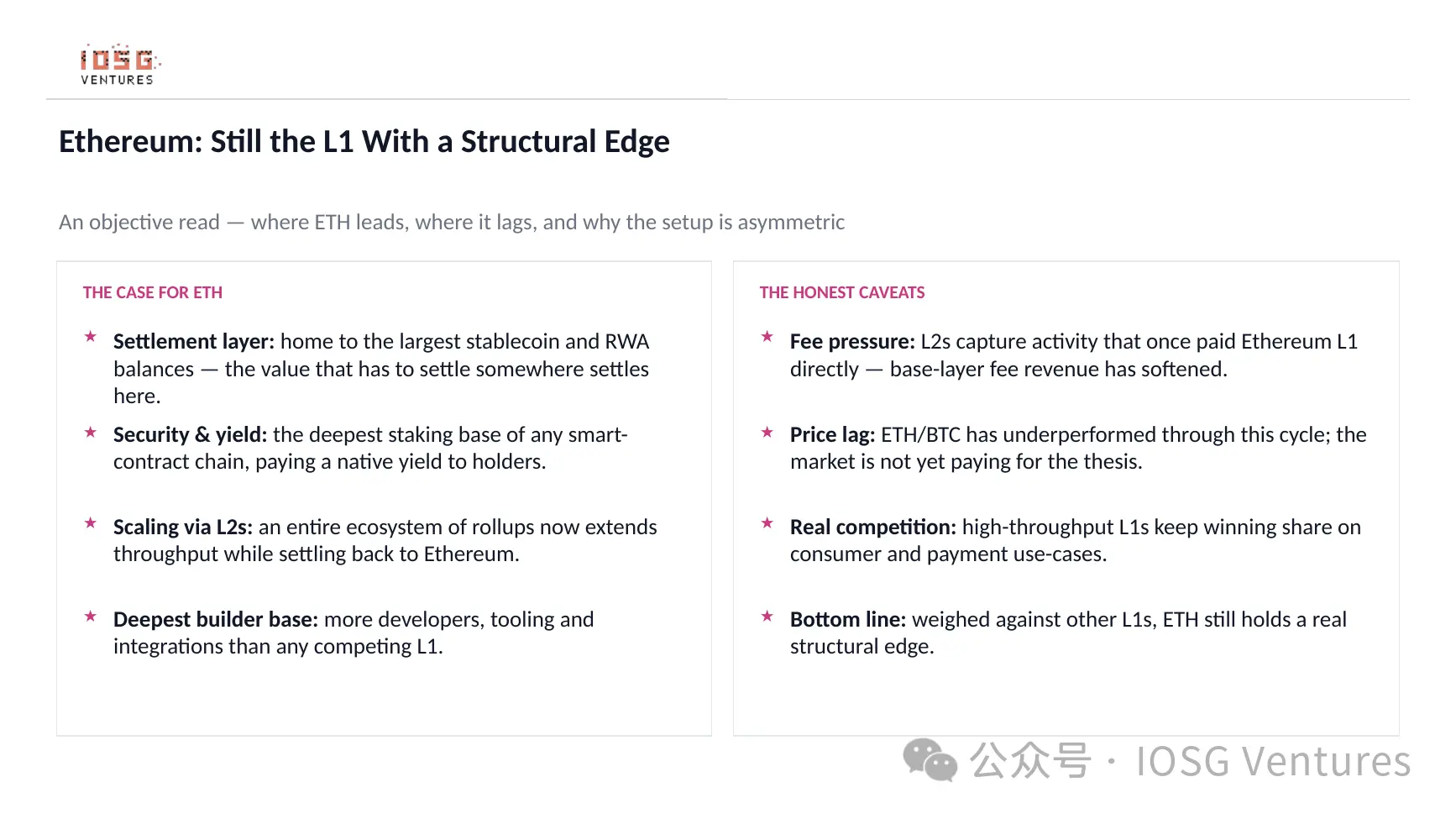
▲ Ethereum: Advantages and Shortcomings
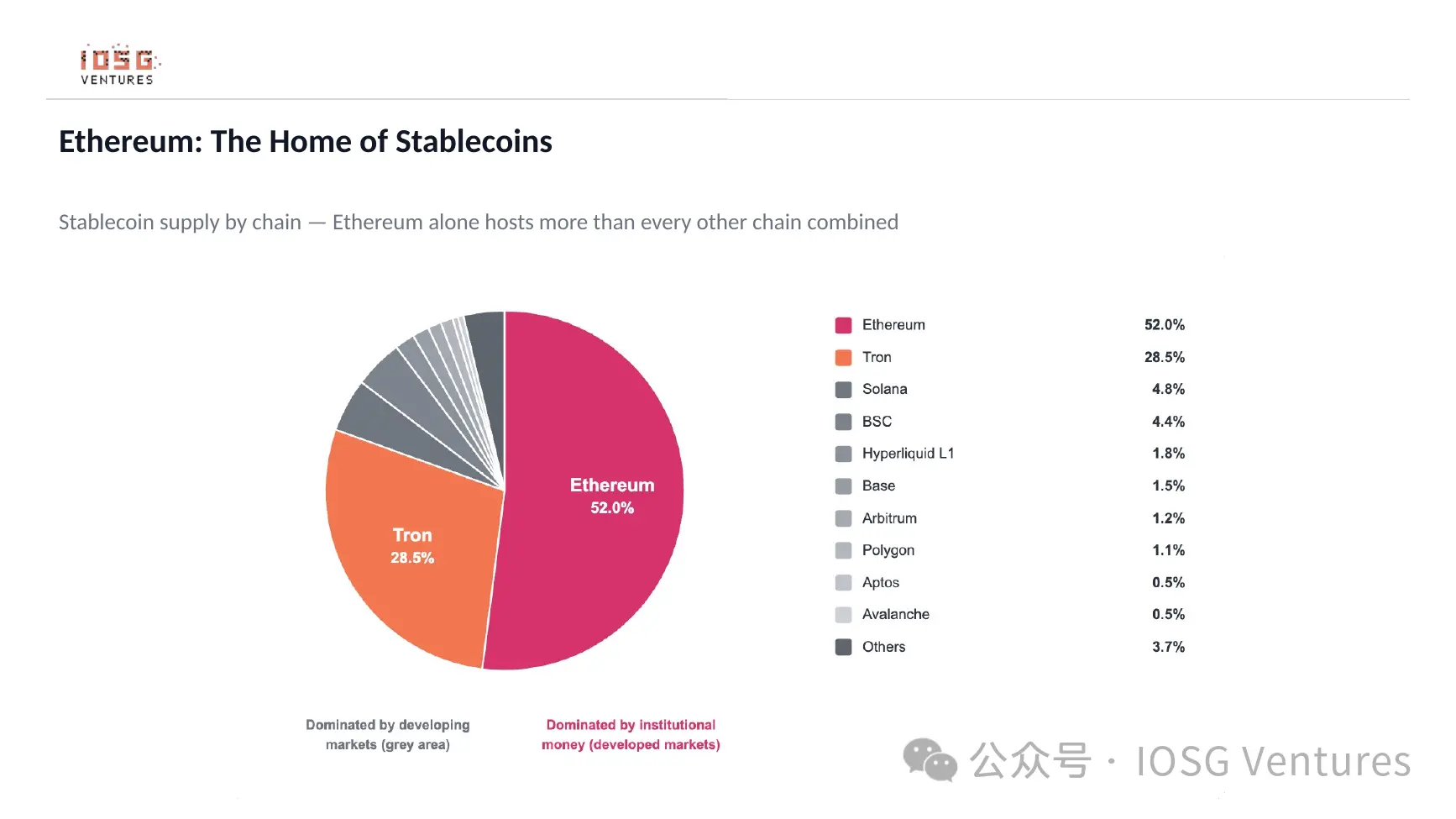
▲ Stablecoin Distribution by Chain
V. How We Invest in a Bear Market: Redefining Allocation Ratios
Next, let’s talk about how IOSG executes investments in a bear market------this is also very interesting because we have redefined the allocation ratios of our investments in a bear market.
We have lowered the proportion of primary markets; while the proportions of OTC, secondary markets, and incubation are rising.
At the same time, we see a clear trend: Crypto is evolving from a trading market into an internet-native financial infrastructure.
First Layer, Better Money, Better Rails: Stablecoins have already proven that better money and better settlement rails can achieve internet-native status ahead of traditional systems.
Second Layer, Internet Capital Markets: RWAs and tokenization can provide clearer real yields and collateral for on-chain dollars.
Third Layer, Large-Scale Applications: I believe the crypto industry will produce the next ByteDance and the next Pinduoduo, just like the internet industry.
Fourth Layer, AI Agent × Crypto: As financial infrastructure becomes internet-native, the ultimate users will no longer be just humans------agents will also need wallets, payments, identities, and programmable ownership.
So ultimately, money goes on-chain, assets go on-chain, and value concentrates on the application layer and interface layer, while AI agents will share the same infrastructure with humans.
VI. Why the Best Investments Are in a Bear Market
Returning to the present. Why are there the best trades and investments in this bear market? Because in a bear market, quality is often mispriced, while real income can prove itself. Here are three cards:
First, valuation misalignment. At the worst of times, truly valuable projects will be driven below their intrinsic value------the best entry prices only appear when others are exiting.
Second, real income can survive. We prefer businesses that can verify cash flow, not just narratives. If a project can survive a bear market------with clear customers and clear products------then it will be amplified by compounding in a bull market.
Third, withstand scrutiny. We only invest in projects that can clearly explain their model from start to finish: who pays, why they pay, and how much they pay. Income that can be externally verified is real income.
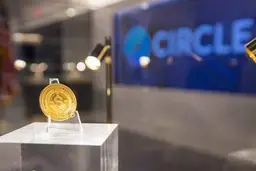
In this round, we see that the truly profitable projects in crypto range from several hundred million to about $5.8 billion, distributed across DeFi and various infrastructures. Below, I will discuss the real situations we see from the front lines in four directions. Direction One · Stablecoins and Payments: Circle, fun.xyz, RedotPay At IOSG, we are still holding 4-hour IC (Investment Committee) meetings every week. Some people ask what projects are worth discussing in a bear market? In fact, there are many. # Circle: Three Sources of Income, One DCF Many people ask about Circle, so let me explain its model. It primarily makes money from three sources:
First, reserve income. About $73 billion in reserves is used to buy short-term debt, earning about $2.6 billion annually at an annualized rate of 3.5%, which will fluctuate with Federal Reserve policies.
Second, distribution costs. Circle shares its main income------about 62%------with partners like Binance and Coinbase, so its gross margin is only 38%.
Third, the underlying long-term equity value. Circle has developed its own public chain, CCTP cross-chain, and developer API, which currently only accounts for about 6% of its income.
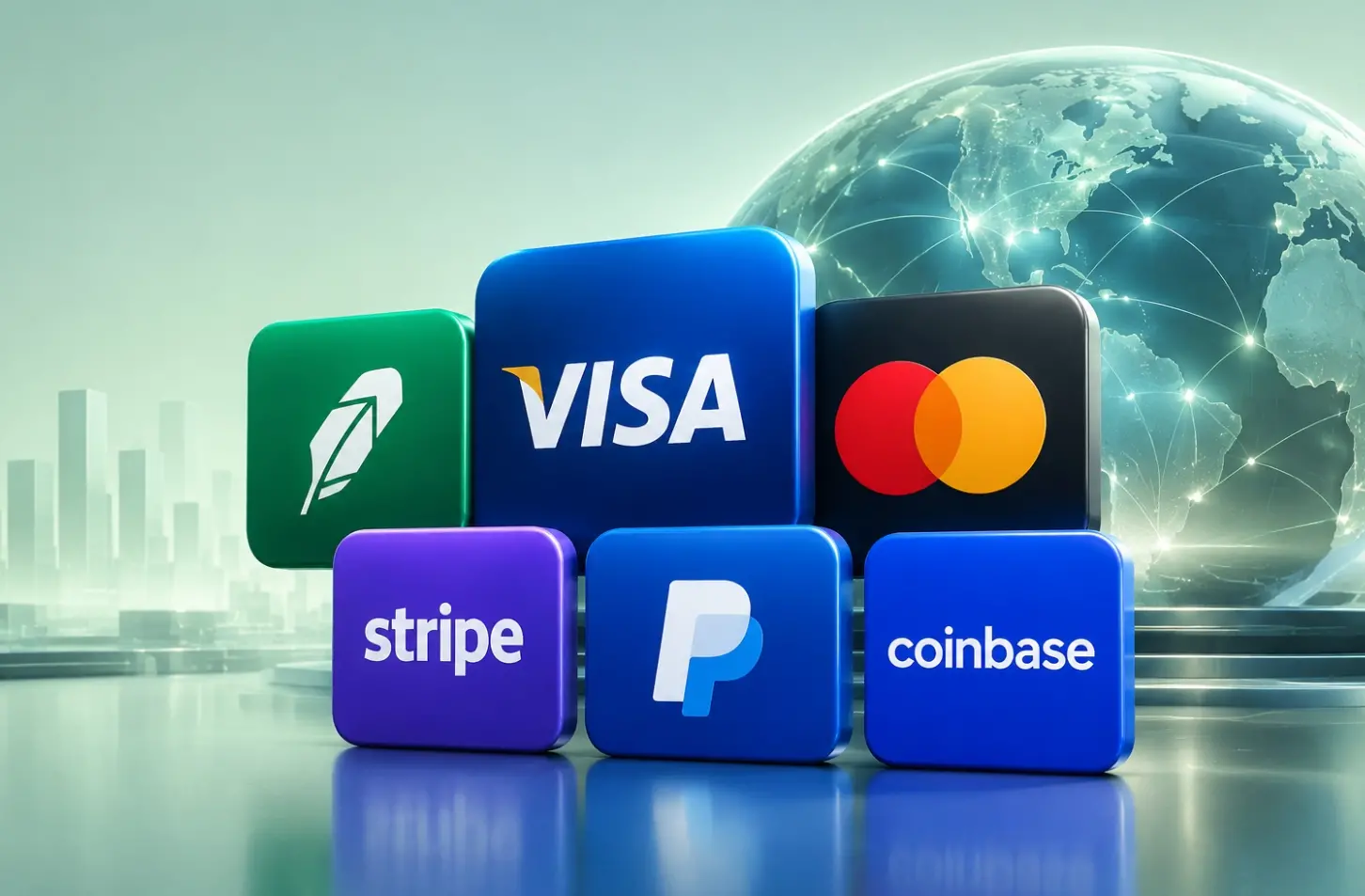
We have created a DCF valuation model for Circle: from stablecoin float → (yield) reserve income → (38% gross margin) stablecoin gross profit → (15 times in the third year, discounted at 20%) present value per share. # Fun.xyz: The Stripe Checkout of the Crypto World fun.xyz can be understood as the Stripe checkout of the crypto world------a universal deposit address (UDA), all money entering Polymarket must go through it, and IOSG is also an investor in it. # RedotPay: A Crypto Card Usable Anywhere RedotPay is currently the most popular crypto payment card on the market. A crypto card that can be used anywhere that accepts Visa and Mastercard, truly bringing crypto into real applications.
A few numbers: over 5 million cards issued, globally available, TPV of about $3 billion, market-leading by a factor of 4, annual revenue of about $150 million. So our underlying judgment is: products combining payments and stablecoins, like RedotPay, are migrating to the mass market and have already gained recognition.
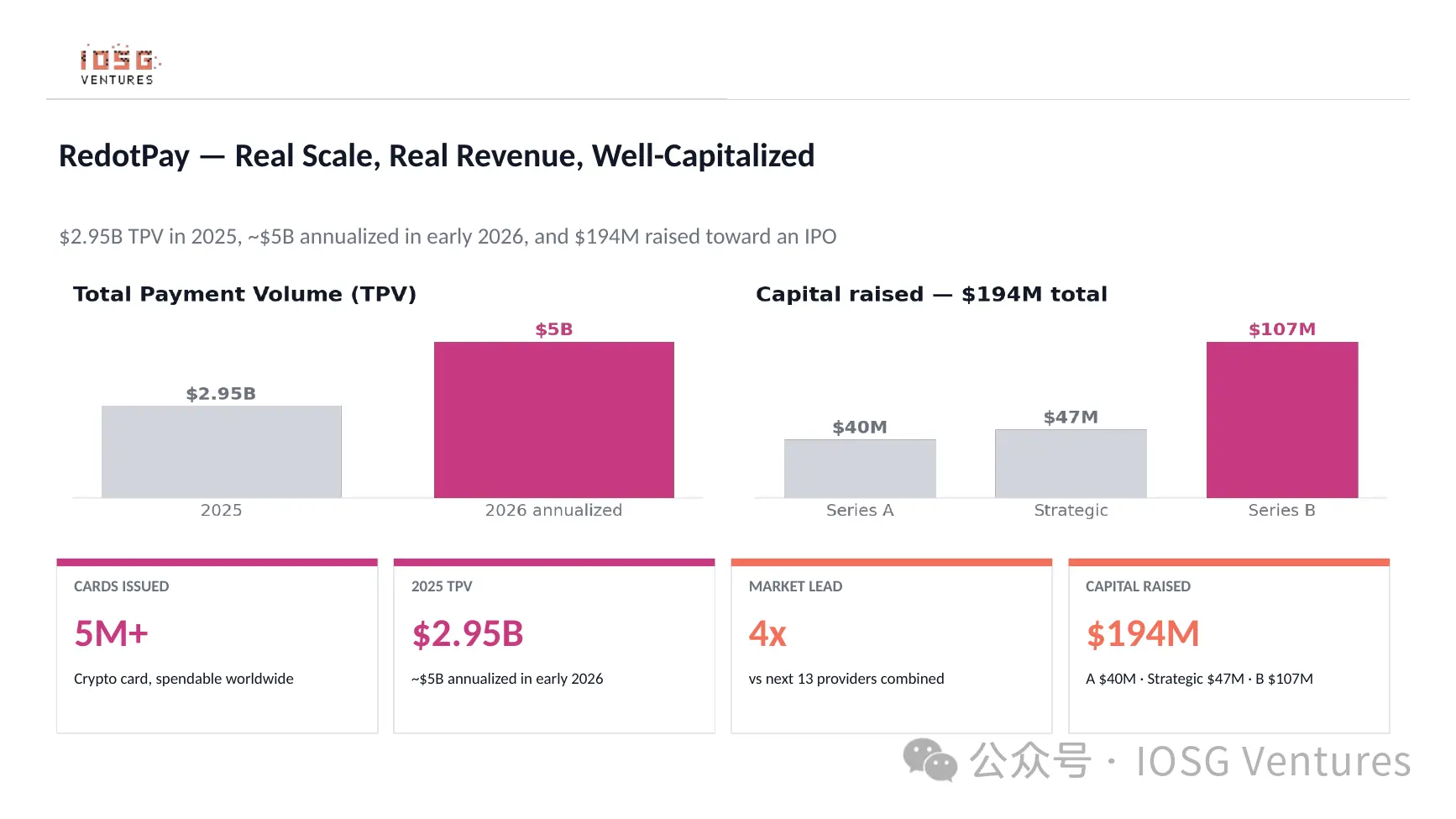 ▲ RedotPay Scale and Capital
Direction Two · Prediction Markets: The Future of Niche is the Future of the Masses
The second direction is prediction markets, which are moving towards the mainstream. Niche products will migrate to mass products, the future of the niche is the future of the masses, which is the cold start phase helping crypto move towards large-scale applications.
▲ RedotPay Scale and Capital
Direction Two · Prediction Markets: The Future of Niche is the Future of the Masses
The second direction is prediction markets, which are moving towards the mainstream. Niche products will migrate to mass products, the future of the niche is the future of the masses, which is the cold start phase helping crypto move towards large-scale applications.
Let’s look at the scale of two industry leaders: Polymarket had a trading volume of $26.2 billion in Q1 2026, a 90% quarter-over-quarter increase; during the World Cup (from June 11 to July 19), the trading volume exceeded $15 billion. Its differentiation lies in globalization and non-custodial nature, making it one of the best representatives of the next generation of crypto applications. Kalshi is taking a compliance route and has obtained a federal license, with a trading volume of about $32.1 billion in Q1 2026, distributed through Robinhood and Interactive Brokers. Founded in 2018, it faced skepticism for years but survived the bear market and obtained a license, producing the steepest revenue curve we have seen in U.S. fintech.
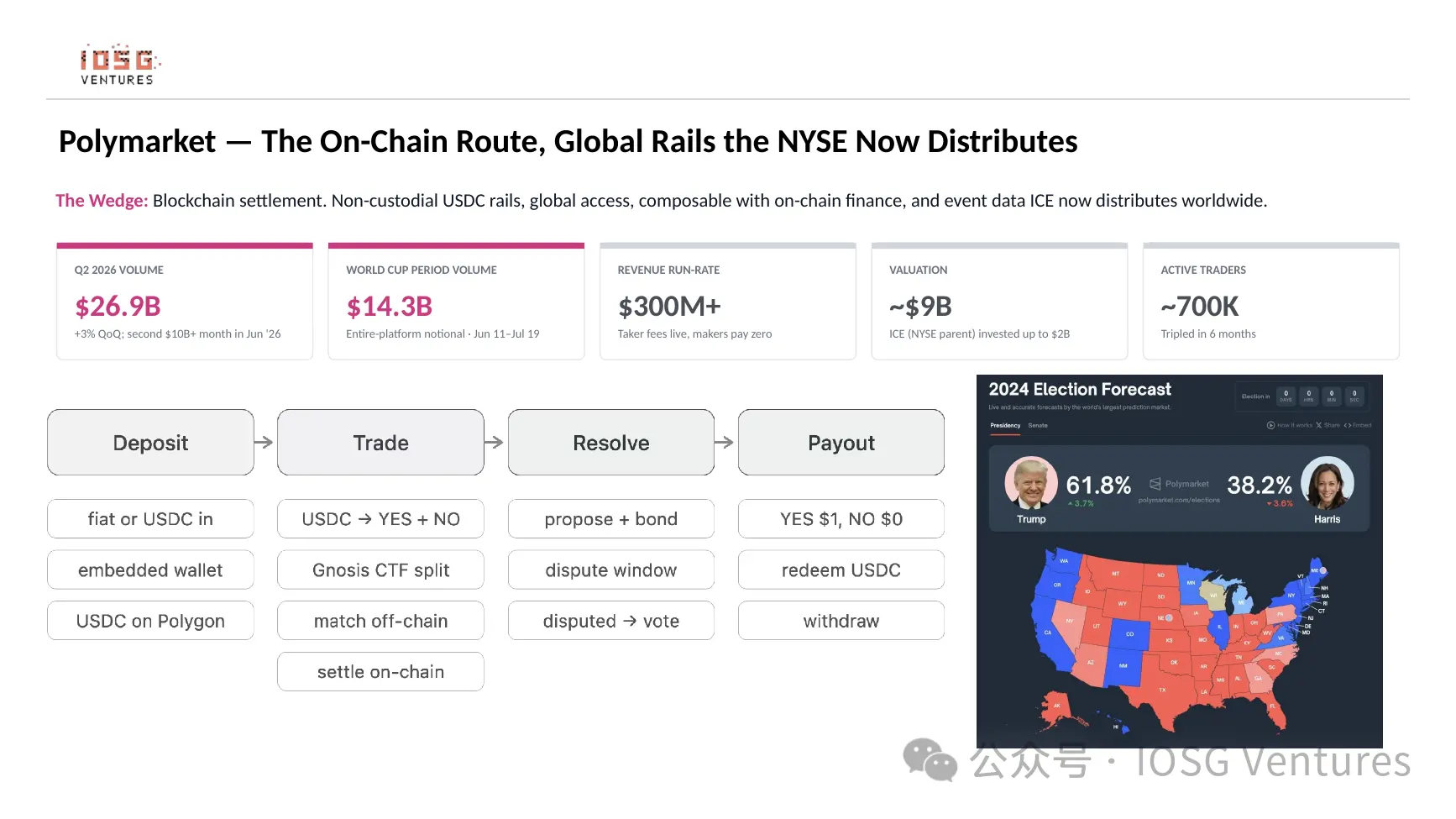
▲ Polymarket · On-Chain Route
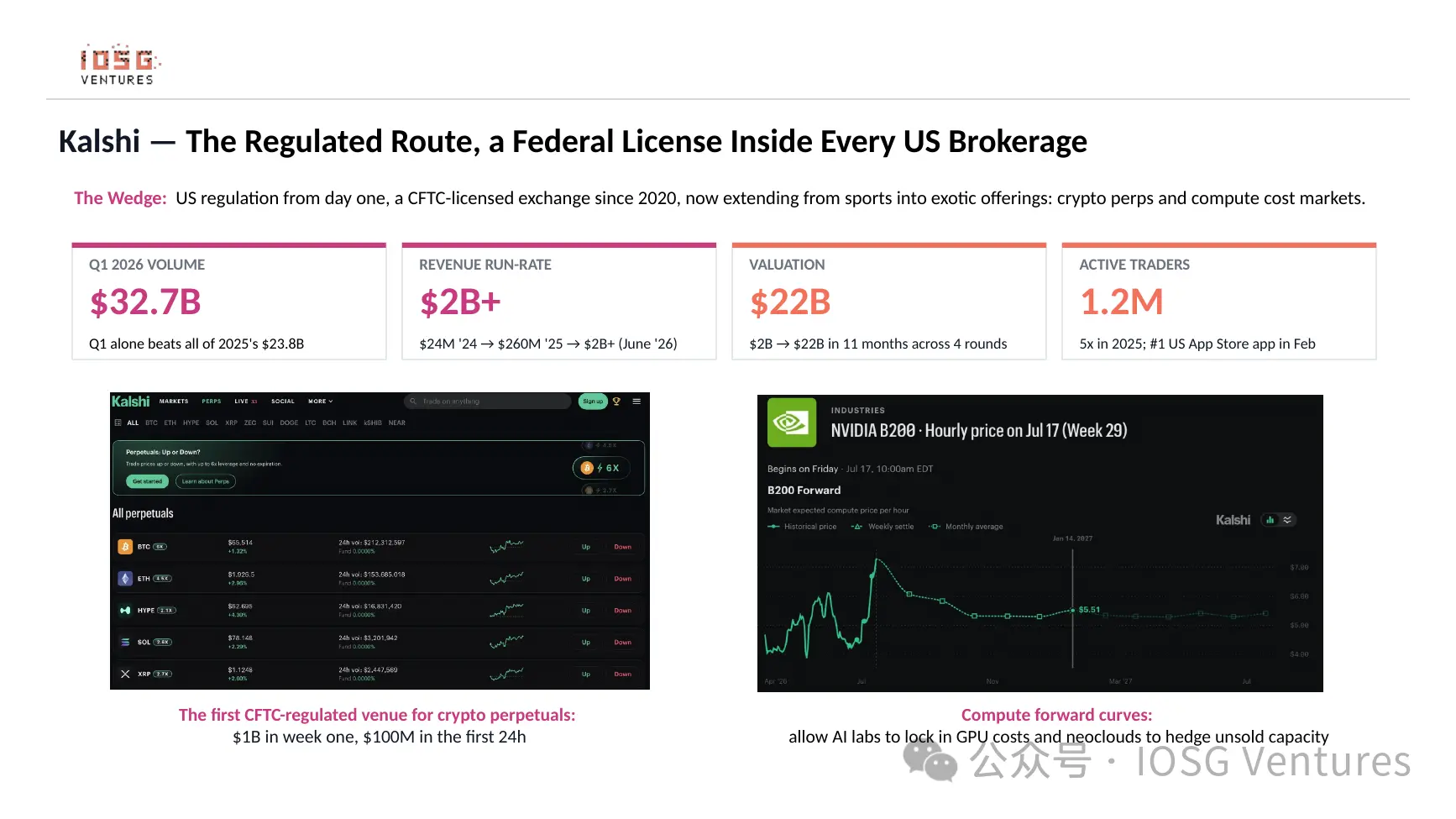 ▲ Kalshi · Compliance Route
Direction Three · AI × Crypto: How Computing Power, Data, and Money Flow The third direction is AI and crypto.
In the past five years, everyone has focused on model quality: whose Transformer is better, whose RLHF is smarter. But now we need to think about a more core logic: Where does the computing power come from? Where does the data come from? How does AI's money flow?
First, computing power. Crypto has proven one thing: open networks can coordinate hardware resources globally. During Ethereum's PoW era (before The Merge in 2022), the total GPU computing power gathered by the entire network was equivalent to that of a cutting-edge training cluster. This does not mean that miners' GPUs can be directly used to train cutting-edge models------the specifications are different------but it proves that: with token incentives, you can aggregate globally dispersed idle hardware. If this mechanism is correctly applied in the AI computing power market, it presents a real opportunity.
Second is data, and third is how AI's money flows, which is the model of agent banking. Here are a few specific cases.
Grass has about 8.5 million users who earn points by sharing unused bandwidth through a browser plugin and app. Its network layer distributes scraping tasks from AI labs to these nodes, then cleans and structures the web pages into enterprise-level data. The key architecture is that it can distribute the demands of AI demand-side companies (like OpenAI and Anthropic, which are willing to pay for training data) to on-chain users, incentivizing them with tokens or income. Currently, its data volume has exceeded 250 PB. The economic model is also very real: projected revenue of about $17 million in 2025, and expected to exceed $70 million in 2026. So you see, projects issuing tokens in crypto are already very real, with income, cash flow, and people willing to pay for them. First to B, then to C is also one of our investment ideas.
Hyperbolic is another IOSG portfolio, focusing on inference and GPU computing power markets. Over 250,000 developers are building on the platform, with clients including some cutting-edge AI labs.
The third typical project transitioning from Crypto to AI is Nous Research, also known as Hermes ("Lobster"). I won't elaborate on the entire tech stack due to time constraints.
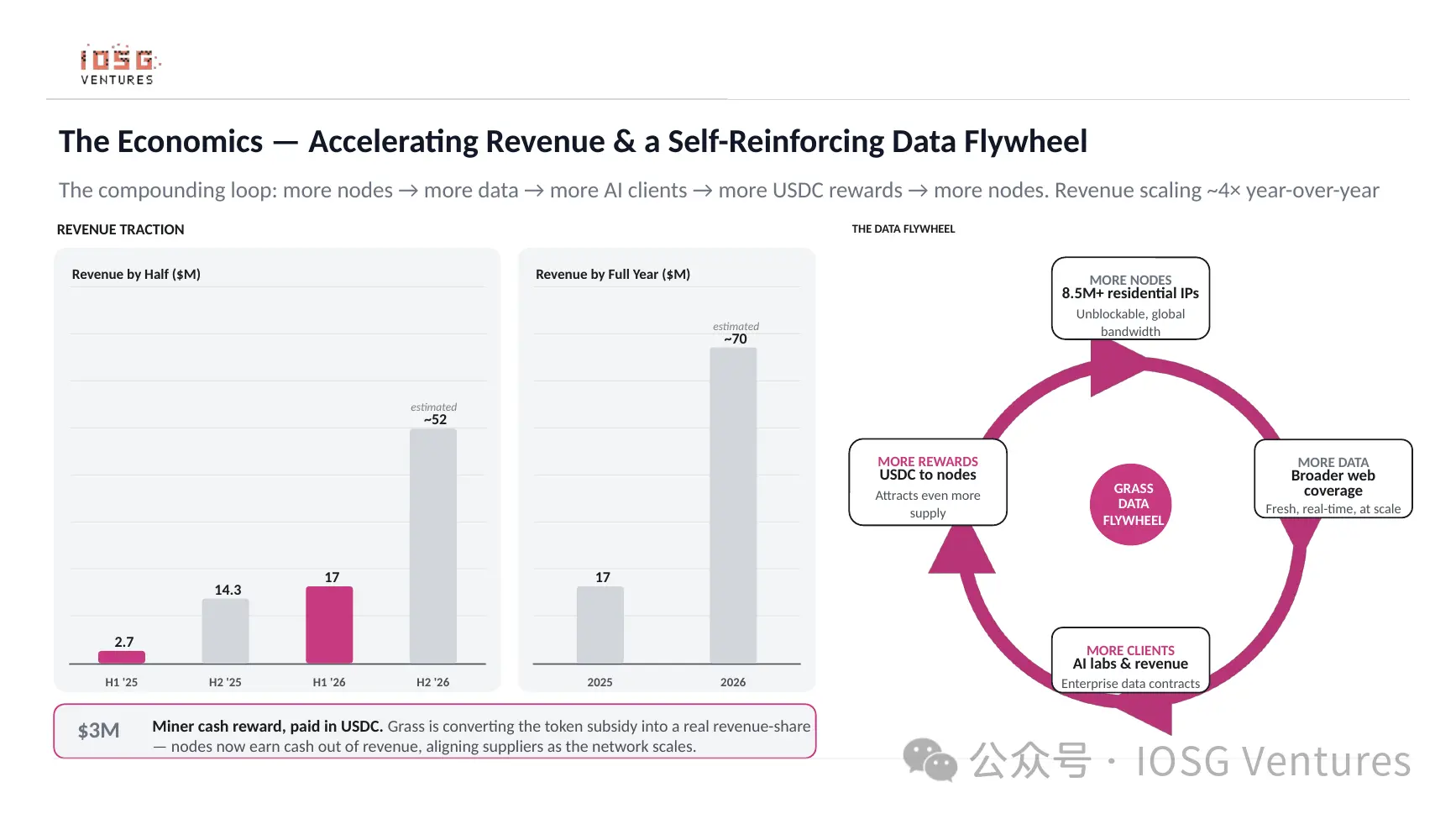 ▲ Grass Economic Model and Data Flywheel
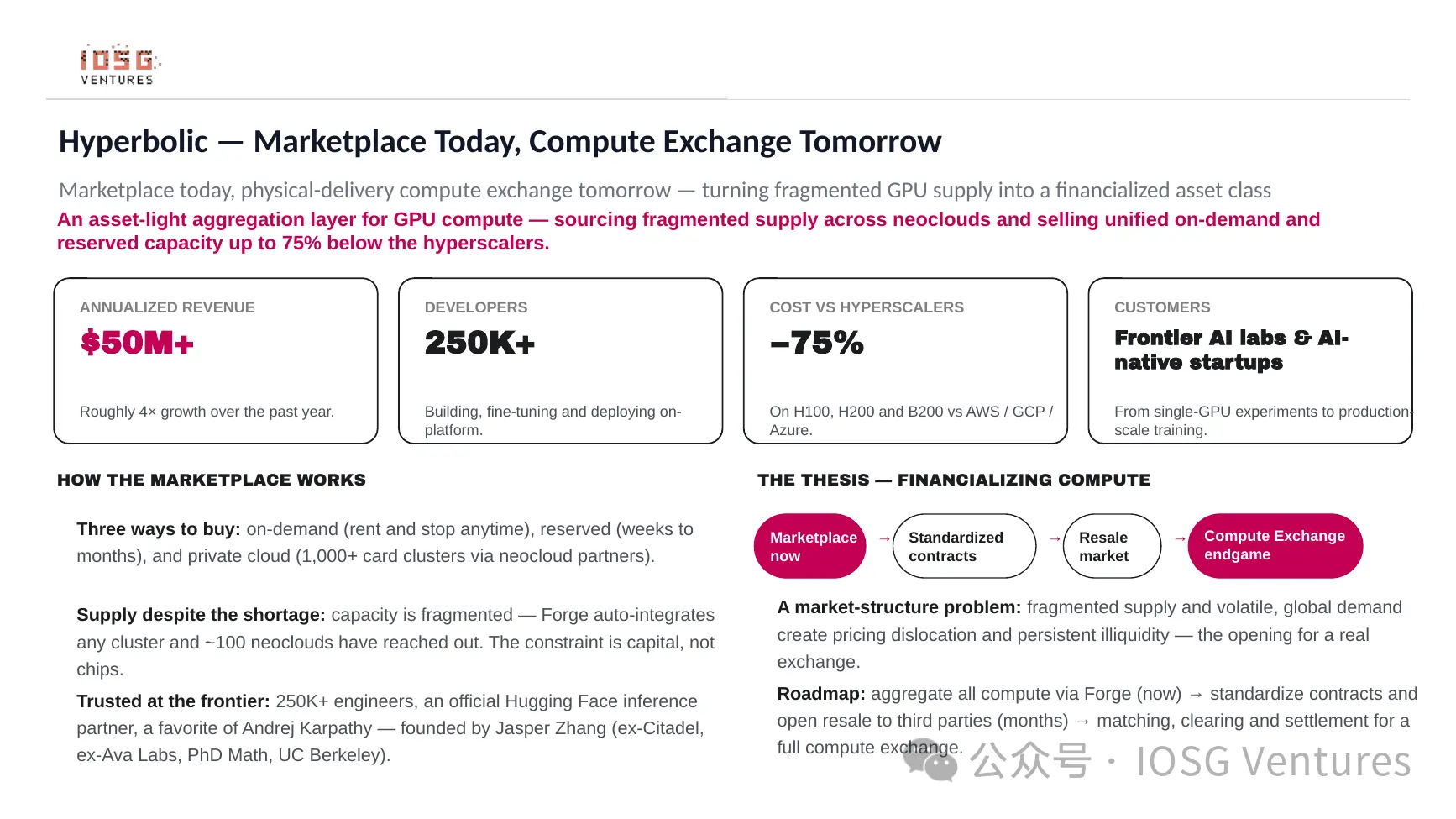 ▲ Hyperbolic Computing Power Market
Direction Four · On-Chain Trading and Credit: Collector Crypt, Hyperliquid
The fourth direction is on-chain trading and on-chain credit, which is very interesting.
▲ Hyperbolic Computing Power Market
Direction Four · On-Chain Trading and Credit: Collector Crypt, Hyperliquid
The fourth direction is on-chain trading and on-chain credit, which is very interesting.
Collector Crypt is like a "pawn shop + card shop," but it operates on-chain. It is currently one of the top two applications on Solana by revenue. The model is simple, divided into three steps: the first step is the supply side, buying and storing physical cards in a vault; the second step is tokenizing them on-chain, turning each card into a tradable token that can be redeemed at any time; the third step is monetizing and exiting. Currently, its cumulative trading volume exceeds $1 billion, with 4 million monthly active users, and its daily revenue is one of the largest applications on Solana; protocol revenue was about $7.2 million in April, about $9 million in May, about $15 million in June, and about $12 million in July. At this scale, it has the opportunity to exceed $200 million in revenue this year. This is a project with real income, issued tokens, and clear demand.
Hyperliquid is also very interesting; why do people say it is "eating Binance"? To put it simply, it is a self-compounding buyback flywheel, which can be understood as a decentralized Binance for futures: every transaction incurs a fee, of which about 97% is used to buy back tokens; more transactions lead to more fees, and more fees lead to more token buybacks, creating a cycle.
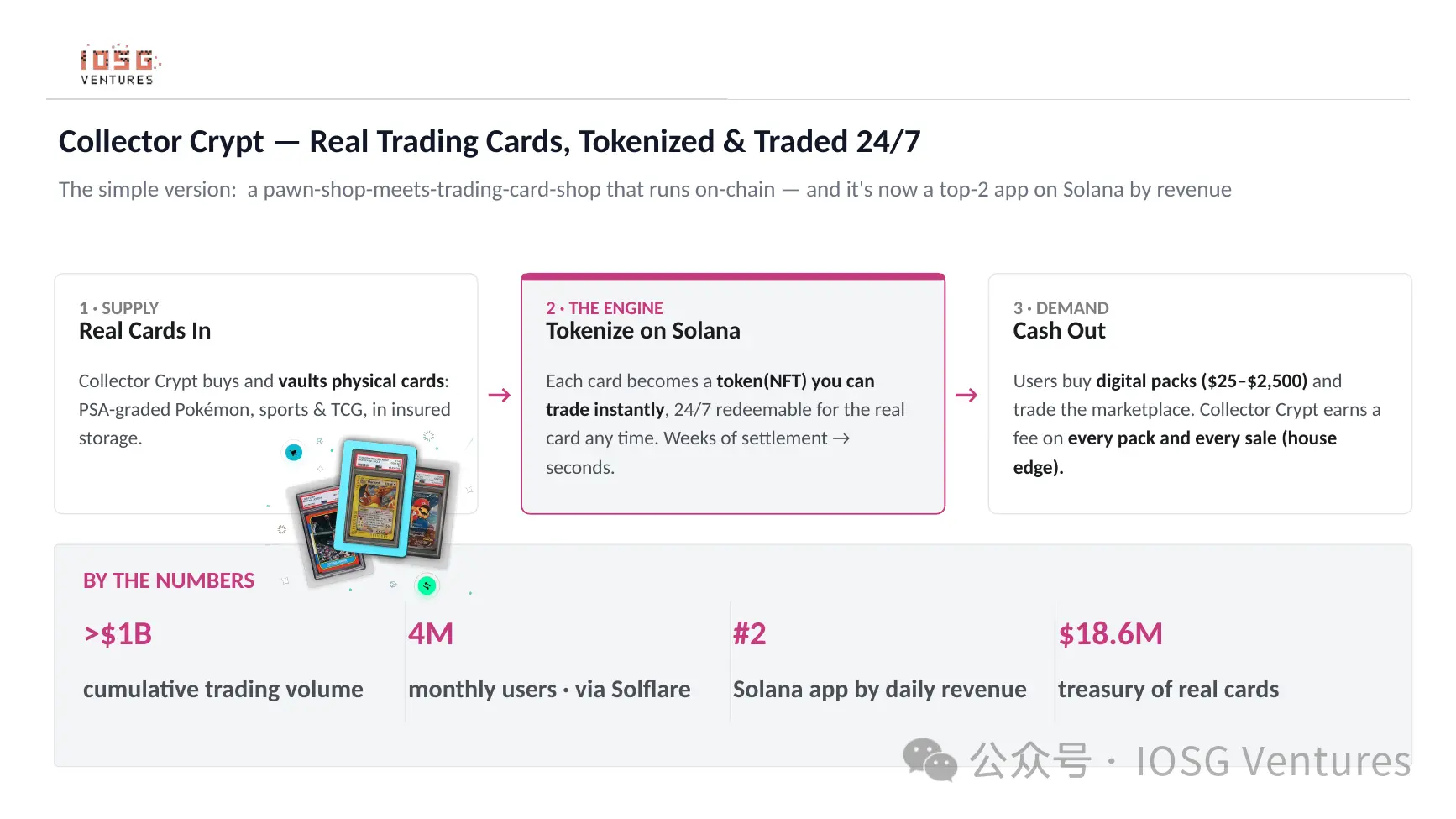
▲ Collector Crypt · On-Chain Cards
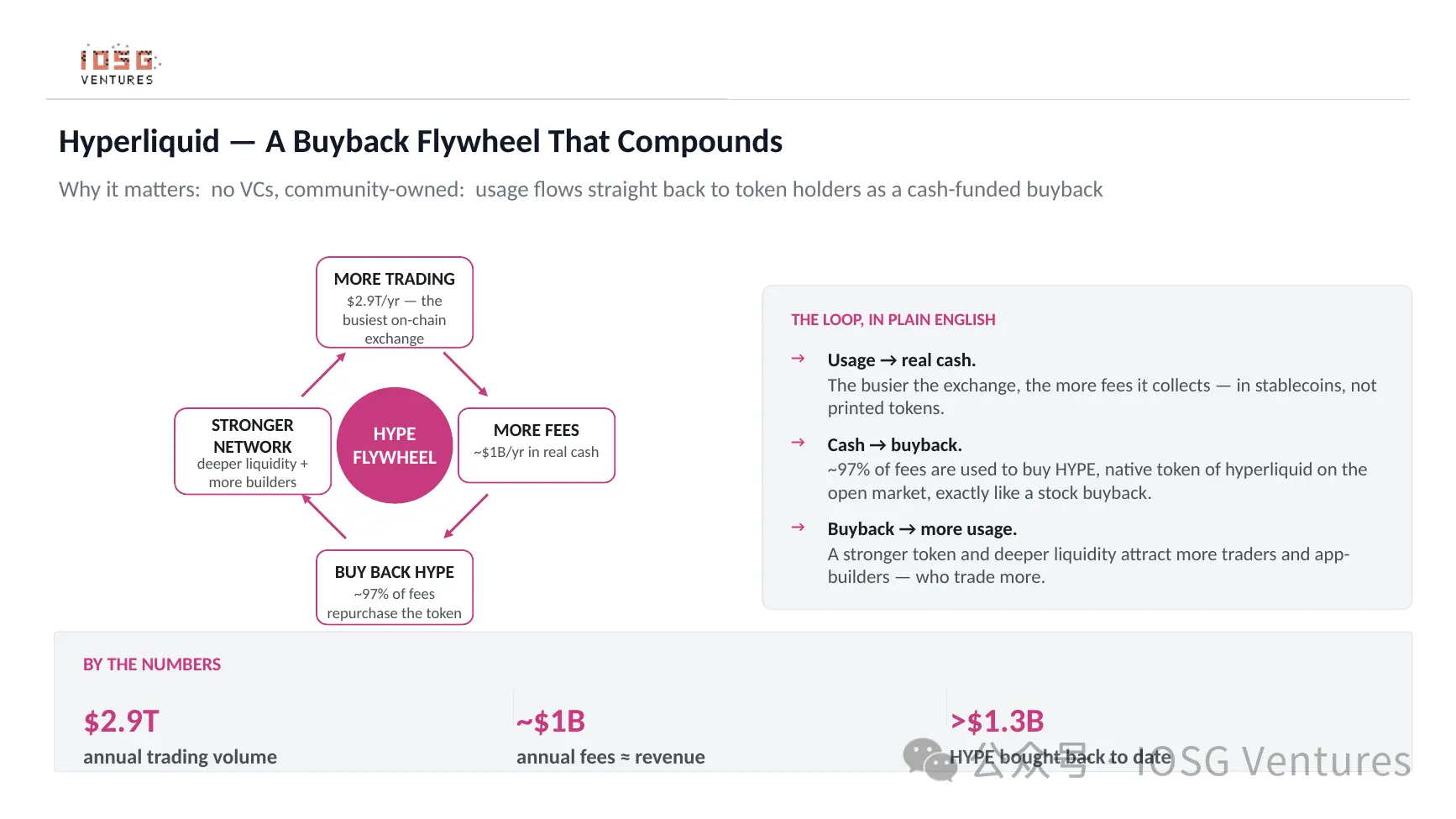
▲ Hyperliquid · Buyback Flywheel
VII. IOSG's Confidence: East-West Reach + Research Moat
Why us? Because IOSG has the best reach in global opportunities------most of our portfolio spans both East and West, North America and Asia; we can also capture the core paradigms of each cycle very early. Supporting all of this is our solid research------in-depth research is our investment moat.
VIII. Conclusion: The Bear Market is the Starting Point for Layout
I have taken up a lot of your time, so let me wrap up.
The best investment opportunities are often hidden in the worst emotions. To emphasize: according to the judgment of "Bitcoin Divine Power," Bitcoin has the opportunity to reach a low point by the end of October this year. So those friends who have turned to AI or U.S. stocks can also look back and reconsider the new opportunities in the crypto market.
So what will we seize?
First, projects with real income. Stablecoins, payments, and AI-related directions are generating new, verifiable cash flows.
Second, businesses that have been wrongly killed by this winter. Many projects have strong fundamentals but are priced as if they have already completed about 90% of the bear market------this price misalignment is an opportunity in itself.
Third, IOSG has captured them early. Three rounds of contrarian, research-driven investments have one goal: to identify winners before the bull market arrives.
The bear market is the starting point for layout. Thank you all.
 Risk warning