Robinhood Chain Cold Start: Asset Accumulation, RWA and Real Demand Verification

 Robinhood Chain has completed its liquidity cold start, but the buying pressure comes from token issuance and secondary speculation, and the demand for RWA has yet to be validated.
Executive Summary
|-------------------------------------------------------------------------------------------------------------------------------------------------------------------------------------------------| | Core Judgment Robinhood Chain has completed its liquidity cold start, but buying pressure comes from token issuance and secondary speculation, and RWA demand has yet to be validated. The largest on-chain balance sheet is the USDG lending via Morpho; trading activity is primarily driven by token issuance platforms and incentive contributions. The gap between the two determines what to focus on in the next phase: whether stock tokens can enter the collateral sequence, whether institutional market-making depth can form, and how much retention remains after subsidies exit. The priority of these three items is higher than the total TVL. |
|------------|----------------|----------------------------------------------| | Metrics | Snapshot on August 30 | What Two Months Indicate | | DeFi Locked Value | $706.76 million | About 8.2 times the $76.73 million on July 6; Morpho accounts for 68% | | Stablecoin Market Size | $769.54 million | 7-day increase of 7.83%; USDG accounts for 57.35%, closing the loop with Robinhood Earn | | DEX Transactions | $1.013 billion / 24h | Weekly increase of +64%, has entered the first-tier chain range | | Perpetual Transactions | $189.86 million / 24h | Weekly decrease of -21.85%, enthusiasm and retention begin to diverge | | Bridged Assets | $2.166 billion | Far exceeds DeFi locked value, about two-thirds have not entered any measurable protocol | | Active RWA Market Value | $148.81 million | Assets exist, but still very small relative to stablecoins and transaction volume | | Meme and Issuance Platforms | Account for 88% of application layer revenue | Current main sources of customer acquisition and revenue; BNB Chain adopts the same strategy, but with named and budgeted public support |
Core Conclusions
1) The competitive moat comes from vertical integration, not technical configuration. Retail distribution, licensed issuing entities, wallet entry, and composable stock tokens are all concentrated in Robinhood; from a technical configuration perspective, Robinhood Chain has no substantial difference from other Arbitrum ecosystem chains.
2) Growth is real, but quality is differentiated. TVL is highly concentrated, and the number of transactions is amplified by token issuance and incentives, with most of the bridged funds not deployed. On August 30, Pons issued 22,600 tokens in a single day, and the combined revenue from GMGN, Pons, and Uniswap accounted for 88% of Robinhood Chain's application layer revenue; attributing this phase's growth to RWA demand at least overestimates it by an order of magnitude.
3) Morpho and USDG constitute the only closed product link currently. Spot depth depends on Uniswap, Rialto, and Pleiades, while the limits for derivatives and cross-asset collateral depend on Lighter and Arcus.
4) Stock tokens are economic exposures to debt securities, not the stocks themselves. Three terms must be included in the due diligence documentation: the underlying stocks are held in custody by Alpaca Securities, pledged to a Swiss collateral agent, holders have priority rights to the series of collateral but no beneficial ownership; primary redemption is only open to authorized participants, initially only BBVI, retail investors can only enter and exit in the secondary market; dividends are taxed as equivalent to dividends under U.S. tax law Section 871(m), with a withholding of 30%, higher than the treaty tax rates enjoyed by most Asian investors holding directly.
5) The allocation order for market-making institutions and funds is: infrastructure and liquidity cooperation first, followed by high-quality RWA protocols. Ecosystem-native tokens should be considered only after revenue is verifiable, chip structure is clear, and evidence of entry conversion is obtained.
6) In the niche market of tokenized stocks, Robinhood is not yet a leader. As of mid to late August, Ondo had about $957 million, Binance bStocks about $622 million, and xStocks about $600 million, together accounting for about 78%; Robinhood's on-chain stock tokens amount to $74.1 million, accounting for 2.6% of the $2.8 billion market. Robinhood holds the distribution channel and its own chain but has not yet captured the market for which it built the chain.
1. Cold Start Completed, Asset Accumulation Has Not Followed
The Robinhood Chain mainnet opened on July 1, 2026, based on Arbitrum Dedicated Blockchains, settling to Ethereum, compatible with EVM, paying Gas in ETH, with Chain ID 4663. Differentiated designs include: targeting RWA, native ERC-4337 account abstraction, first-come-first-served sorting by arrival time, and an 8-seat security council governance------regular upgrades require 6/8 signatures and a 7-day time lock, while emergency actions require 7/8; dispute verification is handled by two licensed validators, Offchain Labs and Alchemy.[1][2][3] Additionally, three facts are recorded by independent evaluation agencies, but Robinhood's official documentation has never mentioned: L2Beat rates Robinhood Chain as not yet reaching Stage 0, with no user exit window; fraud proof is only open to 2 whitelisted addresses, requiring a margin of 1 WETH, while the same tech stack Arbitrum One allows permissionless participation with a margin of 3,600 ETH; L1's 7-of-8 multi-signature is the direct executor of the time lock, allowing for immediate contract upgrades bypassing the 7-day delay.
|--------|----------------------------------------------------|--------------------| | Date | Event | Research Implications | | July 1 | Public mainnet launched; Uniswap, Pleiades, Alchemy, BitGo, Chainlink, etc. launched | Reducing new chain startup risks with mature infrastructure | | Early July | Robinhood Wallet launched stock tokens, on-chain spot and perpetual entry; Earn began to offer to eligible U.S. users | Direct flow from centralized distribution to self-custody/DeFi | | First Week | 17M+ transactions, nearly 350K addresses, >$1B DEX volume; disclosed TVL of about $250M | Strong cold start, mixed with incentives and meme noise | | August 3 | Arkham integrated on-chain browsing and entity labeling | Enhanced institutional monitoring and compliance tools | | Around August 6 | TVL reached about $775M; meme trading heat rose again | Capital accumulation leads real RWA usage | | August 30 | TVL about $706.8M, stablecoins $769.5M, daily DEX volume about $1.0B | Scale has formed, but concentration remains high |
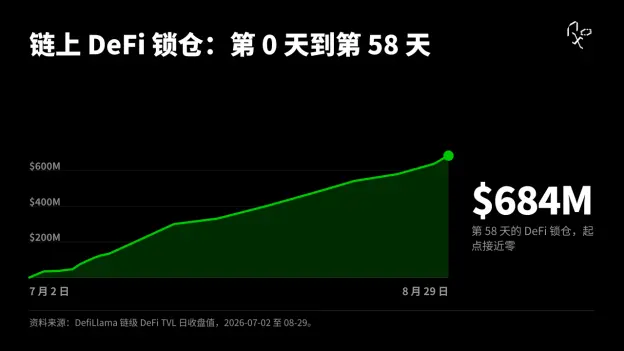
Figure 1|Key Nodes of TVL. There are differences in protocol/chain metrics from different sources; the $250 million in the first week is based on Robinhood's disclosed metrics, while others use DefiLlama and public reports.[4][6][7]
Capital accumulation and network activity show a divergence. According to L2Beat's thirty-day window as of August 18, Robinhood Chain had 292 million transactions, ranking first among Ethereum Layer 2, while Base had 230 million transactions and Arbitrum One had 40.41 million transactions during the same period; however, Robinhood Chain's DeFi locked value during the same period was only one-eighth of Base's. It should be noted that Robinhood Chain has a block interval of about 100 milliseconds, while Base has 2 seconds, meaning transaction counts in cross-chain comparisons will systematically favor chains with faster block times and cannot be directly interpreted as user scale.
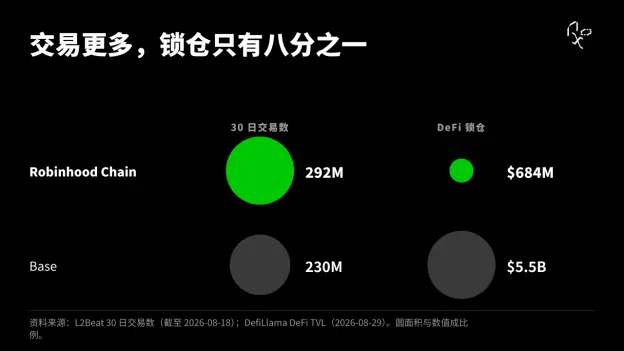
Figure 2|Divergence Between Activity and Accumulated Value. Transaction counts are affected by block intervals, making direct cross-chain comparisons impossible. Data source: L2Beat (30-day transaction count, as of 2026-08-18); DefiLlama (chain DeFi TVL, 2026-08-29).[14][15]
These two indicators correspond to two judgments in this report: the conversion at the Robinhood distribution end is real, while the accumulation at the on-chain asset end has not kept pace. The figure below shows the closed-loop structure designed for Robinhood Chain, which has a gap with the current actual fund distribution; this gap is the subject of discussion in Section 3.
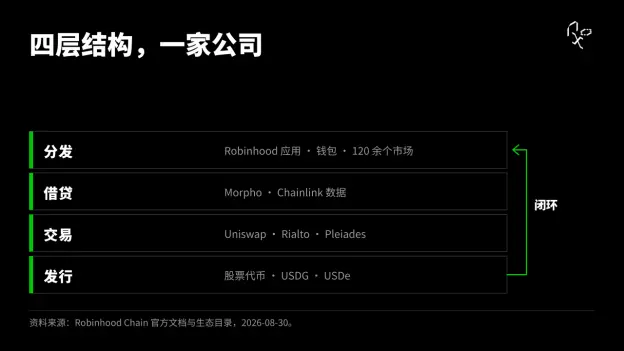
Figure 3 | Value Stack: The four layers of assets, liquidity, returns, and distribution form a closed loop. Source: Robinhood Chain official documentation and ecosystem directory, 2026-08-30.[1][12]
2. Mature Components Vertically Packaged, Trust Model Stands Alone
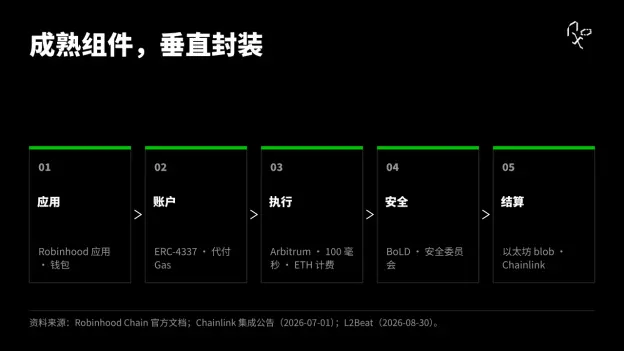
Figure 4 | Overview of Technical Architecture. Source: Robinhood Chain official documentation; Chainlink mainnet integration announcement, 2026-07-01.[1][3][10]
The technical path of Robinhood Chain is to package mature components into a vertical infrastructure aimed at stock tokens without reconstructing the underlying layer. Two configurations need to be explained separately. First, data availability uses Ethereum blobs, with all data required for state reconstruction published to the mainnet, rather than relying on a data availability committee like most Orbit chains, which is more costly and has stronger credibility. Second, ordering adopts a first-come, first-served basis without priority fee bidding, contrary to Arbitrum One's Timeboost fast lane auction. For brokers bound by best execution obligations, forgoing this MEV income is a compliant choice; the cost is that MEV shifts from fee bidding to delayed racing, the latter being opaque and unauditable.[1][3][10]
One configuration undermines the above arrangement and does not appear on any page of Robinhood's official documentation. ArbOS 61 introduces protocol-level transaction filtering: contract 0xebDc…24b7 can register any transaction hash into the ArbFilteredTransactionsManager precompile, forcing the state transition function to fail that transaction, explicitly including transactions that are forced to be included via the L1 delayed inbox. Forced inclusion was originally the only exit channel for users when the sorter crashes or is censored; therefore, L2Beat marks the "sorter failure" column of Robinhood Chain as having no mechanism. For a licensed broker that must be able to halt its own securities venue, having this switch can be understood; the problem is that the official homepage of Robinhood Chain still states it is permissionless, while this capability has never been disclosed.
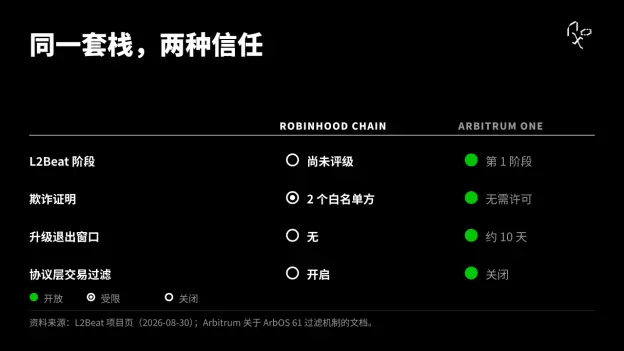
Figure 5 | Two Trust Models Under the Same Technical Stack. Source: L2Beat's project pages for Robinhood Chain and Arbitrum One, 2026-08-30; Arbitrum documentation on ArbOS 61 compliance filtering and Timeboost.[14][16]
3. Capital Concentrated in a Single Lending Closed Loop
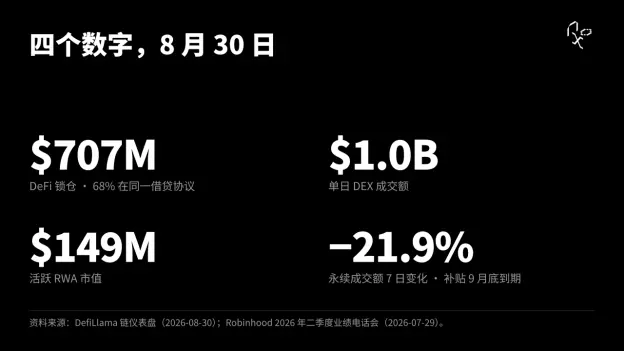
Figure 6 | Growth Quality Scorecard. TVL, transactions, RWA usage, and retention cannot be combined into a single "ecological prosperity" indicator. Source: DefiLlama; Robinhood Q2 2026 earnings call.[4][17]
3.1 Incremental Contribution from Earn---USDG---Morpho Single Link
The TVL of Robinhood Chain increased from $76.73 million on July 6 to $706.76 million on August 30, a net increase of about $630 million. Among them, the Morpho Blue protocol alone accounted for $481.98 million, equivalent to 68.2% of the total chain TVL, with a month-on-month growth of 87.6%. This means that this growth was solely contributed by the lending link of Robinhood Earn---USDG---Morpho, rather than a uniform ecological expansion. The supply of USDe also points to this conclusion: it rose from about $17 million in mid-July to about $253 million on August 11, accounting for about 40% of the on-chain stablecoin scale, with the increment also being yield-bearing funds, not trading reserves. When reading this set of data, it is important to note: DefiLlama counts the treasury curator Steakhouse and the underlying protocol Morpho Blue separately, and their sum will exceed the chain-level TVL; the chain-level metric is the one that does not double count.[4][8]
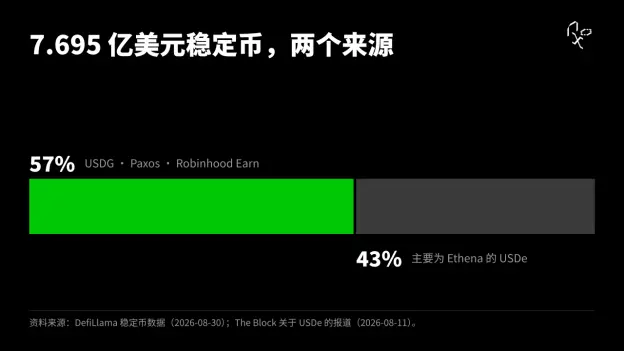
Figure 7 | Stablecoin Structure. USDG accounts for 57.35%, with the rest mainly USDe.[4]
|----------------------------------------------------------------------------------------------| | Quality Adjustment Bridged TVL is $2.166 billion, measurable DeFi TVL is $706.76 million, with a deployment rate of about 32.6%. This is both a potential for continued conversion and may also be funds stuck in cross-chain transfers, wallet idling, and waiting for incentives. |
Referring to Delphi Digital's analytical framework for Base, bridged assets and protocol TVL should be observed separately: the former measures the economic value entering the network, while the latter measures the actual absorption level of applications. Synchronous growth of both indicates healthy capital formation; a continuously widening gap indicates funds are stuck in wallets and cross-chain channels.[13]
4. Growth Driven by Token Issuance, RWA Not Continued
The growth of Robinhood Chain is mainly driven by token issuance and secondary speculation. On August 30, 2026, Pons issued 22,600 tokens in a single day, a month-on-month increase of 40%; the total chain transactions reached 5.52 million, while the daily average was less than 1 million in early July; application layer revenue was $2.66 million, higher than Ethereum's $1.33 million but lower than Solana's $5.07 million, with GMGN, Pons, and Uniswap together accounting for 88%. On the same day, DEX transactions amounted to about $875 million, with Uniswap v4 contributing about $432 million and v3 about $357 million. The components in the early stage were more concentrated: third-party estimates show that meme assets accounted for over 80% of cumulative DEX transactions, while RWA-related transactions accounted for about 4%; the market cap peak of a single token, CASHCAT, was about $156 million, higher than the total market cap of all tokenized assets on Robinhood Chain during the same period.[25][27]
A widely cited ratio needs clarification regarding its scope. The "stock token proportion of 78%" circulated on August 25 has a denominator of $85.1 million in RWA transaction baskets for that day, not the total chain transactions of Robinhood Chain; during the same period, total chain DEX daily transactions ranged between $875 million and $1.013 billion. According to the total chain metric, stock tokens accounted for 8%--10% of transactions, and meme transactions did not have a structural decline. Interpreting this 78% as RWA having replaced meme is a misuse of the denominator.
The first three rings of the growth chain have closed: the issuance platform generates tokens, token trading generates fees and activity, and fees and profit effects lead to new addresses. The fourth ring has yet to form—the users and liquidity brought by the issuance platform have not converted into the holding and trading of stock tokens. Whether this conversion can occur is the only unresolved question throughout this report.
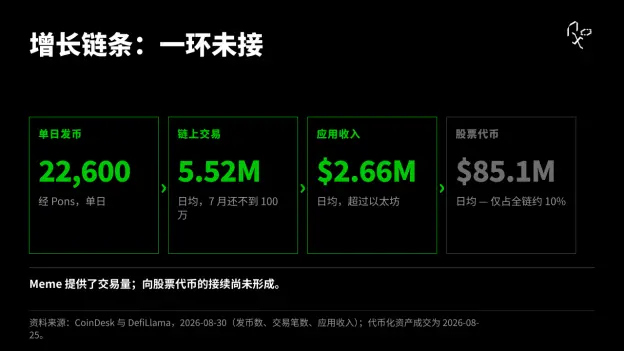
Figure 8 | Growth Chain: Three Rings Closed, One Ring Not Connected. Source: CoinDesk and DefiLlama, 2026-08-30 (number of issued tokens, number of transactions, application layer revenue); tokenized asset transactions are based on August 25, 2026.[25][19]
|--------|-----------------------------|----------------------------------------| | Signal | Positive Interpretation | Needs Caution | | DEX Transactions | Daily $875 million--$1.013 billion, briefly entering the world's largest | Volume manipulation, aggregator routing, and meme turnover may amplify nominal transactions | | Application Revenue | Daily $2.66 million, exceeding Ethereum | 88% comes from GMGN, Pons, and Uniswap, highly concentrated in token issuance and speculation | | Number of Addresses | Strong customer acquisition in the first week, wallet distribution running smoothly | Addresses are not users; first interaction addresses are highly sensitive to airdrop expectations | | Bridged Assets | Over $2.1 billion, funding channels are smooth | Deployment rate is about one-third; funds can come quickly but can also leave quickly | | RWA Market Cap | Active market cap of about $14.881 million | Relatively small compared to stablecoin and speculative transactions, accounting for about 8--10% of total chain transactions |
4.1 Public Position Shifted Within Six Days, No Accompanying Rule Adjustments
Robinhood's public statements regarding meme assets shifted within six days. On July 2, CEO Vlad Tenev stated on CNBC that assets not linked to underlying utility do not constitute productive assets; on July 8, during a period when CASHCAT's market capitalization approached nine figures, it was stated on platform X that Robinhood Chain is also applicable to meme assets and is paying attention to that token account. There were no restrictions, delistings, or rule adjustments during this period, indicating a change in expression rather than a policy shift.[26]
It is necessary to distinguish between "unable to do" and "not willing to do." The ArbOS 61 trading filter has given Robinhood Chain the ability to make any transaction fail, including transactions enforced by L1 inclusion, but this capability has never been used to restrict meme trading. Between regulatory perception and trading volume, Robinhood has effectively chosen the latter.
4.2 Issuing Platforms Dominate Application Layer Revenue
Token issuing platforms are the most competitive segment for Robinhood Chain and the main source of application layer revenue. Pons is independently operated by Pons Labs and was deployed a few days after the mainnet launch, with over 250,000 tokens issued and approximately 58,000 daily active addresses, surpassing the sum of the next two platforms; the fees are 0.0005 ETH issuance fee and 1% transaction fee, with the latter distributed 70%/30% between creators and the protocol, and 80% of the protocol's share used for PONS buybacks. On August 7, Uniswap Labs launched pools.trade on Robinhood Chain, with no issuance fee, and tokens directly deposited into the v4 pool; Memecoin.Fun raised $3.5 million to develop similar products. It should be clarified that Pons has no equity or partnership with Robinhood and is not listed in the official ecosystem directory; platform activity does not constitute official endorsement. More indicative is Uniswap Labs' resource allocation— as an ecological partner on the first day, its focus is on meme issuance rather than RWA.[28]
4.3 Memes Undertake Distribution Functions but Do Not Constitute Barriers
If meme assets are viewed as noise that needs to be tolerated, it underestimates the role of memes in the cold start phase. Memes are currently the lowest marginal cost distribution mechanism in the crypto market: they do not rely on business development, do not require compliance approval, and can bring three things within days—market attention, the first batch of on-chain addresses, and real transaction fee income. These three are precisely the resources that new public chains find most difficult to acquire. On August 30, Robinhood Chain's application layer revenue was $2.66 million, of which 88% was generated by meme-related applications; this revenue covered the cost of sorters, supported market makers' continuous quotes, turning 5.52 million transactions into verifiable network scale, and constituted the commercial basis for Uniswap's willingness to deploy liquidity depth in Robinhood Chain's v4. Functionally, memes are the distribution and customer acquisition layer of Robinhood Chain.
BNB Chain has turned the same strategy into a complete form and is the most suitable comparison object. BNB Chain has explicitly included memes in its ecological strategy: starting in October 2024, it will hold more than four rounds of meme innovation competitions, distributing over $200,000 in incentives to 11 projects; in 2024, it will set up a $900,000 liquidity pool to support the meme ecosystem; and in December 2024, for 14 consecutive days, it will buy the best-performing meme assets of the day with 33 BNB each day and airdrop them to the community. The strategies of the two chains are essentially consistent, with differences in execution: BNB Chain provides named, budgeted public support; Robinhood has management publicly stating its position, along with a trading filter that is installed but not activated, forming a de facto tacit approval. The benefit of public support is that it is controllable and replicable, but the cost is that it must bear endorsement responsibility; tacit approval retains the space for cutting ties at any time, but also means that any budgeted chain can buy the same channel. Therefore, the conclusion of this report is that meme transactions belong to customer acquisition channels, do not constitute structural barriers, and are not included in moat assessments.[30]
|-----------|-----------------------------|--------------------------------------------------| | Dimension | Robinhood Chain | BNB Chain | | Official Position | Management's public statement; no special plans, budgets, or named support | Included in ecological strategy: innovation competitions, liquidity pools, official buybacks, and airdrops | | Support Method | De facto tacit approval; trading filter deployed but not used for meme transactions | Over $200,000 competition incentives, $900,000 liquidity pool, daily purchase of 33 BNB for 14 consecutive days | | Responsibility Attribution | Retains cutting space, can declare no official connection | Publicly named, bears endorsement responsibility | | Continuity to RWA | Stock tokens account for 8%-10% of total chain transactions, continuity has not formed | bStocks issued by BTech Holdings, settled directly on Robinhood Chain |
4.4 Asset Structure Determines Market Structure
A single trading architecture cannot cover all asset categories. Mainstream crypto assets are suitable for public AMM and aggregated routing; stock tokens have a time mismatch between 24-hour trading and the opening and closing times of underlying securities, and long-tail varieties carry higher inventory risks, making them more suitable for RFQ and proprietary market-making quotes; perpetual and high-frequency trading require low-latency order books. This stratification is determined by asset structure.
|-------------------|-----------------|-----------------|------------------| | Architecture | Representative Projects | Most Suitable Scenarios | Key Risks | | Public AMM | Uniswap | Mainstream assets, public composable liquidity | LP impermanent loss; price deviation during closed market periods | | RFQ / PropAMM | Rialto、Pleiades | Stock tokens, large orders, inventory-sensitive assets | Concentration of quoting parties, transparency and extreme market withdrawal | | Liquidity Manager | Arrakis | Concentrated liquidity management under issuer self-custody | Strategy permissions, rebalancing costs | | ZK/CLOB Perps | Lighter、Arcus | High-frequency, leveraged, and cross-asset perpetuals | Clearing depth, latency, incentive retention | | Aggregator/Broker | 1inch、Wallet entry | Price comparison and order routing across multiple venues | Concentration of traffic entry and order flow value distribution |
5. Four Paths Running in Parallel, Customer Acquisition Concentrated in Two
It is not difficult to list the ecosystem by layers; the challenge is identifying which layer is truly bringing in users. There are four paths operating simultaneously on Robinhood Chain, with significant efficiency differences. The first path is the Robinhood app and Robinhood Wallet: the only entry point with a license and retail scale, forming the basis of the entire narrative, but it brings in assets, not trading activity. The second path is the token issuing platform and meme trading tools, represented by Pons, pools.trade, and GMGN: this is the real customer acquisition and revenue engine currently, accounting for 88% of application layer revenue, but this batch of users does not overlap with stock token holders. The third path is lending, namely Morpho and USDG: it carries funds but does not carry users—money flows from Robinhood Earn, solidifying as TVL, without generating transactions. The fourth path is spot and derivatives, represented by Uniswap, Rialto, Pleiades, Lighter, and Arcus: it determines whether the first three paths can be converted into tradable depth. Only two of the four paths truly undertake customer acquisition functions— the Robinhood app and the issuing platform— and these two target different groups of people. Whether the ecosystem can be established depends on whether the lending and trading layers can merge these two groups: specifically, stock tokens entering the collateral sequence and meme users buying stock exposure in the same wallet. The official ecosystem directory of Robinhood has included over 100 integrated projects, but inclusion does not equate to a partnership or safety endorsement.[1][2][12]
|--------|-------------------------------|--------------------|-------------------------------------| | Layer | Representative Projects | Function | Current Assessment | | Entry・Distribution | Robinhood App, Wallet, USDG | Issuance, Distribution, Gas Abstraction, Account Opening | The only licensed retail entry; imports assets, not activity | | Speculation・Launchpad | Pons, pools.trade, GMGN | Token Issuance, meme trading, user acquisition | Current real income and user acquisition engine account for 88% of app revenue; users and stock tokens have almost no overlap | | Lending | Morpho, Steakhouse and other vault curators | USDG earnings and collateral lending | The only fully operational product loop; accepts funds but not users | | Spot | Uniswap, Rialto, Pleiades, 1inch | Public AMM, proprietary AMM, aggregation routing | Determines the real depth and price difference of stock tokens; Uniswap accounts for about 99% | | Derivatives | Lighter, Arcus, Meridian | Perpetual, RWA derivatives, prediction markets | Growth stage; retention after subsidy exit has not been verified | | Cross-chain・Oracles | Chainlink, LayerZero, Across | Pricing, CCIP, asset cross-chain | Key dependency for RWA composability | | Custody・Compliance | BitGo, Fireblocks, TRM, Arkham | Institutional custody, risk monitoring, address tracking | Enhances institutional usability, does not eliminate issuer risk |
|---------------------------|-------------|------------------------------|------------------------------| | Project | Role | Verified Strengths | Still Needs Confirmation | | Pons | Launchpad (third-party) | Issued over 250,000 tokens, daily active users about 58,000, exceeding the sum of the next two | No equity or partnership with Robinhood; token quality and retention | | pools.trade (Uniswap Labs) | Official partner self-built launchpad | No launchpad fees, tokens directly deposited into v4 pool | One month online; ability to acquire share from Pons | | Morpho / Earn | USDG lending and earnings layer | TVL about 482 million, main app directly connected for distribution | Earnings, bad debts, collateral concentration after subsidy exit | | Uniswap | Public AMM liquidity | Contracts verified, aggregator reachable; accounts for about 99% of stock token liquidity | Price difference during market closure; LP inventory risk | | Rialto / Pleiades | RFQ and proprietary AMM | Suitable for large orders and inventory-sensitive RWA | Number of quoting parties; availability under extreme market conditions | | Lighter / Arcus | Spot and derivatives execution | Wallet entry, low-latency matching | Non-incentivized retention; liquidation depth | | Chainlink | Pricing and cross-chain data | Feeds, Data Streams and CCIP | Handling of suspensions, corporate actions, and abnormal quotes |
6. Credit Exposure of Stock Token Issuers
Robinhood states that the new generation of stock tokens is accessible to qualified users in over 120 countries through the Robinhood Wallet, supporting 24-hour trading, lending, and collateral, with over 190 types listed on the public page.[2][9] There are two gaps that need to be pointed out. The first is the gap between coverage and on-chain availability: there are over 2,000 stock tokens in the EU and EEA, while only about 190 can be traded on-chain; these are neither the same batch of assets nor the same legal structure. The second is the direction of regional restrictions: the United States, Canada, the United Kingdom, and Switzerland are explicitly excluded, meaning that the majority of Robinhood's 28.4 million funded accounts at the end of the second quarter, which are primarily U.S. customers, cannot purchase the stock tokens issued by Robinhood. "Over 120 countries" refers to the distribution reach, not the licensing scope.
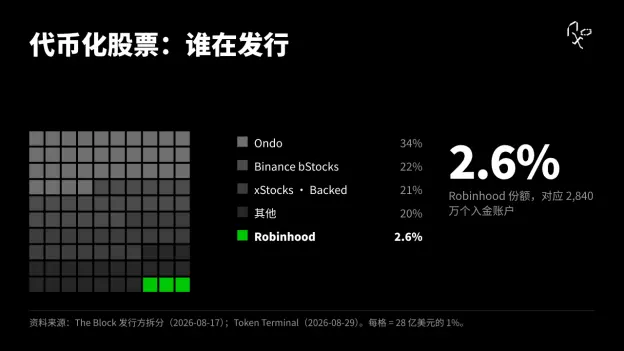
Figure 9|The landscape of stock token issuers. The three leading ones are as of 2026-08-17, while Robinhood is as of 08-29, a difference of 12 days; "Others" is inferred from the total market volume. Source: The Block; Token Terminal.[18][19]
|---------------------------------------------------------------------------------------------------| | Legal Structure Stock tokens are tokenized debt securities issued by Robinhood Assets (Jersey) Limited, providing economic exposure to the underlying securities without granting holders direct legal or beneficial rights to the underlying securities issuer. |
|----------|------------------------------|----------------------| | Risk Dimensions | Key Issues | Monitoring Indicators | | Issuance/Redemption | Holders face issuer debt rights and terms, not on-chain registered shareholder rights | Reserve/Hedge proof, redemption SLA, issuance cap | | Market Timing Mismatch | Tokens trade 24/7, underlying stocks have market open/close, suspensions, and post-market liquidity differences | Weekend premiums, oracle staleness, price differences | | Corporate Actions | Dividends, stock splits, mergers, voting rights handling is complex | Event processing delays and terms consistency | | Regional Compliance | Americans and multiple jurisdictions are restricted | KYC coverage, changes in geographic restrictions, enforcement events | | DeFi Composability Risk | Risks from collateral, liquidation, bridges, oracles, and smart contracts | LTV, liquidation depth, correlation shocks |
6.1 Asset Productivity Has Yet to Form
The key to the next stage lies in the sustainable use of issued assets, rather than continuing to expand the number of tokens displayed, specifically in four areas: entering the lending market as collateral, forming sufficient spot depth, being stably routed by wallets and aggregators, and supporting portfolio management and derivatives under clear risk control. Stock tokens upgrade from static exposure to composable assets, establishing the narrative for RWA.
Before discussing asset productivity, it is necessary to confirm what stock tokens are legally, as this determines which types of funds can purchase them. The market generally believes that xStocks are closer to real stocks than Robinhood's stock tokens, a judgment that contradicts the prospectus: both issuers are special purpose entities registered in Jersey, and the prospectus is approved by the Financial Market Authority of Liechtenstein and is valid in the European Economic Area, with both being fully collateralized debt instruments that do not confer voting rights or beneficial ownership. The real distinction is not in the brand but in whether this instrument is connected to a country's securities settlement system. Currently, only Ondo's U.S. onshore product achieves this: it directly registers securities rights through an SEC-registered transfer agent, thus carrying executable voting rights. For allocators, Robinhood, xStocks, and Ondo offshore are all structured note exposures, while only Ondo U.S. onshore is equity exposure; the two types differ completely in credit risk, tax treatment, and risk control requirements.
bStocks from Binance should be included in the same comparison table: with a scale of approximately $622 million, it is the second-largest issuer and the only product settled by an exchange's proprietary blockchain. The structure of bStocks is derived from the three aforementioned offshore schemes: the issuer is Binance's affiliated entity BTech Holdings Limited; the legal form is a "certificate representing specific financial instruments" approved by the Abu Dhabi Global Market (ADGM) Financial Services Regulatory Authority; the underlying stocks are held 1:1 by a regulated custodian; it does not grant holders ownership or voting rights in the underlying listed companies; it settles on the BNB Chain using the BEP-20 standard, launched on June 12, 2026, and is sold only in the ADGM jurisdiction, prohibiting offerings to U.S. users. After listing the four offshore structures, the conclusion is clearer: the Jersey SPV of Robinhood and xStocks, the ADGM certificate of bStocks, and the offshore notes of Ondo are all essentially credit exposures of the issuers, differing only in regulatory jurisdictions.[29]
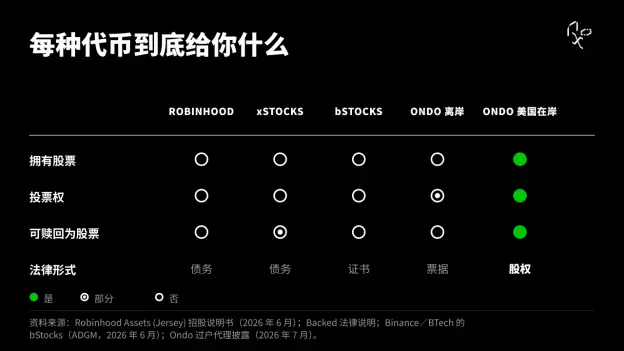
Figure 10 | Rights comparison of four tokenized stock structures. Source: Final terms and base prospectus of Robinhood Assets (Jersey), June 2026; Legal overview of Backed Finance products; Reports by Ledger Insights and CoinDesk on Ondo's onshore transfer agent structure, July 2026.[20][21][22]
|--------------------|--------------------------------------------|--------------------------| | Growth Variables | Robinhood Chain Base | Key Validations | | Stock Token Collateral | Stock Tokens, Chainlink Data Streams, Morpho | LTV, real borrowing demand, closing period basis and liquidation performance | | Native Wallet Transactions | Robinhood Wallet, 1inch/Rialto routing, account abstraction | Best execution, conversion rates, and non-incentivized user retention | | Cross-Protocol Combinations | Stock tokens, stablecoins, lending and trading protocols | Asset availability, cross-protocol security, and real costs | | Collateral Economy | Morpho, USDG, and stock tokens | Stock token LTV, borrowing demand, and liquidation depth under correlation shocks |
7. Outlook, Risks, and Investment Recommendations
|--------|-------------------------|--------------------------|---------------------------| | Dimension | Robinhood Chain | Base | Arbitrum One / Other RWA Chains | | Distribution | Direct access for Robinhood brokerage, wallet, and international users | Coinbase exchange and Smart Wallet | Developer/institutional ecosystem or specific issuers | | Core Assets | Stock/ETF tokens + USDG | Crypto-native assets, USDC, consumer applications | General DeFi or government bonds/fund shares | | Trading Structure | AMM + PropAMM + wallet routing | AMM, social/consumer-driven | Mature DeFi depth or permissioned markets | | Advantages | Integrated issuance---distribution---trading---lending | Scale of users and developers, low cost | Security history, institutional customization or compliance isolation | | Disadvantages | New chain, centralized governance, RWA regulations and liquidity mismatch | Weaker vertical integration for RWA | Retail distribution is generally weak |
Strategically, Robinhood Chain does not need to fully surpass Base on general metrics: as long as a small portion of Robinhood user assets is converted into composable on-chain stocks, dollar yields, and derivatives, a high-value financial vertical chain can be established. The core risk is that brand traffic is diluted by short-term meme trading, and this dilution has already occurred and is in a state tolerated by Robinhood. The verifiable conversion rate is also relatively low: on-chain stock tokens amount to $74.1 million, corresponding to Robinhood's total platform assets of $369 billion at the end of Q2, a ratio of about 0.002%.
7.1 Ecological Opportunity Map

Figure 11 | Ecological opportunity map: structural, repeatable, and defensive opportunities take precedence over short-term trends. Source: NOX Ventures Research.
|---------|--------------------|---------------------|-------------------------| | Priority | Direction | Why Now | Entry Conditions/Triggers | | P1 | Professional market making for stock tokens and USDG | Price differences, 24/7 inventory, and cross-market hedging are necessities | Clear issuance/redemption mechanisms; available hedging; mature API and risk control | | P1 | Morpho/RWA collateral risk infrastructure | Lending is currently the largest source of TVL | Diversified collateral, real borrowing demand, sustainable APY after subsidies | | P1 | Oracles/company actions/compliance data | The larger the RWA scale, the higher the value of data accuracy | Integration with issuers and standard interfaces like Chainlink | | P2 | PropAMM/RFQ liquidity network | More suitable for the long tail and large orders of stock tokens | Verifiable transactions, competitive pricing, and number of market makers | | P2 | RWA perpetual and structured products | High income potential, Robinhood can drive traffic | Liquidation depth, regional compliance, retention of non-incentivized transactions | | P3 | Native Meme/Launchpad | Strong short-term traffic | Event-driven only; strict control of chips, contracts, and exit liquidity |
Key Points of Interest for Market Participants
· The quality of the ecosystem is assessed by these factors: net inflow of TVL, supply of USDG/USDe, utilization rate of Morpho, independent traders on DEX, weekend premiums for stock tokens, and asset deployment rates for bridging.
· When evaluating liquidity protocols, focus on verifying the redemption channels for stock tokens, available hedging venues, competitive pricing levels, and boundaries of risk control responsibilities.
· The inventory, liquidity, and drawdown characteristics of RWA spot, stablecoin yields, and high-volatility native assets differ and cannot be assessed using the same risk assumptions.
· When evaluating ecosystem-native projects, verify non-incentivized transactions, real retention over the past 30 days, team and investor stakes, contract permissions, revenue attribution, and official relationship proofs.
7.2 Future 90-Day Scenarios
|--------|--------|------------------------------------------|----------------------------------------| | Scenario | Probability | Path for the Next 90 Days | Confirmation Signals | | Bull | 25% | Rapid increase in stock token collateral and PropAMM volume; TVL surpasses $1.2B with decreased concentration | RWA trading accounts for >25%; Morpho external protocol TVL >40%; fees not reliant on subsidies | | Base | 50% | TVL maintains between $0.6B and $1.0B, with Meme and RWA coexisting; Robinhood continues to drive traffic | Net increase in stablecoins, DEX daily volume $0.4B–$1.0B, slow expansion of RWA | | Bear | 25% | Volume and price decline after subsidy tapering; regulatory/issuance events trigger redemptions and liquidity contraction | Net outflow from bridging, weekly activity drops >50%, significant discount on stock tokens |
Main catalysts include: the real retention after the expiration of the 90-day Gas subsidy, more stock tokens entering lending collateral, real-time data from Arcus, Rialto, and Pleiades, wallet geographic expansion, mainstream analysis and custody integration, and formal information regarding native tokens or ecological incentives. Two variables have specific timelines: first, the 90-day Gas subsidy and perpetual fee reduction at launch will expire around the end of September, at which point retention can be observed for the first time under non-subsidy conditions; second, on-chain revenue must be shared with Arbitrum according to the Arbitrum expansion plan, with the official stance being 10% of the protocol's net revenue (8% goes to the DAO treasury, 2% to the developer guild), while the Chief Financial Officer stated during the second-quarter conference call that it is "about half," and these two figures cannot be reconciled. Before calculating unit economics, verification must be done with Robinhood's investor relations department.
7.3 Risk Matrix
The risk matrix rates "Regulation/Securities Issuance" as high probability, high impact. This rating is appropriate but must be contextualized in time, as the three events determining whether stock tokens can enter the U.S. have no definite timeline. First, the SEC's innovation exemption for tokenized securities was originally scheduled for May 2026 but was postponed and canceled after August 9, with no new timeline provided; Chairman Paul Atkins stated on August 18 that legislation remains essential. Second, the market structure bill CLARITY passed the House on July 17, 2025, with a vote of 294 to 134, and passed the Senate Banking Committee on May 14, 2026, with a vote of 15 to 9; a motion was introduced by the majority leader on August 8, but it has not yet been voted on and requires 60 votes. Third, the SEC's three divisions issued a statement on tokenized securities on January 28, 2026, categorizing tools that "issue by third parties, provide synthetic economic exposure, and do not confer shareholder rights" as associated securities, explicitly stating they cannot be sold to non-qualified contract participants, and Robinhood's stock tokens fall into this category. Until the best execution and consolidated quote obligations under Reg NMS are exempted, tokenized stocks cannot be legally traded on the U.S. retail side.
The implication for allocators is that "U.S. openness" should not be considered a time assumption in the baseline scenario, as this event currently has no timeline. At the same time, attention must be paid to the opposite progress—on December 11, 2025, the SEC issued a no-action letter for the DTCC tokenization pilot, covering Russell 1000 constituents, U.S. Treasury bonds, and index ETFs; on March 19, 2026, it approved Nasdaq's rule changes for tokenized securities, treating tokenization as a step after T+1 settlement, with tokenized shares sharing the same order book and rights as ordinary shares. The traditional settlement system is approaching the same endpoint from another end and possesses elements that Robinhood's structure cannot provide: real shareholder registration.
|------------|--------|--------|------------------------| | Risk | Probability | Impact | Conclusion | | Regulation/Securities Issuance | High | High | Determines the geographical and combinatorial boundaries for stock tokens | | TVL/Liquidity Concentration | High | Medium-High | High concentration of Morpho and USDG at a single point | | Incentives/Volume Fading | Medium-High | Medium-High | First-month metrics cannot be directly annualized | | Oracles and Market Timing Mismatch | Medium | High | Structural risks of 24/7 RWA trading | | Sequencer/Validator Concentration | Medium | High | Currently only two licensed validators; governance is not fully decentralized | | Bridges/Smart Contracts | Medium | High | Cross-chain assets exceed protocol TVL, presenting a large attack surface | | Brand Association Misjudgment | High | Medium | Inclusion of third-party projects does not equal endorsement by Robinhood |
Appendix A | Data Metrics and Monitoring Framework
It is recommended to adopt a daily UTC uniform slice and retain three sets of metrics at the chain level, protocol level, and asset level. For new chains, the first month should use the 7-day median and 30-day retention, not valuing based on single-day peaks. Among the metrics involved in this report, five groups of differences should not be mixed. First, on-chain value has three parallel metrics: DefiLlama chain-level DeFi TVL at $684 million (08-29), DefiLlama bridging TVL at $2.166 billion, and L2Beat total collateral value at $1.51 billion (08-30), measuring protocol absorption, cross-bridge inflow, and the total value collateralized by Robinhood Chain, with a magnitude difference of over three times. Second, "fees" have two metrics differing by about ten times: chain-level sequencer fees are approximately $551,000 over 24 hours, while total application fees amount to about $5.57 million, with DefiLlama naming both the same. Third, the media commonly uses 15% for the proportion of tokenized stocks in the RWA market, but the denominator it cites (2.8 billion / 44.7 billion) calculates to 6.3%, and this report adopts the latter. Fourth, the number of transactions is affected by block intervals; Robinhood Chain has about 100 milliseconds while Base has 2 seconds, and cross-chain cannot be directly converted to user scale. Fifth, the denominator for "stock tokens accounting for 78%" is the RWA transaction basket for that day ($85.1 million), not the total chain transaction ($875 million to $1.013 billion), with a difference of an order of magnitude.
|--------|---------------------------------|------------------------| | Module | Core Metrics | Red Flag Thresholds (Research Recommendations) | | Capital | TVL, Stablecoins, Net Bridge In, Protocol Deployment Rate | Single Protocol TVL > 70%; 7-day Net Outflow > 20% | | Trading | DEX/Perps Volume, Independent Traders, Maker/Taker, Slippage | Volume increases but independent traders decrease; Top 3 pool volume > 70% | | RWA | Active Market Value, Holders, Weekend Premium, Redemption Delay | Premium/Discount > 2%; Oracle Staleness > 5 minutes | | Lending | Utilization Rate, Borrowing APR, Liquidation, Collateral Concentration | Utilization Rate > 90%; Single Collateral > 50% | | Development | Active Contracts, Deployers, Audits, GitHub | High new deployments but 30-day active contract retention < 10% | | Governance | Upgrades, Validators, Time Locks, Incidents | Frequent emergency upgrades; Validator interruptions |
Conclusion
In the first 60 days after launch, Robinhood Chain accomplished three things that few new chains can achieve: bringing large-scale retail distribution on-chain, establishing a TVL structure centered on dollar lending, and quickly forming high-frequency trading scenarios. The fuel for the third achievement is memes, which does not constitute a flaw—memes played a role in distribution and customer acquisition during the cold start phase, gaining attention, initial addresses, and real fee income at a cost far lower than conventional business development. The current issue is not the existence of memes, but that the users brought in by memes have not yet converted into holders of stock tokens.
We give Robinhood Chain a "Positive Observation/Selective Participation" rating. The direction worth investing resources in is professional liquidity for stock tokens, RWA collateral risk management, and institutional-level data infrastructure; what should be avoided is treating meme transactions themselves as a moat—it's a customer acquisition channel, not a barrier, as the practices of BNB Chain have proven that any chain with a budget can buy the same channels. In the next 90 days, we need to focus on one variable: after the subsidy exits, whether there is a measurable portion of users and fees brought in by the meme channel that remains in stock tokens.
Appendix B | Data Snapshot
|-----------------|----------------|------------------------------|-----------| | Indicator | Value | Time/Scope | Source | | TVL | $706.76M | 2026-08-30, DeFi TVL | DeFiLlama | | Morpho Blue TVL | $481.98M | On-chain protocol attribution | DeFiLlama | | Stablecoin Market Cap | $769.54M | On-chain stablecoins | DeFiLlama | | USDG Proportion | 57.35% | Stablecoin supply proportion | DeFiLlama | | RWA Active Market Cap | $148.81M | Active RWA market cap | DeFiLlama | | DEX Volume | $1.013B / 24h | $5.338B / 7d | DeFiLlama | | Perps Volume | $189.86M / 24h | $2.112B / 7d | DeFiLlama | | Bridge TVL | $2.166B | Native+Canonical+Third Party | DeFiLlama | | Chain Fees | $550.6K / 24h | Chain-level fees | DeFiLlama | | Chain Revenue | $495.5K / 24h | Chain-level revenue | DeFiLlama |
Appendix C | Main Sources
[1] Robinhood Chain Documentation, "About Robinhood Chain" and ecosystem partner directory, accessed on 2026-08-30. https://docs.robinhood.com/chain/
[2] Robinhood Newsroom, "Robinhood Accelerates Global Expansion…", 2026-07-01. https://robinhood.com/us/en/newsroom/robinhood-accelerates-global-expansion-robinhood-chain-mainnet-stock-tokens-agentic-trading/
[3] Robinhood Chain Documentation, "Governance", accessed on 2026-08-30. https://docs.robinhood.com/chain/governance/
[4] DeFiLlama, Robinhood Chain Dashboard, data snapshot 2026-08-30. https://defillama.com/chain/robinhood-chain
[5] Robinhood Chain Documentation, Stock Tokens / Building with Stock Tokens. https://docs.robinhood.com/chain/stock-tokens/
[6] Arbitrum Foundation, Builder's Block #021 / Robinhood Chain Mainnet factsheet, 2026-08. https://blog.arbitrum.foundation/builders-block-021-robinhood-chain-mainnet-live-on-arbitrum-founder-house-london-winners/
[7] Odaily/Foresight News, Robinhood Chain Ecosystem Overview, 2026-07-06. https://www.odaily.news/en/post/5211739
[8] Robinhood, "Invest with Stock Tokens", accessed on 2026-08-30. https://robinhood.com/rhj/stocktokens/
[9] Chainlink, Robinhood Chain mainnet oracle/CCIP announcement, 2026-07-01. https://www.prnewswire.com/news-releases/robinhood-chain-launches-and-adopts-chainlink-to-unlock-access-to-the-onchain-economy-for-millions-of-users-302816242.html
[10] Arkham, Robinhood Chain explorer integration, 2026-08-03. https://info.arkm.com/research/arkham-is-a-robinhood-chain-explorer-and-transaction-scanner
[11] Robinhood Chain official ecosystem directory, accessed on 2026-08-30. https://robinhood.com/us/en/chain/ecosystem/
[12] Delphi Digital, "Exploring Base's Role in the Growing Onchain Economy", 2024-11-26. https://members.delphidigital.io/reports/exploring-bases-role-in-the-growing-on-chain-economy
[13] L2Beat, Robinhood Chain project page (stage rating, validator set, forced inclusion and transaction filters), accessed on 2026-08-30. https://l2beat.com/scaling/projects/robinhood
[14] DefiLlama, Chains API (chain-level DeFi TVL and historical series), data retrieved 2026-08-30. https://api.llama.fi/v2/chains
[15] Arbitrum Docs, "Compliance filtering" and "Timeboost", accessed on 2026-08-30. https://docs.arbitrum.io/launch-arbitrum-chain/chain-config/validation/compliance-filtering
[16] Robinhood Markets, Inc., Q2 2026 financial report and conference call transcript, 2026-07-29. https://investors.robinhood.com/news-releases/news-release-details/robinhood-reports-second-quarter-2026-results
[17] The Block, "Tokenized equities triple market share; Ondo, Binance, xStocks dominate", 2026-08-17. https://www.theblock.co/news/defi/2026-08-17-tokenized-equities-triple-market-share-ondo-binance-xstocks-dominate-411996
[18] Token Terminal, Robinhood tokenized asset market cap and holder data snapshot, 2026-08-29 (cited by The Crypto Times on 2026-08-30). https://www.cryptotimes.io/2026/08/30/uniswap-robinhood-chain-volume-reaches-130m-all-time-high/
[19] Robinhood Assets (Jersey) Limited, Final Terms (Series 86, ISIN JE00BX9HD256) and Tokenised Products Programme base prospectus, 2026-06-25/26. https://cdn.robinhood.com/assets/robinhood/legal/rhjfinaltermsfortokeniseddebtsecuritieslinkedto_boeing.pdf
[20] Backed Finance, "Product & Legal Overview," accessed on 2026-08-30. https://docs.xstocks.fi/docs/product-legal-overview
[21] Ledger Insights, "Ondo launches onshore US tokenized stocks with ownership rights," July 2026. https://www.ledgerinsights.com/ondo-launches-onshore-us-tokenized-stocks-with-ownership-rights/
[23] U.S. Securities and Exchange Commission, Division of Corporation Finance and two other departments, "Staff Statement on Tokenized Securities," 2026-01-28. https://www.sec.gov/newsroom/speeches-statements/corp-fin-statement-tokenized-securities-012826-statement-tokenized-securities
[24] Arbitrum Foundation, "ArbitrumDAO Factsheet: Robinhood Chain Mainnet Launch" (AEP fee-sharing terms), 2026-07-06. https://forum.arbitrum.foundation/t/arbitrumdao-factsheet-robinhood-chain-mainnet-launch/31041
[25] CoinDesk, "Robinhood Chain beats Ethereum in daily revenue as memecoin trading takes over," 2026-08-31 (including the number of tokens issued, transaction counts, application revenue, and DEX transactions on 08-30). https://www.coindesk.com/markets/2026/08/31/robinhood-chain-beats-ethereum-in-daily-revenue-as-memecoin-trading-takes-over
[26] Vlad Tenev, CNBC interview, 2026-07-02; and his X post, 2026-07-08 ("it works great for memes too"). Verified by Yahoo Finance and CryptoNexa.
[27] FinanceFeeds cited calculations from FalconX and Entropy Advisors, 2026-07-29 (in the early stages, memes accounted for over 80% of cumulative DEX transactions, RWA about 4%; CASHCAT peak market value approximately 156 million USD). https://financefeeds.com/robinhood-chain-is-winning-on-memecoins-not-the-tokenized-stocks-it-was-built-for/
[28] Uniswap Labs released pools.trade on Robinhood Chain, 2026-08-07; Pons Labs launchpad operational data and fee rates (cumulative tokens issued, daily active addresses, 1% transaction fee distribution); Memecoin.Fun raised 3.5 million USD. Pons is not affiliated with Robinhood, as stated by its operator.
[29] Binance / BTech Holdings Limited, bStocks tokenized securities announcement and product page, 2026-06-12 (issuer, ADGM FSRA approved certificate structure, 1:1 custody, no voting rights, BNB Chain BEP-20 settlement, jurisdiction restrictions). https://www.bstocks.finance/en
[30] BNB Chain, "Memecoin Landscape on BNB Chain," official blog (meme innovation competition with over four rounds, incentives exceeding 200,000 USD, liquidity pool of 900,000 USD, daily purchase and airdrop of 33 BNB in December 2024). https://www.bnbchain.org/en/blog/memecoin-landscape-on-bnb-chain-a-path-to-community-engagement-and-innovation
Methodology: Prioritize using primary data from Robinhood and chain documents, DefiLlama, and ecosystem parties, with media data used to supplement early peaks. Less than two months after the mainnet launch, there are delays and discrepancies in TVL, protocol attribution, active addresses, and transaction volumes across platforms; all inferences are separated from original facts. Company actions prioritize primary press releases, financial reports, prospectuses, and regulatory registrations; on-chain data prioritizes verifiable aggregator interfaces. Officially undisclosed matters (capital expenditures, exclusive team size, decentralized roadmap for sorters, cross-chain transfer capability of stock tokens, whether Chainlink reserve proofs are configured) are marked as undisclosed, with no speculation. New memes, issuance platforms, and cross-chain reference materials follow the same discipline: the claim of no affiliation between Pons and Robinhood has been verified according to its operator's public statement, and BNB Chain's meme plans are sourced from its official blog.
 Risk warning


Popular articles