Top trader AJC, ranked fourth on the Fomo leaderboard, reveals the trading logic of Robinhood Chain
 Core Viewpoint

 AJC: Robinhood Chain will not be a flash in the pan; the big move has not been revealed yet.
Original Author: threadguy
Compiled by|Odaily Planet Daily Azuma
Editor's Note: This article is an exclusive video interview with AJC, the fourth-ranked Meme master on the current total profit leaderboard of Fomo, conducted by blog host threadguy. AJC is also a researcher at Blockworks Research and has previously shared in-depth insights about the market.
In this round of Robinhood Chain's market explosion, AJC is one of the few top traders with public achievements who is willing to share real strategies with the market. In the following interview, AJC not only talks about his practical experience but also deeply analyzes topics such as "The Rise of Robinhood Chain," "PONS vs PUMP," and "Stock & Meme Pairing."
The following is the content of the interview video, compiled by Odaily Planet Daily. 
Highlights of Trading Career
(Skipping the opening small talk)
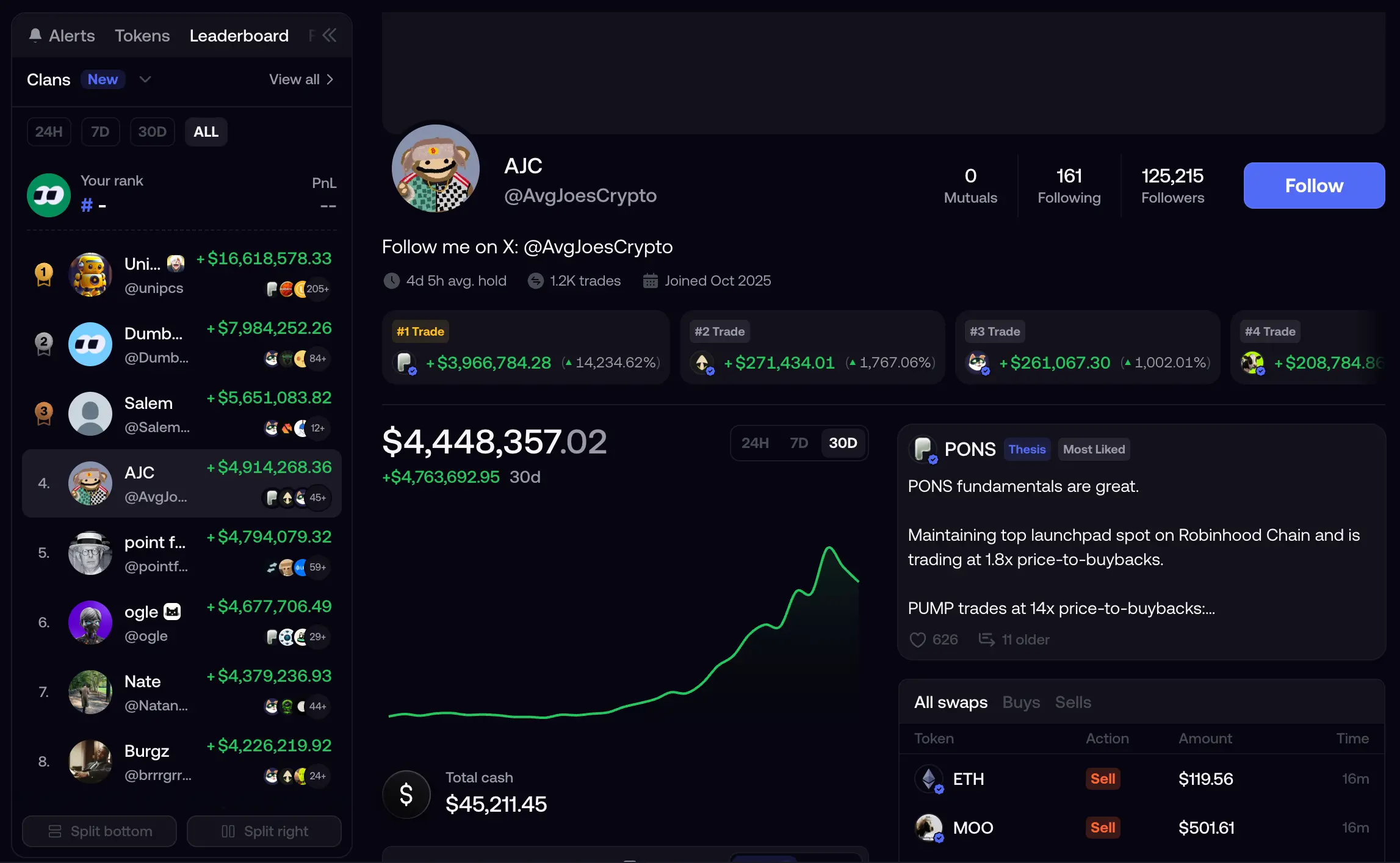
Host (threadguy): First of all, congratulations ------ this is definitely your highlight moment. We just checked your FOMO account, and your assets have risen to nearly 3 million dollars (as of the publication, it is close to 5 million dollars), although most of it is still unrealized gains.
AJC: Haha, actually, I have been cashing out. I will sell slowly, but I'm not the type to dump my entire position at the peak.
So basically, every time I open the Fomo app, I might sell off 1,000 dollars worth of PONS.
Host: Okay, I have to admit, you are better than me. You are now in the top ten of the leaderboard. Can you tell us what you have experienced in the past month?
I have always thought you are a very sharp, accurate judge, and a strong trader, but this time you really seem to have caught a generational market wave.
AJC: Alright. To be honest, it all comes down to Robinhood Chain.
I must confess that I missed the first wave of the market when Robinhood Chain launched. At that time, Messari was being acquired by Blockworks, and I was settling in there, not trading frequently.
I knew Robinhood Chain would definitely take off, but I thought to myself, "There’s still time; this thing won’t rise that quickly." Then Vlad (co-founder and CEO of Robinhood) suddenly focused on Cash Cat, and the whole situation changed instantly.
Fortunately, another opportunity came ------ the NOXA platform inexplicably shut down, equivalent to them throwing away their "money tree." At that moment, I observed and thought, Robinhood is genuinely valuing this chain, which can be seen from Vlad's social media; this is not a fleeting moment.
Many people here were tripped up by their inherent thinking because the cryptocurrency industry has seen too many public chain projects that ended without results, but Robinhood is a completely different beast.
So I went to dig into the Launchpad on the chain and found that besides NOXA, the data and momentum were best with PONS. At that time, I was completely on the sidelines, watching it soar to around 18 million dollars in market value.
Then, Brian changed his profile picture to that classic Meme avatar…
Host (interjecting): Haha, I remember, it directly crashed all the Meme tokens.
AJC: Right! It was crazy; I was watching the market, and PONS dropped 80% in a day. Then I thought, well, now is the time!
I decided to take a gamble. Because I had already determined that the top Launchpad on Robinhood Chain should be worth a nine-figure market value, and it had dropped to 4 million dollars, while it was still the absolute leader. The worst-case scenario was that I would lose 25,000 dollars, but the risk-reward ratio was too good to miss.
The subsequent process was also full of twists and turns; PONS rose to a market value of 60 million dollars and then fell back to 10 million. During that process, I didn’t sell a single token. At that time, various Launchpads on Robinhood Chain were competing fiercely, but in the end, PONS emerged victorious. I believe one of the key reasons PONS ultimately won is that it indeed has its own token, which we can discuss in detail later.
In the last two weeks, the market has started to reprice it. I basically kept an eye on it, watching the charts, and observing my expectations come to fruition step by step.
So this period has indeed been very chaotic, but on the other hand, the truly difficult things have already been accomplished. The current situation is basically just sitting there, watching my "piggy bank" continue to grow.
The Success Path of Robinhood Chain
Host: I mentioned a while ago in the Telegram group ------ in the cryptocurrency field, often "first-mover advantage" can actually be a form of punishment. For example, early NFT Launchpads, and Vector, etc., there are too many such examples ------ you start too early, and later entrants can not only learn from your failures but are often bolder in betting and more willing to take risks.
To be honest, when Robinhood Chain first launched, I had a completely "oh, whatever" attitude ------ looking back now, that thought was simply absurd. Because Robinhood's approach is really interesting. If other centralized exchanges' chains launched a bit later, they might also adopt similar strategies.
Robinhood came in with an extremely meticulous plan, fully embracing on-chain culture, thoroughly understanding the Meme token mechanism, and every step was as precise as a military advance, with no mistakes, no disgusting over-marketing (Triple shill), and no strange deployment issues… all the basic mistakes we have seen time and again when traditional Web2 giants create on-chain products, they avoided completely. Even in the earnings call, their "soft milk" towards Cash Cat was perfectly calibrated. Did this entire approach amaze you, or did you think it was within reason?
AJC: Half and half. First of all, Robinhood is an extremely large publicly traded giant. If they are determined to make their chain succeed, they have all the necessary resources and trump cards to make it happen.
However, their complete embrace of the on-chain native "Degen" culture did surprise me at first. But thinking about it carefully, it makes perfect sense, right? Looking back to 2021, why did DOGE and SHIB completely explode? The core driver was Robinhood. Their user base is naturally very receptive to such high-volatility assets.
So I believe, from this perspective, their deep activation of this attribute is logical. We might really have to give credit to Robinhood's team ------ they keenly captured the emotional vacuum in the market. At that time, on-chain players were generally heartbroken by major mainstream exchanges and new public chains; everyone felt ignored and abandoned, and no one truly cared about retail investors.
As a result, at this moment, the most influential retail trading platform for the younger generation in the U.S. came in with its own chain, warmly embracing these on-chain natives. In that instant, everyone thought, "Wow." So, their choice of this entry path was indeed somewhat unexpected, but logically, it’s not surprising that Robinhood Chain could succeed.
Where is this round of Meme Cycle?
Host: How are you currently managing the active positions in your investment portfolio? What do you think about the explosion of the Robinhood ecosystem in the past two weeks, and what stage is it in the overall narrative evolution? Where exactly are we in the cycle?
AJC: It’s hard to predict precisely. My personal strength lies in keenly sensing "the turning point of something about to start," but once the market really takes off, I usually just go with the flow and ride the roller coaster, often giving back profits (Round-tripping), that’s how I’ve always been.
So I might not be the most authoritative person to answer "topping," but I think you can completely compare this wave to Solana in Q4 2023, or Base in Q1 2024 ------ this is a brand new ecosystem just emerging, and what follows is likely to be a long and sustained upward trend, definitely not a short-lived pulse market; right now, it’s probably just the prelude.
Of course, I have heavily invested here, and I naturally hope this script comes true, but I really can’t believe that if Robinhood is genuinely sincere about moving all the U.S. stock assets on their platform onto the chain and completely opening the door to real-world DeFi, how could this chain just be a flash in the pan?
I watched a podcast by Vlad, and his goal is to tokenize all asset classes in the U.S. stock market, collectibles, and even everything in your investment portfolio onto the chain. And these heavyweight moves have not yet truly landed! Since the big moves haven’t been released yet, it’s hard for me to believe that Robinhood Chain has already peaked.
Admittedly, in recent days, Meme tokens and related stocks have indeed been a bit crazy. I remember yesterday, the revenue captured by Robinhood Chain in a single day was as high as about 3 million dollars, directly surpassing many mainstream Ethereum L2s.
So in the short term, due to the previous rapid rise, it is entirely possible to see a temporary top, but I firmly believe that if the overall cryptocurrency market re-enters a bull market and the situation is no longer stagnant, then the real Alpha and absolute main battlefield will definitely be on Robinhood Chain.
Its retail distribution moat is simply too wide. Those ordinary people who know nothing about the intricate mechanisms of the crypto circle naturally trust Robinhood's endorsement. They see U.S. stock tokens on the chain and feel very secure and willing to try; and the lending, trading, and Meme derivative ecosystem built on these assets will naturally integrate smoothly.
So my conclusion is that while a short-term surge may lead to some consolidation or a small local top, there will absolutely not be a situation where "after reaching the top, funds scatter like birds and beasts, and everyone returns to their old chains." If you firmly believe in the cryptocurrency market over the next 6 to 12 months, you must heavily allocate to Robinhood Chain; this is the optimal solution to enjoy this round of dividends.
PONS vs PUMP
Host: Let me interject with a completely unimportant aside, and then we can continue. I noticed that the Ethereum mainnet seems to be generating only about $4,000 a day through Robinhood Chain. This really illustrates how disastrous the L2 situation is. But that's not important.
Back to positions, you hold a massive PONS position. In fact, just a few months ago, I also developed a strong interest in the on-chain ecosystem, especially Pump.fun. At that time, the platform tokens Anon and Cash both surged to nine-digit market caps, and my first reaction was, "The on-chain world is about to go completely crazy; Pump's ability to attract capital is too exaggerated." Solana is obviously a beneficiary, but I don't really like holding SOL spot, so I bought Pump and Anon.
With Bitcoin breaking through, the entire ecosystem exploded rapidly. As a result, the shift in the crypto world changed faster than any traditional market; in just over ten days, the entire public opinion landscape was completely dominated by Robinhood Chain. Now, even mentioning Solana in a live broadcast seems out of place and has become somewhat taboo; the speed of this transformation is unbelievable.
So from the current trading perspective, how do you view the relative competition between PONS and PUMP, as well as the Solana ecosystem compared to the Robinhood ecosystem?
AJC: If I had to choose, I would want to go long on both. I don't think they are mutually exclusive zero-sum oppositions.
Host: Are you currently holding PUMP?
AJC: I don't have PUMP right now, but I am definitely bullish in spirit. I sincerely hope it continues to rise; I am absolutely not a hater of PUMP.
From a pessimistic PvP perspective, yes, PONS and PUMP are indeed competing for the same batch of on-chain users and the same speculative liquidity, but I prefer to take an optimistic "grow the pie" perspective ------ Robinhood Chain will bring more entirely new external users onto the chain, and this overflow of funds and attention will ultimately also benefit other chains like Solana. They can absolutely coexist and prosper together.
Looking back at the fourth quarter of 2024, as Pump.fun's revenue skyrocketed parabolically, Virtuals also surged, both experiencing explosive growth in the same macro environment. So I would never view them as life-and-death rivals, nor do I believe investors must choose one over the other. If PUMP rises five times from its current position and returns to an all-time high, that would absolutely be a huge benefit for PONS, as it would directly elevate the valuation ceiling of the entire crypto Launchpad sector.
As for the public chain tokens you mentioned, I completely agree. I also do not hold any SOL. If I had to bet on one dog between PUMP and SOL, I would unhesitatingly choose PUMP. Because products like Launchpads are extremely unique ------ they are among the few killer applications in the entire crypto industry that have the strongest "product-market fit" (PMF). As you have emphasized multiple times before, even during extremely bleak bear markets, they can still rake in millions of dollars in real revenue in a single day.
You can mock this user group as a bunch of gamblers, but these people come to the platform every day without fail to place their bets. You can have moral purity, but reality is what it is.
However, the entire crypto capital circle has been obsessively leaning towards the so-called "institutional narrative" over the past few years ------ What do institutions like? How do we tell stories to institutions? This has led to the long-term and severe undervaluation of Launchpad-type protocols. People always feel that "formal institutions won't touch this kind of thing," but look at the real captured revenue of Pump.fun; how many so-called top institutional-backed star projects have been completely obliterated?
Host: Indeed, the data is brutal.
AJC: So for me, this is simply a perfect target that is hard to come by in a bear market: it has a proven strong PMF; due to mainstream capital's biases and bystanders, it enjoys a very low historical valuation multiple; and the protocol's cash flow is sufficiently abundant.
PUMP is an excellent expression of this logic, and PONS is also an outstanding vehicle. My previous enthusiasm for PONS was very simple and straightforward ------ compare the revenue of Pump.fun with that of Pons, and calculate the multiple of their fully diluted valuation (FDV) compared to the buyback scale.
At that time, PUMP's FDV / buyback multiple was about 10 to 15 times; while when I built my position in PONS, its multiple was only about 2 times, and it even hovered between 1 and 2 times later on.
If you believe that the overall on-chain market is entering a bull market, then the logic follows that PUMP and PONS are both severely undervalued. There is absolutely no need to engage in any long-short pair trading; if pairing is necessary, the strategy should be "go long on both."
Host: But have you considered a question: when you calculate Pons's platform revenue, the most popular and top tokens on Robinhood Chain are actually not launched from Pons; isn't that a hidden danger?
AJC: I don't see that as a problem at all.
Host: What if other competitors (like Long) suddenly issue tokens?
AJC: I'm not sure if they will issue tokens. I am increasingly leaning towards a "horseshoe theory" of token issuance ------ either you launch the token on the first day the product goes live, or you should never issue a token at all.
I believe this is precisely the core reason why PONS can break through. There used to be an outdated understanding in the industry that "Launchpad platforms cannot issue platform tokens too early, otherwise the token price will set an invisible ceiling for the platform's ecosystem." But after experiencing so many instances of garbage tokens and being indirectly harvested by teams, the current on-chain retail investors have learned their lesson ------ if there is no clear, non-malicious token binding mechanism visible from day one, and if they cannot feel the alignment of interests between the team and holders, users have no motivation to stay on your platform long-term.
This is the key to PONS's great success. When PONS first came out, it wasn't even officially launched by the team; it was spontaneously launched by the community, and then the team directly took over the community (CTO), clearly announcing: "This is our official platform token, and 80% of the platform's revenue will be used to buy back this token."
Retail investors immediately understood: "Okay, I can now confidently use your platform because you have a truly interest-aligned token; you won't pocket all the trading fees into your private wallets."
This is an extremely profound market paradigm shift, a complete 180-degree reversal from last year's logic. So for me now: if you want to launch a new product, either bring out the token that empowers users on the first day, or don't issue it at all.
The Magic of "Stock & Meme" Pairing
Host: Brother, I actually think this might be one of the most important changes that have happened on-chain. It seems we have finally reached a social consensus: "What constitutes a good token?"
The answer is to make money and then use the profits to buy back tokens. Because tokens have always been the most terrifying cold-start tool for aggregating attention and initial capital; the crypto industry has been a dimensionality reduction strike in this regard. The biggest pain point in the market has always been, after raising money and attracting attention, what exactly do the project parties want to do with it? No one knows.
Until Hyperliquid came in and provided a demonstration: "We figured it out; the money we earn should be used to aggressively buy back our tokens on the open market through TWAP." Of course, Hyperliquid's situation is quite special; they earn much more money, and the team is not under pressure from external venture capital, as they already have money and do not need to pocket profits. At that time, the market was saying: "Don't expect every project to be Hyperliquid; that's an exception."
But then Pump.fun did the same, followed by more other tokens… the entire market has been pushing along this logic: as long as the protocol has real revenue, it is completely capable and should allocate a certain proportion to buy back. Different projects may have different buyback ratios and varying abilities to attract capital, but this alignment of interests between real cash and token holders standing in the same trench has been completely absent for far too many years. Previously, it was all a bunch of ethereal air; founders were behind the scenes heavily dumping through OTC to cash out, leaving retail investors devastated.
Continuing on this on-chain topic ------ before earning the latest several million dollars, your social media has always been on my must-read list because you have an extremely keen sense for various cutting-edge new plays on-chain. From early SocialFi, card draws, to Railgun's privacy narrative, you are always the first to catch the new trends.
I mentioned in a live broadcast before that the current on-chain games might be the most "grand narrative ceiling" equipped ever. Over the past few years, cryptocurrencies have loved to create value out of nothing ------ from early DeFi mining to lending of junk assets, often being drained by hackers. And now, the most liquid, trusted, and solid quality real assets (like U.S. stocks) have been moved on-chain. The crypto market's ability to "play with assets" finally has a solid foundation.
So I am particularly curious, what is your core investment argument regarding the recently explosive Meme stocks? How high can they go? Are you really super optimistic about the liquidity pool mechanism pairing stocks and Meme tokens (Gigapump)?
AJC: Yes, I am extremely optimistic.
It's interesting; last time we talked about Zora, my underlying understanding of Zora is actually 100% interconnected with this. The reason I was so optimistic about Zora is that they recognized the core magic of AMM liquidity pools early on: you can forcibly bind the value of any two assets together through decentralized capital pools.
That was what attracted me to Zora. For example ------ do you remember that influencer who filmed "exquisite morning routines" while holding Saratoga spring water?
Host: I remember; that video went viral and became a top Meme.
AJC: At that time, someone on-chain immediately created a Meme token around him, and its market cap once surged to $20 million; meanwhile, the Saratoga spring water stock in the U.S. also got hyped up and directly soared by 100%.
But in the traditional environment at that time, these two surging assets were completely disconnected in underlying value, with no channel to allow their funds to transmit to each other.
Imagine if that influencer's Meme token had directly formed an AMM liquidity pair with Saratoga's U.S. stock token? These two assets would instantly form a direct value bond. Every time someone buys that Memecoin, the buying pressure would be transmitted to the underlying U.S. stock asset through the underlying mechanism.
Therefore, I highly advocate the paradigm of "pairing meme tokens with their true value drivers." For example, if you launch an AI-themed meme token, what are you pairing it with ETH for? NVIDIA is surging, OpenAI has made technological breakthroughs, what does that have to do with Ethereum? Ethereum won't take off because of the AI revolution.
A reasonable approach would be to directly anchor this AI meme token to NVIDIA, or pair it with equity tokens of pre-IPO unicorns like Anthropic and OpenAI through platforms like Stock.fun.
From this perspective, I am very confident that we finally have the ability to strongly bind the carnival of real cultural assets to their true value carriers. I cannot guarantee how high it will rise, but I firmly believe this will become the standard paradigm for on-chain asset issuance in the future—no longer mindlessly pairing with SOL or ETH, but pairing with the underlying benchmark assets that best match their logical attributes.
Look at how many people on Solana are rushing into various junk tokens every day? If this massive flow of funds spills over into the stock meme space, the valuation ceiling of tokens will be completely shattered. If you want to be bullish on the US-listed company Hims in the long term, you can directly buy BONER; the underlying logic is interconnected: if Hims stock rises by 500% in the future, under the influence of the liquidity pool, BONER will also experience an astonishing correlated increase.
Thus, I am extremely optimistic about this track from a fundamental mechanism perspective.
Host: Let's delve into the technical details. I know many people may be hesitant to break this layer of glass, but you definitely understand the field—when we use US stock tokens (like HIMS stock) to purchase an on-chain paired token (like BONER), what actions actually occur in the underlying on-chain smart contracts and liquidity pools?
AJC: Simply put, it works like this.
First, there is a batch of officially recognized US stock tokens on the Robinhood Chain. These tokens must be minted and introduced on-chain by market makers with whitelist qualifications. For example, Rialto is one of the self-operated AMM market-making institutions on the Robinhood Chain.
The specific purchasing process is as follows: suppose an ordinary user wants to buy $100 worth of BONER, this is essentially equivalent to them indirectly purchasing $100 worth of Hims stock.
- The user holds a universal stablecoin (like USDG);
- The system uses this $100 to buy an equivalent amount of on-chain HIMS stock tokens through the market-making channel;
- This batch of HIMS stock tokens is injected into the BONER/HIMS AMM liquidity pool;
- Finally, the user exchanges for BONER tokens worth $100.
Host: Got it! It’s equivalent to superficially selling Hims for BONER, but in reality, the funds flow is injecting the US stock tokens into the underlying liquidity pool, thereby locking in the stock's spot price.
AJC: Yes, that's completely correct! You can think of it as depositing HIMS.
This also explains another core phenomenon: for example, the recent unusual movements of AMC stock and its on-chain token CINEMA. At that time, the on-chain liquidity for AMC was very shallow, only about $40,000, leading to a severe depeg of the on-chain price.
The only motivation for traditional institutions to move real US stock spots onto the chain is the "risk arbitrage that doesn't exist." As long as the fervent buying of on-chain meme tokens pushes the price of the stock tokens in the pool up by even 0.5%, traditional arbitrage market makers will immediately buy the spot in the US stock market and cross-chain mint tokens to the chain to capture the premium.
This is how the real liquidity of traditional US stocks is forcibly pulled into the underlying flywheel on-chain. Just yesterday, the total locked amount of real-world assets (RWA) on the Robinhood Chain surged by over 30%. This mechanism is indeed functioning on a large scale, but there is a very deadly risk hidden here: US stock tokens can only be minted and redeemed during regular US stock trading hours (or extended pre-market and after-hours periods).
Once the weekend arrives and the US stock market is closed, all mint and redeem channels are completely locked. This leads to certain tokens experiencing impulsive surges over the weekend, while the on-chain liquidity pool cannot arbitrage to stabilize prices— for example, the on-chain AMC token was once driven up to $400, while the actual stock price outside was not even close! Market makers are completely unable to enter the market for arbitrage before Monday's opening.
So everyone must be highly vigilant when trading; never blindly buy these paired stock tokens during the weekend when the US stock market is closed, or when the on-chain pool's liquidity is extremely scarce, otherwise you are just giving market makers a windfall.
Host: So if HIMS stock suddenly encounters a black swan during US trading hours and drops 50% within 15 minutes, will the BONER token crash as well? Why?
AJC: It will definitely crash.
Because AMM automated market makers follow the classic constant product formula (x * y = k). The pricing logic of the two assets in the pool is strongly bound; under the pure vacuum assumption without additional retail buying or selling, if the external fair fiat value of one asset (HIMS stock) is halved by 50%, in order to maintain the relative balance of the pool, the other asset (BONER) will also instantaneously lose 50% of its fiat-equivalent book value.
Host: So they are indeed physically bound in a 1:1 manner!
AJC: Yes. Of course, in actual trading, retail buying and selling behavior will disturb the ratio. For example, even if the stock is halved, if retail investors develop faith in BONER and frantically buy it up, its decline may be partially hedged; but if we completely exclude external buying and selling variables, the two are fundamentally a 1:1 mirrored linkage in value.
Host: This design is genius! It perfectly corroborates the Saratoga case you mentioned earlier.
I was also extremely obsessed with AMC a few months ago; this company is very skilled at playing tricks with its stock price. In 2022, they created a preferred stock called APE, which was a way to raise funds without directly issuing more common stock, and airdropped it 1:1 to all AMC shareholders. That thing ultimately failed and went to zero, but they successfully harvested hundreds of millions of dollars through it.
Why can't AMC directly issue an official APE token on the Robinhood Chain today? AMC's current actual market cap is only around $2 billion—now an AI meme that has emerged on-chain can reach a market cap of $300 million, and GOAT once surged to $1.5 billion, not to mention other top meme tokens. If AMC's management wants to inject endless buying liquidity into the common stock, this would definitely be a better channel!
Vlad would never specifically talk about an ordinary AMC in public, but if it were a token that raked in tens of billions of dollars in trading volume on the Robinhood Chain in a single day, that would be a super narrative that rewrites industry perceptions.
So I completely agree with you that the marginal expectations for stock memes have been elevated to an incredible level. The ceiling for an AI token on Solana might just be a tweet from an ordinary programmer at OpenAI, while the narrative ceiling for a top stock meme could be the CEO of the listed company himself or even the entire army of retail investors on Wall Street!
AJC: Theoretically, yes, but I personally hold a conservative attitude that there are still huge obstacles for listed companies to directly issue meme tokens in an official capacity under the current regulatory laws. Although the regulatory framework is gradually becoming clearer, listed companies venturing into securities-like tokens remain a high-pressure line.
However, I am confident that in the future, there will definitely be some small-cap listed companies brave enough to embrace the meme token community. Their approach may lean towards "community rewards and cultural building"—for example, holding the meme token could unlock exclusive discounts on merchandise or grant specific shareholder-level benefits, reminiscent of the NFT community's play in 2021.
But this is not the first to arrive. I believe the first to jump in will definitely be those from WallStreetBets (the Reddit retail investor hub). They will quickly realize that leveraging the liquidity of on-chain stock memes is an excellent new financial tool for triggering a "short squeeze" in US stocks!
Of course, I personally declare that I do not encourage or participate in any manipulation of the securities market.
We have actually already seen similar signs on-chain; some heavily shorted small-cap stocks, once tokenized, have seen retail investors use aggressive on-chain funding to push prices up, attempting to force traditional market shorts to liquidate.
Of course, all of this could also be the self-indulgence of the crypto-native circle—perhaps outside the crypto circle, no one cares about this underlying mapping, and once the heat passes, everyone runs away. But in the crypto circle, enduring long-term optimism often brings excess returns.
Traditional US companies can reach a new generation of buyers who would never buy their stocks in their lifetime; I may never go to an AMC theater, but if this token can give me discounts on movies or allow me to earn money on-chain, I would be willing to indirectly hold AMC.
This track just ignited fully last week, and the ceiling cannot be measured with old perspectives. You know, the latest animal meme coin on Solana can reach tens of millions of dollars, but how high can the top stocks in the US combined with on-chain carnival reach? No one knows.
Facing the new game rules, being in it is the most exciting.
Mainstream Coins, Where to Go?
Host: Finally, let me ask you one last question; today’s discussion has been so thorough and exciting—what do you think about the current trends of mainstream coins (Majors), and where do you think we are in the crypto cycle? Especially Bitcoin, how do you think the market will move next?
AJC: I am a "permanent bull" on Bitcoin; I will always be bullish on Bitcoin.
In my view, the worst extreme situation has already occurred. For example, when Bitcoin fell to around $60,000, the market was filled with panic and short-selling pressure, but the price simply could not go lower. Since even that situation couldn't push it down further, aside from the uncontrollable "global macro liquidity completely collapsing," I find it hard to imagine what could cause Bitcoin to make a significant new low. Of course, macro black swans are outside my circle of competence, and I have no unique insights, so I simply won't overestimate them as a baseline variable.
As for now, I believe the market is in a healthy "bullish consolidation" phase. After experiencing a strong upward impulse, Bitcoin and the entire crypto market have actually been severely suppressed and washed out for over a year. I see some people casually saying, "Oh, this bear market hasn't really dropped much," and in terms of absolute retracement in USD, it does seem not that exaggerated on paper.
But if we calculate the retracement of crypto assets based on gold, the drop is simply horrific.
Host: Yes, compared to gold, it’s truly unbearable.
AJC: As an old player who has fully experienced three crypto bear markets, I personally feel that this round of bear market is the most severe in terms of psychological torment so far.
The last bear market was quite clear: everyone knew exactly why the crash happened ------ a bunch of well-known Ponzi schemes collapsed, Three Arrows Capital went down, and FTX completely blew up. The reasons were very specific and transparent; everyone knew where the tumors were. As long as these liquidation pressures and leftover minefields were digested, the market could find a bottom and rebound.
But this round of decline is inexplicable, the market is extremely gloomy and fragile. People can't understand where the core suppression comes from; the unknown is what is most frightening ------ if you can't even diagnose what the cause of the illness is, you have no idea when this layer of gloom will completely dissipate.
Host: I completely agree, it's 100% that feeling.
AJC: But precisely because of this, my core viewpoint now is: the crypto market has been suppressed for too long, and as long as there is a slight trigger, it is extremely eager to explode upwards. Almost everyone off the market is sitting on the sidelines with empty positions.
You can see from the market's intense reaction to some macro liquidity easing expectations or policy comments recently that as long as there is a slight stir in sentiment, funds will crazily rush to buy.
I cannot accurately predict what the specific favorable catalyst will be to trigger the next super rally, but the strongest signal released by this round of impulse rebound is ------ the current crypto market is actively seeking every reason to rise, and it will eventually find enough reasons.
At this position, the reasons for continuing to decline are already very few; however, the potential positives that could ignite the market are countless. This is my underlying judgment.
Host: That was fantastic. Brother, once again, heartfelt congratulations on this dreamlike "winning streak." I really enjoy following every step of your trading; you are definitely at the forefront of sensing the market pulse.
Chatting with you is always an unparalleled pleasure. Thank you again for coming to the live broadcast!
AJC: Thank you so much, brother. It’s a great honor to be here.
 Risk warning

Popular articles