PONS surged nearly 20 times, how does it support half of Robinhood Chain's revenue?
 Core Viewpoint

 Market attention is gradually being drawn away by stock memes; has the story of Pons come to an end?
Author: Zhou, ChainCatcher
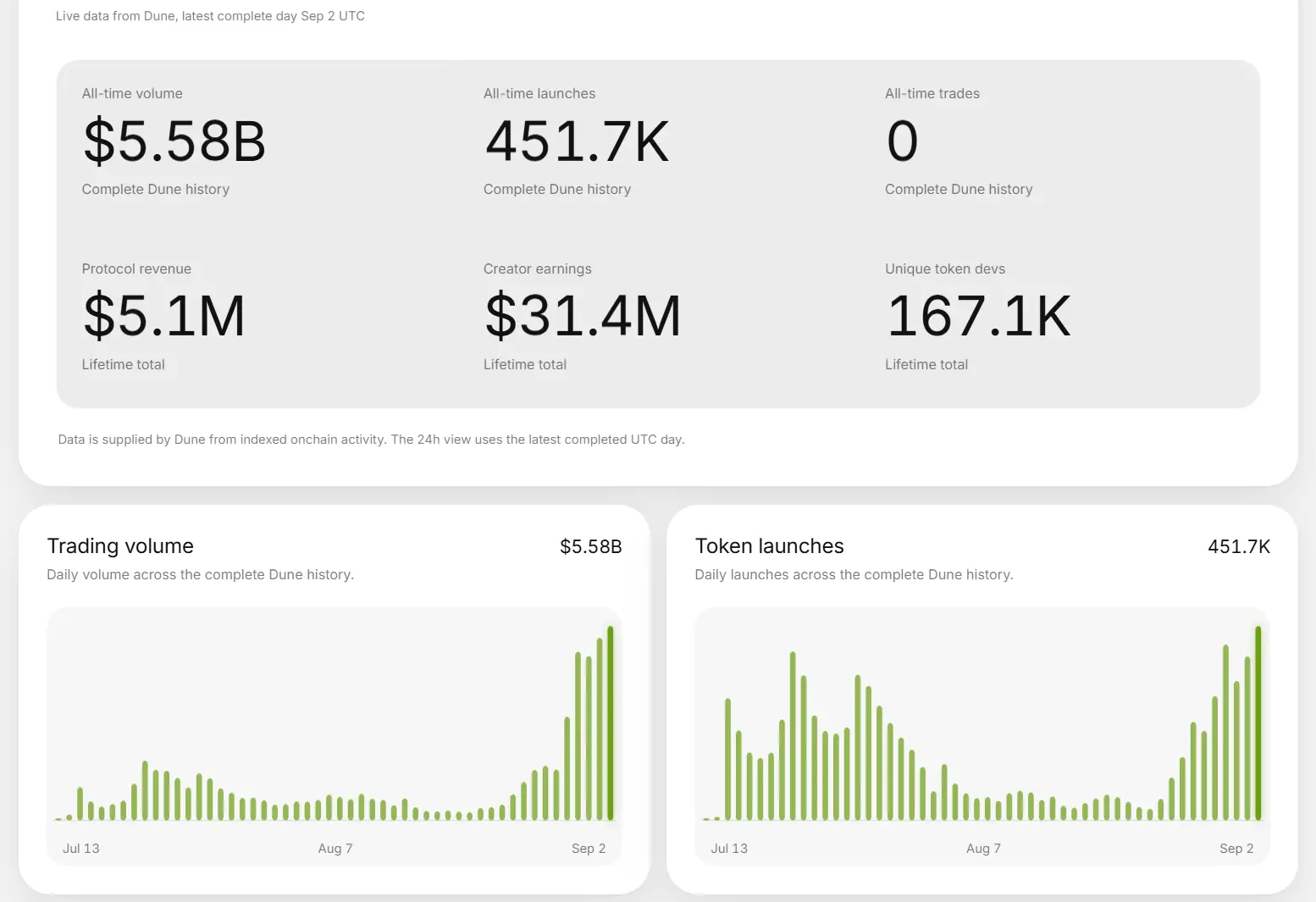
During this period, discussions in the market about Robinhood Chain have been increasing, and Pons is an unavoidable topic. The latest data shows that the cumulative trading volume of Pons has surpassed $5 billion, with over 63% of the trading volume on the Robinhood Chain Launchpad completed through Pons during the same period.
In the past month, the price of the PONS token has increased by about 20 times. On September 2, PONS was listed on Binance Alpha, and its market capitalization has now exceeded $500 million, with a 24-hour increase of over 40%.
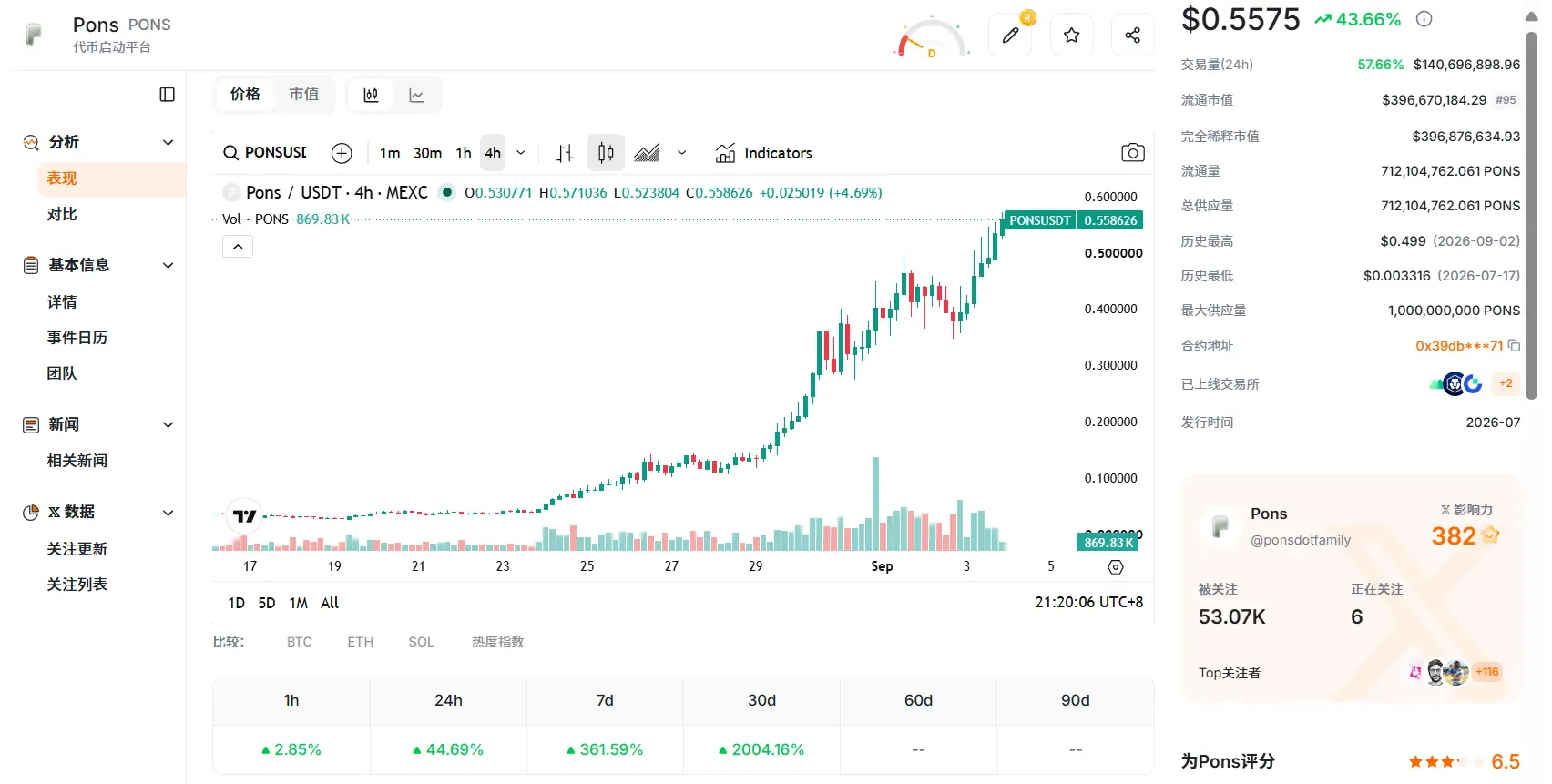
Pons is a token launch platform built on the Robinhood Chain. In less than two months since its launch, it has become the most active application on this new public chain, with token creators having accumulated over $28.7 million in transaction fee sharing.
A team that was almost unknown has established itself as a leading presence in the field within two months. This is the story of Pons and a key clue to understanding the early ecosystem of Robinhood Chain.
From Taking Over Noxa's Traffic to Entering Pools.trade
Robinhood Chain officially launched on the mainnet on July 1. At the beginning, the leading platform in the field was the launchpad Noxa.
However, Noxa suspended new token launches in mid-July, and traffic quickly shifted to the newly started Pons. In just one week, Pons completed over 66,000 token issuances, with the cumulative trading volume on the platform exceeding $380 million, and its market share remained above 50% for several consecutive days.
WLFI advisor Ogle publicly disclosed his holdings on Robinhood Chain, with PONS listed as his second-largest position after Lighter (currently, the total value of his PONS holdings has risen to about $5.4 million).
In late July, Robinhood co-founder and CEO Vlad Tenev followed Pons founder Ozzy on Twitter, causing the market capitalization of PONS to surge to $39 million.
At the beginning of August, the competitive landscape changed. The launchpad pools.trade launched by Uniswap went live on Robinhood Chain on August 5, creating 10,506 tokens on its first day, surpassing Pons' 7,210 during the same period. Uniswap itself is the underlying liquidity pool infrastructure that Pons relies on, and the official entry into similar products has intensified competition in the entire field.
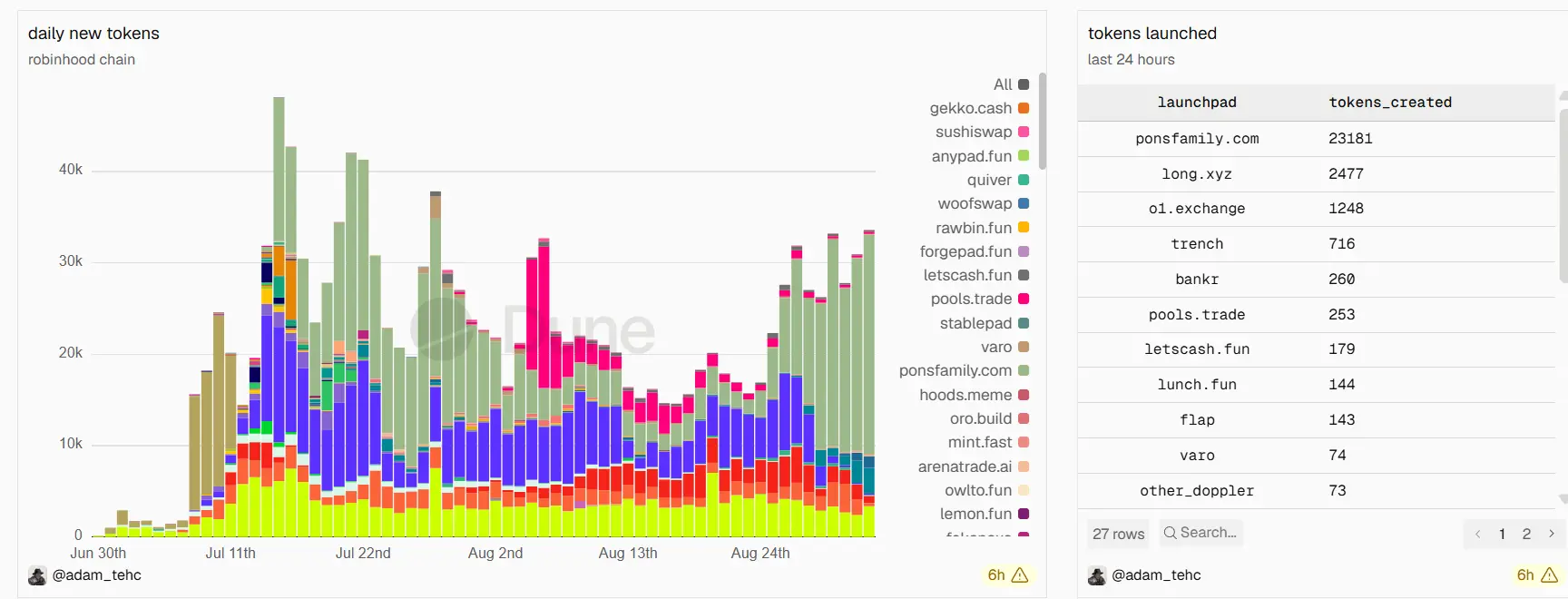
The daily issuance of tokens by Pons also fell from a peak of just over 20,000 in mid-July to a low of only over 1,000 in mid-August. It wasn't until around August 24 that the daily issuance of tokens by Pons began to rebound, with trading volume and the price of PONS rising almost simultaneously, reaching over 20,000 again by the end of August, setting a new high. During the same period, Pons was also promoting a mechanism upgrade.
As of now, the Pons team has not publicly disclosed a complete list of members. The founder's Twitter account is MEADGod (Ozzy), and the account description mentions RootsFi.
It is reported that in May 2025, he introduced RootsFi at the Berachain governance forum under the same identity, positioning it as a native lending protocol with the stablecoin MEAD. RootsFi later completed its transformation, and its current website has positioned itself as a payment network.
Mechanism Upgrade to V2, RWA Proportion Only 5%
The initial model of Pons was very simple: after token creation, it directly entered the liquidity pool of Uniswap V3, with no joint curve and no subsequent migration; trading began in the same pool from the first second.
The creation fee is fixed at 0.0005 ETH, and the transaction fee is 1%, with 70% going to the creator and 30% to the protocol. The early issued tokens still retain the old ratio of 90% to the creator and 10% to the protocol. Of the portion received by the protocol, 80% will be used to buy and burn PONS through TWAP.
The new version V2 has changed to a joint curve priced in ETH, and after tokens are sold on the curve, they automatically graduate, with liquidity permanently locked into Uniswap V4 positions, and creators can no longer withdraw. The priced assets have also expanded from a single ETH to other tokens approved by the platform, including stablecoins and some tokenized stocks.
This mechanism has pushed the launch process and anti-sniping design forward another step. The specific incremental benefits are yet to be observed, but the product has indeed progressed to a new generation.
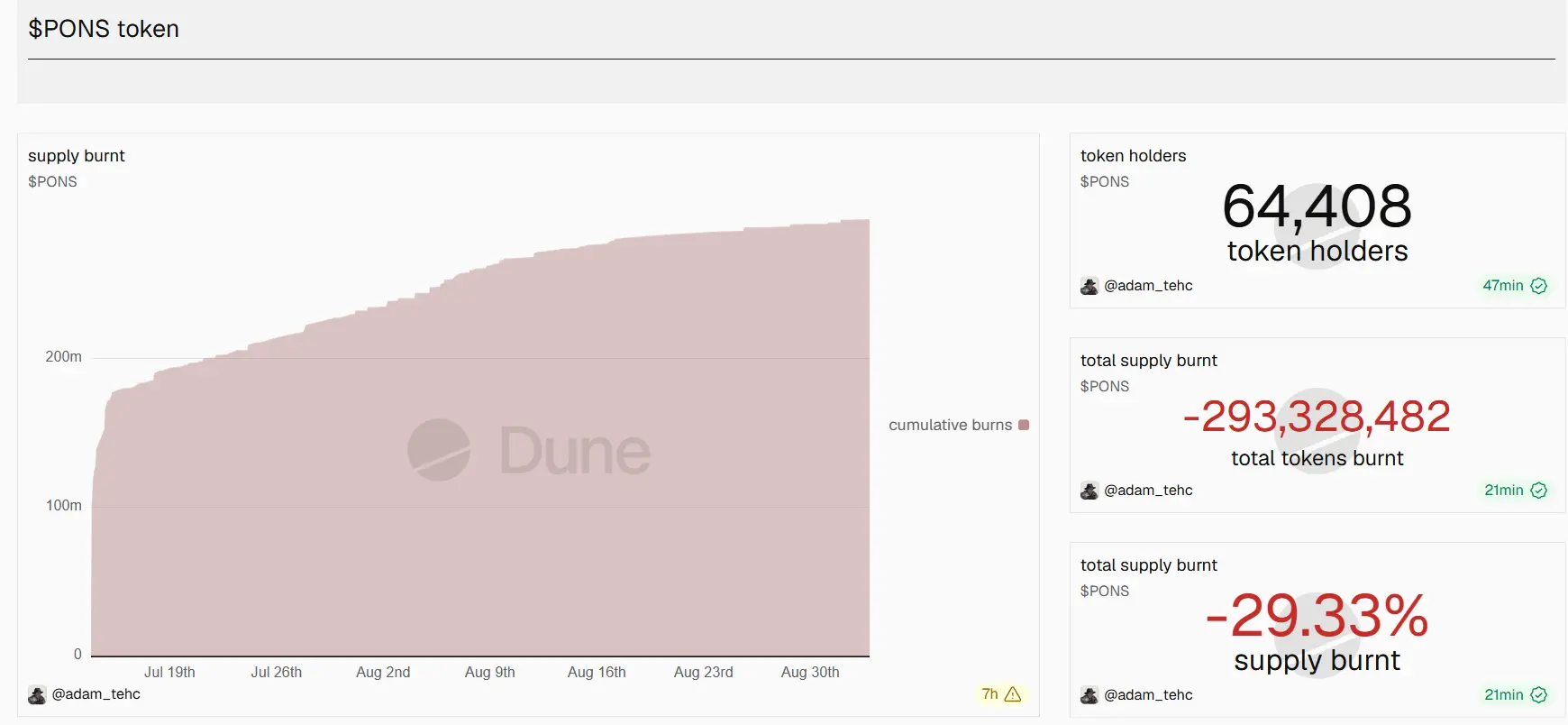
As of early September, PONS has cumulatively burned 293 million tokens, accounting for 29.33% of the maximum issuance, with over 62,000 holding addresses. On the platform level, nearly 600,000 tokens have been issued, with over 150,000 independent creators, and the protocol's cumulative revenue is approximately $4.97 million.
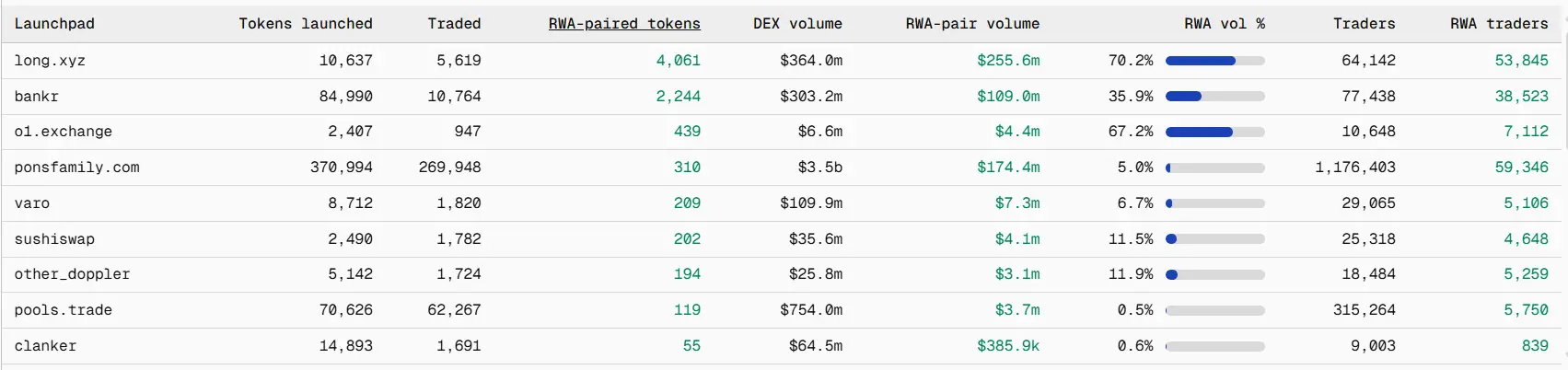
Looking at the entire Robinhood Chain launchpad field, according to Dune panel data, since July, Pons has ranked first in terms of token issuance, on-chain trading volume, and number of traders, with its trading volume accounting for over half of the total volume of several major launchpads.
Additionally, the combination of stocks and memes is becoming a larger trend on Robinhood Chain. According to KOL Dayu, once stock tokens are massively launched on-chain, the first issue to address is actually liquidity; with thousands of stocks, each one needs someone to build a pool, and there is no standard answer for how large it should be.
Memes provide a low-cost solution; once a meme coin paired with a stock takes off, the corresponding liquidity pool will naturally grow with the trading, without needing someone to build it specifically. Conversely, stocks provide memes with a real-world value anchor and narrative.
In his view, this mutual supplementation is the core logic that allows stocks and memes to thrive on Robinhood Chain, rather than just a narrative gimmick.
Pons is also attempting to incorporate stock token trading into its system, with this part of the trading volume currently accounting for about 5% of the platform's total, corresponding to approximately $174 million in cumulative trading volume and 310 stock token trading pairs. However, this is not Pons' main battlefield; the RWA ratios on the same chain for long.xyz, o1.exchange, and bankr are 70.2%, 67.2%, and 35.9%, respectively, all significantly higher than Pons.
Supporting Half of Robinhood Chain's Revenue?
Robinhood Chain has only been live for two months but has already surpassed Ethereum, BSC, Solana, and Base in terms of revenue.
As of September 3, the DEX trading volume on Robinhood Chain in the past 24 hours was approximately $1.85 billion, second only to Solana, surpassing Ethereum mainnet, BSC, and Base.
During the same period, the fees generated by this chain were approximately $4.45 million, three times that of the total for Solana, Ethereum, BSC, and Base, with on-chain revenue of about $4.01 million, nearly 14 times the total of these four chains.
In the DeFiLlama revenue ranking, based on protocol revenue, Pons ranks ninth as a single application. The on-chain data analysis platform Bubblemaps reports that the daily fee revenue generated by PONS is approximately $4.73 million, surpassing the total of Hyperliquid, Polymarket, and Fomo at the application level.
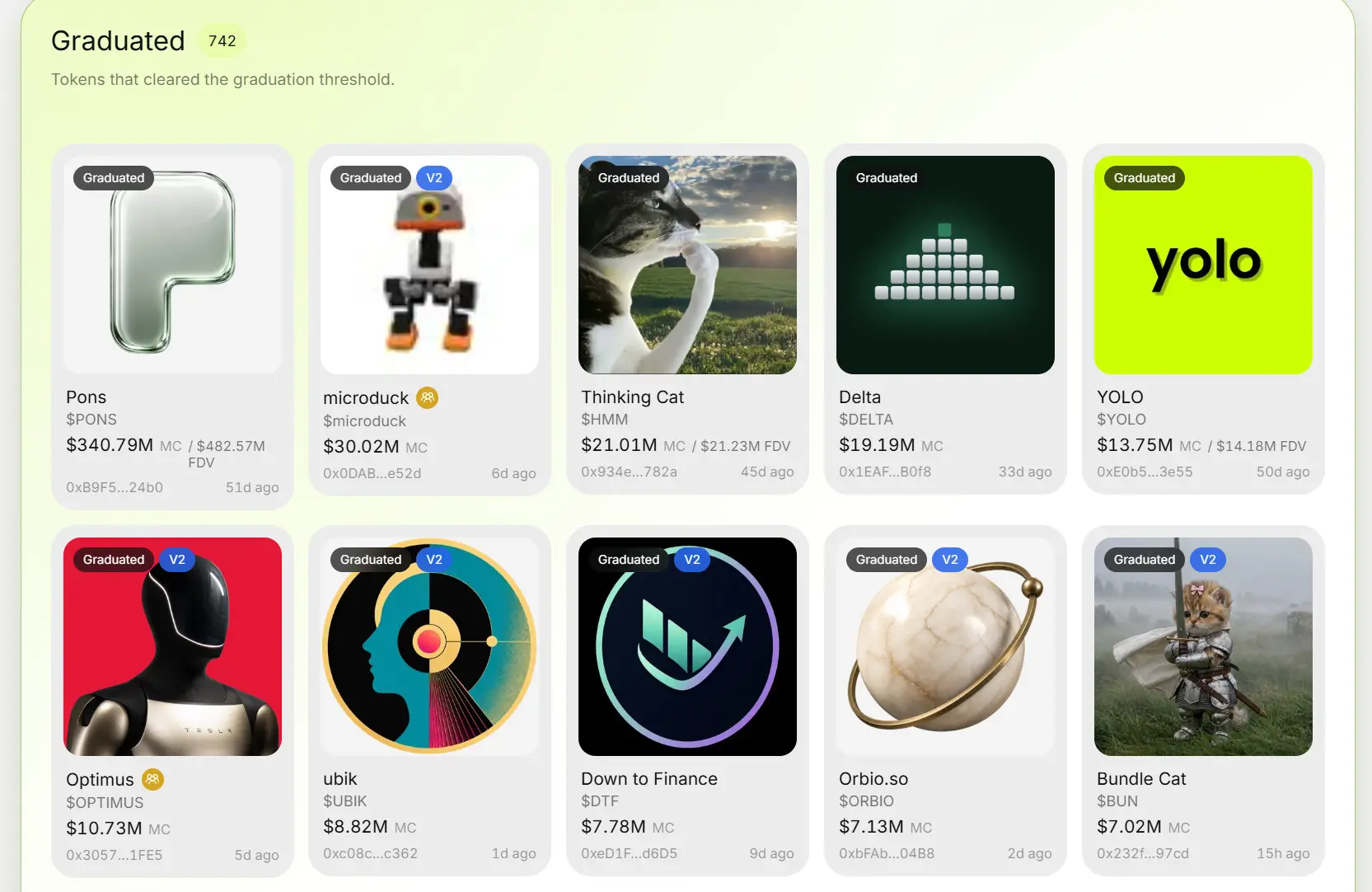
In terms of graduation rates, July statistics show that Pons has cumulatively issued about 67,000 tokens, with 529 reaching the graduation threshold, a ratio of less than 0.8%. By early September, the official website showed a cumulative graduation of 742 tokens, while the cumulative issuance had risen to nearly 600,000, with the graduation rate dropping to around 0.11%.
KOL 0xLoki reminded that newly issued tokens and projects that have not yet taken off carry the highest risks, and investments in Memecoin liquidity pools should be prepared for the possibility of total loss at any time. On the same launchpad, many long-tail tokens have a high concentration of holdings, with some projects having over 80% of their holdings concentrated in a few addresses; once these large holders sell, the price structure is difficult to withstand.
Additionally, it is worth noting that Robinhood Chain has provided users with 90 days of zero gas fees since its mainnet launch, a policy that will expire at the end of September. Currently, the issuance density of 20,000 tokens per day is largely based on the almost zero cost of issuing tokens; whether this rhythm can be maintained after the subsidy is removed remains uncertain.
Trader Timo compared Pons' revenue performance with Virtual's historical peak, stating that such growth is difficult to sustain long-term, and expressed doubts about whether the buyback ratio can be genuinely executed, how long the revenue can last, and whether liquidity is sufficient.
KOL Lanhu pointed out that Pons' strategy is to bring Pump.fun to Robinhood Chain; the gameplay is not new, and while the traffic and attention are online, it is uncertain how long it can last. Others have noted that they have seen many projects that replicate the Pump model and switch chains; changing chains does not equate to solving the fundamental issues, and most ultimately only result in a wave of market activity.
Pons may have proven the success of Robinhood Chain, but whether it can ultimately become a platform that can continuously generate wealth effects remains unanswered by the market.

 Risk warning