Hyperliquid HIP-4 launches on the mainnet without a license, is the prediction market landscape about to change?
 Core Viewpoint

 The unified margin account allows traders to hold positions in perpetual, spot, and prediction markets simultaneously with the same funds, which is unmatched by any independent prediction market platform without a complete product rebuild.
Author: Zhou, ChainCatcher
On August 29, Hyperliquid's HIP-4 officially opened for permissionless deployment. Outcome, as the first third-party Builder to complete mainnet deployment, launched over 20 prediction markets at once, with trading volume surpassing one million dollars within two days. According to feedback from several KOLs, Outcome's fees are more than an order of magnitude lower than those of Polymarket.
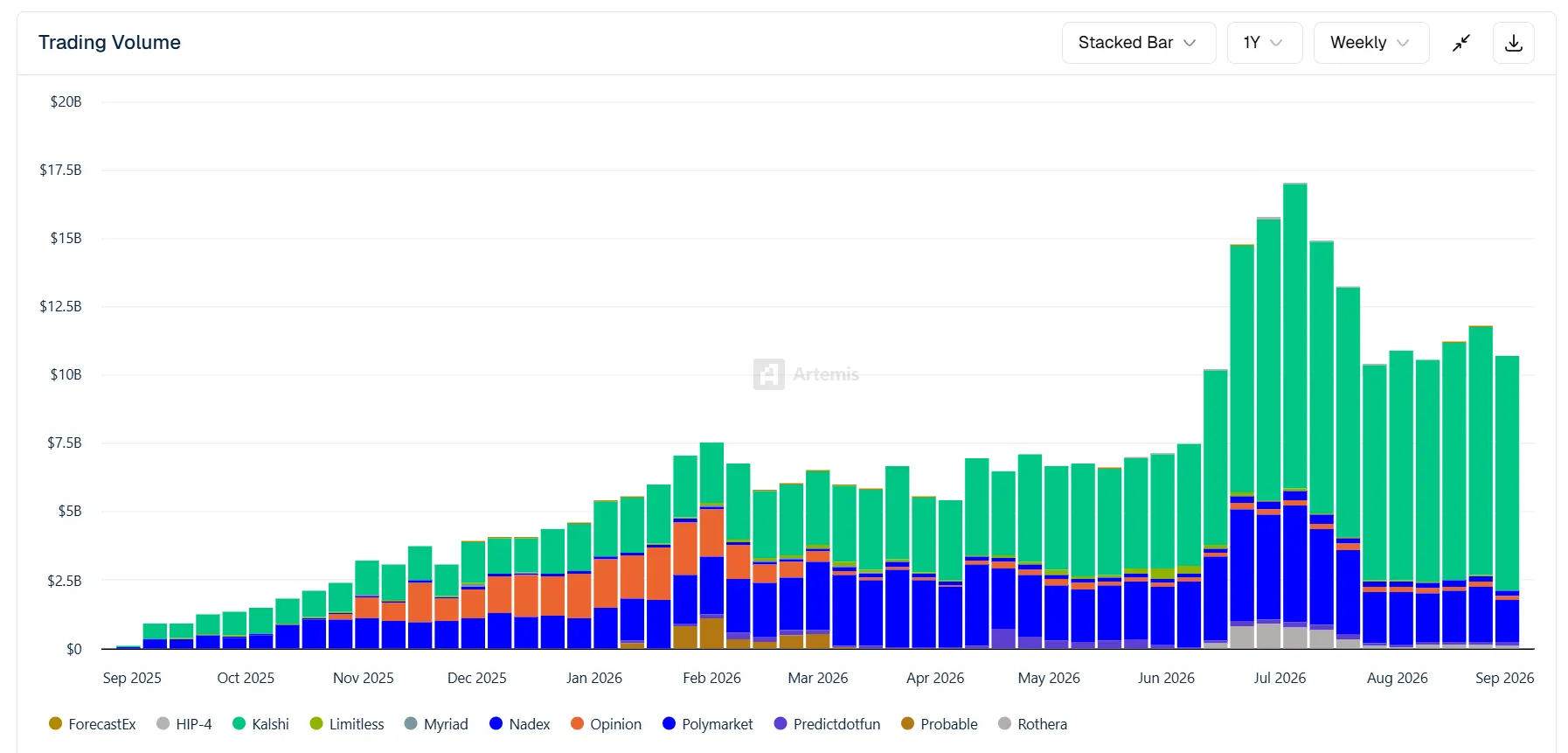
Looking at the veteran players in the prediction market, Polymarket and Kalshi, the gap between the two has widened significantly. According to Artemis data, Kalshi's weekly trading volume is around 9 billion dollars, more than four times Polymarket's approximately 2 billion dollars, with the combined market share of both exceeding 90%, and their valuations have entered the tens of billions.
Hyperliquid's HIP-4 took over half a year from the actual proposal to permissionless mainnet launch, and many see it as a strong competitor to Polymarket and Kalshi. It directly replicated the permissionless model validated in the perpetual contract space to the prediction market, lowering the entry threshold. Whether this is a true disruptive force that can leverage existing market share or just another story of the crypto space seeing a rise in value before the narrative unfolds remains to be seen.
Permissionless Mainnet Launch, Outcome Takes the Lead
It is reported that on September 16, 2025, contributors, including Kalshi's crypto lead John Wang, submitted a community proposal titled Event Perpetuals, which pointed out that HIP-3 oracles are unsuitable for binary events.
On February 2, 2026, Hyperliquid officially announced the formal plan, redirecting focus to Outcome Trading, still referred to as HIP-4.
The mainnet activation on May 2 was the latter version, at that time the market was still deployed by validators, with the first product being a daily settled Bitcoin binary contract, expanding in late May to off-chain events like Federal Reserve decisions and CPI.
In mid-July, the community began calling for permissionless deployment, the testnet was running smoothly, and on August 14, the official fee details were announced. By the end of August, the permissionless mainnet was officially launched, and the deployment threshold was lowered from 1 million HYPE during the proposal stage to 500,000 HYPE (currently over 40 million dollars).
According to official documents, deployers stake 500,000 HYPE, locking it for 6 months. If the market is improperly defined, settlement errors occur, or if not settled within a week, the stake can be voted to be confiscated by validators. The initial quota for each deployer is 100 outcomes, with a maximum of 500 deployed per day, which are reclaimed after settlement. In terms of fees, there are no charges for opening positions and minting; fees appear during closing and settlement, with multipliers set by the deployer, and the protocol and deployer share profits equally.
The method of obtaining deployment rights differs between HIP-4 and HIP-3. In HIP-3, the initial three assets in a perpetual section could be deployed directly, while each additional asset had to participate in a Dutch auction, with prices decaying over time, allowing those willing to offer more HYPE to secure deployment spots. This auction parameter directly followed the settings from HIP-1's spot asset auction. However, HIP-4 bypassed this bidding layer; deployers only need to stake 500,000 HYPE to qualify for deployment without competing with others.
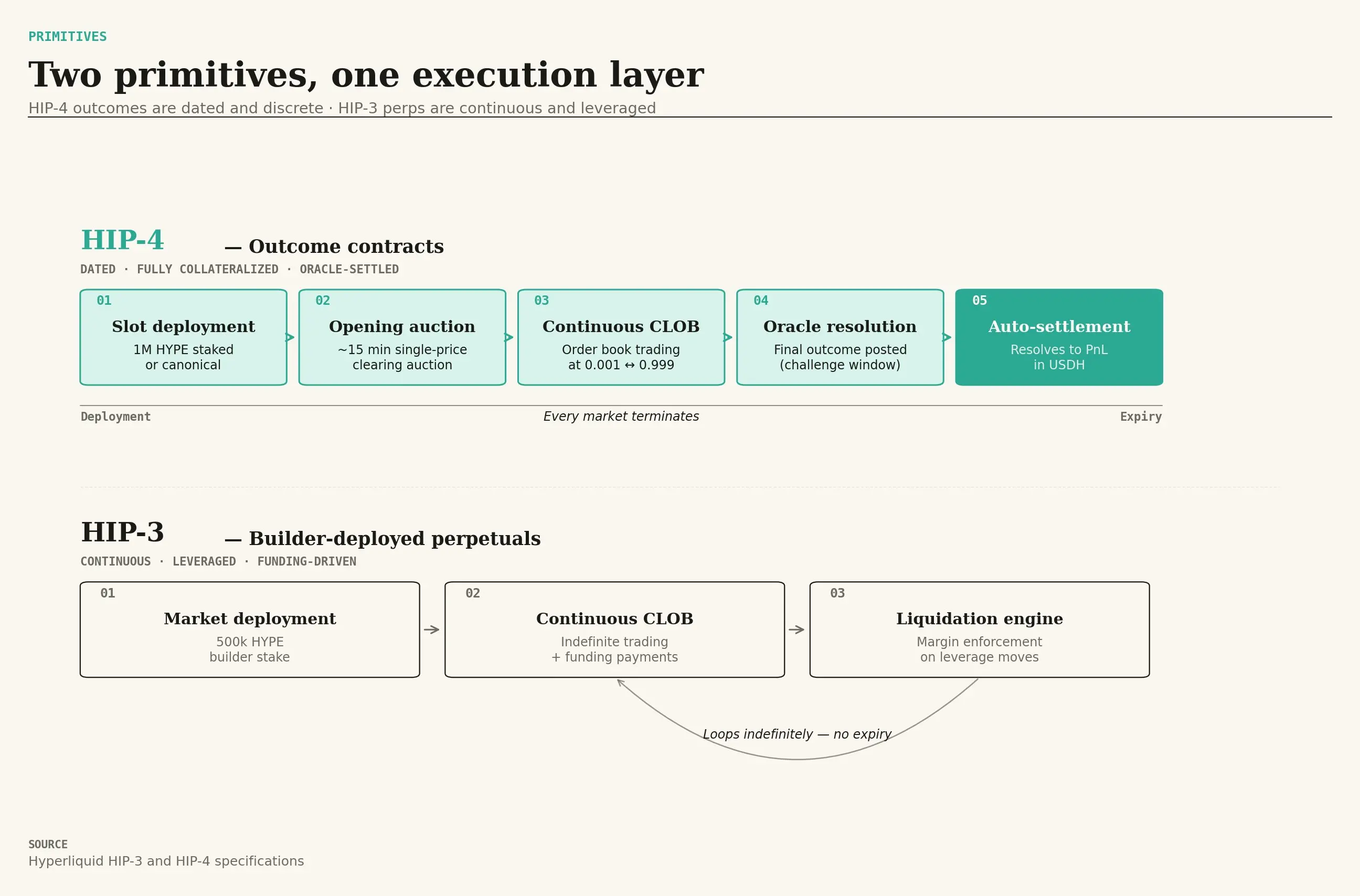
Mechanically, HIP-4 did not directly apply HIP-3's perpetual contract oracle. Researcher Petro D. pointed out that the perpetual contract oracle can change the marked price by a maximum of about 1% per jump, suitable for continuously priced assets like crude oil and Tesla. However, event contracts need to jump from 0.5 to 1 at the moment the result is revealed; using this logic would require 50 jumps, taking nearly 50 minutes, with all gaps being risk-free arbitrage opportunities.
Thus, HIP-4 designed a unique contract, with linear interpolation pricing before expiration, and the binary result given directly by an authorized oracle at expiration, settled on-chain in real-time, with USDC as the settlement currency, and no leverage, forced liquidation, or funding rates involved, with the maximum loss being the principal.
These contracts can share the same margin account with perpetual contracts and spot trades, which Polymarket and Kalshi cannot achieve, as their funds are locked in Polygon wallets or exchange custodial accounts, making it impossible to hedge against on-chain positions.
Outcome became the first third-party Builder to complete deployment. According to their official announcement, Outcome began building projects based on Hyperliquid before HIP-4 was announced and staked 500,000 HYPE before the requirements were made public.
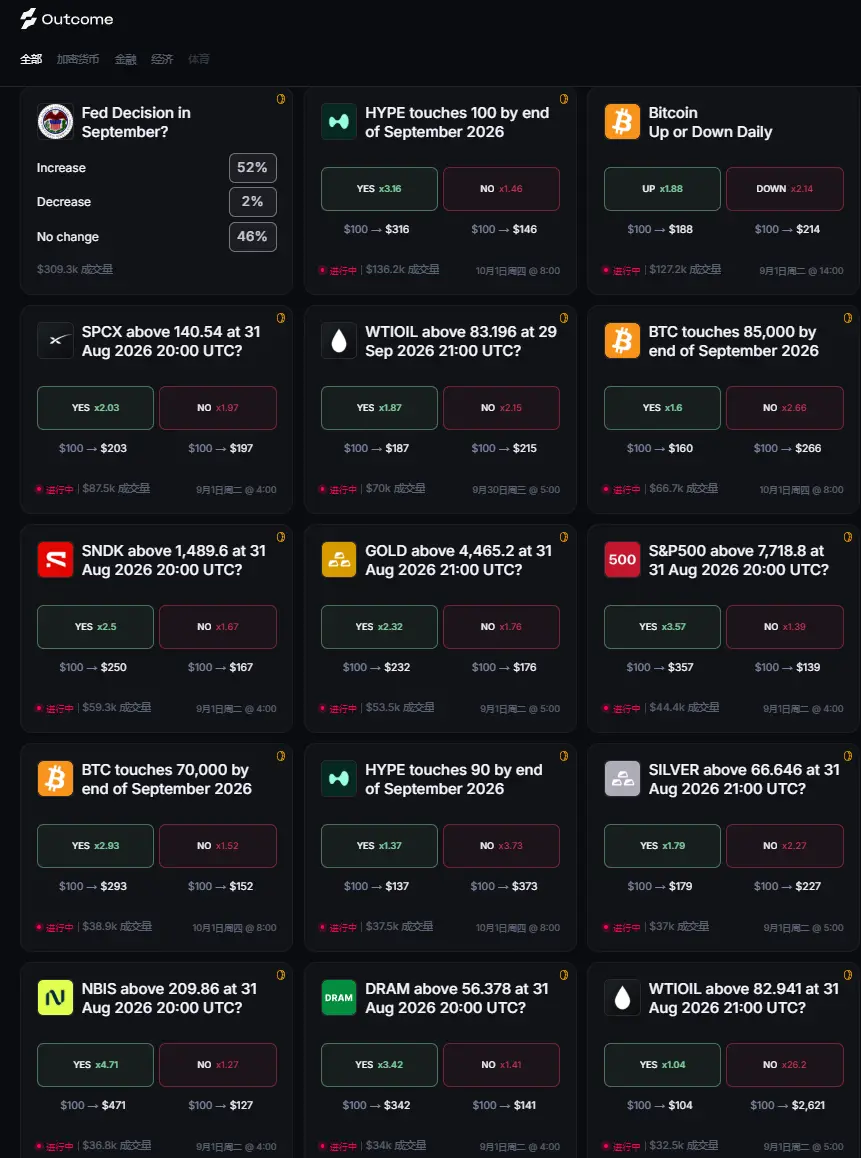
On the first day of launch, the team listed over 20 markets and opened trading rewards exceeding 1 million dollars. The categories are not limited to crypto: price contracts on the S&P 500, Nasdaq, gold, silver, SK Hynix, and WTI crude oil, which were written on HIP-3's perpetual contracts, have all been opened, and sports markets are on the way, with domain names related to the Premier League, La Liga, and the Champions League already registered.
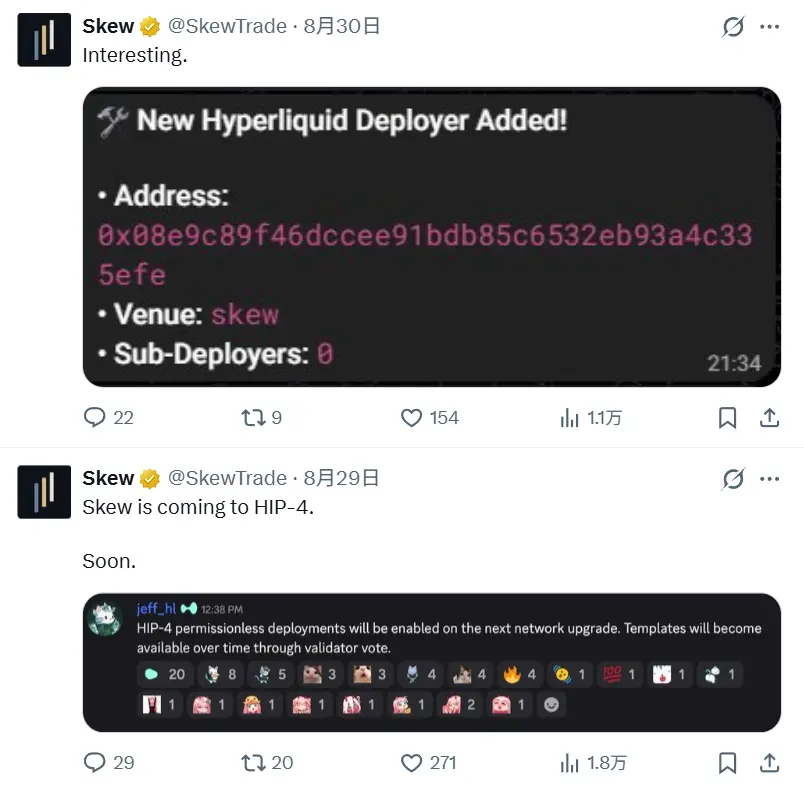
Market news indicates that the second independent prefix visible on Hyperliquid's front end is Skew. On August 30, the official launched a Bitcoin hourly price fluctuation market with the skew: prefix, and third-party dashboards have already recorded its on-chain address. It is collaborating with Nasdaq-listed Hyperion DeFi with 500,000 HYPE, originally planning to deploy HIP-3, but now shifted to the HIP-4 market.
Additionally, the leading trade.xyz from HIP-3 and its backer Unit show on-chain monitoring that the staking address is still moving funds in increments of 500,000, and the community generally expects that the 500,000 HYPE to be released around September 5 will be used for deploying HIP-4.
Many community users believe that more Builders entering the market means more HYPE being staked and more fees flowing back into buybacks, benefiting HYPE's value. However, this flywheel narrative does not seem as certain as it sounds.
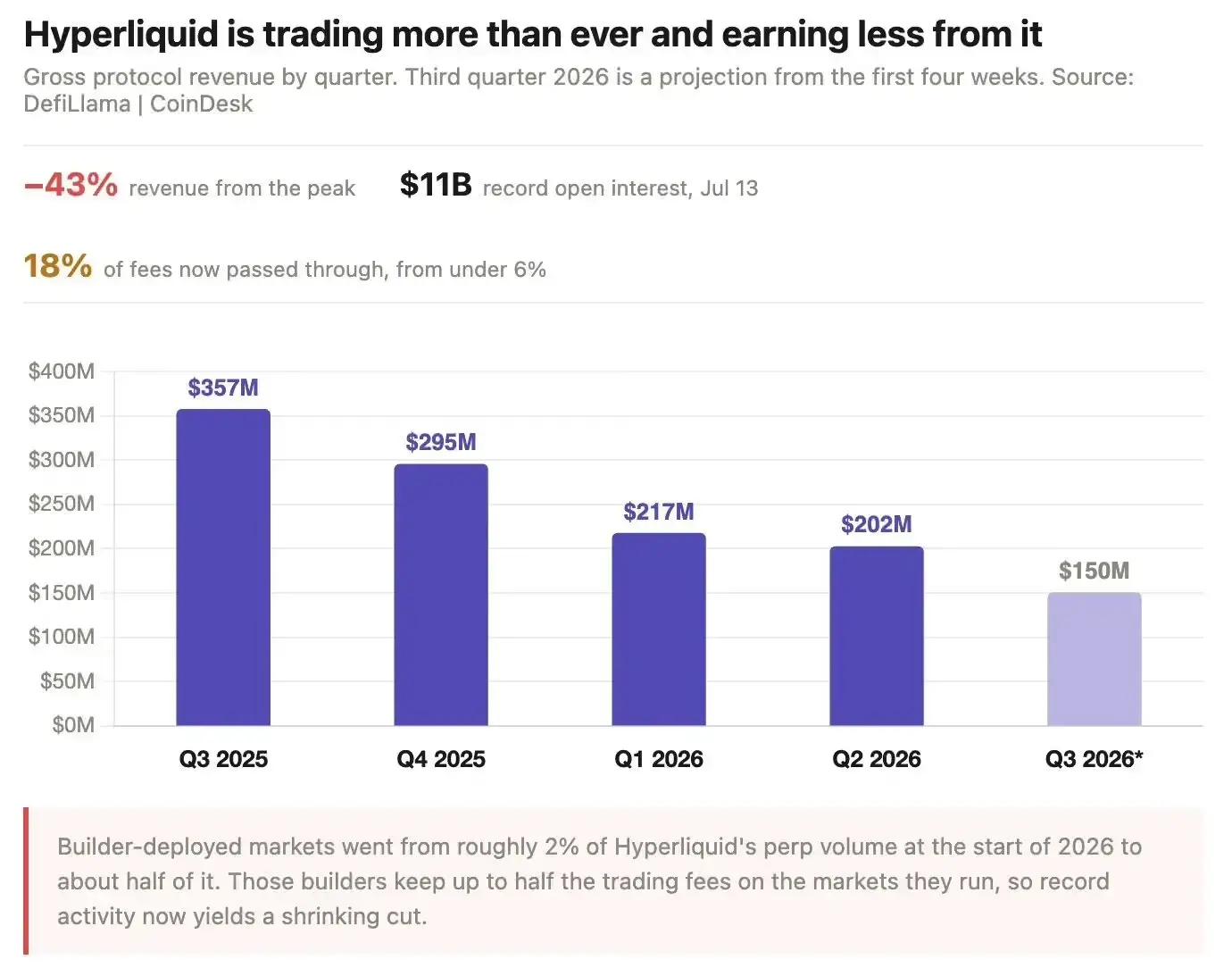
According to on-chain data from DefiLlama, Hyperliquid's gross revenue dropped from a peak of about 357 million dollars in Q3 2025 to about 202 million dollars in Q2 2026, a decline of over 40%, while trading volume reached a historical high during the same period, an important reason being the continuously increasing fee-sharing ratio flowing to Builders.
A Strong Competitor to Polymarket and Kalshi?
Currently, there is much discussion in the market about HIP-4's fees being significantly lower than those of prediction market platforms like Polymarket and Kalshi.
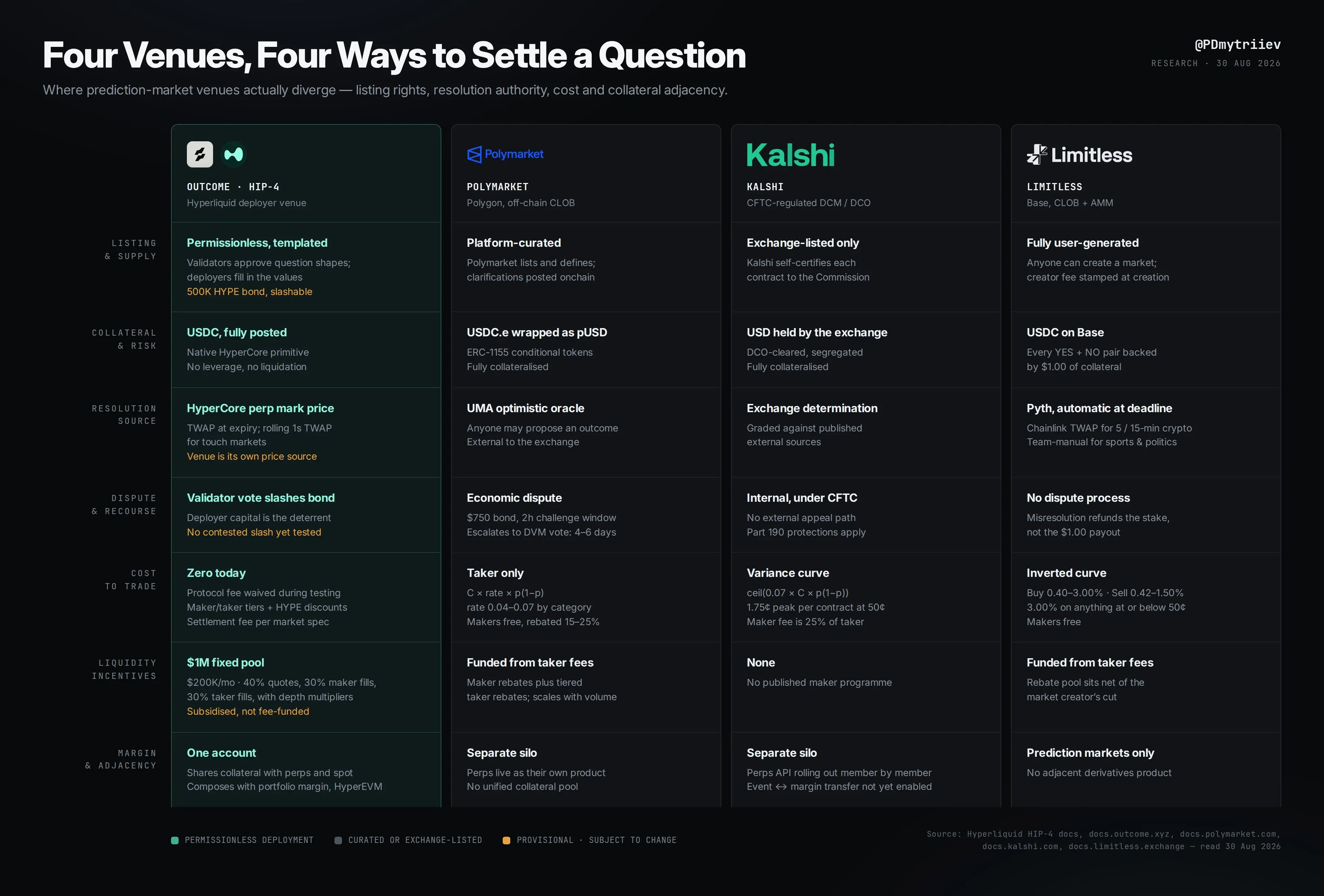
Specifically, according to analysis by researcher @0xinvariant, calculating with 100 shares at a unit price of 0.5 dollars and a principal of 50 dollars, Outcome's round-trip cost is about 7 to 14 basis points, while Polymarket's crypto markets are about 700 basis points, sports markets about 500, and political macro markets about 400, showing a significant gap.
However, Polymarket's geopolitical and election markets have been free of charge for years, making Outcome relatively more expensive in such cases. Additionally, Polymarket returns 15% to 25% of the fees from filled orders to the market makers, while Outcome does not have a similar arrangement, with the fee advantage mainly concentrated in high-frequency short-cycle categories like crypto and finance.
Galaxy Research reports that Hyperliquid's user base is distinctly different from that of Polymarket or Kalshi. The latter two have spent years building products to attract non-crypto users, while Hyperliquid serves active crypto-native traders through its terminal front end, resulting in a relatively niche user base at the top of its funnel.
The report also shows that on the first day of HIP-4's mainnet launch on May 2, prediction market trading volume accounted for only 0.7% of the total industry volume, and on the 25th day, the daily trading volume of Bitcoin subcategories accounted for about 20% of the combined total of Hyperliquid and Polymarket in that category.
Meanwhile, in April, Kalshi and Polymarket had market shares of 47% and 38.9%, respectively, with Hyperliquid still a fraction. More than four months later, according to Artemis data, by late August, HIP-4's weekly transactions totaled only 4.2 million dollars, accounting for less than 0.04% of the industry's trading volume that week.
According to Artemis data, prediction market trading volume significantly surged during the World Cup, rising from a pre-tournament weekly volume of 5 to 7 billion dollars to nearly 17 billion dollars in mid-July, before falling back, with August's weekly trading volume stabilizing around 10 to 12 billion dollars.
Specifically, Kalshi remains the largest segment, but Polymarket's share expanded significantly during the World Cup, and it did not fully retract after the event, maintaining a higher stable share before the competition, while the previously significant sports platform Opinion was diluted.
Additionally, a report from May indicated that about 3.3% of Polymarket's wallets were simultaneously active on Hyperliquid, contributing approximately 12% of Polymarket's trading volume, with 1 in every 8 Hyperliquid users also using Polymarket. At that time, permissionless deployment had not yet opened, and this competition was more about capturing existing users, with limited incremental space.
In fact, it is not just Hyperliquid attacking the prediction market; competition from the opposite direction has already begun. On April 21, Polymarket launched its own perpetual contract product, with up to 10x leverage, covering assets like Bitcoin, Nvidia, and gold; Kalshi followed on May 29, launching CFTC-regulated crypto perpetual contracts, with funding rates settled every 8 hours, becoming the first institution in the U.S. to obtain regulatory approval for perpetual contracts.
However, Polymarket itself also has shortcomings. Data shows that about 75% of users will churn within 90 days, with only 8% to 11% remaining active after a year. During the November 2024 election, monthly active users peaked at 321,500, dropping to 245,000 three weeks later, highlighting the issue of user stickiness that only remains active during major events for native prediction market platforms.
Prediction market player @timemoonc pointed out that Polymarket first charged fees for crypto markets in January this year, with consecutive fee increases in February and March, and the V2 version at the end of March expanded charges to the entire platform. He speculated that Polymarket might be concerned about falling behind in on-chain competition, thus trying to retain as much profit as possible with the pricing power it still holds before HIP-4 is fully rolled out.
Conclusion
In the short term, Hyperliquid's current share is not on the same level as Kalshi and Polymarket, making it premature to talk about disruption. However, from a mechanistic perspective, the unified margin account allows traders to hold perpetual, spot, and prediction market positions with the same funds, which no independent prediction market platform can match without a complete product overhaul.
Previously, ChainCatcher proposed in the article "Can Hyperliquid Win in the Prediction Market?" that prediction markets are essentially a content and operation business, and HIP-4 needs to prove its capabilities in topic supply, credibility building, and user profile adaptation. These areas are not Hyperliquid's traditional strengths, making it difficult to achieve results in the short term.
Therefore, the current permissionless deployment has only opened the supply side, and whether the depth can keep up, whether settlements can withstand controversial markets, and whether the fee advantage can hold will need to be verified by the market.

 Risk warning


Popular articles