The truth about stablecoin cards: they don't save money and can't disrupt Visa
 Core Viewpoint

 What can stablecoins ultimately replace? Objectively speaking, the answer is the clearing and settlement processes, as well as cross-border foreign exchange transactions. They transform the underlying funding channels behind transactions. However, the biggest cost source for domestic card transactions has never been on the settlement infrastructure.
Author | Vaidik Mandloi
Compiled by | Luffy, Foresight News
Did you know? In July, cryptocurrency credit card spending exceeded $759 million, with 9 million transactions. This is almost two and a half times the amount from the same period last year. Moreover, over 90% of the transaction volume was still paid using Visa cards.
Almost all cryptocurrency card projects tell the same story: relying on stablecoin payment channels to bypass card organization fees, returning the saved costs to merchants. Previously, when we analyzed Stripe's establishment of a stablecoin-based cross-border payment link, we also discussed this logic.
To this end, I delved into a core question: what would happen in reality if we tried to set aside traditional card organizations? Can removing Visa and Mastercard really save costs for merchants? Which layer of the payment architecture can stablecoins actually replace?
The conclusion I reached was completely unexpected.
How the Payment System Operates
To find the answer, we first need to clarify where the fees flow when consumers swipe their cards for payment. I initially realized a common misconception: many in the cryptocurrency industry believe that card organizations like Visa take the largest cut of the fees.
This is not the case. When a merchant processes a $100 reward credit card transaction, they need to pay about 2.2% in merchant discount fees, totaling $2.20. The key point is that this $2.20 does not go into Visa's pocket; it is distributed among three parties, and the distribution ratio is not equal.
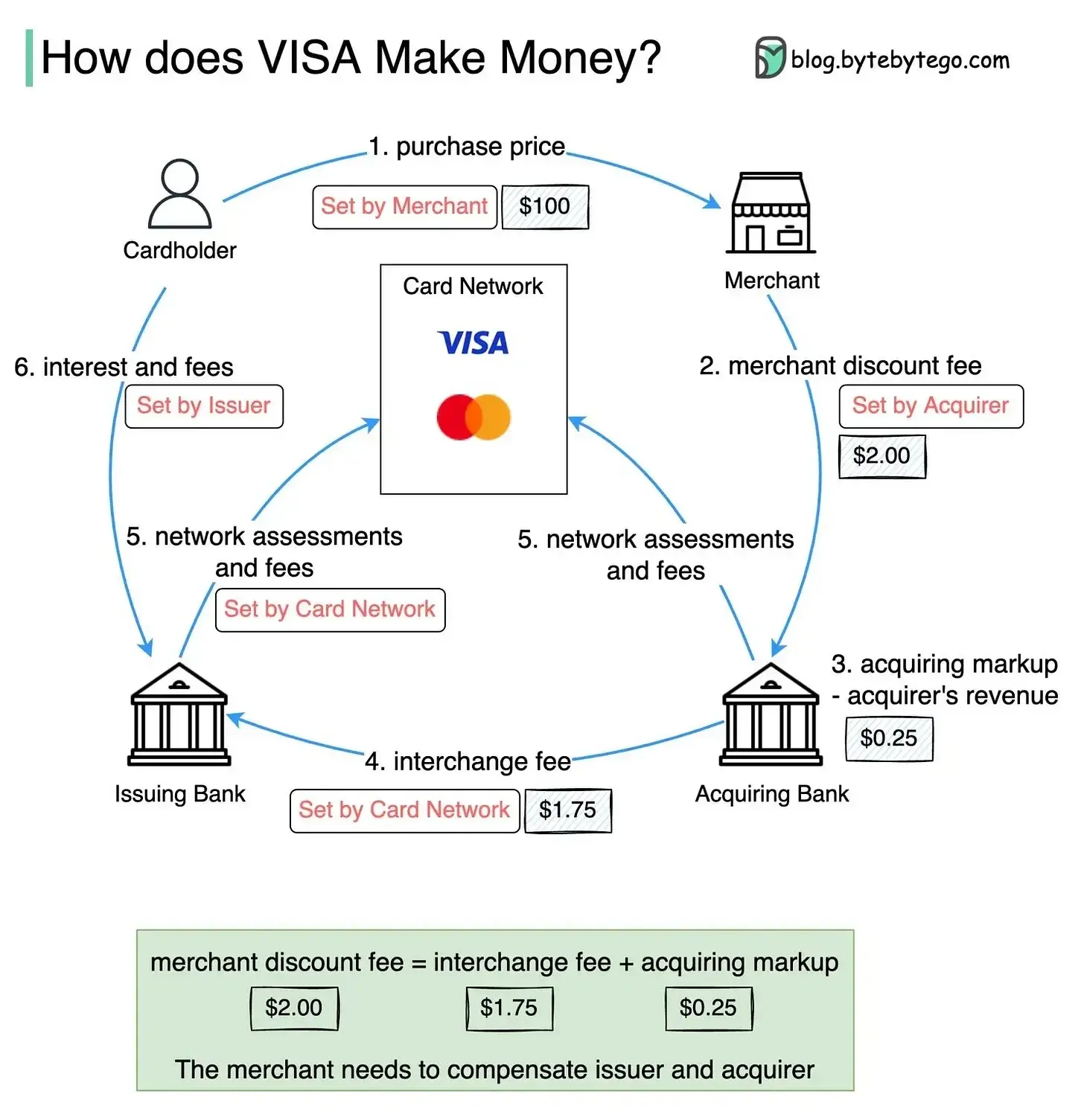
· The largest share, about $1.75, goes to the issuing bank, which is the institution that issues the credit card to consumers. This fee is called the interchange fee, accounting for 70%–80% of the merchant's total fees.
· Next, the payment processor on the merchant side (acquirer) takes a service fee of $0.30–$0.70.
· Finally, the card organizations that everyone wants to disrupt, Visa and Mastercard, only charge an assessment fee of $0.13–$0.18, which accounts for about 7%–9% of the merchant's total expenses.
In other words, simply removing Visa would only eliminate the smallest fee in the entire chain. The fact that Visa charges a small fee has its underlying reasons.
Visa does not extend credit to anyone, so it does not bear credit risk, chargeback disputes, or fraud losses. In fact, Visa does not even participate in the transfer of funds. It is merely an information transmission network that activates only when a user swipes their card at a merchant terminal. Visa's job is to relay authorization information back and forth between the merchant terminal and the issuing bank, and to establish the operational rules for the entire system. The issuing institution bears the most significant responsibilities.
The issuing institution provides credit to consumers and assumes the risk of bad debts; it also bears the cost of funds occupied between the consumer's purchase and the bill payment date, and relies on interchange fees to subsidize card reward programs to attract users to use the card.
This has created an extremely attractive business model for Visa. In 2025, Visa processed $14.2 trillion in payment transactions, with 257.5 billion transactions, generating $40 billion in net income, with a net profit margin close to 50%. On average, Visa earns only about $0.13 per transaction, which is the source of all its profits. Visa's position among the world's highest-valued companies is not due to high fees per transaction, but rather because it processes hundreds of billions of transactions each year, with marginal costs approaching zero, and it does not bear credit risk at all.
Next, we enter the most challenging reality of stablecoin debit cards.
All stablecoin debit cards on the market are debit card products. Before consumption occurs, funds are already stored in the user's wallet in the form of USDC or USDT. There is no fund occupation period, nor does revolving credit generate interest income. This places these cards in a completely different economic model.
Additionally, the U.S. Congress enacted the Durbin Amendment in 2010, which caps the interchange fee for debit cards issued by banks with assets over $10 billion at $0.21 per transaction plus 0.05%. The vast majority of stablecoin debit card solutions choose to collaborate with small partner banks (digital banks) with assets below the $10 billion threshold, which are not subject to the Durbin Act. This is also a common cooperative banking model in the fintech industry.
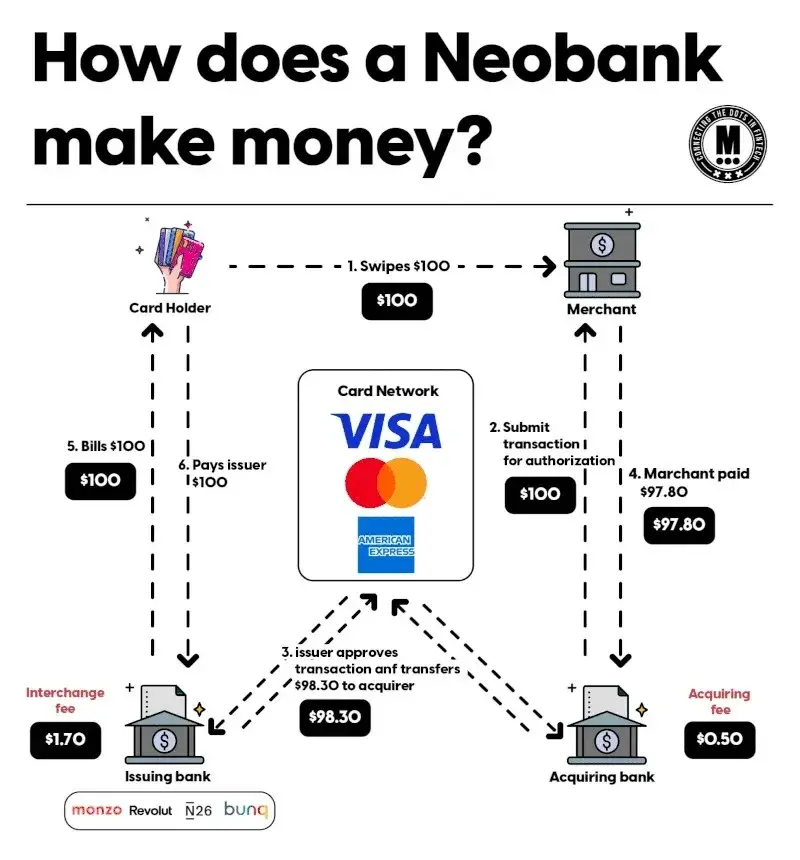
The unrestricted dual information network debit card interchange fee currently averages about $0.62 per transaction. A clear comparison shows that for a $100 transaction, a reward credit card can generate $2.20 in total revenue; whereas a stablecoin debit card, even with a higher exemption rate, generates only $0.62 in total revenue. The project team also has to pay card organization fees, processing fees, and partner bank costs from this $0.62, while also covering fraud losses and operational expenses, leaving only a small margin to consider giving back to merchants.
What Can Stablecoins Truly Replace?
As seen above, the fees saved by eliminating Visa are minimal, and the profit margin for operating stablecoin debit cards based on interchange fees is extremely narrow. However, the value of stablecoin payments may not lie in saving negligible card organization fees, but rather in the potential to replace more core aspects of the payment architecture.
To this end, I revisited the previous article "Stripe Builds Its Own Public Chain," which broke down a cross-border payment into seven major fee components: acceptance, process scheduling, licensing compliance, custody, foreign exchange, issuing, and clearing and settlement. I compared domestic card transactions against these seven layers to analyze which aspects would undergo substantial changes.
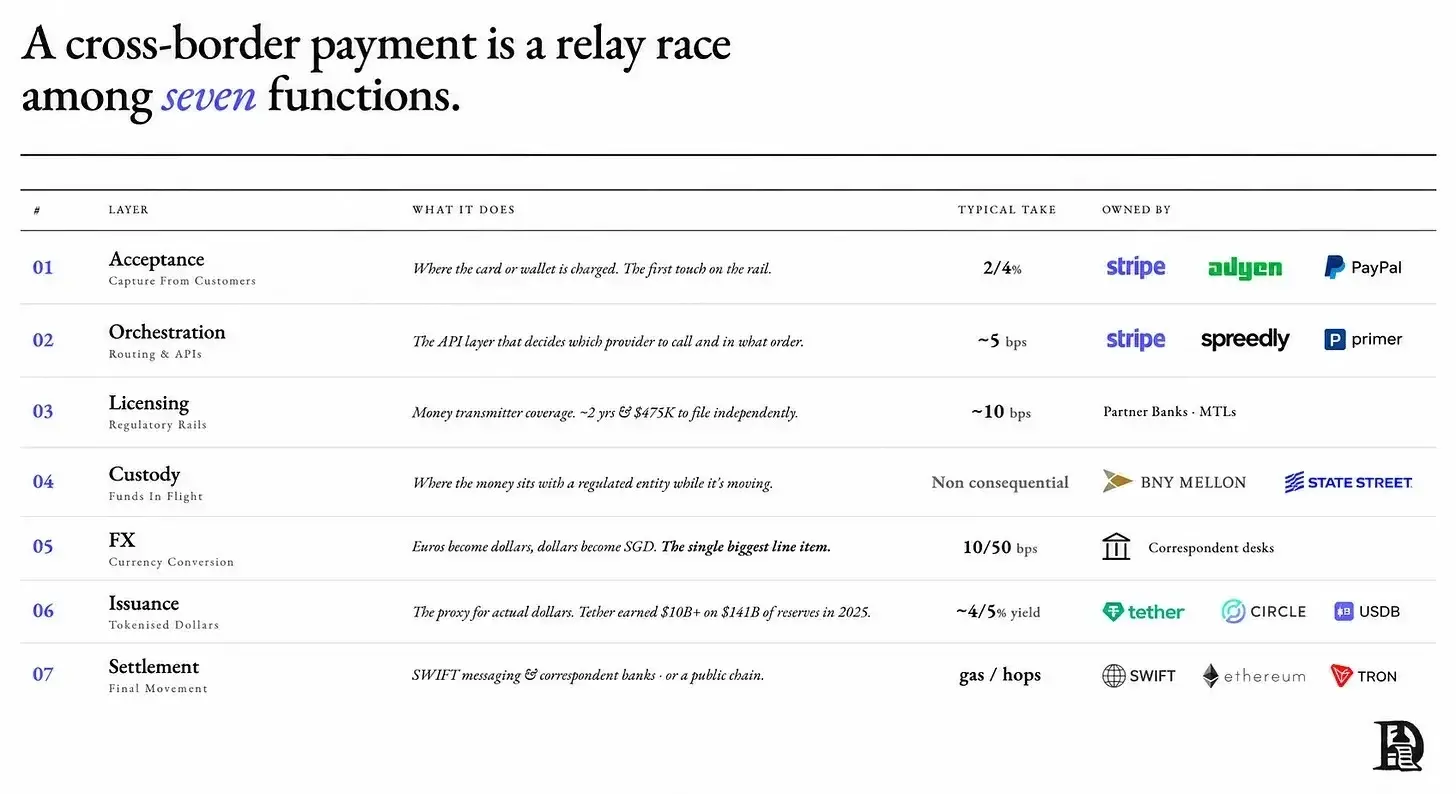
From the merchant's perspective, the transaction acceptance layer remains completely unchanged. The process remains the same, with merchants equipped with terminals and users swiping their cards, still needing to pay the merchant discount fee to the acquirer. Merchants cannot even perceive that the source of funds behind the card is USDC. In the merchant's billing, this transaction is no different from a regular Visa transaction. Similarly, the process scheduling layer still goes through Visa or Mastercard, and the issuing phase still relies on partner banks and card organization BIN numbers. Financial technology companies have been using this model long before the advent of stablecoins, with no fundamental innovation occurring.
The real change happens in the backend, which is also the most easily overlooked area.
The clearing and settlement layer is the only aspect where stablecoins can bring about fundamental change. In the traditional model, the transaction clearing between issuing banks and card organizations follows a T+2 cycle, compounded by weekends and batch processing. To optimize this pain point, service providers like Rain support stablecoin end-of-day settlements with Visa; Mastercard has also begun accepting stablecoins like USDC, PYUSD, and RLUSD for intraday settlements. This significantly compresses the traditional T+2 settlement, bringing it closer to real-time clearing and releasing the operating funds that were previously occupied by issuing banks.
However, the benefits of optimizing operating funds all accrue to the issuing institutions. The discount fee rate paid by merchants will not decrease due to faster settlements, and consumers will not experience any difference in checkout.
The only beneficiary of stablecoin T+0 settlements is the card operator, which no longer needs to advance funds for a two-day cycle. The innovation brought by stablecoins essentially helps issuing institutions optimize fund management. Once scaled up, the profits can be considerable, but they do not provide additional benefits to merchants or consumers. At the same time, Visa has no incentive to lower fees—settlement fund occupation costs have never been borne by Visa; the pressure has always fallen on the issuing banks. Even if stablecoin settlements reduce the funding costs for issuing banks, Visa's own costs remain unchanged, and naturally, the merchant rates stay the same.
It is worth noting that Visa and Mastercard have not resisted stablecoin settlements; rather, they have actively integrated them into their networks. Since 2021, Visa has supported USDC settlements on the Ethereum and Solana networks, with the current annual settlement volume reaching $7 billion. A few months ago, Mastercard acquired BVNK to expand its stablecoin infrastructure. Both card organizations have even stated: "Stablecoins will not disrupt the existing payment landscape; instead, they will reinforce this system."
Major card organizations have not been disrupted or replaced by stablecoins; on the contrary, they have absorbed stablecoins as an upgrade solution for their own settlement layers. Every stablecoin debit card operating on Visa claims to disrupt Visa while contributing transaction volume and continuously paying fees.
Additionally, it should be noted that in related articles about Stripe, we mentioned that stablecoins can indeed lower cross-border payment costs by eliminating multiple layers of intermediary banks; this argument holds true. However, it is essential to distinguish the scenarios: the core pain points of cross-border payments are foreign exchange and multiple intermediaries, while domestic consumption involves a completely different fee structure. The industry directly applies the validated logic of cross-border payments to domestic consumption scenarios, which does not align with the actual cost structure.
The logic of stablecoins empowering cross-border payments is solid, but once applied to domestic consumption, analyzing the flow of fees reveals that this narrative is difficult to sustain.
What can stablecoins ultimately replace? Objectively speaking, the answer is the clearing and settlement phase and cross-border foreign exchange. They transform the underlying funding channels behind transactions. However, the largest source of costs in domestic card transactions has never been based on settlement infrastructure.
 Risk warning