Tron Industry Weekly Report: The simultaneous high positions of stocks and bonds make it difficult for the crypto rebound to sustain, detailed explanation of the global PayFi payment network Credible that connects fiat currency and stablecoins

 Review of the macro and crypto markets from October 5 to 11: Inflation and high interest rates suppress risk assets, BTC and ETH decline. Next week, focus on the US CPI and retail data. Hot topics include stablecoins, RWA, and compliance infrastructure, and a detailed explanation of how Credible achieves T+0 payments through stablecoin liquidity and short-term accounts receivable financing, as well as an overview of regulatory progress in the United States, European Union, and South Korea.
I. Outlook
1. Macroeconomic Summary and Future Predictions
Macroeconomic Summary for This Week (October 5, 2026 - October 11, 2026):
The core contradiction remains the coexistence of economic resilience and inflationary pressure. The U.S. ISM Services PMI for September was 54.9, indicating expansion, but the price index rose to 74.0; initial jobless claims fell to 197,000, with layoffs still low, while the preliminary consumer confidence index for October dropped to 46.3. The Federal Reserve's meeting minutes released on October 7 emphasized inflation risks from energy prices and AI investments; on October 9, the yield on the U.S. 10-year Treasury bond closed at 5.243%, with financing costs still high, putting pressure on the valuation of risk assets.
Macroeconomic Predictions for Next Week (October 12, 2026 - October 18, 2026):
The market is expected to fluctuate mainly around inflation and interest rate expectations. The U.S. September CPI will be released at 20:30 Beijing time on October 14, followed by PPI, retail sales, and initial jobless claims at 20:30 on October 15. If core inflation exceeds expectations and consumption remains strong, further interest rate hike expectations may rise, pushing up the dollar and U.S. Treasury yields; if inflation cools and consumption moderately slows, it will help alleviate tightening concerns. Energy prices remain an important variable, and a single drop is insufficient to confirm a reversal in the inflation trend.
2. Market Movements and Warnings in the Cryptocurrency Industry
Cryptocurrency Market Movements This Week (October 5, 2026 - October 11, 2026):
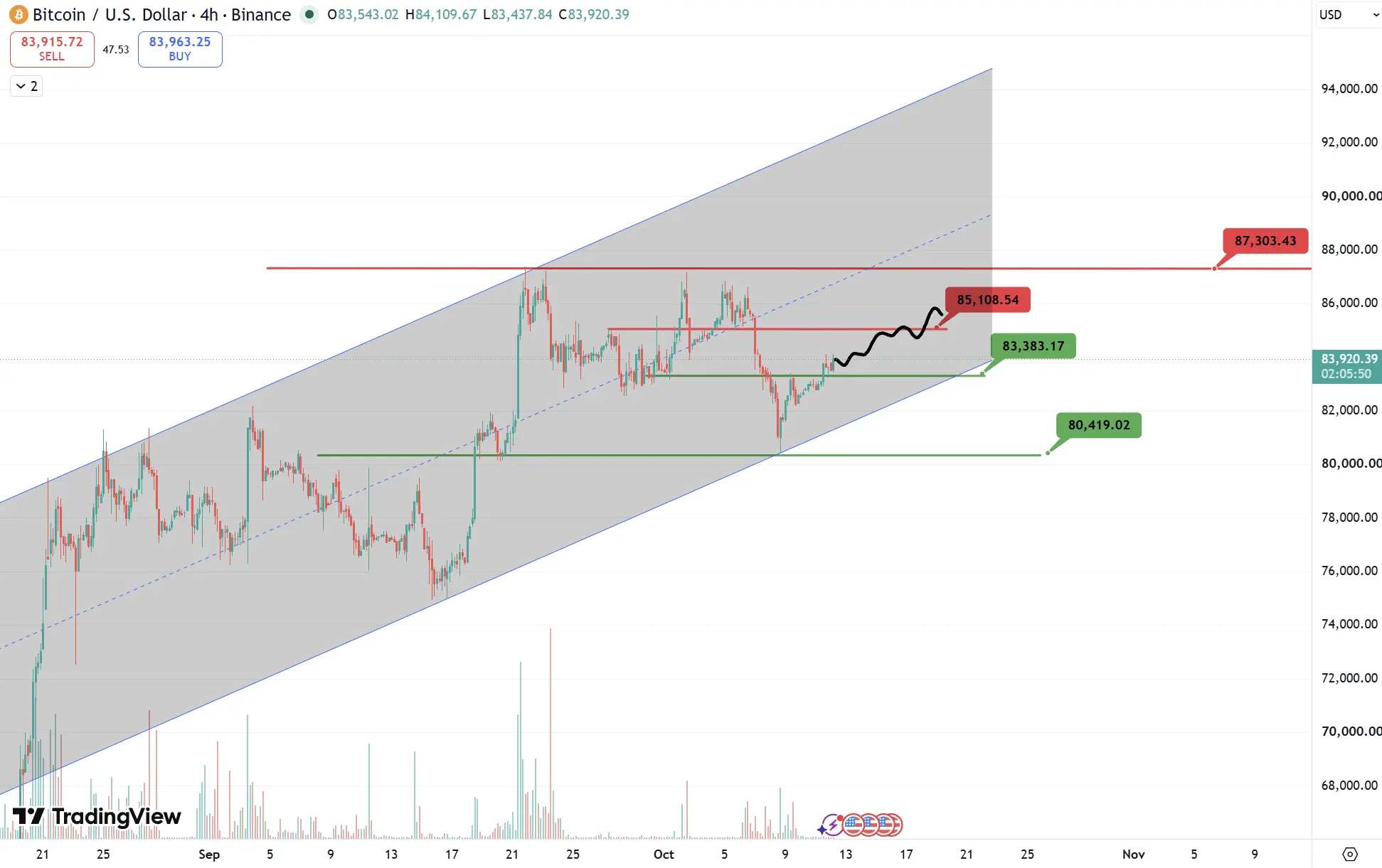
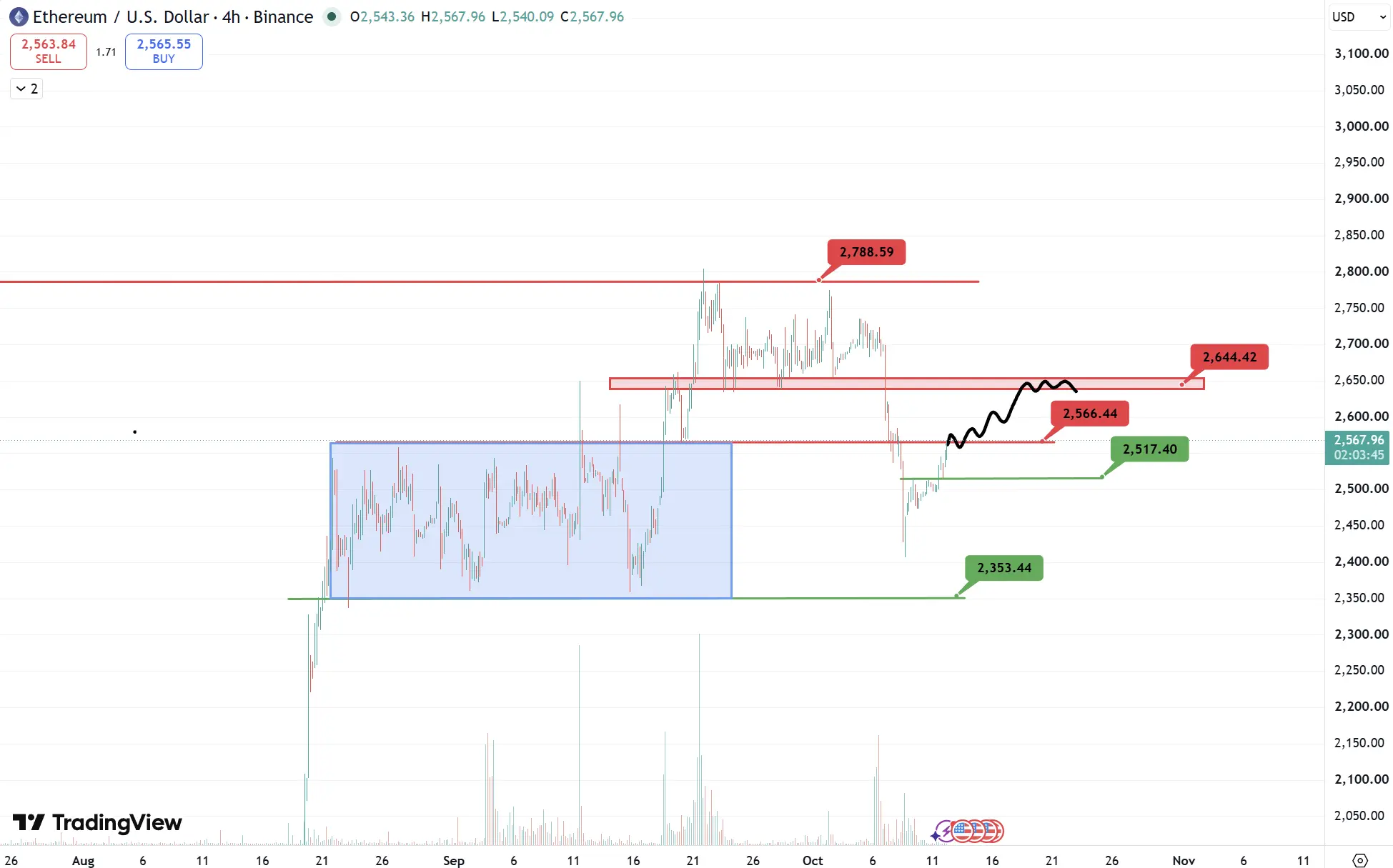
Mainstream coins generally weakened, with a slight rebound over the weekend, and ETH performed weaker than BTC. BTC fell from about $85,950 reported on October 5 to about $82,123 on October 9; as of October 11, 09:30 Beijing time, it was reported at $82,931.96. ETH dropped from about $2,712 on October 5 to about $2,488 on October 9, and then rebounded to $2,506.70 at the same time. The above prices are snapshots from different dates and do not represent the highest or lowest prices for the entire week; the high-interest rate environment and continuous outflows from ETH spot ETFs are noteworthy pressure factors this week.
Cryptocurrency Market Predictions for Next Week (October 12, 2026 - October 18, 2026):
The market is inclined towards data-driven volatility, and whether the rebound can continue depends on U.S. inflation results and ETF fund flows. If CPI is lower than expected, U.S. Treasury yields fall, and ETF funds improve, BTC and ETH are expected to recover this week's losses; if inflation is strong and tightening expectations rise, there is still a risk of further declines. The $80,000 level for BTC and the $2,500 level for ETH can be observed as short-term psychological thresholds, but they should not be seen as definitive support; it is currently insufficient to determine whether the market has resumed a sustained upward trend.
3. Industry and Sector Hotspots
This week's verifiable focus is on stablecoins, RWA, and compliant trading infrastructure. A report released by CoinDesk on October 6 indicated that the stablecoin market reached $313 billion in September, with tokenized stocks amounting to $4.87 billion and monthly trading volume reaching $15.6 billion—these are the data released this week reflecting business growth in related sectors. Meanwhile, the U.S. CFTC has initiated preliminary consultations on a cryptocurrency trading framework, and the EU is advancing unified regulation for major cross-border cryptocurrency service providers, further highlighting the importance of trading, custody, and asset tokenization infrastructure; whether business growth can translate into related token gains still needs to be assessed separately.
II. Market Hotspot Sectors and Potential Projects for the Week
1. Overview of Potential Projects
1.1. Detailed Explanation of $4 Million Total Financing, Participated by Individual Investors—Building a Global PayFi Payment Network Connecting Fiat and Stablecoins: Credible
Introduction
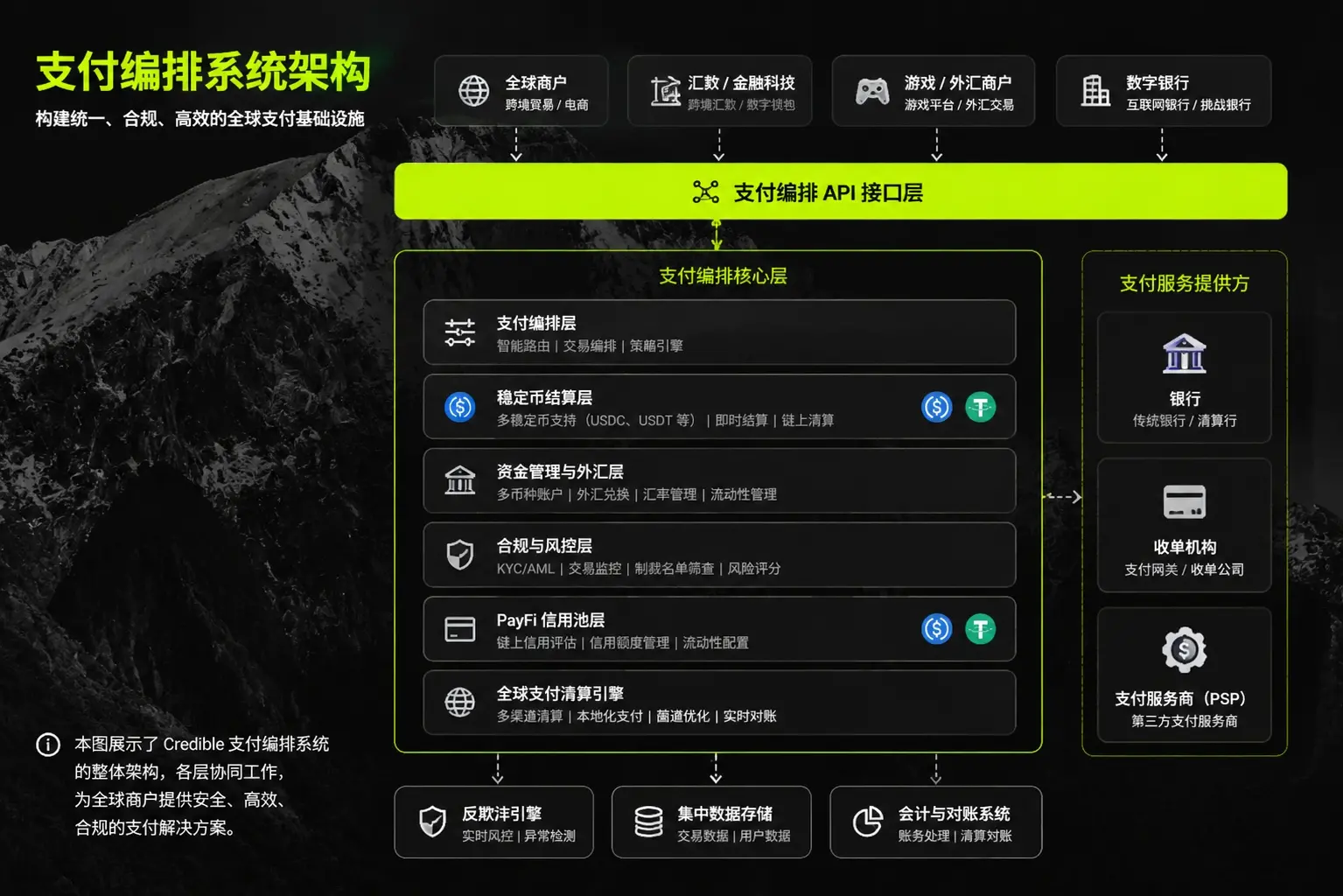
Credible is a payment orchestration platform that combines fiat payment infrastructure with stablecoin liquidity to provide same-day settlement, seamless access to local payment methods, and competitive exchange rate services for global payments.
Credible is built around three main pillars:
Speed
Accessibility
Pricing Advantage
Core Functions
- Pay-In
Credible supports real-time T+0 payments. The platform integrates payment gateways and aggregators to receive fiat payments completed by users through various payment methods while releasing stablecoin liquidity in advance through the PayFi Credit Layer.
Merchants can receive settlement funds immediately, even if the underlying fiat-to-stablecoin conversion process still needs to be completed asynchronously through local fiat payment networks. In this way, Credible combines the settlement delays of traditional fiat payments with on-chain stablecoin liquidity to achieve a faster merchant fund arrival experience.
- Pay-Out
Credible supports T+0 withdrawals and payment distribution. The platform provides local fiat funds in advance to digital banks and fintech companies for cross-border remittances and merchant payments.
At the same time, the process of converting stablecoins to fiat will continue to be cleared asynchronously in the background. This model allows the final recipient to receive funds instantly without waiting for traditional fiat settlement cycles, thus enhancing the efficiency of cross-border payments and commercial payments.
- Yield
Credible offers short-term payment financing services with terms of 1 to 7 days, secured by users' pay-in or pay-out receivables.
This financing layer effectively provides liquidity support for payment businesses, enabling merchants and payment service providers to achieve real-time settlement while generating yields from the payment funds in financing. By combining payment liquidity, stablecoin funds, and short-term credit, Credible has built a PayFi infrastructure that enhances payment efficiency and optimizes capital utilization.
Brief Description of the Protocol Mechanism
- How Credible Works
Credible is a payment orchestration layer designed to decouple payment settlement speed from traditional fiat clearing cycles, achieving real-time (T+0) pay-in and pay-out globally.
This goal is achieved through three core capabilities:
Stablecoin-based Payment Financing
Regulated Fiat Rails
Short-duration Receivable-backed Credit
Through these mechanisms, Credible enables users to quickly complete payments and fund arrivals while the underlying fiat clearing processes can still be completed asynchronously according to traditional financial systems.
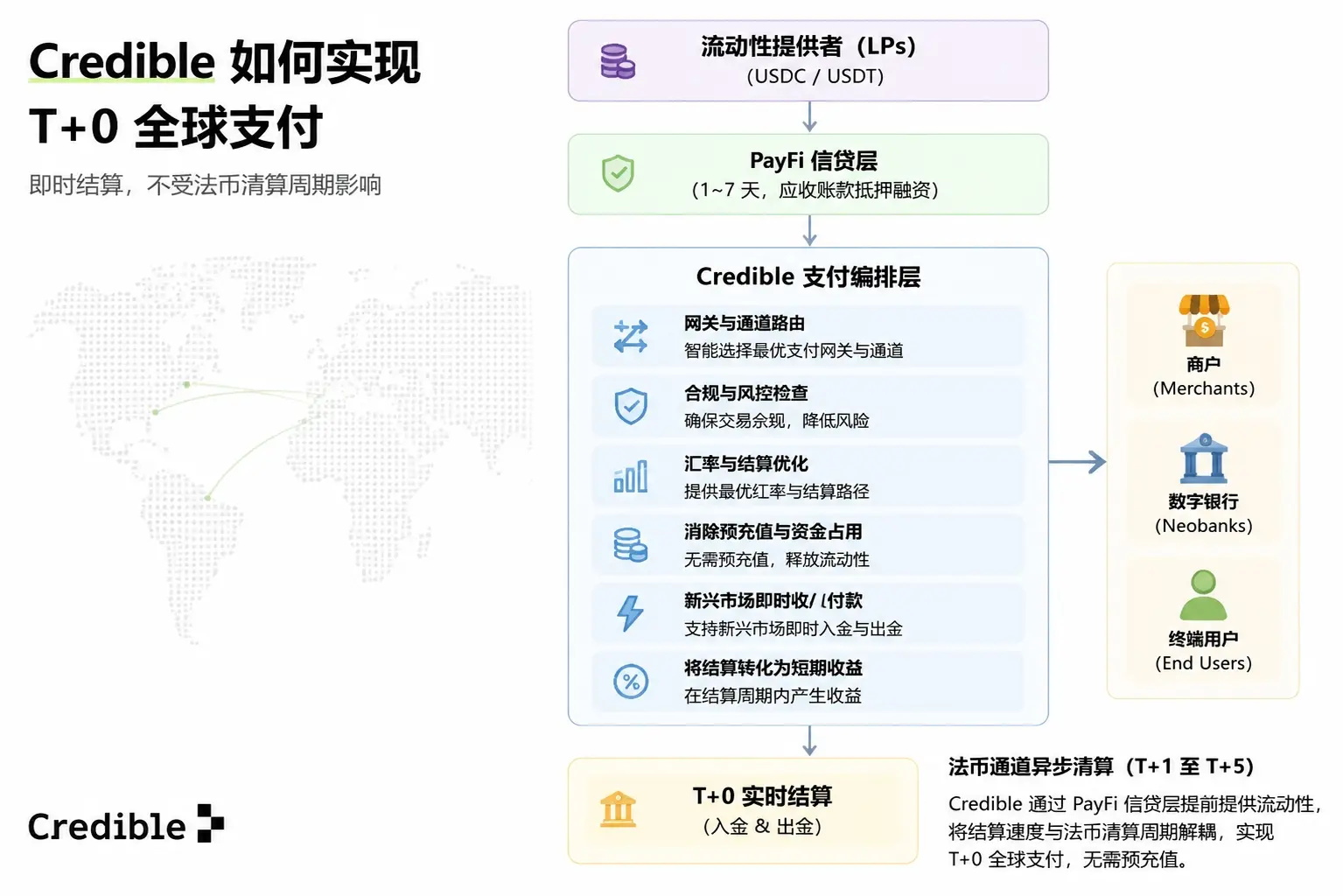
Three Core Participants in the Credible Ecosystem
- Liquidity Providers
Liquidity providers supply stablecoin liquidity to Credible's PayFi Credit Layer, such as:
USDC
USDT
These funds are used to support short-term (1 to 7 days) payment financing, secured by receivables generated from real payment businesses.
LPs can earn returns by providing liquidity for payment processes.
- Payment Platforms
Including:
Digital Banks
Fintech Companies
Merchants
These platforms need to achieve instant pay-in and pay-out in the global market, but traditional payment systems often face:
Pre-funding requirements
Capital being locked for long periods
Slow fiat clearing speeds
Credible helps these platforms achieve instant settlement through the payment financing layer without relying on the slow traditional fiat clearing processes.
- Fiat & Payment Rail Partners
Including:
Payment Gateways
Aggregators
Banks
Local Settlement Partners
These institutions are responsible for completing fiat collection and payment distribution in different markets, but their operations often rely on traditional financial systems, leading to potential delays in clearing cycles.
Credible bridges this time gap through stablecoin liquidity and the payment financing layer.
- What Makes Credible Unique
Credible's core innovation lies in:
Separating payment execution speed from fiat clearing speed.
By providing stablecoin or local fiat liquidity in advance through the PayFi Credit Layer, Credible enables end users and recipients to achieve T+0 (real-time or same-day) settlement.
Even if the underlying processes:
Fiat → Stablecoin conversion;
Stablecoin → Fiat conversion;
are still completed asynchronously according to traditional financial systems, users can still receive funds in advance.
Especially in emerging markets, due to the typically long settlement cycles of local fiat currency systems, Credible addresses the payment efficiency issue through advance financing.
The decoupling of settlement speed and clearing cycles is where Credible's core value lies.
The Credible Stack Is Built on Three Pillars
① PayFi Credit Layer --- Financing
The PayFi Credit Layer is Credible's short-term payment financing module.
This layer provides:
1 to 7 days of short-term financing;
Accounts receivable generated from incoming or outgoing transactions as collateral;
Working capital support for the payment process.
It primarily addresses:
Funding gaps during the payment process;
Merchant and platform pre-funding needs;
Capital occupation issues caused by settlement cycles.
Through this layer, payments can be executed in real-time without the need for pre-deposited funds.
② Payment Orchestration --- Execution
The Payment Orchestration layer is responsible for the unified management and scheduling of different payment channels.
It connects:
Payment gateways;
Aggregators;
Banks;
Stablecoin payment channels.
The system optimizes based on different market conditions, considering:
Speed;
Cost;
Availability;
Compliance requirements;
to select the best payment path.
③ Fiat Settlement Rails --- Clearing
The fiat settlement layer connects the traditional banking system and local payment infrastructure.
These traditional payment networks operate according to their own clearing cycles, which typically include:
T+1;
T+5;
settlement times. Credible does not change these traditional clearing processes but instead achieves real-time user fund availability through payment financing based on them.
Credible does not provide credit loans to businesses or consumers.
It does not offer:
Business loans;
Revolving credit lines;
Long-term operating capital loans;
Merchant or payment platform balance sheet financing.
What Credible provides is liquidity support specifically for the payment cash flow itself. Its financing targets are not business credit but rather short-term accounts receivable generated from real payment transactions.
This model is similar to how DeFi protocols like Aave assess the risk of collateral assets rather than evaluating the borrower's credit; Credible applies this logic to real-world payment infrastructure.
Settlement Timing & Yield Mechanics
Due to the fiat payment system, especially in emerging markets, payment networks typically require T+1 to T+5 clearing times, Credible introduces a controllable financing window.
During this period:
Users can receive funds instantly (T+0);
The fiat clearing process continues asynchronously;
PayFi funds generate yields during the settlement window;
Risks are limited through short terms and real accounts receivable.
This structure reduces cash drag, releases locked liquidity, and transforms the traditional payment settlement process into a more capital-efficient financial infrastructure that can generate yields.
a. Pay-in Detailed Mechanism
Credible helps global fintech companies, digital banks, and internet enterprises in emerging markets accept local payments through a unified payment orchestration layer while utilizing stablecoin-backed liquidity financing for instant T+0 settlements.
Compared to traditional models where businesses need to connect to different payment channels, pre-fund local currency, and wait days for settlement, Credible connects multiple market payment networks through a single API, enabling real-time cross-border fund flows and unified management of complex underlying payment processes.
Step 1: Customers Pay Using Local Methods
Credible supports mainstream local payment channels in emerging markets, including:
UPI (India)
Pix (Brazil)
GCash (Philippines)
OPay (Nigeria)
Local bank transfers and digital wallet networks
Through these local payment methods, merchants can directly accept local currency payments that consumers use daily without changing user payment habits.
Step 2: Credible Orchestrates Collection Across Multiple Providers
In the background, Credible connects multiple payment infrastructures, including:
Local payment processors
Banking partners
Wallet aggregators
On/Off-ramp providers
Unlike relying on a single payment service provider (PSP), Credible dynamically selects the best payment path based on different transaction situations, considering:
Success rates
Uptime
Cost & FX efficiency
Compliance requirements
Businesses only need to connect through one API, while Credible handles the payment complexities across different countries and regions.
Step 3: Payment Confirmation Happens Locally
When users complete payments via UPI, Pix, or digital wallets, Credible receives payment confirmation in real-time.
At this point:
Local payments have been verified;
However, fiat clearing in the traditional banking system may still require additional time.
Credible's core architectural innovation lies in separating payment confirmation from final settlement. In other words, once a user successfully pays, merchants can receive funds without waiting for traditional bank settlements to complete.
Step 4: Instant T+0 Settlement via Stablecoin-Backed Liquidity
Once confirmation is complete, Credible immediately provides funds to merchants through a stablecoin-backed liquidity pool.
Merchants can receive in real-time:
US Dollars (USD)
Euros (EUR)
Stablecoins
The entire process does not require waiting for traditional bank clearing cycles, achieving true T+0 real-time settlement.
Credible essentially provides a layer of short-term payment financing capability to bridge the time gap between instant local payment execution and delayed fiat final settlement.
Step 5: Fiat Funds Settle Asynchronously and Reconcile Automatically
Although merchants have received funds in advance, Credible continues to collect and clear fiat funds through local payment networks in the background.
When fiat funds are finally credited:
Credit exposure is closed;
Fund balances are reconciled;
Financial and ledger systems are updated automatically.
This mechanism reduces businesses' reliance on:
Prefunding
Working capital buffers
Multi-market decentralized settlement management
Step 6: Unified Reporting, Compliance, and Treasury Abstraction
Credible provides a complete Pay-in infrastructure, including:
Unified settlement ledger
Transaction monitoring & fraud controls
KYB/KYC compliance management
Compliance-aware routing for payment path selection
Consolidated reporting across multiple markets
Through Credible, businesses do not need to build separate payment operations systems for different countries, gaining standardized, scalable payment collection capabilities covering multiple emerging markets.
b. Pay-out Detailed Mechanism
Credible provides real-time cross-border payout services for emerging markets through a stablecoin-backed liquidity settlement system.
With a single payment interface, digital banks, fintech companies, and global merchants can send funds to emerging markets while achieving T+0 instant settlements through stablecoin liquidity.
Compared to traditional cross-border payments that require:
Prefunding local currency
Managing fragmented local payment channels
Waiting for bank clearing cycles
Credible unifies the payment execution process, allowing users to initiate a single payout request, and the platform manages the entire process from verification, routing to final delivery.
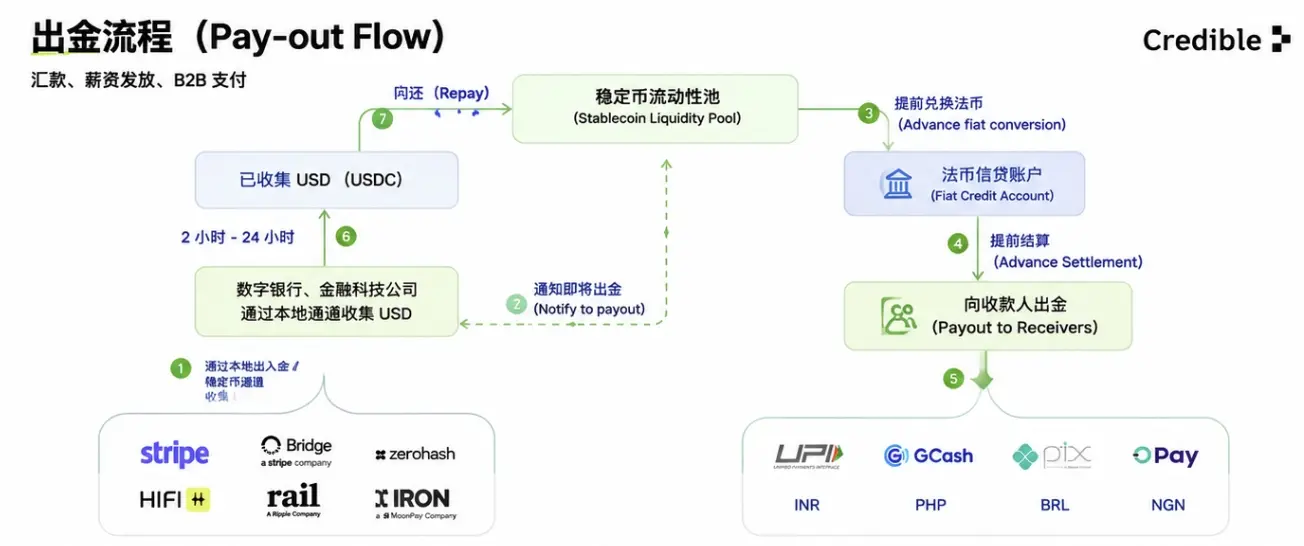
Step 1: You Initiate a Pay-Out via One API
The platform (digital banks, fintech companies, or merchants) submits a payout request through the Credible API, including:
Beneficiary information (bank account / wallet address / identity identifier)
Payment amount and currency
Purpose and reconciliation information (Purpose / Metadata)
Optional compliance information (such as KYC/KYB reference information, source of funds, etc.)
Once Credible receives the request, it immediately generates a payout intent and initiates the subsequent processing flow.
Step 2: Validates Beneficiary + Applies Controls
Before the fund transfer, Credible will perform multiple verification and control measures, including:
Recipient identity verification (format checks, bank routing rules, wallet address checks)
Compliance rules and payment channel policy checks
Fraud risk scoring and transaction frequency limits
Executing KYB/KYC audits based on business process requirements
These mechanisms can reduce payment failure rates and minimize subsequent:
Fund reversals
Retry operations
Settlement disputes
Step 3: Credible routes payments to the best local payment channels
Credible connects to local payment networks in multiple countries and regions, including:
Instant bank transfer channels
Digital wallet networks (e.g., GCash, OPay)
Real-time payment systems (e.g., payment networks similar to UPI)
Local bank partners and payment processors
Compared to relying on a single payment service provider, Credible dynamically selects the best payment path based on different market conditions, considering:
Payment channel availability and stability (Availability & Uptime)
Historical success rate performance (Success Rate)
Cost efficiency (Cost Efficiency)
Rules and compliance requirements of specific payment corridors
Even if Credible subsequently adds new payment service providers or optimizes routing strategies, existing API integrations for users do not need modification.
Step 4: Instant T+0 settlement using stablecoin-backed liquidity
Traditional cross-border payments usually require:
Pre-funding local accounts;
Waiting for fiat currency clearing windows to complete.
Credible addresses this limitation through a built-in stablecoin liquidity layer.
Once the payment request is verified:
Credible provides stablecoin-backed instant liquidity;
Executes payments in real-time through local payment networks;
The platform receives immediate settlement confirmation (T+0);
Users can experience near-instant fund arrival.
This mechanism achieves true real-time cross-border payments while avoiding long-term fund lock-up.
Step 5: Local fiat payment completed and reconciled automatically
Although the platform has completed settlement instantly, Credible continues to finalize the actual fiat payment process in the background through local payment networks and automatically completes fund accounting.
Credible is responsible for managing:
Local fiat fund circulation and partner settlements;
Necessary foreign exchange conversions (FX Conversion);
Ledger updates and balance management;
Exception handling (retries, backup paths, refunds).
This mechanism reduces operational complexity for businesses and provides a more stable and predictable user experience.
Step 6 & 7: Unified reporting, status notifications, and settlement ledger
Credible provides a complete payment operation management tool, including:
Status tracking and Webhook notifications;
Unified settlement ledger across payment regions;
Reconciliation exports and data reports;
Dispute and refund processing workflows;
Compliance records and audit trails.
Through Credible, businesses can obtain a unified payment data view covering multiple countries and regions without maintaining multiple payment service provider backends or establishing independent operational systems in each region.
c. Yield mechanism
Credible generates yield by providing stablecoin liquidity for real-time cross-border payments. Liquidity is only released after confirmation is completed on the fiat payment process.
Credible's liquidity is not deployed in high-risk or speculative lending markets but is used to support short-duration settlement financing backed by real fiat transactions.
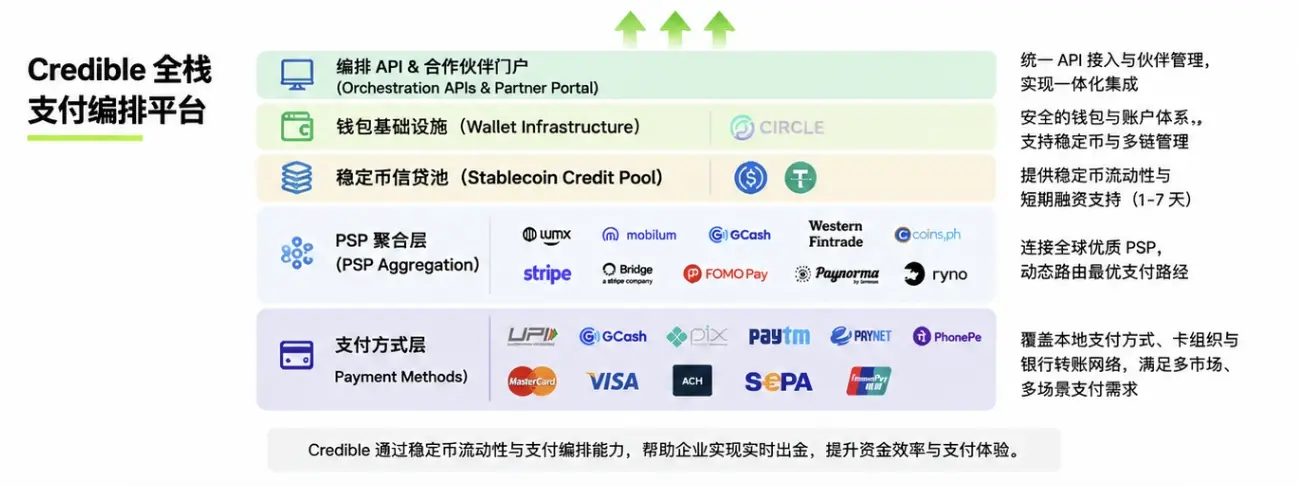
- Settlement financing triggers only after fiat confirmation
Credible only provides T+0 instant settlement after the fiat payment event is confirmed.
Pay-In scenario
Users complete payments through local payment channels, such as:
UPI (India)
Pix (Brazil)
GCash (Philippines)
OPay (Nigeria)
Credible will only initiate stablecoin liquidity support after receiving payment confirmation from the local payment network.
Pay-Out scenario
For the payout process, fiat funds from U.S. or European fintech companies must first complete source-side confirmation, after which Credible will provide liquidity to execute local payments in the target market.
This mechanism ensures that liquidity is only deployed to verified real payment processes rather than lending based on unconfirmed credit risks.
- Yield comes from fees paid for instant settlement
Once the fiat payment is confirmed, Credible will provide stablecoin liquidity in advance to achieve instant settlement.
Fintech companies and merchants will pay fees for the following services:
Real-time settlement access
Liquidity advancement
Payment orchestration and routing
Treasury and FX execution
Liquidity providers earn yield through these transaction-level settlement service fees.
- Short-duration, self-liquidating payment financing
Each liquidity advance corresponds to specific payment receivables and completes settlement within a short time window.
Funds will quickly cycle between the following payment processes:
Confirmed pay-in collections
Confirmed pay-out funding flows
When the fiat payment process is ultimately completed, the corresponding funding risk exposure will automatically close.
- Yield is backed by real payment activity
Credible's yield comes from the scale of real cross-border payment transactions, not from leveraged trading or speculative lending.
Each liquidity advance is supported by the following factors:
Fiat collections confirmed through local payment methods;
Confirmed fiat fund flows from regulated partners;
Structured settlement and reconciliation processes.
Thus, Credible combines payment infrastructure, stablecoin liquidity, and short-term financing, allowing liquidity providers to earn yield from real payment activities while maintaining low-term risk.
Tron comments
Credible's advantage lies in its construction of a global cross-border payment PayFi orchestration infrastructure, achieving T+0 instant settlement that traditional payment systems find difficult to reach by combining stablecoin liquidity, fiat payment networks, and short-term receivables financing. Its core value is decoupling payment confirmation from fiat clearing cycles, providing a unified API to access global local payment channels, and offering intelligent routing, compliance controls, FX optimization, and stablecoin settlement capabilities, helping fintech companies, digital banks, and merchants reduce pre-funding requirements, minimize capital occupation, and enhance cross-border payment efficiency. Meanwhile, its revenue model is built on real payment transaction volumes rather than speculative lending.
The disadvantage is that Credible's business model heavily relies on the ongoing cooperation of global payment networks, local financial institutions, and regulatory environments, and varying payment infrastructure and compliance requirements in different countries may increase expansion difficulties; additionally, the stability of stablecoin liquidity, fiat channel stability, and the growth rate of payment volumes will directly impact platform efficiency and revenue capabilities, facing early challenges such as market education, ecosystem cold starts, and institutional adoption rates.
II. Industry Data Analysis
1. Overall Market Performance
1.1. Spot BTC vs ETH Price Trends
BTC
ETH
III. Macroeconomic Data Review and Key Data Release Points for Next Week
This week's review (October 5, 2026 - October 11, 2026):
U.S. data shows a combination of "service industry continues to expand, fewer layoffs, weakening consumer confidence."
The ISM services PMI for September released on October 5 was 54.9, down from the previous value of 55.4, but the price index rose to 74.0, indicating rising cost pressures;
The initial jobless claims released on October 8 were 197,000, a decrease of 2,000 from the revised previous value;
The preliminary consumer confidence index for October from the University of Michigan fell to 46.3 on October 9, down from 48.1 in September.
Overall, the economy remains resilient, but inflation pressures coexist with weak consumer confidence.
Next week's key points (October 12, 2026 - October 18, 2026):
Key focus:
October 14 at 20:30 U.S. September CPI;
October 15 at 20:30 U.S. September PPI, retail sales, and initial jobless claims released together;
October 16 at 21:15 U.S. September industrial output released.
The most critical are the U.S. CPI and retail sales, which examine inflation pressures and consumer resilience and may significantly impact interest rate expectations.
IV. Regulatory Policies
United States: Initiating the formulation of specialized rules for cryptocurrency trading, custody rules enter public comment period.
On October 5, the U.S. Commodity Futures Trading Commission (CFTC) released an Advance Notice of Proposed Rulemaking (ANPRM) seeking comments on "Cryptocurrency Asset Trading Rules" (Regulation CTX) and "Cryptocurrency Asset Market Rules" (Regulation CAM). The focus is on establishing a dedicated framework for leveraged, margin, or financed cryptocurrency trading involving retail customers and exploring the establishment of a cryptocurrency asset market category under a designated contract market registration system. Specifically, what was initiated this week is the preliminary rulemaking process; no effective rules have been formed yet, nor is there a requirement for all ordinary spot trading platforms to register with the CFTC.
On October 6, the Securities and Exchange Commission (SEC) published a proposal for investment advisors and regulated fund cryptocurrency asset custody rules in the Federal Register, with a comment submission deadline of December 7. The proposal involves how funds and investment advisors should custody cryptocurrency assets, as well as related record-keeping, reporting, and disclosure requirements. The specific progress this week is that the proposal has been officially published and entered the comment solicitation process; it cannot be stated that new custody regulations have been implemented.
European Union: Political Agreement Reached on Unified Regulation of Major Cross-Border Cryptocurrency Service Providers
On October 9, the European Council reached a political agreement on key aspects of the "Market Integration and Regulatory Package" (MISP) negotiations. Among the changes directly related to the cryptocurrency industry is the intention to bring the most significant cross-border cryptocurrency service providers under the direct supervision of the European Securities and Markets Authority (ESMA); compared to the European Commission's original plan covering all such service providers, the Council has adopted a more targeted scope.
The same proposal also aims to expand the business space of the distributed ledger technology pilot system, supporting experiments in digital asset trading and settlement. The progress made this week is at the legislative negotiation level; the negotiation position still needs to complete formal procedures and will then require consultation with the European Parliament. Therefore, it cannot be stated that "ESMA has taken over the regulation of European cryptocurrency exchanges this week."
South Korea: Basic Law on Digital Assets and Stablecoin System Enter Final Coordination Stage
On October 8, the Chairman of the Financial Services Commission of South Korea stated during a National Assembly government affairs committee inspection that the second phase of legislative content for the "Basic Law on Digital Assets," which includes the design of the stablecoin system, is basically ready and currently in the final coordination stage. The regulatory authorities will complete consultations as soon as possible and clarify the overall policy direction. This is an important official statement regarding the progress of South Korea's digital asset legislation this week.
Its significance lies in the fact that the South Korean regulatory framework is continuing to advance towards stablecoins and a more complete digital asset system, but this statement did not confirm the date of the bill's passage or its effective time. The classification of stablecoins, issuance arrangements, and exchange licensing systems still need further clarification; it cannot be inferred that "the Korean won stablecoin has been fully approved for issuance."
 Risk warning