Castle Labs: Three Solutions to the Fixed-Rate Lending Liquidity Dilemma
 Core Viewpoint

 Fixed-rate lending faces challenges such as liquidity fragmentation, funds waiting for matching, and difficulty exiting before maturity. How should this be resolved?
Author: Castle Labs
Compiled by: Jiahua, ChainCatcher
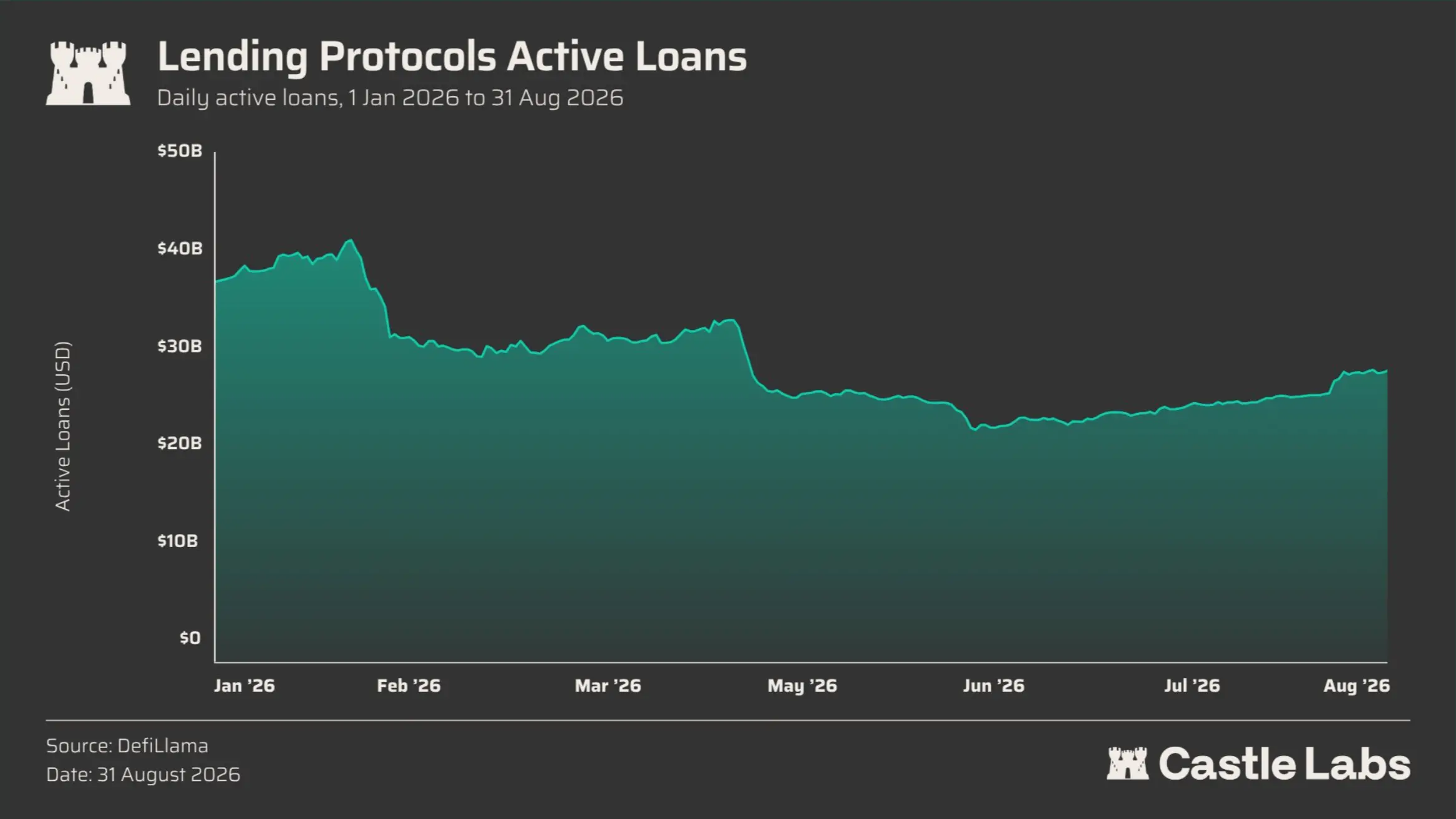
Currently, the active loan scale in the lending sector has reached $28.5 billion, with almost all demand coming from floating-rate lending.
This mechanism works well during stable market periods. However, once a stress event occurs, as the utilization curve changes, borrowing rates may spike rapidly. Rising rates can force some borrowers out of the market or reduce leverage, thereby decreasing the overall efficiency of the credit market.
In fact, DeFi money markets have solved a problem that traditional credit struggles to provide: allowing users to collateralize loans almost instantly.
But one problem remains unresolved: borrowers do not know how much debt cost they will ultimately bear before the loan matures.
Today, many products are emerging around this point, pushing the market towards fixed-rate, fixed-term credit products. In such a market, lenders can earn fixed returns and know in advance how much their deposits will yield; borrowers can also clearly understand how much financing cost they need to pay.
The demand in this type of market mainly comes from three types of participants:
Term-matching borrowers: funds, treasury departments, RWA issuers, and basis/arbitrage trading teams. They need to match the debt maturity date with asset duration, redemption windows, or strategy cycles.
Cost-determined borrowers: revolving borrowers, leveraged yield strategy users, and traders. They may not care about the exact maturity date but need stable borrowing costs to avoid compression of interest spreads.
Lenders/fund managers: treasuries, market makers, and capital allocators. They want to choose the term, collateral, and returns themselves, rather than passively accepting the outcomes generated by utilization rates.
Early fixed-rate lending protocols faced three main issues:
Liquidity fragmentation: Fixed-rate markets fragment liquidity based on maturity dates, interest rates, collateral types, and terms, making it harder to match than a single floating-rate liquidity pool.
Lack of early exit mechanisms: Once a loan starts, if there is no secondary liquidity, redemption path, or other buyers, lenders often find it difficult to exit before maturity. This is usually not a problem in floating-rate lending.
Cold start problem: Lenders are unwilling to lock up funds long-term before matching with a counterparty, yet cannot earn any returns.
As institutional capital allocation increases and complex strategies like revolving lending mature, market users are also changing, leading to a rise in demand for fixed-term markets.
One of the core issues of on-chain lending is the uncertainty brought by floating rates. Fixed-rate lending allows users to know their returns and financing costs at the start of the transaction, while also providing a better user experience, as protocols must directly price for term, collateral quality, exit liquidity, and refinancing risk.
This article will introduce the design solutions adopted by mature protocols originally focused on floating rates, such as Morpho, Jupiter, and Kamino. Together, these three have a total of $6.83 billion in active loans and have recently begun entering the fixed-rate and fixed-term markets.
Morpho Midnight and Tenor Finance
As a mature protocol in the floating-rate lending space, Morpho launched Morpho Midnight in July 2026.
Midnight is an intent-based lending protocol that employs a zero-interest mechanism. Lenders and borrowers first express their transaction intentions, with positions represented as debt units and credit units:
Debt unit: Each unit represents the obligation to repay one loan token before maturity.
Credit unit: Represents the claim on the loan tokens after repayment.
Midnight addresses some issues in fixed-rate lending by allowing loan positions to be traded, providing institutions with term flexibility and more predictable credit conditions. The interest rate is determined by the prices of fixed-term credit units and debt units traded between borrowers and lenders.
In Midnight, the "quotes" posted by lenders and borrowers do not lock up funds but merely express transaction intentions: wishing to borrow or lend funds at a specific price, maturity date, and collateral configuration in a specific market.
Funds are only drawn in during transaction settlement through a callback mechanism. This way, lenders only need to put in funds after a transaction is matched and executed, thus solving the cold start problem and improving capital efficiency.
The Morpho team stated:
"By allowing users to earn floating rates on protocols like Morpho Blue, we can eliminate the opportunity cost that users typically bear while waiting for quotes to match. This will increase users' willingness to post quotes and enhance the overall liquidity available to users."
Another problem facing fixed-rate markets is capital fragmentation, as each maturity date, collateral type, and interest rate range can form independent markets.
Midnight does not immediately draw in funds when users express intent; users can also post cross-market quotes:
"Since the same funds can be quoted in multiple markets simultaneously, the total liquidity that a single quoting party can provide equals: available funds × number of markets."
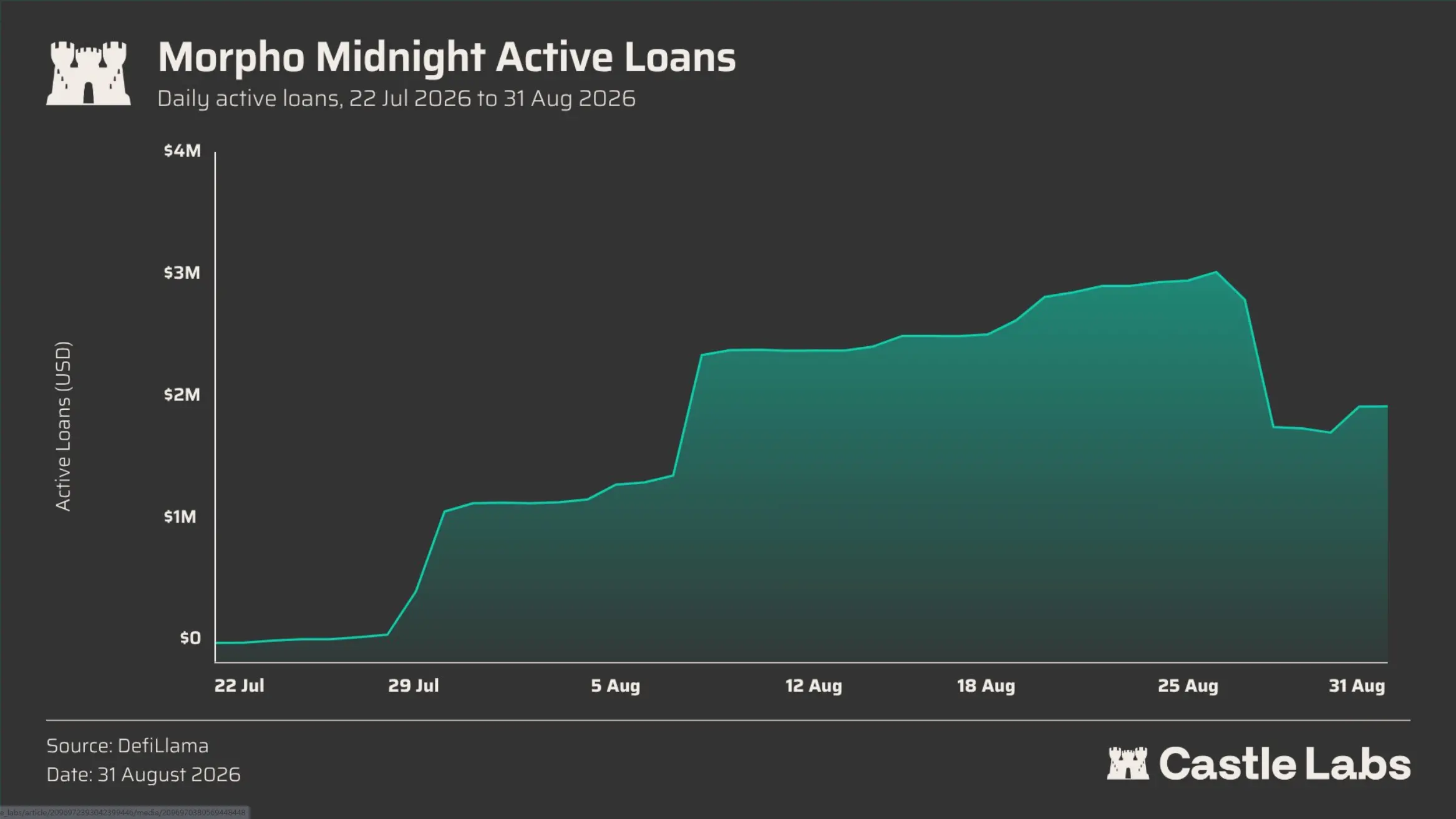
Since its launch in July 2026, the active loan scale of the Midnight market has reached $3 million. Although this figure is still relatively small, the team expects it to change soon, as Midnight also inherits the existing network effects and ecosystem of Morpho.
For example, Morpho Vaults currently hold over $4 billion in funds. Once the vault adapter is released, these funds can start quoting on Morpho Midnight and play an important role in building deep liquidity.
The most noteworthy design of Midnight is its solution to the early exit problem.
In early or illiquid fixed-term markets, lenders and borrowers often find it difficult to exit before maturity. Midnight improves this by making positions interchangeable: lenders can sell credit units, while borrowers can buy debt units, thereby reducing outstanding debt.
If Midnight is the underlying architecture for fixed-rate loans, then an access layer has emerged on top of it: Tenor Finance.
DeFi Frontier refers to Tenor as "Midnight's HIP-3."
Tenor essentially inherits all the underlying functions of Morpho Midnight and adds more product designs on top of that:
Automatic renewal and fallback mechanism: Tenor introduces an automatic renewal feature to avoid positions being liquidated after maturity. It uses an independent Keeper to roll the loan into a new fixed-rate term before maturity. If new fixed-rate liquidity is not matched, the loan can fallback to the floating-rate pool of Morpho Blue.
On-chain OTC protocol: Tenor allows users to request quotes and post customized OTC trading quotes. These quotes can be shared with whitelisted counterparties, supporting direct negotiation between both parties.
Institutional tools and access control: Tenor provides role-based permission management for institutional accounts. Institutions can deploy customized credit markets with access restrictions and limit the participation eligibility of borrowers and lenders based on compliance or KYC requirements.
By adding automatic renewal and fallback mechanisms, Tenor reduces the friction of managing maturity for fixed-term positions. As long as matching liquidity exists or fallback conditions are met, positions can continue more smoothly.
Additionally, Tenor's customizability makes it more suitable for institutional use. The team expects that one side of the platform will connect asset management institutions, while the other side will connect enterprises.
Jupiter Offerbook
The Offerbook of Jupiter Exchange entered public testing in June 2026, roughly coinciding with the release of the Morpho Midnight white paper.
Jupiter's floating-rate product, Jupiter Lend, launched last year, marking its first entry into the lending space. Now, the Offerbook is beginning to enter the fixed-term market.
The Offerbook is an intent-based lending protocol that does not use a price-based clearing mechanism, thus supporting fixed-term lending for long-tail assets.
Loans on the platform have shorter terms, typically ranging from 1 to 30 days. At maturity, if the borrower has not repaid the loan, the lender can directly take possession of the collateral without triggering liquidation.
This design allows NFTs, RWAs, and other assets lacking active price discovery to become collateral, as long as lenders are willing to directly assess and bear the risks of their collateral.
The uniqueness of this model lies in its use of collateral transfer at maturity, replacing continuous price liquidation and helping to establish dedicated markets that support assets that would otherwise be difficult to incorporate into the lending system.
On the Offerbook, users can post loan or borrowing intentions, which will be displayed in the application. Only after a quote is accepted will the platform draw in liquidity.
Since users accept quotes only when matching transactions occur, funds can still remain available for use elsewhere until the order is actually executed, thus solving the cold start problem. Lenders and borrowers can also continue to earn returns on their funds while waiting for transactions that meet all conditions to match.
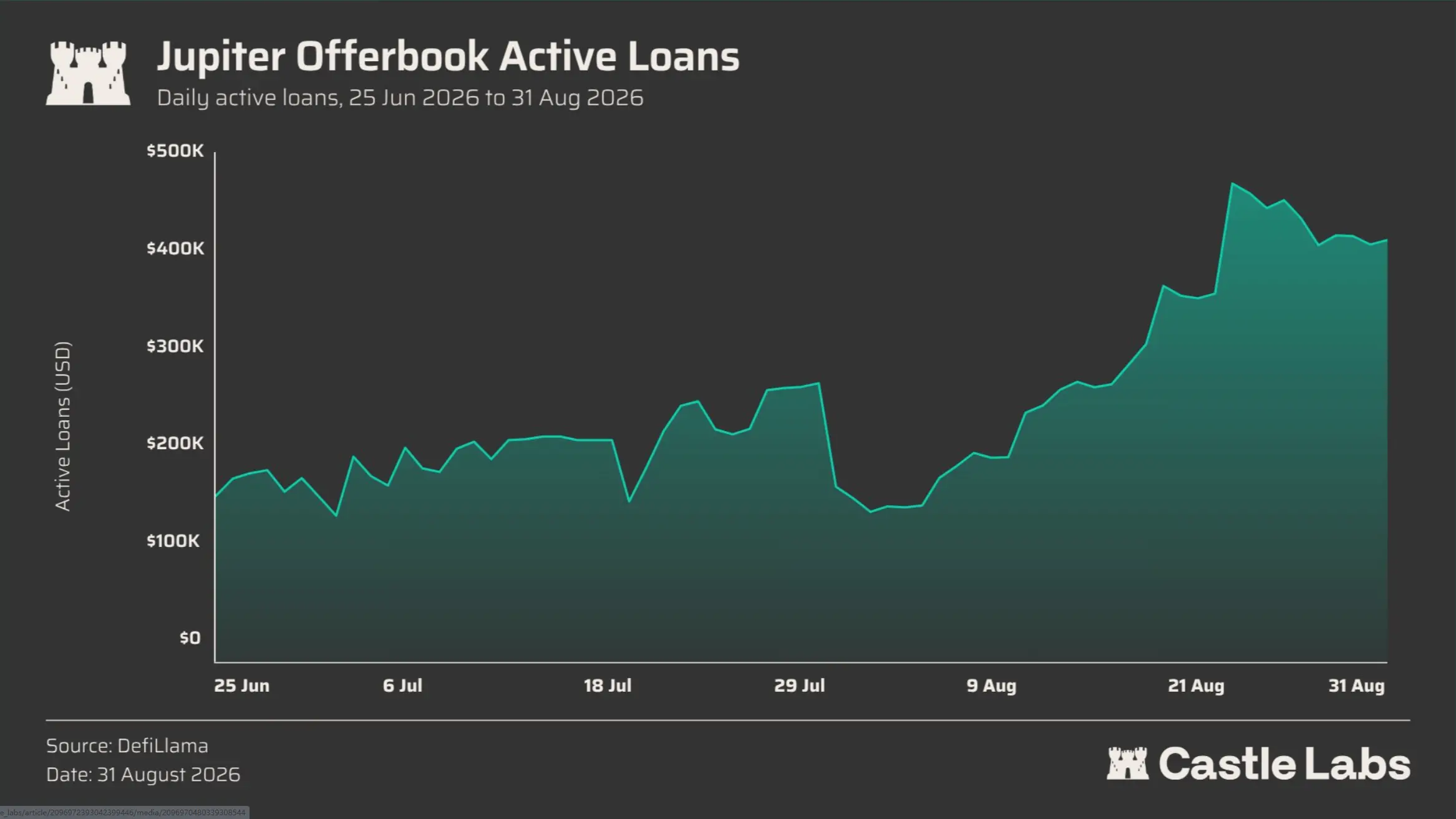
Since its launch, the active loan scale of Jupiter Offerbook has reached $450,000.
Although this model is unique, validating market demand and achieving scale remains challenging, as its scalability depends on whether lenders are willing to directly assess and undertake risks for the collateral.
Kamino
Kamino recently released the white paper for its fixed-rate lending protocol.
Kamino did not build a separate fixed-rate market but added a fixed-rate reserve pool within Kamino Lend.
The advantage of this design lies in its distribution capability. Borrowers can see a clear term structure, and lenders can quote for specific rates and terms without fully exiting the floating-rate system, making fixed-rate borrowing a complement to the existing system.
Each reserve pool on the platform is defined by an interest rate and term. For example, users can borrow USDC at different rates and terms. All the different combinations of rates and terms together form a grid.
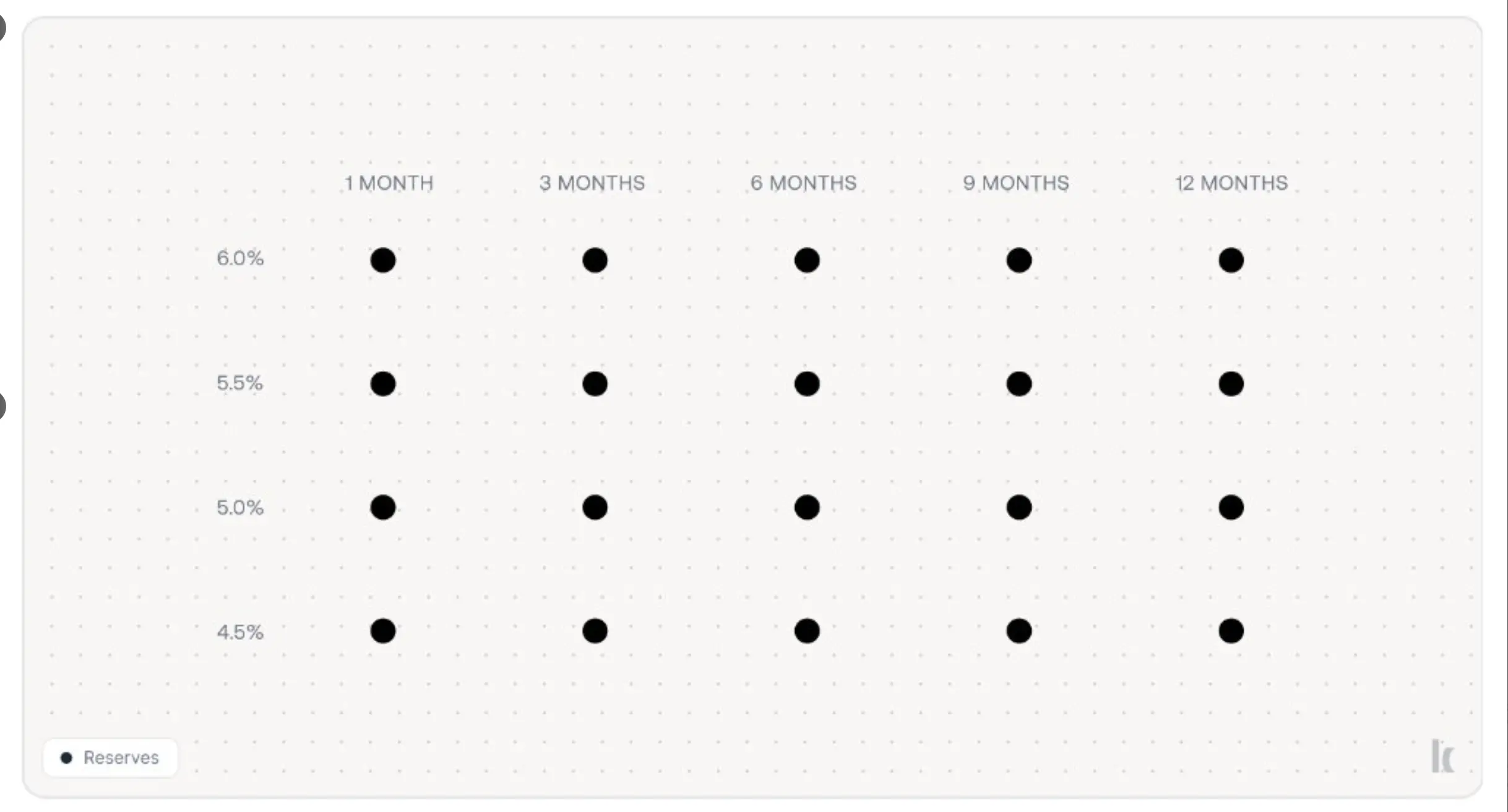
Through this grid, Kamino allows borrowers and lenders to express the prices and terms at which they wish to transact.
Borrowers can post borrowing intentions, specifying collateral, loan size, maximum interest rate, and term. Lenders can post conditional liquidity, indicating the interest rates, terms, and amounts at which they are willing to provide funds.
This grid serves as the execution layer for transactions. Borrowers can draw available fixed-rate liquidity from a pre-set combination of interest rates and terms.
Unlike direct matching, lenders will quote in the structured grid, for example, a 1-month interest rate of 4.5%, a 3-month interest rate of 5%, etc., thereby forming a clear term structure and yield curve for different assets.
With Kamino's infrastructure, borrowers can either post intentions and wait for liquidity matching or borrow directly from the available fixed-rate liquidity in the grid.
Additionally, as long as liquidity allows, Kamino can automatically roll loans over to the next term, with a mechanism similar to Tenor. If there is no available fixed-rate liquidity, the loan can revert to a floating rate. This design addresses the issue of loan maturity and reduces the burden on borrowers to manually manage each maturity.
In terms of exit, lenders need to exit through the Withdrawal Queue.
If funds have already been borrowed, lenders cannot immediately retrieve their funds and will enter a first-in-first-out queue, receiving repayment when the loans in that reserve mature.
This design ensures that the maximum waiting time for lenders is constrained by the reserve term and does not exceed the corresponding reserve's term.
While the parties to the transaction are matched, the funds will not remain idle but will continue to earn returns from the floating rate reserve, alleviating the cold start problem.
Conclusion
Fixed rates do not eliminate the risks exposed by floating rate lending over the past years, but they make the cost of debt clearly visible.
This is precisely what DeFi lending has been lacking.
The advantage of floating rate liquidity pools is that they allow for instant borrowing, but they also compress all demand onto a single utilization curve.
The fixed rate market allows borrowers to price for terms, lenders to choose term and collateral risk, fund managers to allocate funds across different maturities, and application developers to package them into more predictable credit products.
We are also beginning to see early forms of predictable credit products. For example, Aave launched Stable Vaults in July.
This is important because DeFi lending is continuously expanding, with application scenarios covering revolving loans, basis strategies, treasury management, RWA-related assets, and consumer-facing applications.
These users need not just liquidity, but also clear and fixed financing conditions.
We expect competition in the fixed rate lending space to continue to intensify, with more innovative solutions emerging to scale the market.
Currently, the adoption rate of fixed rate lending remains low, with floating rate lending still dominating the market. However, the goal of these products is to enlarge the entire market, as they can serve many scenarios that existing DeFi lending cannot cover.
Moreover, these products are also attempting to address the issues faced by early protocols while having stronger distribution capabilities, as their corresponding floating rate lending products are already relatively mature.
For instance, funds in the floating rate market can be quoted in the fixed rate market while continuing to earn returns and maintain fund efficiency.
As these products gradually mature, a large number of previously unattainable strategies may emerge in the market, creating a new growth flywheel in the lending sector.
 Risk warning