From Construction to Commercialization: Agent Application Layer

 AI construction tools solve the problem of "creation." The next layer of the platform must address execution, payment boundaries, distribution, and the monetization of builders.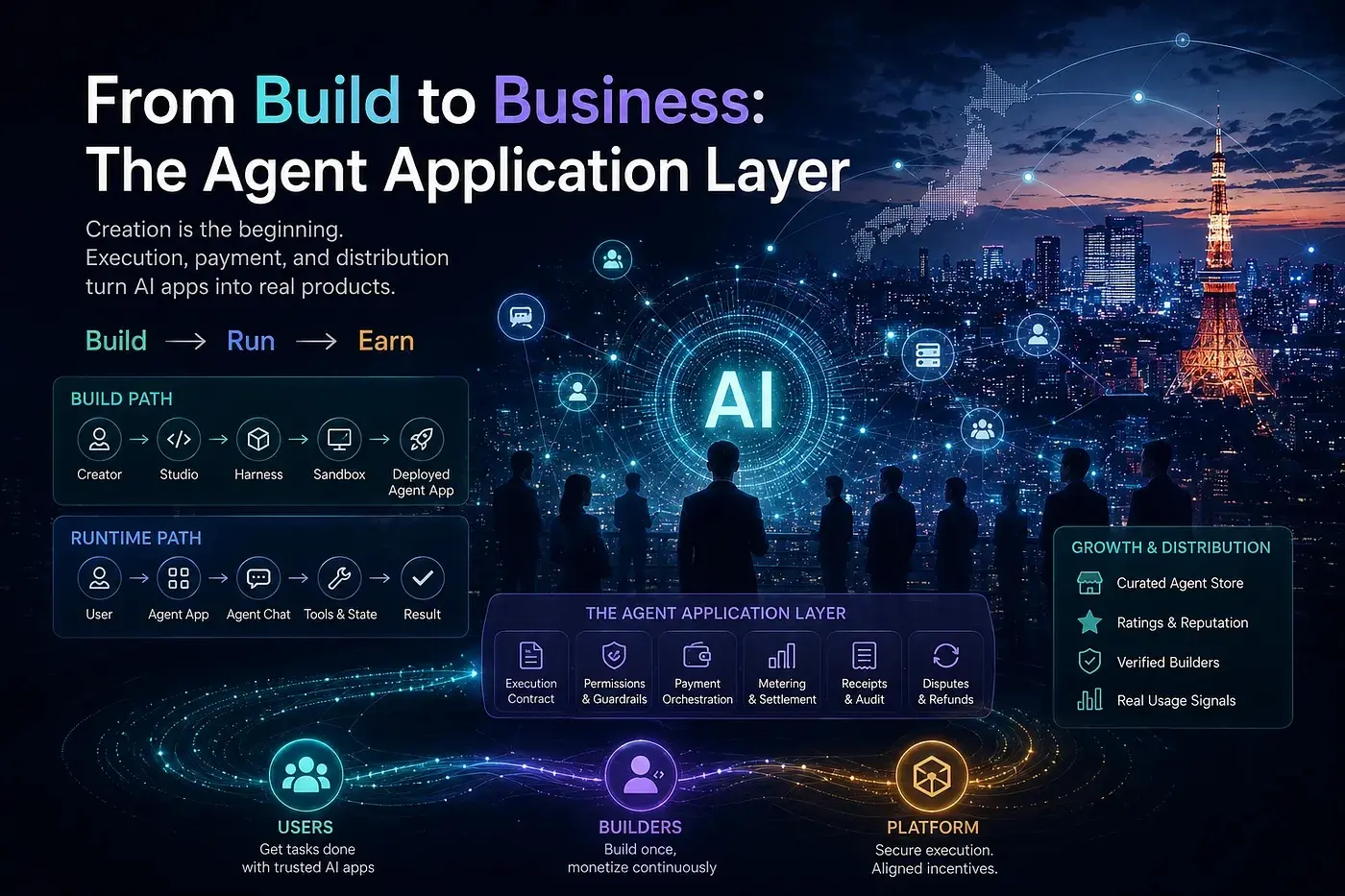
Most AI applications stop their conversations too early. They halt at the moment when "the application is generated."
This was reasonable during the first wave. A year ago, watching a prompt turn into a runnable interface was already the highlight of the event. Today, builders have understood that natural language can generate software. The harder question is: what happens after the application is generated.
Can it run for real users?
Can it perform tasks safely?
Can it measure costs, charge by value, and issue receipts?
Can builders earn revenue from it?
Can users discover it without blindly trusting a random list of applications?
At X-Agent, we repeatedly return to this boundary: creation is necessary, but merely creating does not turn an Agent application into a real product. The missing layer is everything that happens "after the build is complete."
Summary
The next platform-level question is not about generating more AI applications, but about turning the generated Agent applications into executable, distributable, and profitable products. The Build Path and Runtime Path should be treated as two different systems. The former creates applications, while the latter allows real users to operate them.
Payments for Agent applications should be tied to the execution itself—this includes budgeting, metering, confirmation, settlement, receipts, and dispute resolution paths. The Agent store and growth should start from curated distribution and real usage signals, rather than an empty market list.
The Build Path is only half of the product
The Build Path is the part that most people have already recognized. Creator → Studio → Harness (execution framework) → Sandbox → Deployed Agent application. The creator describes what they want, the system interprets this intent, generates an application, previews it in the sandbox, and then moves it to deployment.
This is already valuable. It removes past obstacles that hindered non-engineers and slowed down engineers: repository structure, environment configuration, preview cycles, deployment details, and the initial round of application scaffolding. But if we stop here, we essentially only have a way to "better create supply." More builders can produce more applications, more ideas can reach the demonstration stage, and more prototypes can be shared, but this does not answer the question of "product." A generated application still needs users, tasks, states, permissions, pricing, trust, and distribution.
This is precisely why we distinguish between the Build Path and the Runtime Path.
Runtime is where the application truly becomes useful
The Runtime Path begins after the application deployment is complete. User → Agent application → Agent conversation → Tools/State/Wallet/Payment → Result. This path serves the end user, not the creator. A deployed Agent application should not just be a static page with an AI label. Users should be able to open the application, express intent, ask for details, trigger workflows, check status, call tools, and obtain task results.
This sounds obvious until you actually start building it.
The Agent at build time and the Agent at runtime are two different jobs. The build-time Agent is responsible for assisting in creating applications; the runtime Agent is responsible for assisting users in operating applications. If these two roles are crammed into the same lengthy prompt, the system will become difficult to reason about, hard to ensure safety, and challenging to achieve profitability.
The runtime needs to establish its own set of "contracts" with users. It needs to know what states the application can read and write; it needs to know what tools are available; it needs to know which operations are cheap and reversible, which operations are expensive, involve external systems, or carry risks; it needs to know when to request confirmation; and it needs to leave an audit trail.
This is the difference between "the model gives an answer" and "the application completes a task."
A concrete example: lead analysis is more than just a prompt
Take a simple Agent application as an example: lead analysis after an event or marketing campaign ends. A version relying solely on prompts is common: users paste a list of leads and let the model sort them. The model returns a table, perhaps with a score and suggested follow-up scripts. Useful, but incomplete.
A truly executable Agent application must handle the remaining parts of the workflow:
Import leads from forms, spreadsheets, CRMs, or event systems;
Standardize fields while retaining the original source;
Classify using the model and optionally call enhanced APIs for data supplementation;
Mark which external calls will incur costs;
Request confirmation before sending messages or writing back to the CRM;
Record who approved the operation;
Show what costs were incurred, what resources were consumed, and what results were produced;
Support refunds, retries, or dispute resolution when tasks fail.
This is where many AI applications quietly collapse. The model can suggest what to do next, but the product layer must bear the authorization, execution, costs, and responsibilities. This layer of product capability is what we refer to as "runtime."
Execution requires a contract
We do not believe that "Agent execution" means giving the model unlimited power. A better model should be more constrained: user intent → model proposes a solution → runtime validation → tool execution → audit record. The model is responsible for understanding and planning, while the runtime is responsible for validation and execution.
For any operation of practical significance, the runtime should be able to construct an "Execution Contract." This is not necessarily a document visible on the interface, but an internal object that informs the platform "what will happen next."
An Execution Contract should be able to answer:
Payer: who will pay;
Agent application: which application is executing;
Builder: who created this application;
Task: what task is being executed;
Pricing: how is this task priced;
Budget cap: what is the maximum allowable cost;
Confirmation: is user confirmation needed;
Metering: what should be measured;
Settlement: how payments are settled;
Audit: how the execution process is tracked.
The user experience layer can remain simple:
"This task may cost up to $0.50, do you want to continue?"
But the backend cannot be that simple. It needs to know whether the user approved the task, how much budget was reserved, which tools were called, what the actual execution costs were, whether the task was completed, and what kind of receipts should be issued. Without this contract, payment is just a checkout interface; with it, payment becomes part of the execution process.
Payment is not a checkout button
For Agent applications, payment should not be rigidly attached to the outside of the product. The moment an Agent starts doing real work, costs and value become runtime-level issues. Some operations will consume model tokens, some will call paid APIs, some will involve computation, storage, search, data service providers, deployment infrastructure, or third-party services, and some operations will directly create commercial value.
So the payment question is not just "credit card or wallet?"
But rather:
Who initiated this task?
Who approved this budget?
What resources were consumed?
Was the result completed?
How much should be charged?
How should revenue be shared?
What happens if the task fails?
What records can prove what happened?
This is why we view the payment for Agent applications as an "Agent Commerce Layer." A practical "execution-commerce" state machine might look like this: Quote → Authorization → Reservation → Execution → Metering → Settlement → Receipt issuance → Revenue sharing → Refund/Dispute resolution.
Most users will never need to see this entire mechanism. They should only see a clear cost boundary and a clear result. For example, a typical pricing strategy for a lead analysis Agent application might be:
Free tier: the first 10 runs are free;
Pricing unit: per task;
Task price: $3 per batch of leads;
Budget cap: the maximum allowable internal cost per task;
Whether external costs are directly passed on: yes/no;
Whether confirmation is needed: confirmation required before sending external messages or writing to the CRM.
(These numbers are just examples of the product model and not the actual pricing currently publicly available from X-Agent.)
Builders do not need to account for the original token costs, and users do not need to see every internal metering metric—the platform should translate the execution process into pricing that users can understand. In the early stages, a practical starting point is simple: free tier + usage cap + task SKU. Usage-based pricing applies to model calls, API calls, searches, storage, and computation; task-based pricing applies to clearly defined scenarios, such as analyzing leads, generating a page, deploying an application, generating a report, summarizing a dataset, or running a clearly defined workflow.
Session or subscription-based pricing is suitable for high-frequency tools. Outcome-based pricing is tempting but should be addressed later—before most Agent applications can charge based on commercial results, attribution, risk, trust, liability determination, and dispute resolution mechanisms need to become strong enough.
Abstract payment channels, retain execution contracts
Payment channels should not define the product experience. Users are purchasing task results, not the payment agreement itself. What a builder wants to know is:
How should this Agent application be priced?
Who will pay?
How is cost controlled?
When can builder revenue become reality?
What happens when a task fails?
They do not need to care whether the underlying channel is a credit card, Apple Pay, platform points, invoices, stablecoins, wallets, or some kind of Agent-to-Agent payment agreement. At the product level, these concepts should remain simple: balance, points, invoices, wallet.
At the underlying level, multiple payment channels can coexist:
Credit cards or Apple Pay for mainstream users;
Platform points for common paid tasks;
Invoices or prepaid points for enterprise customers;
Wallets or stablecoin channels for Web3 native users;
Authorized budgets and automatic settlements for Agent-to-Agent scenarios.
Examples of emerging infrastructure include agentic wallets, payment call protocols like x402, stablecoin settlements, and programmable payment systems. They all point in the same direction: software needs payment channels that can work at the runtime level. This does not mean that every Agent application must use cryptocurrency, but rather that the application layer should abstract payment channels while retaining that execution contract above it.
Different users will need different payment channels, but the contract itself should remain consistent.
Distribution is also part of the runtime issue.
Once creation becomes easy, distribution becomes more difficult. AI builders will increase the supply of applications, but this does not mean users can find the right applications, nor does it mean builders can profit from what they create. An Agent application ecosystem requires more than just a public list of applications. It needs discovery mechanisms, trust mechanisms, ranking mechanisms, incentive mechanisms, and usage feedback, while also needing to understand runtime risks.
A typical app store will generally only ask:
What kind of application is this?
Who developed it?
Can I install it?
What are the ratings?
An Agent store needs to ask more:
What operations can this Agent application perform?
What permissions does it require?
What tools can it call?
How much does it cost to use?
What tasks has it completed?
What usage signals can prove it is indeed useful?
What payment or credential history exists?
What is the reputation of this builder?
Who is helping with distribution or content curation?
This is a product direction, not to say that every component is mature today. Our view is that an Agent store should not start from an empty open market, but should begin with "a layer that provides curated distribution and growth support for high-quality Agent applications." This means selecting high-quality applications, giving them initial exposure, operational activities, verifying real usage, rewarding effective distribution behaviors, while filtering out low-quality or fake active data.
Growth mechanisms can help, but they must be tied to real usage. Recommendation rewards, task activities, leaderboards, ecological incentives—these mechanisms only make sense when they genuinely guide users to Agent applications that can solve problems; otherwise, they will only generate traffic without building trust.
The flywheel of the builder economy
Business opportunities arise when building, runtime, payment, and distribution are connected.
Builders create Agent applications
→ Users discover and use them
→ Runtime measures the execution process
→ Users pay for useful tasks
→ Builder revenue becomes possible
→ Referrers or content curators help with distribution
→ Real usage data improves rankings and templates
→ More builders join
Payments are tied to product usage, distribution is tied to execution quality, and builder incentives are tied to runtime measurement. To make this mechanism truly work, the platform ultimately needs a real ledger. Every meaningful paid execution should be able to record:
Gross charge
Model cost
Tool cost
Infrastructure cost
Payment fee
Platform fee
Builder revenue
Referrer reward
Refund amount
Settlement status
Without this foundation, revenue sharing, refunds, enterprise billing, anti-fraud controls, tax reporting, payouts, and audits will become very fragile. With it, Agent applications can become real economic units: builders can publish an application, users can pay for a useful task, content curators can help with distribution, and the platform can rank applications based on execution quality rather than just marketing copy. This is the transition from "application generation" to "Agent application commercialization."
Where is X-Agent positioned?
X-Agent is being built as an "Agent application layer."
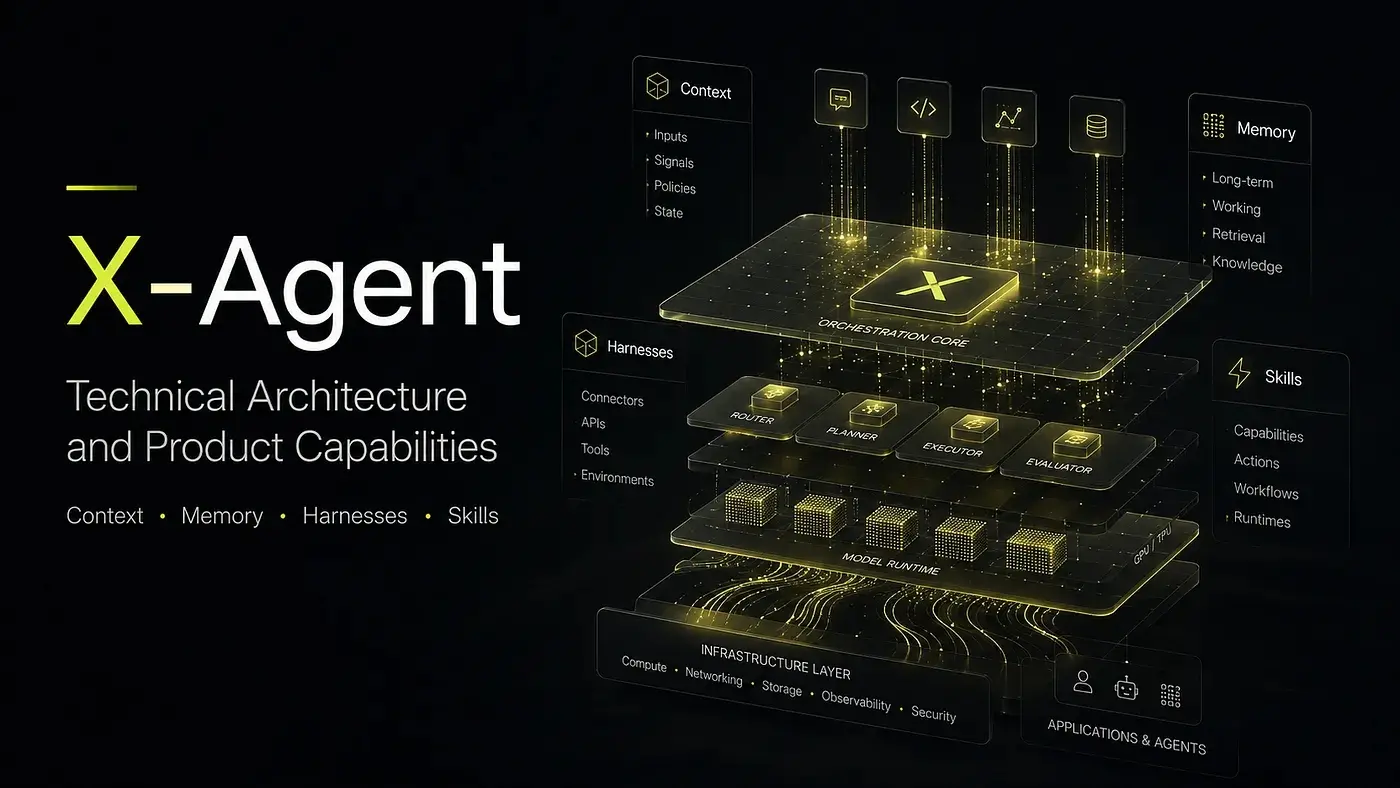
It does not intend to replace the underlying models, does not intend to replace cloud service providers, does not intend to replace wallet infrastructure, and is not just another programming Agent. The technology stack we are building is roughly as follows:
Underlying model
→ Builder / Harness
→ Secure runtime / Tools / Wallet
→ Agent applications
→ Store / Distribution / Growth
The underlying model provides intelligence;
The builder and execution framework convert intent into applications;
Secure runtime, tools, wallets, and payment systems define execution boundaries;
Agent applications target real users;
Store, distribution, and growth systems help high-quality Agent applications achieve scalable user adoption.
The focus is not on whether every piece of the puzzle is complete today, but on the fact that Agent applications need to go through a complete lifecycle: creation → deployment → operation → measurement → charging → settlement → distribution → iterative improvement. If a platform only helps people create applications, then it is only competing at the "application builder" level; if it only provides wallets, then it is just infrastructure; if it only operates growth activities, then it is just a distribution tool.
The Agent application layer connects these three.
From generated applications to Agent commercial entities
The first phase of AI software focuses on intelligence—models that can answer, reason, generate, and provide assistance. The next phase focuses on execution—Agent applications that can use tools, manage states, and complete tasks. The following phase focuses on the economy—Agent applications that can be discovered, priced, paid for, distributed, and continuously improved through real usage.
The generated applications are just the starting point of this conversion chain, not the endpoint of the product. The future of AI applications will not be defined by "how many demo presentations can be generated," but by "how many Agent applications can perform real tasks, reach real users, and maintain real economic activity."
This is precisely the application layer direction that X-Agent is building.
If you are building Agent applications, agent wallet infrastructure, or establishing distribution channels for AI-native software, feel free to follow X-Agent for more notes on runtime, commercialization, and distribution.
 Risk warning
Popular articles