X-Agent technology architecture and product features

 X-Agent provides an application layer for building, deploying, and executing native Agent systems—these systems are not only intelligent but also controllable, auditable, and ready to interact with real-world value networks.
X-Agent serves as a key entry point at the application layer, capturing user intent and importing it into the Agent system.
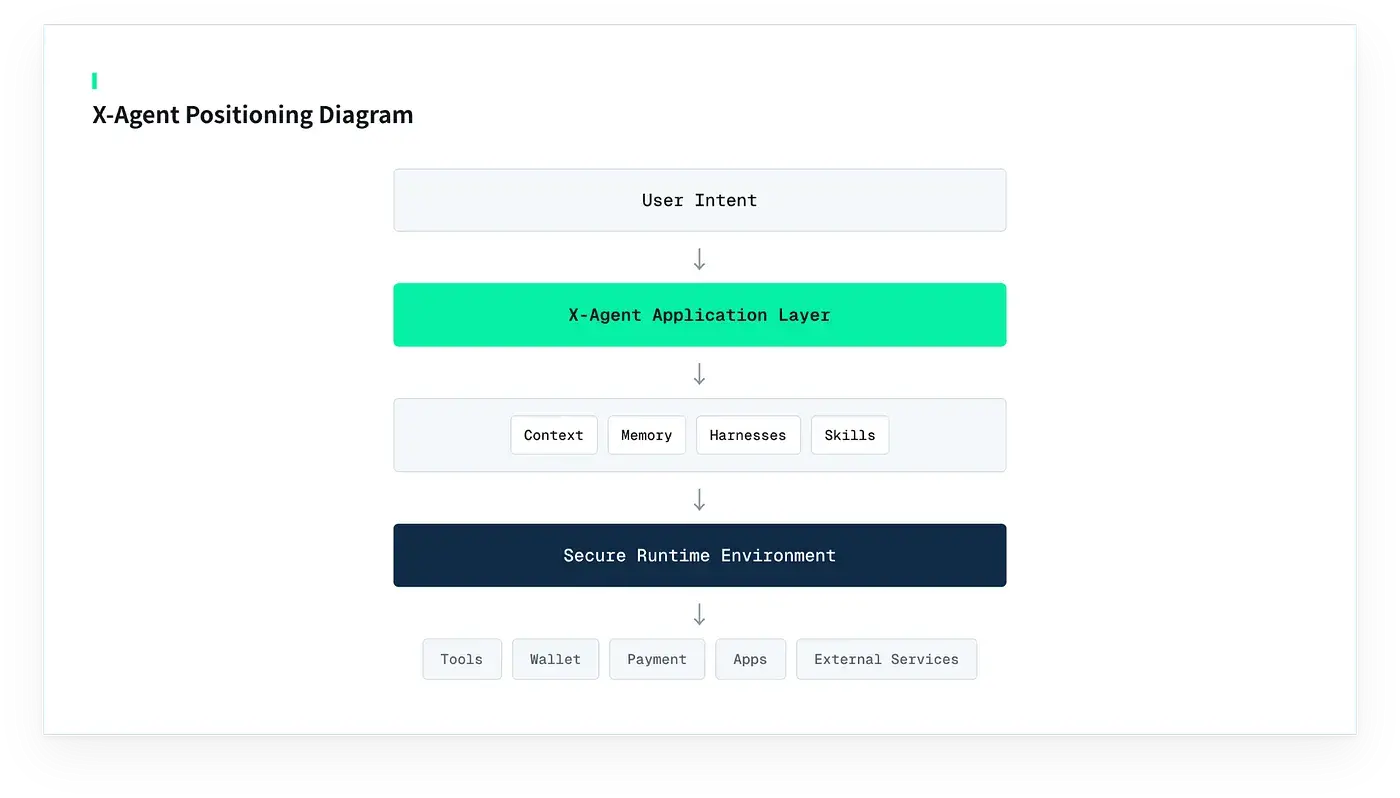
It is built on four architectural pillars: Context, Memory, Harnesses, and Skills. By integrating these four pillars into a Secure Runtime Environment (SRE), X-Agent provides a rigorous execution infrastructure for transforming high-level user goals into complex autonomous workflows.
This structured approach ensures that the transition from "abstract intent" to "executable system" is reliable, verifiable, and controllable. It also makes X-Agent a crucial bridge connecting the underlying technological infrastructure with user-facing application layers.
The design of X-Agent follows a clear framework: just as iOS or Android provide foundational system capabilities for mobile applications, X-Agent provides foundational application layers for autonomous execution. This framework abstracts and packages the four core pillars into a unified Agent unit.
X-Agent Positioning Map
1.1 Context
Context defines the real-time execution environment in which the Agent operates.
It includes not only the dialogue history between the user and the Agent but also user identity, social relationships, application status, session status, task progress, permission boundaries, wallet connection status, available tools, and external service conditions.
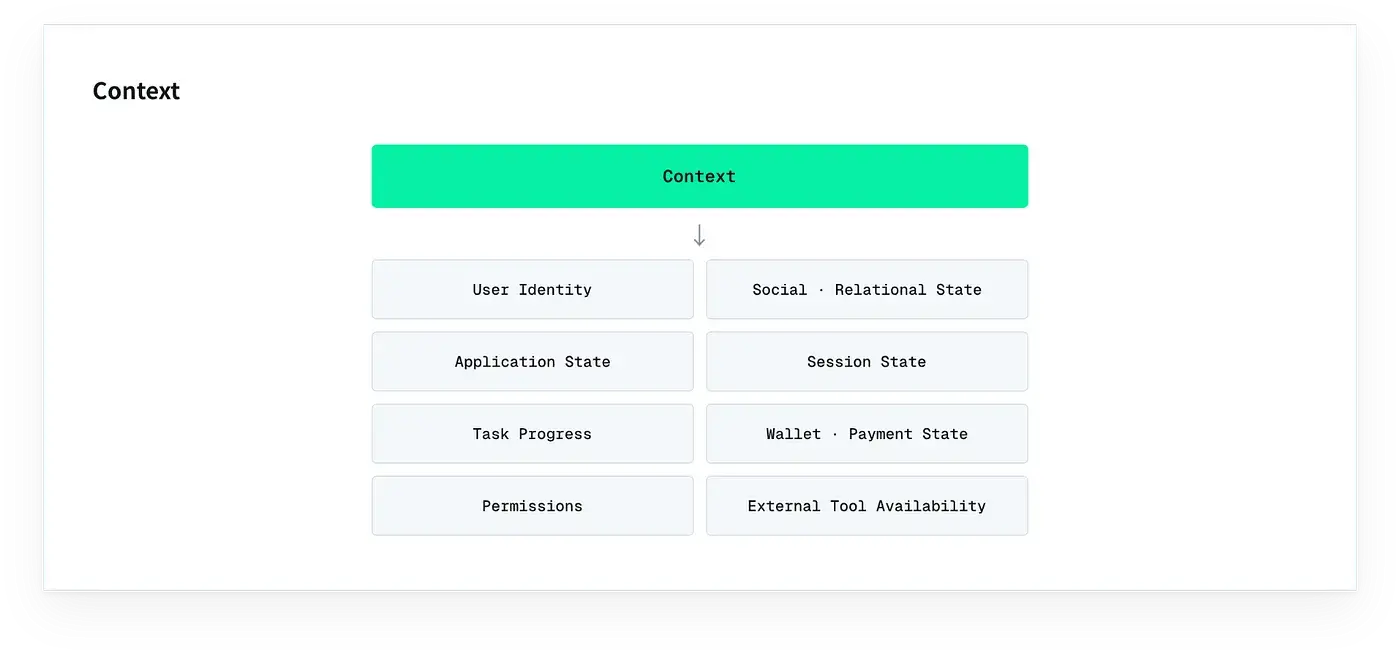
For autonomous Agents, context is not static information but a real-time state layer that helps the Agent understand:
Who is it serving?
Which application is it running in?
What task is currently being executed?
What functionalities are available;
And what constraints must be adhered to.
By continuously loading and updating context, X-Agent ensures that every step of execution is rooted in a real operating environment rather than relying on isolated prompts.
1.2 Memory
Memory provides the Agent with long-term state persistence capabilities across sessions, applications, and multi-Agent workflows.
It enables the Agent to recover historical tasks, retain user preferences, reuse previous execution results, and maintain continuity in long-running workflows.
Unlike short-term context, memory allows the Agent to evolve over time. It may include dialogue history, task records, execution trajectories, application snapshots, user preferences, vectorized knowledge, and the Agent's exclusive long-term state.
With memory capabilities, X-Agent supports not just one-off dialogues but also Agent applications that can run continuously, accumulate knowledge, and self-optimize over time.
1.3 Harnesses
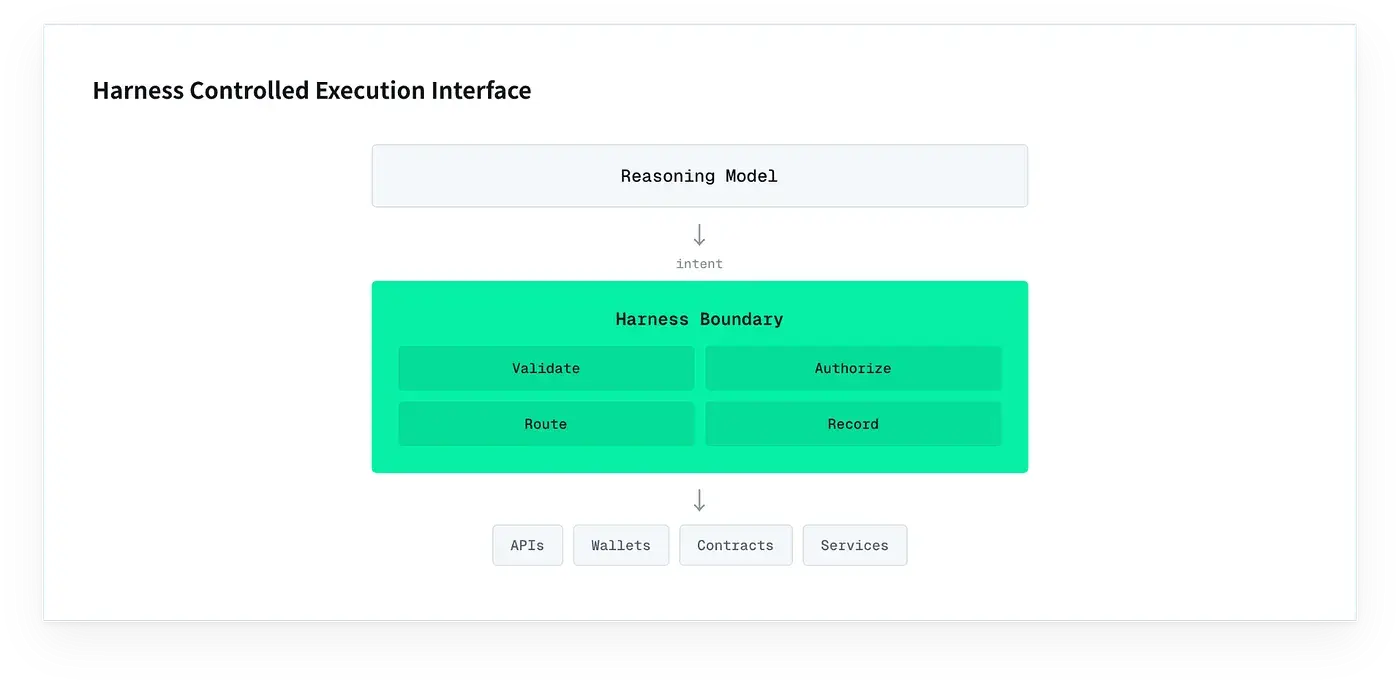
Harnesses are controlled execution interfaces that connect reasoning models with real-world systems.
They are responsible for transforming the intents generated by models into verified, authorized, and recorded execution actions.
Harnesses are not merely a layer of API encapsulation but serve as an "execution boundary."
Before any action reaches external systems, the harness can perform parameter validation, permission checks, policy execution, invocation routing, and execution logging.
Harnesses can interface with external APIs, blockchain oracles, smart contract bindings, wallet adapters, payment interfaces, deployment environments, and enterprise services.
Within the X-Agent framework, the model is responsible for proposing "what should be done," while the harness determines "how this intent can be safely transformed into real execution."
1.4 Skills
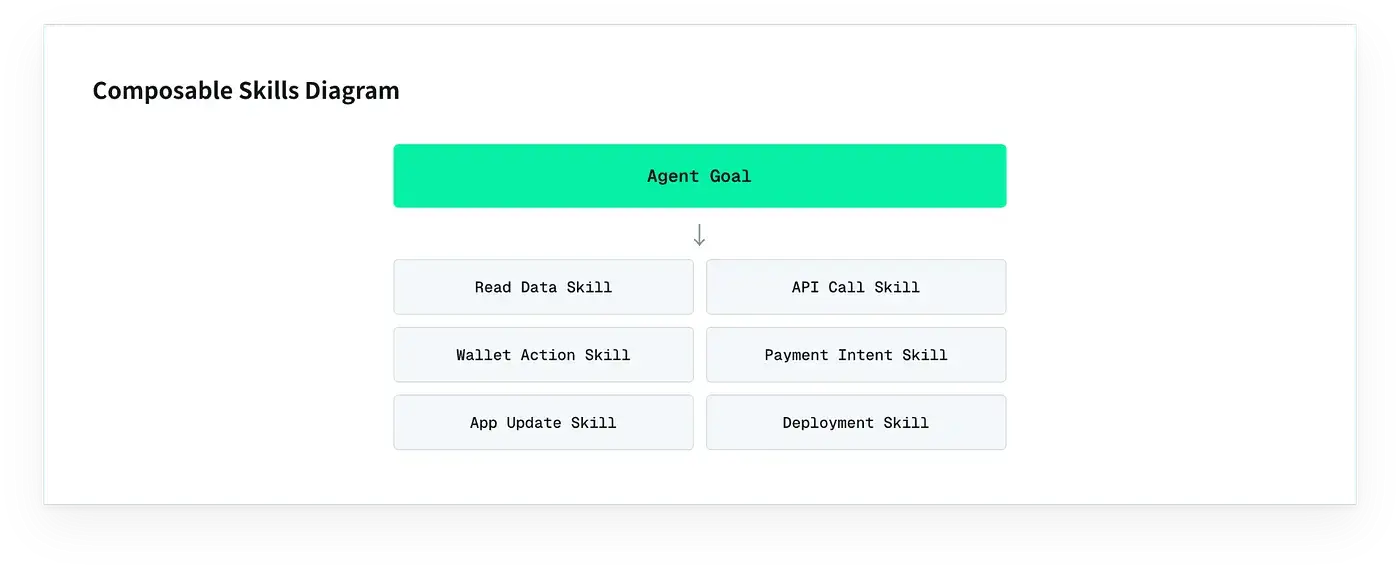
Skills are specialized, reusable, and composable units of execution capability.
They encapsulate specific actions into callable units, allowing the Agent to execute complex workflows without directly manipulating the underlying infrastructure.
A skill may be responsible for reading data, modifying application states, invoking external APIs, interacting with wallets, generating payment intents, updating workflows, deploying applications, or executing specific vertical business tasks.
By modularizing execution capabilities into skills, X-Agent can break down complex autonomous workflows into verifiable, reusable, and auditable execution units.
This also allows Agent capabilities to be combined across different applications and multi-Agent environments.
- Secure Runtime Environment (SRE)
When autonomous Agents interact with external APIs, private documents, cryptocurrency wallets, payment systems, or application states, standard LLM applications face critical execution risks.
These risks include prompt injection, state leakage, unauthorized data modification, credential exposure, and un-auditable operations.
X-Agent addresses these challenges through the Secure Runtime Environment (SRE).
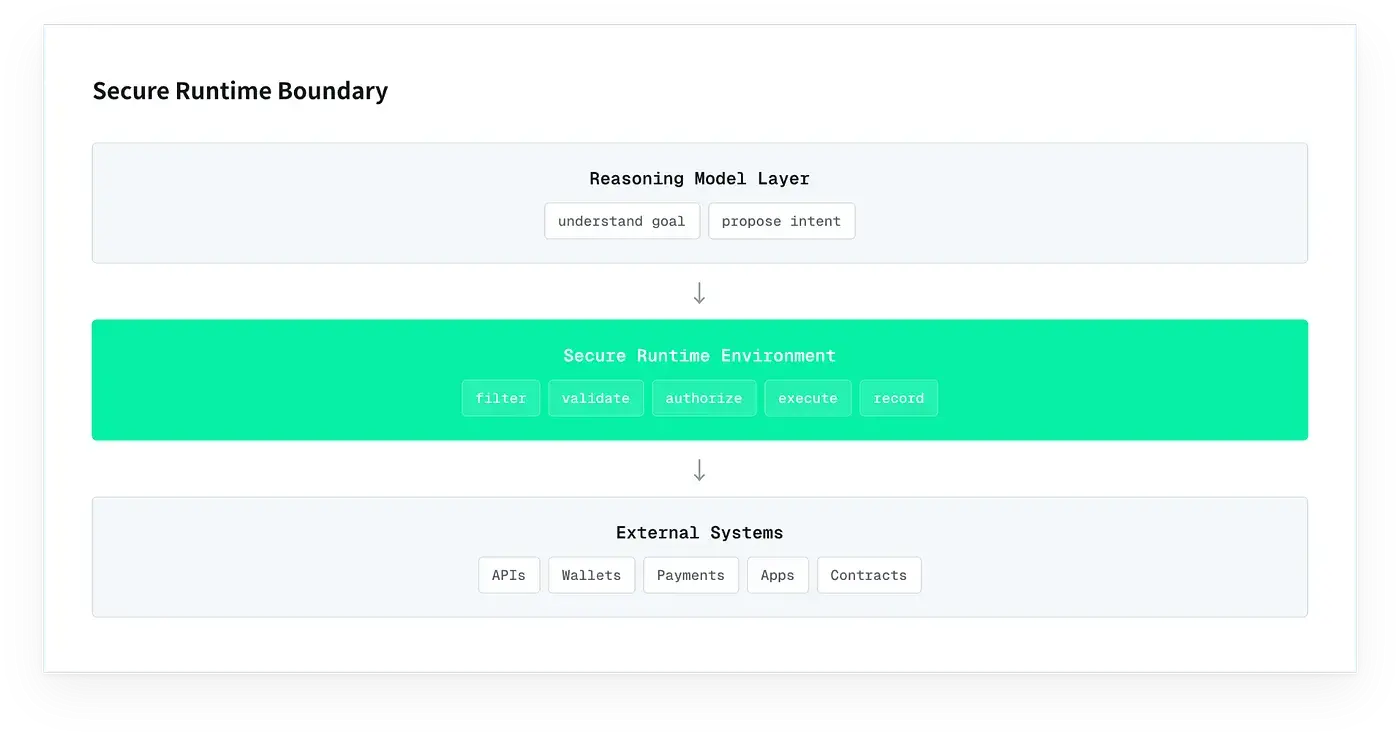
The core principle of SRE is the separation of "reasoning" and "execution."
The reasoning model is responsible for understanding user goals, generating plans, and producing intents; while the runtime environment is responsible for filtering, validating, authorizing, executing, and recording these intents within controlled boundaries.
This architecture ensures that the Agent itself does not directly hold unrestricted access to original credentials, private keys, wallet permissions, sensitive data, or production systems.
Instead, all sensitive operations must go through controlled runtime interfaces and can only be executed after satisfying policy, permission, context, and audit requirements.
Through SRE, X-Agent transforms autonomous execution into a bounded, verifiable process.
Every tool invocation, state update, wallet-related action, payment-related intent, or interaction with external systems can be traced back to the corresponding user goals, workflow steps, runtime decisions, and execution records.
2.1 From Intent to Verifiable Workflow
The execution path of X-Agent begins with user intent and ultimately forms a verifiable workflow record.

The user expresses a high-level goal. X-Agent loads relevant context, retrieves memory, generates an execution plan, verifies each step through the harness, executes specific tasks through skills, and records the results in the Secure Runtime Environment.
For workflows involving wallets or payments, X-Agent can first generate structured, payment-related intents before downstream payment execution occurs.
As a result, financial operations are no longer isolated transactions but become understandable components within a complete, traceable workflow.
- Product Architecture
X-Agent transforms the above technical architecture into three core product capabilities: Builder, Agent Runtime, and Tool/Wallet/Payment Integration Layer.
3.1 Builder
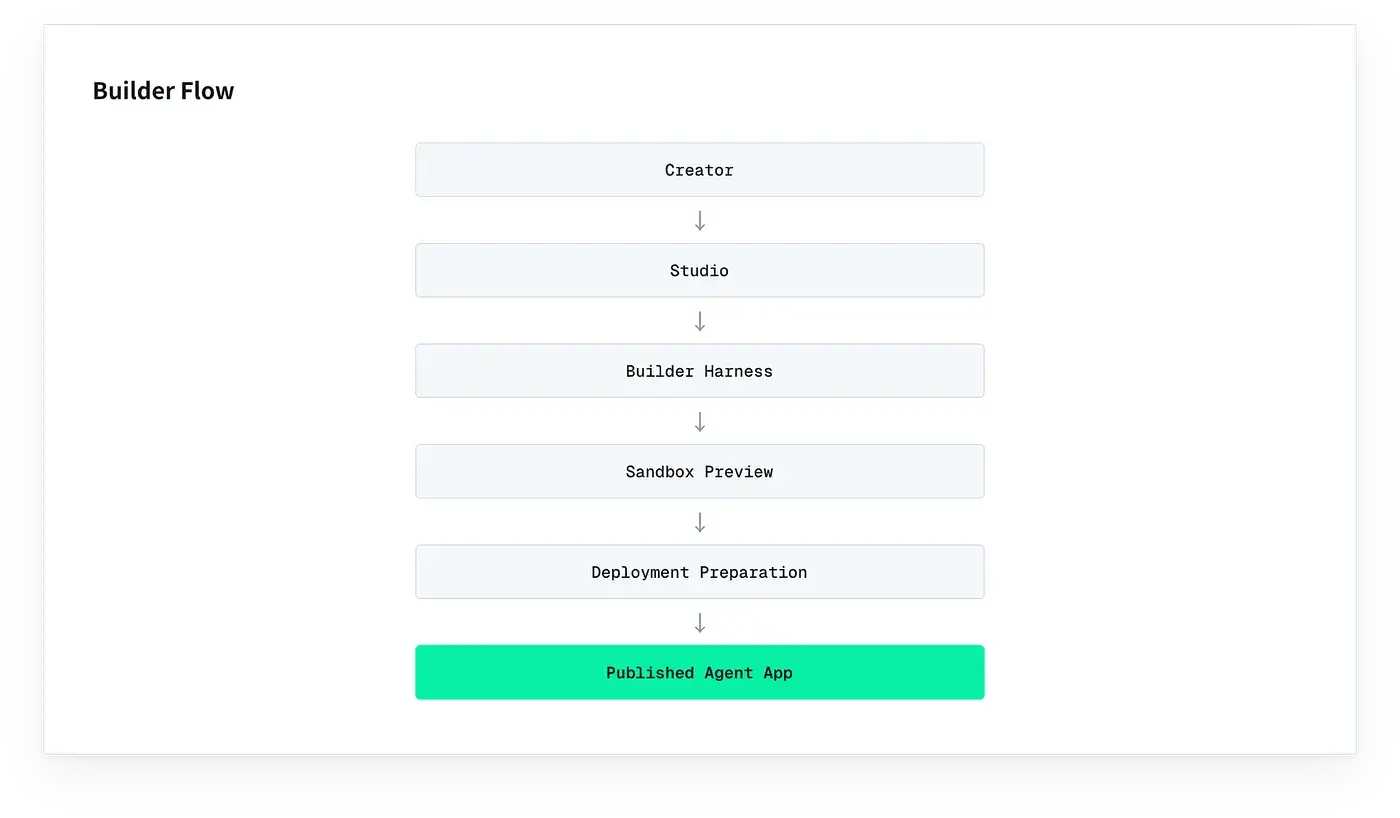
The Builder is an application generation entry point aimed at creators and developers.
Users describe an Agent application in natural language, and X-Agent immediately transforms this goal into application structure, workflow logic, interface states, tool configurations, and deployment preparations.
This creates a path from "intent" directly to "application."
Users describe what they want to build, and X-Agent assists in generating, previewing, iterating, and preparing the application for runtime execution.
3.2 Agent Runtime
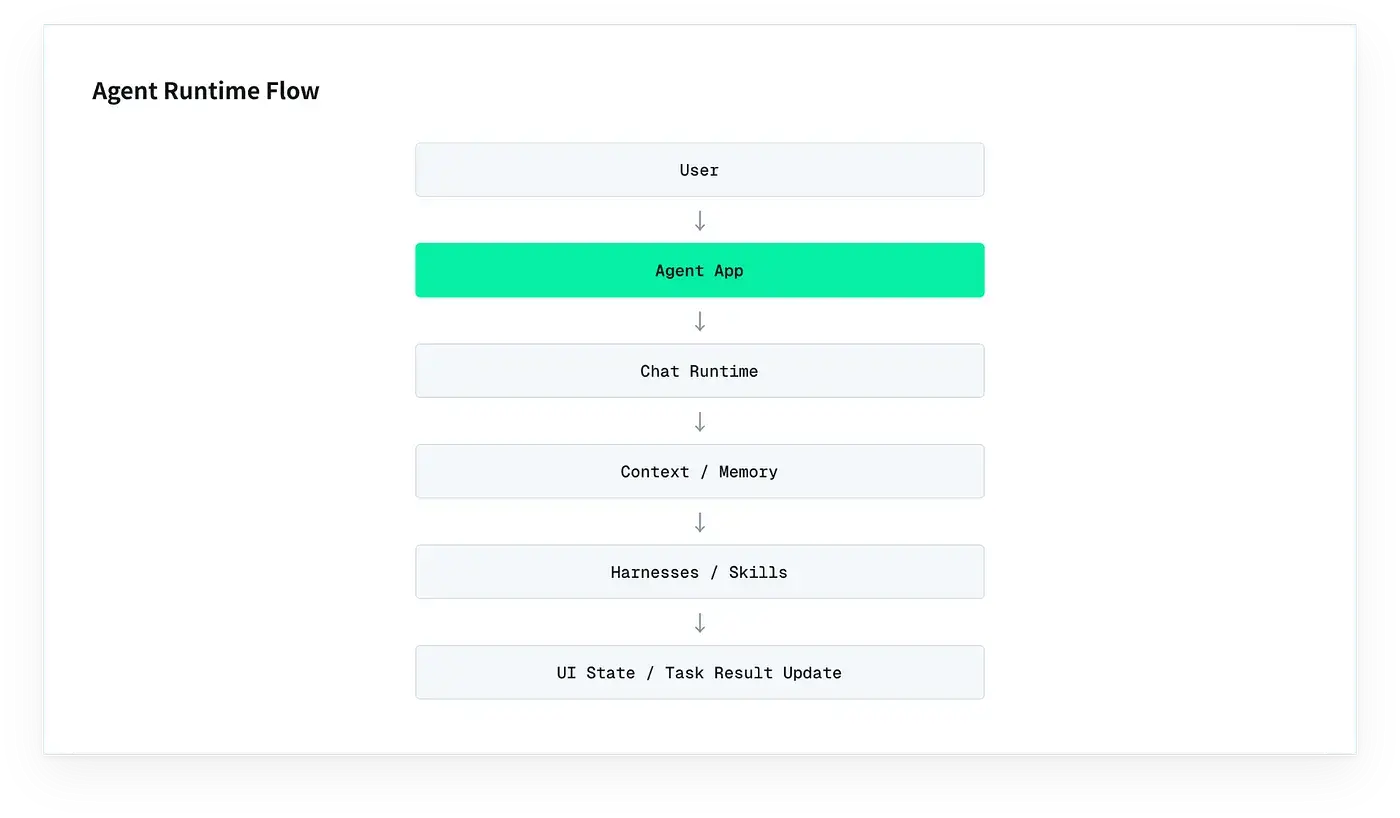
The Agent Runtime is the execution environment for deployed Agent applications.
Once the application is created, users can interact with the embedded Agent, trigger workflows, update application states, access memory, invoke tools, and execute controlled operations within runtime boundaries.
This transforms the application from a static interface into an active, goal-driven Agent system.
3.3 Tool, Wallet, and Payment Layer
X-Agent connects Agents with external tools, wallets, and payment-related infrastructure through harnesses and skills.
At the tool layer, Agents can access external APIs, enterprise systems, data services, and application states.
At the wallet layer, Agents can generate wallet-related intents and route them to controlled adapters.
At the payment layer, Agents can identify value transfer steps within workflows and generate structured, payment-related intents. These intents can then be passed to downstream systems, which are responsible for payment execution, governance, compliance, settlement, and liquidity management.
This makes X-Agent the application generation and execution layer that connects user intent, Agent intelligence, real-world tools, wallets, and value networks.
- Technical Differentiation
X-Agent is not a shell for a chatbot.
It is not a simple tool router.
It is also not just a wallet entry point.
Its differentiation lies in integrating application generation, Agent workflow execution, context awareness, long-term memory, controlled execution interfaces, composable skills, wallet connections, payment-related intent generation, and a Secure Runtime Environment into a unified, natively Agent-oriented application layer.
Through this architecture, X-Agent can transform high-level user intent into verifiable workflows that span context, memory, tools, wallets, payments, and the Secure Runtime Environment.
In short, X-Agent provides an application layer for building, deploying, and executing native Agent systems—these systems are not only intelligent but also controllable, auditable, and ready to interact with the real-world value network.
 Risk warning


Popular articles