Breaking down Anthropic's prospectus: a net loss of 80.7 billion USD in six months, with the fastest listing in mid-November
 Core Viewpoint


 It can be said that what investors are buying is not Anthropic's profits today, but whether it can transform the "country of genius in the data center," mentioned in the prospectus, into cash flow in the corporate accounts under the triple constraints of grid bottlenecks, inference costs, and model reliability.
Author: Joanne, Tencent Technology
Editor: Su Yang, Tencent Technology
On October 26, local time in the United States, Anthropic submitted its S-1 prospectus to the U.S. SEC, officially launching its initial public offering (IPO). The company applied to list on the Nasdaq Global Select Market under the ticker symbol "ANT."
According to insiders, Anthropic plans to go public in the week of November 16, but the specific timing may still be adjusted. Based on the prospectus and recent primary market financing estimates, Anthropic's IPO valuation is expected to fall within the range of $1 trillion to $2 trillion.
The Series H financing completed in May this year has already reached a valuation of $965 billion, and the market expects the IPO fundraising scale to reach around $100 billion. If priced at $2 trillion, Anthropic would surpass SpaceX, becoming the largest IPO in human history.
However, investors are faced with a set of starkly contrasting numbers.
The prospectus reveals that in 2025, Anthropic's revenue will be $4.585 billion, with a net loss of $41.965 billion; in the first half of 2026, revenue will soar to $16.286 billion, but the net loss will expand to $80.748 billion.
On one hand, revenue is projected to increase tenfold in half a year, while on the other hand, the losses are in the hundreds of billions. Where does Anthropic's confidence in seeking a trillion-dollar valuation come from?
01 Pricing Logic: Three Pillars of Models, Applications, and Agents
Anthropic divides its business into three parts: models, applications, and agents.
As the foundation of Anthropic, the Claude model series currently consists of four product lines: Mythos (including Fable), Opus, Sonnet, and Haiku, each corresponding to different positions on the capability, cost, and speed curves.
Data disclosed in the prospectus shows that when commercialization began in 2023, annual revenue was only $41 million, projected to grow to $386 million in 2024, $4.585 billion in 2025, and $16.286 billion in the first half of 2026, representing a year-on-year increase of about 13 times.
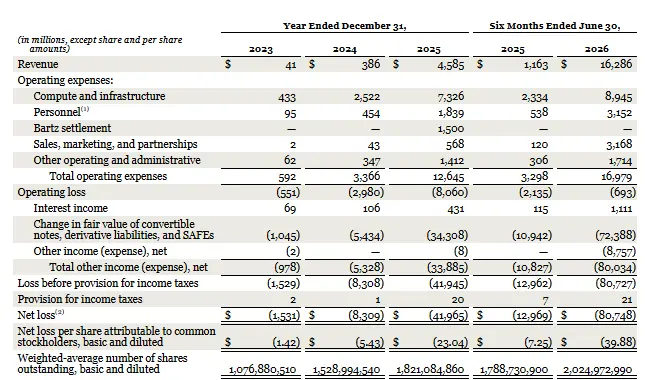
Anthropic financial data, with revenue of $16.286 billion in the first half of this year and a loss of $80.748 billion
The latest quarter's revenue has increased more than an order of magnitude compared to $197 million in the fourth quarter of 2024, with an annualized revenue run rate estimated by the market to be around $65 billion.
Growth mainly comes from pay-for-intelligence. In the first half of 2026, consumption-based revenue reached $13.1 billion, accounting for 80% of total revenue; subscription revenue was $3.2 billion, accounting for 20%. Once enterprise customers embed Claude into critical processes, usage will increase exponentially. The prospectus reveals that as of September 30, 2026, the net revenue retention rate (NRR) is about 900%.
Applications are currently the segment of Anthropic closest to profitability. Subscription revenue increased from $9.8 million in 2024 to $789 million in 2025, reaching $3.2 billion in the first half of 2026. Claude.ai and Claude Cowork merged in September 2026, unifying conversational and agent-based workflows into a single application.
Agents became an independent line only in 2024, but it is the fastest-growing segment. Claude Code has been integrated into the software development processes of major global enterprises, and Claude Cowork, as a knowledge work agent, has adopted usage speeds exceeding those of Claude Code since the research preview opened in January 2026.
The three business areas intersect and collaborate, with safety research encouraging enterprise customers to delegate core processes to models, enterprise data feedback enabling faster model iteration, and improved model capabilities pushing the usable scenarios of agents outward.
Anthropic claims to be "the only laboratory that integrates safety research, cutting-edge models, and enterprise deployment into a single business."
The prospectus estimates that by 2025, the economic value created by global knowledge workers will exceed $40 trillion. IDC predicts that by 2031, AI will have a cumulative impact of $22.5 trillion on the global economy, with global pharmaceutical spending in the life sciences sector alone expected to exceed $2 trillion by 2026.
02 From Opus 5.5 to "A Nation of Geniuses in Data Centers"
The prospectus outlines key milestones that Anthropic has achieved in the past three years and will achieve in the next two to three years.
In terms of model iteration, Claude Opus 5.5 has reduced the single-task cost by about 40% compared to Opus 5, with improvements in inference efficiency directly translating to increased customer usage. Revenue in the second quarter of 2026 is projected to grow by 1368% year-on-year, while computing power and infrastructure spending have only increased by 300% during the same period. This is the core story Anthropic tells investors: revenue is outpacing computing power.
In terms of enterprise deployment, as of September 30, 2026:
- There are over 11,900 customers with annual revenues exceeding $100,000, up from only 950 a year ago;
- There are over 1,900 customers with annual revenues exceeding $1 million;
- There are about 250 customers with annual revenues exceeding $10 million;
- The top five customers contribute about 25% of revenue, with manageable single-customer dependency.
Employee efficiency is also on the rise. The total number of employees has increased from about 940 at the end of 2024 to about 5,300 by September 2026, while TTM revenue per employee has risen from $1.4 million to over $6.6 million. The prospectus attributes this to high talent density, a light sales model, and extensive internal use of Claude itself.
In terms of computing power infrastructure, Anthropic dynamically allocates computing power as a fungible pool by coordinating AWS Trainium, Google TPU, NVIDIA GPU, and AMD GPU.
Additionally, Anthropic is adjusting its computing power procurement methods, attempting to directly lease chips and separate chip arrangements from data center capacity to reduce dependence on a single cloud service provider and seek more stable long-term computing power supply.
Regarding long-term vision, the prospectus states: enabling Claude to be assigned open-ended tasks lasting hours, days, or even weeks, and then execute them autonomously. The ultimate form is "a nation of geniuses in data centers"—millions of virtual collaborators running in parallel, independently or collaboratively solving problems.
03 Differentiation, Five Layers of Vertical Integration
Anthropic explains its cost advantages through five levels: research, models, products, channels, and customers.
The research level includes Constitutional AI, mechanism interpretability, and alignment science; the model level encompasses pre-training, post-training, and evaluation systems; the product level covers the end-to-end matrix of Claude.ai, Claude Code, and Claude Cowork; the operational level involves computing power scheduling, security red teaming, and quality control; the customer level reaches directly to governments, Fortune 500 companies, and developers.
The result of vertical integration is a continuously declining cost curve.
Anthropic reveals that from 2023 to the present, the computing power required to achieve comparable models has been decreasing with each cycle, and the reasoning costs in enterprise scenarios have significantly reduced over two years, with the alignment costs brought by Constitutional AI continuously compressing as a proportion of total training costs.
Customer stickiness also stems from this depth. The prospectus discloses that in the third quarter of 2026, among customers with annual revenues exceeding $100,000, over 50% simultaneously used the Claude Platform and at least one self-developed application, while this proportion was about 30% in the fourth quarter of 2025. The higher the brand trust, the easier it is to acquire customers, and the sales expense ratio has not increased year-on-year despite the surge in customer numbers.
04 The Overlooked Supply Chain
With Anthropic's IPO, the giants hidden in the supply chain are also coming to light.
Amazon is the largest supplier of computing power and a strategic investor. Through two rounds of convertible bond agreements in September 2023 and November 2024, Amazon holds a large amount of Anthropic's convertible bonds, which will convert into non-voting Class N common stock at the time of the IPO (subject to holding limits). The Project Rainier cluster deploys self-developed Trainium chips, which are a core part of Anthropic's multi-chip computing architecture.
Google is another partner that has already generated volume, providing TPU clusters that account for a significant proportion of Anthropic's training computing power.
Microsoft connects through Azure, providing NVIDIA GPU computing power.
Anthropic is natively available on all three major cloud platforms and has established distribution partnerships with system integrators such as Accenture, Deloitte, KPMG, and PwC, as well as data platforms like Salesforce and Snowflake. The company has also jointly established Ode with Anthropic with top private equity firms to deliver Claude solutions to medium-sized enterprises.
The prospectus also reveals that the company is transitioning from pure cloud procurement to a "cloud + owned" hybrid model.
Anthropic Direct allows the company to directly lease chips and host them in dedicated facilities, which will increasingly account for a larger share of computing power investment in the long term. As of September 30, 2026, and beyond, the company has signed procurement commitments and leasing agreements totaling over an undisclosed massive figure, the vast majority of which is related to computing power and infrastructure, with a significant portion occurring before 2030, and the remainder extending to 2031 to 2045.
05 Absolute Control by the Amodei Siblings
Based on the estimated valuation range of $1 trillion to $2 trillion, CEO Dario Amodei and President Daniela Amodei's shareholding could reach a book value in the tens of billions.
However, the governance design in the prospectus is more worth reading than the wealth figures.
First, the seven co-founders have committed to donating 80% of their personal shares to charity. The seven founders are: Dario Amodei, Daniela Amodei, Tom Brown, Jack Clark, Jared Kaplan, Sam McCandlish, and Christopher Olah.
Second, before the IPO, one Class F common stock will be issued to the founders' limited liability company (Founder LLC), which enjoys 50.1% of the total voting rights but has no economic rights.
In other words, the founders lock in more than half of the voting rights with one share of stock but do not share in the profits.
Third, the Long-Term Benefit Trust (LTBT) holds one Class T common stock, which has the right to elect and remove a majority of Class T directors on the board. The LTBT is composed of five trustees with expertise in AI safety, national security, public policy, and social enterprise, with no financial interests.
The prospectus clearly states that the purpose of this structure is to ensure a balance between "shareholder economic interests, affected parties' interests, and the company's public welfare goals."
Fourth, Anthropic is a Public Benefit Corporation (PBC) in Delaware, with its charter stating that its public benefit goal is "to responsibly develop and maintain advanced AI for the long-term interests of humanity."
Fifth, executive compensation and equity incentive scales are relatively large. In 2025, Dario Amodei's total compensation is approximately $18 million, and Daniela Amodei's is about $16.4 million. In July 2026, both of their base annual salaries were raised to about $1.4 million, and they were granted additional Restricted Stock Units (RSUs), with part of the rewards tied to the effectiveness of the IPO and part contingent on continued employment.
The prospectus also disclosed that assuming the IPO takes effect on June 30, 2026, the cumulative equity incentive expenses related to the RSUs amount to approximately $29 billion, with another approximately $23.7 billion yet to be recognized, expected to be recognized over a weighted average of about 2.1 years.
Control is locked in a trust and Class F structure, with 80% of economic interests committed to donation, and incentives tied to the IPO and long-term employment. This arrangement means that public shareholders bear the pressure of daily operations and capital expenditures, while the company's ultimate direction is locked in by the public welfare goal of "long-term human interests."
06 Major Risks: Computing Power, Losses, and Unsustainable Growth
The prospectus also disclosed numerous risks.
First, revenue growth may not be sustainable. Anthropic explicitly warns that recent growth reflects the explosive effect of early adoption in the AI market, and as the revenue base expands and the market matures, the growth rate will decline.
Second, the timing mismatch in computing power investment. Computing power is typically contracted 12 to 18 months in advance, with costs recognized in a lump sum when going live, while corresponding revenues are delayed. When a large amount of new computing power comes online, operating profit margins may face temporary pressure.
Third, non-cash items are hidden in net losses. In the first half of 2026, the net loss of $80.7 billion included $72.4 billion from the fair value changes of convertible bonds, derivative liabilities, and SAFEs, which essentially reflects a revaluation of the company's valuation due to its increase, rather than cash outflow.
The operating loss that truly reflects operations has narrowed to $693 million in the first half of 2026, with adjusted operating profit reaching $1.6 billion. The issue is that as convertible bonds convert to equity at the IPO, this portion of non-accounting losses will disappear in the future, but equity incentive expenses (RSUs) will begin to be recognized in large amounts after the IPO.
Fourth, customer concentration and cloud dependency. The top five customers account for about 25% of revenue, and the company is highly dependent on three cloud providers: Amazon, Google, and Microsoft for computing power.
Fifth, the Bartz lawsuit. In 2025, Anthropic also accounted for $1.5 billion in settlement costs related to the Bartz lawsuit. This copyright class action lawsuit involves the company's use of copyrighted books to train AI models.
As of June 30, 2026, Anthropic has raised a total of $141.1 billion, holding $112.4 billion in cash and cash equivalents and $19.3 billion in short-term investments. This is the confidence that allows it to commit to long-term computing power expenditures and to tell a trillion-dollar story.
Anthropic's IPO is essentially packaging a vertical chain of "safety research—cutting-edge models—enterprise deployment—agent autonomy" into a trillion-dollar bet. The prospectus lays both sides of the bet before investors: one side is a tenfold revenue increase in six months and a 900% net income retention rate, while the other side is hundreds of billions in book losses and rigid dependence on computing power.
It can be said that investors are not buying Anthropic's current profits, but rather whether it can transform the phrase "a genius nation in the data center" from the prospectus into cash flow in corporate accounts under the triple constraints of grid bottlenecks, reasoning costs, and model reliability.
 Risk warning Risk warning