Please answer 2018: Eight years of CEX changes, how are those who initially said "let's give it a try" doing now?

 Five industry veterans reflect on the past eight years, reassessing choices, persistence, and industry changes amidst cyclical shifts.
Author: Deep Tide TechFlow

If you could go back to 2018, what would you want to do the most?
Would it be to precisely target skyrocketing projects? To buy Bitcoin at $3200? Or to persuade your past self not to sell 90 Bitcoin to buy a house?
Although reality doesn't have the thrill of a rebirth story, throwing the question to five industry veterans yields surprisingly unexpected answers.
2018 was a special time: the ICO frenzy had receded, the market suddenly plunged into winter, and no one knew how long this bear market would last;
But it was also in this year that Crypto began to enter the institutional spotlight, the DeFi bull market was brewing, and beyond the triad of major exchanges like Binance, Huobi, and OKEx, more newcomers like Bybit and Bitget started to emerge.
As cycles change, narratives shift, and patterns evolve, a more realistic topic compared to the fantasy of "going back to the past, achieving financial freedom" might be: Have the once brave persistence, cautious attempts, and misunderstood decisions received a more definitive answer from the industry today?
On the occasion of Bitget's eighth anniversary, we had a serious discussion with five practitioners who have experienced the industry's ups and downs across different stages.
Five previously troubling questions, five answers intertwined across time and space. Please respond to 2018: many questions they wish to re-examine.
Can exchanges born in a bear market survive until spring arrives?

Looking back at 2018, the one thing that the CEO most wanted to tell himself was: buy more and hold on.
In the bear market eight years ago, some people hesitated, some left, and some began to truly study this industry; the CEO, as an early seed user of Bitget, belonged to the latter.
At that time, as a small-cap ordinary player, his feelings about 2018 were not heavy; instead, it was a freshness that is hard to replicate today, because in his view: he had never seen an industry where new technologies and projects emerged continuously like in crypto.
This continuous excitement allowed the CEO to capture the differentiation happening in the CEX track.
Huobi was the first CEX he encountered, but at that time, the homogenized experience of large platforms felt dull to him, so he preferred to focus on newcomers, especially on product innovations from various platforms.
However, at that time, this focus was more about experimentation, as no one knew: Could an exchange born in a bear market survive until spring arrives?
The turning point came later when Bitget launched copy trading. This caught the CEO's attention:
At that time, the focus of CEX was almost on spot and perpetual contracts, and few were innovating products. Bitget's copy trading allowed newcomers to follow professional traders with one click, and this proactive change was a watershed moment, allowing Bitget to transition from "one of many new platforms" to a sample he was genuinely willing to observe continuously.
Of course, a single-point innovation is not enough to sustain long-term user engagement. After experiencing multiple cycles, the CEO also developed a deeper judgment about the long-term development of exchanges:
If in 2018, when "everything was still early," exchanges competed on product innovation; then by 2026, when "everything is in competition," exchanges will compete on user service.
And this is also why the CEO still remains at Bitget today. He shared: Compared to other exchanges, you can clearly feel their dedication at Bitget. Product innovation can attract users for the first time, while service experience can convince users to genuinely want to stay.
From this perspective, looking back at the major reshuffle of 2018, the CEO also felt a sense of "inevitability": the bear market continues to eliminate speculators, while true builders are seen more clearly. And this seems to be a microcosm of exchanges:
Eight years itself is a testament to trust; many names have been lost in the cycle changes, while the ones that remain always provide reasons for you to remember them.
When making the first deposit, did you feel secure?

When asked what he would say to his 2018 self, Dylan's answer hasn't changed much compared to 2026: stick to DYOR, manage risks and emotions well, and as long as there are bullets left, one can survive in this industry.
Entering the circle in 2017, Dylan was also a VIP user of multiple mainstream CEX platforms, which provided him with a broad perspective.
Regarding the current situation where major CEX platforms are competing in VIP systems, he pointed out directly: the essence is to compete for retention. Unlike ordinary users who engage in simple trading, the platform acts more like a long-term financial partner for VIP users.
Facing this "partner," Dylan's first standard is safety. After FTX, Merkle trees, proof of reserves, and fund transparency have shifted from being additional points to becoming the baseline. Beyond this, he also values the exchange's attitude and ability to solve problems during emergencies.
The second standard is the trading itself. Liquidity, depth, variety of assets, and transaction speed—these fundamentals will directly determine whether large funds can operate efficiently.
Experience service is Dylan's third standard. Whether it’s transaction speed, trading tools, or operational smoothness, these details determine the comfort of daily use and test the underlying design of the product.
Beyond hard metrics, to create a gap, Dylan also pays attention to many soft skills. In this regard, Dylan shared an intuitive feeling: some platforms often only focus on major clients, providing very rough service to lower-tier VIPs.
But in Dylan's mind, refined operations can enhance the experience, and this is precisely why he became a Bitget VIP. During the process of mutual understanding, Dylan admitted:
The first time he deposited money into Bitget was just a small trial, but over time, with the safety of fund storage, product coverage of needs, and high asset management efficiency, functions like new listings, wealth management, dual-currency investment, and U.S. stocks were continuously improved, trust was gradually established;
Most importantly, Bitget assigns a dedicated account manager to each VIP client, so that any issues can be quickly and effectively addressed, and whether there are events or surrounding gifts, they are notified immediately. This experience of "being cared for" is very touching.
To quantify this trust into data, Dylan admitted: at one point, he had nearly half of his funds in Bitget.
When discussing expectations for the next steps of the VIP system, Dylan still focuses on this "dedication": providing more customized services based on different user needs, such as emphasizing wealth management for those with a lot of USDT. In his view, compared to fee discounts, these details allow users to more easily perceive that "the platform really understands you."
Was the initial decision to "just take a look" later proven right or wrong?

Jessie, who comes from an institutional background, offers a rational answer to her 2018 self: do not attempt to time the market or pick bottoms.
Jessie's correction of the stereotype about crypto occurred in 2019.
Before that, her understanding of the industry was very straightforward: getting rich overnight. But after becoming a strategy researcher at a quantitative institution, she quickly discovered the misunderstanding: for quantitative institutions, what matters more is the stability of the strategy.
The institutional attitude towards crypto changed in 2020. Jessie shared her judgment: after institutions like Grayscale obtained compliance licenses, they began to attempt to issue ETFs, greatly broadening the channels for traditional investors to enter the crypto market.
Capital was willing to come in, but where should the funds go? This is a question of infrastructure choice. Institutions are very different from retail investors, which is Jessie's observation after years in the institution:
Retail investors are easily attracted by hot trends, coming quickly and leaving quickly, but institutions are more rigorous in the early stages; once they successfully onboard, they generally do not withdraw easily, coming slowly and leaving slowly.
For the rigorous examination of institutions in the early stages, Jessie succinctly summarized it into three aspects:
Is the capital sufficiently safe?
Can returns and strategies be standardized and scaled?
Can the platform accommodate a sufficiently large capital volume?
Under this set of standards, Jessie admitted: CEX is often the preferred choice for institutions.
But based on this "preference," Jessie recalled that the team's first interaction with Bitget originated from a "results unknown, just take a look" broad net approach:
At that time, we had just completed a trading system upgrade and wanted to increase strategy capacity through expansion, and the top 10 platforms on CoinMarketCap were on our list.
However, as funds began to be tested, this "just take a look" decision quickly led Jessie to discover:
In addition to providing attractive trading opportunities and profit potential, during periods of severe market fluctuations, Bitget's system stability and fund security also performed excellently; and when faced with risk control events, Bitget could respond quickly and provide fallback options.
Jessie used a very special word to describe this cooperation: refreshing, more specifically, it means not being pretentious, not delaying, and not shirking responsibility.
Jessie shared a small story to describe this feeling: currently, market attention is dominated by TradFi, RWA, and U.S. stocks, and almost all platforms advocate the idea of "one entry to trade globally," where a rich variety of assets can easily lead to backend chaos, which is a common problem for platforms. However, after receiving feedback, Bitget completed adjustments within just two weeks.
More deeply, regarding the realization of the "one entry to trade globally" product, Jessie believes there is a fundamental difference between "superficial construction" and "underlying realization":
Many platforms' "All in One" is aimed at the user-facing front-end superficial construction, while institutions care more about the backend "One System," which concerns whether strategies can be executed in a standardized, stable, and accurate manner. Bitget TradFi not only supports fast speeds but also standardizes the information format and fields pushed by backend API interfaces, which is very clear for institutions.
Of course, the current Bitget is not yet the "perfect answer" in Jessie's eyes. She pointed out that achieving a higher degree of unification and standardization between RWA and Crypto in the backend will be an important direction for the next stage, and Bitget is also promoting optimization in this area.
Have you ever hesitated to speak out for a platform that isn't that big yet?

Link, who sold 2,000 Ethereum and 90 BTC to buy a house in 2018, did not express regret when facing his 2018 self, but instead posed a reflective question: Why was I selling when they were rushing in? Is my understanding lagging behind?
Many people are familiar with Link, starting from an article that garnered over a million views.
In this article, he used Patek Philippe watches as a reference point to share his ten-year experience of achieving financial leap through crypto.
However, when it comes to influence, Link has always maintained a degree of caution about the KOL identity. He candidly stated: I prefer to call myself a blogger.
As an early participant in the industry, he understands the controversy surrounding the KOL role. Rewinding to the chaotic era of 2018: while there was a lack of industry regulation and credibility systems, traffic and wealth were more starkly linked. In this context, there were indeed a group of people who stigmatized KOLs.
But there are also some who believe that "influence is not for harvesting, but for taking responsibility," and clearly defining the bottom line is the essential difference between KOLs and bloggers in Link's eyes. He believes: KOLs play with traffic, while bloggers create valuable content.
So, when collaboration comes knocking, Link's first reaction is always: Is it worth betting my credibility on? Over time, a simple set of screening criteria has taken shape:
- Seriousness: Has the product been repeatedly refined and can it withstand scrutiny?
- Brand ethos: Does the platform have a positive value system?
- Keeping up with the times: Is the project stuck in past achievements?
Under this set of standards, when Bitget first sent out merchandise and extended an interview invitation, even though Bitget's scale at the time was not that large and it was even dealing with some public opinion issues, Link did not hesitate much. His reasoning was straightforward:
Some may think Bitget loves to stir things up, but when it comes to "being seen," no one can deny its efforts. This effort is reflected in both marketing and products. For example, when the industry shifted to U.S. stocks, Bitget worked tirelessly to implement many functions, which is quite rare;
At the same time, I was very clear that at that time my content had no financial ties with Bitget. I had also criticized Bitget; praising when it does well and offering suggestions when it doesn't is very normal. I was just sharing what I thought was worth sharing.
Beyond this calmness, Link also shared his additional observations:
The Chinese have a strong voice in the CEX track, and it can even be said that in the global financial industry, this is the only field where the Chinese hold the dominant power. Every exchange has its own advantages and significance.
At the end of the conversation, regarding the current KOL ecosystem, Link shared his core judgment: Compared to 2018, it is easier to become a KOL now, but it has become harder to be a blogger. He added: There are many methods and paths to gain traffic, but the market pace is getting faster, and the threshold for long-term value content output is constantly rising.
After all, traffic may expand, but responsibility does not shrink.
Can Bitget really transform from a "small exchange" to one of the "top three in the Chinese-speaking world"?

Looking back on his past eight years in crypto, Xie Jiayin's most important message to his past self would be: If you feel lonely now, it's because you are standing at the entrance of the future.
Today, Xie Jiayin has become one of the most well-known executives in the crypto industry.
But when he first entered crypto eight years ago, Xie Jiayin's first feeling was loneliness: flipping through his WeChat friend list, as someone from a major internet company, he couldn't find like-minded old friends.
He had also considered returning to a major internet company. In 2019, during a deep bear market, Xie Jiayin interviewed with a company, but they said: You are great in every way, but you have a blockchain stain. At that moment, he realized that going back was not as easy as he had imagined.
But the gentle resilience may be the true character of Xie Jiayin. He stated: Traditional industries make us find our position on a pre-drawn map, but blockchain gives us the opportunity to participate in drawing this map.
On January 2, 2024, after multiple rounds of observation, communication, and negotiation, Xie Jiayin welcomed his most important career turning point: joining Bitget as the head of the Chinese-speaking market.
At that time, he was ambitious: "I have ambition, and Bitget has ambition," often mentioning "top three in the Chinese-speaking world," and actively becoming the mastermind behind achieving all of this.
Creating the warmest exchange is Xie Jiayin's first "strategy."
This seemingly abstract slogan has been broken down by Xie Jiayin into a series of service principles: all users are VIPs when they come; if they encounter any problems, someone responds, someone solves, someone takes responsibility, and someone guarantees; over 20 angels are active in more than 1,000 WeChat groups, building a feedback communication bridge between the brand and users.
The judgment is straightforward: the product determines whether users will come, the service determines whether users are willing to stay, and the warmth determines whether they are willing to recommend you to friends;
The effect is also significant. Currently, Bitget's service capabilities have almost become a model for other platforms to learn from.
The second "strategy" is more focused on the UEX strategy.
In September 2025, Bitget launched the UEX panoramic exchange strategic vision, with a clear goal of supporting one-stop trading of global quality assets including crypto, U.S. stocks, gold, ETFs, and foreign exchange through a single account.
At first, there were continuous mocking voices: some said it was not doing its job, and others said it was a new concept. In response, Xie Jiayin expressed understanding:
The initial ridicule was expected, but strategy is not for explanation; it is for fulfillment.
According to official data, the cumulative trading volume of rToken reached 1.2 million transactions by August 2026, with AUM exceeding $200 million; at the same time, Bitget's TradFi contracts had a cumulative trading volume of over 250 million transactions in August, with monthly trading volume maintaining above $100 billion for two consecutive months; meanwhile, the trading volume of non-crypto assets on the Bitget platform has peaked at 40% of the total volume, with 52% of users' holdings already including cryptocurrencies and U.S. stocks.
In addition, following the UEX announcement, almost all trading platforms have begun to follow suit in related directions such as U.S. stocks and TradFi.
The achievements are evident, but when asked whether he can "slap the mockers in the face" now, Xie Jiayin rationally analyzed:
The market will not buy into your concept just because it sounds good; it will stay because your product is genuinely useful.
And regarding the initial goal of "top three in the Chinese-speaking world," his answer is more relaxed than two years ago:
The top three is just a number. Compared to where it appears on a ranking, I want to truly enter the hearts of users and become their default choice.
Finally, when discussing the next key focus, Xie Jiayin shared more core measures for institutional services with the example of the "Archimedes Plan":
As one of the core levers for driving trading, the "Archimedes Plan" aims to provide $300 million in special funding support for quantitative trading companies, asset management institutions, and market-making institutions, with $100 million dedicated to supporting emerging and growing quantitative institutions adopting market-neutral strategies, and $200 million aimed at providing interest-free funds to institutions with mature strategies and certain trading scales. This plan is expected to support over 50 projects in the next six months.
In addition to continuously enhancing institutional service capabilities and actively inviting more market makers or quantitative teams to join, Bitget will also continue to refine its products, functions, and experiences, aiming to provide a better trading experience.
The so-called "top three" may never be the endpoint.
The next eight years: In 2034, what do you most want to validate?
As the conversation drew to a close, this time-traveling dialogue that started in 2018 and met in 2026 also reached the starting point for the next eight years.
When asked "Looking ahead to the next eight years from the present, what do you most want to validate?" the five people's answers varied in focus:
Xiang focused inward, wanting to validate the results of his efforts; Dylan looked at the macro, curious whether crypto could break free from the influence of the Federal Reserve in the future; Jessie wanted to understand the direction of the entire industry through observations of Bitcoin's market share trends; Link's focus was more diverse, wanting to know about Bitcoin's new narratives, the landing of stablecoins, and whether retail opportunities are decreasing as crypto moves towards compliance.
The parts of the question that have formed a consensus may be the answers accumulated over the past eight years, while the areas that still have disagreements may become the real battleground for the next eight years.
For Xie Jiayin, who has just celebrated Bitget's eighth anniversary, the questions he wants to validate are more direct and specific:
Eight years later, as the UEX strategy continues to deepen, when global assets converge at a unified entrance, we look forward to the arrival of a more equitable and inclusive financial era.
Of course, how the answer will be eight years later is still unknown, just like when he first entered crypto eight years ago, he was uncertain whether to stay and cultivate, and when he joined Bitget in 2024, he also did not know whether the "top three in the Chinese-speaking world" could be achieved.
But uncertainty is one of the most attractive aspects of this industry.
In the past eight years, facing a series of questions such as how to survive a bear market, how to retain users, and how to open boundaries, Bitget, like those who hold a "let's give it a try" mentality, has repeatedly validated answers in cycles.
And now, carrying unvalidated questions, Xie Jiayin looks forward to meeting more users at the peak eight years later.
It was so in 2018, and it will still be so in 2026.
Please answer Crypto; the answer is still being written.
 Risk warning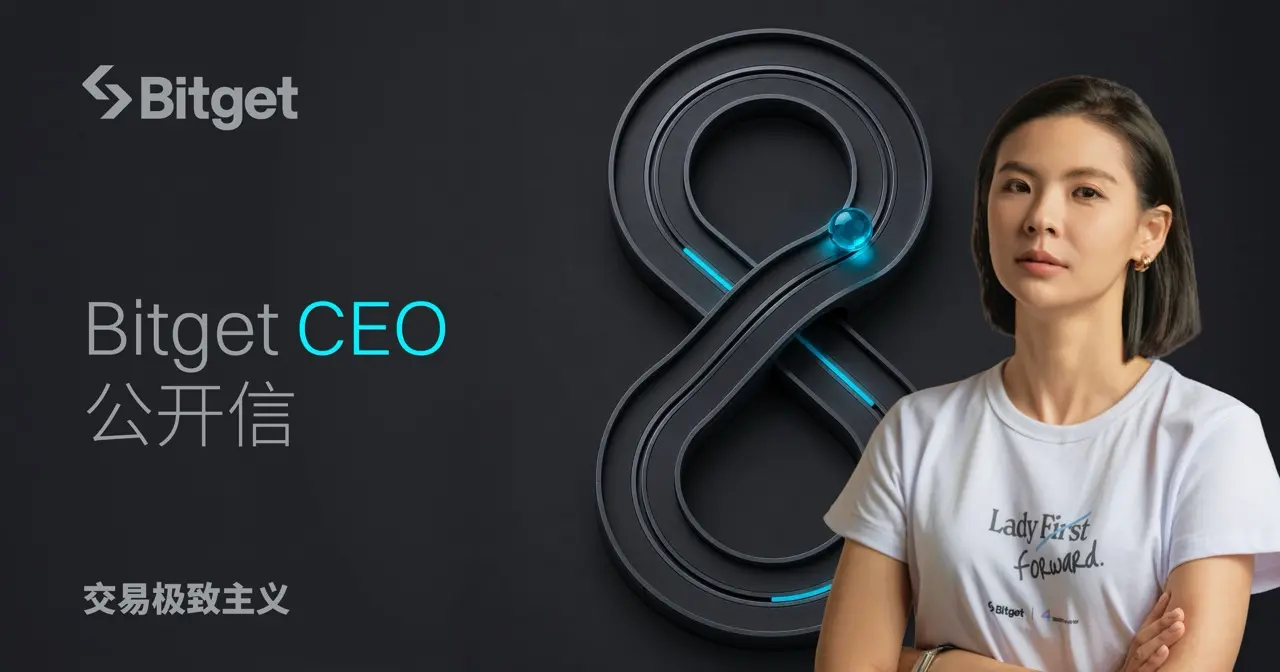




Popular articles