The Tragedy of CoinEx: Limited Income and Infinite Risk
 Core Viewpoint

 Who will take on the next wave of funding? The funds from Iran and other sanctioned areas will not simply disappear because of the exit of an exchange; they need to find the next entry point.
Author: Zhou, ChainCatcher
1. After Nine Years of Operation, CoinEx Chooses to Exit
On September 15, the cryptocurrency exchange CoinEx announced it would cease operations and enter an orderly liquidation. The announcement stated that the cryptocurrency market has been in a prolonged slump, with a significant shrinkage in overall trading volume and liquidity in the industry, while regulatory requirements in several major jurisdictions have continued to rise, making compliance costs exceed reasonable boundaries.
Founder Haipo Yang, who is also the founder and CEO of ViaBTC Group, previously worked at Tencent and Futu, and independently wrote the code for the ViaBTC mining pool in 2016 and launched it.
CoinEx was born at the peak of the bull market in 2017, subsequently launching products such as the platform token CET, wallet, CSC public chain, and OneSwap, with operations covering over 200 countries and regions.
According to the official announcement, new user registrations will stop from September 15, with contracts entering a phase of only reducing positions. Fiat, leverage, lending, wealth management, staking, and strategy trading will no longer accept new orders. From September 22, all non-spot business will cease, and on-chain recharges excluding CET will be closed. On September 29, spot trading will close, and non-USDT assets will be converted to USDT by the platform, with remaining CET in accounts being repurchased at an unlimited quantity for 0.005 USDT each, while CSC and OneSwap will cease operations simultaneously.
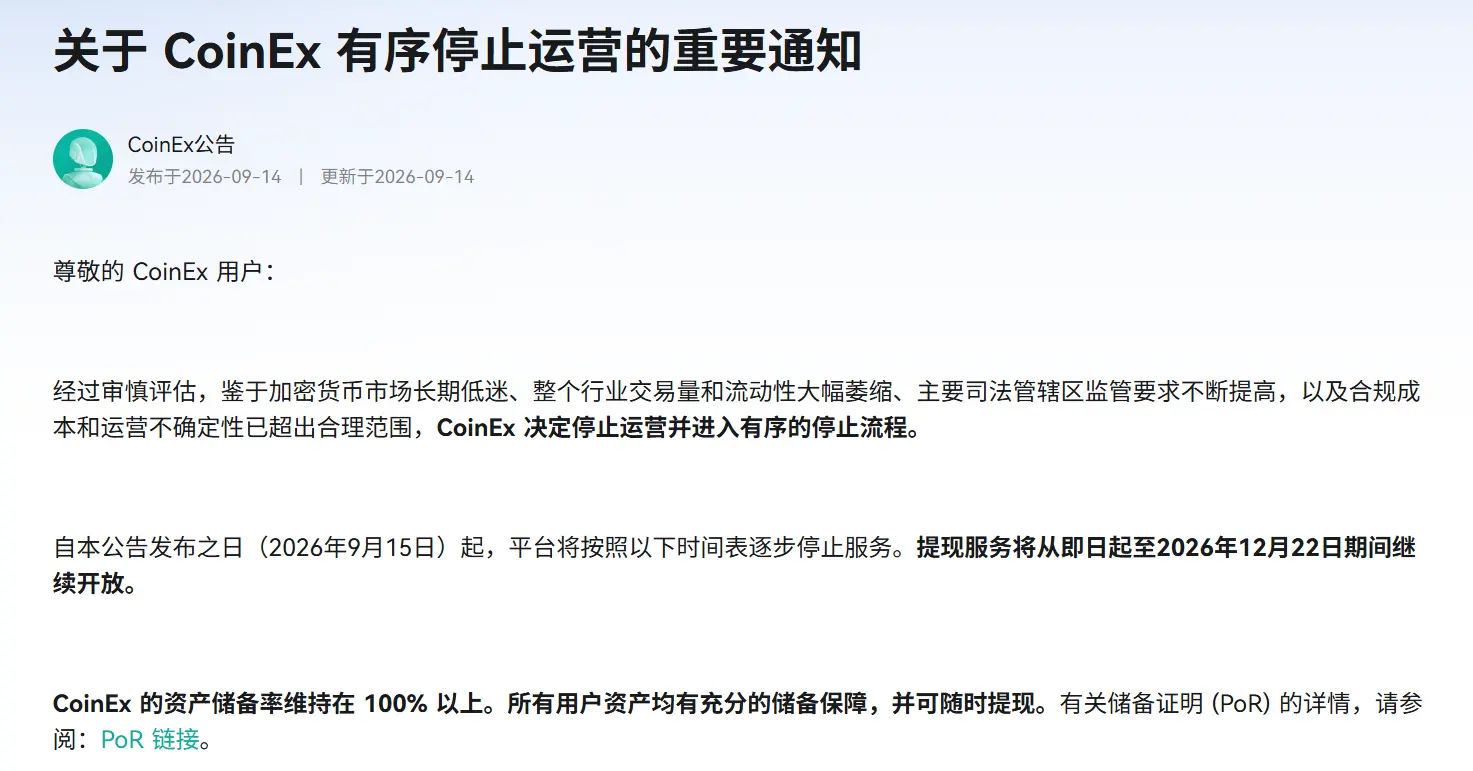
At 02:00 UTC on December 22, the withdrawal channel will close. Any USDT not withdrawn by the deadline will be transferred to independent custody, with a monthly custody fee of 5% based on the balance at the cutoff time, and the claim window will last until August 22, 2028. The platform claims that the asset reserve ratio exceeds 100%, and user assets can be fully redeemed.
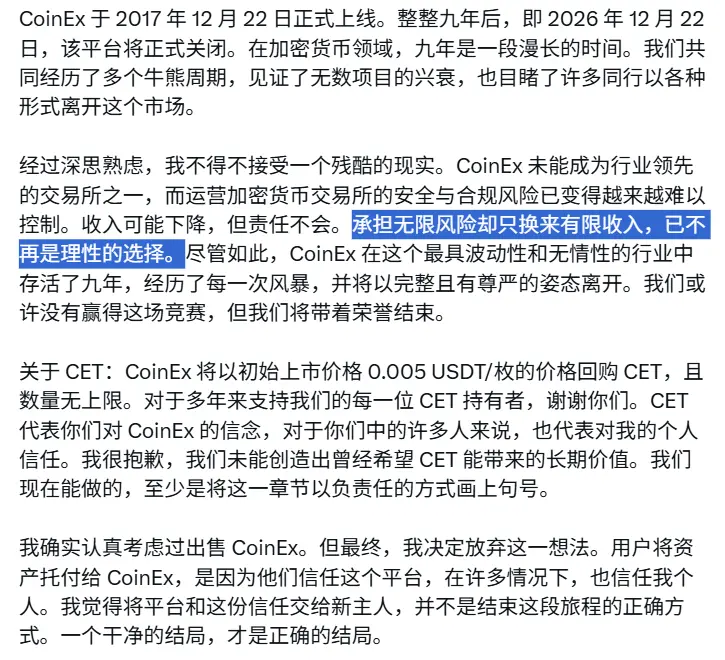
This exchange was launched on December 22, 2017, and the official closure date is set for December 22, 2026, marking exactly nine years. CoinEx Wallet, CoinEx Vault, and the ViaBTC mining pool are not included in this shutdown and will continue to operate independently.
Haipo Yang posted that the safety and compliance risks of operating a cryptocurrency exchange have become increasingly difficult to manage. Revenue can decline, but responsibilities do not decrease. Trading unlimited risks for limited income is no longer a rational choice.
He stated that he had seriously considered selling CoinEx but ultimately decided against it. Users entrust their assets to this platform largely out of trust in the platform and himself. Transferring this trust to new owners is not the right way to end this journey.
2. The Founder Calculated the Numbers, Pessimistic About the Crypto Market?
In April of this year, Haipo Yang published an article on his personal blog titled “The Endgame of Cryptocurrency”, offering a rather pessimistic judgment on the future of the entire cryptocurrency industry, with core arguments roughly divided into several layers.
The first layer defines Bitcoin as a purely consensus asset, lacking production value, consumption value, and real monetary function. The analogy between gold and Bitcoin does not hold; gold has nearly half of its demand coming from physical consumption, with maintenance costs almost zero, while Bitcoin relies on the power grid, the internet, miners, and exchanges. If any one of these links is severed, the entire system will collapse.
The second layer defines the cryptocurrency industry as a zero-sum game, summarized by a formula where net inflow equals historical consumption plus margin balance. The industry's rigid operational consumption is estimated to be between $35 billion and $50 billion annually, mainly from mining, exchange operations, and project expenditures. If we also consider the spillover consumption from individual participants that is difficult to quantify, the real annual consumption may reach $60 billion to $80 billion, with historical cumulative consumption already at the trillion-dollar level.
The third layer reveals that the leverage structure is quite fragile. After stripping away stablecoins, lost coins, and heavily locked altcoins, the real circulating market value of the cryptocurrency market is about $1.6 trillion, while the total amount of funds that can actually serve as margin is around $200 billion, resulting in an effective leverage ratio of about 8 times. If 5% of holders choose to cash out simultaneously, liquidity will dry up.
The fourth layer indicates that the two blood transfusion channels that supported the market over the past two years are closing. ETFs and digital asset treasury companies represented by Strategy have collectively brought in about $200 billion in real fiat inflows, which is seen not as market recognition of crypto assets but as the last blood transfusion to prevent system collapse. The purchasing volume of most digital asset treasury companies has recently dropped by 99% from their peak, with only Strategy still buying, and ETFs experienced several weeks of net outflows earlier this year.
The fifth layer compares the entire cryptocurrency industry to a company that has never turned a profit and relies entirely on rounds of external financing to survive. In 2017, it raised funds from retail investors, in 2020 to 2021, it raised another round based on DeFi and NFT concepts, and from 2024 to 2025, it raised its final round through ETFs and digital asset treasury companies. The accessible new funding pools have been exhausted, and there are no new buyers to be found for the next round.
He did not announce that the industry would go to zero. The demand for censorship-resistant transfers and free trading still exists; it will just shrink to match the real demand. Intermediaries like exchanges will feel the first effects of blood loss.
This blog post is considered one of the most desperate articles about the cryptocurrency industry, with its underlying logic closely aligned with the statement in the announcement five months later that "revenue can decline but responsibilities will not decrease." Limited income can no longer withstand unlimited risks, and he chose to leave while he could still fully redeem.
3. Where Will Small and Medium Exchanges Go?
Market cycles and pessimistic predictions explain why CoinEx wants to exit. In fact, the announcement's statement about compliance costs exceeding boundaries had already been publicly amplified three months ago.
In June of this year, a reporter from the Wall Street Journal cited on-chain data and data from TRM Labs, stating that since 2019, traceable transactions involving Iranian entities through CoinEx have exceeded $3.84 billion, and CoinEx is considered one of the important channels for Iran to connect with the global market using cryptocurrency.
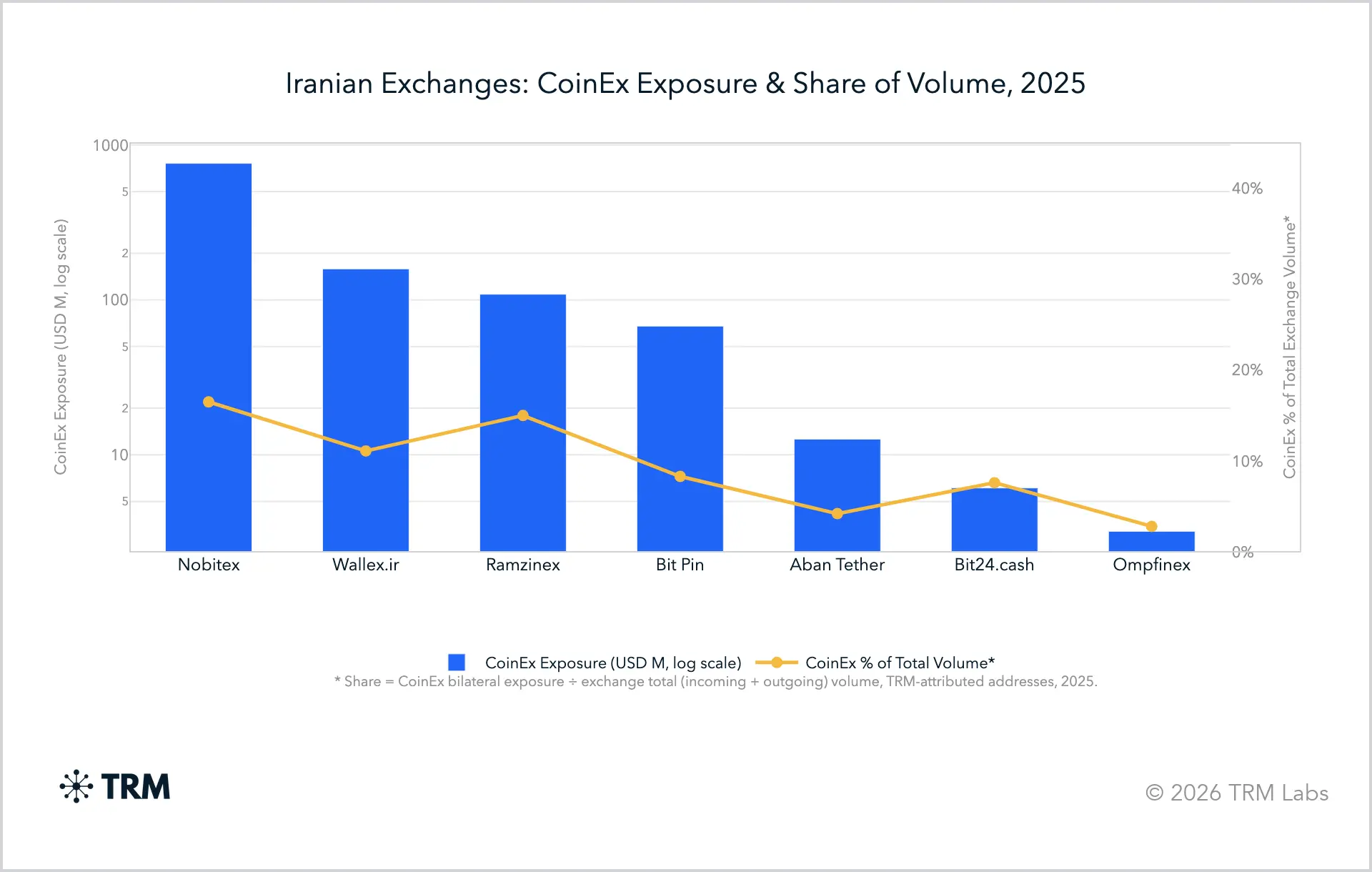
According to the original report from TRM Labs, CoinEx is the largest foreign competitor of Iran's largest local exchange, Nobitex, with a volume approximately nine times that of the second-largest competitor, accounting for 16.3% of Nobitex's total trading volume in 2024. The report also stated that almost all major local exchanges in Iran direct about 5% to 10% of their trading volume to CoinEx, involving platforms such as Nobitex, Wallex, Ramzinex, and Bit Pin, and this connection was established in batches from 2018 to 2022. TRM believes that this distribution and connection rhythm resemble a structural arrangement rather than independent market choices.
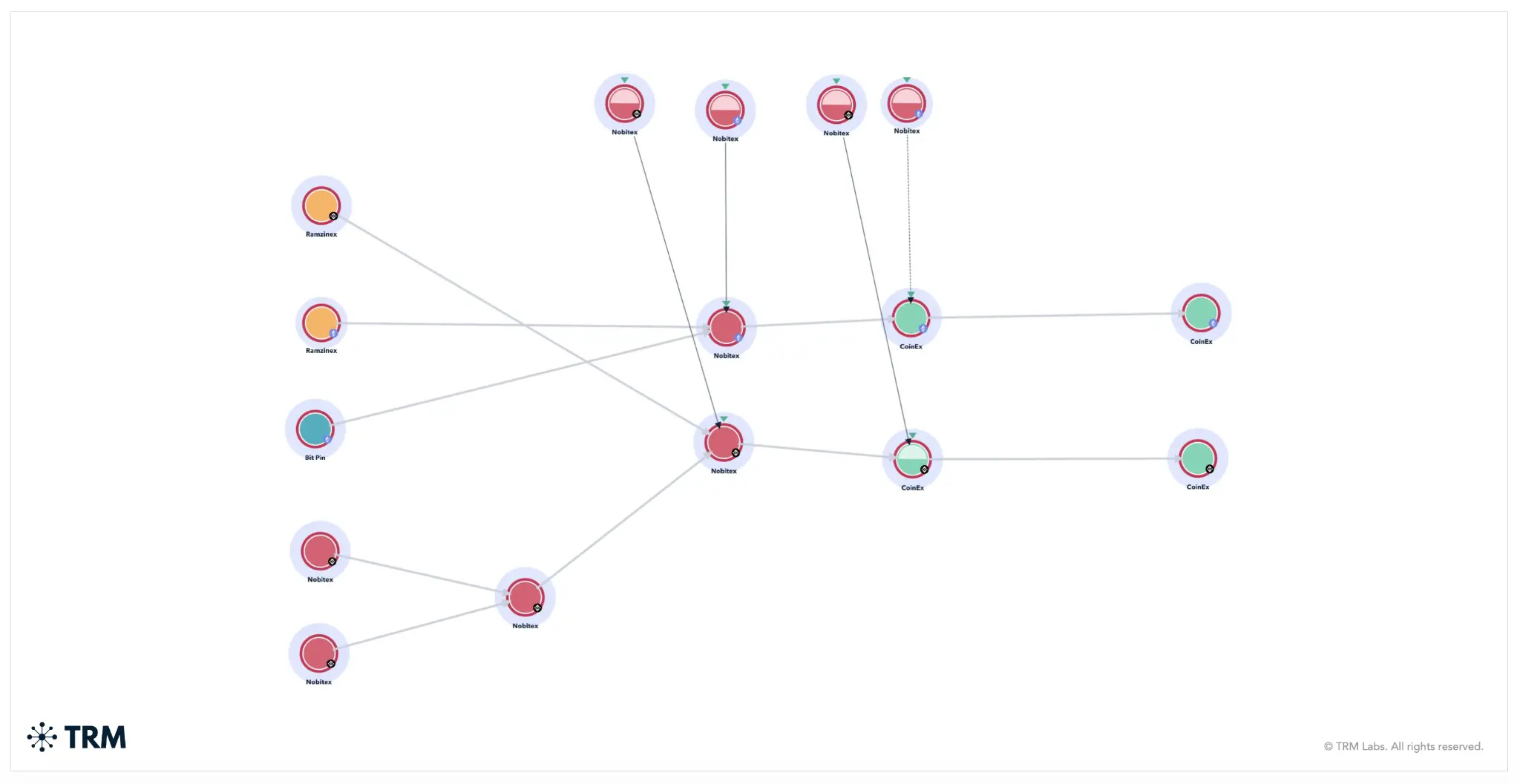
Additionally, the report mentioned an Iranian named Alireza Derakhshan, involved in a U.S.-sanctioned oil sales network, whose transactions were processed by CoinEx's wallet between 2022 and 2025. Another case involves the London-registered exchange Zedcex, whose associated figure Babak Zanjani has been identified by the U.S. Treasury as a sanctions evasion strategist for the Iranian Revolutionary Guard and was officially added to the sanctions list this January.
Investigators stated that two wallets associated with the Iranian central bank were linked to approximately $1.5 billion stolen by North Korean hackers from Bybit, and after multiple layers of circulation, one path pointed to CoinEx, although TRM did not provide specific amounts. Furthermore, from June 2025 to June 2026, approximately $67 million in funds related to the Iranian central bank were traced to CoinEx.
CoinEx subsequently issued a statement, denying any business relationships with the Iranian government, Iranian local exchanges, Revolutionary Guard-related entities, or other sanctioned parties, and also denied proactively providing funding channels. The statement noted that the official domain was blocked in Iran in 2021, and the platform has no operational entity in Iran. Just because on-chain funds passed through a certain platform does not mean the platform was aware of, supported, or participated in related activities.
Regarding transactions related to Derakhshan and Zedcex, CoinEx stated that based on existing information, they all occurred before the U.S. Treasury's formal designation. The statement also mentioned that after the Bybit theft incident, the platform assisted in account restrictions and asset freezes. In 2023, CoinEx itself also suffered a hacking attack, resulting in losses of tens of millions of dollars.
On June 2, the U.S. Treasury imposed sanctions on Nobitex and three other Iranian exchanges. The TRM Labs report mentioned that on the same day, CoinEx switched its hot wallets, and two days later, the scale of funds flowing between the two parties plummeted to below $150,000.
Behind this funding chain lies an earlier story. It is reported that in 2023, the U.S. penalized Binance for serving Iranian customers, after which Binance tightened its compliance controls. Subsequently, CoinEx's trading volume began to rise, and by 2024, it had replaced Binance as Nobitex's largest foreign trading counterpart.
In the context of the entire industry, this may not just be the story of CoinEx alone. Since 2026, several exchanges, including BitMEX and BitMart, have successively shut down or entered liquidation. According to RootData, as of late August, 261 cryptocurrency projects have been listed as dead.

As of now, Bitcoin has fallen about 40% from its historical peak, while Ethereum's decline is still close to 50%. A few leading exchanges hold the vast majority of user custody assets. After the EU MiCA regulations came into full effect in July, over 80% of registered companies failed to obtain licenses. The ongoing expenses for licenses, risk control, and legal matters are a long-term burden for platforms with limited trading volume.
When an exchange's business scale cannot support compliance costs, there are not many visible paths ahead. It either exits the market or finds other ways to maintain cash flow. CoinEx chose the former, returning assets to users and exiting gracefully.
As for the small and medium exchanges still at the table, there is no answer as to which path they will take. What is certain is that the funds from Iran and other sanctioned areas will not simply disappear due to the exit of one exchange; they just need to find the next entry point.

 Risk warning
Popular articles