The U.S. House Committee advances a bill to establish "strategic Bitcoin reserves" as a permanent mechanism
 Core Viewpoint

 The bill will provide a clear long-term institutional framework for the Bitcoin held by the government.
Original Title: House Committee Advances Bill to Make Strategic Bitcoin Reserve Permanent
Original Author: Bitcoin News
Original Compilation: Jerry, ChainCatcher
Key Points
- The ARMA bill will upgrade the "Strategic Bitcoin Reserve" from a presidential executive order policy to a permanent federal statutory program.
- The government-held Bitcoin included in the reserve will, in principle, be subject to a 20-year holding period during which it cannot be sold, exchanged, auctioned, or used as collateral.
- The bill will introduce a public proof-of-reserve disclosure mechanism, independent audits, and require research on how to increase Bitcoin holdings without raising taxes or expanding the fiscal deficit.
What Changes Will the Bill Bring
The House Financial Services Committee has advanced a bill that aims to enshrine the "Strategic Bitcoin Reserve" established by President Trump into U.S. federal law, making it a permanent institutional arrangement.
On September 16, Eastern Time, the American Reserve Modernization Act of 2026 (ARMA, bill number H.R. 8957) was passed by the committee with 28 votes in favor and 21 against.
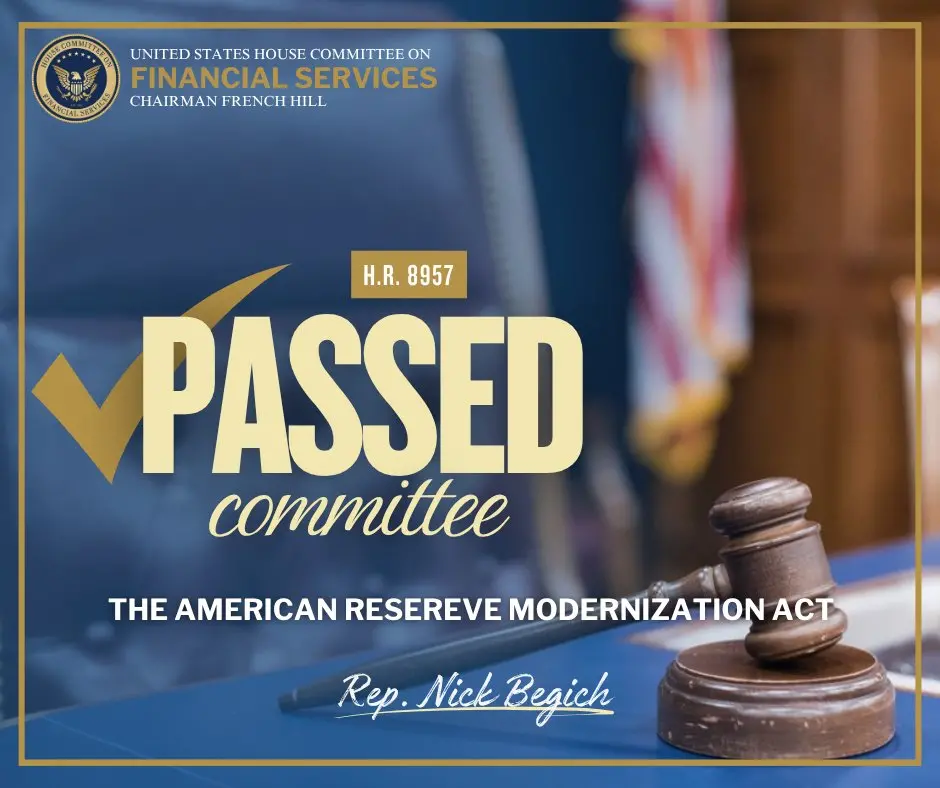
The bill requires the U.S. government to deposit Bitcoin obtained through criminal and civil forfeiture procedures into the "Strategic Bitcoin Reserve," managed by the Treasury, and stipulates that the government must hold it for at least 20 years.
However, the bill has not yet become law. Before it can be signed by the president, it must still be approved by the full House and the Senate.
Trump established the "Strategic Bitcoin Reserve" through an executive order in March 2025, directing the federal government to retain Bitcoin seized through criminal and civil forfeiture rather than selling it through auctions.
The issue is that executive orders can be modified or revoked by future presidents. The ARMA will elevate this policy to federal law, significantly raising the threshold for subsequent governments to overturn this reserve mechanism.
It is estimated that the U.S. government currently holds over 300,000 BTC. Blockchain analytics firm Arkham Intelligence estimates this number to be around 324,527 BTC, valued at approximately $24.7 billion based on reported data.

The exact number remains uncertain, as the government has never published a unified ledger of its Bitcoin holdings.
For Bitcoin holders, the most critical part of the bill is the proposed 20-year holding requirement.
According to the legislative text, Bitcoin deposited into the Strategic Bitcoin Reserve cannot, in principle, be sold, exchanged, auctioned, or used as collateral during this period. This means that a significant amount of government-held Bitcoin will effectively exit the potential selling pressure range for the next 20 years.
The bill also directs the Treasury and the Commerce Department to research how to increase Bitcoin holdings over the next five years without raising taxes, expanding government borrowing, or increasing the federal deficit.
However, the bill does not allocate funds for the government to directly enter the market to purchase Bitcoin. At the same time, ARMA requires federal agencies to report on their holdings or control of digital assets.
This legislation requires the establishment of a public proof-of-reserve disclosure and independent audit mechanism, allowing the public to better understand how much Bitcoin the government holds and whether it possesses the corresponding private keys.
The bill mandates the Treasury to conduct regular public disclosures regarding the federal government's Strategic Bitcoin Reserve and sets different requirements for quarterly and annual reports:
Quarterly reports must be prepared by the Secretary of the Treasury and disclose the total Bitcoin holdings in the reserve, transaction records during the reporting period, and proof that the government still controls the asset's private keys. The report must also include a public cryptographic attestation and be published on the Treasury's official website.
An independent third-party auditing firm with expertise in cryptographic proof will be selected to verify the accuracy and completeness of the quarterly reports; the Comptroller General will oversee the reserves, reports, and auditing work.
Additionally, the Secretary of the Treasury and the Secretary of Commerce must submit a preliminary research report and annual updates to Congress, assessing the feasibility of increasing Bitcoin holdings over the next five years.
Related reports will evaluate the risks, costs, and potential benefits of increasing Bitcoin holdings and assess whether purchases can be made in a budget-neutral manner. The reports will be submitted to the Senate Banking Committee and Finance Committee, as well as the House Financial Services Committee and the Appropriations Committee.
Bill sponsor Begich pointed out that the current system is too fragmented.
"We cannot allow the Bitcoin held by the federal government to be idly stored in a fragmented and inconsistent custodial state," Begich stated, emphasizing concerns about cybersecurity and accounting.
The bill distinguishes Bitcoin from other digital assets.
Other digital assets obtained through government forfeiture procedures will, in principle, enter a separate "Digital Asset Stockpile" rather than the Strategic Bitcoin Reserve. This means that Ethereum and other tokens may not be subject to the same 20-year restrictions as Bitcoin.
The legislation also includes provisions to protect private Bitcoin ownership and self-custody, explicitly stating that nothing in this law shall authorize the government to confiscate or interfere with legally held private Bitcoin.
Supporters believe that this bill will provide a clear long-term institutional framework for the Bitcoin already held by the government.

 Risk warning



Popular articles